Chapter 16 Sensory Lecture Outline
Is Sensation Different from Perception? Sensation  is a conscious or unconscious awareness of external or internal stimuli.  Sensation is any stimuli the body is aware of Chemoreceptors, thermoreceptors, nociceptors, baroreceptors Perception is the conscious awareness & interpretation of a sensation. precisely localization & identification memories of our perceptions are stored in the cortex
Sensory Modalities Sensory Modality  is the property by which one sensation is distinguished from another. Different types of sensations touch, pain, temperature, vibration, hearing, vision Generally, each type of sensory neuron can respond to only one type of stimulus. Two classes of sensory modalities The  general senses  include both somatic and visceral senses, which provide information about conditions within internal organs. The  special senses  include the modalities of smell, taste, vision, hearing, and equilibrium.
Sensory Receptors Receptor Structure may be simple or complex General Sensory Receptors (Somatic Receptors) no structural specializations in free nerve endings that provide us with pain, tickle, itch, temperatures some structural specializations in receptors for touch, pressure & vibration  Special Sensory Receptors (Special Sense Receptors) very complex structures---vision, hearing, taste, & smell
Alternate Classifications of Sensory Receptors Structural classification Type of response to a stimulus Location of receptors & origin of stimuli Type of stimuli they detect
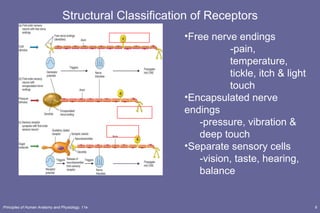
Structural Classification of Receptors Free nerve endings -pain, temperature, tickle, itch & light touch Encapsulated nerve endings -pressure, vibration & deep touch Separate sensory cells -vision, taste, hearing, balance
Classification by Stimuli Detected Mechanoreceptors detect pressure or stretch touch, pressure, vibration, hearing, proprioception, equilibrium & blood pressure Thermoreceptors detect temperature Nociceptors detect damage to tissues Photoreceptors detect light Chemoreceptors detect molecules taste, smell & changes in body fluid chemistry
Classification by Response to Stimuli Generator potential free nerve endings, encapsulated nerve endings & olfactory receptors produce generator potentials Receptor potential vision, hearing, equilibrium and taste receptors produce receptor potentials Amplitude of potentials vary with stimulus intensity
Classification by Location Exteroceptors near surface of body receive external stimuli hearing, vision, smell, taste, touch, pressure, pain, vibration & temperature Interoceptors monitors internal environment (BV or viscera) not conscious except for pain or pressure Proprioceptors muscle, tendon, joint & internal ear senses body position & movement
SOMATIC SENSATIONS   Tactile Sensations Tactile sensations  are touch, pressure, and vibration plus itch and tickle. receptors include  corpuscles of touch (Meissner’s corpuscles),  hair root plexuses,  type I (Merkel’s discs) type II cutaneous (Ruffini’s corpuscles)  mechanoreceptors,  lamellated (Pacinian) corpuscles,  free nerve endings
Touch Crude touch  refers to the ability to perceive that something has simply touched the skin Discriminative touch (fine   touch)  provides specific information about a touch sensation such as location, shape, size, and texture of the source of stimulation. Receptors for touch include  corpuscles of touch  ( Meissner’s   corpuscles ) and hair root plexuses; these are rapidly adapting receptors. Type I cutaneous mechanoreceptors (tactile or Merkel discs) and type II cutaneous mechanoreceptors (end organs of Ruffini) are slowly adapting receptors for touch.
Pressure and Vibration Pressure  is a sustained sensation that is felt over a larger area than touch. Pressure sensations  generally result from stimulation of tactile receptors in deeper tissues and are longer lasting and have less variation in intensity than touch sensations Receptors for pressure are type II cutaneous mechanoreceptors and lamellated (Pacinian) corpuscles. Like corpuscles of touch ( Meissner’s   corpuscles ), lamellated corpuscles adapt rapidly. Vibration  sensations result from rapidly repetitive sensory signals from tactile receptors receptors for vibration sensations are corpuscles of touch and lamellated corpuscles, which detect low-frequency and high-frequency vibrations, respectively.
Itch and Tickle Itch  and  tickle  receptors are free nerve endings. Tickle is the only sensation that you may not elicit on yourself.
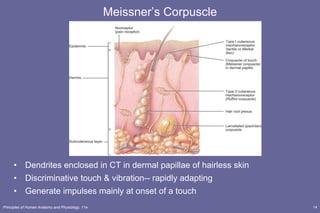
Meissner’s Corpuscle Dendrites enclosed in CT in dermal papillae of hairless skin  Discriminative touch & vibration-- rapidly adapting  Generate impulses mainly at onset of a touch
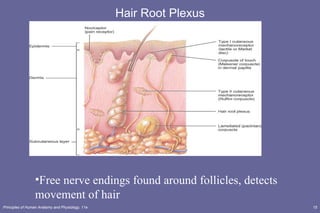
Hair Root Plexus Free nerve endings found around follicles, detects movement of hair
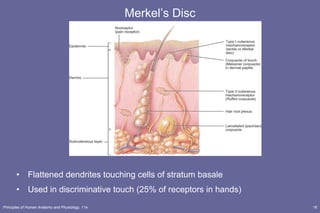
Merkel’s Disc Flattened dendrites touching cells of stratum basale Used in discriminative touch (25% of receptors in hands)
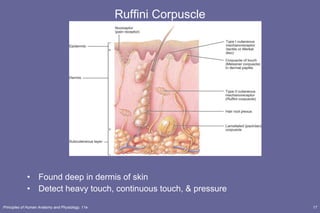
Ruffini Corpuscle Found deep in dermis of skin Detect heavy touch, continuous touch, & pressure
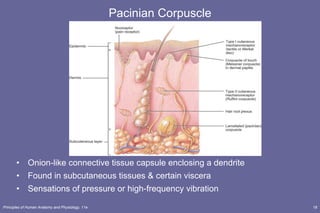
Pacinian Corpuscle Onion-like connective tissue capsule enclosing a dendrite Found in subcutaneous tissues & certain viscera  Sensations of pressure or high-frequency vibration
Somatic Tactile Sensations - Summary Touch crude touch is ability to perceive something has touched the skin discriminative touch provides location and texture of source Pressure is sustained sensation over a large area Vibration is rapidly repetitive sensory signals  Itching is chemical stimulation of free nerve endings Tickle is stimulation of free nerve endings only by someone else
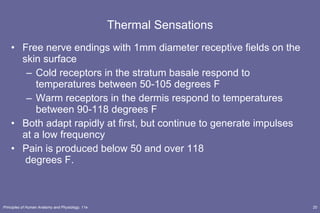
Thermal Sensations Free nerve endings with 1mm diameter receptive fields on the skin surface Cold receptors in the stratum basale respond to temperatures between 50-105 degrees F Warm receptors in the dermis respond to temperatures between 90-118 degrees F Both adapt rapidly at first, but continue to generate impulses at a low frequency  Pain is produced below 50 and over 118  degrees F.
Pain Sensations Pain receptors  ( nociceptors ) are free endings that are located in nearly every body tissue Free nerve endings found in every tissue of body except the brain adaptation is slight if it occurs at all. Stimulated by excessive distension, muscle spasm, & inadequate blood flow Tissue injury releases chemicals such as K+, kinins or prostaglandins that stimulate nociceptors
Proprioceptive Sensations Receptors located in skeletal muscles, in tendons, in and around joints, and in the internal ear convey nerve impulses related to muscle tone, movement of body parts, and body position. This awareness of the activities of muscles, tendons, and joints and of balance or equilibrium is provided by the  proprioceptive  or  kinesthetic sense .
Proprioceptive or Kinesthetic Sense Awareness of body position & movement walk or type without looking estimate weight of objects Proprioceptors adapt only slightly Sensory information is sent to cerebellum & cerebral cortex signals project from muscle, tendon, joint capsules & hair cells in the vestibular apparatus receptors discussed here include muscle spindles, tendon organs (Golgi tendon organs), and joint kinesthetic receptors (Figure 16.4).

Lecture 6 sensory

  • 1.
    Chapter 16 SensoryLecture Outline
  • 2.
    Is Sensation Differentfrom Perception? Sensation is a conscious or unconscious awareness of external or internal stimuli. Sensation is any stimuli the body is aware of Chemoreceptors, thermoreceptors, nociceptors, baroreceptors Perception is the conscious awareness & interpretation of a sensation. precisely localization & identification memories of our perceptions are stored in the cortex
  • 3.
    Sensory Modalities SensoryModality is the property by which one sensation is distinguished from another. Different types of sensations touch, pain, temperature, vibration, hearing, vision Generally, each type of sensory neuron can respond to only one type of stimulus. Two classes of sensory modalities The general senses include both somatic and visceral senses, which provide information about conditions within internal organs. The special senses include the modalities of smell, taste, vision, hearing, and equilibrium.
  • 4.
    Sensory Receptors ReceptorStructure may be simple or complex General Sensory Receptors (Somatic Receptors) no structural specializations in free nerve endings that provide us with pain, tickle, itch, temperatures some structural specializations in receptors for touch, pressure & vibration Special Sensory Receptors (Special Sense Receptors) very complex structures---vision, hearing, taste, & smell
  • 5.
    Alternate Classifications ofSensory Receptors Structural classification Type of response to a stimulus Location of receptors & origin of stimuli Type of stimuli they detect
  • 6.
    Structural Classification ofReceptors Free nerve endings -pain, temperature, tickle, itch & light touch Encapsulated nerve endings -pressure, vibration & deep touch Separate sensory cells -vision, taste, hearing, balance
  • 7.
    Classification by StimuliDetected Mechanoreceptors detect pressure or stretch touch, pressure, vibration, hearing, proprioception, equilibrium & blood pressure Thermoreceptors detect temperature Nociceptors detect damage to tissues Photoreceptors detect light Chemoreceptors detect molecules taste, smell & changes in body fluid chemistry
  • 8.
    Classification by Responseto Stimuli Generator potential free nerve endings, encapsulated nerve endings & olfactory receptors produce generator potentials Receptor potential vision, hearing, equilibrium and taste receptors produce receptor potentials Amplitude of potentials vary with stimulus intensity
  • 9.
    Classification by LocationExteroceptors near surface of body receive external stimuli hearing, vision, smell, taste, touch, pressure, pain, vibration & temperature Interoceptors monitors internal environment (BV or viscera) not conscious except for pain or pressure Proprioceptors muscle, tendon, joint & internal ear senses body position & movement
  • 10.
    SOMATIC SENSATIONS Tactile Sensations Tactile sensations are touch, pressure, and vibration plus itch and tickle. receptors include corpuscles of touch (Meissner’s corpuscles), hair root plexuses, type I (Merkel’s discs) type II cutaneous (Ruffini’s corpuscles) mechanoreceptors, lamellated (Pacinian) corpuscles, free nerve endings
  • 11.
    Touch Crude touch refers to the ability to perceive that something has simply touched the skin Discriminative touch (fine touch) provides specific information about a touch sensation such as location, shape, size, and texture of the source of stimulation. Receptors for touch include corpuscles of touch ( Meissner’s corpuscles ) and hair root plexuses; these are rapidly adapting receptors. Type I cutaneous mechanoreceptors (tactile or Merkel discs) and type II cutaneous mechanoreceptors (end organs of Ruffini) are slowly adapting receptors for touch.
  • 12.
    Pressure and VibrationPressure is a sustained sensation that is felt over a larger area than touch. Pressure sensations generally result from stimulation of tactile receptors in deeper tissues and are longer lasting and have less variation in intensity than touch sensations Receptors for pressure are type II cutaneous mechanoreceptors and lamellated (Pacinian) corpuscles. Like corpuscles of touch ( Meissner’s corpuscles ), lamellated corpuscles adapt rapidly. Vibration sensations result from rapidly repetitive sensory signals from tactile receptors receptors for vibration sensations are corpuscles of touch and lamellated corpuscles, which detect low-frequency and high-frequency vibrations, respectively.
  • 13.
    Itch and TickleItch and tickle receptors are free nerve endings. Tickle is the only sensation that you may not elicit on yourself.
  • 14.
    Meissner’s Corpuscle Dendritesenclosed in CT in dermal papillae of hairless skin Discriminative touch & vibration-- rapidly adapting Generate impulses mainly at onset of a touch
  • 15.
    Hair Root PlexusFree nerve endings found around follicles, detects movement of hair
  • 16.
    Merkel’s Disc Flatteneddendrites touching cells of stratum basale Used in discriminative touch (25% of receptors in hands)
  • 17.
    Ruffini Corpuscle Founddeep in dermis of skin Detect heavy touch, continuous touch, & pressure
  • 18.
    Pacinian Corpuscle Onion-likeconnective tissue capsule enclosing a dendrite Found in subcutaneous tissues & certain viscera Sensations of pressure or high-frequency vibration
  • 19.
    Somatic Tactile Sensations- Summary Touch crude touch is ability to perceive something has touched the skin discriminative touch provides location and texture of source Pressure is sustained sensation over a large area Vibration is rapidly repetitive sensory signals Itching is chemical stimulation of free nerve endings Tickle is stimulation of free nerve endings only by someone else
  • 20.
    Thermal Sensations Freenerve endings with 1mm diameter receptive fields on the skin surface Cold receptors in the stratum basale respond to temperatures between 50-105 degrees F Warm receptors in the dermis respond to temperatures between 90-118 degrees F Both adapt rapidly at first, but continue to generate impulses at a low frequency Pain is produced below 50 and over 118 degrees F.
  • 21.
    Pain Sensations Painreceptors ( nociceptors ) are free endings that are located in nearly every body tissue Free nerve endings found in every tissue of body except the brain adaptation is slight if it occurs at all. Stimulated by excessive distension, muscle spasm, & inadequate blood flow Tissue injury releases chemicals such as K+, kinins or prostaglandins that stimulate nociceptors
  • 22.
    Proprioceptive Sensations Receptorslocated in skeletal muscles, in tendons, in and around joints, and in the internal ear convey nerve impulses related to muscle tone, movement of body parts, and body position. This awareness of the activities of muscles, tendons, and joints and of balance or equilibrium is provided by the proprioceptive or kinesthetic sense .
  • 23.
    Proprioceptive or KinestheticSense Awareness of body position & movement walk or type without looking estimate weight of objects Proprioceptors adapt only slightly Sensory information is sent to cerebellum & cerebral cortex signals project from muscle, tendon, joint capsules & hair cells in the vestibular apparatus receptors discussed here include muscle spindles, tendon organs (Golgi tendon organs), and joint kinesthetic receptors (Figure 16.4).