Lecture 5
Address Mapping
ADDRESS MAPPING
• The delivery of a packet to a host or a router
requires two levels of addressing: logical and
physical.
• We need to be able to map a logical address to
its corresponding physical address and vice
versa.
• This can be done by using either static or
dynamic mapping.
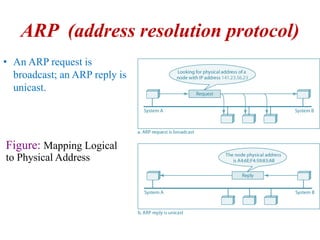
ARP (address resolution protocol)
Figure: Mapping Logical
to Physical Address
• An ARP request is
broadcast; an ARP reply is
unicast.
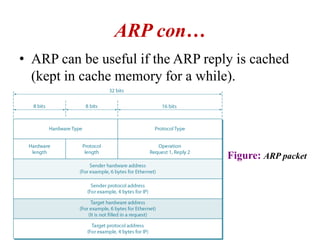
ARP con…
• ARP can be useful if the ARP reply is cached
(kept in cache memory for a while).
Figure: ARP packet
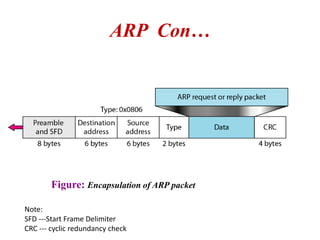
ARP Con…
Figure: Encapsulation of ARP packet
Note:
SFD ---Start Frame Delimiter
CRC --- cyclic redundancy check
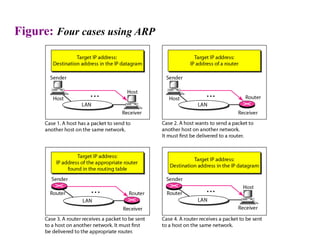
Figure: Four cases using ARP
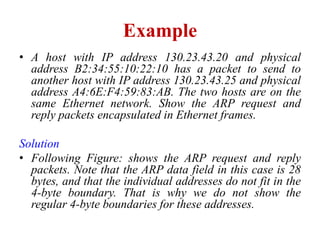
Example
• A host with IP address 130.23.43.20 and physical
address B2:34:55:10:22:10 has a packet to send to
another host with IP address 130.23.43.25 and physical
address A4:6E:F4:59:83:AB. The two hosts are on the
same Ethernet network. Show the ARP request and
reply packets encapsulated in Ethernet frames.
Solution
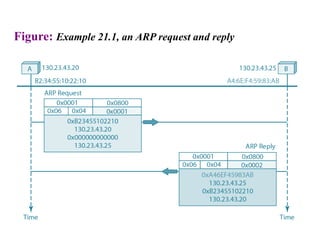
• Following Figure: shows the ARP request and reply
packets. Note that the ARP data field in this case is 28
bytes, and that the individual addresses do not fit in the
4-byte boundary. That is why we do not show the
regular 4-byte boundaries for these addresses.
Figure: Example 21.1, an ARP request and reply
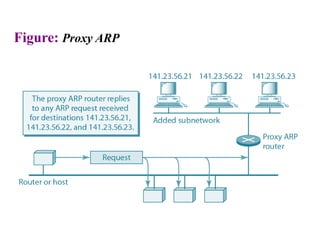
Figure: Proxy ARP
Mapping Physical to Logicial Address:
RARP, BOOTP, and DHCP
• A diskless station just booted.
• An organization does not have enough IP
addresses to assign to each station.
21.11
Reverse Address Resolution Protocol
(RARP)
• A machine can use the phy address to get the logical
address using RARP.
• A RARP messages is created and brodcast on the
local network.
• The machine on the local network that knows the
logical address will respond with a RARP reply.
• Broadcasting is done at data link layer.
• Broadcast requests does not pass the boundaries of a
network.
Bootstrap Protocol (BOOTP)
• BOOTP is a TCP/IP protocol.
• It allows a client to find its IP address and the
name of a load file from a server on the
network.
• A client uses BOOTP to find this information
without intervention from the user of the client
21.13
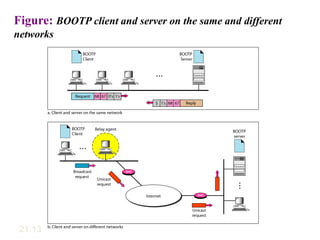
Figure: BOOTP client and server on the same and different
networks
• DHCP provides static and dynamic address
allocation that can be manual or automatic.
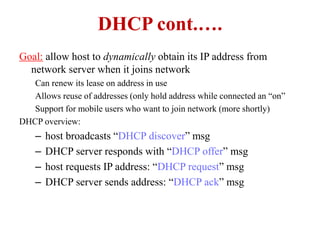
DHCP cont.….
Goal: allow host to dynamically obtain its IP address from
network server when it joins network
Can renew its lease on address in use
Allows reuse of addresses (only hold address while connected an “on”
Support for mobile users who want to join network (more shortly)
DHCP overview:
– host broadcasts “DHCP discover” msg
– DHCP server responds with “DHCP offer” msg
– host requests IP address: “DHCP request” msg
– DHCP server sends address: “DHCP ack” msg
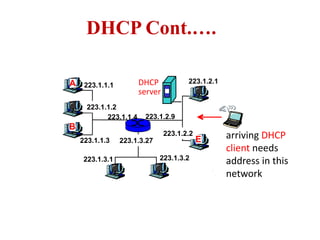
DHCP Cont.….
223.1.1.1
223.1.1.2
223.1.1.3
223.1.1.4 223.1.2.9
223.1.2.2
223.1.2.1
223.1.3.2
223.1.3.1
223.1.3.27
A
B
E
DHCP
server
arriving DHCP
client needs
address in this
network
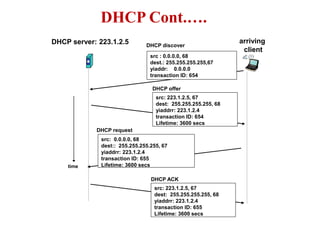
DHCP Cont.….
DHCP server: 223.1.2.5 arriving
client
time
DHCP discover
src : 0.0.0.0, 68
dest.: 255.255.255.255,67
yiaddr: 0.0.0.0
transaction ID: 654
DHCP offer
src: 223.1.2.5, 67
dest: 255.255.255.255, 68
yiaddrr: 223.1.2.4
transaction ID: 654
Lifetime: 3600 secs
DHCP request
src: 0.0.0.0, 68
dest:: 255.255.255.255, 67
yiaddrr: 223.1.2.4
transaction ID: 655
Lifetime: 3600 secs
DHCP ACK
src: 223.1.2.5, 67
dest: 255.255.255.255, 68
yiaddrr: 223.1.2.4
transaction ID: 655
Lifetime: 3600 secs

Lecture 5.address mapping on data communication pdf

  • 1.
  • 2.
    ADDRESS MAPPING • Thedelivery of a packet to a host or a router requires two levels of addressing: logical and physical. • We need to be able to map a logical address to its corresponding physical address and vice versa. • This can be done by using either static or dynamic mapping.
  • 3.
    ARP (address resolutionprotocol) Figure: Mapping Logical to Physical Address • An ARP request is broadcast; an ARP reply is unicast.
  • 4.
    ARP con… • ARPcan be useful if the ARP reply is cached (kept in cache memory for a while). Figure: ARP packet
  • 5.
    ARP Con… Figure: Encapsulationof ARP packet Note: SFD ---Start Frame Delimiter CRC --- cyclic redundancy check
  • 6.
  • 7.
    Example • A hostwith IP address 130.23.43.20 and physical address B2:34:55:10:22:10 has a packet to send to another host with IP address 130.23.43.25 and physical address A4:6E:F4:59:83:AB. The two hosts are on the same Ethernet network. Show the ARP request and reply packets encapsulated in Ethernet frames. Solution • Following Figure: shows the ARP request and reply packets. Note that the ARP data field in this case is 28 bytes, and that the individual addresses do not fit in the 4-byte boundary. That is why we do not show the regular 4-byte boundaries for these addresses.
  • 8.
    Figure: Example 21.1,an ARP request and reply
  • 9.
  • 10.
    Mapping Physical toLogicial Address: RARP, BOOTP, and DHCP • A diskless station just booted. • An organization does not have enough IP addresses to assign to each station.
  • 11.
    21.11 Reverse Address ResolutionProtocol (RARP) • A machine can use the phy address to get the logical address using RARP. • A RARP messages is created and brodcast on the local network. • The machine on the local network that knows the logical address will respond with a RARP reply. • Broadcasting is done at data link layer. • Broadcast requests does not pass the boundaries of a network.
  • 12.
    Bootstrap Protocol (BOOTP) •BOOTP is a TCP/IP protocol. • It allows a client to find its IP address and the name of a load file from a server on the network. • A client uses BOOTP to find this information without intervention from the user of the client
  • 13.
    21.13 Figure: BOOTP clientand server on the same and different networks
  • 14.
    • DHCP providesstatic and dynamic address allocation that can be manual or automatic.
  • 15.
    DHCP cont.…. Goal: allowhost to dynamically obtain its IP address from network server when it joins network Can renew its lease on address in use Allows reuse of addresses (only hold address while connected an “on” Support for mobile users who want to join network (more shortly) DHCP overview: – host broadcasts “DHCP discover” msg – DHCP server responds with “DHCP offer” msg – host requests IP address: “DHCP request” msg – DHCP server sends address: “DHCP ack” msg
  • 16.
  • 17.
    DHCP Cont.…. DHCP server:223.1.2.5 arriving client time DHCP discover src : 0.0.0.0, 68 dest.: 255.255.255.255,67 yiaddr: 0.0.0.0 transaction ID: 654 DHCP offer src: 223.1.2.5, 67 dest: 255.255.255.255, 68 yiaddrr: 223.1.2.4 transaction ID: 654 Lifetime: 3600 secs DHCP request src: 0.0.0.0, 68 dest:: 255.255.255.255, 67 yiaddrr: 223.1.2.4 transaction ID: 655 Lifetime: 3600 secs DHCP ACK src: 223.1.2.5, 67 dest: 255.255.255.255, 68 yiaddrr: 223.1.2.4 transaction ID: 655 Lifetime: 3600 secs