Network Layer:
Address Mapping, Error Reporting, and
Multicasting
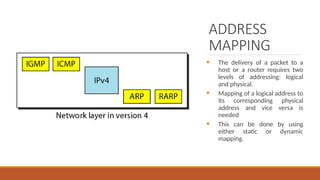
ADDRESS
MAPPING
• The delivery of a packet to a
host or a router requires two
levels of addressing: logical
and physical.
• Mapping of a logical address to
its corresponding physical
address and vice versa is
needed
• This can be done by using
either static or dynamic
mapping.
ARP (Address
Resolution Protocol)
operation
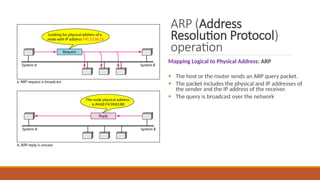
Mapping Logical to Physical Address: ARP
• The host or the router sends an ARP query packet.
• The packet includes the physical and IP addresses of
the sender and the IP address of the receiver.
• The query is broadcast over the network
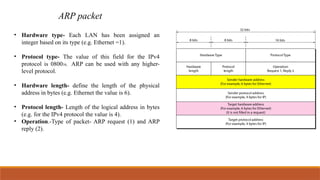
ARP packet
• Hardware type- Each LAN has been assigned an
integer based on its type (e.g. Ethernet =1).
• Protocol type- The value of this field for the IPv4
protocol is 080016, ARP can be used with any higher-
level protocol.
• Hardware length- define the length of the physical
address in bytes (e.g. Ethernet the value is 6).
• Protocol length- Length of the logical address in bytes
(e.g. for the IPv4 protocol the value is 4).
• Operation.-Type of packet- ARP request (1) and ARP
reply (2).
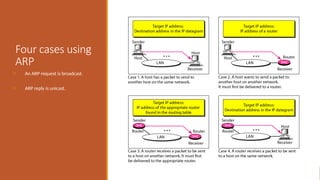
Four cases using
ARP
o An ARP request is broadcast.
o ARP reply is unicast.
RARP
• Reverse Address Resolution Protocol (RARP) finds
the logical address for a machine that knows only
its physical address.
• To create an IP datagram, a host or a router needs
to know its own IP address or addresses. The IP
address of a machine is usually read from its
configuration file stored on a disk file.
• A RARP request is created and broadcast on the
local network.
• Two protocols, BOOTP and DHCP, are replacing
RARP
 Mapping Physical to Logical Address
• The Bootstrap Protocol (BOOTP) is a client/server protocol designed to provide
physical address to logical address mapping. BOOTP is an application layer protocol and
is not a dynamic configuration protocol.
• The Dynamic Host Configuration Protocol (DHCP) has been devised to provide static and
dynamic address allocation
• DHCP has a second database with a pool of available IP addresses for Dynamic Address
Allocation
• DHCP server issues a lease for a specific time
BOOTP and DHCP
Internet Control Message Protocol
(ICMP)
• The IP protocol is a best-effort delivery service that delivers a datagram from its original
source to its final destination.
• No error-reporting or error-correcting mechanism.
• Lacks a mechanism for host and management queries.
• The ICMP has been designed to compensate for the above two deficiencies. It is a companion
to the IP protocol.
• ICMP always reports error messages to the original source.
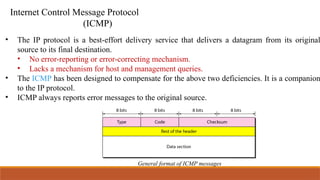
General format of ICMP messages
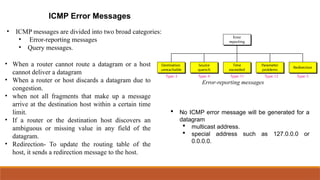
Error-reporting messages
 No ICMP error message will be generated for a
datagram
 multicast address.
 special address such as 127.0.0.0 or
0.0.0.0.
ICMP Error Messages
• ICMP messages are divided into two broad categories:
• Error-reporting messages
• Query messages.
• When a router cannot route a datagram or a host
cannot deliver a datagram
• When a router or host discards a datagram due to
congestion.
• when not all fragments that make up a message
arrive at the destination host within a certain time
limit.
• If a router or the destination host discovers an
ambiguous or missing value in any field of the
datagram.
• Redirection- To update the routing table of the
host, it sends a redirection message to the host.
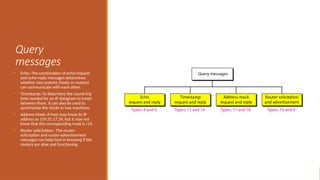
Query
messages
• Echo:-The combination of echo-request
and echo-reply messages determines
whether two systems (hosts or routers)
can communicate with each other.
• Timestamp:-To determine the round-trip
time needed for an IP datagram to travel
between them. It can also be used to
synchronize the clocks in two machines.
• Address Mask:-A host may know its IP
address as 159.31.17.24, but it may not
know that the corresponding mask is /24.
• Router solicitation:- The router-
solicitation and router-advertisement
messages can help host in knowing if the
routers are alive and functioning.
Internet Group
Management
Protocol
(IGMP)
• The IP protocol can be involved in two types of communication:
unicasting and multicasting.
• IGMP is one of the necessary, but not sufficient, protocols that is
involved in multicasting.
• IGMP is a companion to the IP protocol.
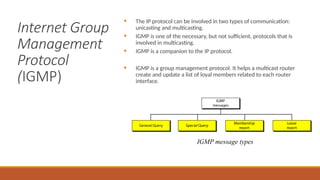
• IGMP is a group management protocol. It helps a multicast router
create and update a list of loyal members related to each router
interface.
IGMP message types
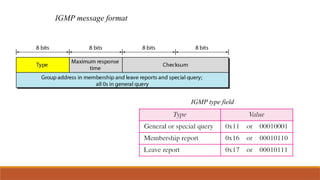
IGMP message format
IGMP type field
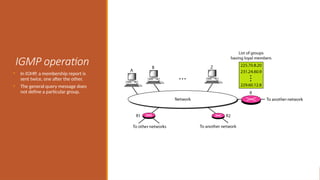
IGMP operation
• In IGMP, a membership report is
sent twice, one after the other.
• The general query message does
not define a particular group.
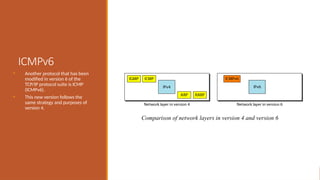
ICMPv6
• Another protocol that has been
modified in version 6 of the
TCP/IP protocol suite is ICMP
(ICMPv6).
• This new version follows the
same strategy and purposes of
version 4.
Comparison of network layers in version 4 and version 6
Debugging
tools
ICMP for debugging:
• ping
• traceroute or tracert
Watch this video
https://www.youtube.com/watch?v=S5M4xKopg5A&ab_channel=Make8Real2017
Watch this video
https://www.youtube.com/watch?v=vJV-GBZ6PeM&ab_channel=PowerCertAnimatedVideos

Address Mapping includes ARP, RARP, ICMP

  • 1.
    Network Layer: Address Mapping,Error Reporting, and Multicasting
  • 2.
    ADDRESS MAPPING • The deliveryof a packet to a host or a router requires two levels of addressing: logical and physical. • Mapping of a logical address to its corresponding physical address and vice versa is needed • This can be done by using either static or dynamic mapping.
  • 3.
    ARP (Address Resolution Protocol) operation MappingLogical to Physical Address: ARP • The host or the router sends an ARP query packet. • The packet includes the physical and IP addresses of the sender and the IP address of the receiver. • The query is broadcast over the network
  • 4.
    ARP packet • Hardwaretype- Each LAN has been assigned an integer based on its type (e.g. Ethernet =1). • Protocol type- The value of this field for the IPv4 protocol is 080016, ARP can be used with any higher- level protocol. • Hardware length- define the length of the physical address in bytes (e.g. Ethernet the value is 6). • Protocol length- Length of the logical address in bytes (e.g. for the IPv4 protocol the value is 4). • Operation.-Type of packet- ARP request (1) and ARP reply (2).
  • 5.
    Four cases using ARP oAn ARP request is broadcast. o ARP reply is unicast.
  • 6.
    RARP • Reverse AddressResolution Protocol (RARP) finds the logical address for a machine that knows only its physical address. • To create an IP datagram, a host or a router needs to know its own IP address or addresses. The IP address of a machine is usually read from its configuration file stored on a disk file. • A RARP request is created and broadcast on the local network. • Two protocols, BOOTP and DHCP, are replacing RARP  Mapping Physical to Logical Address
  • 7.
    • The BootstrapProtocol (BOOTP) is a client/server protocol designed to provide physical address to logical address mapping. BOOTP is an application layer protocol and is not a dynamic configuration protocol. • The Dynamic Host Configuration Protocol (DHCP) has been devised to provide static and dynamic address allocation • DHCP has a second database with a pool of available IP addresses for Dynamic Address Allocation • DHCP server issues a lease for a specific time BOOTP and DHCP
  • 8.
    Internet Control MessageProtocol (ICMP) • The IP protocol is a best-effort delivery service that delivers a datagram from its original source to its final destination. • No error-reporting or error-correcting mechanism. • Lacks a mechanism for host and management queries. • The ICMP has been designed to compensate for the above two deficiencies. It is a companion to the IP protocol. • ICMP always reports error messages to the original source. General format of ICMP messages
  • 9.
    Error-reporting messages  NoICMP error message will be generated for a datagram  multicast address.  special address such as 127.0.0.0 or 0.0.0.0. ICMP Error Messages • ICMP messages are divided into two broad categories: • Error-reporting messages • Query messages. • When a router cannot route a datagram or a host cannot deliver a datagram • When a router or host discards a datagram due to congestion. • when not all fragments that make up a message arrive at the destination host within a certain time limit. • If a router or the destination host discovers an ambiguous or missing value in any field of the datagram. • Redirection- To update the routing table of the host, it sends a redirection message to the host.
  • 10.
    Query messages • Echo:-The combinationof echo-request and echo-reply messages determines whether two systems (hosts or routers) can communicate with each other. • Timestamp:-To determine the round-trip time needed for an IP datagram to travel between them. It can also be used to synchronize the clocks in two machines. • Address Mask:-A host may know its IP address as 159.31.17.24, but it may not know that the corresponding mask is /24. • Router solicitation:- The router- solicitation and router-advertisement messages can help host in knowing if the routers are alive and functioning.
  • 11.
    Internet Group Management Protocol (IGMP) • TheIP protocol can be involved in two types of communication: unicasting and multicasting. • IGMP is one of the necessary, but not sufficient, protocols that is involved in multicasting. • IGMP is a companion to the IP protocol. • IGMP is a group management protocol. It helps a multicast router create and update a list of loyal members related to each router interface. IGMP message types
  • 12.
  • 13.
    IGMP operation • InIGMP, a membership report is sent twice, one after the other. • The general query message does not define a particular group.
  • 14.
    ICMPv6 • Another protocolthat has been modified in version 6 of the TCP/IP protocol suite is ICMP (ICMPv6). • This new version follows the same strategy and purposes of version 4. Comparison of network layers in version 4 and version 6
  • 15.
    Debugging tools ICMP for debugging: •ping • traceroute or tracert
  • 16.
  • 17.