Topic To Be Covered:
A* Search Algorithm
Jagdamba Education Society's
SND College of Engineering & Research Centre
Department of Computer Engineering
SUBJECT: Artificial Intelligence & Robotics
Lecture No-9(ii)
Prof.Dhakane Vikas N
A* Search Algorithm
 This is informed search technique also called as HEURISTIC search.
 This algo. Works using heuristic value.
 A* uses h(n)->Heuristic function & g(n)->Cost to reach the node ‘n’ from
start state.
 Find shortest path though search spaces.
 Estimated Cost f(n)=g(n)+h(n)
 A* gives Fast & Optimal result as compared with previous algorithms.
 Space & Time Complexity of BFS is also O(V+E) where V is vertices and E
is edges.
 Also Written as:-O(b) ^d Where, b->Branching factor d->depth
A* Search Algorithm
 A* Algorithm extends the path that minimizes the following function-
f(n) = g(n) + h(n)
Here,
 ‘n’ is the last node on the path
 g(n) is the cost of the path from start node to node ‘n’
 h(n) is a heuristic function that estimates cost of the cheapest path from
node ‘n’ to the goal node
Algorithm-
 The implementation of A* Algorithm involves maintaining two lists-
OPEN and CLOSED.
 OPEN contains those nodes that have been evaluated by the heuristic
function but have not been expanded into successors yet.
 CLOSED contains those nodes that have already been visited.
The algorithm is as follows-
A* Search Algorithm
The algorithm is as follows-
Step-01:
 Define a list OPEN.
 Initially, OPEN consists solely of a single node, the start node S.
Step-02:
If the list is empty, return failure and exit.
Step-03:
 Remove node n with the smallest value of f(n) from OPEN and move it
to list CLOSED.
 If node n is a goal state, return success and exit.
Step-04:
Expand node n.
A* Search Algorithm
Step-05:
 If any successor to n is the goal node, return success and the solution by
tracing the path from goal node to S.
 Otherwise, go to Step-06.
Step-06:
For each successor node,
 Apply the evaluation function f to the node.
 If the node has not been in either list, add it to OPEN.
Step-07:
Go back to Step-02.
A* Search Algorithm
Example with Solution:
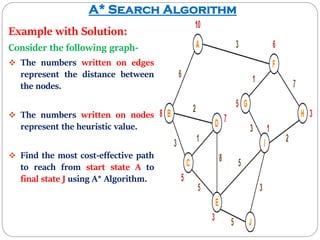
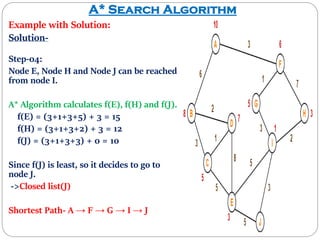
Consider the following graph-
 The numbers written on edges
represent the distance between
the nodes.
 The numbers written on nodes
represent the heuristic value.
 Find the most cost-effective path
to reach from start state A to
final state J using A* Algorithm.
A* Search Algorithm
Example with Solution:
Solution-
Step-01:
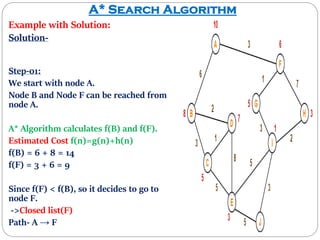
We start with node A.
Node B and Node F can be reached from
node A.
A* Algorithm calculates f(B) and f(F).
Estimated Cost f(n)=g(n)+h(n)
f(B) = 6 + 8 = 14
f(F) = 3 + 6 = 9
Since f(F) < f(B), so it decides to go to
node F.
->Closed list(F)
Path- A → F
A* Search Algorithm
Example with Solution:
Solution-
Step-02:
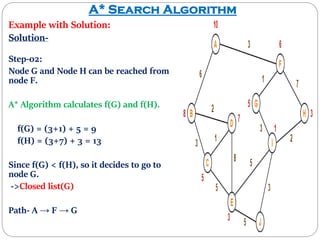
Node G and Node H can be reached from
node F.
A* Algorithm calculates f(G) and f(H).
f(G) = (3+1) + 5 = 9
f(H) = (3+7) + 3 = 13
Since f(G) < f(H), so it decides to go to
node G.
->Closed list(G)
Path- A → F → G
A* Search Algorithm
Example with Solution:
Solution-
Step-03:
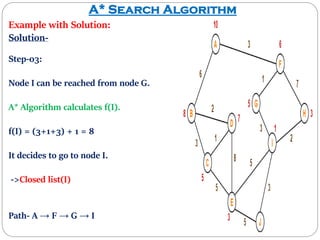
Node I can be reached from node G.
A* Algorithm calculates f(I).
f(I) = (3+1+3) + 1 = 8
It decides to go to node I.
->Closed list(I)
Path- A → F → G → I
A* Search Algorithm
Example with Solution:
Solution-
Step-04:
Node E, Node H and Node J can be reached
from node I.
A* Algorithm calculates f(E), f(H) and f(J).
f(E) = (3+1+3+5) + 3 = 15
f(H) = (3+1+3+2) + 3 = 12
f(J) = (3+1+3+3) + 0 = 10
Since f(J) is least, so it decides to go to
node J.
->Closed list(J)
Shortest Path- A → F → G → I → J
A* Search Algorithm
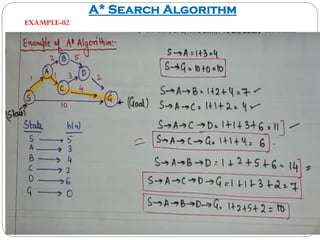
EXAMPLE-02
A* Search Algorithm
Advantages of BFS:
A* Algorithm is one of the best path finding algorithms.
It is Complete & Optimal
Used to solve complex problems.
Disadvantages of BFS:
Requires more memory
A* Search Algorithm
A* Search Algorithm

A* Search Algorithm

  • 1.
    Topic To BeCovered: A* Search Algorithm Jagdamba Education Society's SND College of Engineering & Research Centre Department of Computer Engineering SUBJECT: Artificial Intelligence & Robotics Lecture No-9(ii) Prof.Dhakane Vikas N
  • 2.
    A* Search Algorithm This is informed search technique also called as HEURISTIC search.  This algo. Works using heuristic value.  A* uses h(n)->Heuristic function & g(n)->Cost to reach the node ‘n’ from start state.  Find shortest path though search spaces.  Estimated Cost f(n)=g(n)+h(n)  A* gives Fast & Optimal result as compared with previous algorithms.  Space & Time Complexity of BFS is also O(V+E) where V is vertices and E is edges.  Also Written as:-O(b) ^d Where, b->Branching factor d->depth
  • 3.
    A* Search Algorithm A* Algorithm extends the path that minimizes the following function- f(n) = g(n) + h(n) Here,  ‘n’ is the last node on the path  g(n) is the cost of the path from start node to node ‘n’  h(n) is a heuristic function that estimates cost of the cheapest path from node ‘n’ to the goal node Algorithm-  The implementation of A* Algorithm involves maintaining two lists- OPEN and CLOSED.  OPEN contains those nodes that have been evaluated by the heuristic function but have not been expanded into successors yet.  CLOSED contains those nodes that have already been visited. The algorithm is as follows-
  • 4.
    A* Search Algorithm Thealgorithm is as follows- Step-01:  Define a list OPEN.  Initially, OPEN consists solely of a single node, the start node S. Step-02: If the list is empty, return failure and exit. Step-03:  Remove node n with the smallest value of f(n) from OPEN and move it to list CLOSED.  If node n is a goal state, return success and exit. Step-04: Expand node n.
  • 5.
    A* Search Algorithm Step-05: If any successor to n is the goal node, return success and the solution by tracing the path from goal node to S.  Otherwise, go to Step-06. Step-06: For each successor node,  Apply the evaluation function f to the node.  If the node has not been in either list, add it to OPEN. Step-07: Go back to Step-02.
  • 6.
    A* Search Algorithm Examplewith Solution: Consider the following graph-  The numbers written on edges represent the distance between the nodes.  The numbers written on nodes represent the heuristic value.  Find the most cost-effective path to reach from start state A to final state J using A* Algorithm.
  • 7.
    A* Search Algorithm Examplewith Solution: Solution- Step-01: We start with node A. Node B and Node F can be reached from node A. A* Algorithm calculates f(B) and f(F). Estimated Cost f(n)=g(n)+h(n) f(B) = 6 + 8 = 14 f(F) = 3 + 6 = 9 Since f(F) < f(B), so it decides to go to node F. ->Closed list(F) Path- A → F
  • 8.
    A* Search Algorithm Examplewith Solution: Solution- Step-02: Node G and Node H can be reached from node F. A* Algorithm calculates f(G) and f(H). f(G) = (3+1) + 5 = 9 f(H) = (3+7) + 3 = 13 Since f(G) < f(H), so it decides to go to node G. ->Closed list(G) Path- A → F → G
  • 9.
    A* Search Algorithm Examplewith Solution: Solution- Step-03: Node I can be reached from node G. A* Algorithm calculates f(I). f(I) = (3+1+3) + 1 = 8 It decides to go to node I. ->Closed list(I) Path- A → F → G → I
  • 10.
    A* Search Algorithm Examplewith Solution: Solution- Step-04: Node E, Node H and Node J can be reached from node I. A* Algorithm calculates f(E), f(H) and f(J). f(E) = (3+1+3+5) + 3 = 15 f(H) = (3+1+3+2) + 3 = 12 f(J) = (3+1+3+3) + 0 = 10 Since f(J) is least, so it decides to go to node J. ->Closed list(J) Shortest Path- A → F → G → I → J
  • 11.
  • 12.
    A* Search Algorithm Advantagesof BFS: A* Algorithm is one of the best path finding algorithms. It is Complete & Optimal Used to solve complex problems. Disadvantages of BFS: Requires more memory