Introduction to Software Engineering 
Muhammad Nasir 
m.nasir@iiu.edu.pk 
Software Process Model (2)
Outline 
 Evolutionary Process Models 
 Prototyping 
 Spiral Model 
 Component based development (CBD)
Evolutionary Process Model 
 A process model that has been explicitly designed to 
accommodate a product that evolves over time. 
 Produce an increasingly more complete version of the 
software with each iteration. 
 Evolutionary Models are iterative. 
 Evolutionary models are: 
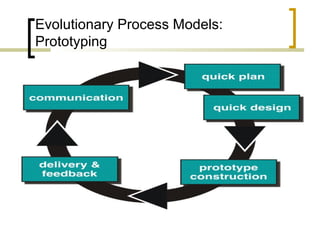
 Prototyping 
 Spiral Model
Evolutionary Process Models: 
Prototyping
Prototyping (cont..) 
 Often, a customer defines a set of general 
objectives for software, but does not identify 
detailed requirements for functions and features. 
 In this case Prototyping is best suited 
 Prototyping can be used together with other 
models for elicitation of requirements 
 The prototype can serve as “the first system.” 
 Some prototypes are “Throw Away” while others 
also evolve and become part of the actual system
Prototyping (cont..) 
 Both customers and developers like the prototyping paradigm. 
 Customer/End user gets a feel for the actual system 
 Developer get to build something immediately. 
Problem Areas: 
 Developer often makes implementation in order to get a prototype 
working quickly without considering long term maintainability and 
Quality, efficient algorithms etc. 
 Customer cries foul and demand that “a few fixes” be applied to 
make the prototype a working product, due to that software quality 
suffers as a result. 
Customer and developer both must agree that the prototype is built to 
serve as a mechanism for defining requirement.
Evolutionary Model: Spiral 
Model
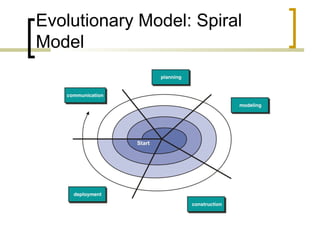
Spiral Model 
 Combines iterative nature of prototyping with the controlled and 
systematic aspects of the linear sequential model 
 Using spiral, software developed in as series of evolutionary release. 
 Early iteration, release might be on paper or prototype. 
 Later iteration, more complete version of software. 
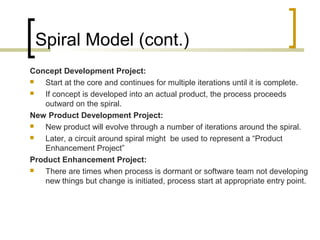
 Divided into framework activities (C,P,M,C,D). Each activity represent 
one segment. 
 Evolutionary process begins in a clockwise direction, beginning at the 
center risk. 
 First circuit around the spiral might result in development of a product 
specification. Subsequently, develop a prototype while progressively 
constructing more sophisticated version of software. 
 Unlike other process models that end when software is delivered. 
 It can be adapted to apply throughout the life of software.
Spiral Model
Spiral Model (cont.) 
Concept Development Project: 
 Start at the core and continues for multiple iterations until it is complete. 
 If concept is developed into an actual product, the process proceeds 
outward on the spiral. 
New Product Development Project: 
 New product will evolve through a number of iterations around the spiral. 
 Later, a circuit around spiral might be used to represent a “Product 
Enhancement Project” 
Product Enhancement Project: 
 There are times when process is dormant or software team not developing 
new things but change is initiated, process start at appropriate entry point.
Spiral Model (cont.) 
 The spiral model uses prototyping as a risk 
reduction mechanism. 
 It maintains the systematic stepwise approach 
suggested by the classic life-cycle 
 But incorporates it into an iterative framework 
that more realistically reflects the real world. 
 The spiral model demands a direct 
consideration of technical risks at all stages 
of the project
Spiral Model (cont..) 
Problem Area: 
 It may be difficult to convince customers (particularly in 
contract situations) that the evolutionary approach is 
controllable. 
 It demands considerable risk assessment expertise 
 If a major risk is not uncovered and managed, problems will 
undoubtedly occur.
Specialized Process Model 
 Specialized process models take on 
many of the characteristics of one or 
more of the traditional models 
presented in the preceding sections. 
 However, these models tend to be 
applied when a specialized or 
narrowly defined software 
engineering approach is chosen.
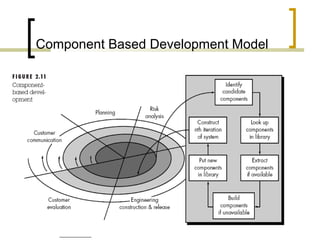
Component Based Development Model 
 Commercial off-the-shelf (COTS) software 
components, provide targeted functionality with 
well-defined interfaces 
 that enable the component to be integrated into 
the software that is to be built. 
 The component-based development model 
incorporates many of the characteristics of the 
spiral model.
CBD (Cont…) 
1. Available component-based products are 
researched and evaluated for the application 
domain in question. 
2. Component integration issues are considered. 
3. A software architecture is designed to 
accommodate the components. 
4. Components are integrated into the architecture. 
5. Comprehensive testing is conducted to ensure 
proper functionality.
Component Based Development Model
CBD Model (cont.) 
 The component-based development 
model leads to software reuse, and 
reusability and a number of 
measurable benefits. 
 Reduction in software development 
cycle time as well as 
 Reduction in project cost
The End 
 Thanks for Listening 
 Questions & Answers

Lecture 4 software process model (2)

  • 1.
    Introduction to SoftwareEngineering Muhammad Nasir m.nasir@iiu.edu.pk Software Process Model (2)
  • 2.
    Outline  EvolutionaryProcess Models  Prototyping  Spiral Model  Component based development (CBD)
  • 3.
    Evolutionary Process Model  A process model that has been explicitly designed to accommodate a product that evolves over time.  Produce an increasingly more complete version of the software with each iteration.  Evolutionary Models are iterative.  Evolutionary models are:  Prototyping  Spiral Model
  • 4.
  • 5.
    Prototyping (cont..) Often, a customer defines a set of general objectives for software, but does not identify detailed requirements for functions and features.  In this case Prototyping is best suited  Prototyping can be used together with other models for elicitation of requirements  The prototype can serve as “the first system.”  Some prototypes are “Throw Away” while others also evolve and become part of the actual system
  • 6.
    Prototyping (cont..) Both customers and developers like the prototyping paradigm.  Customer/End user gets a feel for the actual system  Developer get to build something immediately. Problem Areas:  Developer often makes implementation in order to get a prototype working quickly without considering long term maintainability and Quality, efficient algorithms etc.  Customer cries foul and demand that “a few fixes” be applied to make the prototype a working product, due to that software quality suffers as a result. Customer and developer both must agree that the prototype is built to serve as a mechanism for defining requirement.
  • 7.
  • 8.
    Spiral Model Combines iterative nature of prototyping with the controlled and systematic aspects of the linear sequential model  Using spiral, software developed in as series of evolutionary release.  Early iteration, release might be on paper or prototype.  Later iteration, more complete version of software.  Divided into framework activities (C,P,M,C,D). Each activity represent one segment.  Evolutionary process begins in a clockwise direction, beginning at the center risk.  First circuit around the spiral might result in development of a product specification. Subsequently, develop a prototype while progressively constructing more sophisticated version of software.  Unlike other process models that end when software is delivered.  It can be adapted to apply throughout the life of software.
  • 9.
  • 10.
    Spiral Model (cont.) Concept Development Project:  Start at the core and continues for multiple iterations until it is complete.  If concept is developed into an actual product, the process proceeds outward on the spiral. New Product Development Project:  New product will evolve through a number of iterations around the spiral.  Later, a circuit around spiral might be used to represent a “Product Enhancement Project” Product Enhancement Project:  There are times when process is dormant or software team not developing new things but change is initiated, process start at appropriate entry point.
  • 11.
    Spiral Model (cont.)  The spiral model uses prototyping as a risk reduction mechanism.  It maintains the systematic stepwise approach suggested by the classic life-cycle  But incorporates it into an iterative framework that more realistically reflects the real world.  The spiral model demands a direct consideration of technical risks at all stages of the project
  • 12.
    Spiral Model (cont..) Problem Area:  It may be difficult to convince customers (particularly in contract situations) that the evolutionary approach is controllable.  It demands considerable risk assessment expertise  If a major risk is not uncovered and managed, problems will undoubtedly occur.
  • 13.
    Specialized Process Model  Specialized process models take on many of the characteristics of one or more of the traditional models presented in the preceding sections.  However, these models tend to be applied when a specialized or narrowly defined software engineering approach is chosen.
  • 14.
    Component Based DevelopmentModel  Commercial off-the-shelf (COTS) software components, provide targeted functionality with well-defined interfaces  that enable the component to be integrated into the software that is to be built.  The component-based development model incorporates many of the characteristics of the spiral model.
  • 15.
    CBD (Cont…) 1.Available component-based products are researched and evaluated for the application domain in question. 2. Component integration issues are considered. 3. A software architecture is designed to accommodate the components. 4. Components are integrated into the architecture. 5. Comprehensive testing is conducted to ensure proper functionality.
  • 16.
  • 17.
    CBD Model (cont.)  The component-based development model leads to software reuse, and reusability and a number of measurable benefits.  Reduction in software development cycle time as well as  Reduction in project cost
  • 18.
    The End Thanks for Listening  Questions & Answers