
Evolutionary Software
Process Model
Taha Shahid (Student643310)
Semester 5 – Miss Samra
Objectives of this Presentation:
• To give a small introduction of Software Process
Model.
• To describe Evolutionary SPM.
• To describe following types of ESPM:
– Incremental mode
– Spiral model
– Component assembling model
What is Software Process Model?
A software process model is a standardized
format for
– Planning
– Organizing, and
– Running
a development project.
How many models of SPM are there?
Hundreds of different models exist and are
used but following are the most important models:
• Linear Process Models
– Waterfall Model
– Prototyping Model
• Evolutionary Software Process Models
– Incremental Model
– Spiral Model
– Component Assembly Model
What Evolutionary means?
This word is derived from the word “Evolution”.
Evolution (noun): A regular process in which something
changes into a different and usually much better form.
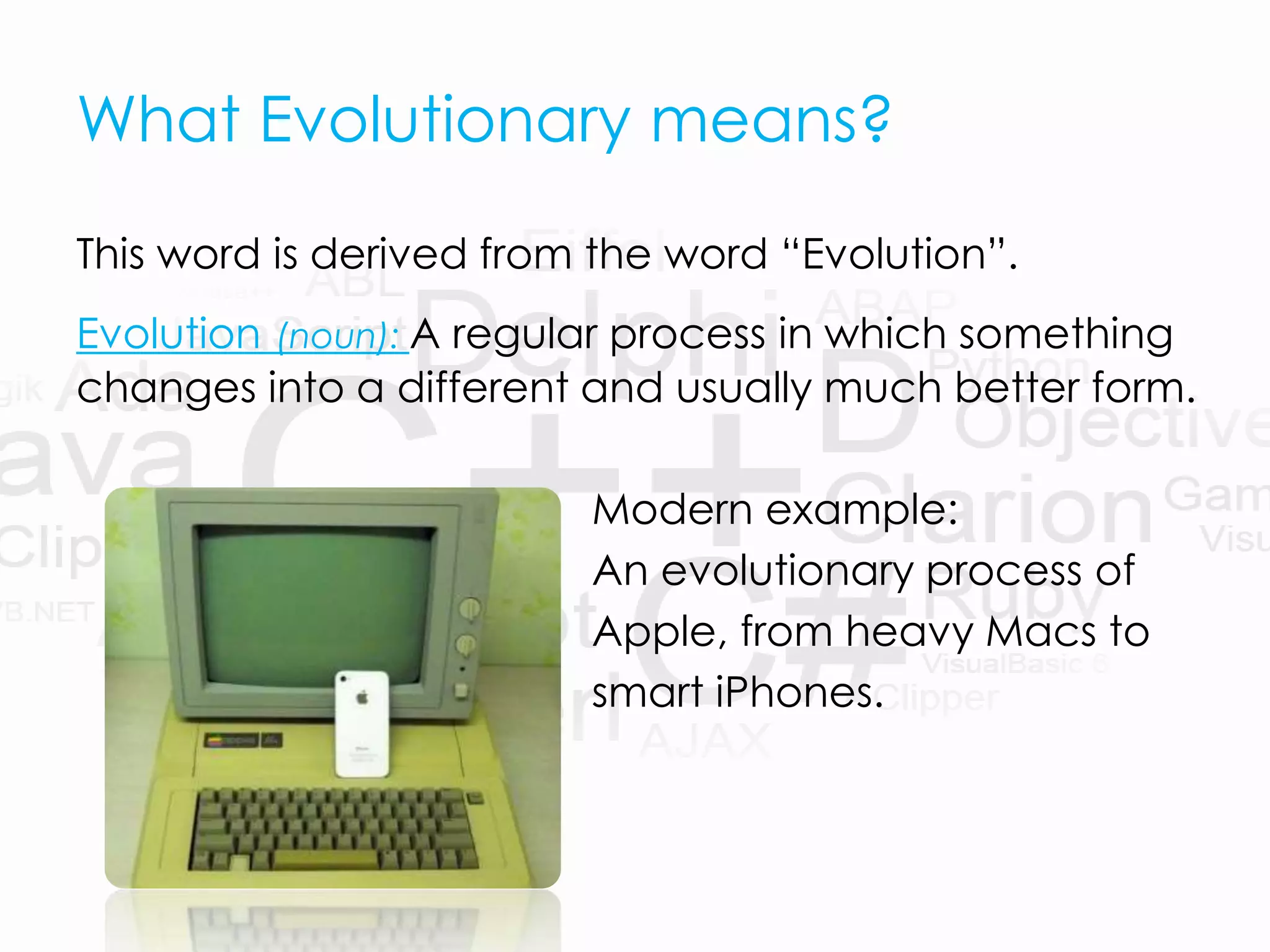
Modern example:
An evolutionary process of
Apple, from heavy Macs to
smart iPhones.
Evolutionary Software Process
Model
Evolutionary Software Process Model
Evolutionary software models are iterative. They are
characterized in manner that enables the software
engineers to develop increasingly more complete version
of a software.
In programming "iteration" means sequential access
to objects. It is typically a cycle.
Software engineers can follow this process model
that has been clearly designed to put up a product that
regularly complete over time.
How many categories are there of ESPM?
The ESPM has been categorized into 3 types of
models.
1. Incremental Model
2. Spiral Model
3. Component Assembly Model
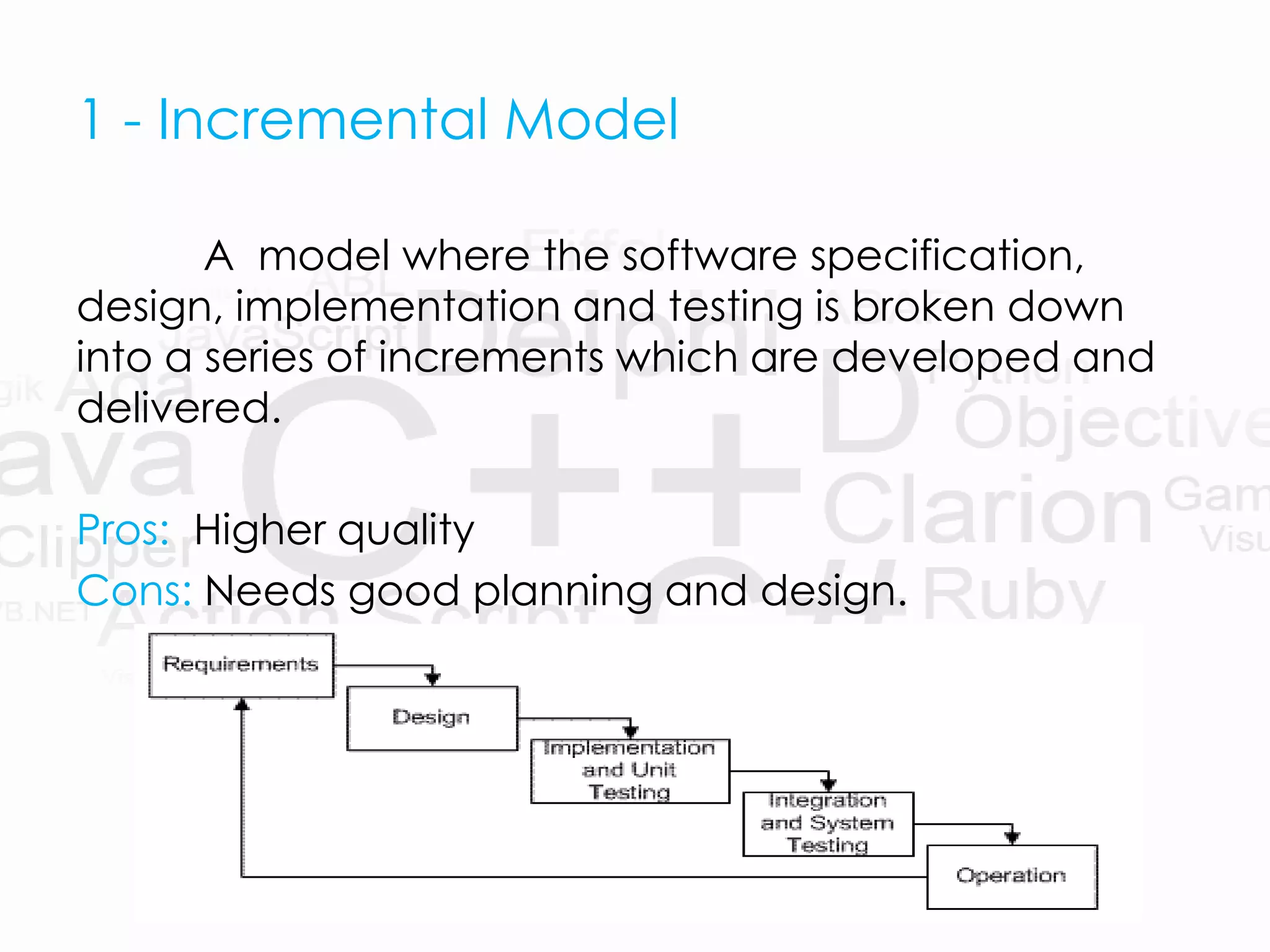
1 - Incremental Model
A model where the software specification,
design, implementation and testing is broken down
into a series of increments which are developed and
delivered.
Pros: Higher quality
Cons: Needs good planning and design.
2 - Splral Model?
2 - Spiral Model
Another evolutionary life cycle model that
combines the linear nature of the Waterfall model
and the iterative (repetitive) nature of the Prototyping
model. The project life cycle is divided into phases,
and each phase is executed in all of the iteration of
the Spiral Model.
Pros: More detailed processes for each phase.
Cons: Costly
Sometimes difficult to implement.
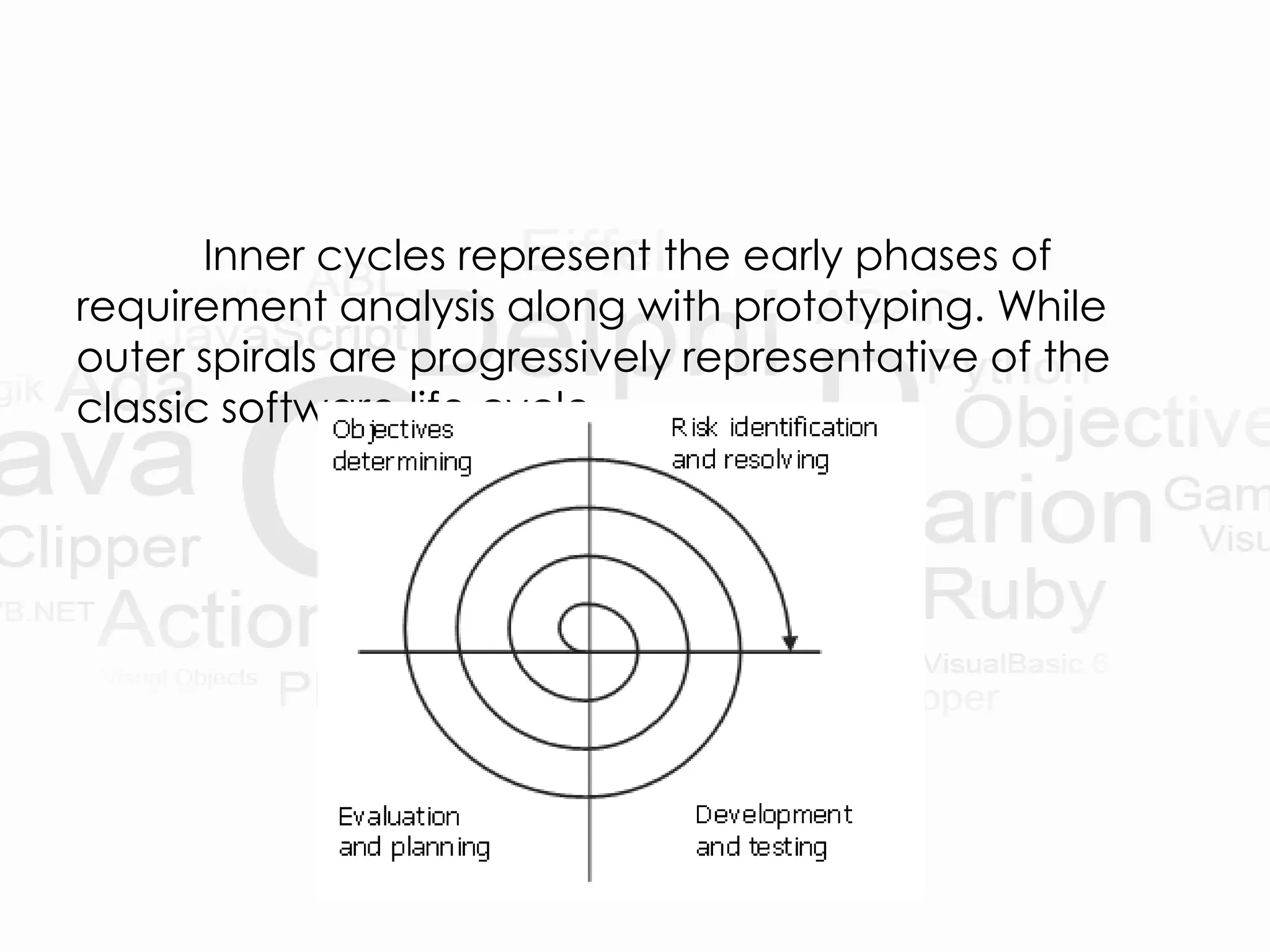
Inner cycles represent the early phases of
requirement analysis along with prototyping. While
outer spirals are progressively representative of the
classic software life cycle.
3 - Component Assembly Model
Component Assembly Model is just like the
Prototype model, in which first a prototype is created
according to the requirements of the customer. Thus,
this is one of the most beneficial advantages of
component assembly model as it saves lots of time
during the software development program.
Instead of searching for different codes and
languages, the developers using this model opt for the
available components and use them to make an
efficient program.
No Questions Please!!!
Thanks 

Evolutionary Software Process Module in Easy Terminology by Taha Shahid

  • 1.
    Evolutionary Software Process Model TahaShahid (Student643310) Semester 5 – Miss Samra
  • 2.
    Objectives of thisPresentation: • To give a small introduction of Software Process Model. • To describe Evolutionary SPM. • To describe following types of ESPM: – Incremental mode – Spiral model – Component assembling model
  • 3.
    What is SoftwareProcess Model? A software process model is a standardized format for – Planning – Organizing, and – Running a development project.
  • 4.
    How many modelsof SPM are there? Hundreds of different models exist and are used but following are the most important models: • Linear Process Models – Waterfall Model – Prototyping Model • Evolutionary Software Process Models – Incremental Model – Spiral Model – Component Assembly Model
  • 5.
    What Evolutionary means? Thisword is derived from the word “Evolution”. Evolution (noun): A regular process in which something changes into a different and usually much better form. Modern example: An evolutionary process of Apple, from heavy Macs to smart iPhones.
  • 6.
  • 7.
    Evolutionary Software ProcessModel Evolutionary software models are iterative. They are characterized in manner that enables the software engineers to develop increasingly more complete version of a software. In programming "iteration" means sequential access to objects. It is typically a cycle. Software engineers can follow this process model that has been clearly designed to put up a product that regularly complete over time.
  • 8.
    How many categoriesare there of ESPM? The ESPM has been categorized into 3 types of models. 1. Incremental Model 2. Spiral Model 3. Component Assembly Model
  • 9.
  • 10.
    1 - IncrementalModel A model where the software specification, design, implementation and testing is broken down into a series of increments which are developed and delivered. Pros: Higher quality Cons: Needs good planning and design.
  • 11.
    2 - SplralModel?
  • 12.
    2 - SpiralModel Another evolutionary life cycle model that combines the linear nature of the Waterfall model and the iterative (repetitive) nature of the Prototyping model. The project life cycle is divided into phases, and each phase is executed in all of the iteration of the Spiral Model. Pros: More detailed processes for each phase. Cons: Costly Sometimes difficult to implement.
  • 13.
    Inner cycles representthe early phases of requirement analysis along with prototyping. While outer spirals are progressively representative of the classic software life cycle.
  • 14.
    3 - ComponentAssembly Model
  • 15.
    3 - ComponentAssembly Model Component Assembly Model is just like the Prototype model, in which first a prototype is created according to the requirements of the customer. Thus, this is one of the most beneficial advantages of component assembly model as it saves lots of time during the software development program. Instead of searching for different codes and languages, the developers using this model opt for the available components and use them to make an efficient program.
  • 16.