Lecture 3.1 and 3.2-
Measurements
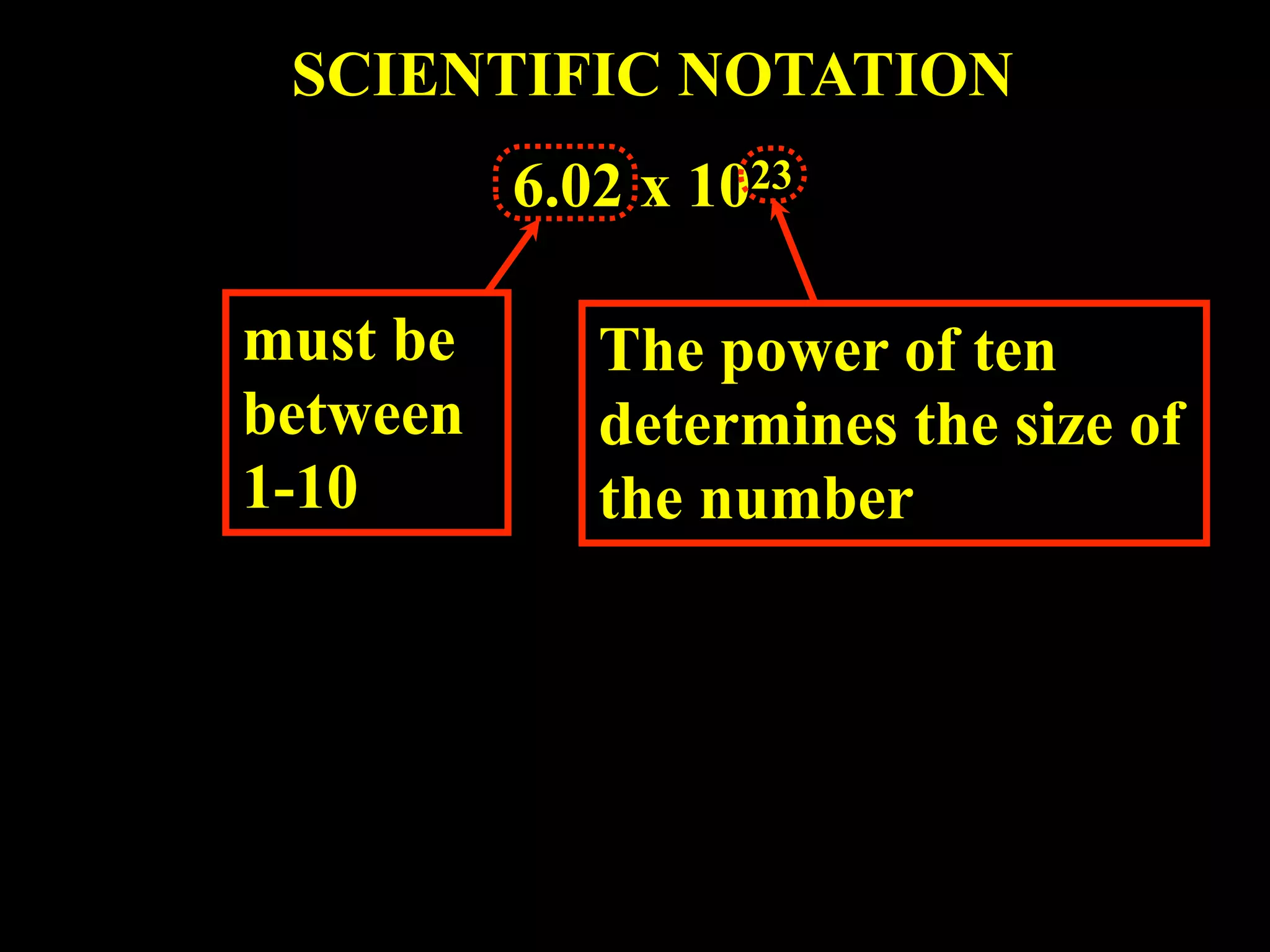
SCIENTIFIC NOTATION

is used to represent very large
or very small numbers
SCIENTIFIC NOTATION
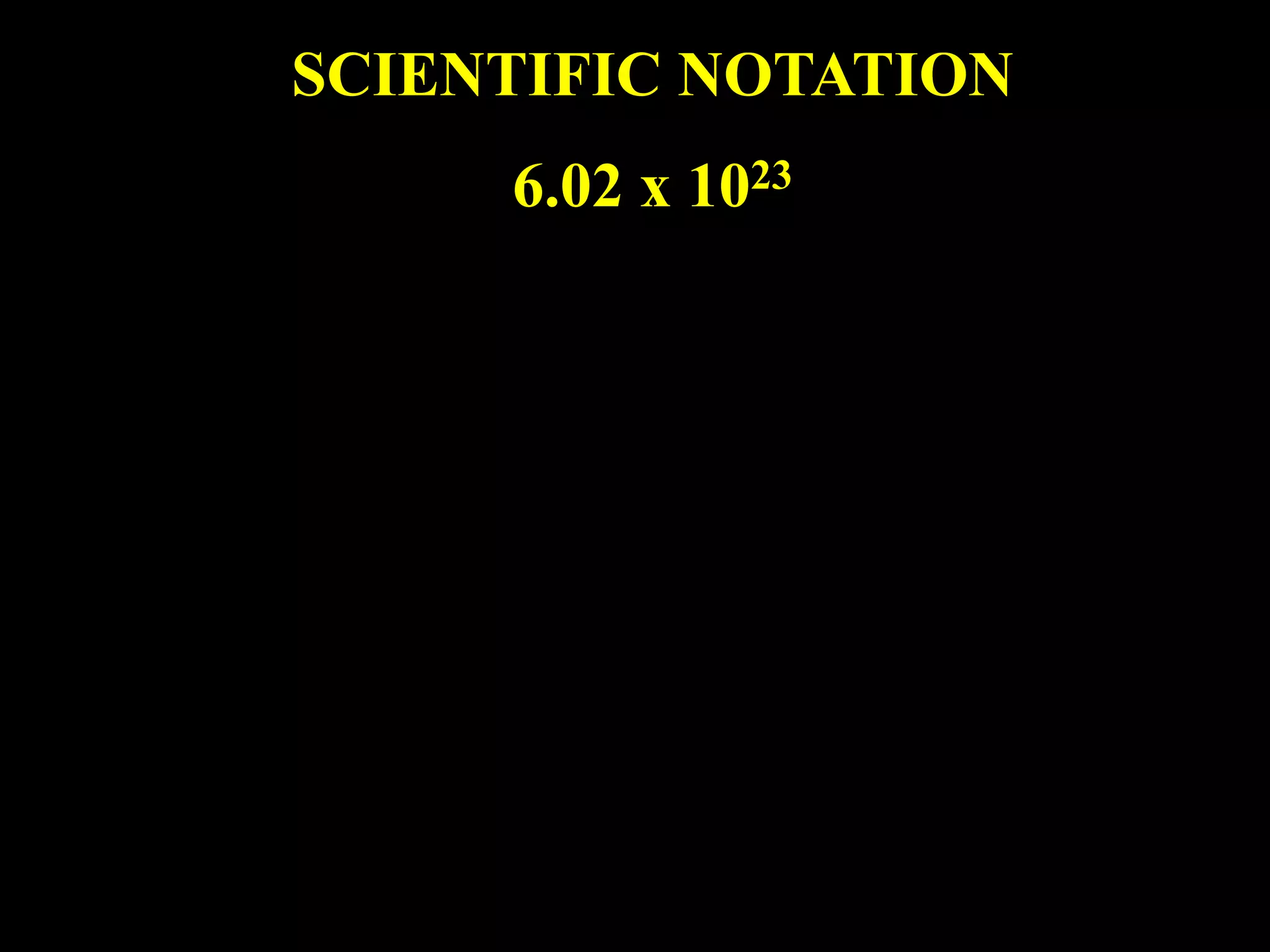
     6.02 x 10²³
SCIENTIFIC NOTATION
          6.02 x 10²³

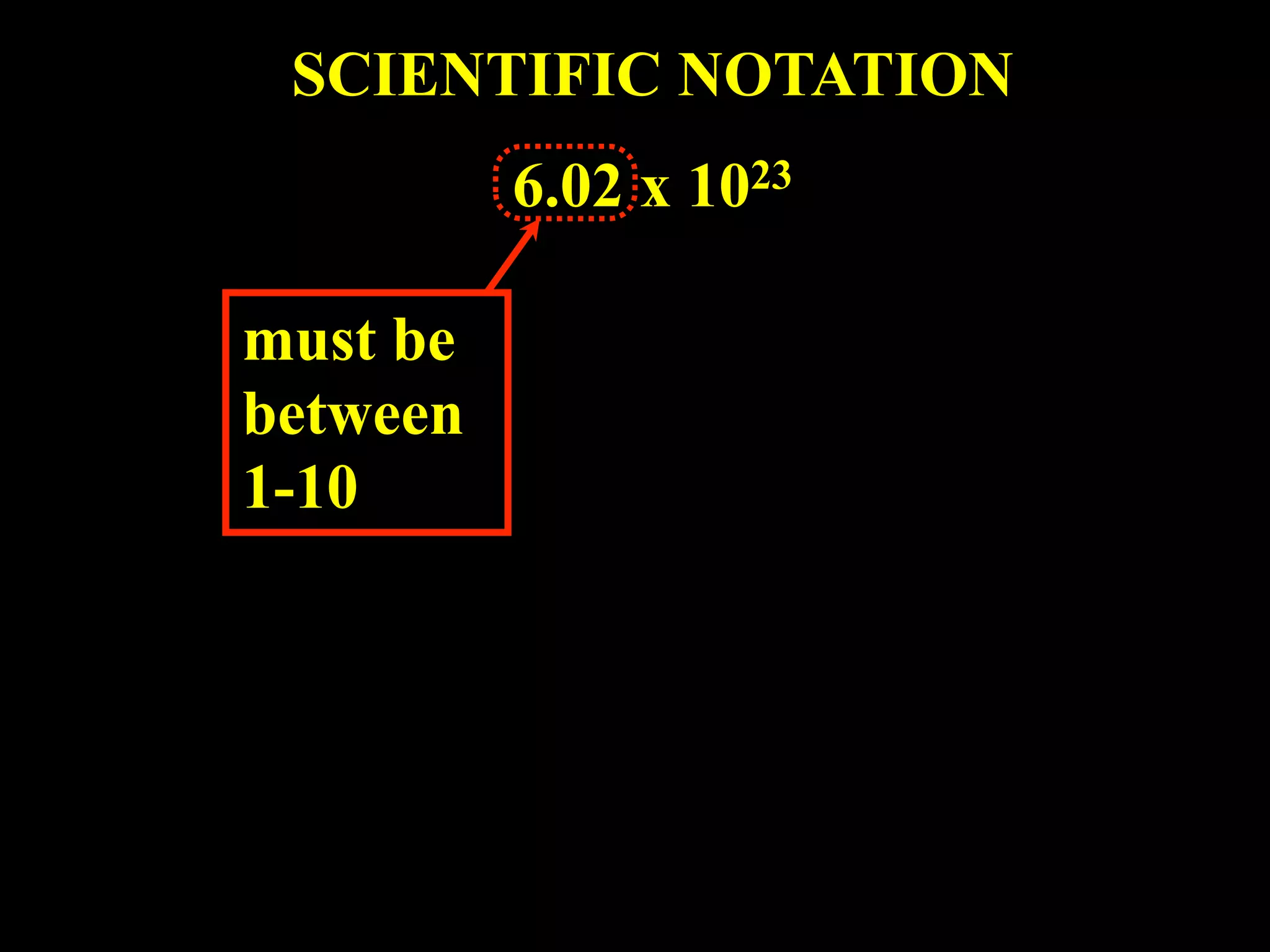
must be
between
1-10
SCIENTIFIC NOTATION
          6.02 x 10²³

must be      The power of ten
between      determines the size of
1-10         the number
SCIENTIFIC NOTATION
                 6.02 x 10²³

         must be      The power of ten
         between      determines the size of
         1-10         the number
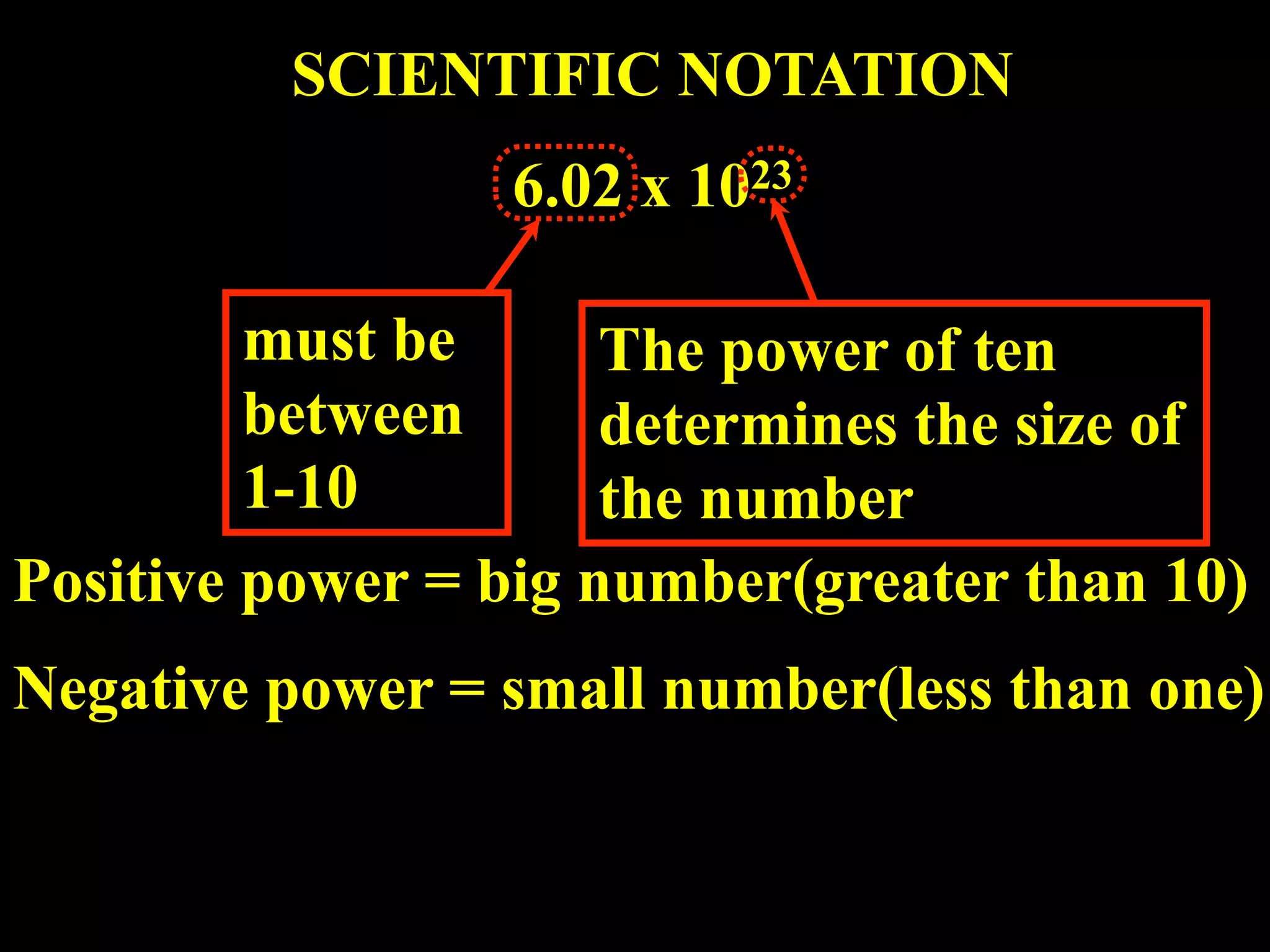
Positive power = big number(greater than 10)
Negative power = small number(less than one)
SCIENTIFIC NOTATION
                 6.02 x 10²³

         must be      The power of ten
         between      determines the size of
         1-10         the number
Positive power = big number(greater than 10)
Negative power = small number(less than one)
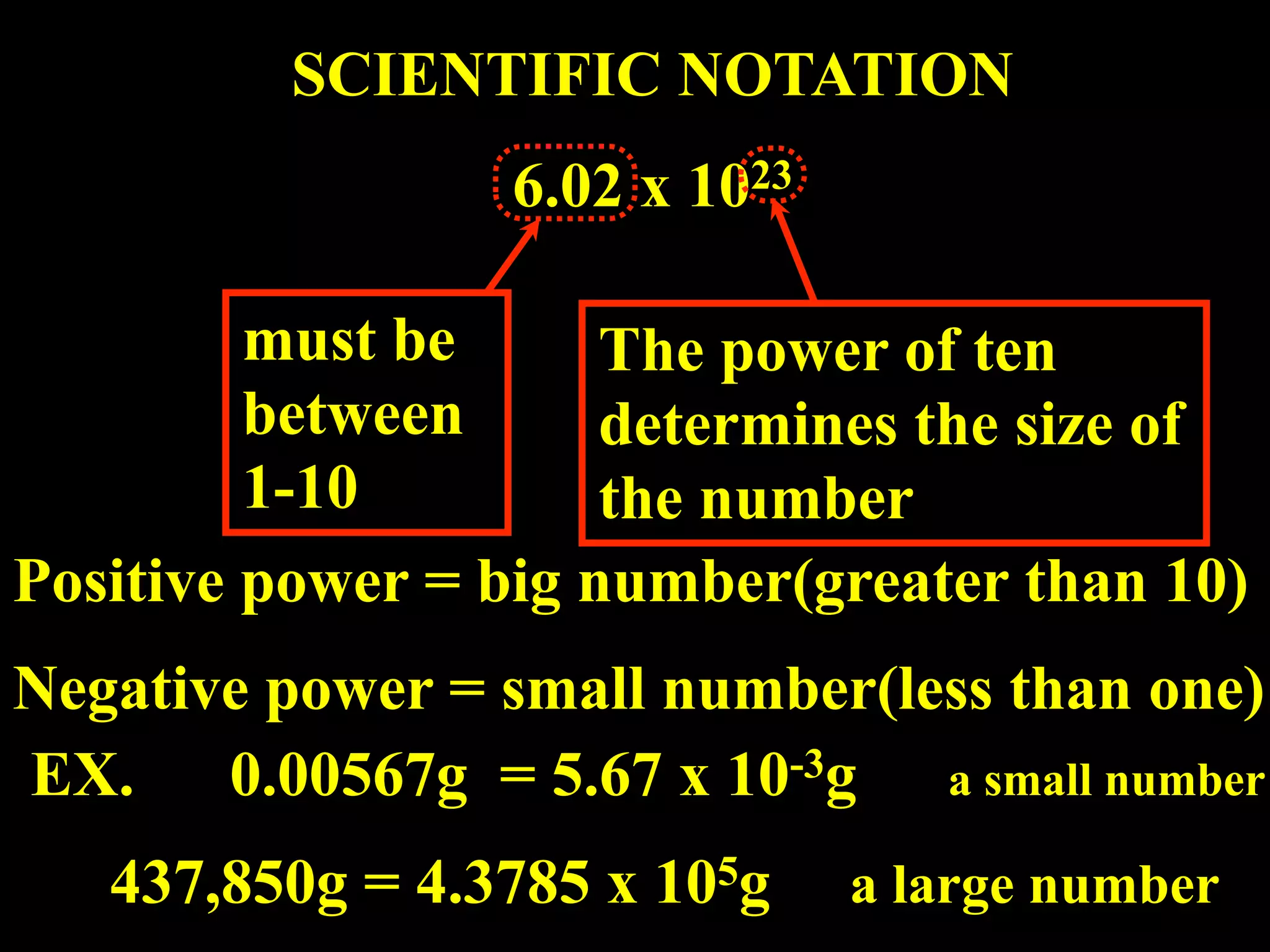
EX.    0.00567g = 5.67 x 10⁻³g a small number
   437,850g = 4.3785 x 10⁵g    a large number
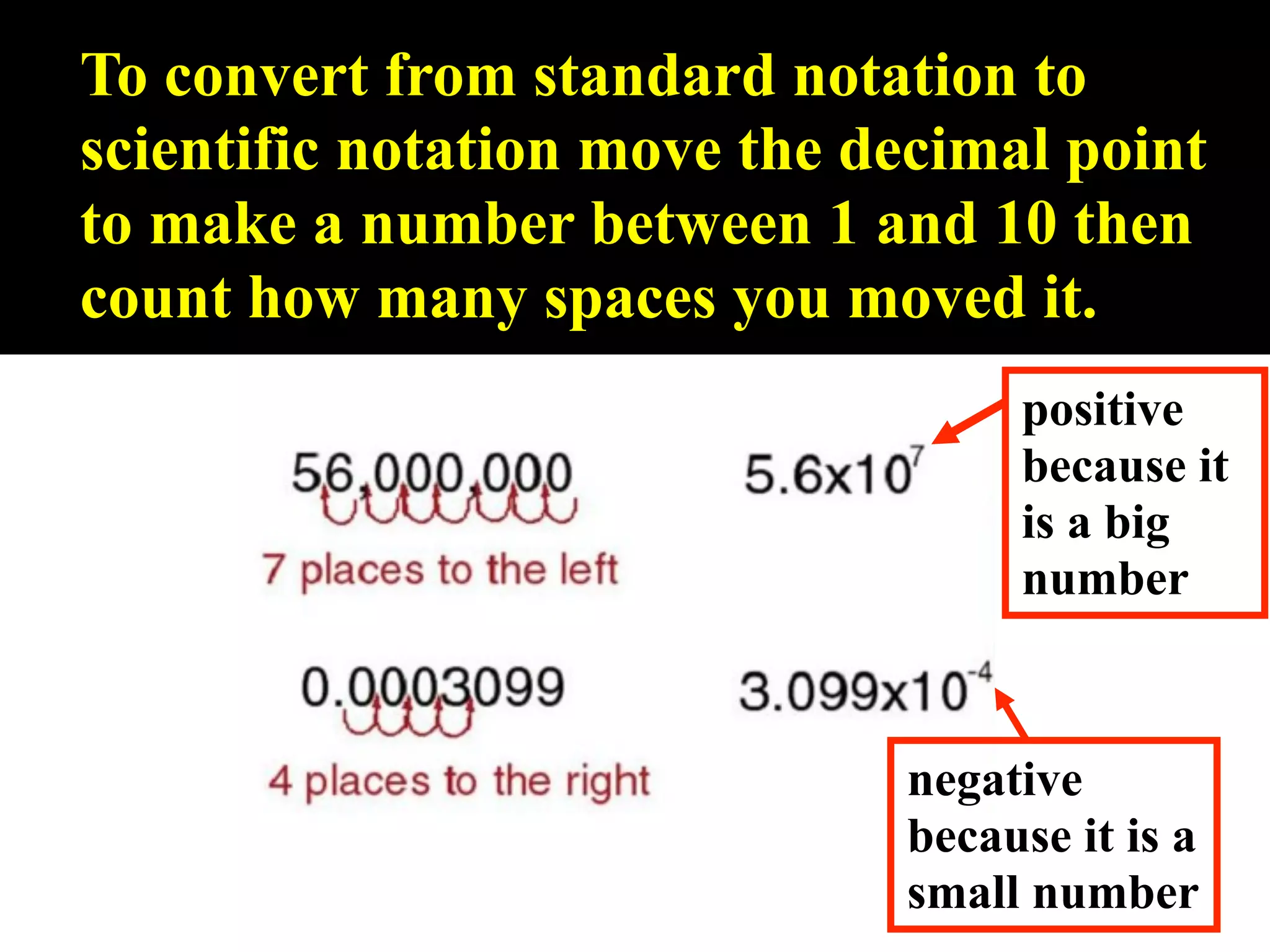
To convert from standard notation to
scientific notation move the decimal point
to make a number between 1 and 10 then
count how many spaces you moved it.
                                   positive
                                   because it
                                   is a big
                                   number


                              negative
                              because it is a
                              small number
Accuracy and Precision
  • Accuracy measures how close a
   measurement comes to the actual
   value.
  • Precision measures how close a
   series of measurements are to each
   other.
3.1
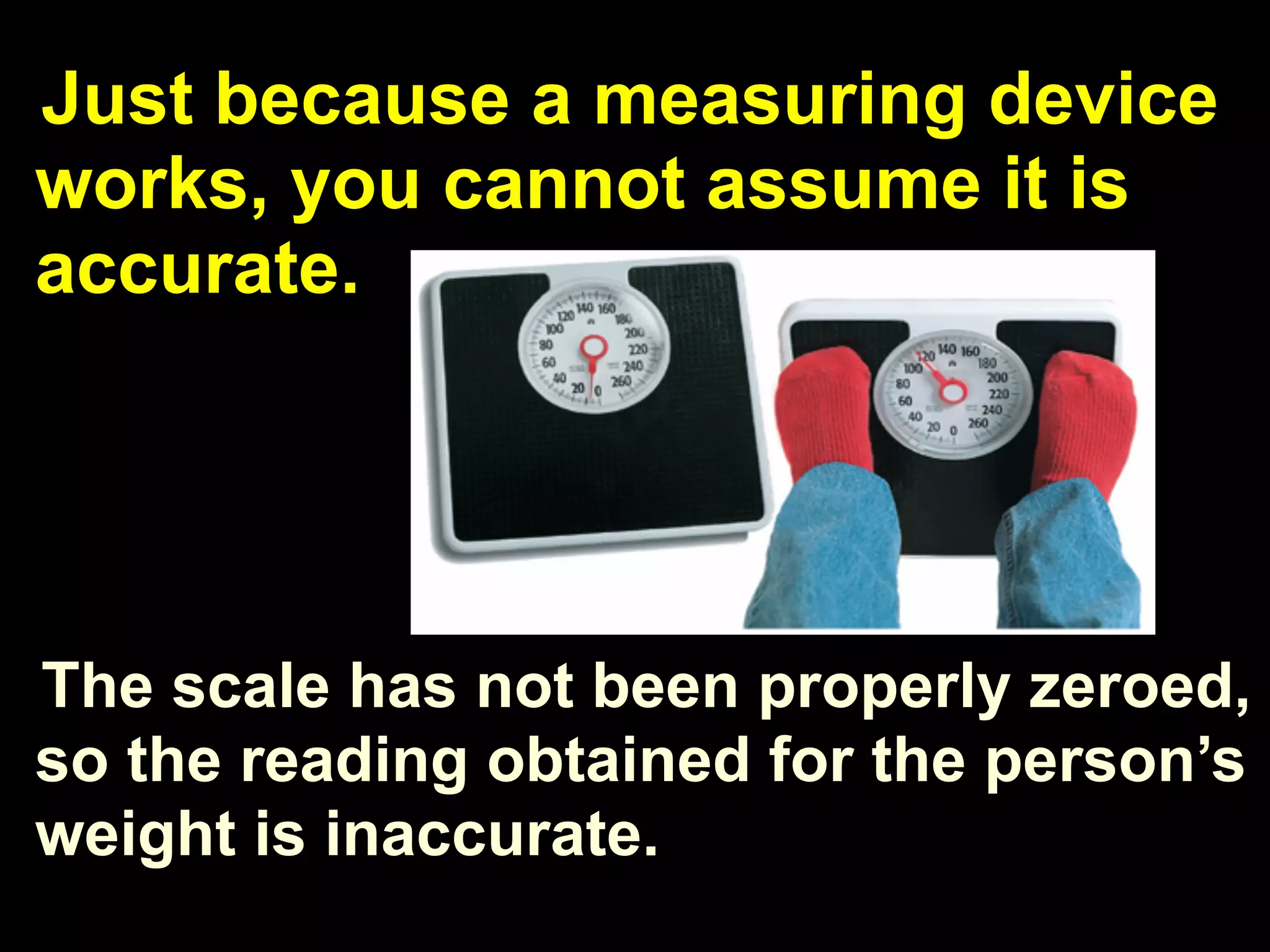
Just because a measuring device
works, you cannot assume it is
accurate.


The scale has not been properly zeroed,
so the reading obtained for the person’s
weight is inaccurate.
Significant digits
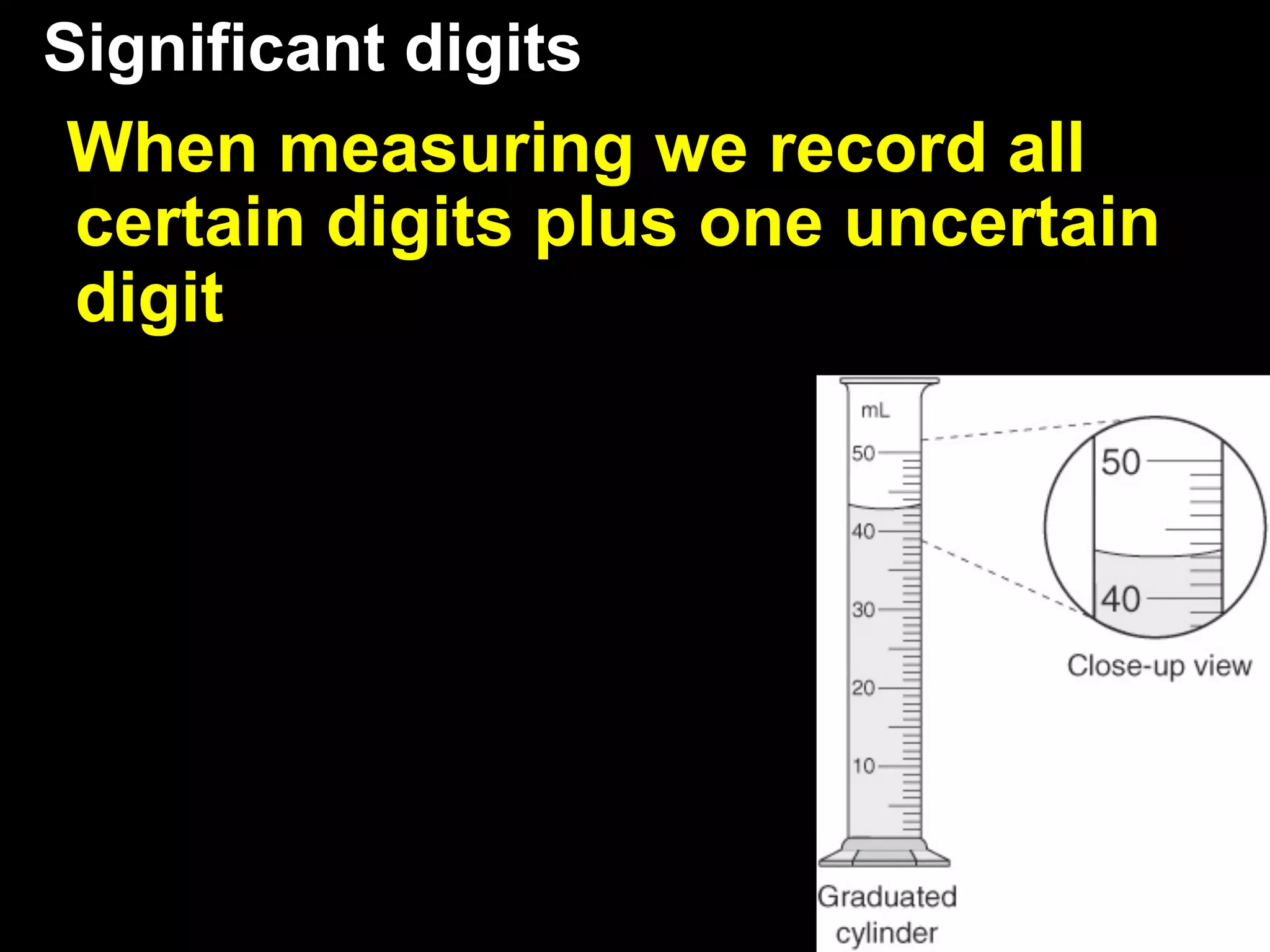
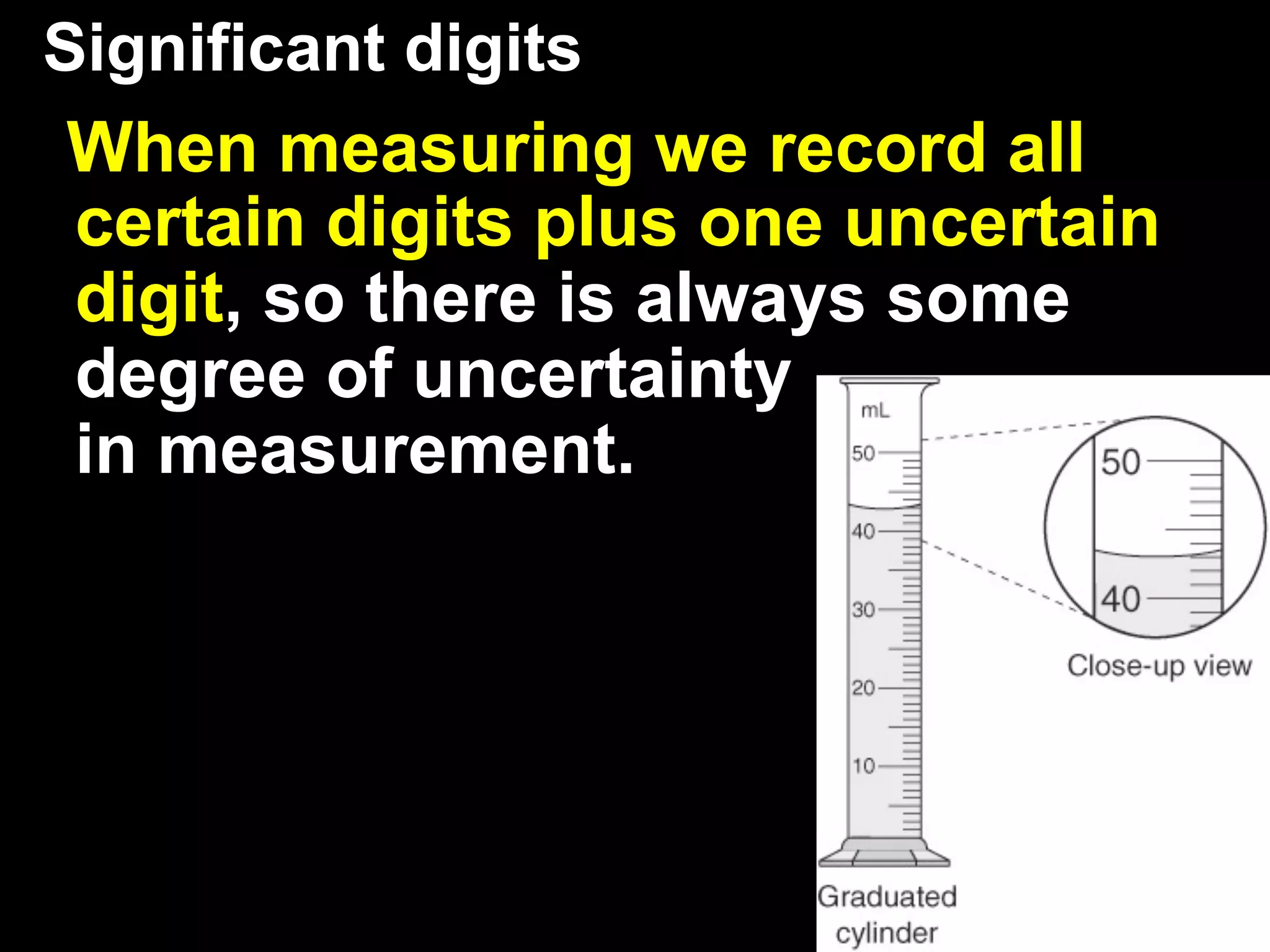
When measuring we record all
certain digits plus one uncertain
digit
Significant digits
When measuring we record all
certain digits plus one uncertain
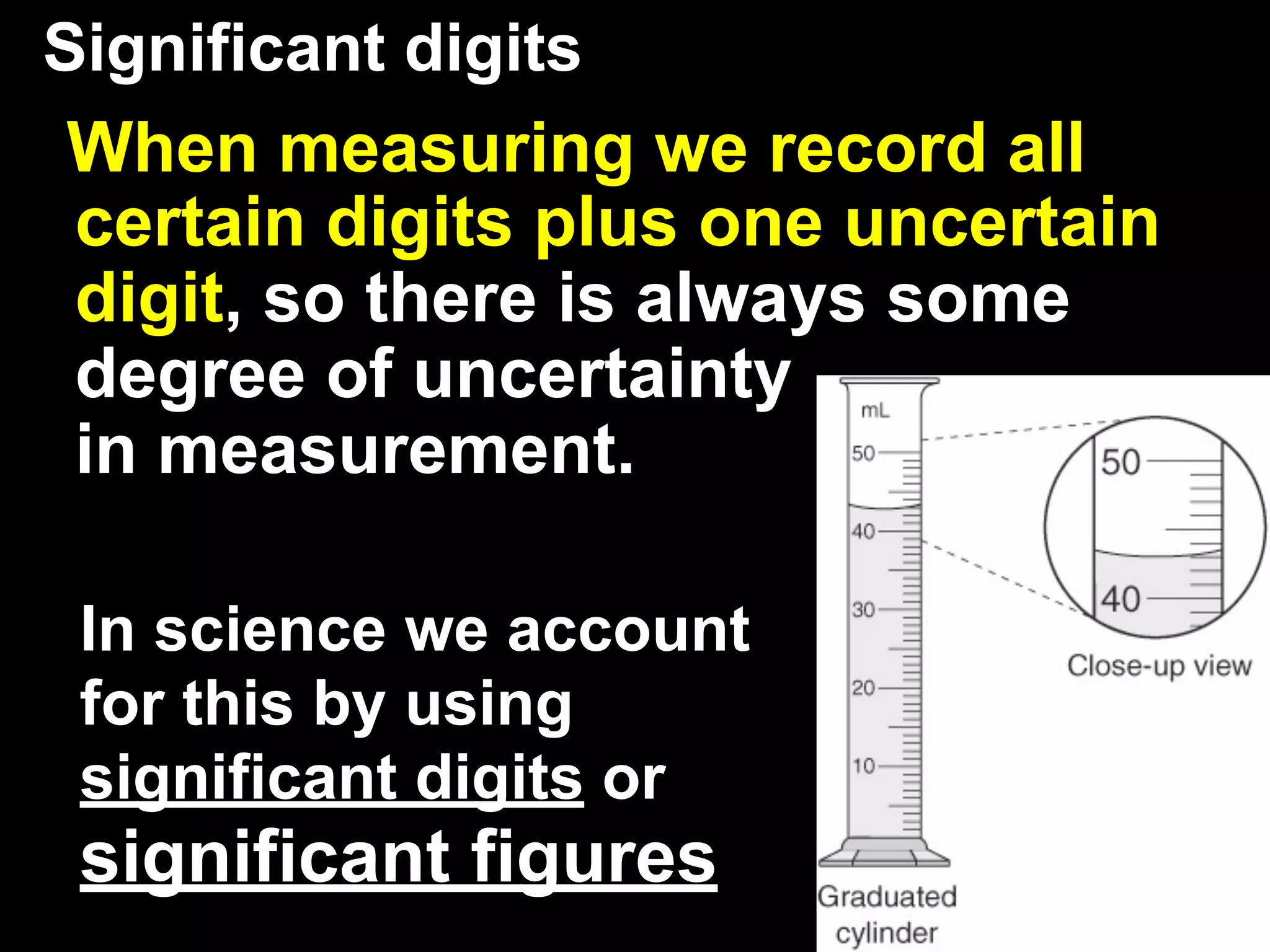
digit, so there is always some
degree of uncertainty
in measurement.
Significant digits
When measuring we record all
certain digits plus one uncertain
digit, so there is always some
degree of uncertainty
in measurement.

 In science we account
 for this by using
 significant digits or
 significant figures
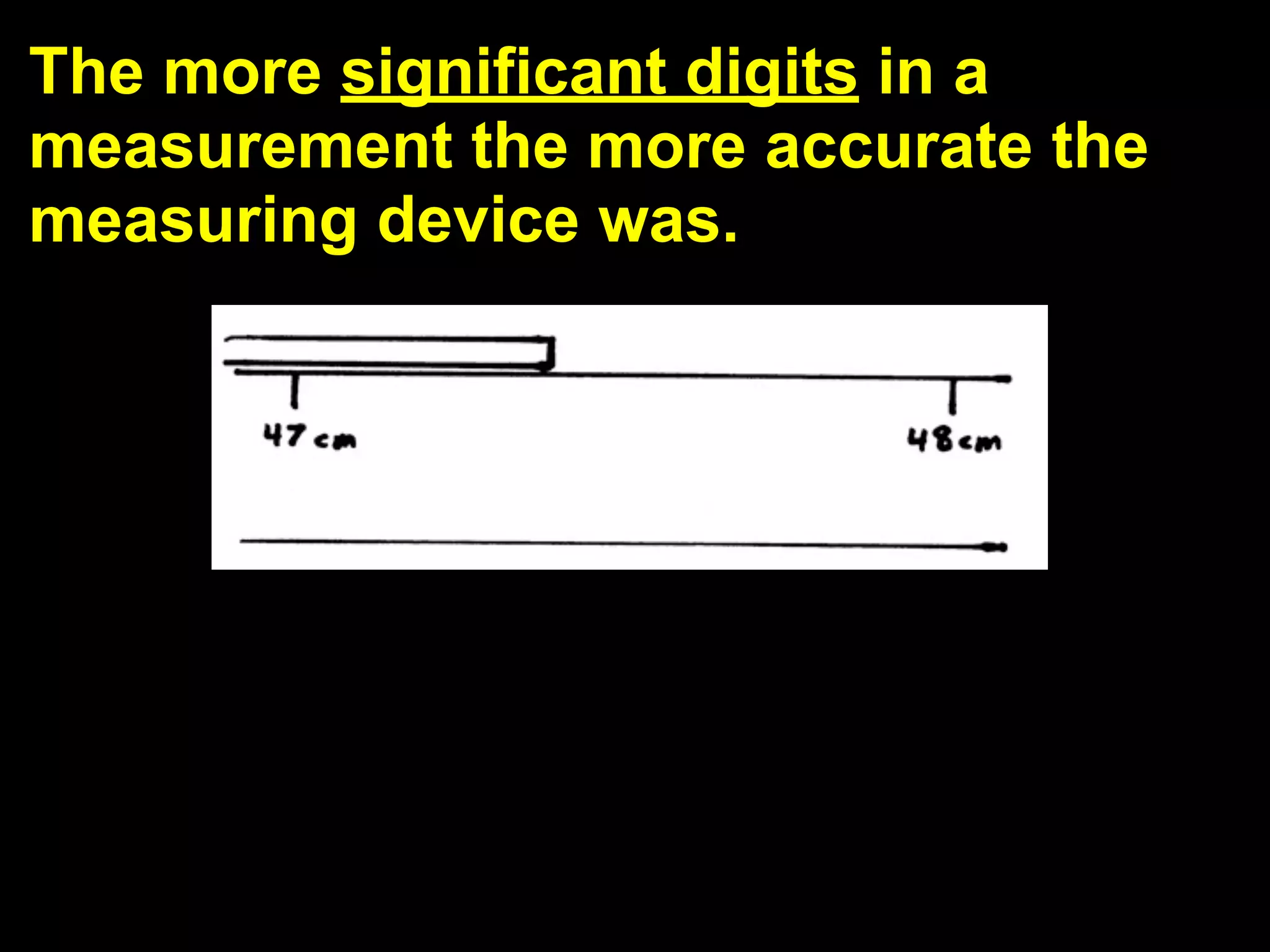
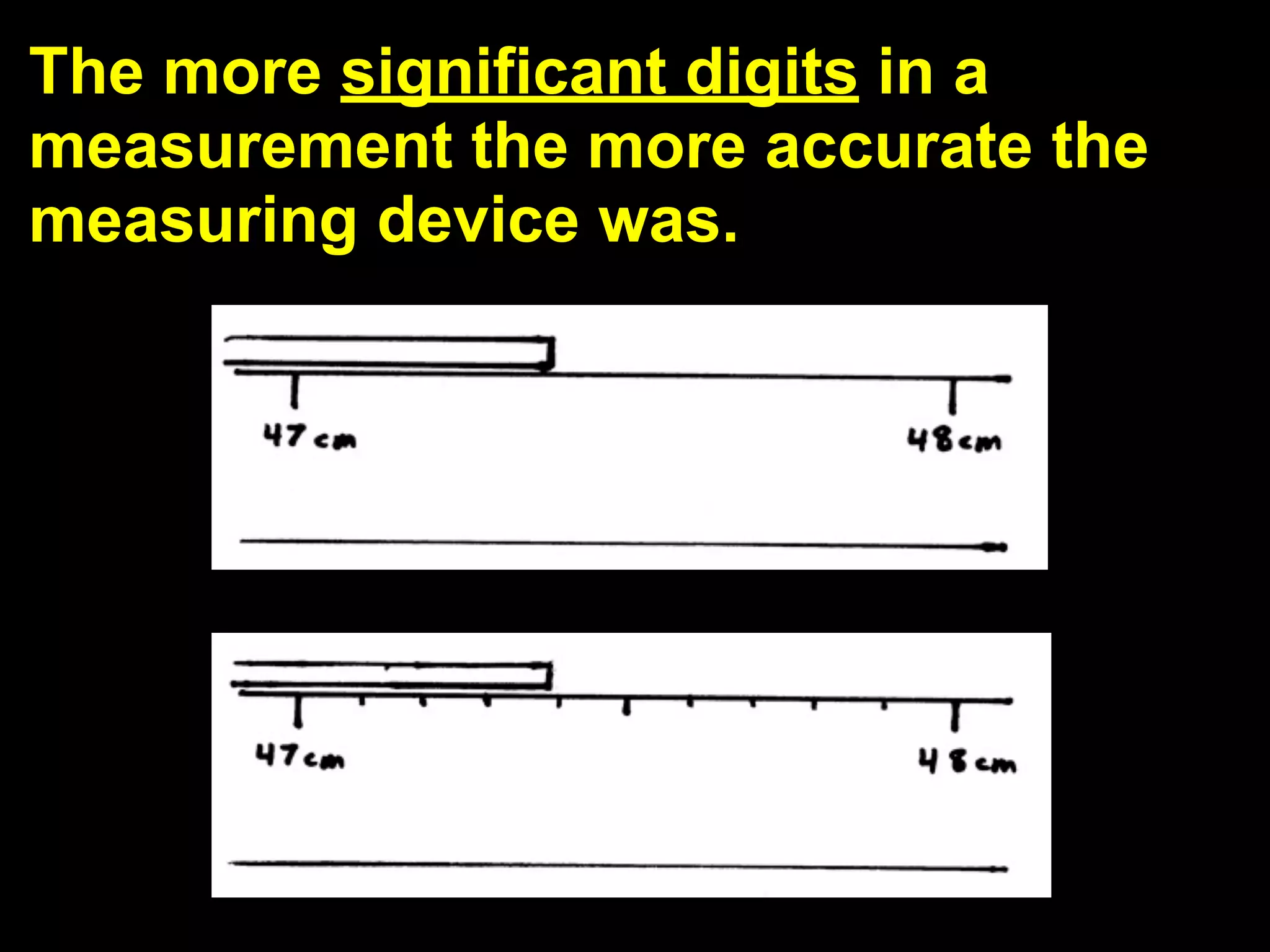
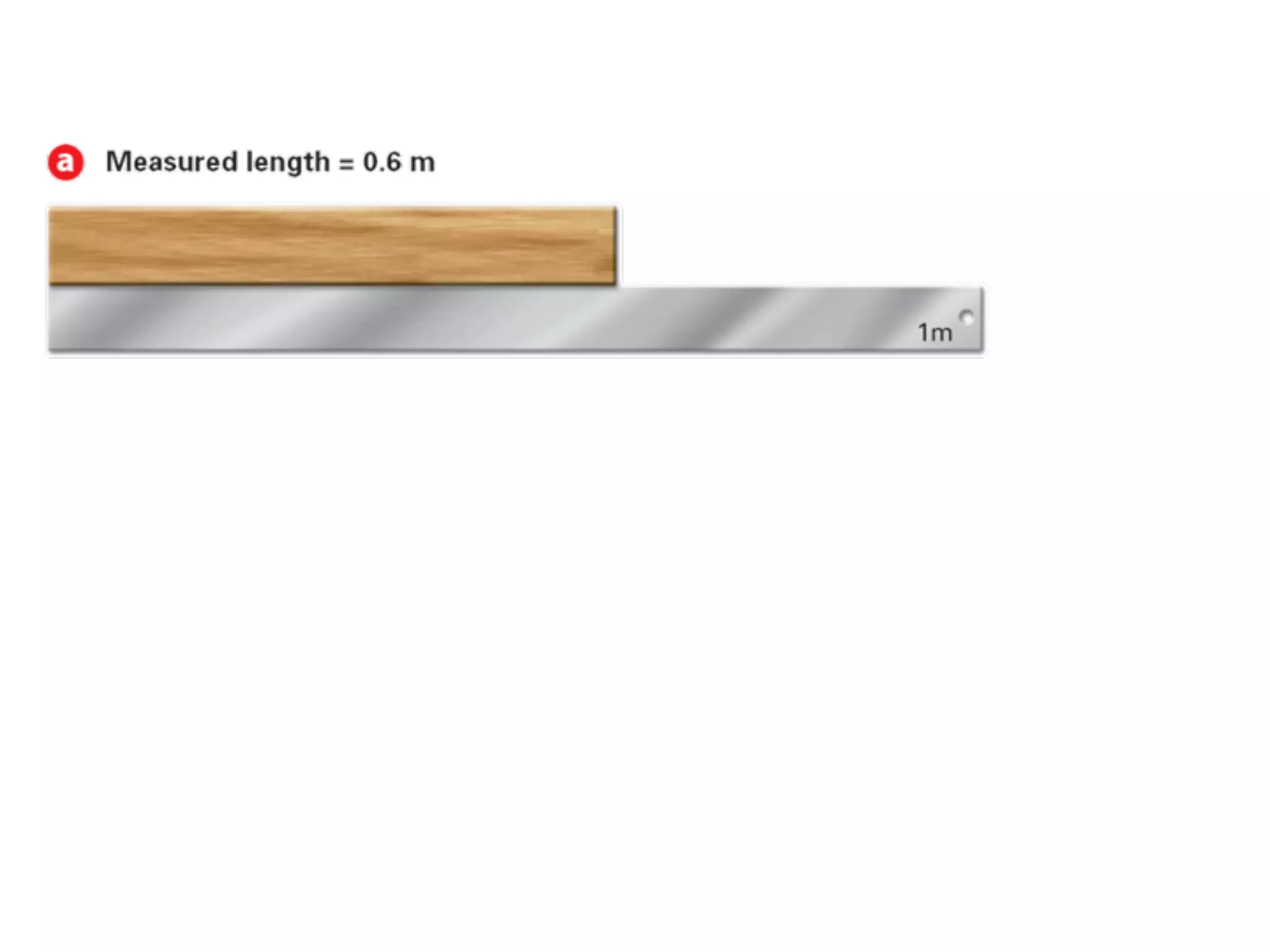
The more significant digits in a
measurement the more accurate the
measuring device was.
The more significant digits in a
measurement the more accurate the
measuring device was.
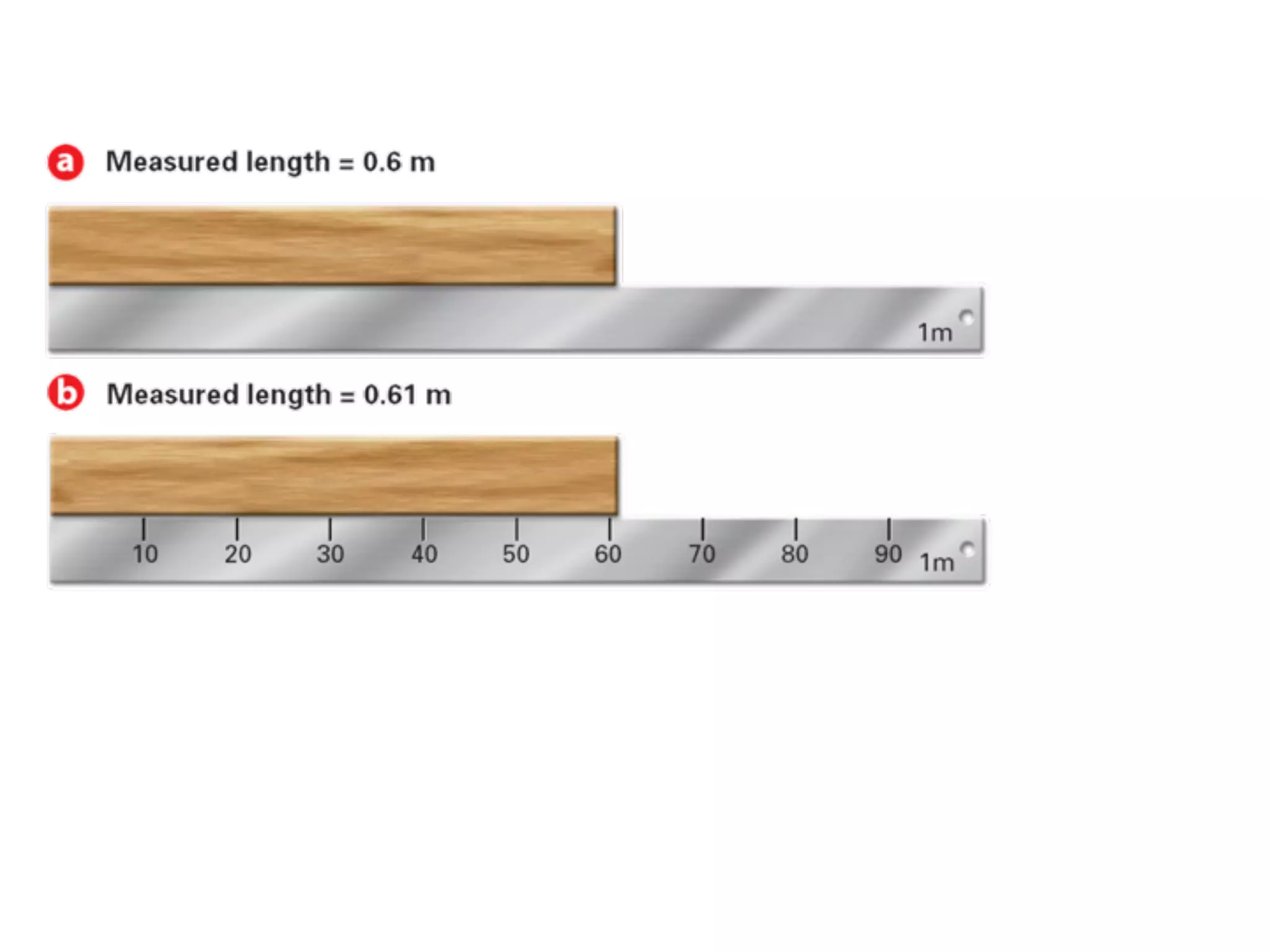
The more significant digits in a
measurement the more accurate the
measuring device was.
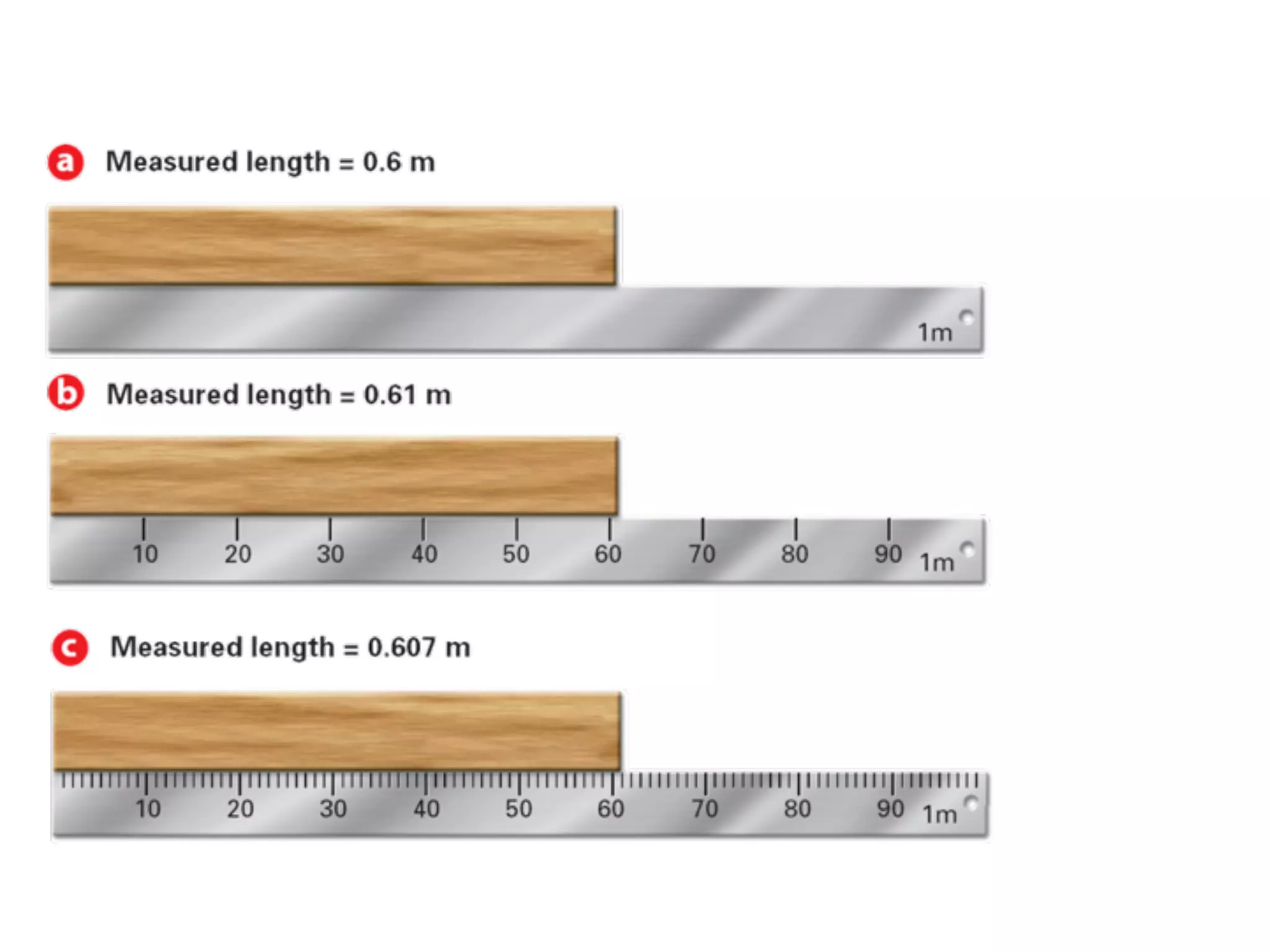
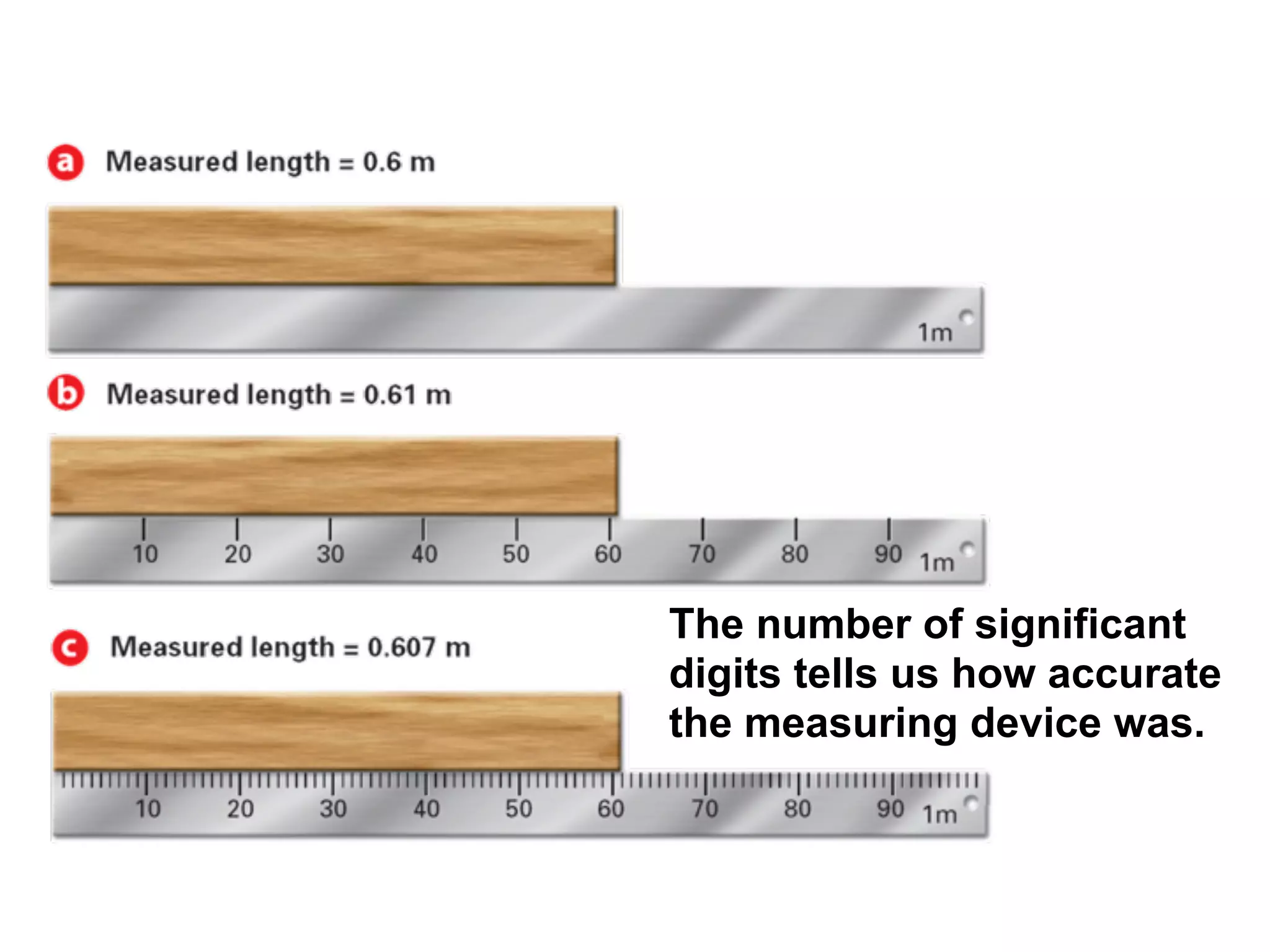
The number of significant
digits tells us how accurate
the measuring device was.
Reporting calculations with the
correct number of significant digits
Reporting calculations with the
correct number of significant digits


  Our calculations are only as
  precise as our least precise
  measurement.
Our calculations are only as precise as
our least precise measurement
Our calculations are only as precise as
our least precise measurement

      If 30 beans have a mass of
  17.3g what is the average mass?
Our calculations are only as precise as
our least precise measurement

      If 30 beans have a mass of
  17.3g what is the average mass?

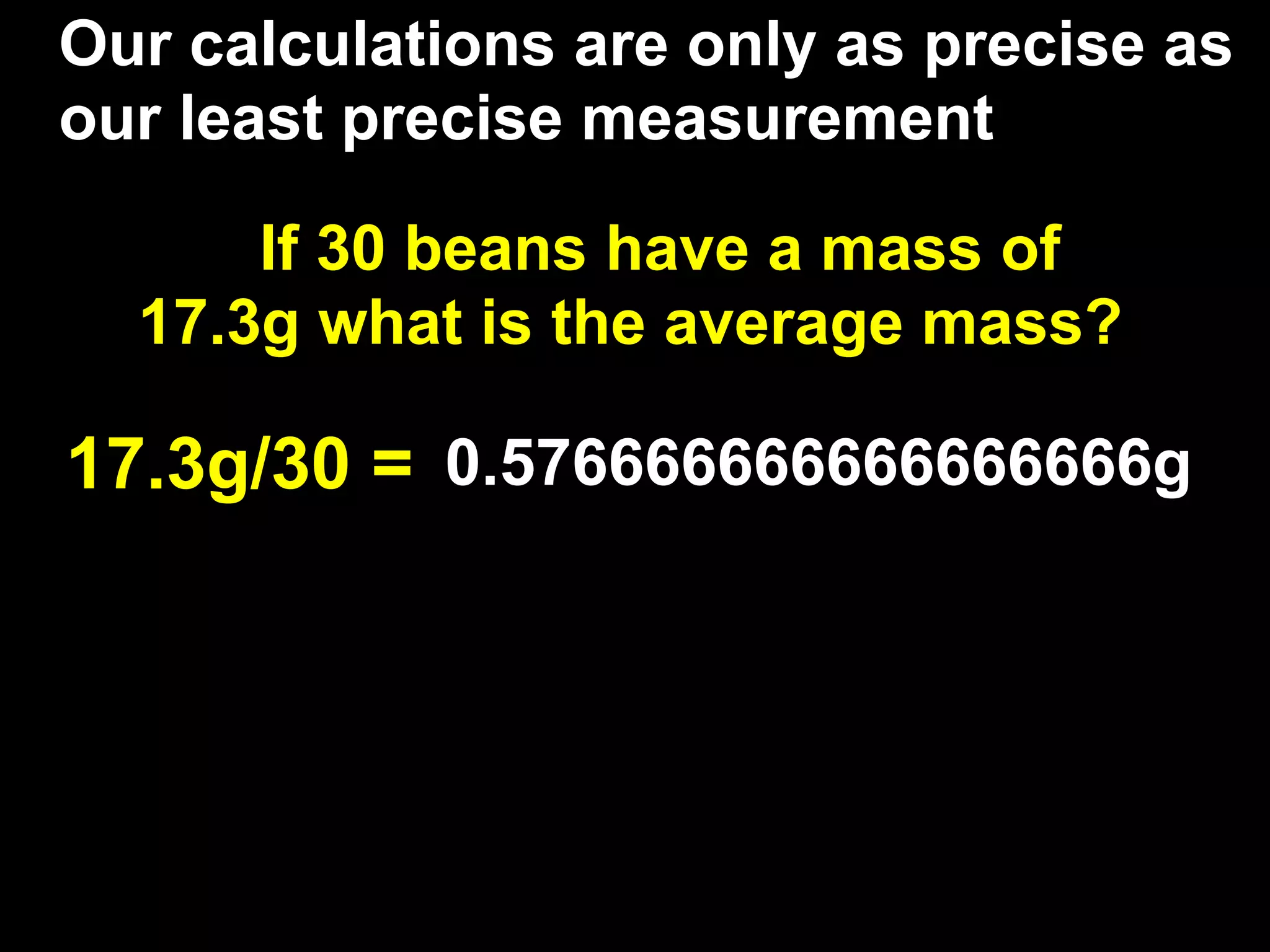
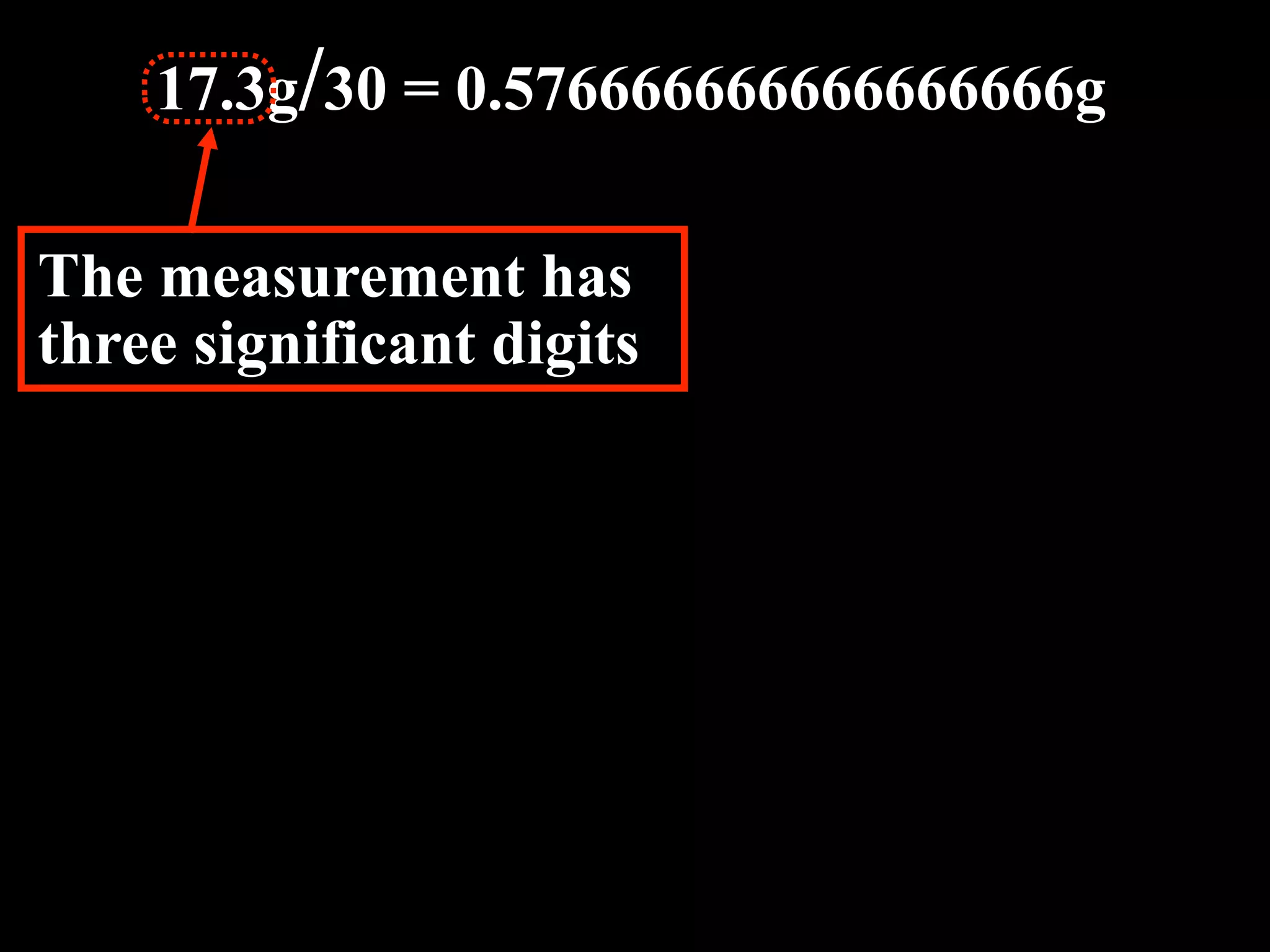
17.3g/30 =
Our calculations are only as precise as
our least precise measurement

      If 30 beans have a mass of
  17.3g what is the average mass?

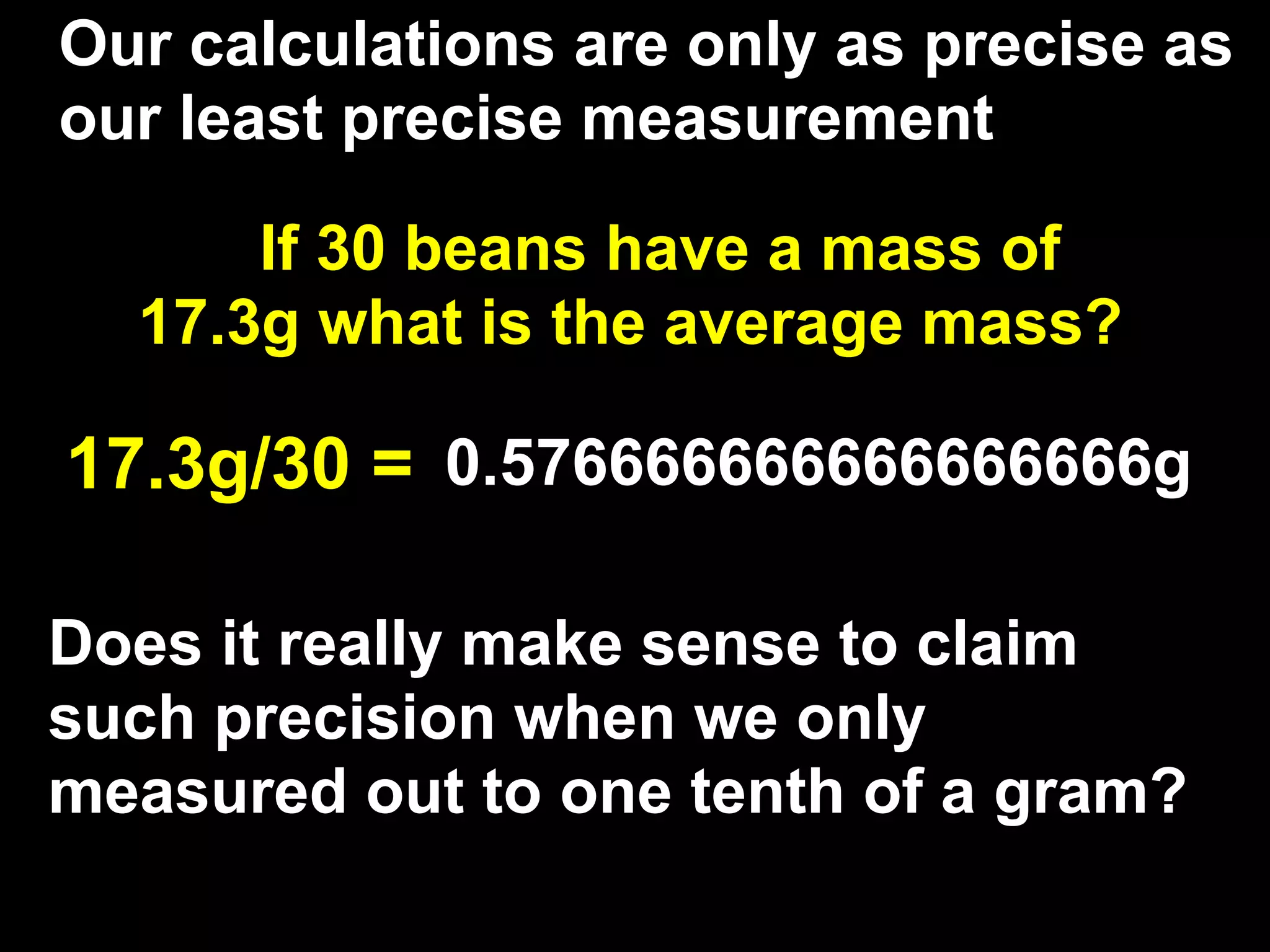
17.3g/30 = 0.576666666666666666g
Our calculations are only as precise as
our least precise measurement

      If 30 beans have a mass of
  17.3g what is the average mass?

17.3g/30 = 0.576666666666666666g

Does it really make sense to claim
such precision when we only
measured out to one tenth of a gram?
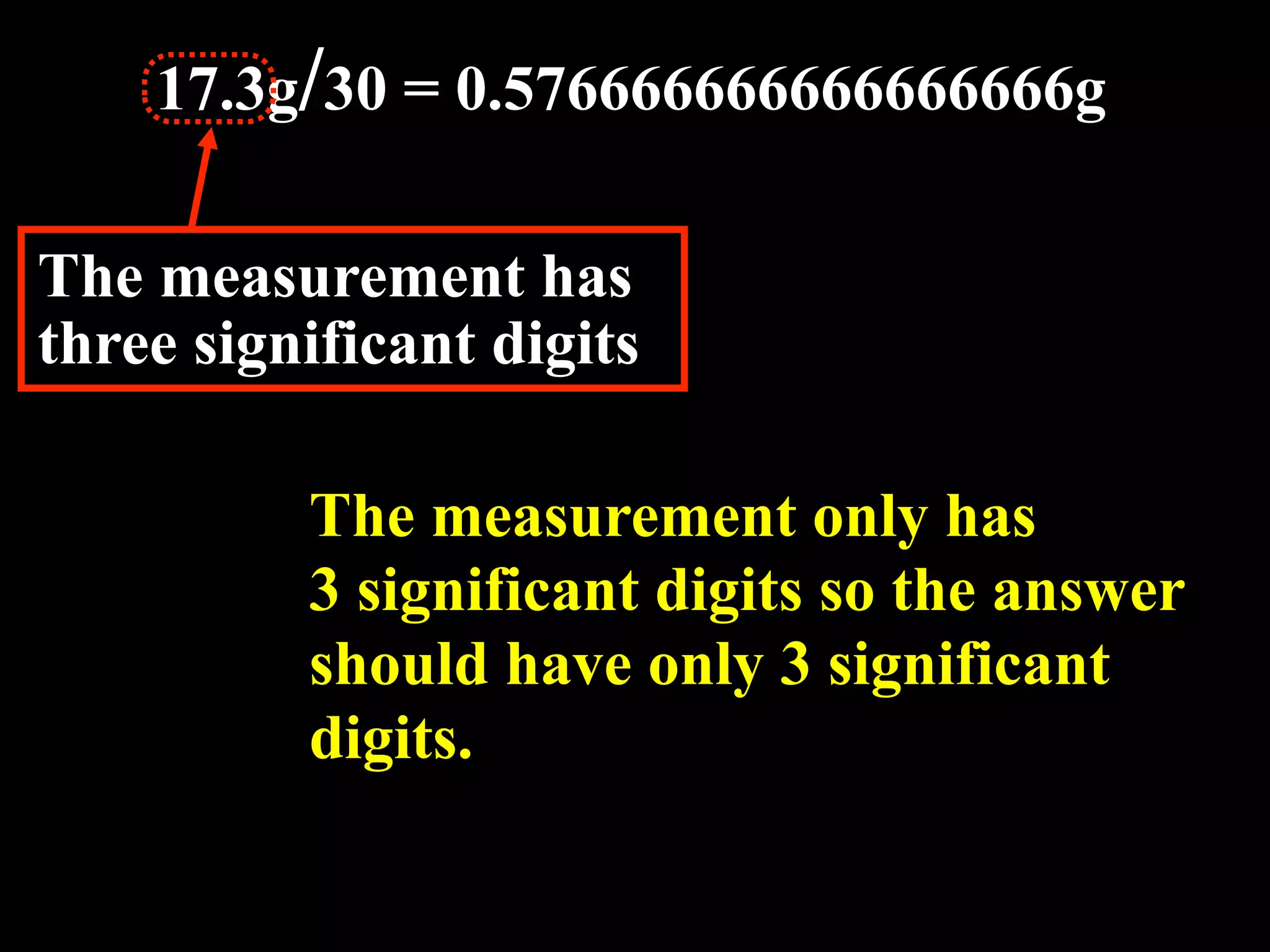
17.3g/30 = 0.576666666666666666g

The measurement has
three significant digits
17.3g/30 = 0.576666666666666666g

The measurement has
three significant digits

          The measurement only has
          3 significant digits so the answer
          should have only 3 significant
          digits.
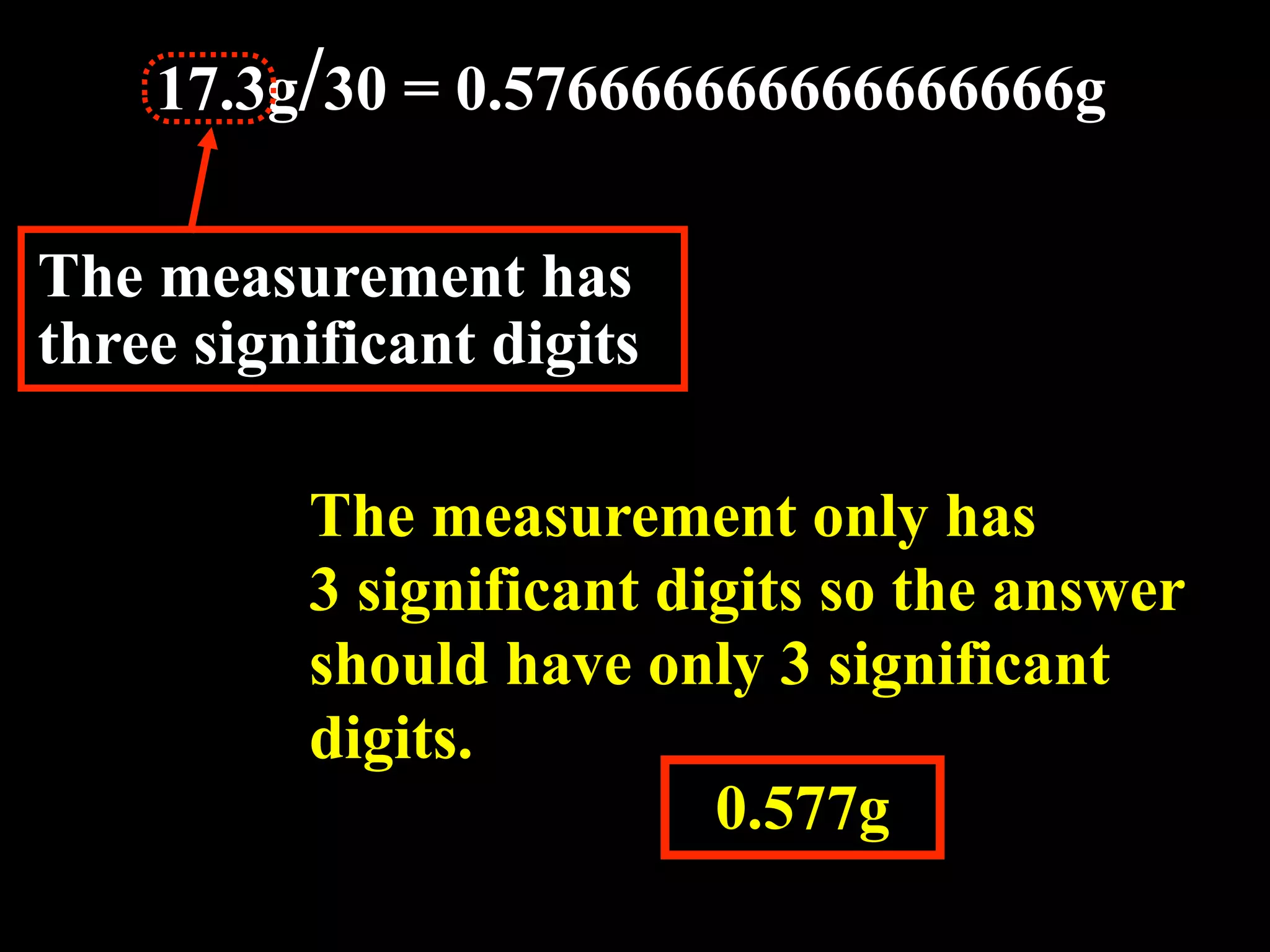
17.3g/30 = 0.576666666666666666g

The measurement has
three significant digits

          The measurement only has
          3 significant digits so the answer
          should have only 3 significant
          digits.
                          0.577g
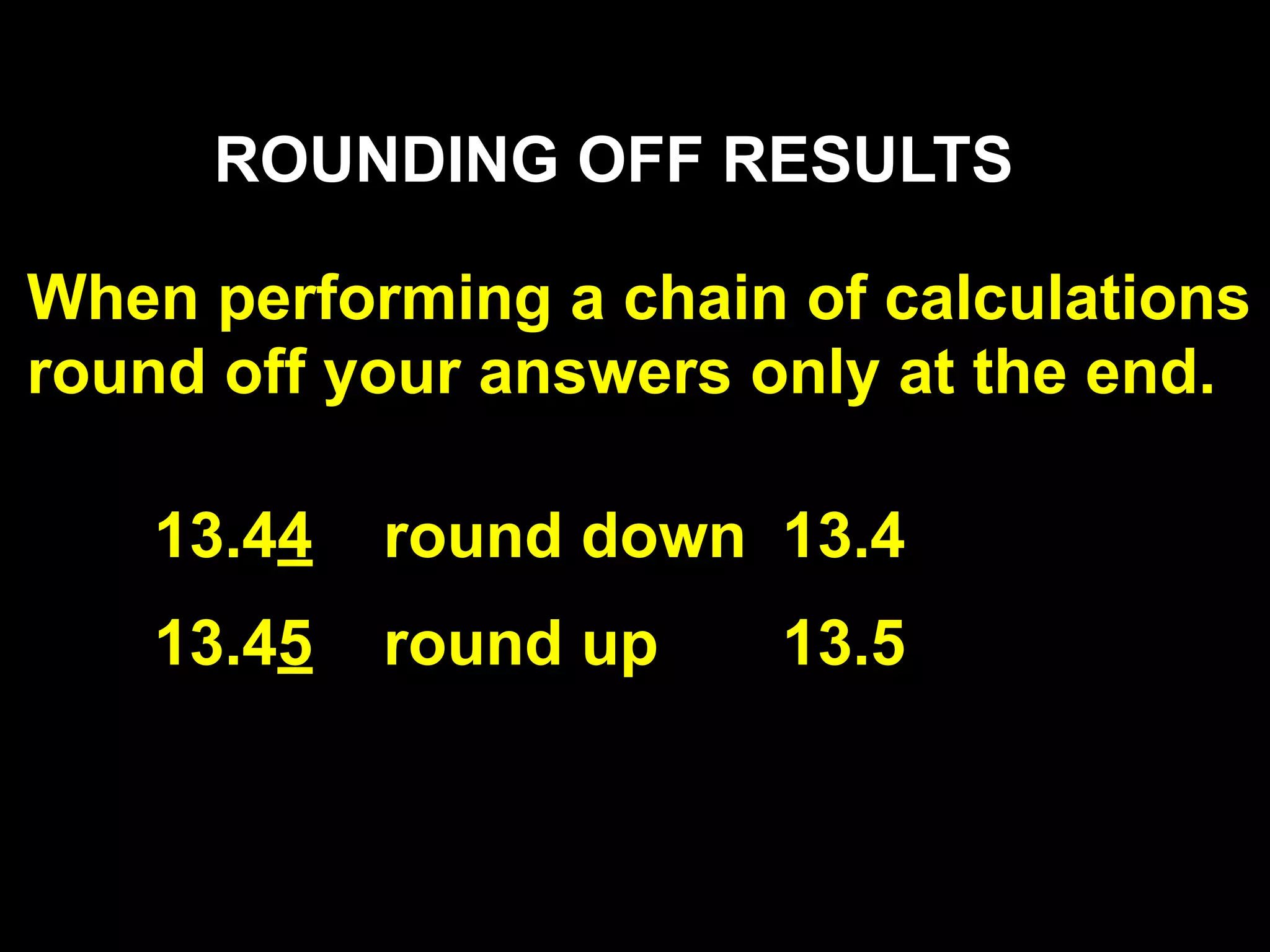
ROUNDING OFF RESULTS

When performing a chain of calculations
round off your answers only at the end.
    13.44   round down 13.4
    13.45   round up    13.5
3.1        Using and Expressing
           Measurements


 A measurement is a quantity that
  has both a number and a unit.
Measuring with SI Units
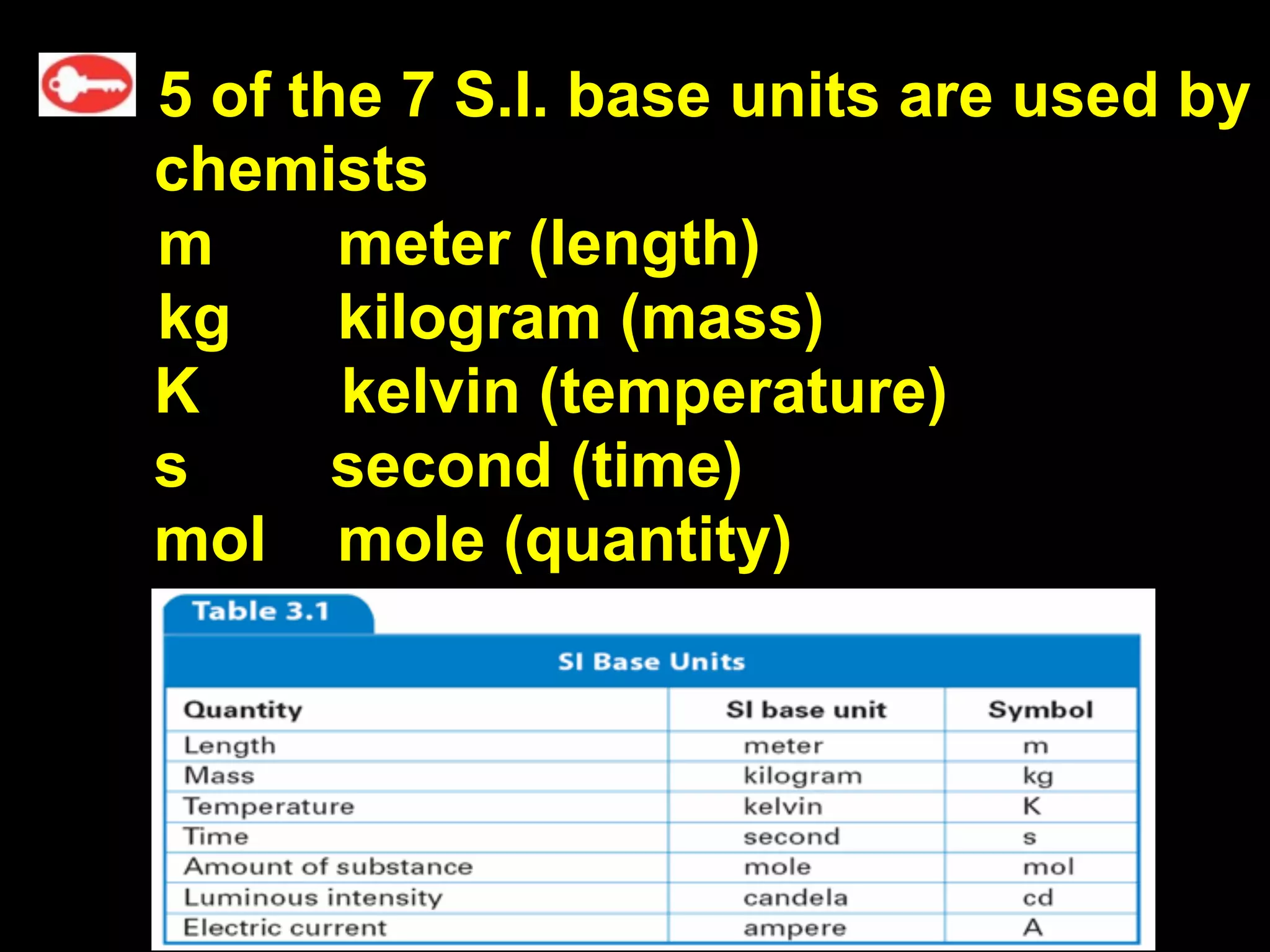
5 of the 7 S.I. base units are used by
chemists
m      meter (length)
kg     kilogram (mass)
K      kelvin (temperature)
s      second (time)
mol mole (quantity)
3.2         Units and Quantities
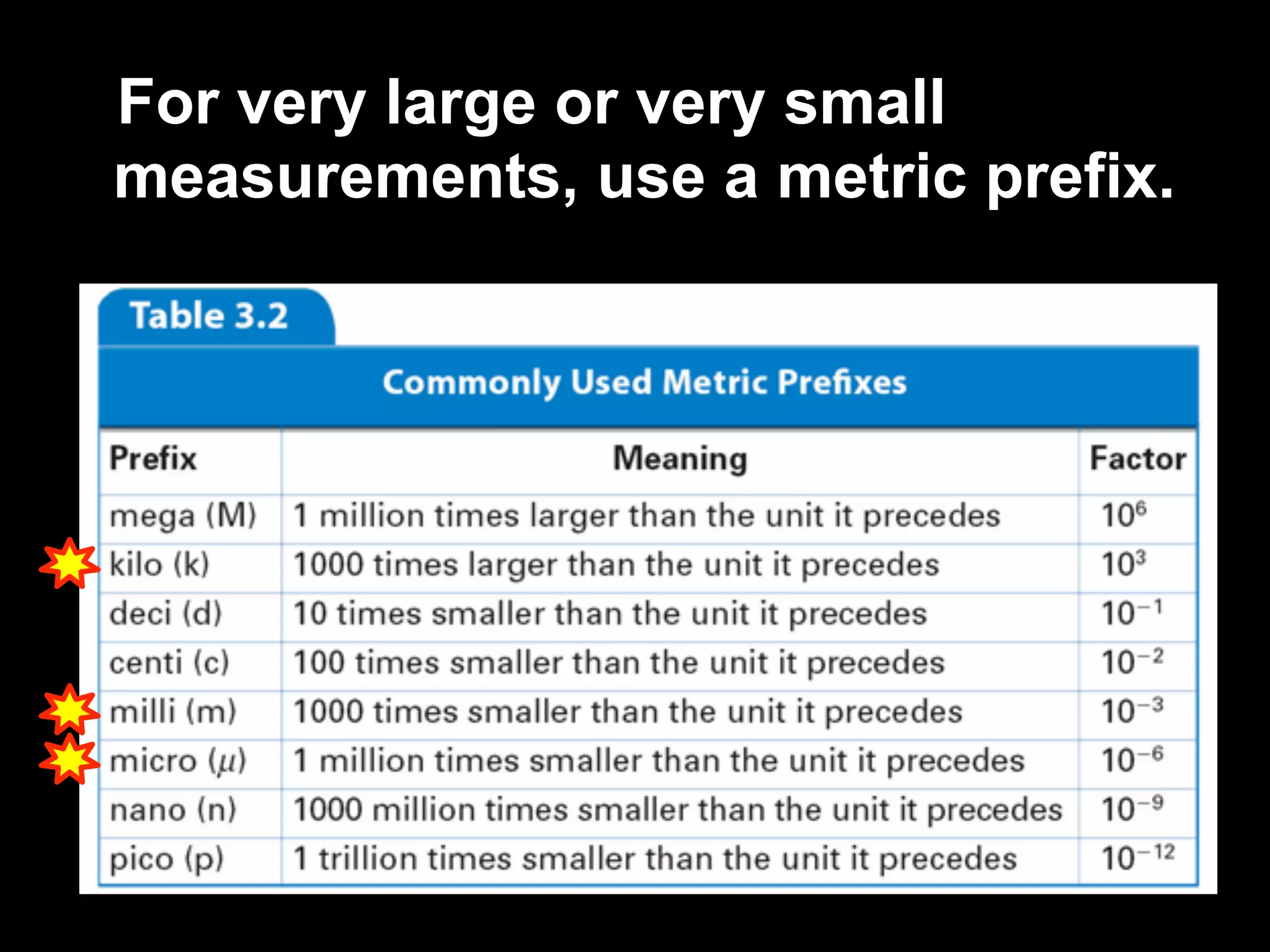
For very large or very small
measurements, use a metric prefix.
3.2   Units and Quantities
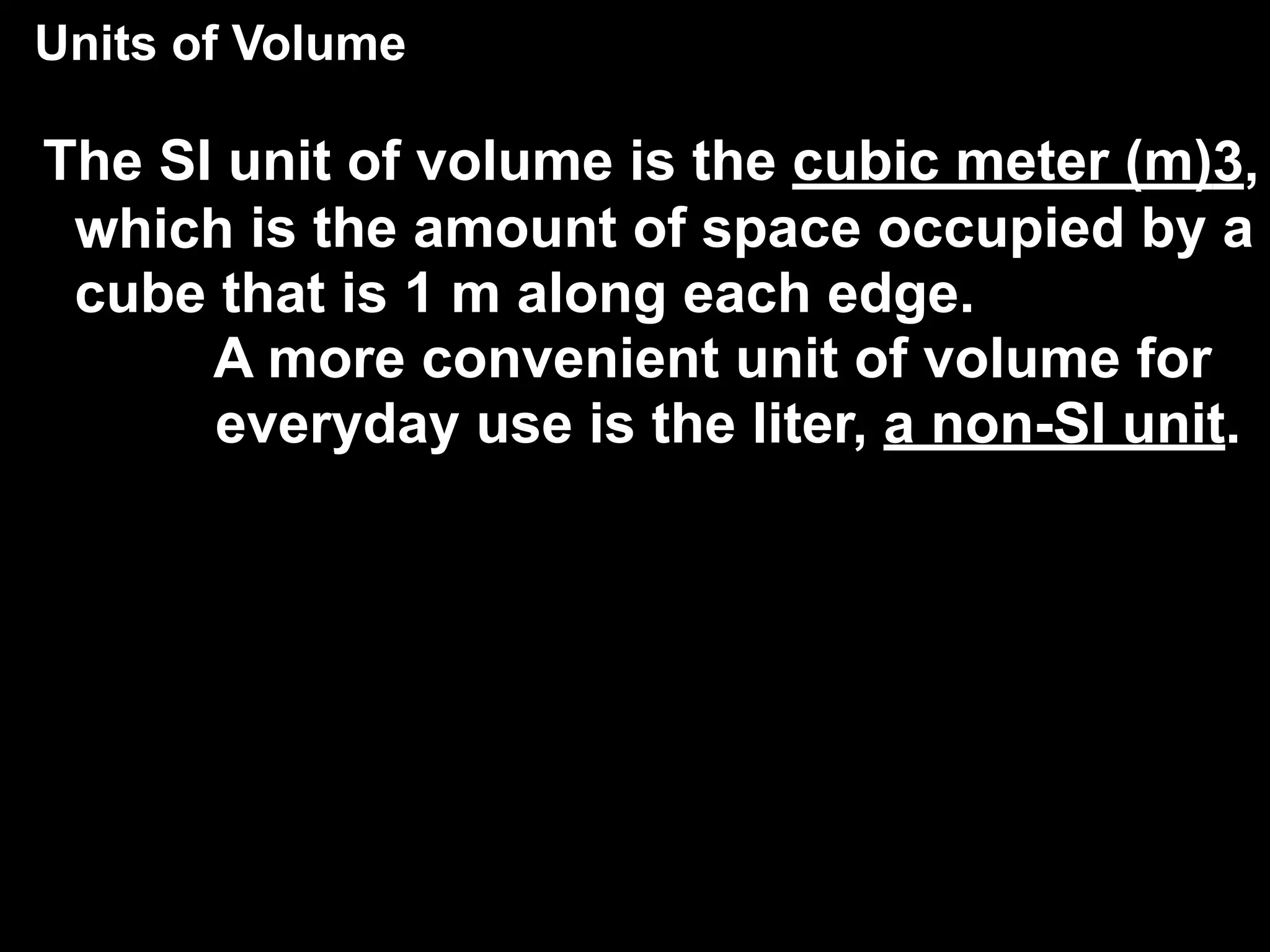
Units of Volume
    3.2           Units and Quantities

The SI unit of volume is the cubic meter (m)3,
 which is the amount of space occupied by a
 cube that is 1 m along each edge.
      A more convenient unit of volume for
      everyday use is the liter, a non-SI unit.
Units of Volume
    3.2           Units and Quantities

The SI unit of volume is the cubic meter (m)3,
 which is the amount of space occupied by a
 cube that is 1 m along each edge.
      A more convenient unit of volume for
      everyday use is the liter, a non-SI unit.

A liter (L) is the volume of a cube
 that is 10 centimeters (10 cm)
 along each edge.

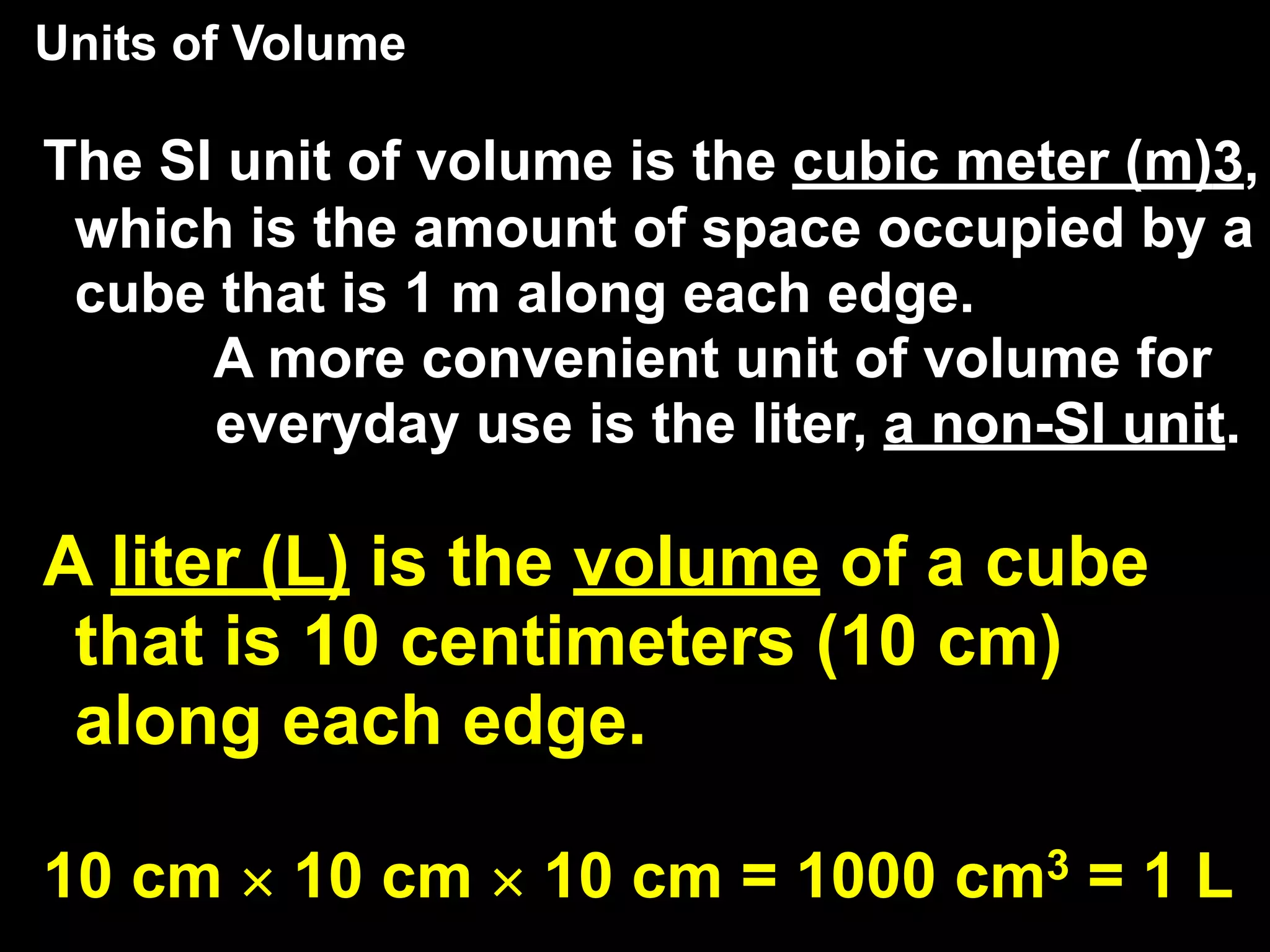
10 cm × 10 cm × 10 cm = 1000 cm3 = 1 L
3.2          Units and Quantities


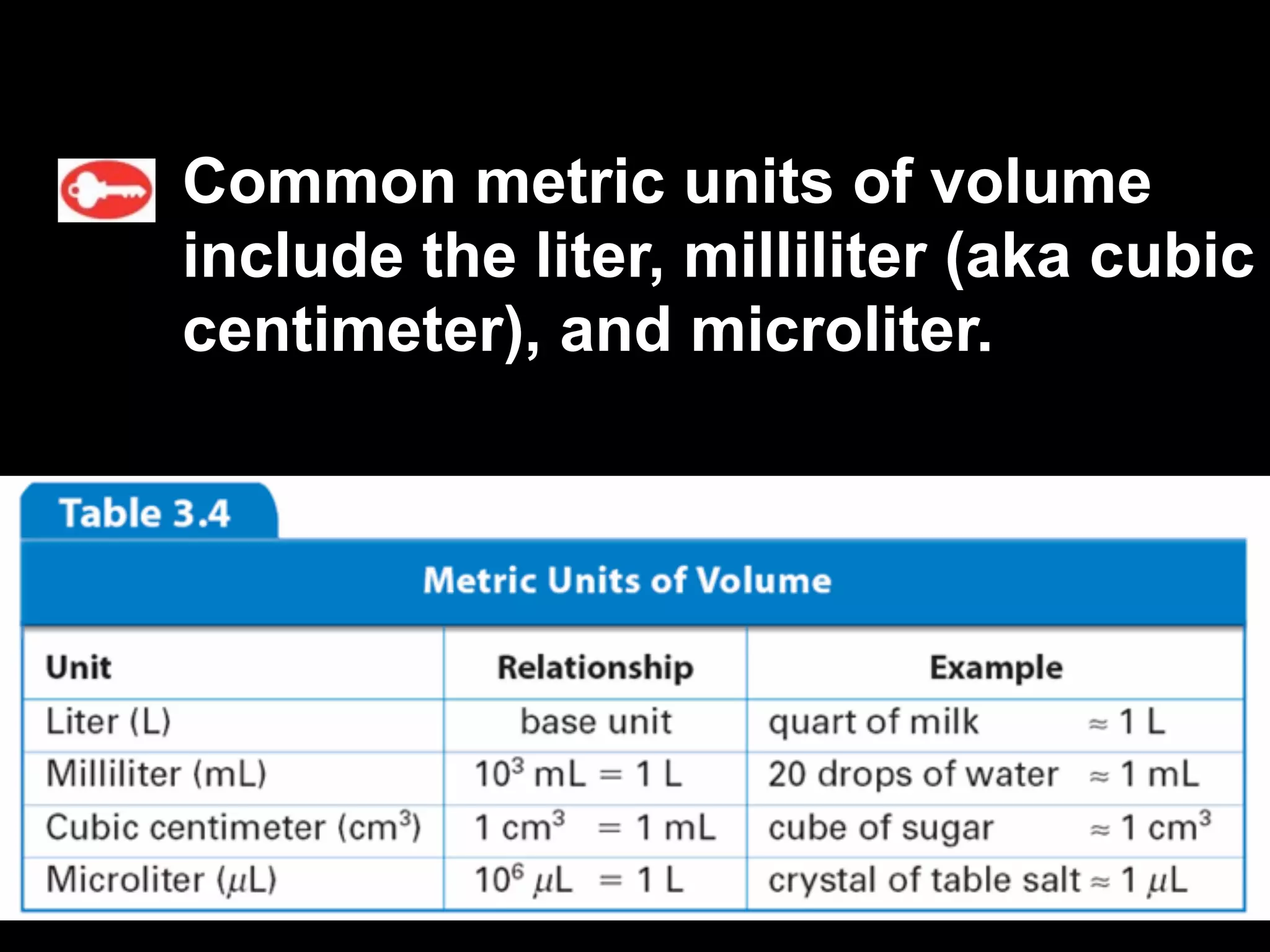
  Common metric units of volume
  include the liter, milliliter (aka cubic
  centimeter), and microliter.
3.2         Units and Quantities


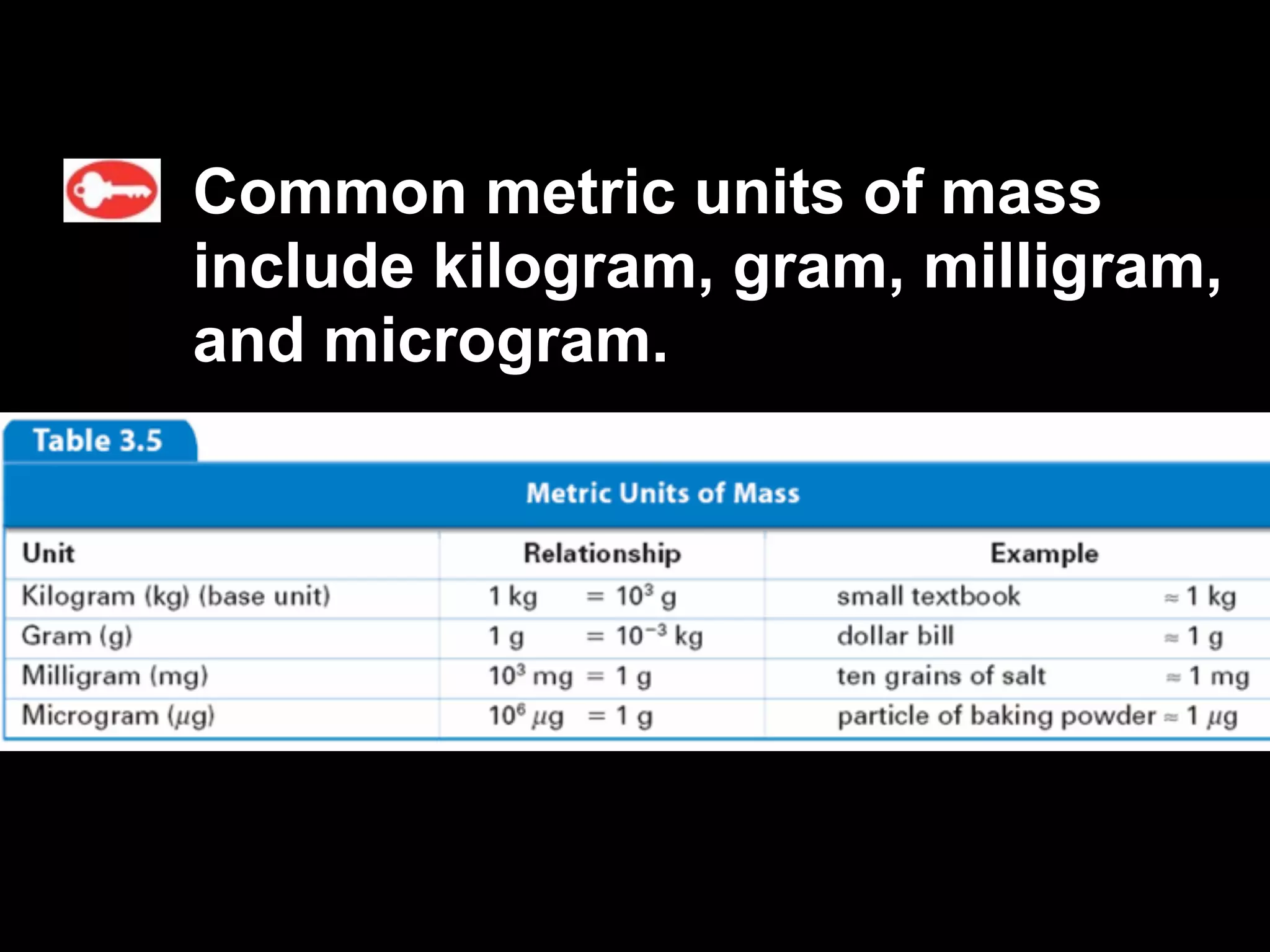
  Common metric units of mass
  include kilogram, gram, milligram,
  and microgram.
3.2        Units and Quantities


 Scientists commonly use two
  equivalent units of temperature,
  the degree Celsius and the kelvin.
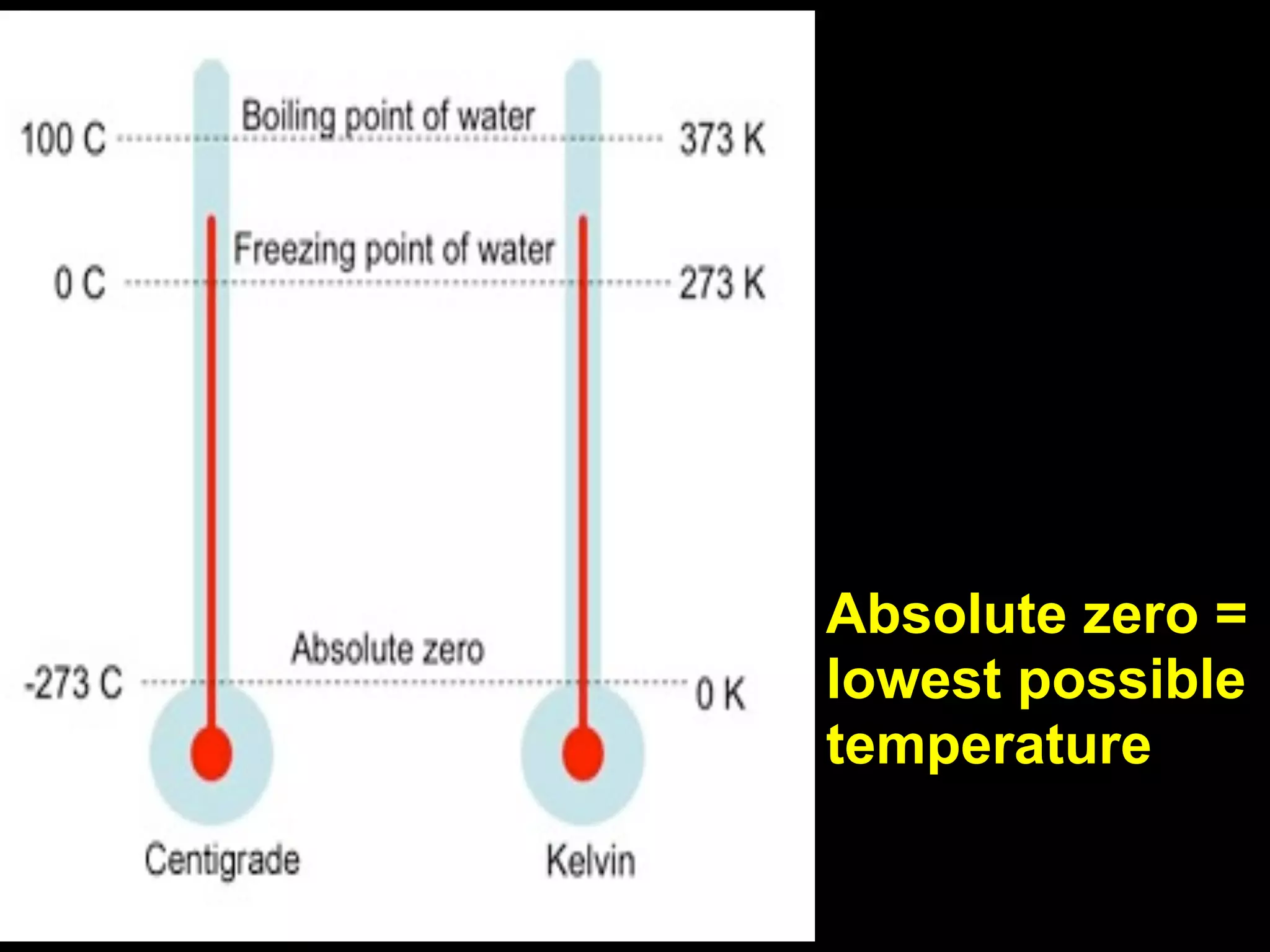
Absolute zero =
lowest possible
temperature
3.2     Units and Quantities


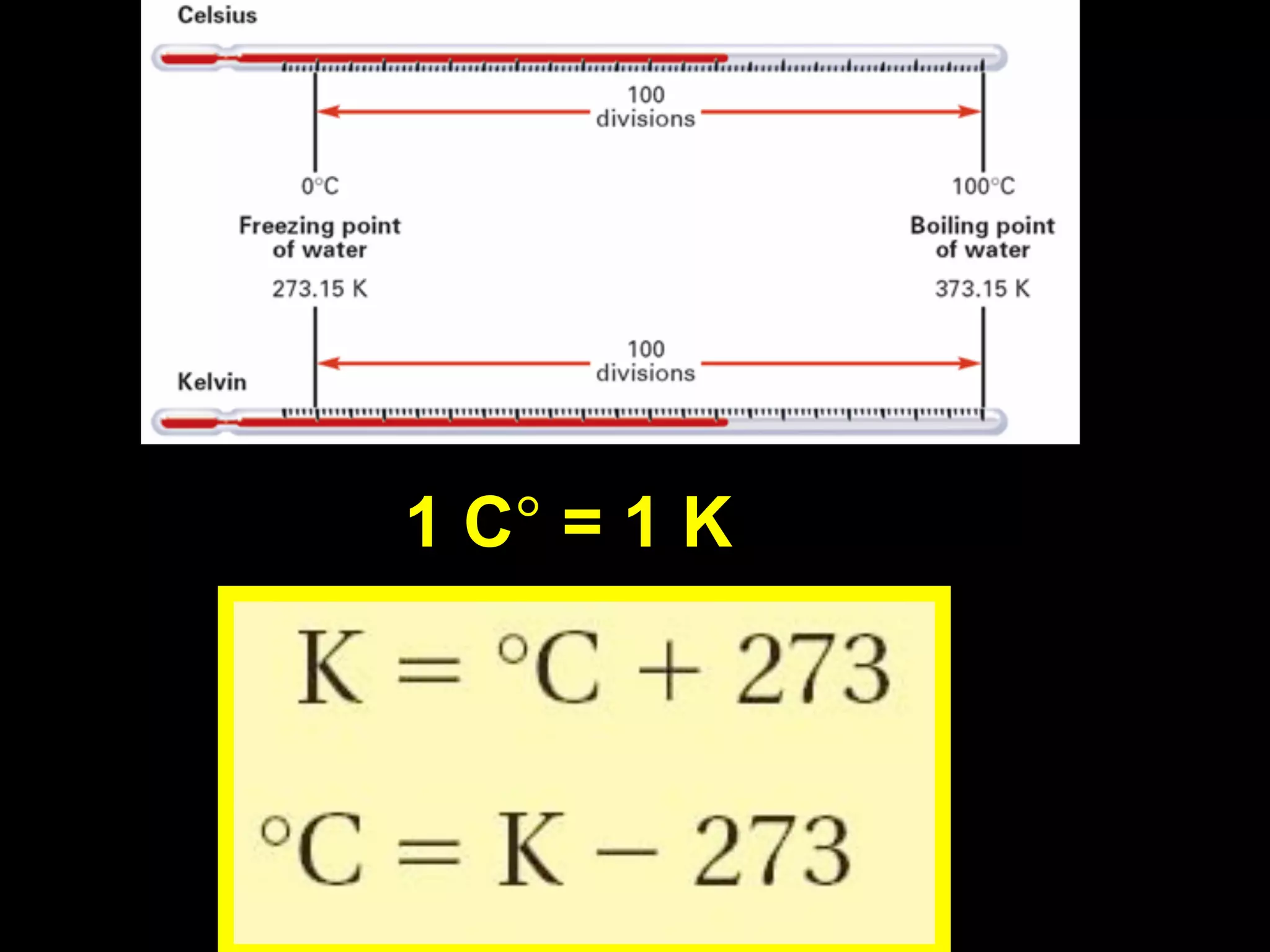
      1 C° = 1 K
3.2   Units and Quantities
3.2       Units and Quantities


 Energy is the capacity to do
  work or to produce heat.
3.2         Units and Quantities
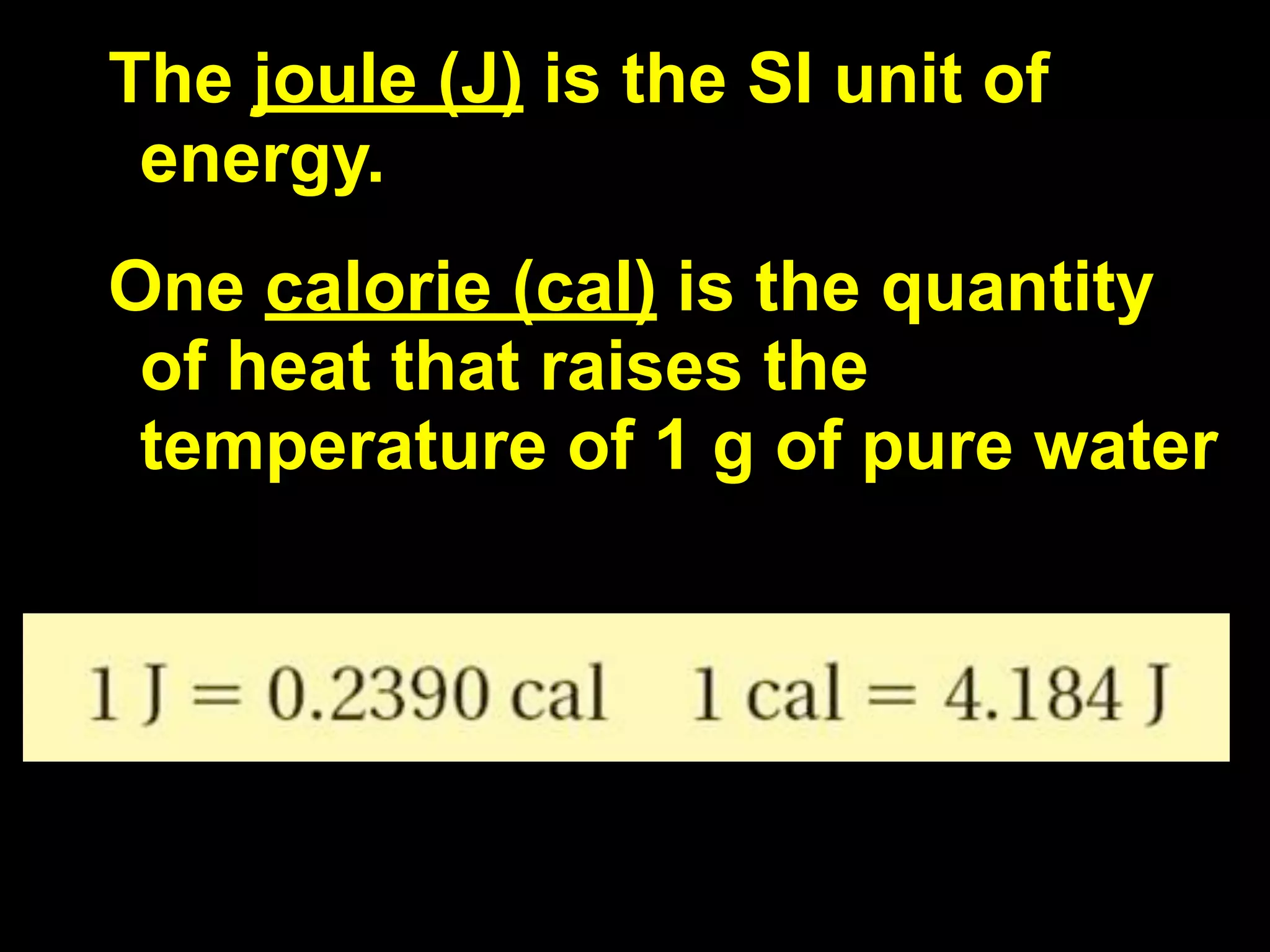
The joule (J) is the SI unit of
 energy.
One calorie (cal) is the quantity
 of heat that raises the
 temperature of 1 g of pure water

Lecture 3.1- Measurements (P)

  • 1.
    Lecture 3.1 and3.2- Measurements
  • 2.
    SCIENTIFIC NOTATION is usedto represent very large or very small numbers
  • 3.
  • 4.
    SCIENTIFIC NOTATION 6.02 x 10²³ must be between 1-10
  • 5.
    SCIENTIFIC NOTATION 6.02 x 10²³ must be The power of ten between determines the size of 1-10 the number
  • 6.
    SCIENTIFIC NOTATION 6.02 x 10²³ must be The power of ten between determines the size of 1-10 the number Positive power = big number(greater than 10) Negative power = small number(less than one)
  • 7.
    SCIENTIFIC NOTATION 6.02 x 10²³ must be The power of ten between determines the size of 1-10 the number Positive power = big number(greater than 10) Negative power = small number(less than one) EX. 0.00567g = 5.67 x 10⁻³g a small number 437,850g = 4.3785 x 10⁵g a large number
  • 8.
    To convert fromstandard notation to scientific notation move the decimal point to make a number between 1 and 10 then count how many spaces you moved it. positive because it is a big number negative because it is a small number
  • 9.
    Accuracy and Precision • Accuracy measures how close a measurement comes to the actual value. • Precision measures how close a series of measurements are to each other.
  • 10.
  • 11.
    Just because ameasuring device works, you cannot assume it is accurate. The scale has not been properly zeroed, so the reading obtained for the person’s weight is inaccurate.
  • 12.
    Significant digits When measuringwe record all certain digits plus one uncertain digit
  • 13.
    Significant digits When measuringwe record all certain digits plus one uncertain digit, so there is always some degree of uncertainty in measurement.
  • 14.
    Significant digits When measuringwe record all certain digits plus one uncertain digit, so there is always some degree of uncertainty in measurement. In science we account for this by using significant digits or significant figures
  • 15.
    The more significantdigits in a measurement the more accurate the measuring device was.
  • 16.
    The more significantdigits in a measurement the more accurate the measuring device was.
  • 17.
    The more significantdigits in a measurement the more accurate the measuring device was.
  • 21.
    The number ofsignificant digits tells us how accurate the measuring device was.
  • 22.
    Reporting calculations withthe correct number of significant digits
  • 23.
    Reporting calculations withthe correct number of significant digits Our calculations are only as precise as our least precise measurement.
  • 24.
    Our calculations areonly as precise as our least precise measurement
  • 25.
    Our calculations areonly as precise as our least precise measurement If 30 beans have a mass of 17.3g what is the average mass?
  • 26.
    Our calculations areonly as precise as our least precise measurement If 30 beans have a mass of 17.3g what is the average mass? 17.3g/30 =
  • 27.
    Our calculations areonly as precise as our least precise measurement If 30 beans have a mass of 17.3g what is the average mass? 17.3g/30 = 0.576666666666666666g
  • 28.
    Our calculations areonly as precise as our least precise measurement If 30 beans have a mass of 17.3g what is the average mass? 17.3g/30 = 0.576666666666666666g Does it really make sense to claim such precision when we only measured out to one tenth of a gram?
  • 29.
    17.3g/30 = 0.576666666666666666g Themeasurement has three significant digits
  • 30.
    17.3g/30 = 0.576666666666666666g Themeasurement has three significant digits The measurement only has 3 significant digits so the answer should have only 3 significant digits.
  • 31.
    17.3g/30 = 0.576666666666666666g Themeasurement has three significant digits The measurement only has 3 significant digits so the answer should have only 3 significant digits. 0.577g
  • 32.
    ROUNDING OFF RESULTS Whenperforming a chain of calculations round off your answers only at the end. 13.44 round down 13.4 13.45 round up 13.5
  • 33.
    3.1 Using and Expressing Measurements A measurement is a quantity that has both a number and a unit.
  • 34.
    Measuring with SIUnits 5 of the 7 S.I. base units are used by chemists m meter (length) kg kilogram (mass) K kelvin (temperature) s second (time) mol mole (quantity)
  • 35.
    3.2 Units and Quantities For very large or very small measurements, use a metric prefix.
  • 36.
    3.2 Units and Quantities
  • 37.
    Units of Volume 3.2 Units and Quantities The SI unit of volume is the cubic meter (m)3, which is the amount of space occupied by a cube that is 1 m along each edge. A more convenient unit of volume for everyday use is the liter, a non-SI unit.
  • 38.
    Units of Volume 3.2 Units and Quantities The SI unit of volume is the cubic meter (m)3, which is the amount of space occupied by a cube that is 1 m along each edge. A more convenient unit of volume for everyday use is the liter, a non-SI unit. A liter (L) is the volume of a cube that is 10 centimeters (10 cm) along each edge. 10 cm × 10 cm × 10 cm = 1000 cm3 = 1 L
  • 39.
    3.2 Units and Quantities Common metric units of volume include the liter, milliliter (aka cubic centimeter), and microliter.
  • 40.
    3.2 Units and Quantities Common metric units of mass include kilogram, gram, milligram, and microgram.
  • 41.
    3.2 Units and Quantities Scientists commonly use two equivalent units of temperature, the degree Celsius and the kelvin.
  • 42.
    Absolute zero = lowestpossible temperature
  • 43.
    3.2 Units and Quantities 1 C° = 1 K
  • 46.
    3.2 Units and Quantities
  • 47.
    3.2 Units and Quantities Energy is the capacity to do work or to produce heat.
  • 48.
    3.2 Units and Quantities The joule (J) is the SI unit of energy. One calorie (cal) is the quantity of heat that raises the temperature of 1 g of pure water

Editor's Notes

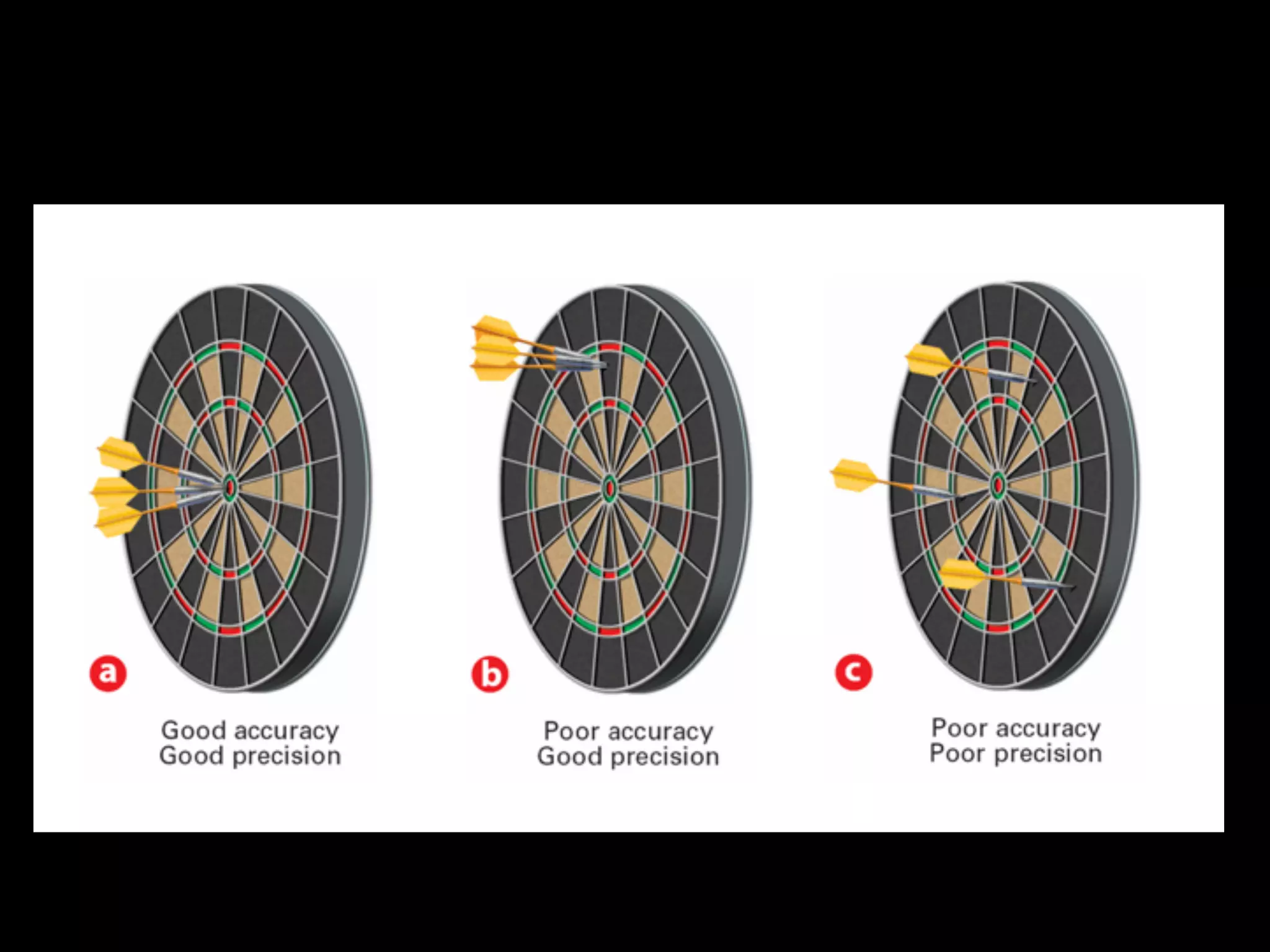
  • #11 The distribution of darts illustrates the difference between accuracy and precision. a) Good accuracy and good precision: The darts are close to the bull’s-eye and to one another. b) Poor accuracy and good precision: The darts are far from the bull’s-eye but close to one another. c) Poor accuracy and poor precision: The darts are far from the bull’s-eye and from one another.
  • #12 The scale below has not been properly zeroed, so the reading obtained for the person’s weight is inaccurate. There is a difference between the person’s correct weight and the measured value. Calculating What is the percent error of a measured value of 114 lb if the person’s actual weight is 107 lb?
  • #17 Three differently calibrated meter sticks are used to measure the length of a board. a) A meter stick calibrated in a 1-m interval. b) A meter stick calibrated in 0.1-m intervals. c) A meter stick calibrated in 0.01-m intervals. Measuring How many significant figures are reported in each measurement?