Measurement
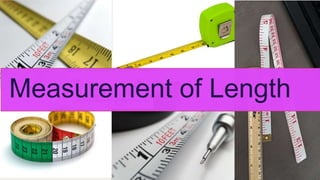
Measurement of Length
Metric Measure of Length
Measurement of something from its one end to the other
is called its length. The standard unit of length is meter.
We use different units to measure different lengths.
Millimeter, centimeter , decimeter are smaller unit used to
measure smaller distance, meter is used to measure
average distance, whereas units like decameter,
hectometer and kilometer are used to measure longer
distance. All these units are related to each other.
Changing Metric Units of Length
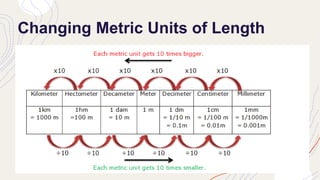
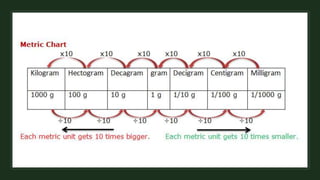
When we move from one metric unit to another to the right in the above
metric chart, the value of metric unit becomes ten times smaller i.e. one
tenth and when we move from one metric unit to another to the left in the
metric chart, the value of metric unit becomes ten times bigger.
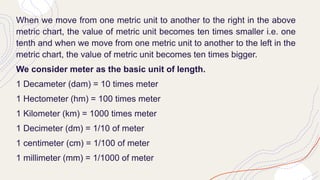
We consider meter as the basic unit of length.
1 Decameter (dam) = 10 times meter
1 Hectometer (hm) = 100 times meter
1 Kilometer (km) = 1000 times meter
1 Decimeter (dm) = 1/10 of meter
1 centimeter (cm) = 1/100 of meter
1 millimeter (mm) = 1/1000 of meter
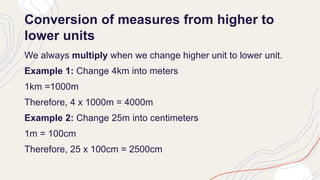
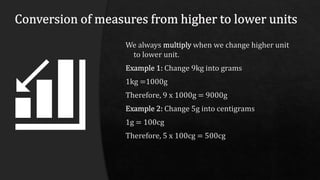
Conversion of measures from higher to
lower units
We always multiply when we change higher unit to lower unit.
Example 1: Change 4km into meters
1km =1000m
Therefore, 4 x 1000m = 4000m
Example 2: Change 25m into centimeters
1m = 100cm
Therefore, 25 x 100cm = 2500cm
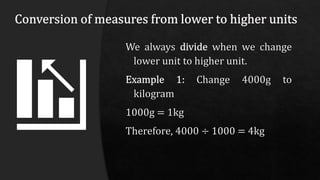
Conversion of measures from lower to
higher units
We always divide when we change lower unit to higher
unit.
Example: Change 6000m to kilometer
1000m = 1km
Therefore,6000÷1000=6km
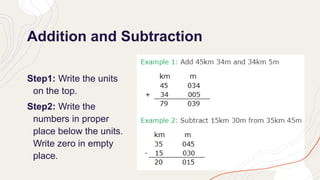
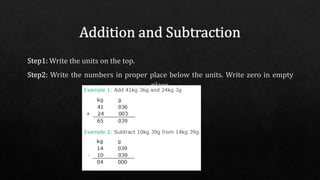
Addition and Subtraction
Step1: Write the units
on the top.
Step2: Write the
numbers in proper
place below the units.
Write zero in empty
place.
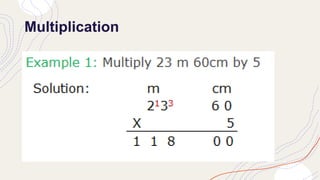
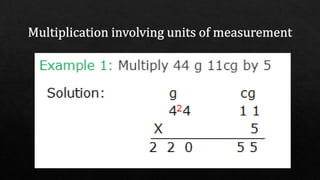
Multiplication
Division
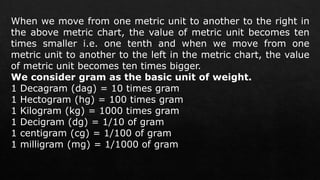
When we move from one metric unit to another to the right in
the above metric chart, the value of metric unit becomes ten
times smaller i.e. one tenth and when we move from one
metric unit to another to the left in the metric chart, the value
of metric unit becomes ten times bigger.
We consider gram as the basic unit of weight.
1 Decagram (dag) = 10 times gram
1 Hectogram (hg) = 100 times gram
1 Kilogram (kg) = 1000 times gram
1 Decigram (dg) = 1/10 of gram
1 centigram (cg) = 1/100 of gram
1 milligram (mg) = 1/1000 of gram
Measurement of
Capacity
Measurement of capacity
The maximum amount that something can hold is called
capacity. The standard unit of capacity is liter. We use
different units to measure different capacity. Milliliter,
centiliter , deciliter are smaller unit used to measure
smaller capacity, liter is commonly used to measure
capacity, whereas units like decaliter, hectoliter and
kiloliter are used to measure larger capacity. All these
units are related to each other.
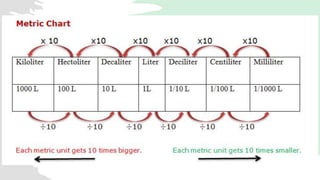
When we move from one metric unit to another to the right in
the above metric chart, the value of metric unit becomes ten
times smaller i.e. one tenth and when we move from one
metric unit to another to the left in the metric chart, the value
of metric unit becomes ten times bigger.
We consider liter as the basic unit of capacity.
1 Decaliter (dal) = 10 times liter
1 Hectoliter (hl) = 100 times liter
1 Kiloliter (kl) = 1000 times liter
1 Deciliter (dl) = 1/10 of liter
1 centiliter (cl) = 1/100 of liter
1 milliliter (ml) = 1/1000 of liter
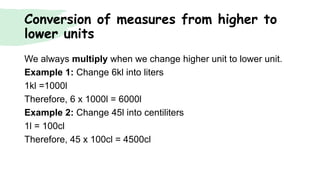
Conversion of measures from higher to
lower units
We always multiply when we change higher unit to lower unit.
Example 1: Change 6kl into liters
1kl =1000l
Therefore, 6 x 1000l = 6000l
Example 2: Change 45l into centiliters
1l = 100cl
Therefore, 45 x 100cl = 4500cl
Conversion of measures from lower to
higher units
We always divide when we change lower unit to higher
unit.
Example 1: Change 8000L to kilo liter
1000L = 1kL
Therefore, 8000 ÷ 1000 = 8L
Addition and Subtraction
Step1: Write the units
on the top.
Step2: Write the
numbers in proper
place below the units.
Write zero in empty
place.
Multiplication involving units of
measurement
Division involving units of measurement
THANK
YOU

Measurement

  • 1.
  • 3.
  • 4.
    Metric Measure ofLength Measurement of something from its one end to the other is called its length. The standard unit of length is meter. We use different units to measure different lengths. Millimeter, centimeter , decimeter are smaller unit used to measure smaller distance, meter is used to measure average distance, whereas units like decameter, hectometer and kilometer are used to measure longer distance. All these units are related to each other.
  • 5.
  • 6.
    When we movefrom one metric unit to another to the right in the above metric chart, the value of metric unit becomes ten times smaller i.e. one tenth and when we move from one metric unit to another to the left in the metric chart, the value of metric unit becomes ten times bigger. We consider meter as the basic unit of length. 1 Decameter (dam) = 10 times meter 1 Hectometer (hm) = 100 times meter 1 Kilometer (km) = 1000 times meter 1 Decimeter (dm) = 1/10 of meter 1 centimeter (cm) = 1/100 of meter 1 millimeter (mm) = 1/1000 of meter
  • 7.
    Conversion of measuresfrom higher to lower units We always multiply when we change higher unit to lower unit. Example 1: Change 4km into meters 1km =1000m Therefore, 4 x 1000m = 4000m Example 2: Change 25m into centimeters 1m = 100cm Therefore, 25 x 100cm = 2500cm
  • 8.
    Conversion of measuresfrom lower to higher units We always divide when we change lower unit to higher unit. Example: Change 6000m to kilometer 1000m = 1km Therefore,6000÷1000=6km
  • 9.
    Addition and Subtraction Step1:Write the units on the top. Step2: Write the numbers in proper place below the units. Write zero in empty place.
  • 10.
  • 11.
  • 15.
    When we movefrom one metric unit to another to the right in the above metric chart, the value of metric unit becomes ten times smaller i.e. one tenth and when we move from one metric unit to another to the left in the metric chart, the value of metric unit becomes ten times bigger. We consider gram as the basic unit of weight. 1 Decagram (dag) = 10 times gram 1 Hectogram (hg) = 100 times gram 1 Kilogram (kg) = 1000 times gram 1 Decigram (dg) = 1/10 of gram 1 centigram (cg) = 1/100 of gram 1 milligram (mg) = 1/1000 of gram
  • 21.
  • 22.
    Measurement of capacity Themaximum amount that something can hold is called capacity. The standard unit of capacity is liter. We use different units to measure different capacity. Milliliter, centiliter , deciliter are smaller unit used to measure smaller capacity, liter is commonly used to measure capacity, whereas units like decaliter, hectoliter and kiloliter are used to measure larger capacity. All these units are related to each other.
  • 24.
    When we movefrom one metric unit to another to the right in the above metric chart, the value of metric unit becomes ten times smaller i.e. one tenth and when we move from one metric unit to another to the left in the metric chart, the value of metric unit becomes ten times bigger. We consider liter as the basic unit of capacity. 1 Decaliter (dal) = 10 times liter 1 Hectoliter (hl) = 100 times liter 1 Kiloliter (kl) = 1000 times liter 1 Deciliter (dl) = 1/10 of liter 1 centiliter (cl) = 1/100 of liter 1 milliliter (ml) = 1/1000 of liter
  • 25.
    Conversion of measuresfrom higher to lower units We always multiply when we change higher unit to lower unit. Example 1: Change 6kl into liters 1kl =1000l Therefore, 6 x 1000l = 6000l Example 2: Change 45l into centiliters 1l = 100cl Therefore, 45 x 100cl = 4500cl
  • 26.
    Conversion of measuresfrom lower to higher units We always divide when we change lower unit to higher unit. Example 1: Change 8000L to kilo liter 1000L = 1kL Therefore, 8000 ÷ 1000 = 8L
  • 27.
    Addition and Subtraction Step1:Write the units on the top. Step2: Write the numbers in proper place below the units. Write zero in empty place.
  • 28.
  • 29.
  • 30.