+
William Stallings
Computer Organization
and Architecture
9th Edition
+
Chapter 2
Computer Evolution and Performance
+
History of Computers
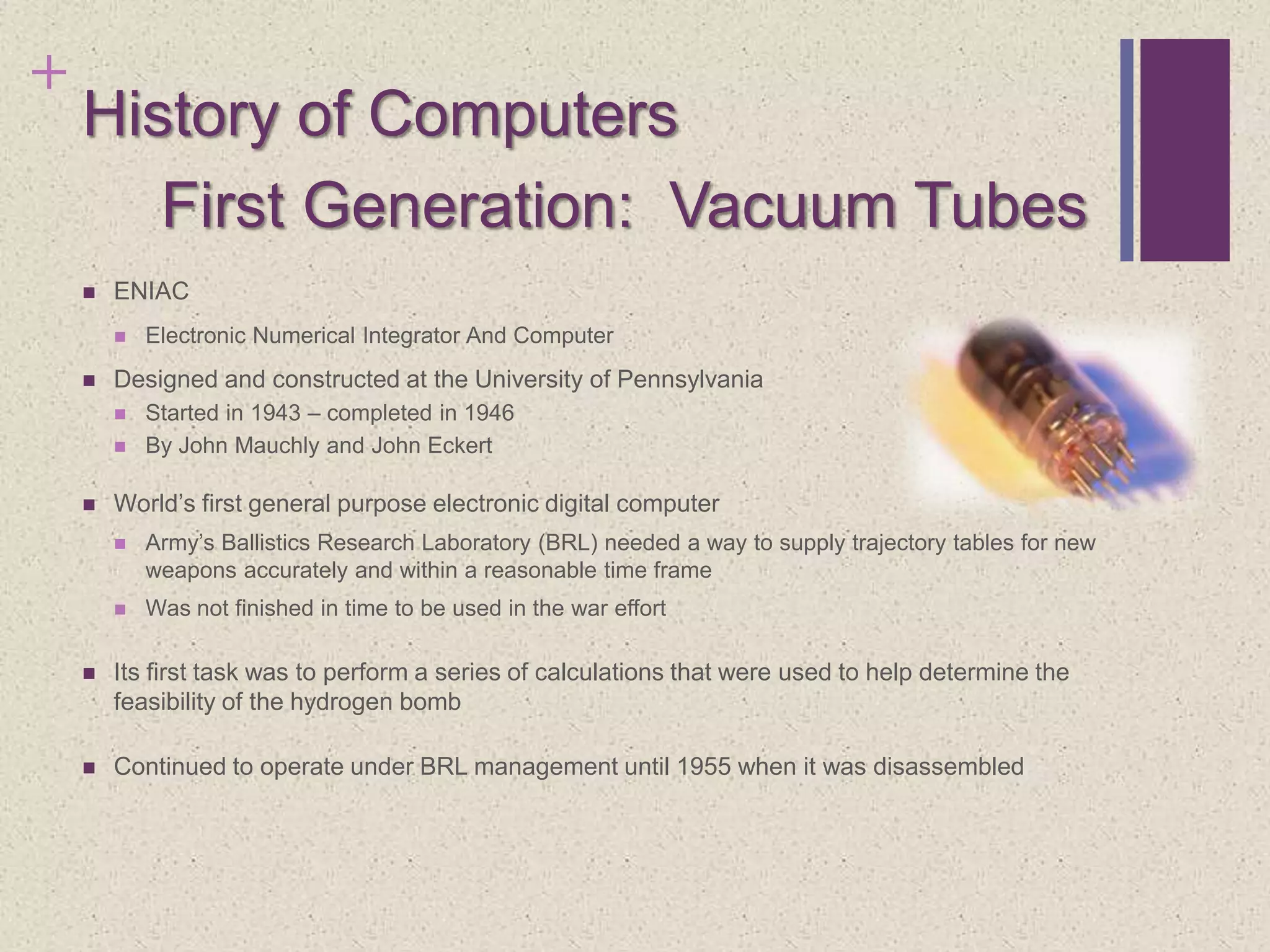
 ENIAC
 Electronic Numerical Integrator And Computer
 Designed and constructed at the University of Pennsylvania
 Started in 1943 – completed in 1946
 By John Mauchly and John Eckert
 World’s first general purpose electronic digital computer
 Army’s Ballistics Research Laboratory (BRL) needed a way to supply trajectory tables for new
weapons accurately and within a reasonable time frame
 Was not finished in time to be used in the war effort
 Its first task was to perform a series of calculations that were used to help determine the
feasibility of the hydrogen bomb
 Continued to operate under BRL management until 1955 when it was disassembled
First Generation: Vacuum Tubes
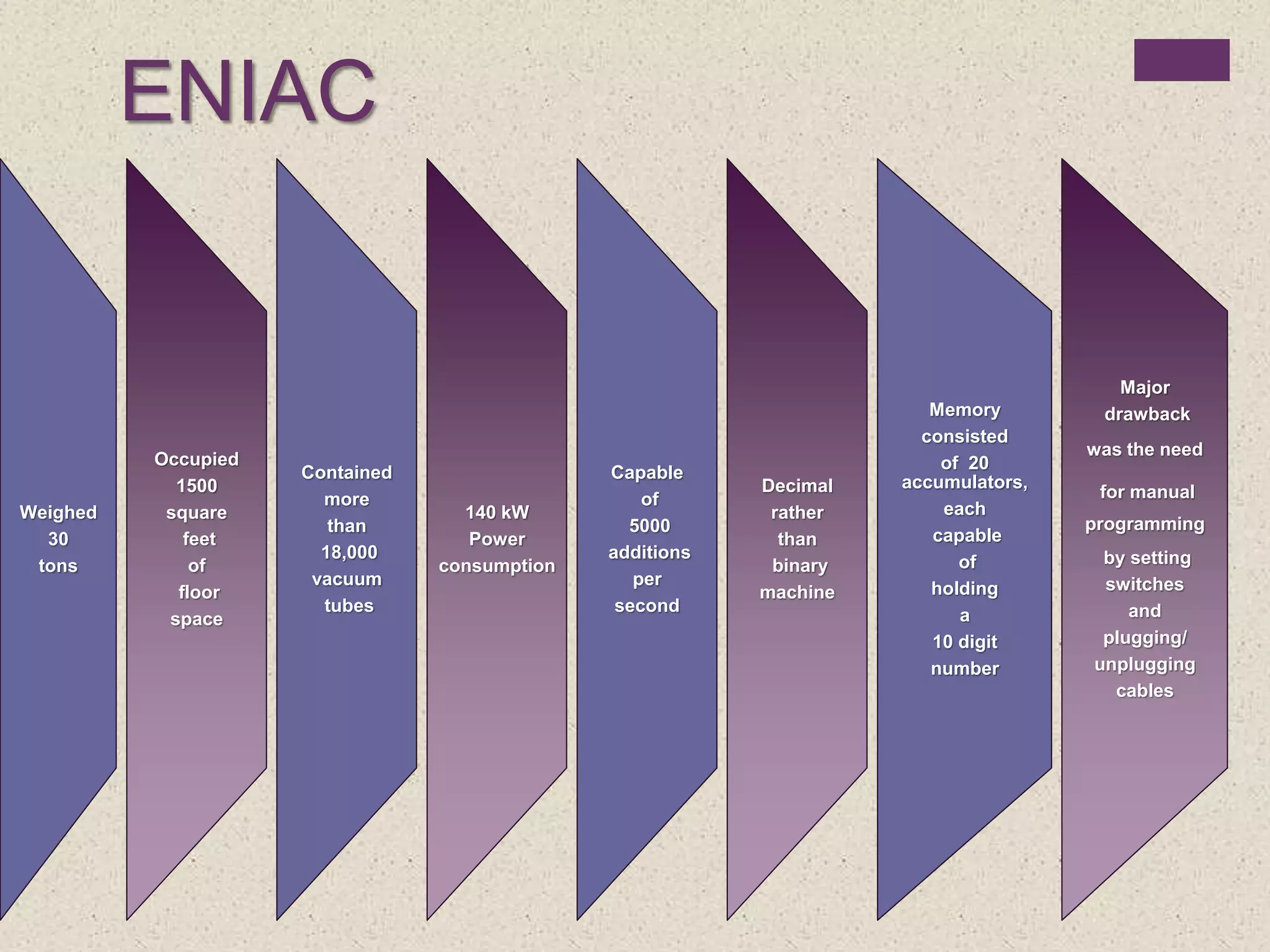
ENIAC
Weighed
30
tons
Occupied
1500
square
feet
of
floor
space
Contained
more
than
18,000
vacuum
tubes
140 kW
Power
consumption
Capable
of
5000
additions
per
second
Decimal
rather
than
binary
machine
Memory
consisted
of 20
accumulators,
each
capable
of
holding
a
10 digit
number
Major
drawback
was the need
for manual
programming
by setting
switches
and
plugging/
unplugging
cables
+
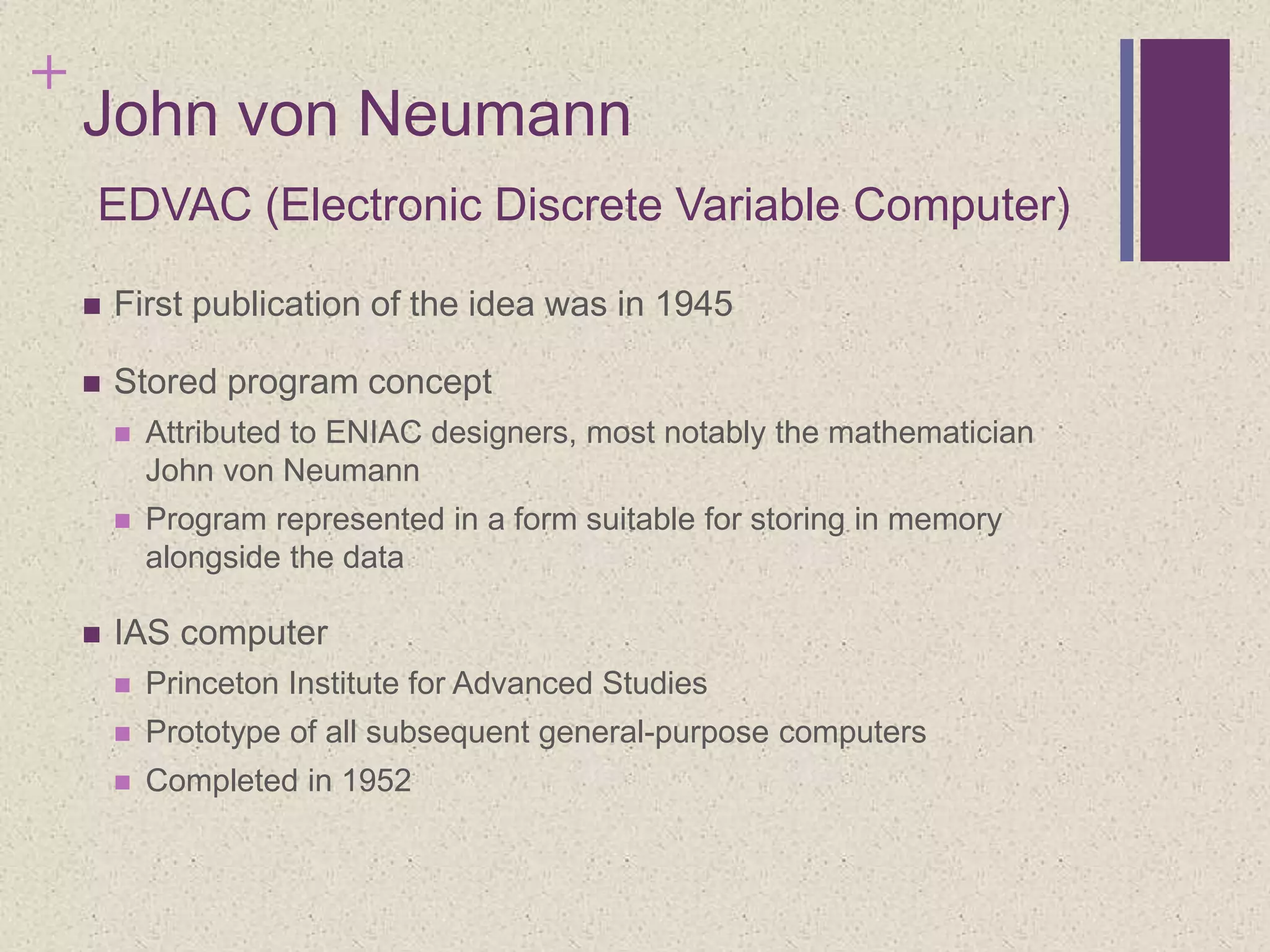
John von Neumann
 First publication of the idea was in 1945
 Stored program concept
 Attributed to ENIAC designers, most notably the mathematician
John von Neumann
 Program represented in a form suitable for storing in memory
alongside the data
 IAS computer
 Princeton Institute for Advanced Studies
 Prototype of all subsequent general-purpose computers
 Completed in 1952
EDVAC (Electronic Discrete Variable Computer)
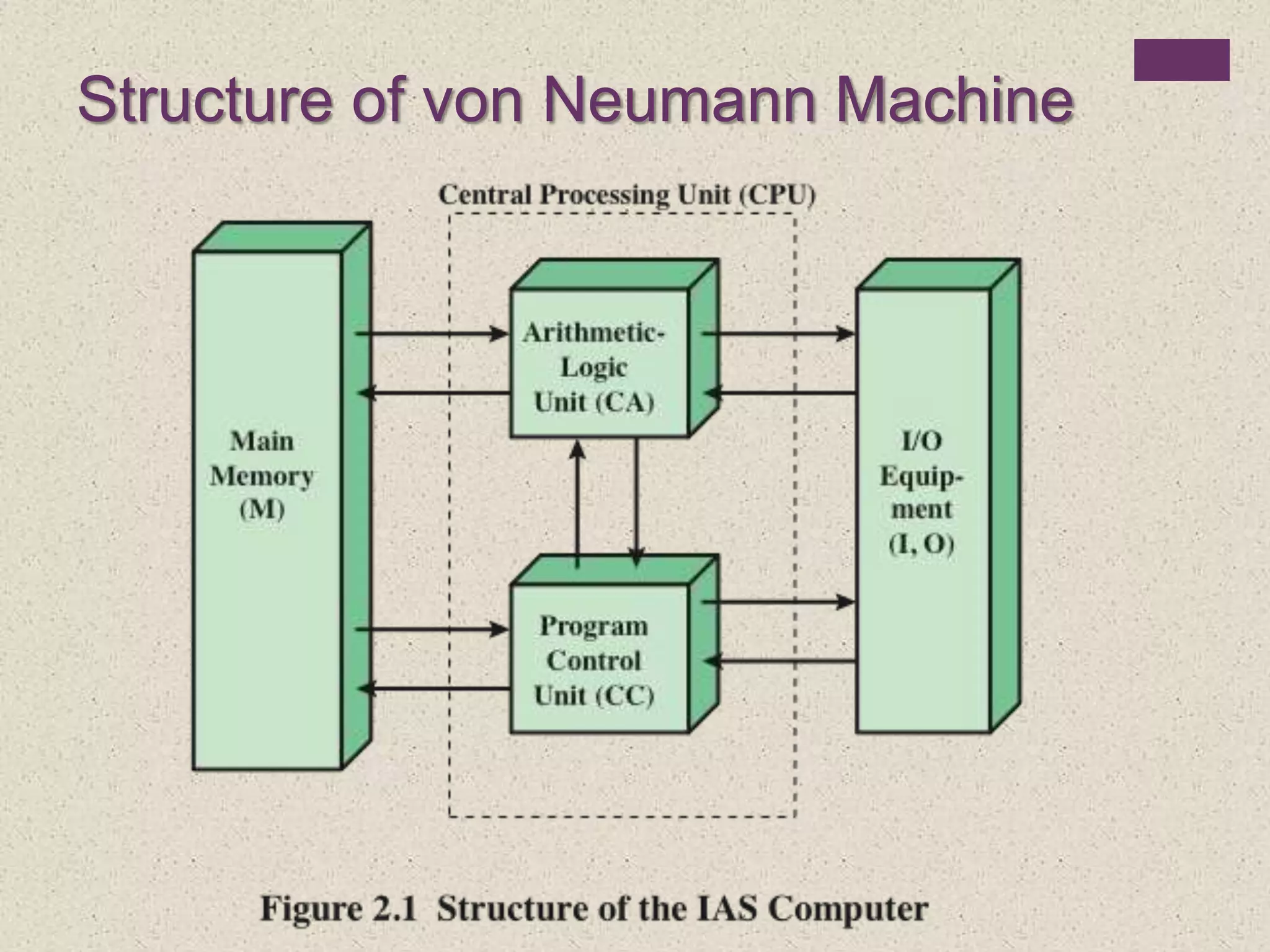
Structure of von Neumann Machine
+
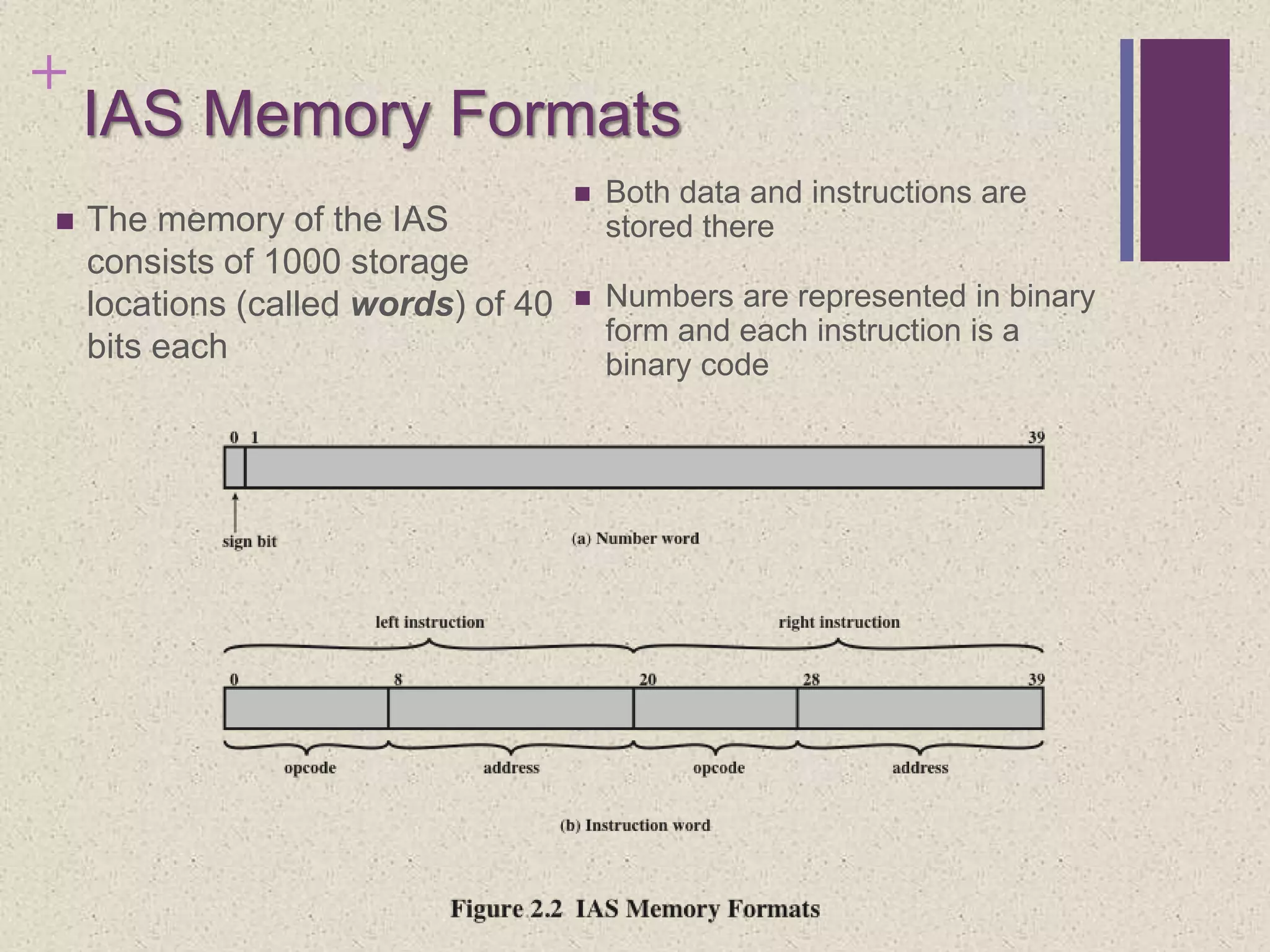
IAS Memory Formats
 Both data and instructions are
stored there
 Numbers are represented in binary
form and each instruction is a
binary code
 The memory of the IAS
consists of 1000 storage
locations (called words) of 40
bits each
+
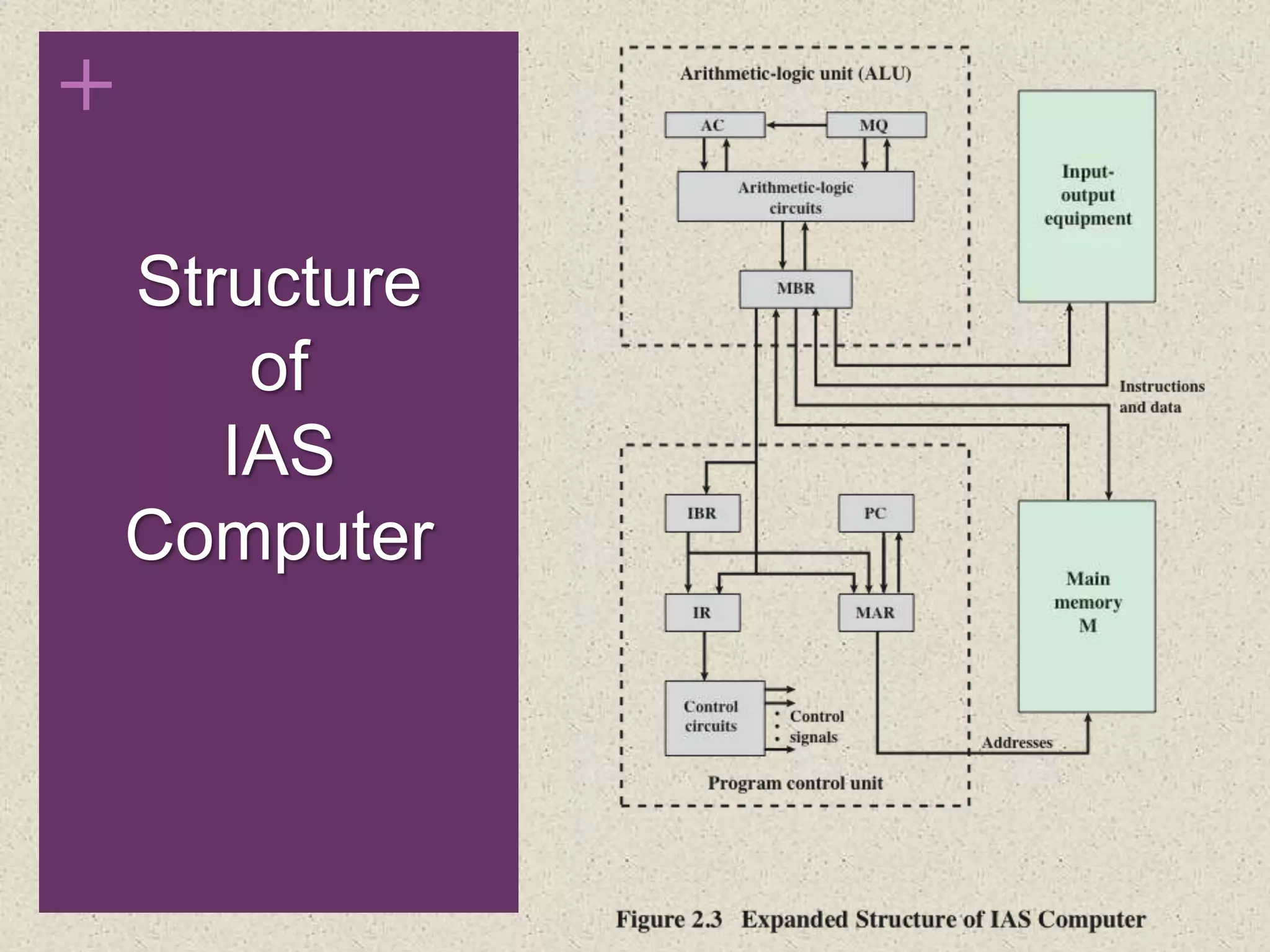
Structure
of
IAS
Computer
+ Registers
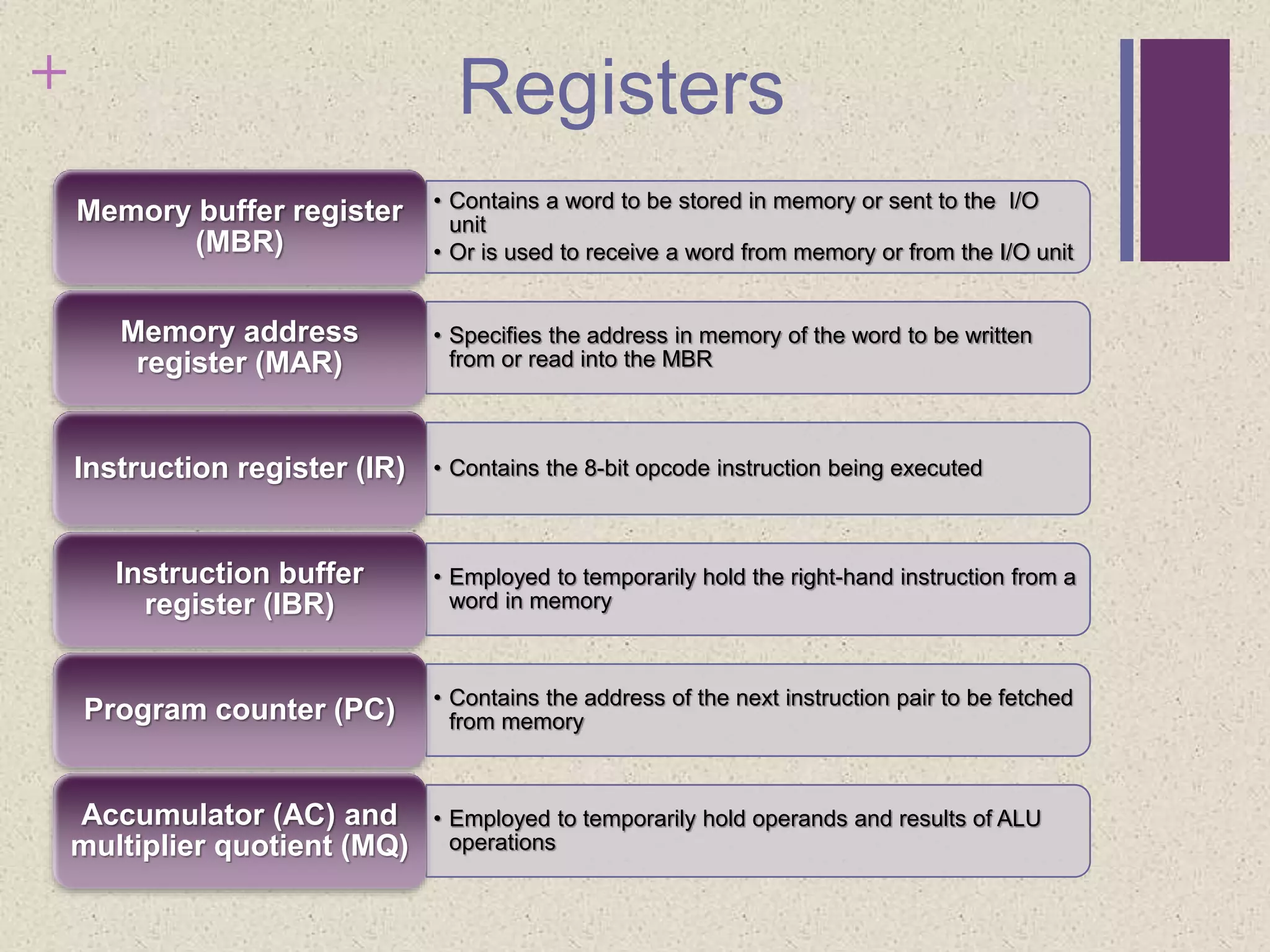
• Contains a word to be stored in memory or sent to the I/O
unit
• Or is used to receive a word from memory or from the I/O unit
Memory buffer register
(MBR)
• Specifies the address in memory of the word to be written
from or read into the MBR
Memory address
register (MAR)
• Contains the 8-bit opcode instruction being executed
Instruction register (IR)
• Employed to temporarily hold the right-hand instruction from a
word in memory
Instruction buffer
register (IBR)
• Contains the address of the next instruction pair to be fetched
from memory
Program counter (PC)
• Employed to temporarily hold operands and results of ALU
operations
Accumulator (AC) and
multiplier quotient (MQ)
+
Commercial Computers
 1947 – Eckert and Mauchly formed the Eckert-Mauchly Computer
Corporation to manufacture computers commercially
 UNIVAC I (Universal Automatic Computer)
 First successful commercial computer
 Was intended for both scientific and commercial applications
 Commissioned by the US Bureau of Census for 1950 calculations
 The Eckert-Mauchly Computer Corporation became part of the
UNIVAC division of the Sperry-Rand Corporation
 UNIVAC II – delivered in the late 1950’s
 Had greater memory capacity and higher performance
 Backward compatible
UNIVAC
+
IBM
 Was the major manufacturer of
punched-card processing
equipment
 Delivered its first electronic
stored-program computer (701)
in 1953
 Intended primarily for scientific
applications
 Introduced 702 product in 1955
 Hardware features made it
suitable to business applications
 Series of 700/7000 computers
established IBM as the
overwhelmingly dominant
computer manufacturer
+
History of Computers
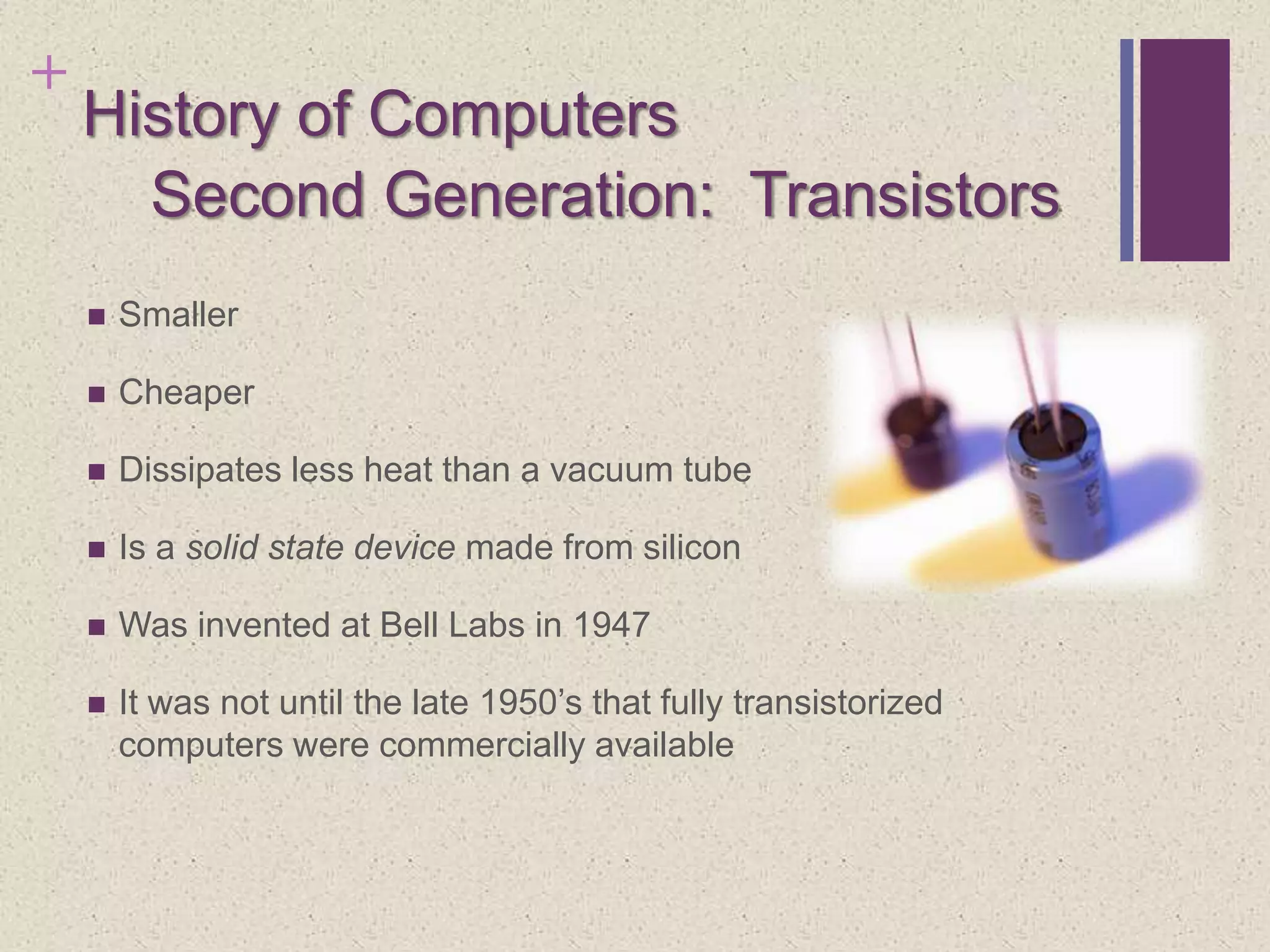
 Smaller
 Cheaper
 Dissipates less heat than a vacuum tube
 Is a solid state device made from silicon
 Was invented at Bell Labs in 1947
 It was not until the late 1950’s that fully transistorized
computers were commercially available
Second Generation: Transistors
+
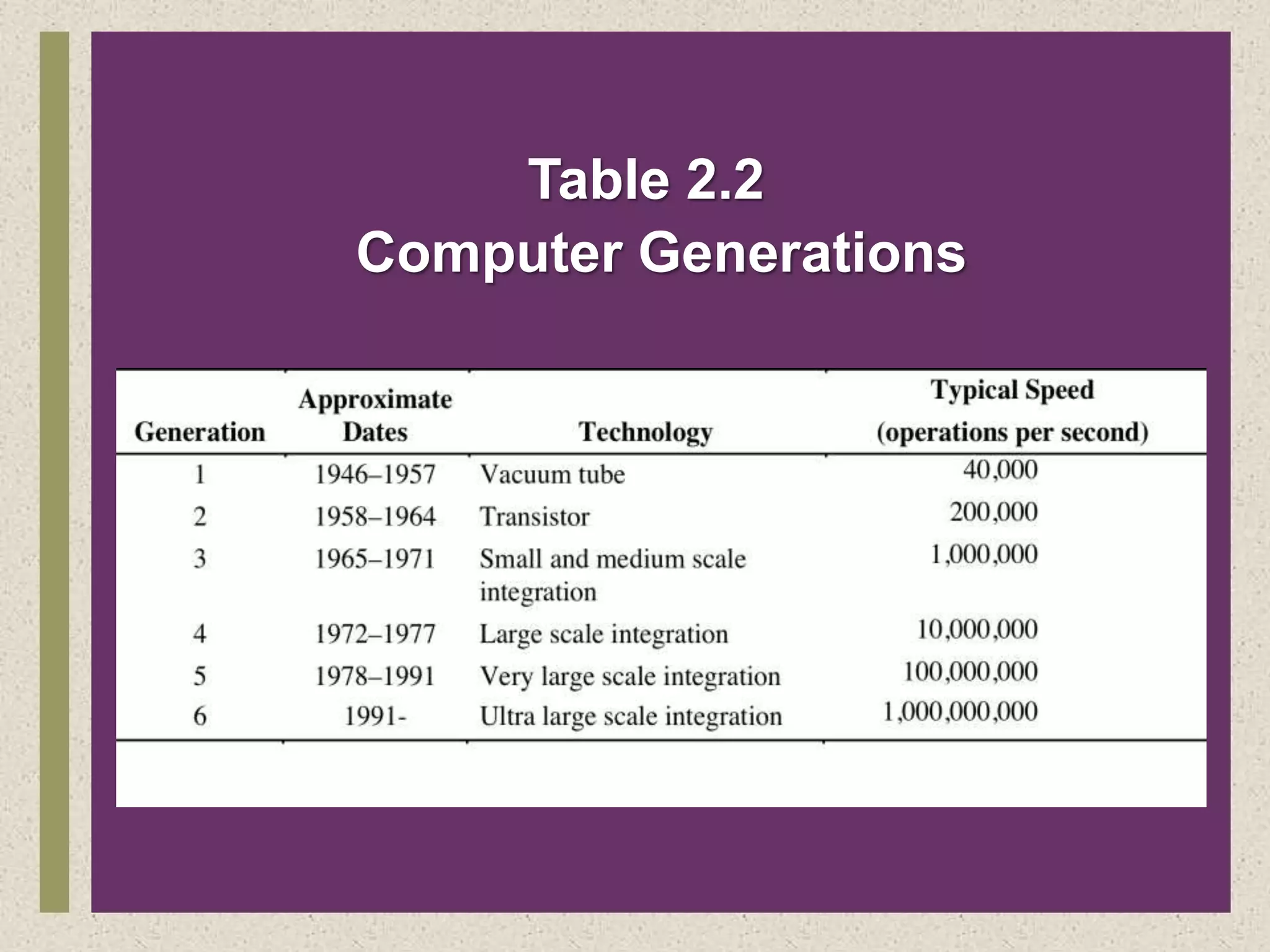
Computer Generations
Table 2.2
Computer Generations
+
Second Generation Computers
 Introduced:
 More complex arithmetic and
logic units and control units
 The use of high-level
programming languages
 Provision of system software
which provided the ability to:
 load programs
 move data to peripherals
and libraries
 perform common
computations
 Appearance of the Digital
Equipment Corporation (DEC)
in 1957
 PDP-1 was DEC’s first
computer
 This began the mini-computer
phenomenon that would
become so prominent in the
third generation
Third Generation: Integrated Circuits
History of Computers
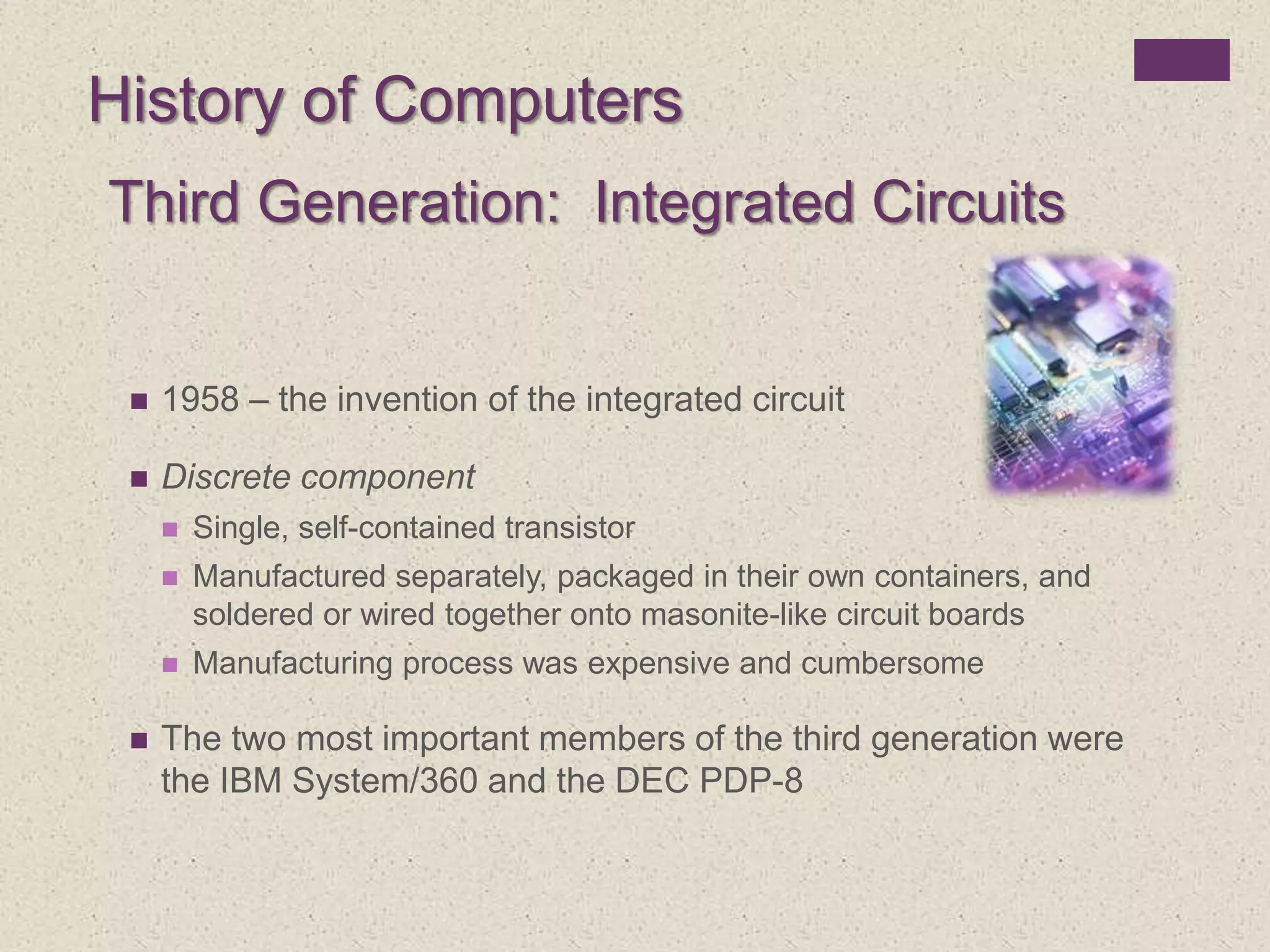
 1958 – the invention of the integrated circuit
 Discrete component
 Single, self-contained transistor
 Manufactured separately, packaged in their own containers, and
soldered or wired together onto masonite-like circuit boards
 Manufacturing process was expensive and cumbersome
 The two most important members of the third generation were
the IBM System/360 and the DEC PDP-8
+
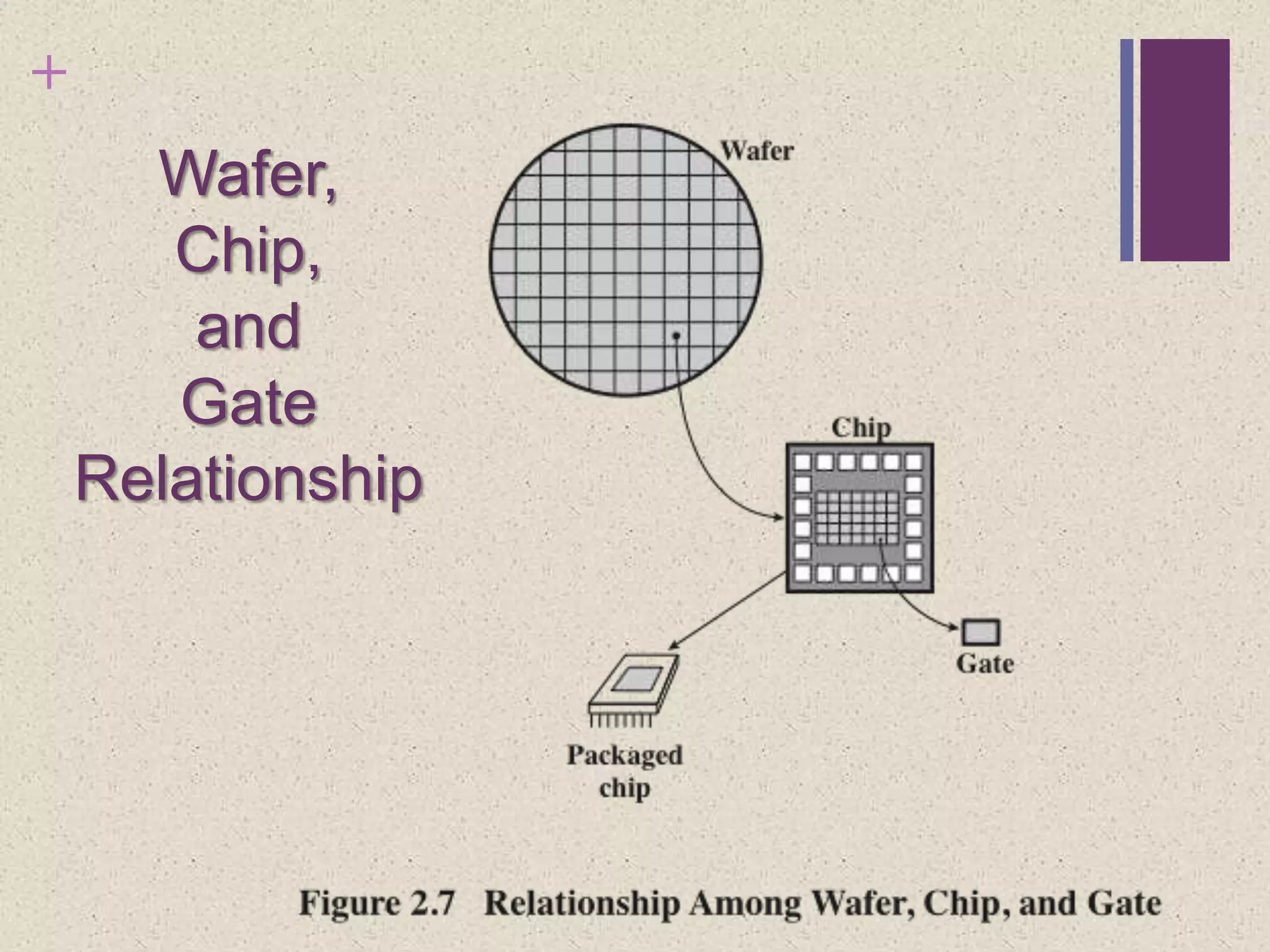
Integrated
Circuits
 A computer consists of gates,
memory cells, and
interconnections among these
elements
 The gates and memory cells
are constructed of simple digital
electronic components
 Data storage – provided by
memory cells
 Data processing – provided by
gates
 Data movement – the paths
among components are used to
move data from memory to
memory and from memory
through gates to memory
 Control – the paths among
components can carry control
signals
 Exploits the fact that such
components as transistors,
resistors, and conductors can be
fabricated from a semiconductor
such as silicon
 Many transistors can be
produced at the same time on a
single wafer of silicon
 Transistors can be connected
with a processor metallization to
form circuits
+
Wafer,
Chip,
and
Gate
Relationship
+
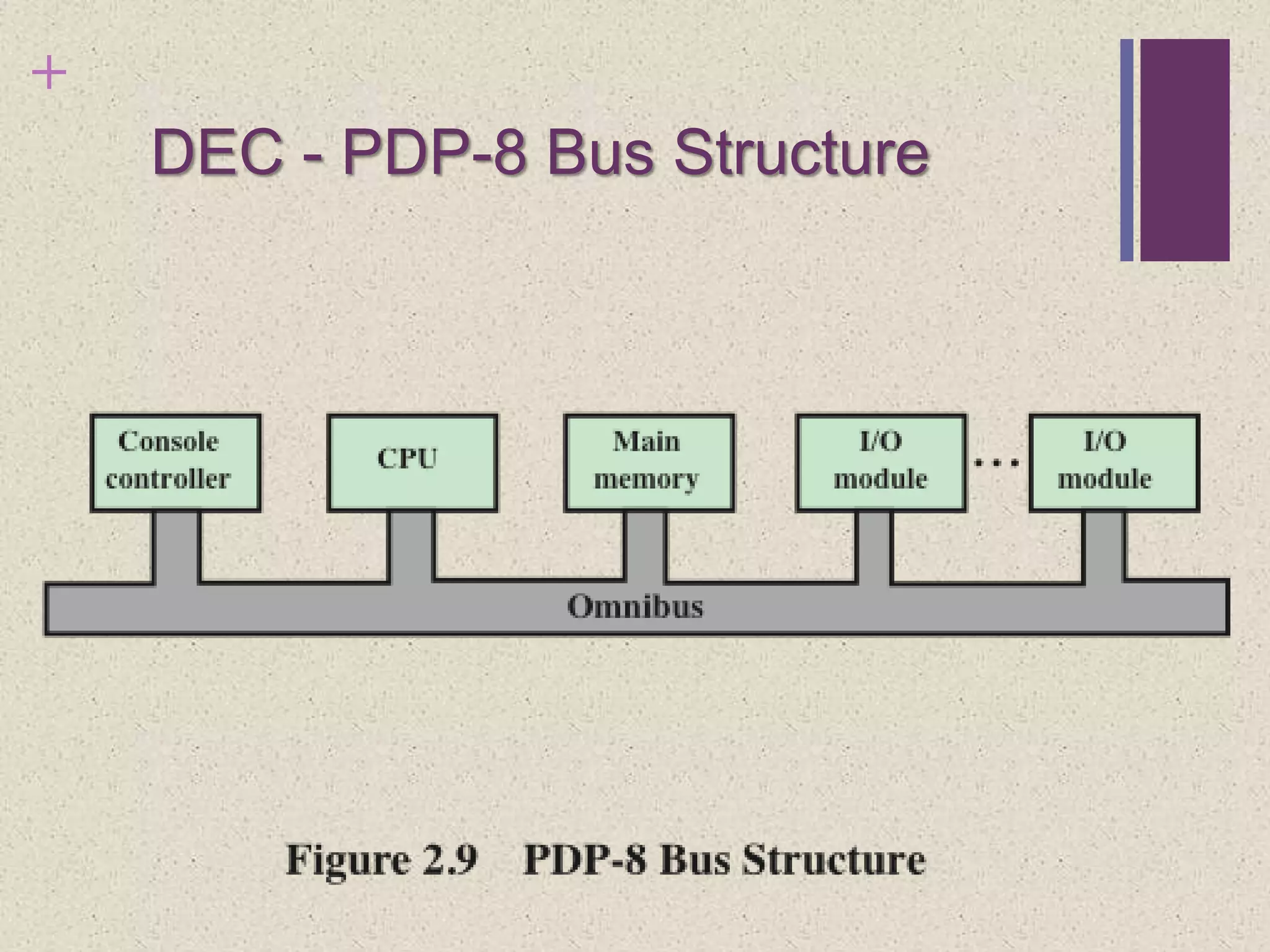
DEC - PDP-8 Bus Structure
+
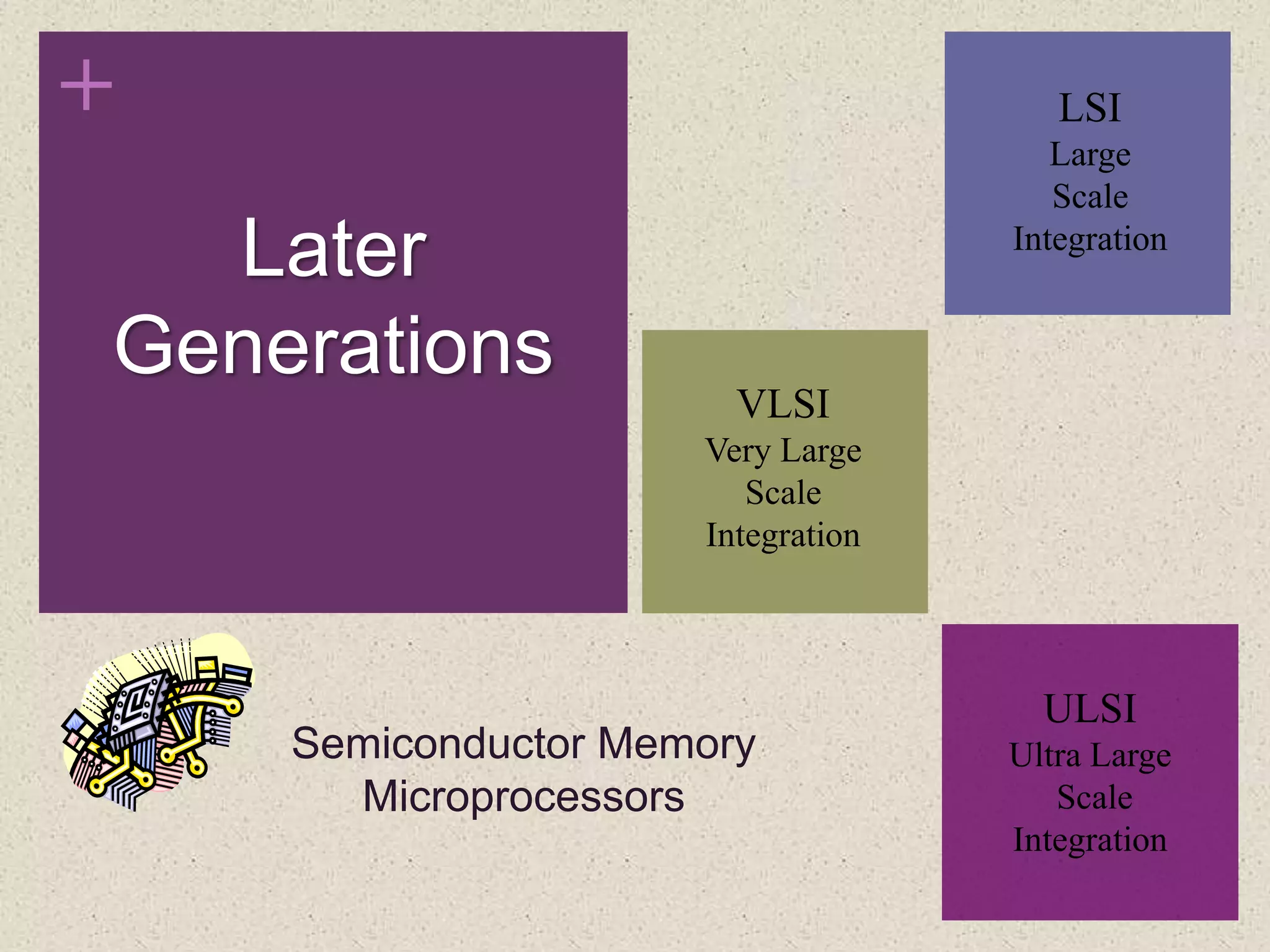
Later
Generations
LSI
Large
Scale
Integration
VLSI
Very Large
Scale
Integration
ULSI
Ultra Large
Scale
Integration
Semiconductor Memory
Microprocessors
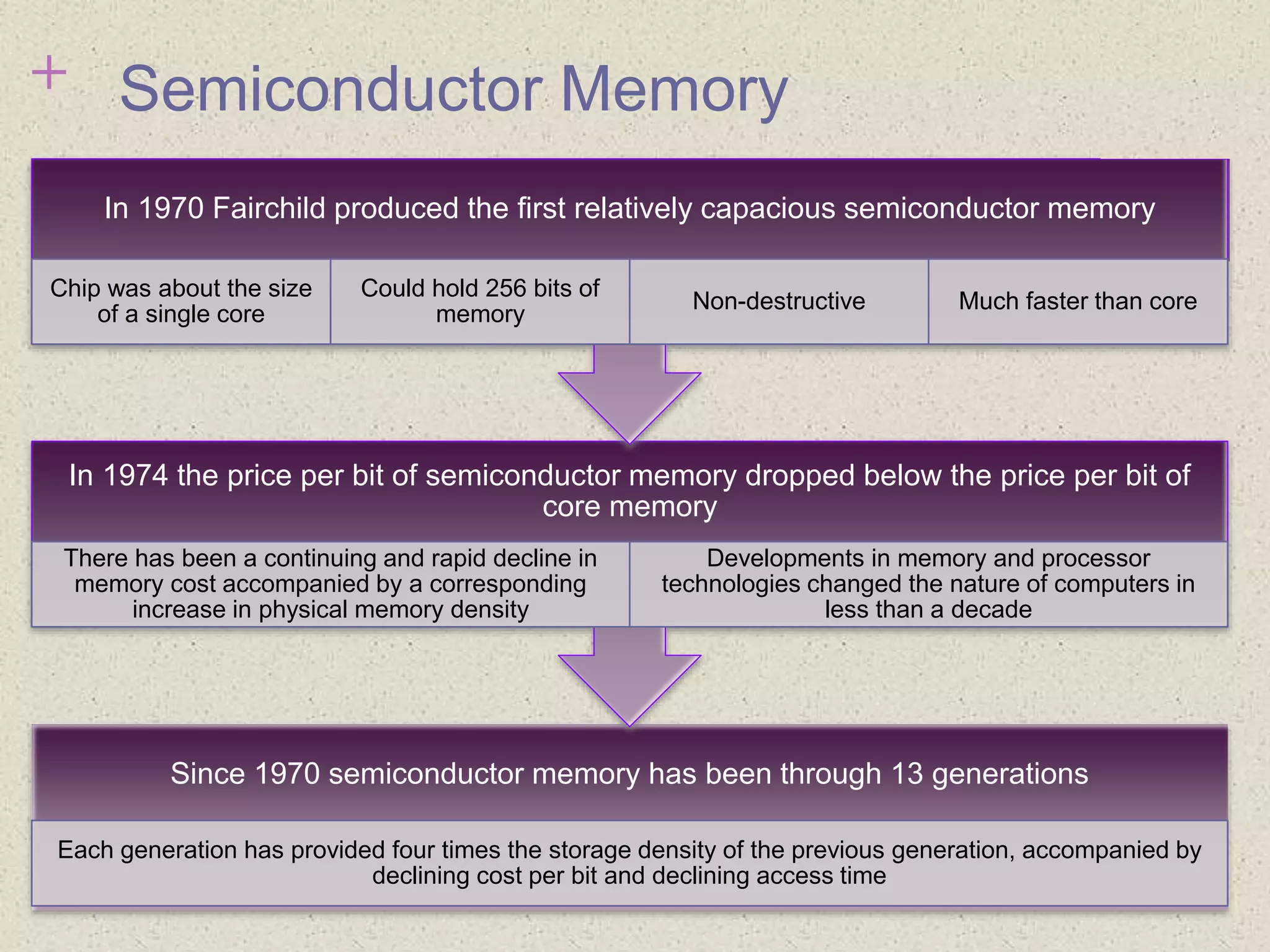
+ Semiconductor Memory
Since 1970 semiconductor memory has been through 13 generations
Each generation has provided four times the storage density of the previous generation, accompanied by
declining cost per bit and declining access time
In 1974 the price per bit of semiconductor memory dropped below the price per bit of
core memory
There has been a continuing and rapid decline in
memory cost accompanied by a corresponding
increase in physical memory density
Developments in memory and processor
technologies changed the nature of computers in
less than a decade
In 1970 Fairchild produced the first relatively capacious semiconductor memory
Chip was about the size
of a single core
Could hold 256 bits of
memory
Non-destructive Much faster than core
+
Microprocessors
 The density of elements on processor chips continued to rise
 More and more elements were placed on each chip so that fewer
and fewer chips were needed to construct a single computer
processor
 1971 Intel developed 4004
 First chip to contain all of the components of a CPU on a single chip
 Birth of microprocessor
 1972 Intel developed 8008
 First 8-bit microprocessor
 1974 Intel developed 8080
 First general purpose microprocessor
 Faster, has a richer instruction set, has a large addressing capability
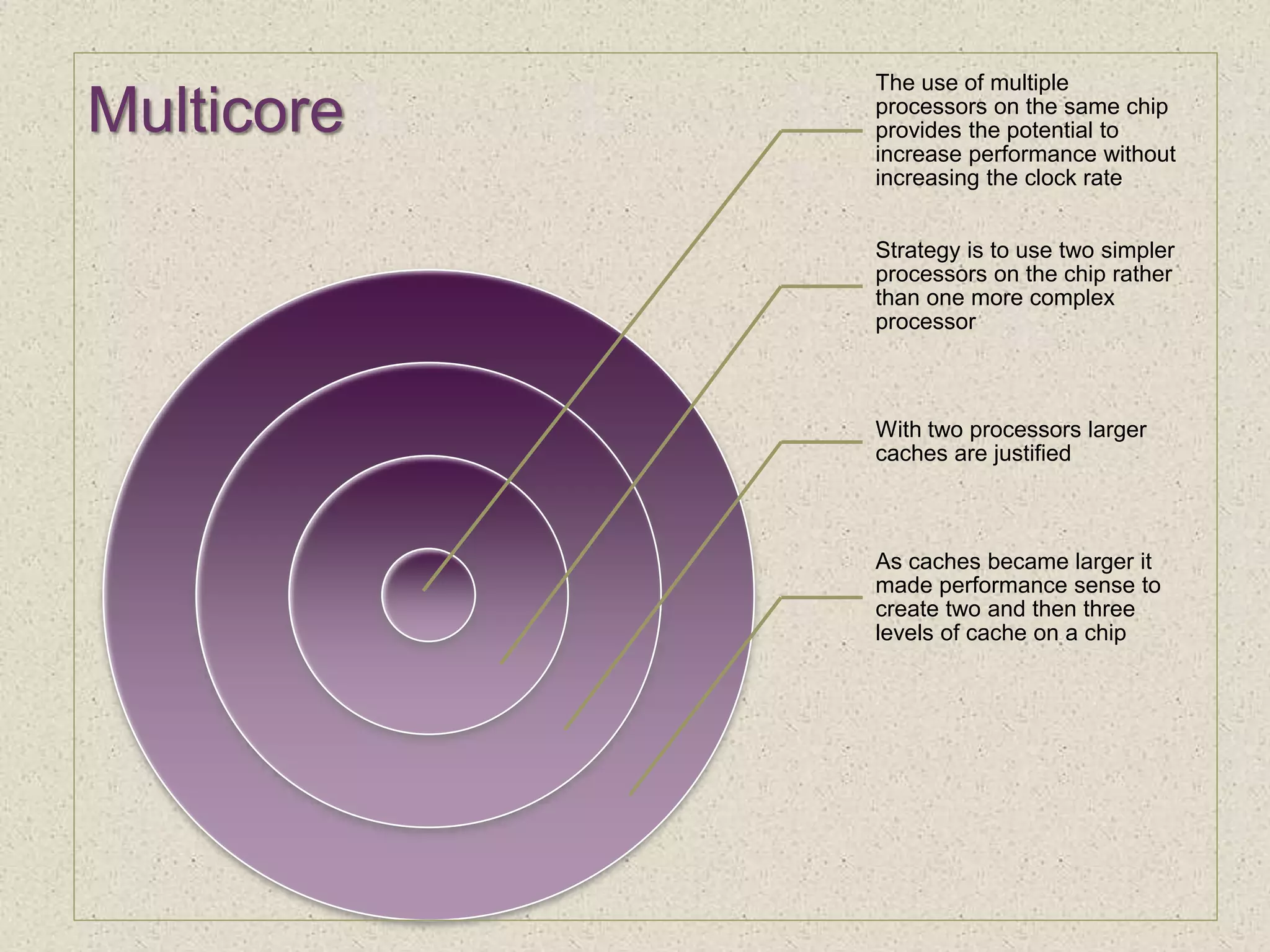
The use of multiple
processors on the same chip
provides the potential to
increase performance without
increasing the clock rate
Strategy is to use two simpler
processors on the chip rather
than one more complex
processor
With two processors larger
caches are justified
As caches became larger it
made performance sense to
create two and then three
levels of cache on a chip
Multicore
+
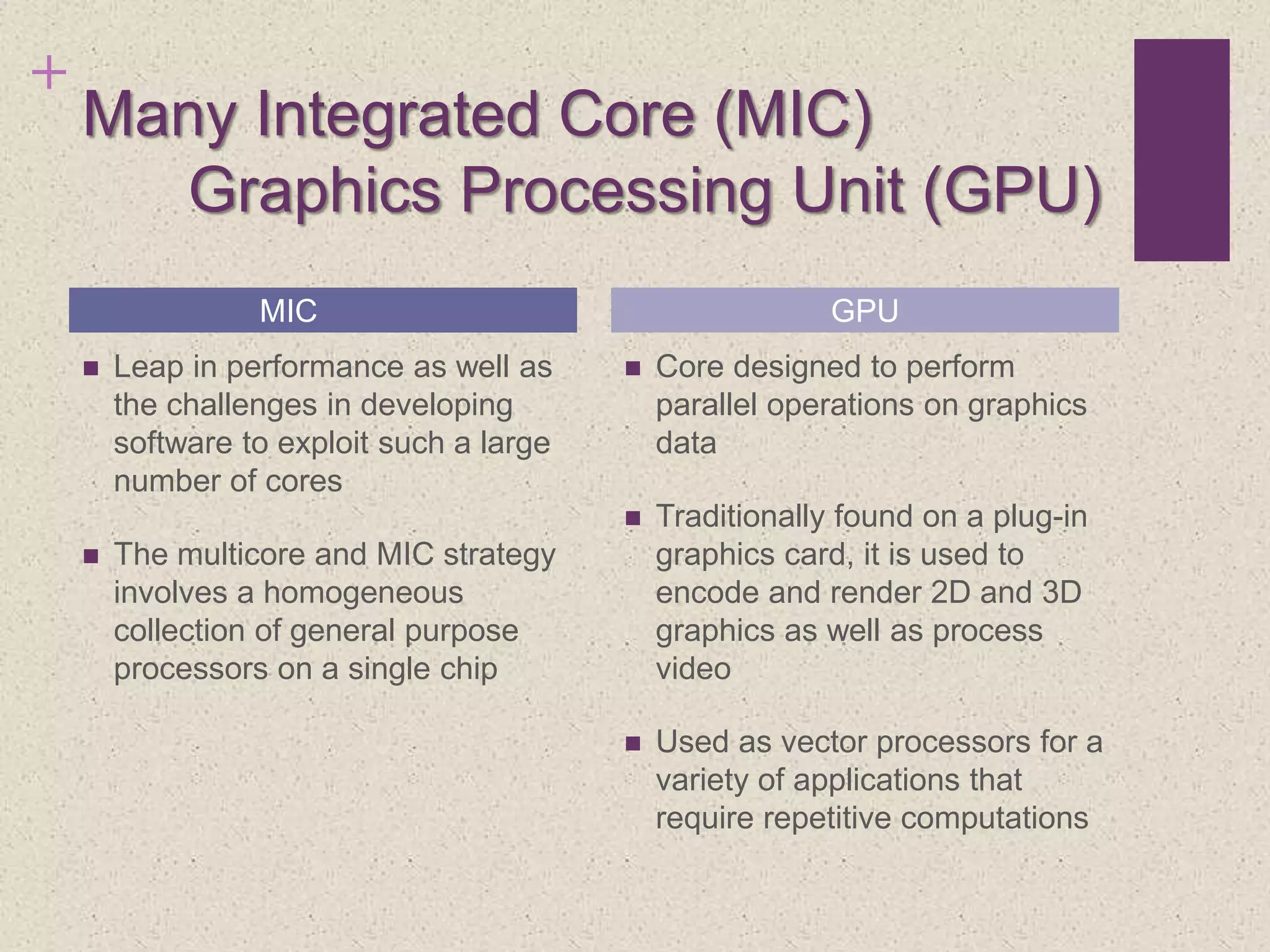
Many Integrated Core (MIC)
Graphics Processing Unit (GPU)
 Leap in performance as well as
the challenges in developing
software to exploit such a large
number of cores
 The multicore and MIC strategy
involves a homogeneous
collection of general purpose
processors on a single chip
 Core designed to perform
parallel operations on graphics
data
 Traditionally found on a plug-in
graphics card, it is used to
encode and render 2D and 3D
graphics as well as process
video
 Used as vector processors for a
variety of applications that
require repetitive computations
MIC GPU
+
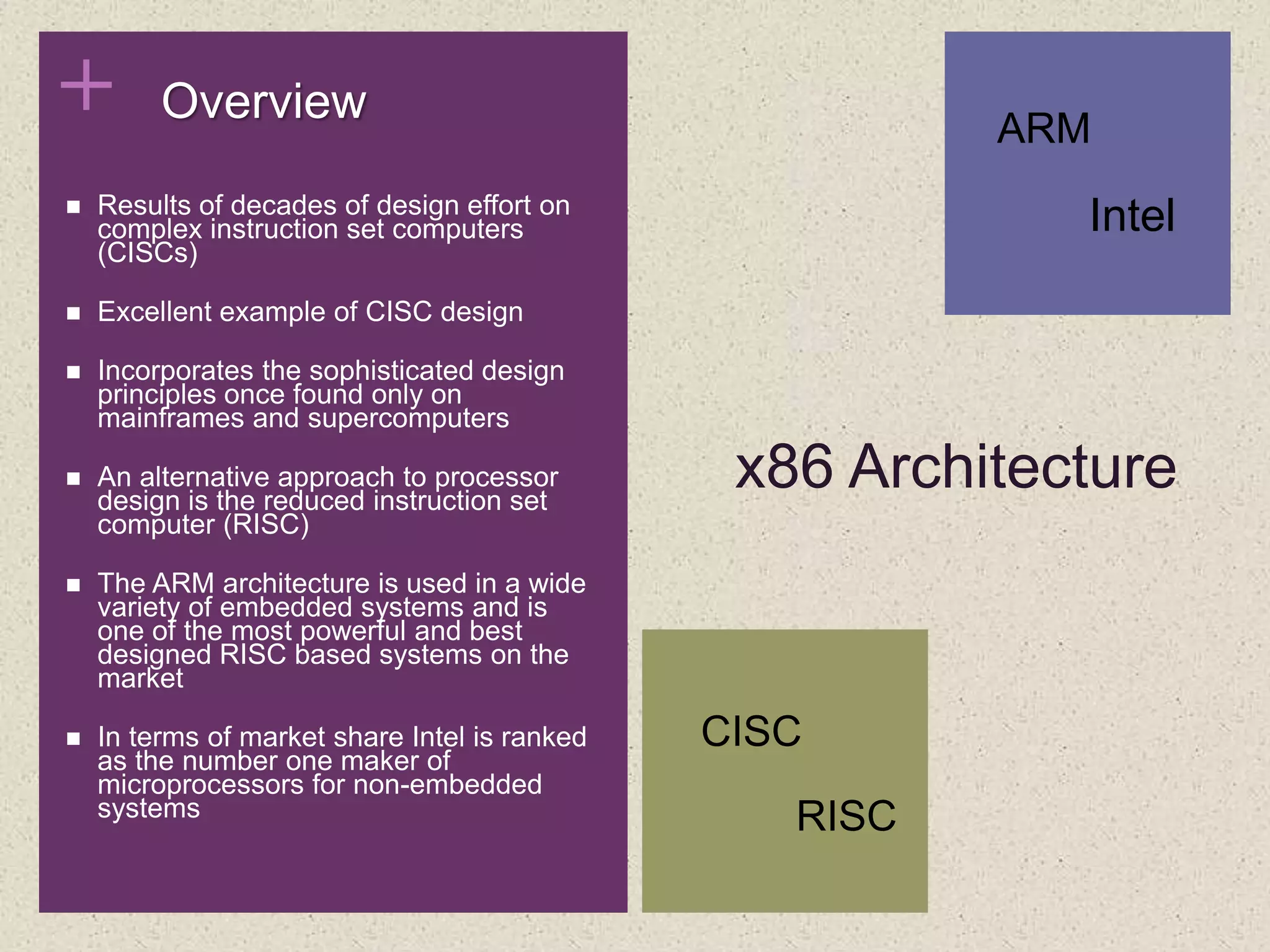
x86 Architecture
 Results of decades of design effort on
complex instruction set computers
(CISCs)
 Excellent example of CISC design
 Incorporates the sophisticated design
principles once found only on
mainframes and supercomputers
 An alternative approach to processor
design is the reduced instruction set
computer (RISC)
 The ARM architecture is used in a wide
variety of embedded systems and is
one of the most powerful and best
designed RISC based systems on the
market
 In terms of market share Intel is ranked
as the number one maker of
microprocessors for non-embedded
systems
Overview
CISC
RISC
Intel
ARM
+
x86 Evolution
 8080
 First general purpose microprocessor
 8-bit machine with an 8-bit data path to
memory
 Used in the first personal computer (Altair)
 8086
 16-bit machine
 Used an instruction cache, or queue
 First appearance of the x86 architecture
 8088
 used in IBM’s first personal computer
 80286
 Enabled addressing a 16-MByte memory
instead of just 1 MByte
 80386
 Intel’s first 32-bit machine
 First Intel processor to support multitasking
 80486
 More sophisticated cache technology and
instruction pipelining
 Built-in math coprocessor
+
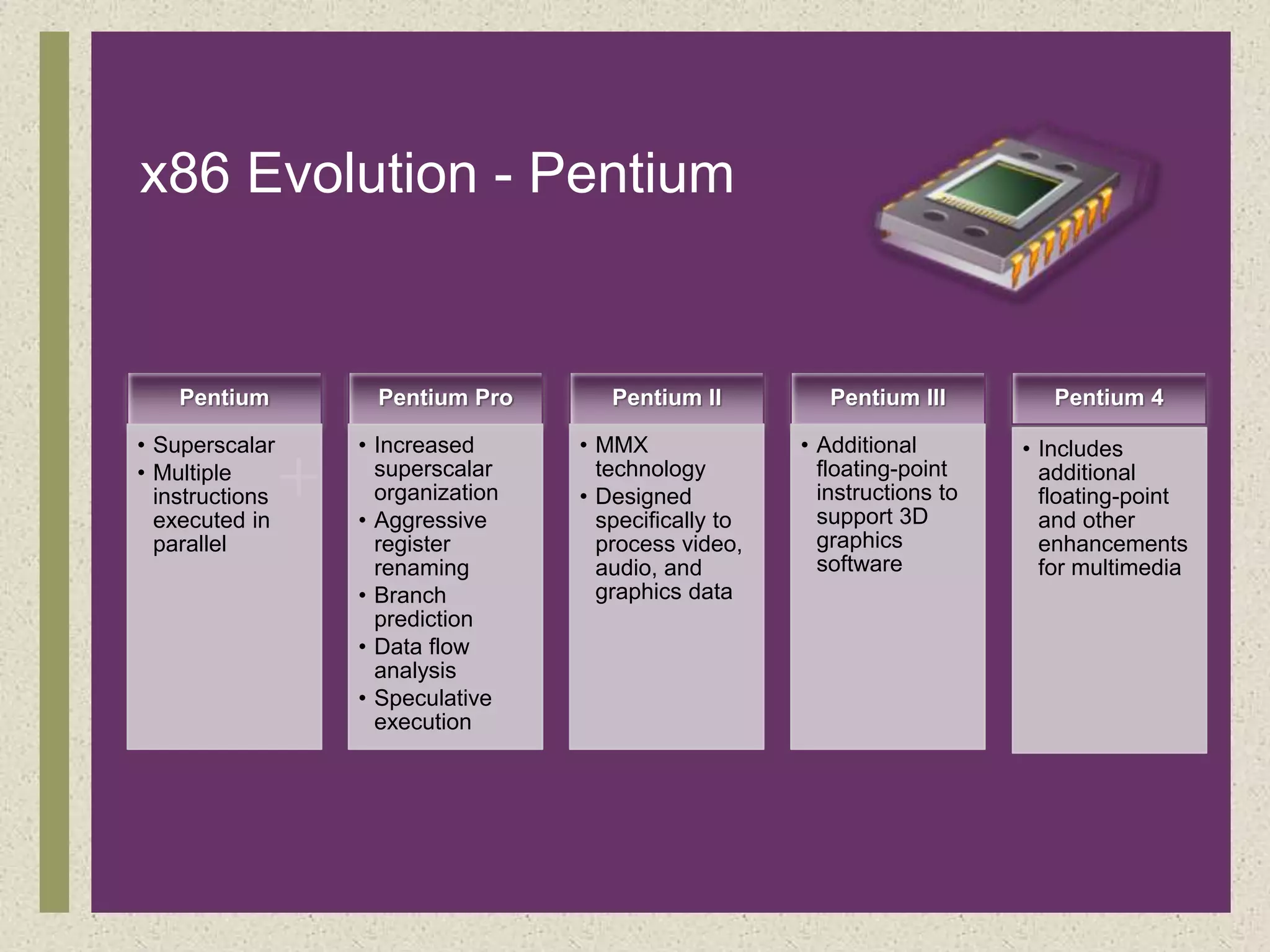
x86 Evolution - Pentium
Pentium
• Superscalar
• Multiple
instructions
executed in
parallel
Pentium Pro
• Increased
superscalar
organization
• Aggressive
register
renaming
• Branch
prediction
• Data flow
analysis
• Speculative
execution
Pentium II
• MMX
technology
• Designed
specifically to
process video,
audio, and
graphics data
Pentium III
• Additional
floating-point
instructions to
support 3D
graphics
software
Pentium 4
• Includes
additional
floating-point
and other
enhancements
for multimedia
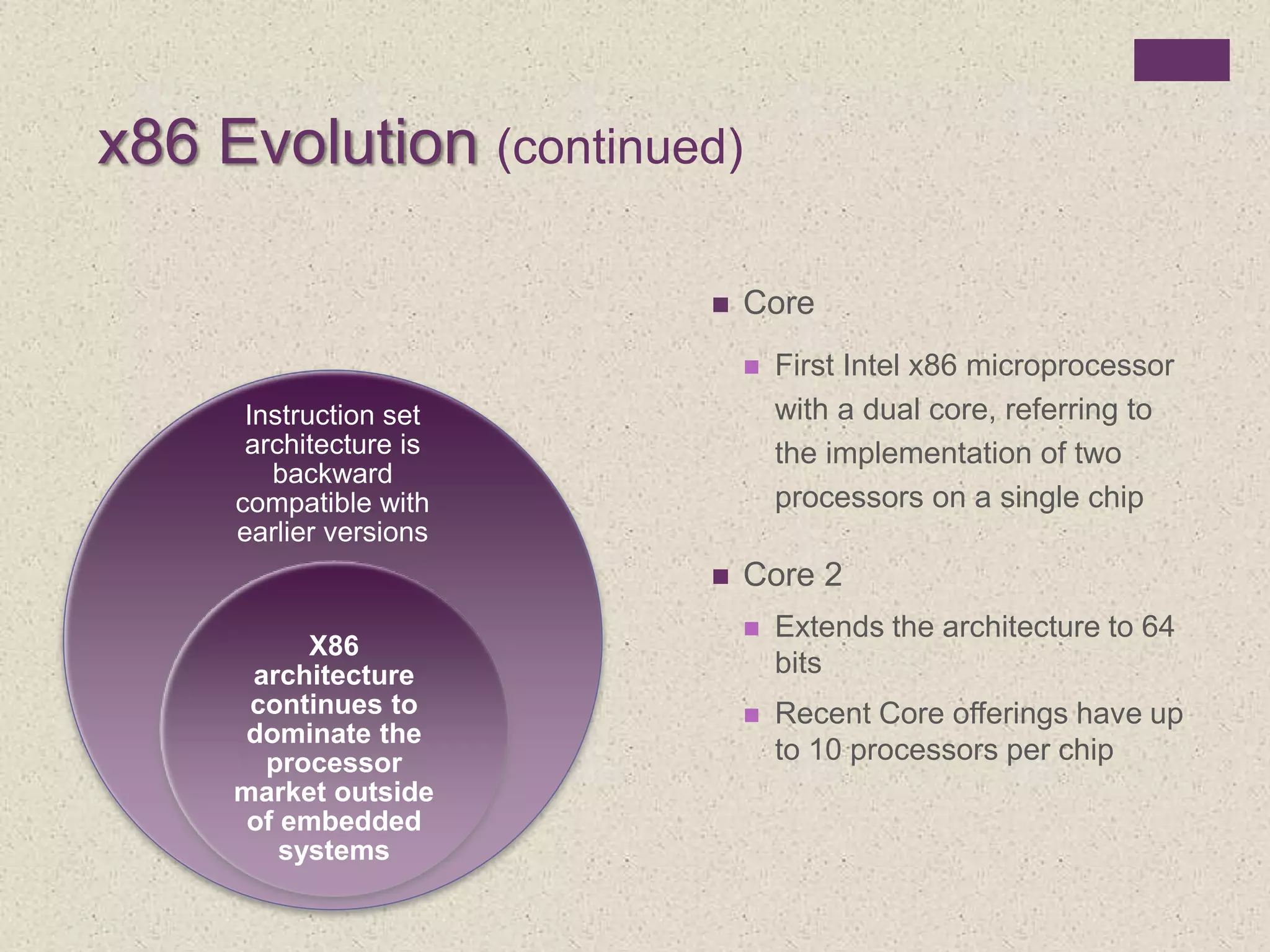
x86 Evolution (continued)
 Core
 First Intel x86 microprocessor
with a dual core, referring to
the implementation of two
processors on a single chip
 Core 2
 Extends the architecture to 64
bits
 Recent Core offerings have up
to 10 processors per chip
Instruction set
architecture is
backward
compatible with
earlier versions
X86
architecture
continues to
dominate the
processor
market outside
of embedded
systems

Computer_Evolution_Ch2.pptx

  • 1.
  • 2.
  • 3.
    + History of Computers ENIAC  Electronic Numerical Integrator And Computer  Designed and constructed at the University of Pennsylvania  Started in 1943 – completed in 1946  By John Mauchly and John Eckert  World’s first general purpose electronic digital computer  Army’s Ballistics Research Laboratory (BRL) needed a way to supply trajectory tables for new weapons accurately and within a reasonable time frame  Was not finished in time to be used in the war effort  Its first task was to perform a series of calculations that were used to help determine the feasibility of the hydrogen bomb  Continued to operate under BRL management until 1955 when it was disassembled First Generation: Vacuum Tubes
  • 4.
  • 5.
    + John von Neumann First publication of the idea was in 1945  Stored program concept  Attributed to ENIAC designers, most notably the mathematician John von Neumann  Program represented in a form suitable for storing in memory alongside the data  IAS computer  Princeton Institute for Advanced Studies  Prototype of all subsequent general-purpose computers  Completed in 1952 EDVAC (Electronic Discrete Variable Computer)
  • 6.
    Structure of vonNeumann Machine
  • 7.
    + IAS Memory Formats Both data and instructions are stored there  Numbers are represented in binary form and each instruction is a binary code  The memory of the IAS consists of 1000 storage locations (called words) of 40 bits each
  • 8.
  • 9.
    + Registers • Containsa word to be stored in memory or sent to the I/O unit • Or is used to receive a word from memory or from the I/O unit Memory buffer register (MBR) • Specifies the address in memory of the word to be written from or read into the MBR Memory address register (MAR) • Contains the 8-bit opcode instruction being executed Instruction register (IR) • Employed to temporarily hold the right-hand instruction from a word in memory Instruction buffer register (IBR) • Contains the address of the next instruction pair to be fetched from memory Program counter (PC) • Employed to temporarily hold operands and results of ALU operations Accumulator (AC) and multiplier quotient (MQ)
  • 10.
    + Commercial Computers  1947– Eckert and Mauchly formed the Eckert-Mauchly Computer Corporation to manufacture computers commercially  UNIVAC I (Universal Automatic Computer)  First successful commercial computer  Was intended for both scientific and commercial applications  Commissioned by the US Bureau of Census for 1950 calculations  The Eckert-Mauchly Computer Corporation became part of the UNIVAC division of the Sperry-Rand Corporation  UNIVAC II – delivered in the late 1950’s  Had greater memory capacity and higher performance  Backward compatible UNIVAC
  • 11.
    + IBM  Was themajor manufacturer of punched-card processing equipment  Delivered its first electronic stored-program computer (701) in 1953  Intended primarily for scientific applications  Introduced 702 product in 1955  Hardware features made it suitable to business applications  Series of 700/7000 computers established IBM as the overwhelmingly dominant computer manufacturer
  • 12.
    + History of Computers Smaller  Cheaper  Dissipates less heat than a vacuum tube  Is a solid state device made from silicon  Was invented at Bell Labs in 1947  It was not until the late 1950’s that fully transistorized computers were commercially available Second Generation: Transistors
  • 13.
  • 14.
    + Second Generation Computers Introduced:  More complex arithmetic and logic units and control units  The use of high-level programming languages  Provision of system software which provided the ability to:  load programs  move data to peripherals and libraries  perform common computations  Appearance of the Digital Equipment Corporation (DEC) in 1957  PDP-1 was DEC’s first computer  This began the mini-computer phenomenon that would become so prominent in the third generation
  • 15.
    Third Generation: IntegratedCircuits History of Computers  1958 – the invention of the integrated circuit  Discrete component  Single, self-contained transistor  Manufactured separately, packaged in their own containers, and soldered or wired together onto masonite-like circuit boards  Manufacturing process was expensive and cumbersome  The two most important members of the third generation were the IBM System/360 and the DEC PDP-8
  • 16.
    + Integrated Circuits  A computerconsists of gates, memory cells, and interconnections among these elements  The gates and memory cells are constructed of simple digital electronic components  Data storage – provided by memory cells  Data processing – provided by gates  Data movement – the paths among components are used to move data from memory to memory and from memory through gates to memory  Control – the paths among components can carry control signals  Exploits the fact that such components as transistors, resistors, and conductors can be fabricated from a semiconductor such as silicon  Many transistors can be produced at the same time on a single wafer of silicon  Transistors can be connected with a processor metallization to form circuits
  • 17.
  • 18.
    + DEC - PDP-8Bus Structure
  • 19.
  • 20.
    + Semiconductor Memory Since1970 semiconductor memory has been through 13 generations Each generation has provided four times the storage density of the previous generation, accompanied by declining cost per bit and declining access time In 1974 the price per bit of semiconductor memory dropped below the price per bit of core memory There has been a continuing and rapid decline in memory cost accompanied by a corresponding increase in physical memory density Developments in memory and processor technologies changed the nature of computers in less than a decade In 1970 Fairchild produced the first relatively capacious semiconductor memory Chip was about the size of a single core Could hold 256 bits of memory Non-destructive Much faster than core
  • 21.
    + Microprocessors  The densityof elements on processor chips continued to rise  More and more elements were placed on each chip so that fewer and fewer chips were needed to construct a single computer processor  1971 Intel developed 4004  First chip to contain all of the components of a CPU on a single chip  Birth of microprocessor  1972 Intel developed 8008  First 8-bit microprocessor  1974 Intel developed 8080  First general purpose microprocessor  Faster, has a richer instruction set, has a large addressing capability
  • 22.
    The use ofmultiple processors on the same chip provides the potential to increase performance without increasing the clock rate Strategy is to use two simpler processors on the chip rather than one more complex processor With two processors larger caches are justified As caches became larger it made performance sense to create two and then three levels of cache on a chip Multicore
  • 23.
    + Many Integrated Core(MIC) Graphics Processing Unit (GPU)  Leap in performance as well as the challenges in developing software to exploit such a large number of cores  The multicore and MIC strategy involves a homogeneous collection of general purpose processors on a single chip  Core designed to perform parallel operations on graphics data  Traditionally found on a plug-in graphics card, it is used to encode and render 2D and 3D graphics as well as process video  Used as vector processors for a variety of applications that require repetitive computations MIC GPU
  • 24.
    + x86 Architecture  Resultsof decades of design effort on complex instruction set computers (CISCs)  Excellent example of CISC design  Incorporates the sophisticated design principles once found only on mainframes and supercomputers  An alternative approach to processor design is the reduced instruction set computer (RISC)  The ARM architecture is used in a wide variety of embedded systems and is one of the most powerful and best designed RISC based systems on the market  In terms of market share Intel is ranked as the number one maker of microprocessors for non-embedded systems Overview CISC RISC Intel ARM
  • 25.
    + x86 Evolution  8080 First general purpose microprocessor  8-bit machine with an 8-bit data path to memory  Used in the first personal computer (Altair)  8086  16-bit machine  Used an instruction cache, or queue  First appearance of the x86 architecture  8088  used in IBM’s first personal computer  80286  Enabled addressing a 16-MByte memory instead of just 1 MByte  80386  Intel’s first 32-bit machine  First Intel processor to support multitasking  80486  More sophisticated cache technology and instruction pipelining  Built-in math coprocessor
  • 26.
    + x86 Evolution -Pentium Pentium • Superscalar • Multiple instructions executed in parallel Pentium Pro • Increased superscalar organization • Aggressive register renaming • Branch prediction • Data flow analysis • Speculative execution Pentium II • MMX technology • Designed specifically to process video, audio, and graphics data Pentium III • Additional floating-point instructions to support 3D graphics software Pentium 4 • Includes additional floating-point and other enhancements for multimedia
  • 27.
    x86 Evolution (continued) Core  First Intel x86 microprocessor with a dual core, referring to the implementation of two processors on a single chip  Core 2  Extends the architecture to 64 bits  Recent Core offerings have up to 10 processors per chip Instruction set architecture is backward compatible with earlier versions X86 architecture continues to dominate the processor market outside of embedded systems