Surveying 1
AWAIS AHMED MIRZA
LECTURER (BPS-18) @ CIVIL ENGINEERING DEPARTMENT,
MEHRAN U.E.T., JAMSHORO.
Outcomes:
 You will have knowledge about Surveying and
Surveying’s Intruments that are used in fields.
 You will learn different new terminologies about
surveying.
 This lecture would also help you for objective oriented
study.
 You will have to memorize some constants.
Define Surveying?
 The art of determining the relative
positions of different objects on the
surface of earth or beneath the
surface of earth, by measuring the
horizontal distances between them
,and by preparing a map to any
suitable scale is called surveying.
Introduction to various
Surveying Instruments:
 In Surveying, we measure horizontal
distances, horizontal angels, vertical
angles, levels and etc.
Surveying Instruments 5
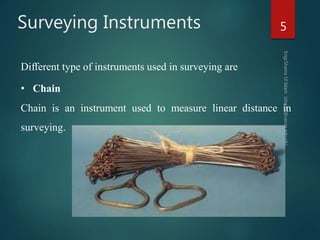
Different type of instruments used in surveying are
• Chain
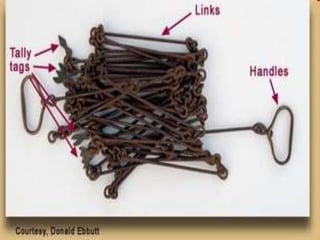
Chain is an instrument used to measure linear distance in
surveying.
Chains
 The chain is composed of 100 or 150 pieces of steel /iron
which are also called links. The ends of each link are bent
into a loop and connected together by means of three oval
rings which give flexibility to the chain. The joints of the
links are usually open, but in the best chains they are mostly
welded.
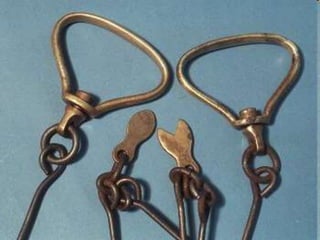
 The ends of the chain are provided with brass handless for
dragging the chain on the ground, so that the chain can be
turned round without twisting. The out side of the handle is
the zero point or the end point of the chain and the length
of the chain is measured from the out side of the one
handle to the out side of the other. The length of the link
is the distance between the centers of the two consecutive
/ continuous middle rings.
Types of Chain
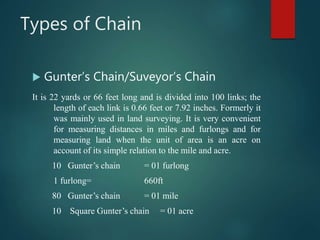
 Gunter’s Chain/Suveyor’s Chain
It is 22 yards or 66 feet long and is divided into 100 links; the
length of each link is 0.66 feet or 7.92 inches. Formerly it
was mainly used in land surveying. It is very convenient
for measuring distances in miles and furlongs and for
measuring land when the unit of area is an acre on
account of its simple relation to the mile and acre.
10 Gunter’s chain = 01 furlong
1 furlong= 660ft
80 Gunter’s chain = 01 mile
10 Square Gunter’s chain = 01 acre
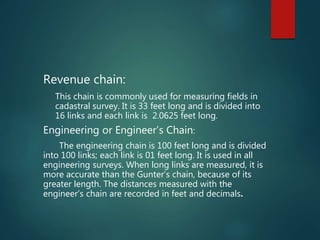
Revenue chain:
This chain is commonly used for measuring fields in
cadastral survey. It is 33 feet long and is divided into
16 links and each link is 2.0625 feet long.
Engineering or Engineer’s Chain:
The engineering chain is 100 feet long and is divided
into 100 links; each link is 01 feet long. It is used in all
engineering surveys. When long links are measured, it is
more accurate than the Gunter’s chain, because of its
greater length. The distances measured with the
engineer’s chain are recorded in feet and decimals.
 Metric Chain:
 Those countries in which the meter is the unit of
length, chains of 10, 20 and 30 meters are commonly
used. The 20-meter chain which is in most common
chain use is divided into 100 links.
 30 meter chain into 150 links
 Each link 20 cm
 In 1 meter =5 links
Tapes
 Accurate measurements are carried out through tape in
survey.
 Lighter in weight.
 Easier to handle than chain
 Types
 Cloth or linen tape
 Invar tape( Metallic-nickel)
 Steel tape(Cloth wire)
 Fiberglass tape
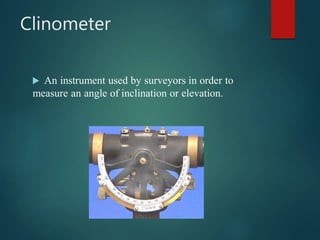
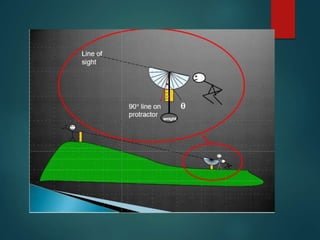
Clinometer
 An instrument used by surveyors in order to
measure an angle of inclination or elevation.
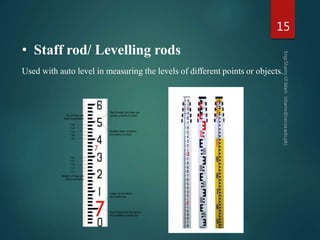
• Staff rod/ Levelling rods
Used with auto level in measuring the levels of different points or objects.
15
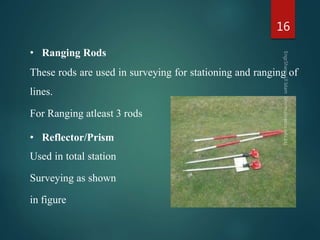
• Ranging Rods
These rods are used in surveying for stationing and ranging of
lines.
For Ranging atleast 3 rods
• Reflector/Prism
Used in total station
Surveying as shown
in figure
16
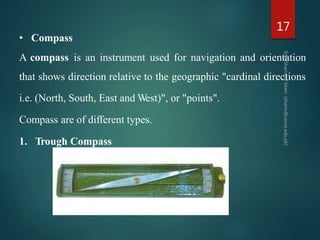
• Compass
A compass is an instrument used for navigation and orientation
that shows direction relative to the geographic "cardinal directions
i.e. (North, South, East and West)", or "points".
Compass are of different types.
1. Trough Compass
17
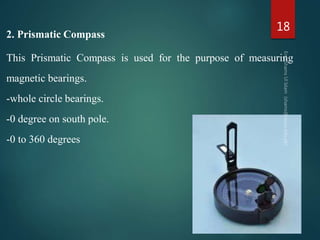
2. Prismatic Compass
This Prismatic Compass is used for the purpose of measuring
magnetic bearings.
-whole circle bearings.
-0 degree on south pole.
-0 to 360 degrees
18
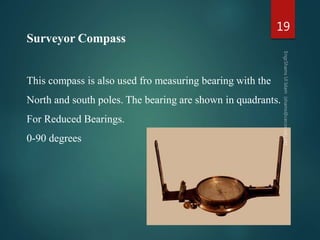
Surveyor Compass
This compass is also used fro measuring bearing with the
North and south poles. The bearing are shown in quadrants.
For Reduced Bearings.
0-90 degrees
19
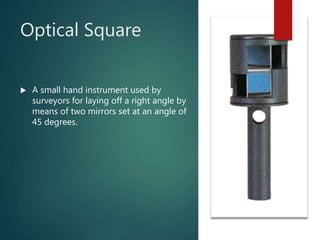
Optical Square
 A small hand instrument used by
surveyors for laying off a right angle by
means of two mirrors set at an angle of
45 degrees.
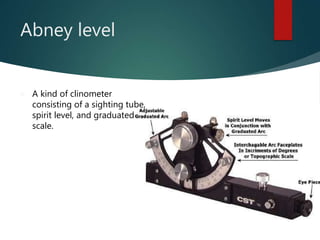
Abney level
 A kind of clinometer
consisting of a sighting tube,
spirit level, and graduated
scale.
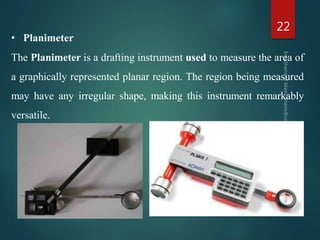
• Planimeter
The Planimeter is a drafting instrument used to measure the area of
a graphically represented planar region. The region being measured
may have any irregular shape, making this instrument remarkably
versatile.
22
• Bags
Used for keeping the instruments
like prism etc. safe.
• Field Book
Used for entering the
field data (measurements).
23
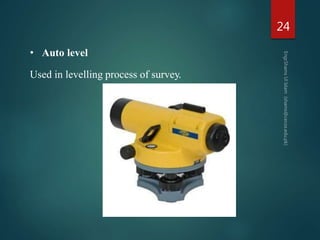
• Auto level
Used in levelling process of survey.
24
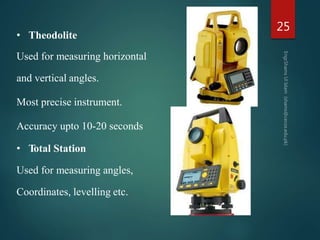
• Theodolite
Used for measuring horizontal
and vertical angles.
Most precise instrument.
Accuracy upto 10-20 seconds
• Total Station
Used for measuring angles,
Coordinates, levelling etc.
25
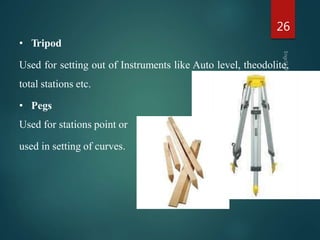
• Tripod
Used for setting out of Instruments like Auto level, theodolite,
total stations etc.
• Pegs
Used for stations point or
used in setting of curves.
26
• Scales
Used in plotting of surveying works
27
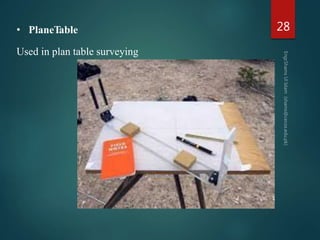
• PlaneTable
Used in plan table surveying
28
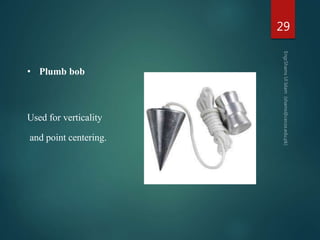
• Plumb bob
Used for verticality
and point centering.
29
Instruments for measuring
horizontal distances:
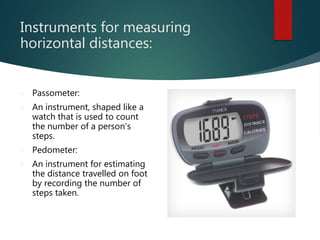
 Passometer:
 An instrument, shaped like a
watch that is used to count
the number of a person's
steps.
 Pedometer:
 An instrument for estimating
the distance travelled on foot
by recording the number of
steps taken.
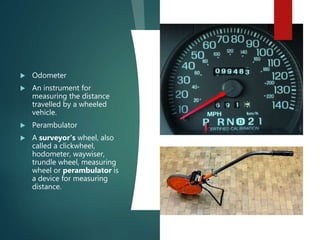
 Odometer
 An instrument for
measuring the distance
travelled by a wheeled
vehicle.
 Perambulator
 A surveyor's wheel, also
called a clickwheel,
hodometer, waywiser,
trundle wheel, measuring
wheel or perambulator is
a device for measuring
distance.
Extra Instruments.
 Line ranger
 Cross Staff
 Alidade
 Sextant
 French Cross Staff
 Geodimeter
 Fathometer
 Ghat Tracer
 Substense Bar
 Tellurometer
 Gradiometer.
 Tachometer

Surveying instruments with their uses

  • 1.
    Surveying 1 AWAIS AHMEDMIRZA LECTURER (BPS-18) @ CIVIL ENGINEERING DEPARTMENT, MEHRAN U.E.T., JAMSHORO.
  • 2.
    Outcomes:  You willhave knowledge about Surveying and Surveying’s Intruments that are used in fields.  You will learn different new terminologies about surveying.  This lecture would also help you for objective oriented study.  You will have to memorize some constants.
  • 3.
    Define Surveying?  Theart of determining the relative positions of different objects on the surface of earth or beneath the surface of earth, by measuring the horizontal distances between them ,and by preparing a map to any suitable scale is called surveying.
  • 4.
    Introduction to various SurveyingInstruments:  In Surveying, we measure horizontal distances, horizontal angels, vertical angles, levels and etc.
  • 5.
    Surveying Instruments 5 Differenttype of instruments used in surveying are • Chain Chain is an instrument used to measure linear distance in surveying.
  • 8.
    Chains  The chainis composed of 100 or 150 pieces of steel /iron which are also called links. The ends of each link are bent into a loop and connected together by means of three oval rings which give flexibility to the chain. The joints of the links are usually open, but in the best chains they are mostly welded.  The ends of the chain are provided with brass handless for dragging the chain on the ground, so that the chain can be turned round without twisting. The out side of the handle is the zero point or the end point of the chain and the length of the chain is measured from the out side of the one handle to the out side of the other. The length of the link is the distance between the centers of the two consecutive / continuous middle rings.
  • 9.
    Types of Chain Gunter’s Chain/Suveyor’s Chain It is 22 yards or 66 feet long and is divided into 100 links; the length of each link is 0.66 feet or 7.92 inches. Formerly it was mainly used in land surveying. It is very convenient for measuring distances in miles and furlongs and for measuring land when the unit of area is an acre on account of its simple relation to the mile and acre. 10 Gunter’s chain = 01 furlong 1 furlong= 660ft 80 Gunter’s chain = 01 mile 10 Square Gunter’s chain = 01 acre
  • 10.
    Revenue chain: This chainis commonly used for measuring fields in cadastral survey. It is 33 feet long and is divided into 16 links and each link is 2.0625 feet long. Engineering or Engineer’s Chain: The engineering chain is 100 feet long and is divided into 100 links; each link is 01 feet long. It is used in all engineering surveys. When long links are measured, it is more accurate than the Gunter’s chain, because of its greater length. The distances measured with the engineer’s chain are recorded in feet and decimals.
  • 11.
     Metric Chain: Those countries in which the meter is the unit of length, chains of 10, 20 and 30 meters are commonly used. The 20-meter chain which is in most common chain use is divided into 100 links.  30 meter chain into 150 links  Each link 20 cm  In 1 meter =5 links
  • 12.
    Tapes  Accurate measurementsare carried out through tape in survey.  Lighter in weight.  Easier to handle than chain  Types  Cloth or linen tape  Invar tape( Metallic-nickel)  Steel tape(Cloth wire)  Fiberglass tape
  • 13.
    Clinometer  An instrumentused by surveyors in order to measure an angle of inclination or elevation.
  • 15.
    • Staff rod/Levelling rods Used with auto level in measuring the levels of different points or objects. 15
  • 16.
    • Ranging Rods Theserods are used in surveying for stationing and ranging of lines. For Ranging atleast 3 rods • Reflector/Prism Used in total station Surveying as shown in figure 16
  • 17.
    • Compass A compassis an instrument used for navigation and orientation that shows direction relative to the geographic "cardinal directions i.e. (North, South, East and West)", or "points". Compass are of different types. 1. Trough Compass 17
  • 18.
    2. Prismatic Compass ThisPrismatic Compass is used for the purpose of measuring magnetic bearings. -whole circle bearings. -0 degree on south pole. -0 to 360 degrees 18
  • 19.
    Surveyor Compass This compassis also used fro measuring bearing with the North and south poles. The bearing are shown in quadrants. For Reduced Bearings. 0-90 degrees 19
  • 20.
    Optical Square  Asmall hand instrument used by surveyors for laying off a right angle by means of two mirrors set at an angle of 45 degrees.
  • 21.
    Abney level  Akind of clinometer consisting of a sighting tube, spirit level, and graduated scale.
  • 22.
    • Planimeter The Planimeteris a drafting instrument used to measure the area of a graphically represented planar region. The region being measured may have any irregular shape, making this instrument remarkably versatile. 22
  • 23.
    • Bags Used forkeeping the instruments like prism etc. safe. • Field Book Used for entering the field data (measurements). 23
  • 24.
    • Auto level Usedin levelling process of survey. 24
  • 25.
    • Theodolite Used formeasuring horizontal and vertical angles. Most precise instrument. Accuracy upto 10-20 seconds • Total Station Used for measuring angles, Coordinates, levelling etc. 25
  • 26.
    • Tripod Used forsetting out of Instruments like Auto level, theodolite, total stations etc. • Pegs Used for stations point or used in setting of curves. 26
  • 27.
    • Scales Used inplotting of surveying works 27
  • 28.
    • PlaneTable Used inplan table surveying 28
  • 29.
    • Plumb bob Usedfor verticality and point centering. 29
  • 30.
    Instruments for measuring horizontaldistances:  Passometer:  An instrument, shaped like a watch that is used to count the number of a person's steps.  Pedometer:  An instrument for estimating the distance travelled on foot by recording the number of steps taken.
  • 31.
     Odometer  Aninstrument for measuring the distance travelled by a wheeled vehicle.  Perambulator  A surveyor's wheel, also called a clickwheel, hodometer, waywiser, trundle wheel, measuring wheel or perambulator is a device for measuring distance.
  • 32.
    Extra Instruments.  Lineranger  Cross Staff  Alidade  Sextant  French Cross Staff  Geodimeter  Fathometer  Ghat Tracer  Substense Bar  Tellurometer  Gradiometer.  Tachometer