HRM policies & practices
Introduction to course
• Nature and scope of HRM
• Challenges in HRM
• An investment perspective of HRM
• Human resource planning
• Job analysis & job design
• Recruitment & selection
• Inducting & placing new hires
• Performance appraisal
• Compensation management (components of remuneration, incentives,
benefits & services, fringe benefits, perquisites, top executives
remuneration)
• Health & safe environment
• Managing separations & rightsizing
• Industrial relations
• Trade unions
• Resolving disputes
• Labour laws in Pakistan
• Equal employment practices in Pakistan
• International human resource management
• Evaluating HR effectiveness
Lecture Overview
HRM Definition
Scope of HRM
Difference between HRM and PM
Functions of HRM Department
HRM Functions and Objectives
CHAPTER 1
Understanding the nature & scope of hrm
Overview
•What is HRM?
•Hrm activities
•Scope of HRM
•Difference between HRM &
PM
•HRM objectives and functions
HUMAN RESOURCE MANAGEMENT (HRM)
HRM definition
“HRM is management function
concerned with hiring, motivating
& maintaining people in an
organization. It focuses on people
in organization”.
(Aswathappa, 2008, pg.5)
HRM: peoples dimensions in organizations
 HRM: application of management functions & principles
related to employees
 HRM functions applicable every where(not for profit & profit
driven organizations)
 Employees decisions are integrated
 Employee decision brings effectiveness/efficiency in
organization
 HRM includes all major activities in professional life of a
worker
 All activities from employee entry to managing performance &
training until he/she leaves
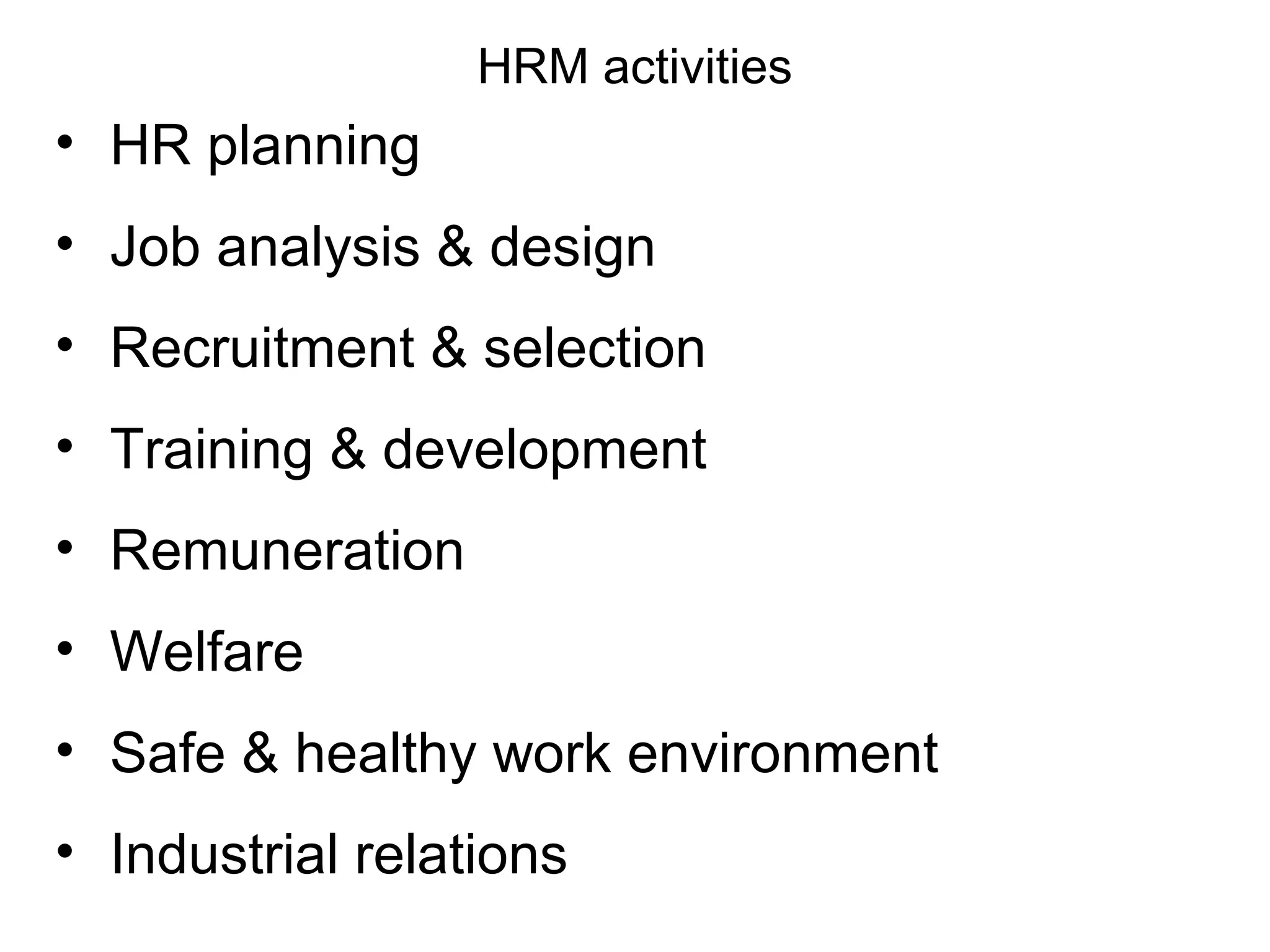
HRM activities
• HR planning
• Job analysis & design
• Recruitment & selection
• Training & development
• Remuneration
• Welfare
• Safe & healthy work environment
• Industrial relations
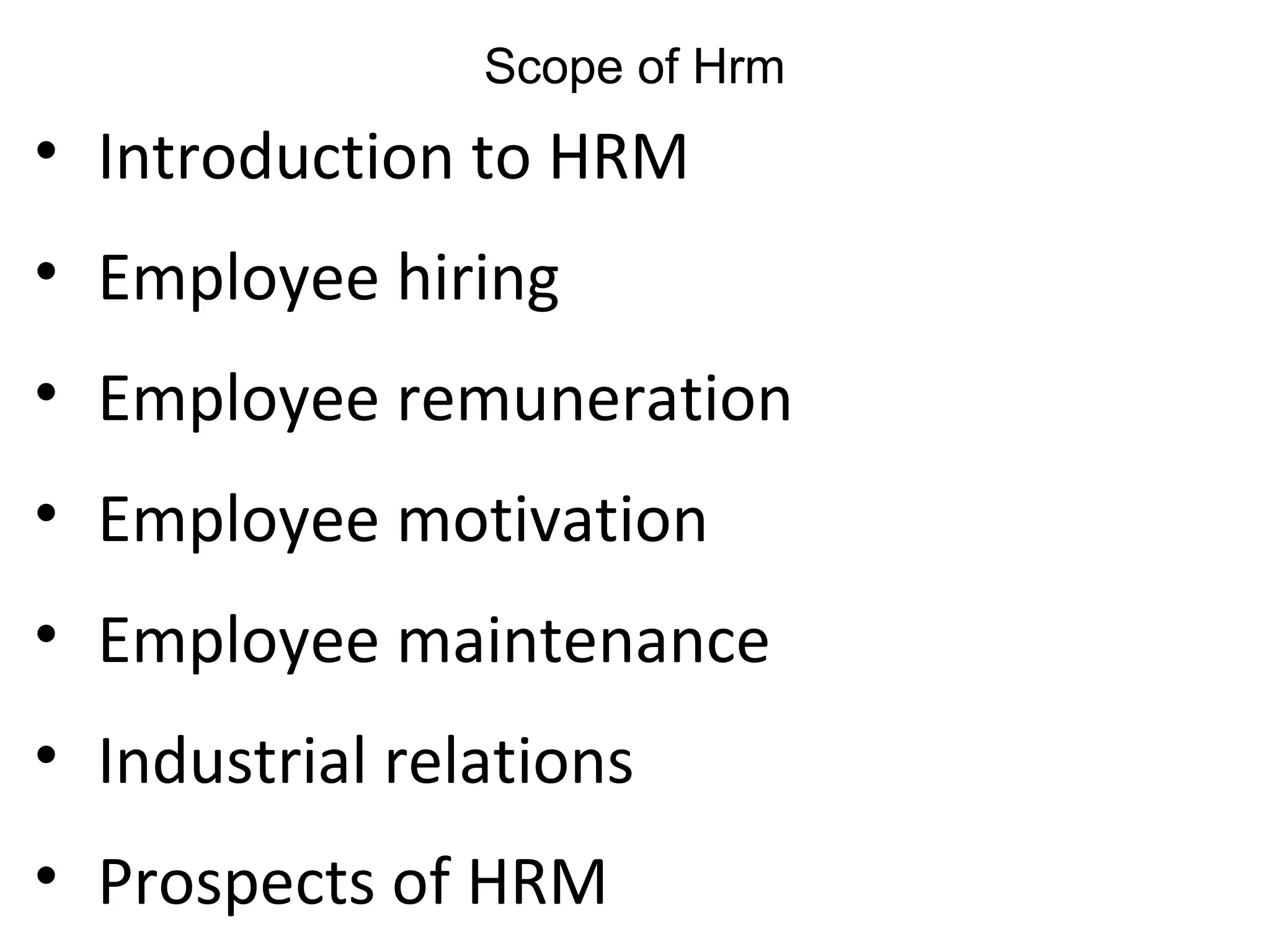
Scope of Hrm
• Introduction to HRM
• Employee hiring
• Employee remuneration
• Employee motivation
• Employee maintenance
• Industrial relations
• Prospects of HRM
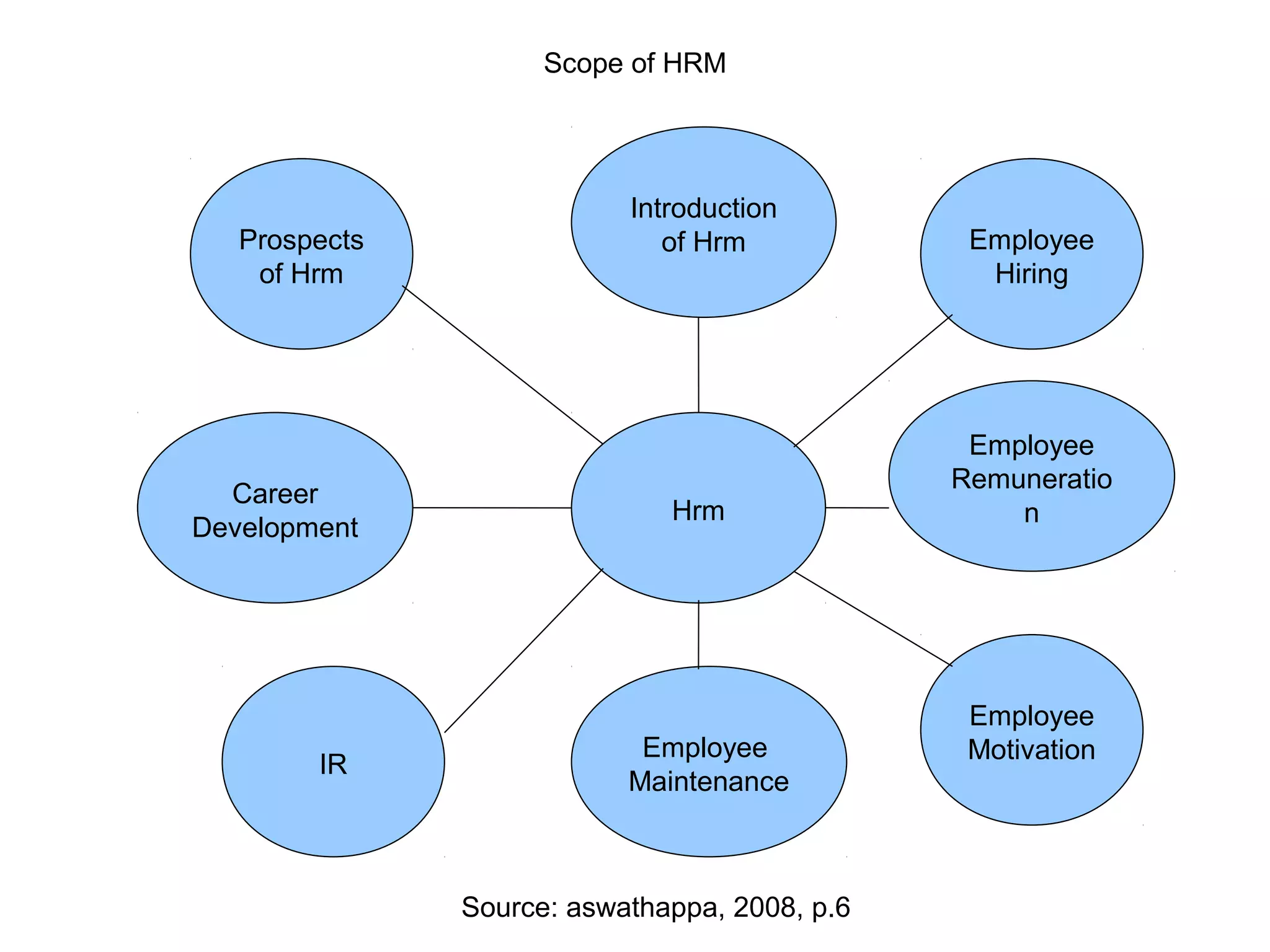
Scope of HRM
Hrm
Prospects
of Hrm
IR
Career
Development
Introduction
of Hrm Employee
Hiring
Employee
Remuneratio
n
Employee
MotivationEmployee
Maintenance
Source: aswathappa, 2008, p.6
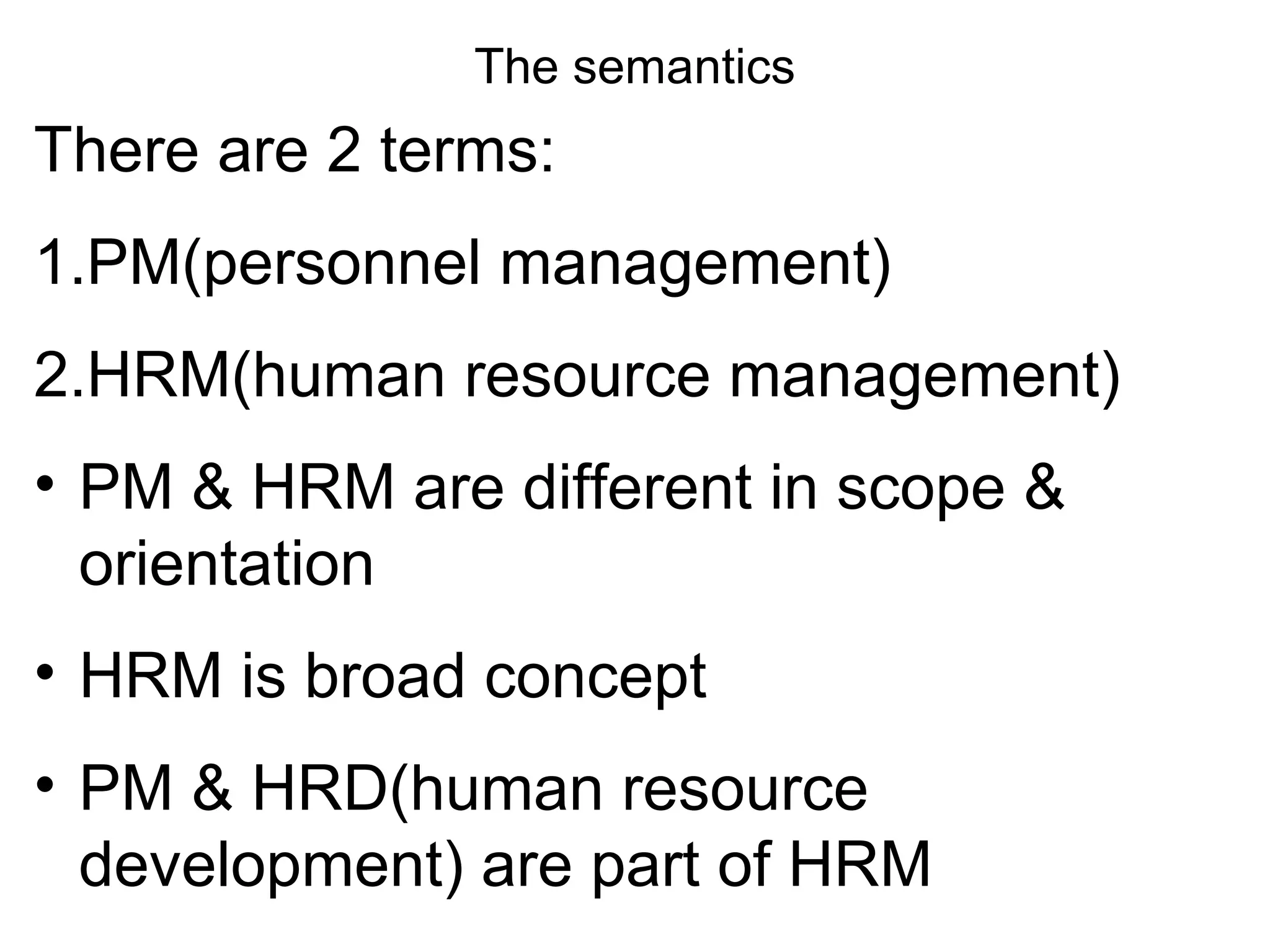
The semantics
There are 2 terms:
1.PM(personnel management)
2.HRM(human resource management)
• PM & HRM are different in scope &
orientation
• HRM is broad concept
• PM & HRD(human resource
development) are part of HRM
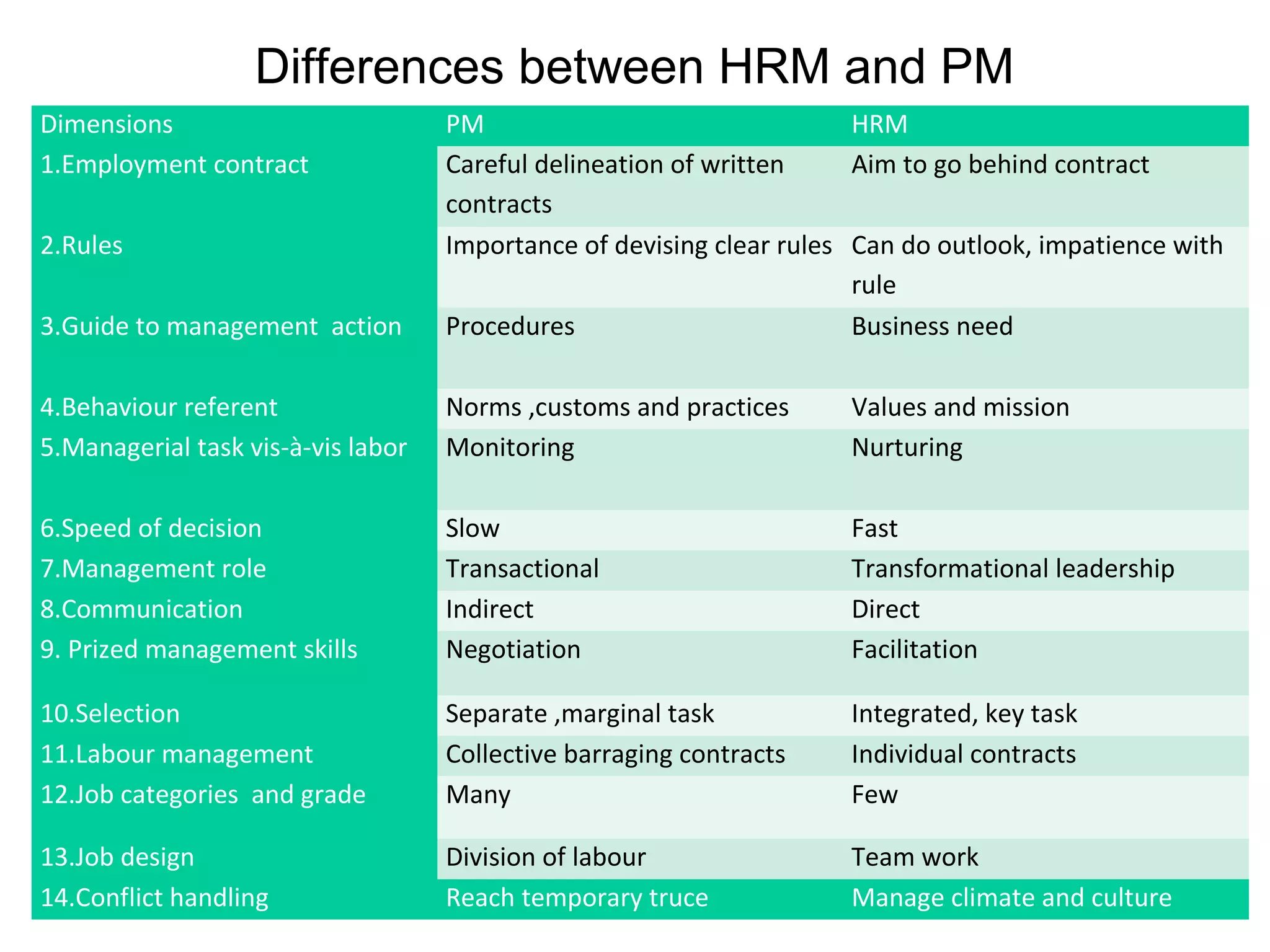
Differences between HRM and PM
Dimensions PM HRM
1.Employment contract Careful delineation of written
contracts
Aim to go behind contract
2.Rules Importance of devising clear rules Can do outlook, impatience with
rule
3.Guide to management action Procedures Business need
4.Behaviour referent Norms ,customs and practices Values and mission
5.Managerial task vis-à-vis labor Monitoring Nurturing
6.Speed of decision Slow Fast
7.Management role Transactional Transformational leadership
8.Communication Indirect Direct
9. Prized management skills Negotiation Facilitation
10.Selection Separate ,marginal task Integrated, key task
11.Labour management Collective barraging contracts Individual contracts
12.Job categories and grade Many Few
13.Job design Division of labour Team work
14.Conflict handling Reach temporary truce Manage climate and culture
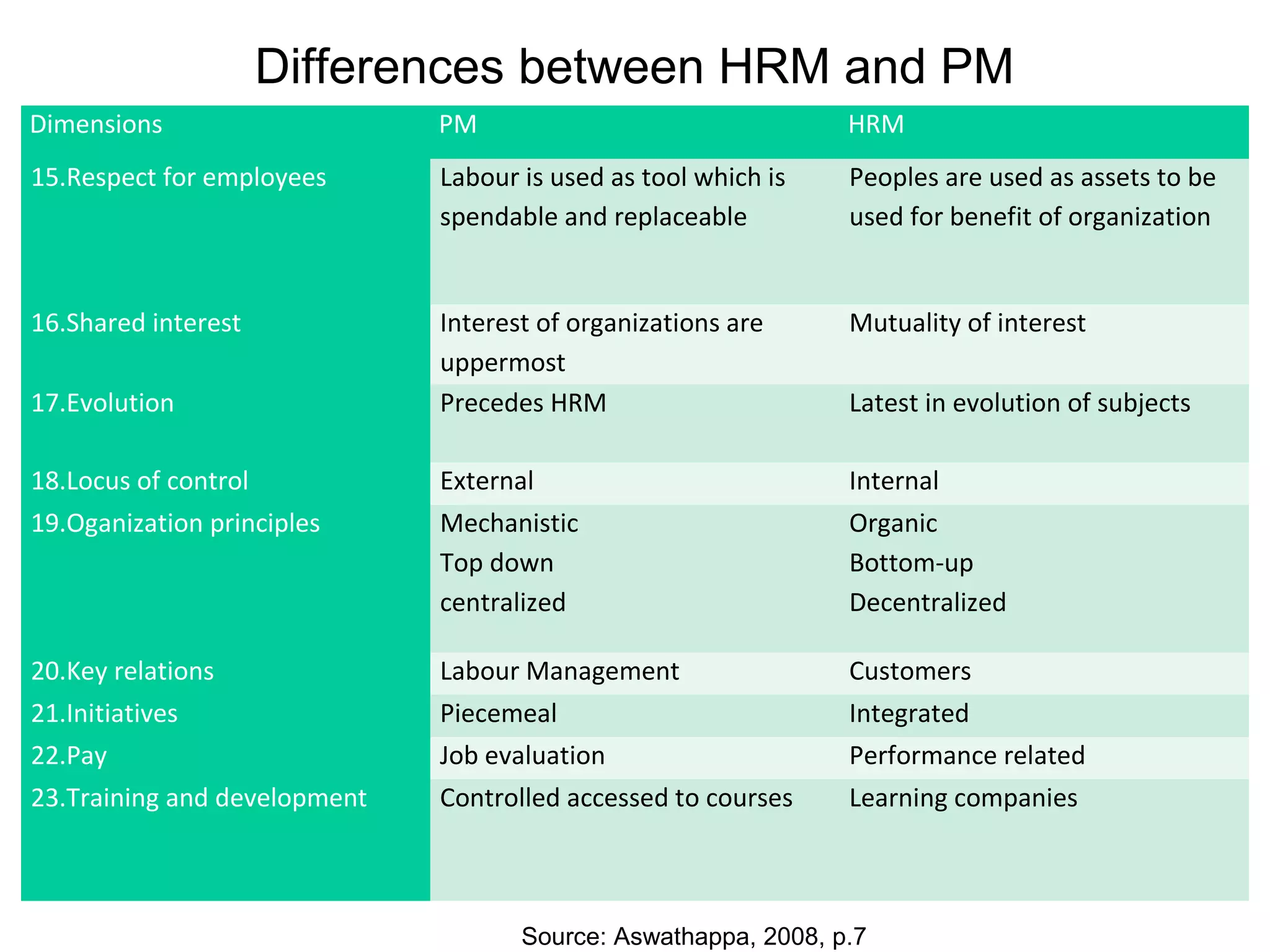
Differences between HRM and PM
Dimensions PM HRM
15.Respect for employees Labour is used as tool which is
spendable and replaceable
Peoples are used as assets to be
used for benefit of organization
16.Shared interest Interest of organizations are
uppermost
Mutuality of interest
17.Evolution Precedes HRM Latest in evolution of subjects
18.Locus of control External Internal
19.Oganization principles Mechanistic
Top down
centralized
Organic
Bottom-up
Decentralized
20.Key relations Labour Management Customers
21.Initiatives Piecemeal Integrated
22.Pay Job evaluation Performance related
23.Training and development Controlled accessed to courses Learning companies
Source: Aswathappa, 2008, p.7
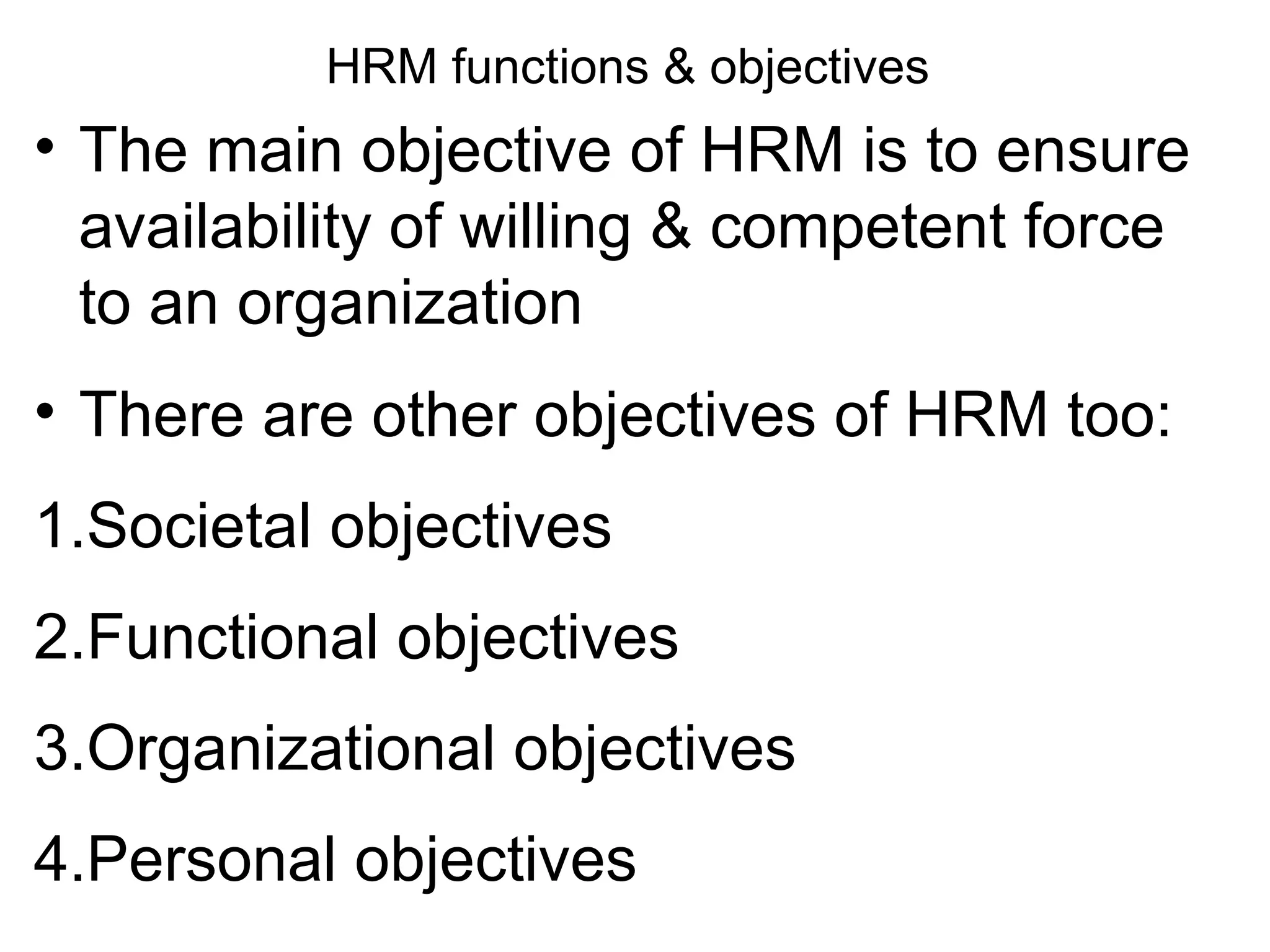
HRM functions & objectives
• The main objective of HRM is to ensure
availability of willing & competent force
to an organization
• There are other objectives of HRM too:
1.Societal objectives
2.Functional objectives
3.Organizational objectives
4.Personal objectives
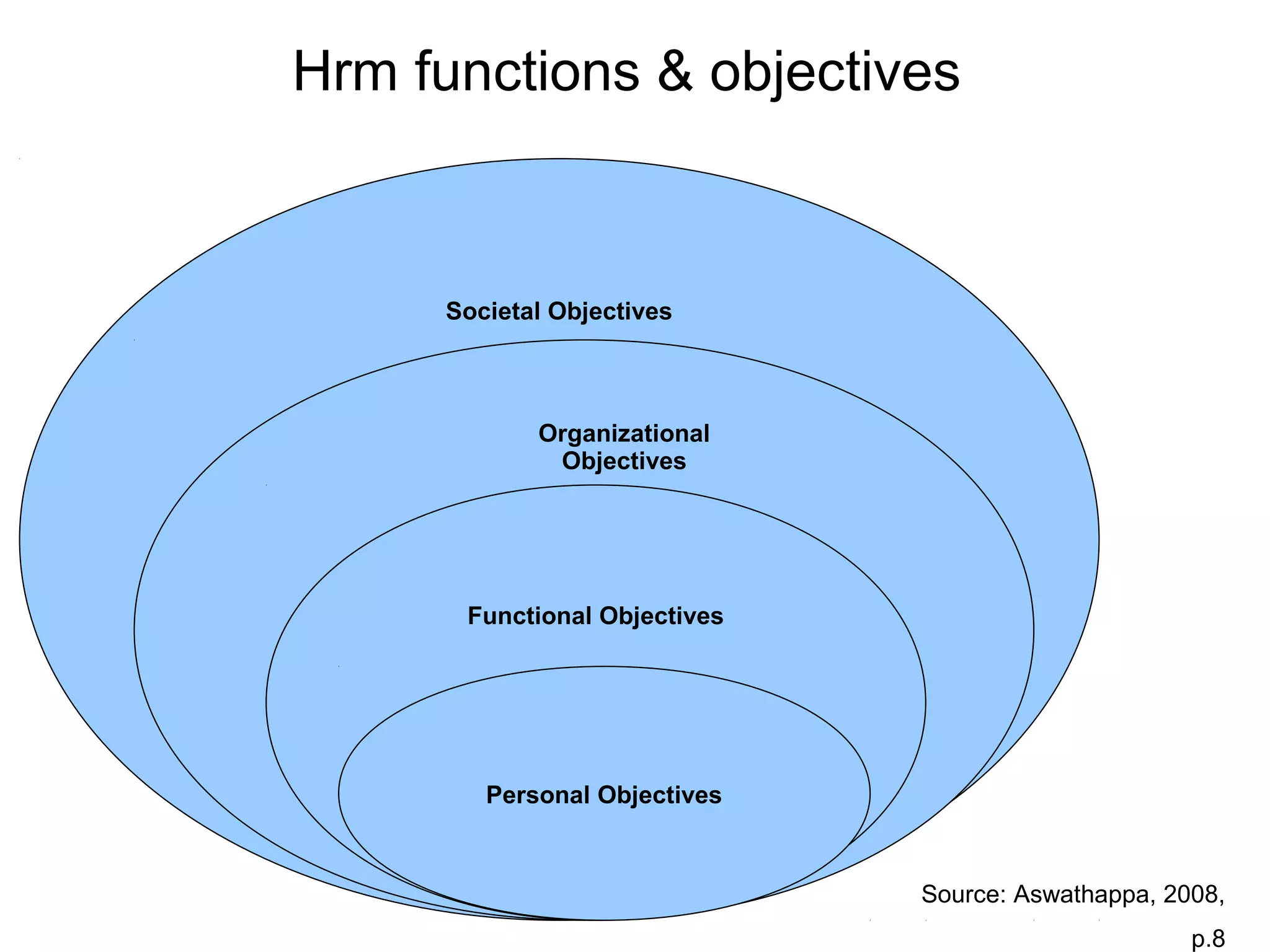
Hrm functions & objectives
Societal Objectives
Functional Objectives
Personal Objectives
Source: Aswathappa, 2008,
p.8
Organizational
Objectives
HRM functions & objectives
1. Societal objectives:
• Societal objectives of HRM make sure that
organization is socially & ethically responsible
• Minimizing negative impact of societal
demands on organizations
• For example: EOE laws forces organizations
to be ethical in recruitment, to minimize
discrimination against hiring based on
ethnicity, race, religion, etc.
2. Organizational objectives:
• To determine role of HRM in
organizational effectiveness
• Its purpose is to assist/serve
organization
• HR department also serve
other departments
3. Functional objectives:
• To maintain departmental
contribution in organizational
effectiveness
• HR department services must
fit into organizational needs
4. Personal objectives:
• To assist employees in achieving their
personal/individual goals
• Maximum contribution to organization
• Personal objectives are achieved when
employees are satisfied, motivated &
retained
• Satisfied employees give excellent
services& leads to excellent
organizational performance
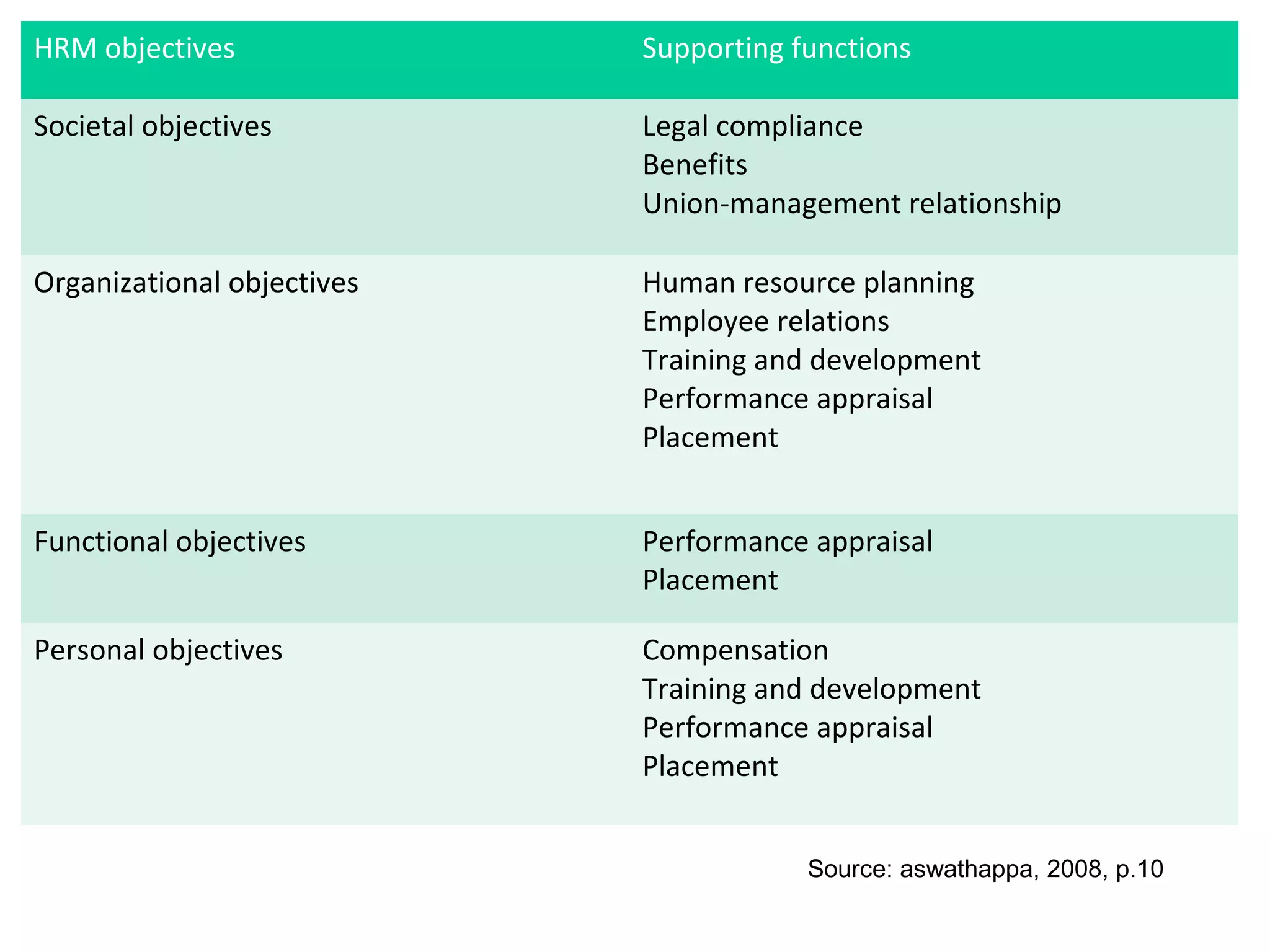
HRM objectives Supporting functions
Societal objectives Legal compliance
Benefits
Union-management relationship
Organizational objectives Human resource planning
Employee relations
Training and development
Performance appraisal
Placement
Functional objectives Performance appraisal
Placement
Personal objectives Compensation
Training and development
Performance appraisal
Placement
Source: aswathappa, 2008, p.10
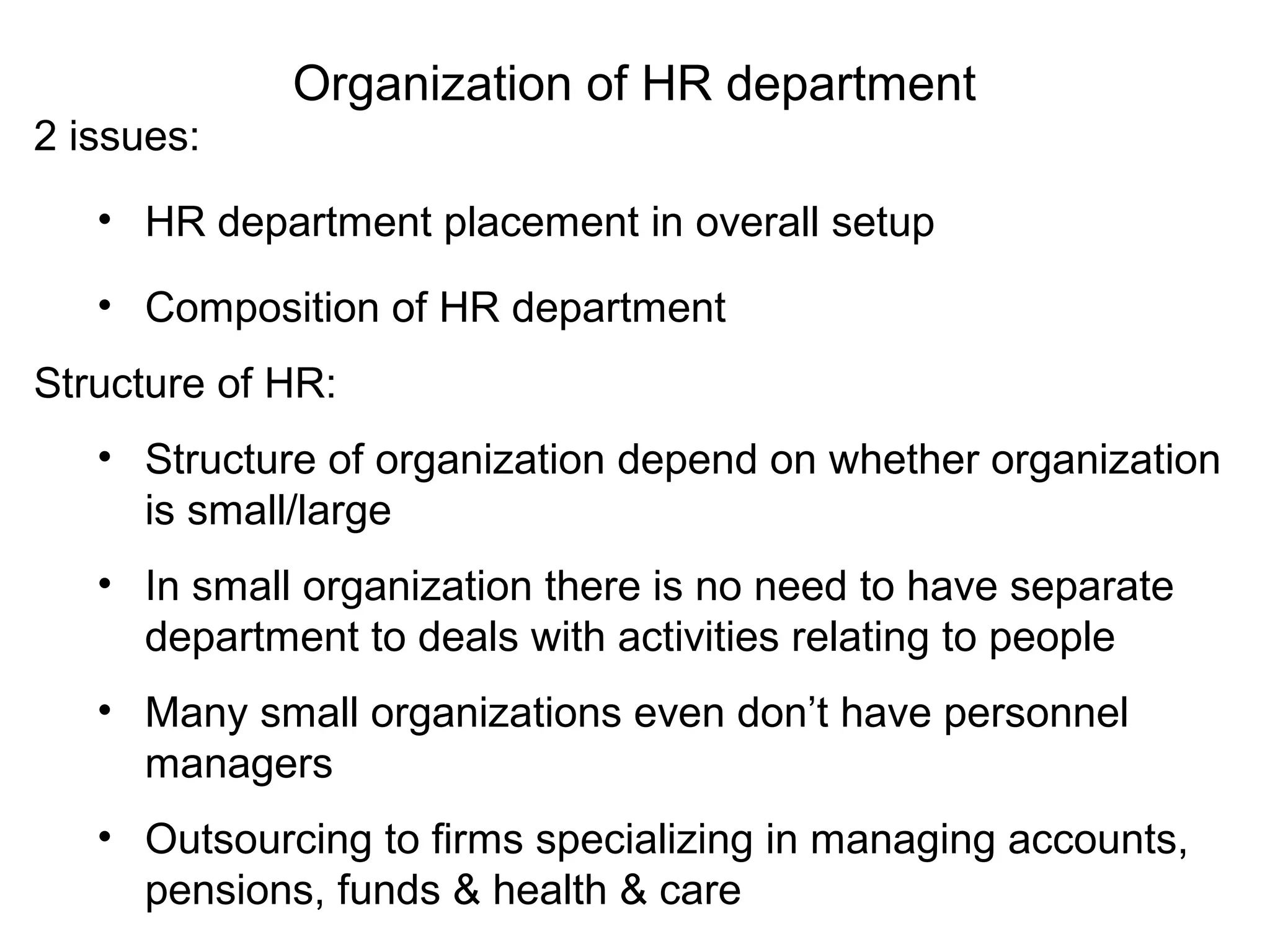
Organization of HR department
2 issues:
• HR department placement in overall setup
• Composition of HR department
Structure of HR:
• Structure of organization depend on whether organization
is small/large
• In small organization there is no need to have separate
department to deals with activities relating to people
• Many small organizations even don’t have personnel
managers
• Outsourcing to firms specializing in managing accounts,
pensions, funds & health & care
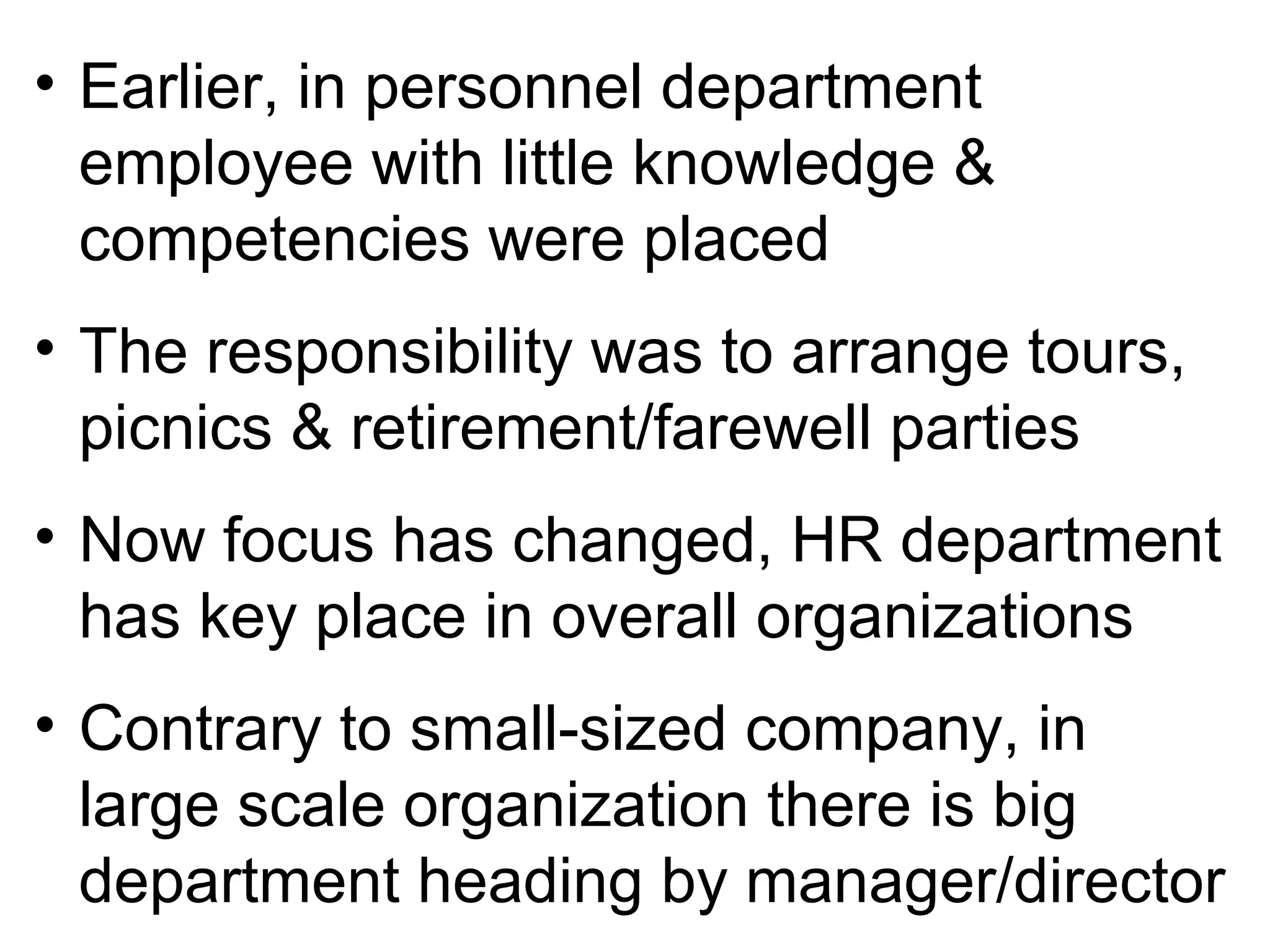
• Earlier, in personnel department
employee with little knowledge &
competencies were placed
• The responsibility was to arrange tours,
picnics & retirement/farewell parties
• Now focus has changed, HR department
has key place in overall organizations
• Contrary to small-sized company, in
large scale organization there is big
department heading by manager/director
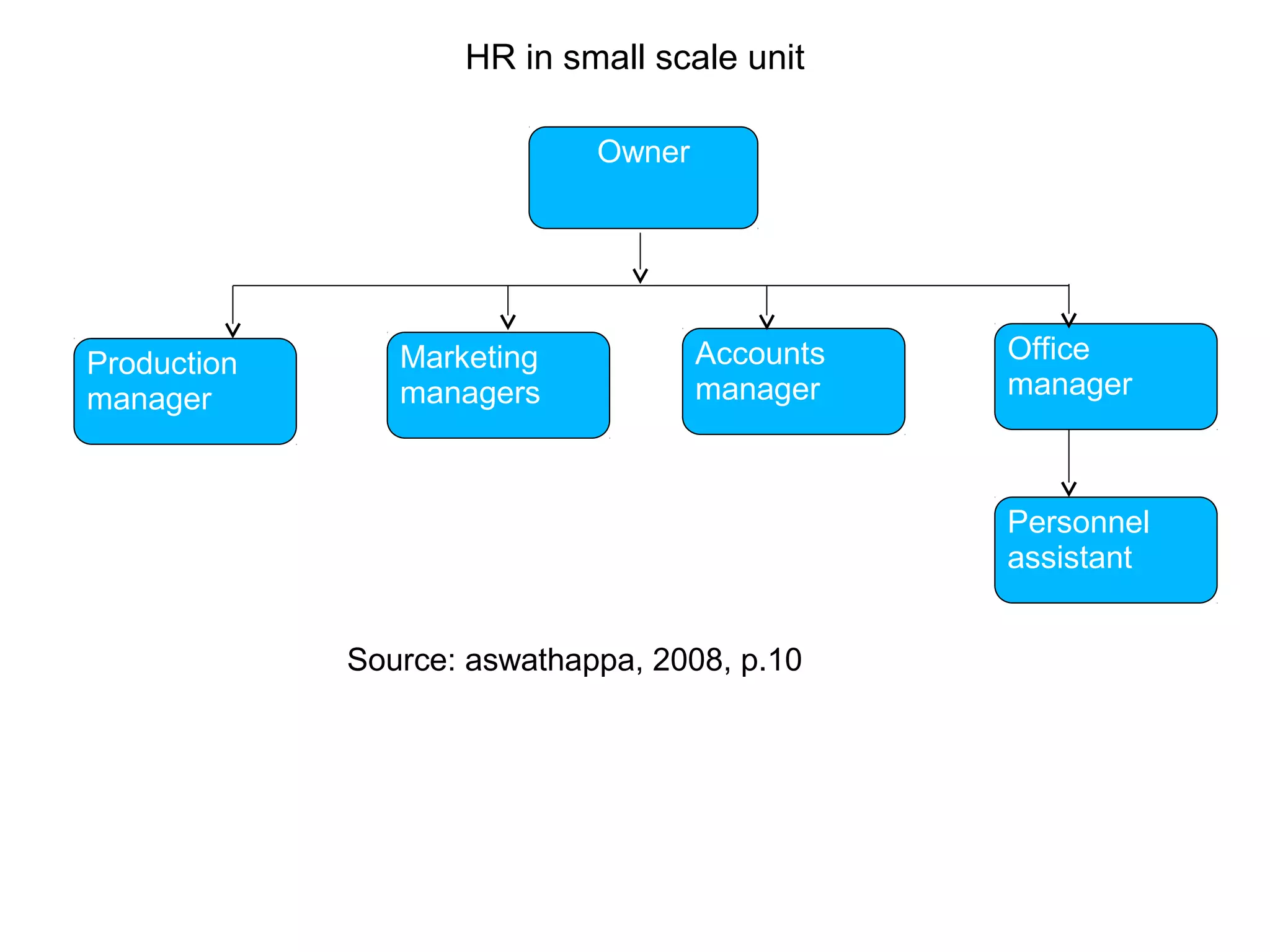
HR in small scale unit
Source: aswathappa, 2008, p.10
Owner
Production
manager
Personnel
assistant
Office
manager
Accounts
manager
Marketing
managers
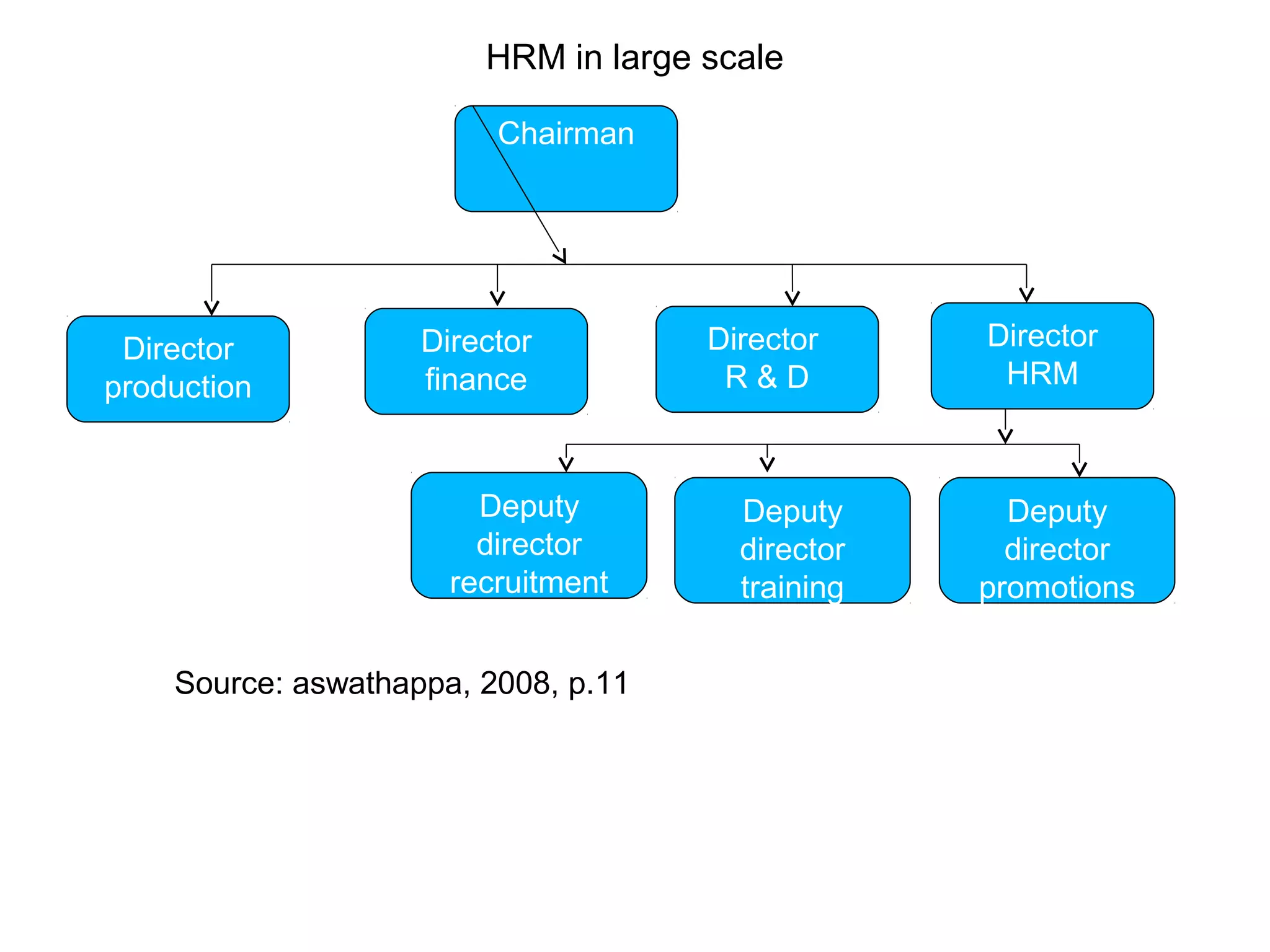
HRM in large scale
Source: aswathappa, 2008, p.11
Chairman
Deputy
director
training
Director
HRM
Director
R & D
Director
finance
Director
production
Deputy
director
recruitment
Deputy
director
promotions
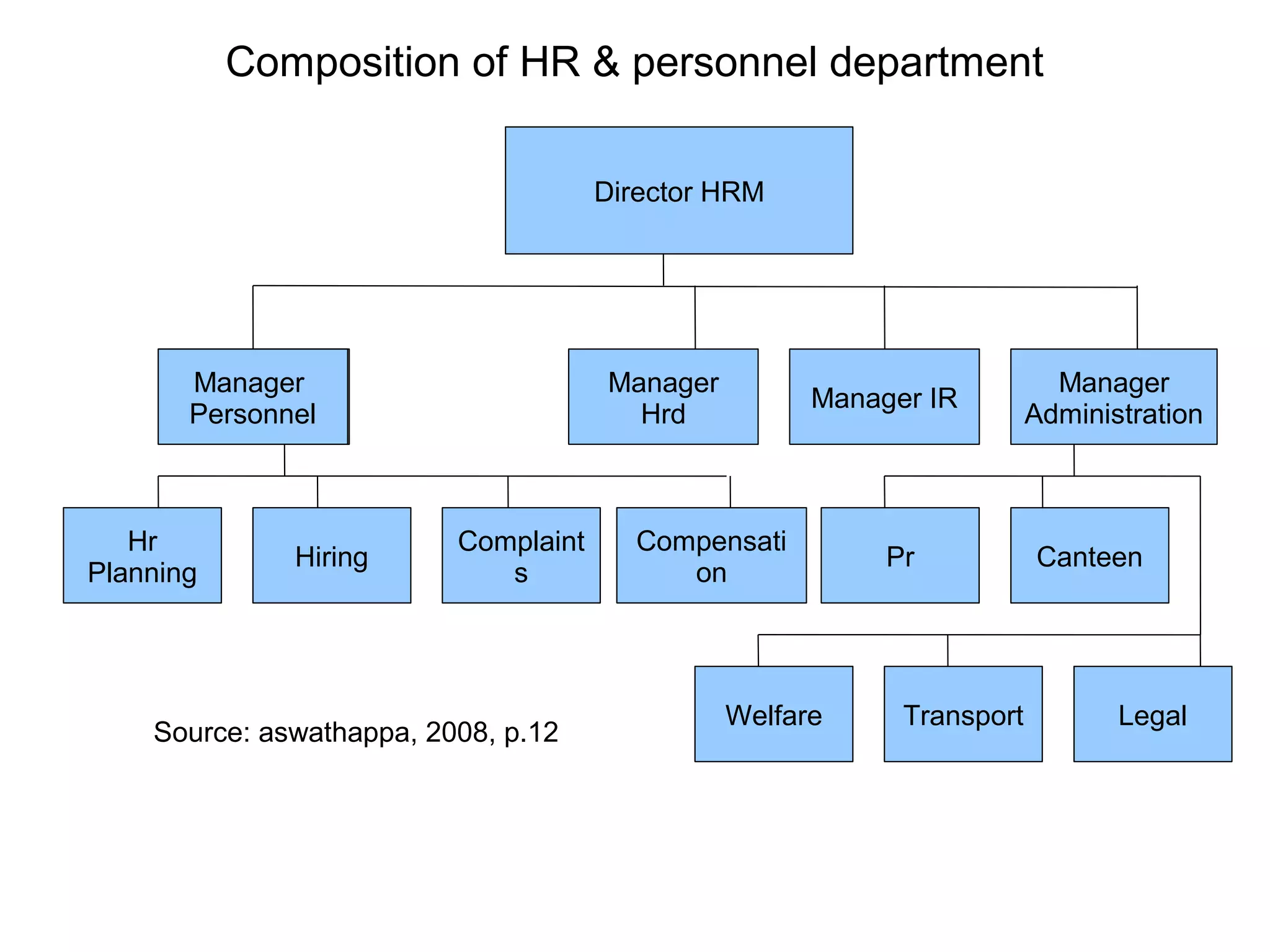
Composition of HR & personnel department
Director
HRM
Director HRM
Manager
Personnel
Manager
Administration
Manager
Hrd
Manager IR
Hr
Planning
Hiring
Complaint
s
Compensati
on
Pr Canteen
Welfare Transport Legal
Source: aswathappa, 2008, p.12
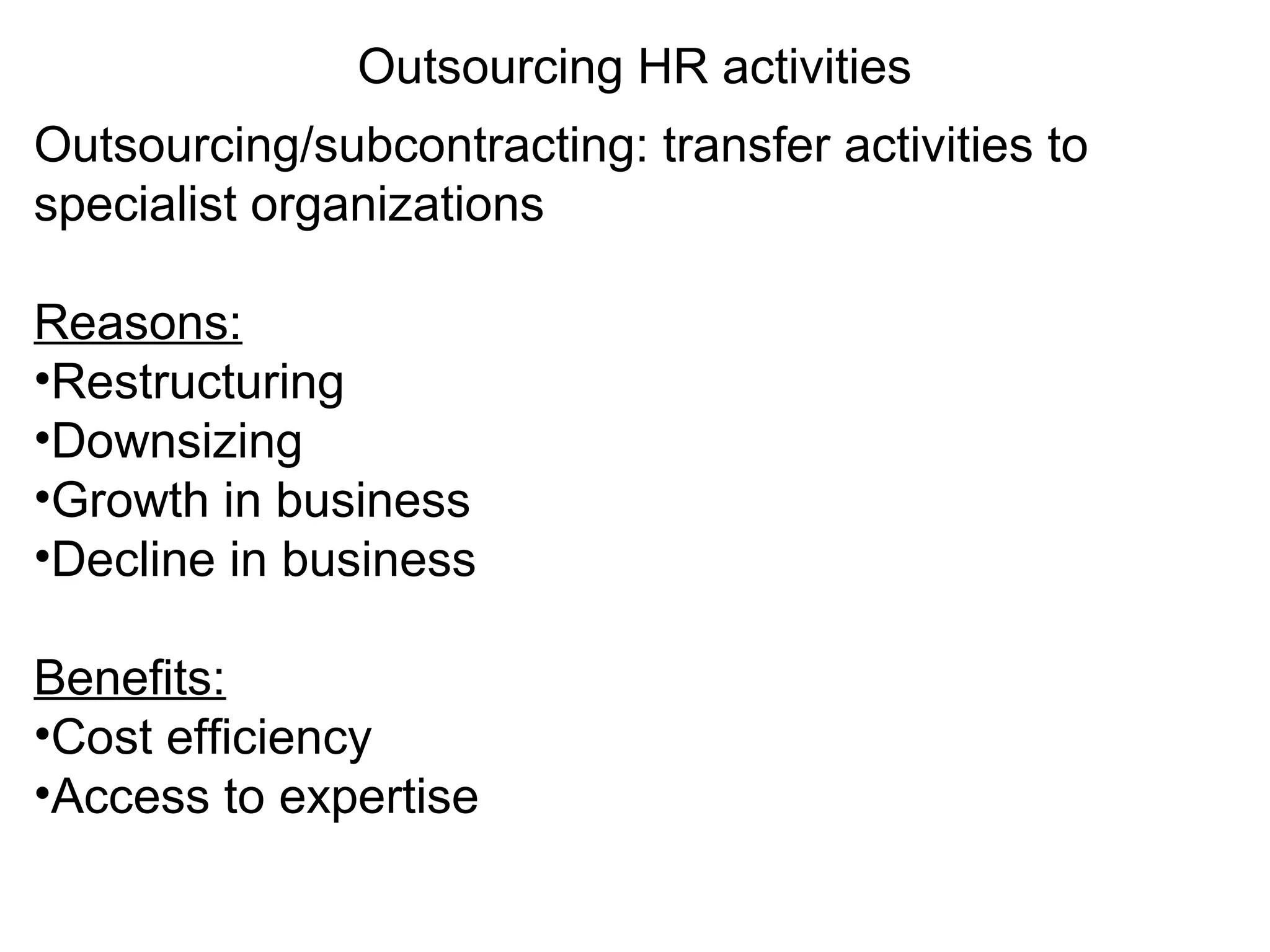
Outsourcing HR activities
Outsourcing/subcontracting: transfer activities to
specialist organizations
Reasons:
•Restructuring
•Downsizing
•Growth in business
•Decline in business
Benefits:
•Cost efficiency
•Access to expertise

Lecture 1 new

  • 1.
    HRM policies &practices
  • 2.
    Introduction to course •Nature and scope of HRM • Challenges in HRM • An investment perspective of HRM • Human resource planning • Job analysis & job design • Recruitment & selection • Inducting & placing new hires • Performance appraisal • Compensation management (components of remuneration, incentives, benefits & services, fringe benefits, perquisites, top executives remuneration)
  • 3.
    • Health &safe environment • Managing separations & rightsizing • Industrial relations • Trade unions • Resolving disputes • Labour laws in Pakistan • Equal employment practices in Pakistan • International human resource management • Evaluating HR effectiveness
  • 4.
    Lecture Overview HRM Definition Scopeof HRM Difference between HRM and PM Functions of HRM Department HRM Functions and Objectives
  • 5.
    CHAPTER 1 Understanding thenature & scope of hrm
  • 6.
    Overview •What is HRM? •Hrmactivities •Scope of HRM •Difference between HRM & PM •HRM objectives and functions
  • 7.
    HUMAN RESOURCE MANAGEMENT(HRM) HRM definition “HRM is management function concerned with hiring, motivating & maintaining people in an organization. It focuses on people in organization”. (Aswathappa, 2008, pg.5)
  • 8.
    HRM: peoples dimensionsin organizations  HRM: application of management functions & principles related to employees  HRM functions applicable every where(not for profit & profit driven organizations)  Employees decisions are integrated  Employee decision brings effectiveness/efficiency in organization  HRM includes all major activities in professional life of a worker  All activities from employee entry to managing performance & training until he/she leaves
  • 9.
    HRM activities • HRplanning • Job analysis & design • Recruitment & selection • Training & development • Remuneration • Welfare • Safe & healthy work environment • Industrial relations
  • 10.
    Scope of Hrm •Introduction to HRM • Employee hiring • Employee remuneration • Employee motivation • Employee maintenance • Industrial relations • Prospects of HRM
  • 11.
    Scope of HRM Hrm Prospects ofHrm IR Career Development Introduction of Hrm Employee Hiring Employee Remuneratio n Employee MotivationEmployee Maintenance Source: aswathappa, 2008, p.6
  • 12.
    The semantics There are2 terms: 1.PM(personnel management) 2.HRM(human resource management) • PM & HRM are different in scope & orientation • HRM is broad concept • PM & HRD(human resource development) are part of HRM
  • 13.
    Differences between HRMand PM Dimensions PM HRM 1.Employment contract Careful delineation of written contracts Aim to go behind contract 2.Rules Importance of devising clear rules Can do outlook, impatience with rule 3.Guide to management action Procedures Business need 4.Behaviour referent Norms ,customs and practices Values and mission 5.Managerial task vis-à-vis labor Monitoring Nurturing 6.Speed of decision Slow Fast 7.Management role Transactional Transformational leadership 8.Communication Indirect Direct 9. Prized management skills Negotiation Facilitation 10.Selection Separate ,marginal task Integrated, key task 11.Labour management Collective barraging contracts Individual contracts 12.Job categories and grade Many Few 13.Job design Division of labour Team work 14.Conflict handling Reach temporary truce Manage climate and culture
  • 14.
    Differences between HRMand PM Dimensions PM HRM 15.Respect for employees Labour is used as tool which is spendable and replaceable Peoples are used as assets to be used for benefit of organization 16.Shared interest Interest of organizations are uppermost Mutuality of interest 17.Evolution Precedes HRM Latest in evolution of subjects 18.Locus of control External Internal 19.Oganization principles Mechanistic Top down centralized Organic Bottom-up Decentralized 20.Key relations Labour Management Customers 21.Initiatives Piecemeal Integrated 22.Pay Job evaluation Performance related 23.Training and development Controlled accessed to courses Learning companies Source: Aswathappa, 2008, p.7
  • 15.
    HRM functions &objectives • The main objective of HRM is to ensure availability of willing & competent force to an organization • There are other objectives of HRM too: 1.Societal objectives 2.Functional objectives 3.Organizational objectives 4.Personal objectives
  • 16.
    Hrm functions &objectives Societal Objectives Functional Objectives Personal Objectives Source: Aswathappa, 2008, p.8 Organizational Objectives
  • 17.
    HRM functions &objectives 1. Societal objectives: • Societal objectives of HRM make sure that organization is socially & ethically responsible • Minimizing negative impact of societal demands on organizations • For example: EOE laws forces organizations to be ethical in recruitment, to minimize discrimination against hiring based on ethnicity, race, religion, etc.
  • 18.
    2. Organizational objectives: •To determine role of HRM in organizational effectiveness • Its purpose is to assist/serve organization • HR department also serve other departments
  • 19.
    3. Functional objectives: •To maintain departmental contribution in organizational effectiveness • HR department services must fit into organizational needs
  • 20.
    4. Personal objectives: •To assist employees in achieving their personal/individual goals • Maximum contribution to organization • Personal objectives are achieved when employees are satisfied, motivated & retained • Satisfied employees give excellent services& leads to excellent organizational performance
  • 21.
    HRM objectives Supportingfunctions Societal objectives Legal compliance Benefits Union-management relationship Organizational objectives Human resource planning Employee relations Training and development Performance appraisal Placement Functional objectives Performance appraisal Placement Personal objectives Compensation Training and development Performance appraisal Placement Source: aswathappa, 2008, p.10
  • 22.
    Organization of HRdepartment 2 issues: • HR department placement in overall setup • Composition of HR department Structure of HR: • Structure of organization depend on whether organization is small/large • In small organization there is no need to have separate department to deals with activities relating to people • Many small organizations even don’t have personnel managers • Outsourcing to firms specializing in managing accounts, pensions, funds & health & care
  • 23.
    • Earlier, inpersonnel department employee with little knowledge & competencies were placed • The responsibility was to arrange tours, picnics & retirement/farewell parties • Now focus has changed, HR department has key place in overall organizations • Contrary to small-sized company, in large scale organization there is big department heading by manager/director
  • 24.
    HR in smallscale unit Source: aswathappa, 2008, p.10 Owner Production manager Personnel assistant Office manager Accounts manager Marketing managers
  • 25.
    HRM in largescale Source: aswathappa, 2008, p.11 Chairman Deputy director training Director HRM Director R & D Director finance Director production Deputy director recruitment Deputy director promotions
  • 26.
    Composition of HR& personnel department Director HRM Director HRM Manager Personnel Manager Administration Manager Hrd Manager IR Hr Planning Hiring Complaint s Compensati on Pr Canteen Welfare Transport Legal Source: aswathappa, 2008, p.12
  • 27.
    Outsourcing HR activities Outsourcing/subcontracting:transfer activities to specialist organizations Reasons: •Restructuring •Downsizing •Growth in business •Decline in business Benefits: •Cost efficiency •Access to expertise