 Policies are broad guidelines as to how the objectives
of a business are to be achieved.
 “Personnel policies lay down the decision making
criteria in line with the overall purpose of the
organisation in the area of Human Resource
Management.”
 A policy is designed to guide the organisational
members to deal with a particular situation in a
particular manner. It delimits the area within which a
decision is to be made and assures that the decision
will be consistent with and contributive to business
objectives.
1
The policies are needed in various areas of personnel management
such as recruitment, employment, training, placement, transfer
and promotion, compensation, performance appraisal, welfare, etc.
Thus, following steps are taken while formulating personnel
policies:
1. Preliminary Investigation
2. Environment scanning
3. Identification of Policy areas
4. Analysis of Alternative policies
5. Participation of Lower Levels
6. Approval of Top Management
7. Implementation of Policy
8. Policy Appraisal
2
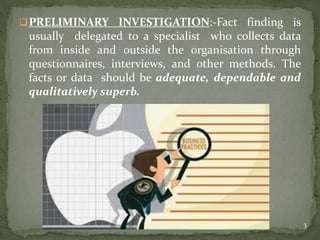
PRELIMINARY INVESTIGATION:-Fact finding is
usually delegated to a specialist who collects data
from inside and outside the organisation through
questionnaires, interviews, and other methods. The
facts or data should be adequate, dependable and
qualitatively superb.
3
4
ENVIRONMENT
SCANNING:-The policy
committee should carefully
analyse the information
available with it. The whole
information may be divided
into internal environment
and external environment.
Internal environment deals
with physical resources,
human resources,
organisational structure,
values and beliefs, etc.
External environment
relates to
Social, political, economic, and technological
conditions in the country. Monitoring and predicting
the environmental changes are important for policy
formulation.
IDENTIFICATION OF POLICY AREAS:-In
formulating policies, it is essential to specify clearly
the areas needing policies.The benefit of specifying
area needing policies is that it will help in collecting
right type of information.The information may be
collected from company’s manuals and other
publications, key executives and the publications of
government, trade associations, trade unions and
other sources.
5
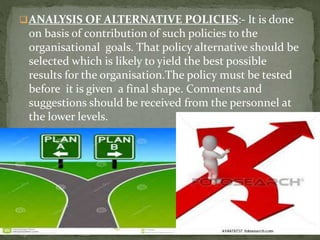
ANALYSIS OF ALTERNATIVE POLICIES:- It is done
on basis of contribution of such policies to the
organisational goals. That policy alternative should be
selected which is likely to yield the best possible
results for the organisation.The policy must be tested
before it is given a final shape. Comments and
suggestions should be received from the personnel at
the lower levels.
6
7
PARTICIPATION OF LOWER
LEVELS:-The ultimate choice
of policy should be made with
the active participation of those
who use and live with the result
it gives. Those who have put in
their contribution at suggestion
and fact finding stage will feel
committed to it.
APPROVAL OF TOP MANAGEMENT:- Policy
formulation committee should report to the top
management its considered opinion integrating the
members’ judgements and findings.
8
IMPLEMENTATION OF POLICY:- The authority
required to adopt and launch a policy definitely rests
with the top management. Top management alone
can decide whether the policy adequately represents
the organisational objectives or not.
POLICY APPRAISAL:-The appraisal of
appropriateness and usefulness is done. And any
serious difficulty with a new or revised policy is to be
reported to the top management alongwith
constructive suggestions.
9
Personnel policies must cover all areas of human
resource management. Usually personnel policies are
framed with regard to all functions of human resource
management as stated below:-
10
EMPLOYMENT POLICIES OR RECRUITMENT AND
SELECTION POLICIES:
i. Minimum hiring qualification
ii. Preferred sources of recruitment
iii. Reliance on various selection devices such as tests,
reference checks, and interview.
11
TRAINING AND DEVELOPMENT POLICIES:-
i. Opportunities for training and development
ii. Basis for Training
iii. Types of training, viz., on-the-job, or off-the-job
iv. Programmes of executive development
12
TRANSFER AND PROMOTION POLICIES:-
i. Rationale of transfer
ii. Periodicity of transfer
iii. Length of service and qualifications required for
promotion
13
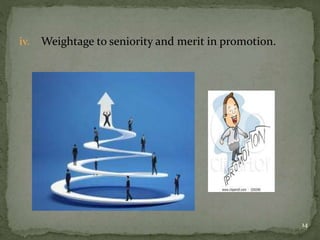
iv. Weightage to seniority and merit in promotion.
14
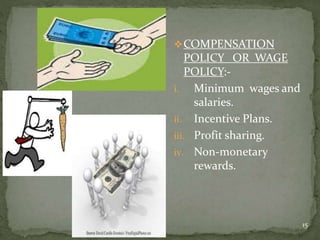
COMPENSATION
POLICY OR WAGE
POLICY:-
i. Minimum wages and
salaries.
ii. Incentive Plans.
iii. Profit sharing.
iv. Non-monetary
rewards.
15
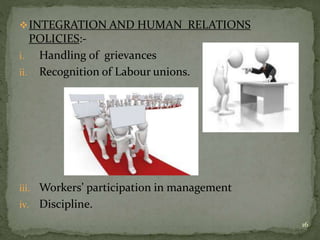
INTEGRATION AND HUMAN RELATIONS
POLICIES:-
i. Handling of grievances
ii. Recognition of Labour unions.
iii. Workers’ participation in management
iv. Discipline.
16
WORKING CONDITIONS AND WELFARE
POLICIES:-
i. Kinds and standards of working conditions.
ii. Safety programme.
iii. Types of welfare services.
iv. Financing of employee services.
17
HR POLICIES
OF
18
 Training and Hiring Policies.
 Recruitment and Selection Policy
 360-degree Feedback.
 ESTS.
 STARS.
 GFT.
“Employees share a deep connection and sense of pride for
being associated with the legend that is Taj”
19

Hrm policies

  • 1.
     Policies arebroad guidelines as to how the objectives of a business are to be achieved.  “Personnel policies lay down the decision making criteria in line with the overall purpose of the organisation in the area of Human Resource Management.”  A policy is designed to guide the organisational members to deal with a particular situation in a particular manner. It delimits the area within which a decision is to be made and assures that the decision will be consistent with and contributive to business objectives. 1
  • 2.
    The policies areneeded in various areas of personnel management such as recruitment, employment, training, placement, transfer and promotion, compensation, performance appraisal, welfare, etc. Thus, following steps are taken while formulating personnel policies: 1. Preliminary Investigation 2. Environment scanning 3. Identification of Policy areas 4. Analysis of Alternative policies 5. Participation of Lower Levels 6. Approval of Top Management 7. Implementation of Policy 8. Policy Appraisal 2
  • 3.
    PRELIMINARY INVESTIGATION:-Fact findingis usually delegated to a specialist who collects data from inside and outside the organisation through questionnaires, interviews, and other methods. The facts or data should be adequate, dependable and qualitatively superb. 3
  • 4.
    4 ENVIRONMENT SCANNING:-The policy committee shouldcarefully analyse the information available with it. The whole information may be divided into internal environment and external environment. Internal environment deals with physical resources, human resources, organisational structure, values and beliefs, etc. External environment relates to
  • 5.
    Social, political, economic,and technological conditions in the country. Monitoring and predicting the environmental changes are important for policy formulation. IDENTIFICATION OF POLICY AREAS:-In formulating policies, it is essential to specify clearly the areas needing policies.The benefit of specifying area needing policies is that it will help in collecting right type of information.The information may be collected from company’s manuals and other publications, key executives and the publications of government, trade associations, trade unions and other sources. 5
  • 6.
    ANALYSIS OF ALTERNATIVEPOLICIES:- It is done on basis of contribution of such policies to the organisational goals. That policy alternative should be selected which is likely to yield the best possible results for the organisation.The policy must be tested before it is given a final shape. Comments and suggestions should be received from the personnel at the lower levels. 6
  • 7.
    7 PARTICIPATION OF LOWER LEVELS:-Theultimate choice of policy should be made with the active participation of those who use and live with the result it gives. Those who have put in their contribution at suggestion and fact finding stage will feel committed to it.
  • 8.
    APPROVAL OF TOPMANAGEMENT:- Policy formulation committee should report to the top management its considered opinion integrating the members’ judgements and findings. 8
  • 9.
    IMPLEMENTATION OF POLICY:-The authority required to adopt and launch a policy definitely rests with the top management. Top management alone can decide whether the policy adequately represents the organisational objectives or not. POLICY APPRAISAL:-The appraisal of appropriateness and usefulness is done. And any serious difficulty with a new or revised policy is to be reported to the top management alongwith constructive suggestions. 9
  • 10.
    Personnel policies mustcover all areas of human resource management. Usually personnel policies are framed with regard to all functions of human resource management as stated below:- 10
  • 11.
    EMPLOYMENT POLICIES ORRECRUITMENT AND SELECTION POLICIES: i. Minimum hiring qualification ii. Preferred sources of recruitment iii. Reliance on various selection devices such as tests, reference checks, and interview. 11
  • 12.
    TRAINING AND DEVELOPMENTPOLICIES:- i. Opportunities for training and development ii. Basis for Training iii. Types of training, viz., on-the-job, or off-the-job iv. Programmes of executive development 12
  • 13.
    TRANSFER AND PROMOTIONPOLICIES:- i. Rationale of transfer ii. Periodicity of transfer iii. Length of service and qualifications required for promotion 13
  • 14.
    iv. Weightage toseniority and merit in promotion. 14
  • 15.
    COMPENSATION POLICY OR WAGE POLICY:- i.Minimum wages and salaries. ii. Incentive Plans. iii. Profit sharing. iv. Non-monetary rewards. 15
  • 16.
    INTEGRATION AND HUMANRELATIONS POLICIES:- i. Handling of grievances ii. Recognition of Labour unions. iii. Workers’ participation in management iv. Discipline. 16
  • 17.
    WORKING CONDITIONS ANDWELFARE POLICIES:- i. Kinds and standards of working conditions. ii. Safety programme. iii. Types of welfare services. iv. Financing of employee services. 17
  • 18.
  • 19.
     Training andHiring Policies.  Recruitment and Selection Policy  360-degree Feedback.  ESTS.  STARS.  GFT. “Employees share a deep connection and sense of pride for being associated with the legend that is Taj” 19