OVERVIEW
 What is HRM?
 What are the objectives of HRM?
• What is unique about HRM?
• HRM stakeholders……………
 Distinction between PM & HRM
• Evolution of HRM in Bangladesh
• Who completes HR tasks?
• HRM Model
 Key activities of human resources
• Responsibility for HRM
LEARNING OBJECTIVES
‘EMPLOYEES ARE THE MOST IMPORTANT
ASSET OF THE ORGANIZATION’
• The quality and effectiveness of the organization is
determined by the quality of the people that are
employed.
• Success for most organizations depends on
finding the employees with the skills to
successfully perform the tasks required to attain
the company’s strategic goals.
WHAT IS HUMAN RESOURCE MANAGEMENT?
According to the British Institute of Personnel
Management :
“Personnel Management can be defined as “that
part of management which is concerned with
people at work and with their relationship within
an organization.”
WHAT IS HUMAN RESOURCE MANAGEMENT?
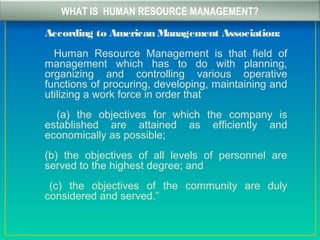
According to American Management Association:
Human Resource Management is that field of
management which has to do with planning,
organizing and controlling various operative
functions of procuring, developing, maintaining and
utilizing a work force in order that
(a) the objectives for which the company is
established are attained as efficiently and
economically as possible;
(b) the objectives of all levels of personnel are
served to the highest degree; and
(c) the objectives of the community are duly
considered and served.”
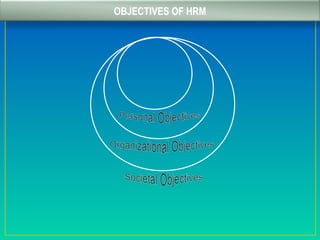
OBJECTIVES OF HRM
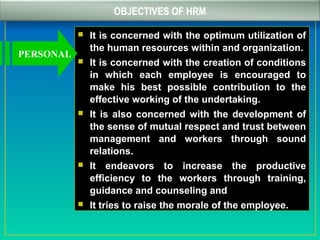
OBJECTIVES OF HRM
 It is concerned with the optimum utilization of
the human resources within and organization.
 It is concerned with the creation of conditions
in which each employee is encouraged to
make his best possible contribution to the
effective working of the undertaking.
 It is also concerned with the development of
the sense of mutual respect and trust between
management and workers through sound
relations.
 It endeavors to increase the productive
efficiency to the workers through training,
guidance and counseling and
 It tries to raise the morale of the employee.
PERSONAL
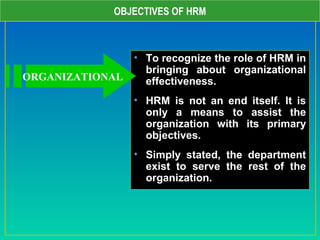
OBJECTIVES OF HRM
• To recognize the role of HRM in
bringing about organizational
effectiveness.
• HRM is not an end itself. It is
only a means to assist the
organization with its primary
objectives.
• Simply stated, the department
exist to serve the rest of the
organization.
ORGANIZATIONAL
OBJECTIVES OF HRM
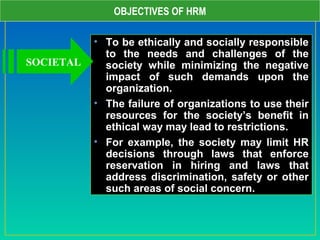
• To be ethically and socially responsible
to the needs and challenges of the
society while minimizing the negative
impact of such demands upon the
organization.
• The failure of organizations to use their
resources for the society’s benefit in
ethical way may lead to restrictions.
• For example, the society may limit HR
decisions through laws that enforce
reservation in hiring and laws that
address discrimination, safety or other
such areas of social concern.
SOCIETAL
• Service is delivered by people.
• Low quality HR leads to low quality
customer service.
• In the 21st century effective knowledge
management translates into competitive
advantage and profits.
• Knowledge comes from a firm’s people.
WHY IS HRM IMPORTANT?
HR is multidisciplinary:
• It applies the disciplines of Economics (wages,
markets, resources), Psychology (motivation,
satisfaction), Sociology (organization structure,
culture) and Law (Maternity Benefit Act, Min.
Wage Act, Factories Act, IRO, etc.).
• HR is embedded within the work of all managers,
and most individual contributors due to the need
of managing people (subordinates, peers and
superiors) as well as teams to get things done.
WHAT IS UNIQUE ABOUT HRM?
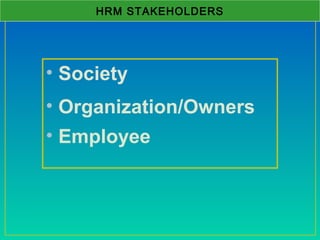
• Society
• Organization/Owners
• Employee
HRM STAKEHOLDERS
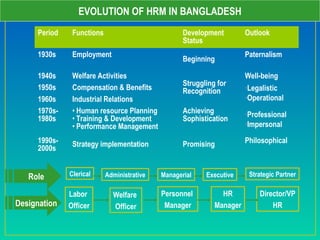
EVOLUTION OF HRM IN BANGLADESH
Period Functions Development
Status
Outlook
1930s Employment
Beginning
Paternalism
1940s Welfare Activities
Struggling for
Recognition
Well-being
1950s Compensation & Benefits •Legalistic
•Operational1960s Industrial Relations
1970s-
1980s
• Human resource Planning
• Training & Development
• Performance Management
Achieving
Sophistication
•Professional
•Impersonal
1990s-
2000s
Strategy implementation Promising Philosophical
Labor
Officer
Welfare
Officer
Personnel
Manager
HR
ManagerDesignation
Clerical Administrative Managerial ExecutiveRole Strategic Partner
Director/VP
HR
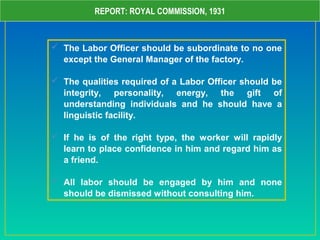
REPORT: ROYAL COMMISSION, 1931
 The Labor Officer should be subordinate to no one
except the General Manager of the factory.
 The qualities required of a Labor Officer should be
integrity, personality, energy, the gift of
understanding individuals and he should have a
linguistic facility.
 If he is of the right type, the worker will rapidly
learn to place confidence in him and regard him as
a friend.
 All labor should be engaged by him and none
should be dismissed without consulting him.
 
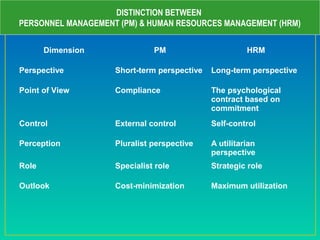
DISTINCTION BETWEEN
PERSONNEL MANAGEMENT (PM) & HUMAN RESOURCES MANAGEMENT (HRM)
Dimension PM HRM
Perspective Short-term perspective Long-term perspective
Point of View Compliance The psychological
contract based on
commitment
Control External control Self-control
Perception Pluralist perspective A utilitarian
perspective
Role Specialist role Strategic role
Outlook Cost-minimization Maximum utilization
 
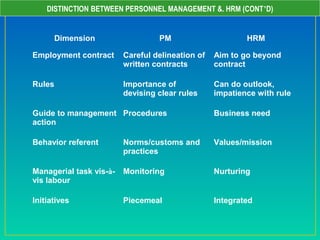
DISTINCTION BETWEEN PERSONNEL MANAGEMENT &. HRM (CONT’D)
Dimension PM HRM
Employment contract Careful delineation of
written contracts
Aim to go beyond
contract
Rules Importance of
devising clear rules
Can do outlook,
impatience with rule
Guide to management
action
Procedures Business need
Behavior referent Norms/customs and
practices
Values/mission
Managerial task vis-à-
vis labour
Monitoring Nurturing
Initiatives Piecemeal Integrated
 
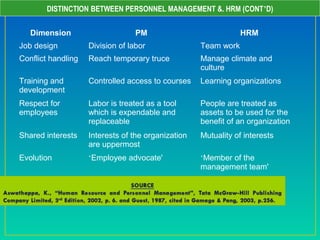
Dimension PM HRM
Job design Division of labor Team work
Conflict handling Reach temporary truce Manage climate and
culture
Training and
development
Controlled access to courses Learning organizations
Respect for
employees
Labor is treated as a tool
which is expendable and
replaceable
People are treated as
assets to be used for the
benefit of an organization
Shared interests Interests of the organization
are uppermost
Mutuality of interests
Evolution ‘Employee advocate' ‘Member of the
management team'
DISTINCTION BETWEEN PERSONNEL MANAGEMENT &. HRM (CONT’D)
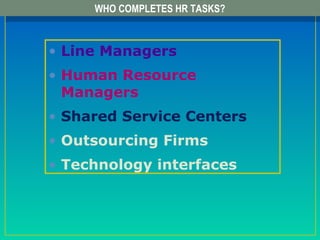
WHO COMPLETES HR TASKS?
• Line Managers
• Human Resource
Managers
• Shared Service Centers
• Outsourcing Firms
• Technology interfaces
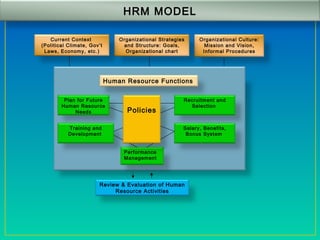
Organizational Culture:
Mission and Vision,
Informal Procedures
Organizational Strategies
and Structure: Goals,
Organizational chart
Current Context
(Political Climate, Gov’t
Laws, Economy, etc.)
Review & Evaluation of Human
Resource Activities
Performance
Management
Plan for Future
Human Resource
Needs
Recruitment and
Selection
Training and
Development
Salary, Benefits,
Bonus System
Human Resource Functions
Policies
HRM MODEL
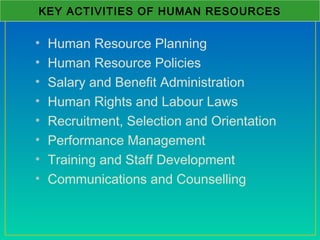
• Human Resource Planning
• Human Resource Policies
• Salary and Benefit Administration
• Human Rights and Labour Laws
• Recruitment, Selection and Orientation
• Performance Management
• Training and Staff Development
• Communications and Counselling
KEY ACTIVITIES OF HUMAN RESOURCES
• The responsibility for human resource
management activities rest with each
MANAGER.
• If a MANAGER does not accept this
responsibility then HR activities will only
partially get done.
• HR department provides strategies, systems,
tools and support to Managers to ensure
effective staff management!
RESPONSIBILITY FOR HRM

HRM Introduction

  • 1.
  • 2.
     What isHRM?  What are the objectives of HRM? • What is unique about HRM? • HRM stakeholders……………  Distinction between PM & HRM • Evolution of HRM in Bangladesh • Who completes HR tasks? • HRM Model  Key activities of human resources • Responsibility for HRM LEARNING OBJECTIVES
  • 3.
    ‘EMPLOYEES ARE THEMOST IMPORTANT ASSET OF THE ORGANIZATION’ • The quality and effectiveness of the organization is determined by the quality of the people that are employed. • Success for most organizations depends on finding the employees with the skills to successfully perform the tasks required to attain the company’s strategic goals.
  • 4.
    WHAT IS HUMANRESOURCE MANAGEMENT? According to the British Institute of Personnel Management : “Personnel Management can be defined as “that part of management which is concerned with people at work and with their relationship within an organization.”
  • 5.
    WHAT IS HUMANRESOURCE MANAGEMENT? According to American Management Association: Human Resource Management is that field of management which has to do with planning, organizing and controlling various operative functions of procuring, developing, maintaining and utilizing a work force in order that (a) the objectives for which the company is established are attained as efficiently and economically as possible; (b) the objectives of all levels of personnel are served to the highest degree; and (c) the objectives of the community are duly considered and served.”
  • 6.
  • 7.
    OBJECTIVES OF HRM It is concerned with the optimum utilization of the human resources within and organization.  It is concerned with the creation of conditions in which each employee is encouraged to make his best possible contribution to the effective working of the undertaking.  It is also concerned with the development of the sense of mutual respect and trust between management and workers through sound relations.  It endeavors to increase the productive efficiency to the workers through training, guidance and counseling and  It tries to raise the morale of the employee. PERSONAL
  • 8.
    OBJECTIVES OF HRM •To recognize the role of HRM in bringing about organizational effectiveness. • HRM is not an end itself. It is only a means to assist the organization with its primary objectives. • Simply stated, the department exist to serve the rest of the organization. ORGANIZATIONAL
  • 9.
    OBJECTIVES OF HRM •To be ethically and socially responsible to the needs and challenges of the society while minimizing the negative impact of such demands upon the organization. • The failure of organizations to use their resources for the society’s benefit in ethical way may lead to restrictions. • For example, the society may limit HR decisions through laws that enforce reservation in hiring and laws that address discrimination, safety or other such areas of social concern. SOCIETAL
  • 10.
    • Service isdelivered by people. • Low quality HR leads to low quality customer service. • In the 21st century effective knowledge management translates into competitive advantage and profits. • Knowledge comes from a firm’s people. WHY IS HRM IMPORTANT?
  • 11.
    HR is multidisciplinary: •It applies the disciplines of Economics (wages, markets, resources), Psychology (motivation, satisfaction), Sociology (organization structure, culture) and Law (Maternity Benefit Act, Min. Wage Act, Factories Act, IRO, etc.). • HR is embedded within the work of all managers, and most individual contributors due to the need of managing people (subordinates, peers and superiors) as well as teams to get things done. WHAT IS UNIQUE ABOUT HRM?
  • 12.
    • Society • Organization/Owners •Employee HRM STAKEHOLDERS
  • 13.
    EVOLUTION OF HRMIN BANGLADESH Period Functions Development Status Outlook 1930s Employment Beginning Paternalism 1940s Welfare Activities Struggling for Recognition Well-being 1950s Compensation & Benefits •Legalistic •Operational1960s Industrial Relations 1970s- 1980s • Human resource Planning • Training & Development • Performance Management Achieving Sophistication •Professional •Impersonal 1990s- 2000s Strategy implementation Promising Philosophical Labor Officer Welfare Officer Personnel Manager HR ManagerDesignation Clerical Administrative Managerial ExecutiveRole Strategic Partner Director/VP HR
  • 14.
    REPORT: ROYAL COMMISSION,1931  The Labor Officer should be subordinate to no one except the General Manager of the factory.  The qualities required of a Labor Officer should be integrity, personality, energy, the gift of understanding individuals and he should have a linguistic facility.  If he is of the right type, the worker will rapidly learn to place confidence in him and regard him as a friend.  All labor should be engaged by him and none should be dismissed without consulting him.
  • 15.
      DISTINCTION BETWEEN PERSONNEL MANAGEMENT(PM) & HUMAN RESOURCES MANAGEMENT (HRM) Dimension PM HRM Perspective Short-term perspective Long-term perspective Point of View Compliance The psychological contract based on commitment Control External control Self-control Perception Pluralist perspective A utilitarian perspective Role Specialist role Strategic role Outlook Cost-minimization Maximum utilization
  • 16.
      DISTINCTION BETWEEN PERSONNELMANAGEMENT &. HRM (CONT’D) Dimension PM HRM Employment contract Careful delineation of written contracts Aim to go beyond contract Rules Importance of devising clear rules Can do outlook, impatience with rule Guide to management action Procedures Business need Behavior referent Norms/customs and practices Values/mission Managerial task vis-à- vis labour Monitoring Nurturing Initiatives Piecemeal Integrated
  • 17.
      Dimension PM HRM Jobdesign Division of labor Team work Conflict handling Reach temporary truce Manage climate and culture Training and development Controlled access to courses Learning organizations Respect for employees Labor is treated as a tool which is expendable and replaceable People are treated as assets to be used for the benefit of an organization Shared interests Interests of the organization are uppermost Mutuality of interests Evolution ‘Employee advocate' ‘Member of the management team' DISTINCTION BETWEEN PERSONNEL MANAGEMENT &. HRM (CONT’D)
  • 18.
    WHO COMPLETES HRTASKS? WHO COMPLETES HR TASKS? • Line Managers • Human Resource Managers • Shared Service Centers • Outsourcing Firms • Technology interfaces
  • 19.
    Organizational Culture: Mission andVision, Informal Procedures Organizational Strategies and Structure: Goals, Organizational chart Current Context (Political Climate, Gov’t Laws, Economy, etc.) Review & Evaluation of Human Resource Activities Performance Management Plan for Future Human Resource Needs Recruitment and Selection Training and Development Salary, Benefits, Bonus System Human Resource Functions Policies HRM MODEL
  • 20.
    • Human ResourcePlanning • Human Resource Policies • Salary and Benefit Administration • Human Rights and Labour Laws • Recruitment, Selection and Orientation • Performance Management • Training and Staff Development • Communications and Counselling KEY ACTIVITIES OF HUMAN RESOURCES
  • 21.
    • The responsibilityfor human resource management activities rest with each MANAGER. • If a MANAGER does not accept this responsibility then HR activities will only partially get done. • HR department provides strategies, systems, tools and support to Managers to ensure effective staff management! RESPONSIBILITY FOR HRM