HUMAN RESOURCE MANAGEMENT
PREPARED BY
Dr. M.S. Balaji
Associate Professor & Head
Research Department of Business Administration
Sourashtra College(Autonomous)
Madurai-625004
HRM
Chapter-1
HRM–Meaning,
Definition,
Objectives,
Scope,
Function.
Meaning of HRM:
🠶According to Leon C.megginson, the term human
resources can be thought of as “the total knowledge
skills, creative abilities, talents and aptitudes of an
organization’s workforce, as well as the value,
attitude and beliefs of the individuals involved.”
🠶The term resources can be thought, “The total
knowledge, Skills, CreativeAbilities, Talents &
Aptitudes of an Organizations work force as well as
the value,Attitude & Beliefs of the individual
involved.”
HRM
Definition:
🠶HRM means, employing the people, developing their
resources, utilizing, maintaining & compensating their
services in tune with the job and organizational
requirements with the view to contribute of the goals of the
organization, individual to the society.
🠶HRM can be defined as managing (planning, organizing,
directing & controlling) the functions of employee,
developing and compensating human resources resulting in
the creation & development of human relations with the
view to contribute proportionately (dew to them) to the
organizational individual & social goals.
HRM
Objectives of HRM:
🠶HRM is concern with employees both as individual & as a
group in attain the goals.
🠶It is concerned with the development of human resources
that is knowledge, capability, skills, potentiality etc..,
🠶HRM covers all levels & categories (unskilled, skilled etc..,)
of employees.
🠶HRM is the continuous and never ending process.
🠶It aims at obtaining the goals of the organization, individual
society in an intergraded approach approach.
HRM
🠶Organizational goals may include growth, survival, development in
addition to profitability, production etc..,
🠶Individual employee goals consists of job satisfaction, job security,
high salary, opportunity for development etc..,
🠶Goals of the society include equal employment opportunity, protecting
the disadvantaged sections and a physically handicapped minimization
of inequalities in the distribution of income etc..,
🠶HRM is mostly concerned with managing human resources at work.
🠶HRM is the central sub-system of an organization & it permeates all
types of functional management that is production management,
marketing management, and financial management.
HRM
Objectives of HRM:
Function of HRM
HRM
1, managerial functions
• Planning
🠶It is a pre-determined course of action. Planning pertains to
formulating strategies of personnel programs and changes in
advance that will contribute to the organizational goals.
• Organizing
🠶In the words of J.C.Massie, an organization is a “structure and a
process by which a co- operative group of human beings allocates
its task among its members, identifies relationship and integrates
its activities towards a common objective”
HRM
• Directing
🠶The next logical function after completing planning and
organizing is the execution of the plan. The function of
personnel management at any level is motivating,
commanding, leading and activating people. The willing and
effective co-operation of employees for the attainment of
organizational goals is possible through proper direction.
Tapping the maximum potentialities of the people is possible
through motivation and command.
HRM
• Controlling
🠶After planning, organizing and directing various
activities of personnel management, the performance is
to be verified in order to know that the personnel
functions are performed in conformity with the plans and
directions of an organization. Controlling also involves
checking, verifying and comparing of the actuals with
the plans, identification of deviations if any and
correcting of identified deviations.
HRM
HRM as a central sub-system
HRM
2, operative functions
• employment
🠶 job analysis:
it is the process of study and collection of information relating
to the operations and responsibilities of a specific job.
🠶 human resources planning:
it is a process for determination and assuring that the
organization will have an adequate number of qualified persons,
available at proper times, preforming jobs which would meet the
needs of the organization and which would provide satisfaction for
the individuals involved.
HRM
🠶Recruitment:
it is the process of searching for prospective employees and
stimulating them to apply for jobs in an organization.
🠶Selection:
it is the process of ascertaining the qualifications, experiences,
skills, knowledge etc.., of an applicant with a view to appraising
his/her suitability to a job.
🠶Placement:
it is the process of assigning the selected candidate with the
most suitable job in terms of job requirements. It is matching of
employee specification with job requirements.
HRM
• Human resources development:
🠶Performance appraisal:
it is the systematic evaluation of individuals with respect to
their performance on the job and their potential for development.
🠶Training:
it is the process of imparting to the employees technical and
operating skills and knowledge.
🠶Management development:
it is the process of designing and conducting suitable executive
development programs so as to develop the managerial and human relation skill
of employees.
HRM
🠶Career planning and development:
it is the planning of one’s career and implementation of career
plans by means of education, training, job search and acquisition of
work experiences. It includes internal and external mobility.
🠶Internal mobility:
it includes vertical and horizontal movement of an employee
within an organization. It consists of transfer, promotion and
demotion.
🠶Transfer:
it is the process of placing employees in the same level jobs
where they can be utilized more effectively in consistence with their
potentialities and needs of the employees and the organization.
HRM
🠶Promotion:
it deals with upward reassignment given to an employee in the
organization to occupy higher position which commands better status
and/or pay keeping in human resources of the employees and the job
requirements.
🠶Demotion:
it deals with downward reassignment to an employee in the
organization
🠶Change and organization development:
change implies the creation of imbalances in the existent
pattern or situation.
HRM
• Compensation:
🠶Job evaluation:
it is the process of determining relative worth of job.
🠶Wage and salary administration:
this is the process of development and operating a suitable
wage and salary programme.
🠶 incentives:
it is the process of formulating, administering and reviews the
schemes of incentives in addition to regular payment of wages and
salary.
HRM
HRM
🠶Bonus:
it includes payment of statutory bonus according to the
payment of bonus act, 1965 its latest amendments.
🠶Fringe benefits:
these are the various benefits at the fringe of the wage.
Management provides benefits to motivate the employees and to
meet their life’s contingencies.
🠶Social security measures:
management provide social security to their employees in
addition to the fringe benefits.
HRM
• Human relations:
🠶Practicing various human resources policies and
programs like employment, development and
compensation and interaction among employees
create a sense of relationship between the
individual worker and management, among
workers and trade unions and the management
HRM
• Industrial relations:
🠶Industrial relations refers to the study of relations
among employees, employer, government and trade
unions.
• Recent trends in HRM:
🠶Human resources management has been advancing at a
fast rate.
The objectives of HRM are basically four folds:
HRM
1 , SO CIETAL OBJECTIVES
2, ORGANIZATIONAL OBJECTIVES
3, FUNCTIONAL OBJECTIVES
4, PERSONAL OBJECTIVES
🠶The basic objective of HRM towards the society should be
ensure that their organization managers human resources in an
ethical & socially responsible & ethical thoughts. The objective
includes.
a) To manage human resources is an ethical & socially responsible
manner.
b) To ensure compliance with legal & ethical standards.
c) to ensure the negative impact of societal demands upon the
organization
1 , SO CIETAL OBJECTIVES
HRM
2, ORGANIZATIONAL OBJECTIVES
🠶 It includes
a) HR dept., like any other dept., in an organization, should focus
on achieving the goals of the organization. If it does not means
this purpose, the HR dept., can not exist in the long run.
b) HR dept., should recognize its role in bringing about
organizational effectiveness.
c) HRM is not an end in itself it is only mean to assit the
organization with its primary objectives.
HRM
3, FUNCTIONAL OBJECTIVES
🠶 includes the following
a) To maintain HR dept., contribution at a level appropriate to the
organization need. Resources are wasted when HRM is either
more or less sophisticated to suit the organization demands.
b) The dept., level of service must be tailored fit the organization.
It serves though training & development.
c) HRM should employ the skills & abilities of the work force
efficiently it should aim at making the people’s strength
productive & to benefit the organization.
d) HRM aims at providing the organization with well-trained &
well-motivated employees.
HRM
4, PERSONAL OBJECTIVES
🠶Personal objective of the employees must be met if employees
are to be maintained, retained & motivated other wise employee
performance & satisfaction may decline & they may leave the
organization. The objective of HRM in this context are:
a) HRM should increase to the fullest extent the employees job
satisfaction.
b) HRM should also meet the self-actualization needs of the
employees. It should stimulate every employee to achieve his
potential.
HRM
HRM
c)HRM should assist the employees in an achieving the personal
goals at least in so far as these goals enhance the individuals
contribution to the organization.
d)HRM should develop & maintain a quality of work life. It makes
employment in the organization desirable personal & social
situation organizational performance can never be proved without
improving the quality of work life.
e)HRM should also communicate HR policies to all employees. It
will help the HRM in tapping the ideas, opinions, feeling & the of
the employees.
Scope of HRM:
According to Dale Yorder, the scope of HRM is very wide it
consists of following activities:
🠶Setting goals policies relationships & establishing & maintaining
a suitable organization for leadership & co-operation
🠶Collective bargaining, contract negotiation, contract
administration and grievance handling.
🠶Staffing the organization, finding, getting & holding the
prescribed types & number of workers
HRM
Scope of HRM:
🠶Aiding in the self-development of employees at all levels
providing opportunities for personal development & growth
as well.
🠶Motivating the workers by providing incentives & other
needs.
🠶Reviving & auditing manpower in the organization.
🠶Carrying out studies & design a system in improving man
power management.
HRM
HRM has a crucial role to play in the organization, the
following are the scope of the HRM.
1 , IDENTIFYING & DEVELOPING PERSONS
2, RETAINING S UITABLE PERSO NS
3, C REATING WORK C ULTURE
4, EDUCATING MANAGERIAL PERSONNEL
5, C ONDUCTING RESEARC H
6, DEVELOPING A C OMMUNICATION S YS TEM
HRM
1 , IDENTIFYING & DEVELOPING PERSONS
HRM helps in sup potting the “right man for the
right job” so, that persons are assigned jobs as
per their attitudes. By providing the right types of
training its possible to develop the employees,
potentialities to the maximum. They are also
motivated to give the maximum to the
organization.
HRM
2, RETAINING S UITABLE P ERSONS
Rapid development of personal is throwing news
challenges of every day. Modernization of various
techniques & revolution communication as result is
great demand for trained & highly skilled personal.
HRM not only helps in recruiting the right
persons but also it useful in retaining them.
HRM
3, C REATING WORK C ULTURE
HRM approach emphasis the development of the
employees potentials &using it for achieving
organization goal, aims at priorities of individual
workers are given due to wait age in the schemes of
the organization HR policy is back to buy human
values, understanding & concept for the welfare of
the people the work culture in the organization
includes people will satieties & enjoy their work.
HRM
4, EDUCATING MANAGERIAL PERSO NNEL
HRM approach will succeed only when
managerial personal change their attitude towards
the work force. There is a need to educated to
executed manager & top management regarding
various aspect of human resource approach adopted
by the organization.
HRM
5, C ONDUCTING RESEARC H
HRM will be successful only it we know the
aspiration & expectations of various persons
working in the organizations. The framing of
human resource policies, strategies &
approaches depend upon the information
collected through research.
HRM
6, DEVELOPING A C OMMUNICATION S YS TEM
There is a need to develop downward,
upward & lateral communication in the
organization. HRM develops a system of
communicated to the policies of the
management are properly communicated to the
lowest level of hierarchy & feed back from
lower levels is connived to the top management
HRM
Chapter-2
Human resource planning
Definition
Objectives
Need & importance
Human resource planning process
Human resources planning
Meaning & definition
Objectives & benefits
Factors affecting HRP
Process of HRP
Human resources planning
DEFINITION:
🠶E.W. Vetter viewed HRP, as a process by which an
organization should move from its organization
should move from its current man power position to
its desire man power position. Through planning
management strives to have the right number & right
kind of people for right job at right time, doing things
which results in both the organization & individual
receiving maximum long – run benefit.
FACTORS AFFECTING HRP:
External factors
. Level of economic
. Govt., policies
. Natural factors
. International factors
. Business environment
. Level of technology
. Information technology
. Development (future supply HR)
Internal factors
. Time horizons
. Strategies of company
. HR policies of company
. Job analysis
. Type & quality of management
. Formal & informal groups
. Company’s production, operation policy, Trade unions.
FACTORS AFFECTING HRP:
OBJECTIVES:
🠶To recruit & retain human resources of required quality &
quantity.
🠶To fore see the employee turnover & make arrangements for
minimizing the turn over & filling up the consequent vacancy
( vacancies )
🠶 To fore see the impact of technology on work, existing
employee and future human resources requirements.
🠶To improve the standards, skills, knowledge , ability ,
discipline etc.,
🠶To assess the surplus or shortage of human resources
& take measures accordingly.
🠶To make the best use of its human resources.
🠶To estimate the cost of human resources.
OBJECTIVES:
🠶It checks the corporate plan of the organization.
🠶Off sets uncertainty & change but the HRP off sets,
uncertainty & change to maximum extent possible &
enables the organization to have right men & at right
time & in the right place.
🠶It provides scope for advancement & development
etc…
🠶It help to anticipate the cost of salary, enhancement,
better benefits etc.
BENEFITS:
🠶It helps to anticipate the cost of salary, benefits & all the cost
of human resources facilitating the formulation of budget in
the organization.
🠶To foresee the changes in values, aptitude & human resources
& to change the techniques of inter – personal mgmt. etc…
🠶To plan for physical facilities, working conditions & the
volume of additional fringe benefits like canteen, schools,
hospitals, child care centers, company’s stores etc.
BENEFITS:
🠶It gives an idea of the type of text to be used & interview
techniques in selection based on the level of skills,
qualifications, intelligence values etc. of future human
resources
🠶It causes the development of various sources of human
resources contribution to meet the organizational needs.
🠶It facilitates the control of all the function, operations,
contribution & the cost of human resources.
BENEFITS:
Factors Affecting HRP
External factors
🠶Govt., policy – industrial policy , labor policy , industrial
relationship, jobs (reservation )
🠶Level of economic development – HRD – supply ( provides
human resource policy Training means imparting the knowledge)
Development relates to the managerial development.
🠶Business environment – volume of business increases 
require mends of HR  increases in plenty.
External factors
🠶Information technology – it – process of re – engineering
resource planning.
🠶Levels of technology – HR wanted ( multi – tasking skills )
🠶International factors – DD & SS of HR Demand &
supply.
Internal factors
🠶Company strategies- expansion, diversification Result the
demand of HR in terms of quality & quantity.
🠶HR policies – policy of company considered by quality of
HR, Compensation level, quality of work etc…
🠶Job analysis – HRP based job analyses is, i.e. job
description & job specification.
Internal factors
🠶Type & qualities of information – planning needs &
accurate information.
🠶Company’s production / operation policy – to plan how
much they have to produce & buy from outside. To prepare
final product plan by kinds of quality & quantity.
🠶Trade unions – no. of working hours will employee work
for a week, recruitment sources.
Process of HRP
Analyzing the co – operate & unit level strategies.
🠶 Which includes expansion, diversification, mergers, acquisition, low cost & reduction &
operations etc…
🠶 Production implementation technology, marketing & HR implementations.
Demand forecasting of the overall human resource requirement – job design, job
analysis, should be throwly reviewed reflecting future HR & organization plans.
🠶 Imparting fore casted method are as follows,
Managerial judgment :
Statistical techniques :
Work study techniques :
Decision of no of employees based on past experience.
It includes ratio – trend analysis.
Total production & activities are to be estimated & required
number of employees are calculated.
🠶 Supply forecasting – to obtain data & information about the present human inventory.
A, Existing inventory – relates to present human resources inventory in terms of HR
components, number, designation wise & dept. wise.
🠶 Estimating the net human resource requirements – ( demand forecast )
🠶 For a future data & supply forecast for that date.
🠶 Action plan for re deployment, redundancy / retrenchment
🠶 In case of surplus,
A, Re – deployment
1,Out placement
🠶 In tensed to provide career guidance for dis placed employees including redeployment,
elsewhere in the organization, writing, resumes, interviews etc…
2, Employment in the system consent
3, Employment in the other companies
B, Redundancy / retrenchment – Programs includes
1,Reduce work hours.
2,Work sharing
3,Lay – off can be temporary / permanent.
4,Leave of absence without pay
5,Voluntary retirement.
Modify the organization plans strategy.
🠶In case of inadequate supply the man power planner suggest the
mgmt. to alter or modify the organization plan.
Forecast future supply from all resources.
1,Out sourcing plan
2,Requirement & selection plan
3,Training & development plan
4,Productivity plan. Which includes maximization of productivity or minimization. Of labor,
cost through technology methods.
5,Retention plant.
Human Resource Management
Unit – II
Dr. M.S. Balaji
Job Analysis
• According to the U.S. Department of Labour,
job analysis as “the process of determining,
by observation and study and reporting
pertinent information relating to the nature
of a specific job. It is the determination of
the tasks which comprise the job and of the
skills, knowledge, abilities and
responsibilities required of the worker of a
successful performance and which
differentiate one job from all others”
Process of Job Analysis
1.Collection of Background Information.
2.Selection of Representative position to be
Analysed.
3.Collection of JobAnalysis Data.
4.Developing a Job Description.
5.Developing Job specification.
6. Developing Employee specification.
Job Analysis
Information & Facts
Job Description Job Specification
Job Description
Job identification – job, title, location, code,
short name.
Job summary
Brief job contents
Authority, responsibility, Hazards etc...,.
Relation to other job (Supervisors, Peers,
Sub-ordinates)
Supervision taken location in hierarchy
Machine, Tools, and equipments
Condition of work, speed, standing, posture, health,
hazards, occupational diseases etc.....,.
Job Specification
• Educational qualification required to that job
• Experience
• Training
• Initiative
• Physical effort
• Physical skill
• Responsibility
• Communication skills
• Emotional characteristics
• Unusual sensory demands such as vision, smell
wearing etc.....,
Job Description - Definition
• A Job Description is “an organized,
factual statement of the duties and
responsibilities of a specific job”.
• In brief, it should tell what is to be
done, how it is done and why?
• It is a standard of function, in that it
defines the appropriate and authorised
content of a job.
Job Specification – Definition
• A job specification is “a statement of the
minimum acceptable human qualities
necessary to perform a job properly.”
• In contrast to the job description, it is a
standard of personnel and designates the
qualities required for acceptable
performance.
Job Evaluation – Definition
• Wendel L. French defines “A process of
determining the relative work of various jobs
within the organization, so that the differential
wages may be paid to Jobs of different worth”.
• Job Evaluation is defined as the overall
activity of involving orderly, systematic
methods, and procedure for ranking, grading &
weighing of jobs to determine the value of
specific jobs in relation to other jobs.
Types of Job Evaluation Method
Quantitative Non – Quantitative
Points
Rating M Ranking M Job
Classification
& Grading M
Factors
Comparison M
Simple Ranking
Ranking the key jobs
Paired comparison
Single Factor ranking
Method
Quantitative Techniques
1. Points Rating Method
This method of job evaluation should be
developed systematically and applied through
methodically in order to avoid the anomalies.
The important steps in developing the techniques are
i. Constituting a representative committee of
members from various departments for job
evaluation
ii. Selecting a sample of jobs and preparing jobs
specification and employees
descriptions, job
specification.
iii. Selecting and defining those factors which are
related to all jobs are considered to be the most
critical in determining the relative degrees of
difficulty & responsibility between jobs such as
skill, effort, responsibility and job condition.
iv. Determining the weight of each factor according to
its relative importance.
v. Defining each factor specifying the scope &
elements of each factor.
vi. Dividing each factor into levels and defining each
level.
vii. Appraise all the jobs and arrive at a composite
numerical value for each job.
viii.Determining relative value of each level within
factors. Factors can be divided into point values by
arithmetic or geometric progression
Factor Comparison Method
• The mechanism of this steps involves the following
steps:
i. Developing job descriptions, job specification or job
requirements covering physical requirements,
mental, skill requirements, training & experience,
responsibility & authority, working conditions
etc...............................,.
ii. Selecting a number of key jobs:
This step is more critical & useful from the point
of final evaluation as the other jobs are assigned
monetary values based on the fixed wage rates
arrived from the key jobs on the basis of
negotiations it must clearly divisible into sub-factors
& components. This step also involves dividing the
job into sub-factors & components.
iii. The sub-factors of each key job must be given relative
ranks based on their individual contribution to the total
job, the sub-factors of two key jobs (for example Welder
and Mechanical Engineer) competitive at picture of the
ranking two jobs in factor ranking
iv. The sub-factors of each of the key jobs, as well as factor
evaluation, money worth of each sub-factor of the key
jobs is ascertained in order to know the total money value
(salary) of each of the key job in monetary value of each
of the key jobs (per day)
v. It is integrating the monetary value of sub-factors arrived
through factor evaluation with those of ranking factors,
whether the difference among factors as per the ranking &
factor evaluation.
vi. The comparing all jobs the same grade or level with the
related key job & establishing monetary value to the sub-
factors of the various jobs based on the monetary value of
sub factors or key jobs.
Recruitment – Definition
• Recruitment is defined as a process to
discover the sources of man power to
meet the requirements of the staffing
schedule of
effective measures for attracting
man power in adequate numbers
selection of
the employees & to
the
to
an
facilitate effective
efficient work force.
DEFINITION
• “The process of searching for prospective
employees & stimulating them to apply for
jobs in the organisation”-Edwin B. Flippo.
SUBSYSTEMS OF RECRUITMENT
• 1.Finding out & developing Sources.
• 2.Developing techniques to attract candidates.
• 3.Employing the technique.
• 4.Stimulating the candidates and making them
to apply for jobs.
Factors affecting Recruitment
• INTERNAL FACTORS:
• Company’s pay package
• Quality of work life
• Organizational structure.
• Career planning & growth.
• Company’s size, growth rate, products/services
&Name and fame.
• Geographical spread.
• Role of trade unions.
• Cost of recruitment.
Factors affecting recruitment
• EXTERNALFACTORS:
• Socio-economic factors.
• Supply & Demand factors.
• Employment rate.
• Labour market conditions.
• Political ,Legal & Govt .,factors viz.,
SC/ST/BC Reservations &Sons-of-soil
• Information system-E. Exchange,Internet.
RECRUITMENT POLICY
• Recruitment Policy is derived from the
personnel policy of the organisation.
• After formulation of Recruitment Policy,
management has to decide whether centralise
/decentralise the recruitment function.
• Centralised Rect.-Commercial Banks.
• Decentralised Rect.-Indian Railways (Gr.III
and Gr.IV positions).
• Both has merits and demerits.
SOURCES OF RECRUITMENT
• 2 SOURCES Viz., INTERNAL &
EXTERNAL( Traditional& Modern methods)
• I.INTERNAL SOURCES:
• 1.Present permanent employees.
• 2.Present temporary/Casual employees.
• 3.Retrenched/Retired employees.
• 4.Dependants of deceased, disabled, retired &
present employees.
SOURCES OF RECRUITMENT
• II.EXTERNAL SOURCES:
• 1.Traditional sources-
1.Advertisements2.Employment
exchanges3.Personnel consultants
4.Colleges,Universities and
Institutions.5.Recommendations.6.Labour
contractors.7.Casual &Unsolicited applicants.
External sources -Modern sources
1. Campus
interview.
2. Walk-in-
Interview.
3. Personal
consultation.
4. Head Hunting
5. Leasing.
6. E-Recruitment.
7. Data banks.
8. Similar
organizations.
9.Trade unions.
10.Outsourcing.
TECHNIQUES OF RECRUITMENT
Traditional Technique
of Recruitment
1.Campus Recruitment.
2.Public employment
exchange.
3.Professional
Organizations.
4.Data banks.
5.CasualApplicants.
6. Trade Unions.
7. Private Employees.
Modern Technique of
Recruitment
1.Walk-in.
2.Consult-in.
3.Head hunting.
4.Body shopping.
5.Business alliances.
6.Tele-Recruitment.
7.ESOP(Employees Stock
Ownership Programme).
8.Offering higher pay &
facilities.
Traditional Sources of Recruitment
1. Campus Recruitment: Inexperience graduate can be
got interview, organisation can get inexperienced
candidates.
2. Public Employment Exchange: These are provide for
collection of information & vacancies.
3. Professional Organizations: It gets complete Bio-data
of their members & exchanging information,
clarifying doubts etc........,
4. Data Banks: These are like employment exchanges,
educational institutes candidates etc.
5. CasualApplicants: Image of the organisations its
prompt response participation local activities.
6. Trade Unions: Generally employed or under
employed.
Modern Sources of Recruitment
1. Walk-in: To attend interview directly
2. Consult in: Encourage the job seekers
3. Head Hunting: The organisation can get
senior executive persons.
4. Body Shopping: Training institutes, human
resources, possible employment.
5. Mergers &Acquisitions:Ad-hoc basis –
hourly, part-time.
6. E-recruitment: The technological revolution
and tele-communication mode.
Sources of Recruitment Used by
Skill & Level
• 1.Unskilled &Semi-skilled.
• 2.Skilled.
• 3.Professional employees.
• 4.Managerial Level.
DEFINITION FOR SELECTION
• Selection is the process of picking individuals
who have relevant qualifications to fill jobs in
an organisation.The basic purpose is to choose
the individual who can most successfully
perform the job, from the pool of qualified
candidates.
Essentials of selection procedure
1. Authority for selection-some one should
have.
2. There must be some standard of personnel
with which a prospective employee may be
compared ,i.e.,a comprehensive JD & JS
should be available beforehand.
3. Sufficient no. of applicants.
4. Scientific selection system.
5. Own/Using SelectionAgencies/Consultants.
Factors affecting Selection
• 1.Profile matching.
• 2.Organisational & social environment.
• 3.Successive hurdles.
• 4.Multiple correlation. (A deficiency in one
factor can be counter-balanced by an excess
amount of another ).Composite test sore index
is used.
SELECTION Process/Stages/Procedure
• 1.Reception.
• 2.Scrutiny ofApplications received. (Clinical, Weighted
methods & Biographical inventories).
• 3.Preliminary/Screening interview.
• 4.BlankApplication forms.
• 5.Conucting Tests/Written Examination. (Performance &
psychological Tests).
• 6.Final Interview.
• 7.Group Discussion.
• 8.Checking of references/Reference checks.
• 9.Medical Examination.
• 10.Final Decision/Selection.
• 11.Employment/Appointment/Placement & Induction.
Types of Tests
• I.PERFORMANCE TESTS:
• 1.Work sampling.
• 2.Job knowledge.
• 3.Assessment Centres.
• II.PSYCHOLOGICALTESTS:
• 1.Intelligence Tests.
• 2.Aptitude Tests (Mechanical & clerical aptitude,
Psychomotor tests).
• 3.Interest Tests.
• 4.Situatonal Tests (GD, In Basket).
• 5.Personality Tests (ThematicApperception Test,
Rorchach Inkblot Test etc).
Types of Interviews
• 1.Preliminary Interview-(a) Informal
Interview (b) Unstructured Interview.
• 2.Core Interview-(a) Back ground
information Interview (b) Job &
Probing I (c) Stress I (d) The GD I(e)
Formal & structured I (f) Panel I (g)
Depth Interview.
• 3.Decision –making Interview.
PLACEMENT
• The candidate reports for the duty & the
organisation place him initially in that job
for which he is selected.
• Generally final placement is decided after
the initial training is over on the basis of
candidate’s aptitude & performance
during the training/probation period.
• Probation-6 moths to 2 years.
PLACEMENT PROCESS
• Collect details about the employee.
• Construct the employee profile.
• Match between sub-group profile &
Individual’s profile.
• Compare sub-group profile to job family
profile.
• Match between job family profiles & sub-
group profiles.
• Assign individuals to job family.
INDUCTION(ORIENTATION)
• Introducing the new employees to the
organisation and its policies, procedures
& rues, location, surroundings is called
Induction.
• For adjustment and adaptability.
• Process of receiving and welcoming an
employee.
Induction information
• 1.About the Company.
• 2.About the Department.
• 3.Abou the Superiors, Subordinates
etc.
INDUCTION PROCESS/PROGRAMME
• 1.Reprting for duty to the HOD.
• 2.The HOD welcomes the new employee.
• 3.HOD introduce him to Organisational /Branch
Head.
• 4.O/B Head introduce him to important employees.
• 5.HOD introduces to all the employees of
Department.
• 6.Supervisor introduces to co-workers in that
section/unit to the work/job, material, machine etc.
• 7.Providing information about duties, responsibilities,
rights ,facilities, provisions, welfare measures etc.
• 8.Supervisor clarifies the doubts of new employee
about the work.
PERFORMANCE APPRAISAL
Dr. M.S. Balaji
PERFORMANCE APPRAISAL
• It is amethod of evaluating the behaviourof
employeesin the workspot, normallyincludingboth
the quantitative and qualitative aspects of job
performance.
• It is asystematic& objectiveway of evaluating both
work-related behaviourand potential of employees.
Characteristicsof PA
•Thesystematic processof P
A involves 3 steps:
1.Setting work standards
2.Assessing employeesactual performancerelative to
thesestandards
3.Offering feedback to theemployeeto eliminate
deficiencies& improveperformance.
• PA is carried out periodically.
• Provideinformationabout employeeperformance,
worth of the job,standards of work etc.
TYPES OF APPRAISERS
• 1.Self Appraisal.
• 2.360degreePA.
• 3.Supervisors.
• 4.Peers.
• 5.Subordinates.
• 6.Customers/Usersof services.
• 7.Consultants.
WhentoAppraise?
1.Formal-Systematicappraisalsare
conducted onaregularbasis. (e.g.)every6
months orannually.
2.lnformal-It is conducted whenever the
supervisororpersonnelmanagersfeel it
necessary.
METHODS OF PA
I.TRADITIONAL METHODS:
1.GraphicRating Scales(Continuous & DC).
2.EmployeeComparisonSystem. (i)Rank OrderSystem
(ii)PairedComparisonSystem(iii)Forced
Distribution System.
3.Check List Rating System. (i)SimpleCL. (ii)
Weighted CL. (iii)Critical Incident Method.
4.Essay orFreeform Appraisal.
5.Group Appraisal.
6.Confidential Report.
METHODS OF PA
II. MODERN METHODS:
1. Behaviourally Anchored Rating
(BARS).
2. Assessment Centre.
3. Human ResourcesAccounting.
4. ManagementBy Objectives. (MBO).
5. Psychological Appraisal.
Scales.
I.TRADITIONAL METHODS:
1. GraphicRatingScales
• This is theoldest and widely usedtechnique
• Simplest and most popularmethod of Performance
Appraisal
• Graphicrating scalescompareindividual performanceto
an absolute standard.
• In this method, judgements about performanceare
recordedonascale.
• Theappraisersaresupplied with printed forms, onefor
eachemployee.
• These forms contain a number of objectives, behaviours
and trait-based qualities and characters to be rated like
quality and volume of work, job knowledge,
dependability, initiative, attitude etc...,
• A rating scale lists traits & a range of performance,
values for eachtrait.
• The supervisor rates each subordinate by circling or
checking the score that best describes employees
performancefor eachtrait.
• Theassignedvalues arethentotalled.
• The selection of factors to be measured on the graphic-
rating scalean important point under the system.
RankOrderSyste
m
It is thesimplest andoldest methodof merit-rating.
Every employeeis judgedasawholewithout
distinguishingtheratesfrom his performance.
A list isthen preparedforrankingthe workersin
orderof their performanceonthe job.Sothat, an
excellentemployeeis at the top and the pooremployee
at thebottom(last line).
It permitscomparisonof all employeein any single
rating groupregardlessof the type of work.
PairedComparisonMethod
In this methodevery personis comparedtrait-wise,
with other persons,oneat atime, thenumberof times
onepersonis comparedwith othersis tallied on a
pieceof paper.
This numberhelp in yieldingrank ordersof employee
This methodgivemorereliablerating systemthan
straight ranking method.
It will besuitable when only the numberof personis
small.
ForcedDistributionMethod
 Someratters/ PerformanceAppraiserssuffer froma
constant errori.e. either the rate of employeesasgood,
averageorpoor.
 They donot evaluatetheemployeesproperly.
 This system minimizes ratters bias. So that all employees
arenot similarly rated.
 This system is basedonthe perceptionsthat all employees
canbedivided into FIVE categoriesnamely
1. Outstanding, 2. Above Average,3. Average,4. Below
Average,5. Poor
 Theratter is askedto place
10%personsin Outstanding
20%personsin Above Average
40%personsin Average
20%personsin BelowAverage
10%personsin Poor
Themainideain this system is to spreadratings in the
numberof grade.
This method obviouslyeliminatesthe groupof subjective
judgement onthepart of thesupervisors.
Besides this system is easyto understand & administrate
Numberof Persons
20% 40% 20% 10%
10%
Poor Below Average Above Outstanding
Average Average
ForcedDistribution ranking is flexible (feasible)for more
numberof employees.
CheckList RatingSyste
m
• A list of statements that describes the characteristics
and performanceof employeesonthe job.
• The ratter checks to indicate whether the behaviour of
the employee is POSITIVE or NEGAVTIVE to each
statement.
• The performance of the employee is rated on the basis
of numberof POSITIVE checks.
• There arethree types of Check List Ranking System
which aregivenasfollows
1. SimpleCheckList
• A sampleof CheckList may contain suchquestions
• Is the employeehardworking?
• Is he/she is regularonthework?
Yes No
Yes No
• Doeshe/she Co-operateswith his/her supervisor?
Yes No
• Basedon theanswers, theratter ratewhetherthe
employeepossesPOSITIVE orNEGATIVE PA
2. WeightedCheckList
• It involves weighting different items in the check
list, having aseriesof statements about an
individual, to indicate that somearemore
important than others.
• The weighted checklist, however, is expensive to
design, sincethe checklist for eachdifferent jobin
the organisationmust beproceeded.
• It is atime consumingprocess.
3. CriticalIncidentMethod
o Thismethodattempts to measurethe workers
performancein terms of certain EVENTS or
INCIDENTS that occurin thecourseof work.
o Theassumption is this methodis the performanceof
theemployeeonthehappeningof critical incidents
determineshis/her successor failure.
o Thesupervisorkeepsarecordof critical incidents at
different timesand then ratesonthat basis.
EssayorFreeFor
mAppraisal
This method requiresthemanagertowrite ashort
essaydescribingeachemployee’sperformance
during therating period.
This format emphasises evaluation of overall
performance, based on strengths/weakness of
employeeperformance rather than specific job
dimensions.
The supervisor continuously watches the subordinates
and writes essay about eachof them.
GroupAppraisal
Employees arerated by an appraisal group, consisting of
their supervisor and 3 or 4 other persons who have some
knowledgeof theperformance.
Thesupervisorexplains about his group,nature of
subordinates,dutiesetc…, theappraisalgroupthen
discusses the standards of performanceof the employees
& the causesof the particular level of performanceand
offers suggestionfor future improvement,if any.
ConfidentialReports
 Thesupervisorappraisesthe performanceof his
subordinatesbasedonhis observations,
judgement and institutions.
 The superiorkeeps his judgement and report
confidentially.
 In other words, the appraiser doesnot allow the
employeeto know the reportandhis
performance.
BARS
It’s acombinationofCIMethodandWeightedCL
RatingScales.
• Constructionof BARS:Thesteps are.,
• 1.CollectCriticalIncidents.
• 2.Identify PerformanceDimensions,
• 3.Reclassificationof Incidents.
• 4.AssigningScaleValues to the Incidents.
• 5.Producingthe Final Instrument.
Assessment Centre
This methodof appraisalis first applied in GermanArmy in
1930.
This is not atechniqueof performanceappraisalitself.
In fact, it is asystemororganisation, where assessment of
severalindividuals is doneby various expertsby using
various techniques.
In additionto the methodsdiscussedsofar therearesome
additional methods arealsoemployedduring appraisalsuch
asroleplaying, casestudies, stimulation exercises,
structuredinsight, transactionalanalysisetc…,
HumanResourcesAccounting
 It dealswith costand contribution of humanresourcesto
theorganisation.
 Costof the employeesincludes cost of manpower
planning, recruitment, selection,induction, placement,
training, development,wagesandbenefits etc.
 Employeecontribution is the moneyvalue of employee
servicewhichcanbemeasuredbylabourproductivity or
valueaddedby humanresource.
 Costof humanresourcesmaybetaken asstandard.
 Employeeperformancecanbemeasuredin terms of
employeecontribution to theorganisation.
 Employeeperformancecanbetaken asPOSITIVE
when contribution is morethan the cost
 Performanceis viewed asNEGATIVE when the
contribution is lessthan thecost.
ManagementbyObjectives(MbO)
• MbO isa‘processwherebythesuperiorand
subordinate managersof an organisation jointly
identifyitscommongoals,defineeachindividual’s
majorareasof responsibilityin termsof result
expected of himand usethese measuresof guidesfor
operating the unit and assessingthe contribution of
its members.
• Thesubordinate and superiorjointly determinegoals
to beaccomplishedduringthe appraisalperiodand
what levelof performanceis necessaryforthe
subordinateto satisfactorily achievespecific goals.
 Duringtheappraisal period, thesuperiorand
subordinateupdate and alter goalsasnecessarydue
to changesin businessenvironment.
 Both superiorand subordinate jointly discuss whether
the subordinateachievedthe goalsornot. If not, they
should identify the reasonsfor derivation like
strike/lock-out, market changeetc.
PsychologicalAppraisal
• Psychologicalappraisals areconductedto assesthe
employee’s potential.
• Psychologicalappraisalsconsistsof
i. In-depthinterviews
ii. Psychological tests
iii. Consultationsand discussionswith theemployee
iv. Discussionswith superiors,subordinates and peers
and
v. Reviews of other evaluations.
 Evaluationisconductedintheareasof
i.
ii.
Employee’sintellectualabilities
Emotional stability
iii. Motivational responses
iv. Reasoningand analyticalabilities
v. Interpretationand judgement skills
vi. Sociability
vii. Employee’sabilitytocomprehendtheventsand
viii.Ability to foreseethefuture
 ThePsychologicalappraisal results areuseful for
decision-makingabout
i. Employeeplacement,
ii. Career-planningand development and
iii. Trainingand development
USES OF PA
I.ADMINISTRATIVE USES:
1.Training.
2.Promotion.
3.Transfers & Discharges.
4.Wage& Salary Administration.
5.HR Research.
II.OTHERUSES:
1.Self-improvementof theEmployees.
2.BetterEmployeeRelations.
3.Recordsof Performance.
4.Discoveryof exceptionaltalents.
PROBLEMS OF PA
• 1.Rating Biases.
• 2.HaloEffect.
• 3.The Error of Central Tendency.
• 4.The Leniency& Strictness.
• 5.Personalprejudice.
• 6.The RecencyEffect.
• 7.Unsatisfactoryforms.
• 8.Secrecy.
• 9.Feedbacksetback.
• 10.BasedonSubjectivity.
DearStudents
WISHYOU ALL
SUCCESS THANK YOU
ALL….
TRAINING AND DEVELOPMENT
UNIT-III
TRAINING AND DEVELOPMENT
⚫Meaning and definition of training
⚫Difference between training & Development
⚫Objectives of training
⚫Needs and importance of training
⚫Types of training
⚫Steps in training program
⚫Training methods
⚫Meaning:
Training is the act of increasing the knowledge and skill
of an employee for doing a particular job.
⚫Definition:
Dale S. Beach defines the training as “organized
procedure by which people learn knowledge and/or skills for
a definite purpose”.
DIFFERENCE BETWEEN TRAINING AND DEVELOPMENT
Training is distinct from development. Training is
a short term process utilizing a systematic and organized
procedure by which non-managerial personnel learn technical
knowledge and skills for a definite purpose. Development is a
long term educational process utilizing a systematic and
organized procedure by which personnel learn conceptual and
theoretical management knowledge for general purpose.
Training refers to instructions in technical and
mechanical operations like operation of a machine. It is
designed primarily for non-managers. It is for a short duration
and for a specific job related purpose. Development, on the
hand, involves philosophical and theoretical educational
management concepts and it is designed for managers. It
involves broader education and its purpose is long term
development.
Training helps an individual learn how to
perform his present job satisfactorily. Development
involves preparing the individual for a future job and
growth of individual in all respects. Training is mostly the
result of initiatives taken by the management. It is the result of
some outside motivation. Development is mostly the result of
internal motivation.
Development complements training because
human resources can exert their full potential only when the
learning process goes far beyond simple routine. Training is,
thus a reactive process whereas development is a proactive
process. Development is future oriented, training focusing on
the personal growth of the employee.
OBJECTIVES OFTRAINING:
The training objectives are laid down keeping in the view the
company’s goals and objective. But the general objective of any
training program are as follows:
⚫The basic objectives of training is to help develop capacities
and capabilities of the employees both new and old by
upgrading their skills and knowledge so that the organization
could gainfully avail of services for higher grade professional,
technical, sales or production positions from within the
organization.
⚫Training aims to help existing employees in improving their
level of performance. In case of new employees, training has to
provide them with basic knowledge and skills they need for
intelligent performance of their specific tasks.
⚫The aims of training are not only providing new knowledge and
skills to the employees, but creating in them self consciousness
and a greater awareness to recognize their responsibilities
and contribute their very best to the organization they serve.
⚫Sometimes, it may not be possible for the management to fill in
some important work positions from outside. Under such
conditions, the apprenticeship programmes aiming at improving
the skills of the present employees come to aid of the company
to tide over the position by making available their
requirements of the personnel from within the organization.
⚫ The main objective of training is to bring about efficiency and
effectiveness in an organization. So that the organization may
remain competitive in highly competitive market situations and for
the achievements of organizational goals.
⚫ Training play a significant role in dynamic companies which are
more than often on the run for their survival, to bring about
technological changes like automation, highly mechanized and
computer oriented systems, which may in their turn creates new
problems, new methods, new procedure, new equipments, new
skills and knowledge, new jobs, new product and services all these
make the functioning of training a must in an organization as
otherwise, the employees will find themselves to be helpless to
handle new jobs and adapt themselves to the changes, may feel
frustrated and compelled to leave their jobs.
NEEDS AND IMPORTANCE OF TRAINING
⚫ Increased productivity:
Training improves the performance of employees. Increased
skill and efficiency results in better quantity and quality of
production.Atrained worker will handle machines carefully and
will use the materials in an economical way.
⚫ Higher employee morale:
A trained worker derives happiness and job satisfaction from
his work. He feels happy when his performance is up to the mark.
This also gives him job security and ego satisfaction. The employees
will properly look after a worker who performs well. All these
factors will improve employee’s morale.
⚫ Less supervision:
The degree of supervision required for a trained worker will be
less. He will not be dependent upon the supervisor for minute details
and may carry on his work himself. On the other hand untrained
worker will need constant watch he will require the guidance of the
supervisor very often.Atrained worker will be most disciplined and
independent. He will not any type of interference in his work and
may not give any opportunity to the supervisor of complaints. Such
workers can take more interest in their work and may contribute
significantly in reducing managerial problems of supervision.
⚫ Less wastages:
Untrained workers may waste more materials, damage machines and
equipments and may cause accidents.Accidents generally occur due
to deficiency in the operator and not in the machine.Atrained
worker will know the art of operating the machine properly. He will
also use the material and other equipments in a systematic way
causing less wastages. The control of less wastes will substantially
reduce the manufacturing cost. The amount spent of training the
workers will provide an asset to the organization
⚫ Easy adaptability:
The technologically advancements will require new approach to
work. The new methods of work are constantly undergoing a change.
This will necessitate the adaptability of workers to changing the work
environment.Atrained worker can be more adaptive to change than
an untrained one. The former can easily new work technique with a
little bit of guidance. There may not be any need to employ few
workers for running new machines. The present workers will learn
new techniques with some sort of orientation. The trained persons
will adopt to new situation more easily because they have technical
knowledge.
⚫ Reduced turnover and absenteeism:
Labour turnover and absenteeism are mainly due to job
dissatisfaction. When a worker is properly trained he will take keen
interest in his job and can derive satisfaction from it.Asatisfied
person may not like to leave his job and try at a new place. Training
helps in reducing labour absenteeism by increasing job satisfaction
among them.
⚫Employee development:
Training also helps in development of employees. It first
helps in locating talent in them and then developing it to the
maximum. The adaptability of a worker will help him in
working on new and improved jobs. If a worker learns fast, then
he will be able to develop his talent and improve his
performance. Training gives him an opportunity to show his
work also.
TYPES OF TRAINING
The following types of training are generally in use:
⚫Orientation or induction training
⚫On-the-job-training
⚫Off-the-job-training
⚫Apprenticeship training
⚫Refresher training
⚫Vestibule training
⚫Orientation or induction training:
This type of training is given to help a new entrant for
adapting himself to the new environment. The employee is
given a full description of the job he is expected to do. He is
also informed about the policies, procedures and rules
which are related to his work. Some enterprises have a
specific person who gives full information about the
organization and job to every new entrant. The newcomer is
also taken around the factory and informed about the location
of various department and offices.
Anewcomer will also like to know about his supervisors
and subordinates. Orientation training helps him to
acquaint himself with his immediate boss and the person
who will work under his command. He is also given an
organization chart so that he knows his position in the
enterprise in relation to other employees.
⚫ On-the-job training:
This is one of the commonly used type of training. It is also an
effective method of training the operative personnel. In this
method the worker is trained on the job and at his work place. He
get training under the same type of conditions in which he will be
working later on. The new worker generally attached supervisor or a
senior worker who will tell him the technique of doing that job. When
a worker is trained on those very machines on which he will work,
then he will adapt more easily to the new working condition.
⚫ Off-the-job training:
This type of training can be given in a number of ways. Off-
the-job training consists of lectures, conferences, group
discussions, case studies, programme instructions, etc.
This method is generally used by government and public
enterprises. A school or an institution is established to provide
training to all types of persons.Aprogramme of training is designed to
suit the needs of jobs the trainees will occupy. Sometimes different
courses are arranged for separate groups of employees.
Only big enterprises mayafford to setup separate schools but this
method is commonly in use in many concerns.The lecture method or
group discussion helps new employees to learn theoretical aspects of
the jobs.Various rules, regulations etc. can easily be explained to
employees throughlecture system.
⚫Apprenticeship training:
In apprenticeship training, a worker is attached to an
experienced or senior worker.The worker learns while
observing his senior and helping him in the task.The period
of apprenticeship is generally long, ranging from two to five
years.
The trainees are paid only nominal wagesasapprentices during
training.This method of training is generally used in technical jobs.
Mechanics,electricians, plumbers learn their jobs byworking with
trained persons.This is one of the traditional methods of training and is
still in use for learning certain jobs.
Refresher training:
Refresher training is helpful in acquainting personnel
with latest improvements in their work. The changing
technological methods require fresh training to existing
employees even if they are well trained or qualified. Everybody
requires to attend refresher courses to know the latest techniques
of doing the work. Such training also helps in refreshing the
memory of employees.
The introductions of new products may also necessitate
fresh training of employees.
Vestibule training:
The term vestibule training is used to impart training in
a class room in the plant. The word meaning of ‘vestibule’
denotes a room between the outdoor and the interior of a
building. It means that workers are trained at some place in the
factory.
When large number of workers are to be given training, then a separate
training department is set up. The instructors impart on-the-job training
to new workers. This method is similar to that of on-the-job
training. The difference is only of place and trainers. In vestibule
training, special instructors are appointed for this job while line
persons give training in the second method. In the former method,
the place of training is different while in ‘on-the-job training’
workers are asked to work at a place where they are supposed to work
later on.
ADV
ANTAGE OFVESTIBULE TRAINING:
⚫Alarge number of persons can be trained at a time.
⚫The instructors are specialist in their fields and are able to impart
training in a much better way. Moreover, their job is only training,
they acquire better experience of giving training.
⚫The trainees can concentrate on training work only
⚫The line supervisors are not burdened with the task of giving
training. They can concentrate on their work without any strain of
DISADVANTAGES OFVESTIBULE TRAINING:
⚫The trainees get training at a place away from their place
of work. They are not encountered with the practical
difficulties faced at actual work place
⚫The line supervisors start blaming training programmes
when some deficiency is found in trainee’s work
⚫This method of training is very costly. A number of
machines will be purchased for this purpose and
instructors are also required to impact training; small
concerns cannot afford this type of training method.
STEPS IN SYSTEMATIC TRAINING PLAN
Atraining plan essential involves seven steps namely:
⚫Determining training needs
⚫Establishing training policies
⚫Setting goals and objectives of training
⚫Preparing training budget
⚫Deciding about the training venue
⚫Deciding about the methods and techniques to be
deployed in training
⚫Determining methods of evaluating training
1. Determining training needs:
The first step of training is to determine what training, if any, is
required. According to Thayer & McGhee model training needs
can be identified through the following types of analysis
a)Organisational analysis:
It involves a study of the entire organisation in terms of
its objective, it resources, resource allocation and utilization, growth
potential and its environment.
Organisation analysis consists of:
i) Analysis of objective:
This is a study of short term and long-term
objectives and the strategies followed at various levels to meet
these objectives. General objectives to need to be translate in to
specific and operational targets. It is also necessary to continuously
review and revise the objectives.
ii) Resource utilization analysis:
How the various organisational resources viz.
financial, physical and human are put to use is the main focus of
this analysis. The contributions of various departments are also
examined by establishing efficiency indices for each unit.
iii) Environmental scanning:
In the analysis, the economic, social,
political and technological environment of the organisation
is examined. This is necessary to identify the environmental
factors which the organisation can influence and the factors
which it cannot control.
iv) Organisational climate analysis:
The climate of an organization reflects the
employee’s attitudes. It also represent management’s
attitude towards employee development. Without adequate
management support and appropriate supervisory styles, a
training programme cannot be successful. Analysis of
organizational climate can influence and the factors which it
cannot control.
2. Establishing training policies:
Company’s policies play a vital role in the formulation
and designing of a training programme. Every organization
should have a well established training policy. Such a
policy represents the top management’s responsibility for
training for its employees and comprises rules and procedures
governing the standard and scope of training and development.
3. Setting goals and objectives of training:
Once specific training needs have been determined and
policies relating thereto established, stage comes for setting
goals and objectives of training for filling these needs.
Broadly speaking, The immediate objective of training are to
help an employee to improve performance and on his
present job. Long range objective are to guide the qualified
man in preparations for positions involving greater
responsibilities.
Major types of goals and objectives are:
i) Operational objectives: Mainly concerned with
efficiency in organizational working and outputs such as
enhanced sales, reduced costs and improved productivity.
ii) Performance objective: Relate to individual
performance in terms of both efficiency and quality,
organisational’s effective performance within allocated funds.
iii) Instructional objectives: pertain to the trainee’s grasp
and applicability of the lessons or instructions as received
during the learning process, which can generally be
evaluated at the end of the training programme by some
sort of objective
iv) Reaction objectives: these are primarily subjective in
nature. Participants being very much alive to the learning
situations give expression to their feelings and come out with
reactions about the training progammes.
v) Personal growth objective: Indicative of stimulating
feelings of self confidence, self competence, self image and other
aspects of self realization.
vi) Innovation or change making objective: these form a
very important type of objectives which are generally
developmental in nature and have a large effect and return.
4. Preparing training budget:
Preparation of training budget is specifically concerned with
the allocation of funds to be provided for the training for
carrying out the training activities as envisaged in the plan.
5. Deciding about the training venue:
The decision about the training venue depends invariably on
the type of training to be given. For in the company and On-the-
job training, the venue naturally is the plant itself. In the case
Off-the-job training and training through external sources, the
venue has to be somewhat away from the trainee’s working
environments. The venue of the training will be the place where
the outside agency is located.
6. Deciding about the methods and technique to be deployed in
training:
Broadly speaking, the training methods and techniques vary
from unorganized system of learning from working colleagues, to
more systematic methods of instruction through programmed texts.
No wonder, training may range from highly specified instructions in
the procedures to be adopted while performing a particular job, to
every general instruction concerning economy and society. Factors
that generally matter in the selection or choice of a particular
method or technique for training are:
i) Depth of knowledge, nature of the skills called for in
particular jobs to be filled.
ii) Background of the trainees for assessing their
capacities and potential and ascertaining their aptitudes.
iii) Various kinds of operative problems confronted by the
organisation or for achievement of any other specific organization
objective which compel them to bring in use particular methods and
techniques.
iv) Consideration of facilities by way of cost, time,
material, equipments etc. As available for number particular
training and for particular situation.
v) Number of persons to be trained and developed.
7. Determining methods of evaluating training:
Evaluating training is fundamentally concerned with the
extent of achievement of objectives as set out in the training
plan. It is the measurement of the effectiveness of
performance after training and collecting useful feedback
for future training. The four methods successfully employed
for the evaluation of training are:
i) Judging and measuring reactions of
participants in various aspects as outlined in the training
programme.
ii) Assessing and measuring how far the learning has
been gainful and effective, that is, what exactly has been
achieved by way of new knowledge, understanding and skills
by the participants? This is done by means of tests.
iii) Evaluating new and different attitudinal and
behavioural changes in the performance of the job of the
participants as observer by their supervisors themselves, their
peers, and the colleagues or associates of the participants.
iv) Measuring results or changes in terms of costs,
grievances, quality and production.
METHODS OF TRAINING
⚫ On – the – job method
• Job rotation
• Job instruction
• Coaching
• Committee assignments
⚫ Off – the – job method
• Conference or discussions
• Lecture methods
• Role playing
• Vestibule training
• Programmed instruction
ON THE JOB METHODS
On the job training method are follow as:
⚫ Job rotation:
This type of training involves the movement of the trainee
from one job to another. The trainee receives job knowledge and
gains experience from his supervisor or trainer in each of the
different job assignments. Through this method of training is
common in training managers for general managers position, trainees
can also be rotated from job to job in workshop jobs.
⚫ Job instruction or training through step by step:
This method is also known as training through step by step.
Under this method, trainer explains the trainee the way of doing
the job. job knowledge & skills and allow him to do the job. The
trainer appraises the performance of the trainee provide feedback
information and corrects the trainee.
⚫Coaching:
The trainee is placed under a particular supervisor
functions as a coach in training the individual. The
supervisor provides with feedback to the trainee on his
performance and offers him some suggestions for
improvement. Often the trainee shares some of the duties and
responsibilities of the coach and relieves him of his burden.
⚫Committee assignments:
Under the committee assignment, a group of trainees are
given and asked to solve and actual organizational problem.
The trainees solve the problem jointly. It develops team work.
OFFTHE JOB METHOD
Off the job training method are as follows:
⚫Conference or discussions:
It is a method in training the clerical, professional and
supervisory personal. This method involves group of people
who pose ideas, examine and share facts, ideas and data,
test assumptions and draw conclusions, all of which
contribute to the improvement of job performance. The
participants feel free to speak in small groups
⚫Lecture method:
The lecture is traditional and direct method of
instructions. The instructor organizes the material and gives
it to a group of trainees in the form of a talk. An advantage
of lecture method is that it is direct and can be for a large
group of trainees.
⚫Role playing:
It is defined as a method of human interaction that
involves realistic behavior in imaginary situations. This
method of training involved action, doing and practice. The
participants play the role of certain characters, such as the
production manager, mechanical engineer, workers and like.
This method is mostly used for developing interpersonal
interactions and relations.
⚫Vestibule training:
In this method of training, trainee is separated from the
job actual work conditions are stimulated in a class room.
Material, files and equipments those are used in actual job
performance are also used in training. Theory can be related
to practice in this method.
⚫Programmed instructions:
In recent year this method has become popular. The
subject matter to be learned is presented in a series of
carefully planned sequential units. These units are
arranged from simple to more complex levels of
instruction. This method is expensive and time consuming.
TRAINING AND DEVELOPMENT
UNIT-III
TRAINING AND DEVELOPMENT
⚫Meaning and definition of training
⚫Difference between training & Development
⚫Objectives of training
⚫Needs and importance of training
⚫Types of training
⚫Steps in training program
⚫Training methods
⚫Meaning:
Training is the act of increasing the knowledge and skill
of an employee for doing a particular job.
⚫Definition:
Dale S. Beach defines the training as “organized
procedure by which people learn knowledge and/or skills for
a definite purpose”.
DIFFERENCE BETWEEN TRAINING AND DEVELOPMENT
Training is distinct from development. Training is a
short term process utilizing a systematic and organized
procedure by which non-managerial personnel learn technical
knowledge and skills for a definite purpose. Development is a
long term educational process utilizing a systematic and
organized procedure by which personnel learn conceptual and
theoretical knowledge for general purpose.
Training refers to instructions in technical and
mechanical operations like operation of a machine. It is
designed primarily for non-managers. It is for a short duration
and for a specific job related purpose. Development, on the
hand, involves philosophical and theoretical educational
concepts and it is designed for managers. It involves broader
education and its purpose is long term development.
Training helps an individual learn how to perform
his present job satisfactorily. Development involves preparing
the individual for a future job and growth of individual in all
respects. Training is mostly the result of initiatives taken by
the management. It is the result of some outside motivation.
Development is mostly the result of internal motivation.
Development complements training because
human resources can exert their full potential only when the
learning process goes far beyond simple routine. Training is,
thus a reactive process whereas development is a proactive
process. Development is future oriented training focusing on
the personal growth of the employee.
OBJECTIVES OFTRAINING:
The training objectives are laid down keeping in the view the
company’s goals and objective. But the general objective of any
training program are as follows:
⚫The basic objectives of training is to help develop capacities and
capabilities of the employees both new and old by upgrading
their skills and knowledge so that the organization could
gainfully avail of services for higher grade professional,
technical, sales or production positions from within the
organization.
⚫Training aims to help existing employees in improving their level
of performance. In case of new employees, training has to
provide them with basic knowledge and skills they need for
intelligent performance of their specific tasks.
⚫The aims of training are not only providing new knowledge and
hob skills to the employees, but creating in them self
consciousness and a greater awareness to recognize their
responsibilities and contribute their very best to the organization
they serve.
⚫Sometimes, it may not be possible for the management to fill in
some important work positions from outside. Under such
conditions, the apprenticeship programmes aiming at improving
the skills of the present employees come to aid of the company to
tide over the position by making available their requirements of
the personnel from within the organization.
⚫The main objective of training is to bring about efficiency and
effectiveness in an organization. So that the organization may
remain competitive in highly competitive market situations and
for the achievements of organizational goals.
⚫Training play a significant role in dynamic companies which are
more than often on the run for their survival, to bring about
technological changes like automation, highly mechanized and
computer oriented systems, which may in their turn creates new
problems, new methods, new procedure, new equipments, new
skills and knowledge, new jobs, new product and services all
these make the functioning of training a must in an organization
as otherwise, the employees will find themselves to be helpless
to handle new jobs and adapt themselves to the changes, may
feel frustrated and compelled to leave their jobs.
NEEDS AND IMPORTANCE OF TRAINING
⚫ Increased productivity:
Training improves the performance of employees. Increased
skill and efficiency results in better quantity and quality of
production.Atrained worker will handle machines carefully and
will use the materials in an economical way.
⚫ Higher employee morale:
A trained worker derives happiness and job satisfaction from
his work. He feels happy when his performance is up to the mark.
This also gives him job security and ego satisfaction. The employees
will properly look after a worker who performs well. All these
factors will improve employee’s morale.
⚫ Less supervision:
The degree of supervision required for a trained worker will be
less. He will not be dependent upon the supervisor for minute details
and may carry on his work himself. On the other hand untrained
worker will need constant watch he will require the guidance of the
supervisor very often.Atrained worker will be most disciplined and
independent. He will not any type of interference in his work and
may not give any opportunity to the supervisor of complaints. Such
workers can take more interest in their work and may contribute
significantly in reducing managerial problems of supervision.
⚫ Less wastages:
Untrained workers may waste more materials, damage machines and
equipments and may cause accidents.Accidents generally occur due
to deficiency in the operator and not in the machine.Atrained
worker will know the art of operating the machine properly. He will
also use the material and other equipments in a systematic way
causing less wastages. The control of less wastes will substantially
reduce the manufacturing cost. The amount spent of training the
workers will provide an asset to the organization
⚫ Easy adaptability:
The technologically advancements will require new approach to
work. The new methods of work are constantly undergoing a change.
This will necessitate the adaptability of workers to changing the work
environment.Atrained worker can be more adaptive to change than
an untrained one. The former can easily new work technique with a
little bit of guidance. There may not be any need to employ few
workers for running new machines. The present workers will learn
new techniques with some sort of orientation. The trained persons
will adopt to new situation more easily because they have technical
knowledge.
⚫ Reduced turnover and absenteeism:
Labour turnover and absenteeism are mainly due to job
dissatisfaction. When a worker is properly trained he will take keen
interest in his job and can derive satisfaction from it.Asatisfied
person may not like to leave his job and try at a new place. Training
helps in reducing labour absenteeism by increasing job satisfaction
among them.
⚫Employee development:
Training also helps in development of employees. It first
helps in locating talent in them and then developing it to the
maximum. The adaptability of a worker will help him in
working on new and improved jobs. If a worker learns fast, then
he will be able to develop his talent and improve his
performance. Training gives him an opportunity to show his
work also.
TYPES OF TRAINING
The following types of training are generally in use:
⚫Orientation or induction training
⚫On-the-job-training
⚫Off-the-job-training
⚫Apprenticeship training
⚫Refresher training
⚫Vestibule training
⚫Orientation or induction training:
This type of training is given to help a new entrant for
adapting himself to the new environment. The employee is
given a full description of the job he is expected to do. He is
also informed about the policies, procedures and rules which
are related to his work. Some enterprises have a specific
person who gives full information about the organization and
job to every new entrant. The newcomer is also taken around
the factory and informed about the location of various
department and offices.
A newcomer will also like to know about his supervisors
and subordinates. Orientation training helps him to acquaint
himself with his immediate boss and the person who will work
under his command. He is also given an organization chart sao
that he knows his position in the enterprise in relation to other
employees.
⚫ On-the-job training:
This is one of the commonly used type of training. It is also an
effective method of training the operative personnel. In this method the
worker is trained on the job and at his work place. He get training
under the same type of conditions in which he will be working later
on. The new worker generally attached supervisor or a senior worker
who will tell him the technique of doing that job. When a worker is
trained on those very machines on which he will work, then he will
adapt more easily to the new working condition.
⚫ Off-the-job training:
This type of training can be given in a number of ways. Off-the-
job training consists of lectures, conferences, group discussions, case
studies, programme instructions, etc.
This method is generally used by government and public
enterprises.Aschool or an institution is established to provide training
to all types of persons. A programme of training is designed to suit the
needs of jobs the trainees will occupy. Sometimes different courses are
arranged for separate groups of employees.
Only big enterprises mayafford to setup separate schools but this
method is commonly in use in many concerns.The lecture method or
group discussion helps new employees to learn theoretical aspects of
the jobs.Various rules, regulations etc. can easily be explained to
employees throughlecture system.
⚫Apprenticeship training:
In apprenticeship training, aworker is attached to an experienced
or senior worker.The worker learns while observing his senior and
helping him in the task.The period of apprenticeship is generally long,
ranging from two to five years.The trainees are paid only nominal
wagesasapprentices during training.This method of training is
generally used in technical jobs.Mechanics,electricians, plumbers
learn their jobs byworking with trained persons.This is one of the
traditional methods of training and is still in use for learning certain
jobs.
Refresher training:
Refresher training is helpful in acquainting personnel with
latest improvements in their work. The changing technological
methods require fresh training to existing employees even if
they are well trained or qualified. Everybody requires to attend
refresher courses to know the latest techniques of doing the
work. Such training also helps in refreshing the memory of
employees.
The introductions of new products may also necessitate
fresh training of employees.
Vestibule training:
The term vestibule training is used to impart training in a
class room in the plant. The word meaning of ‘vestibule’
demotes a room between the outdoor and the interior of a
building. It means that workers are trained at some place in the
factory.
When large number of workers are to be given training, then a separate
training department is set up. The instructors impart on-the-job training
to new workers. This method is similar to that of on-the-job training.
The difference is only of place and trainers. In vestibule training,
special instructors are appointed for this job while line persons give
training in the second method. In the former method, the place of
training is different while in ‘on-the-job training’ workers are asked
to work at a place where they are supposed to work later on.
ADV
ANTAGE OFVESTIBULE TRAINING:
⚫Alarge number of persons can be trained at a time.
⚫The instructors are specialist in their fields and are able to impart
training in a much better way. Moreover, their job is only training,
they acquire better experience of giving training.
⚫The trainees can concentrate on training work only
⚫The line supervisors are not burdened with the task of giving
training. They can concentrate on their work without any strain of
giving training
DISADVANTAGES OFVESTIBULE TRAINING:
⚫The trainees get training at a place away from their place
of work. They are not encountered with the practical
difficulties faced at actual work place
⚫The line supervisors start blaming training programmes
when some deficiency is found in trainee’s work
⚫This method of training is very costly. A number of
machines will be purchased for this purpose and
instructors are also required to impact training; small
concerns cannot afford this type of training method.
STEPS IN SYSTEMATIC TRAINING PLAN
Atraining plan essential involves seven steps namely:
⚫Determining training needs
⚫Establishing training policies
⚫Setting goals and objectives of training
⚫Preparing training budget
⚫Deciding about the training venue
⚫Deciding about the methods and techniques to be
deployed in training
⚫Determining methods of evaluating training
1. Determining training needs:
The first step of training is to determine what training, if any, is
required. According to Thayer & McGhee model training needs
can be identified through the following types of analysis
a)Organisational analysis:
It involves a study of the entire organisation in terms of
its objective, it resources, resource allocation and utilization, growth
potential and its environment.
Organisation analysis consists of:
i) Analysis of objective:
This is a study of short term and long-term
objectives and the strategies followed at various levels to meet these
objectives. General objectives to need to be translate in to specific
and operational targets. It is also necessary to continuously review
and revise the objectives.
ii) Resource utilization analysis:
How the various organisational resources viz.
financial, physical and human are put to use is the main focus of this
analysis. The contributions of various departments are also examined
by establishing efficiency indices for each unit.
iii) Environmental scanning:
In the analysis, the economic, social,
political and technological environment of the organisation is
examined. This is necessary to identify the environmental
factors which the organisation can influence and the factors
which it cannot control.
iv) Organisational climate analysis:
The climate of an organization reflects the
employee’s attitudes. It also represent management’s attitude
towards employee development. Without adequate
management support and appropriate supervisory styles, a
training programme cannot be successful. Analysis of
organizational climate can influence and the factors which it
cannot control.
2. Establishing training policies:
Company’s policies play a vital role in the formulation
and designing of a training programme. Every organization
should have a well established training policy. Such a policy
represents the top management’s responsibility for training for
its employees and comprises rules and procedures governing
the standard and scope of training and development.
3. Setting goals and objectives of training:
Once specific training needs have been determined and
and policies relating thereto established, stage comes for
setting goals and objectives of training for filling these needs.
Broadly speaking, The immediate objective of training are to
help an employee to improve performance and on his present
job. Long range objective are to guide the qualified man in
preparations for positions involving greater responsibilities.
Major types of goals and objectives are:
i) Operational objectives: Mainly concerned with
efficiency in organizational working and outputs such as
enhanced sales, reduced costs and improved productivity.
ii) Performance objective: Relate to individual
performance in terms of both efficiency and quality,
organisational’s effective performance within allocated funds.
iii) Instructional objectives: pertain to the trainee’s grasp
and applicability of the lessons or instructions as received
during the learning process, which can generally be evaluated at
the end of the training programme by some sort of objective
iv) Reaction objectives: these are primarily subjective in
nature. Participants being very much alive to the learning
situations give expression to their feelings and come out with
reactions about the training progammes.
v) Personal growth objective: Indicative of stimulating
feelings of self confidence, self competence, self image and other
aspects of self realization.
vi) Innovation or change making objective: these form a
very important type of objectives which are generally
developmental in nature and have a large effect and return.
4. Preparing training budget:
Preparation of training budget is specifially concerned with the
allocation of funds to be provided for the training for carrying out
the training activities as envisaged in the plan.
5. Deciding about the training venue:
The decision about the training venue depends invariably on
the type of training to be given. For in the company and On-the-job
training, the venue naturally is the plant itself. In the case Off-the-
job training and training through external sources, the venue has to
be somewhat away from the trainee’s working environments. The
venue of the trainng will be the place where the outside agency is
located.
6. Deciding about the methods and technique to be deployed in
training:
Broadly speaking, the training methods and techniques vary
from unorganized system of learning from working colleagues to
more systematic methods of instruction through programmed texts.
No wonder, training may range from highly specified instructions in
the procedures to be adopted while performing a particular job, to
every general instruction concerning economy and society. Factors
that generally matter in the selection or choice of a particular method
or technique for training are:
i) Depth of knowledge, nature of the skills called for in
particular jobs to be filled.
ii) Background of the trainees for assessing their
capacities and potential and ascertaining their aptitudes.
iii) Various kinds of operative problems confronted by the
organisation or for achievement of any other specific organization
objective which compel them to bring in use particular methods and
techniques.
iv) Consideration of facilities by way of cost, time,
material, equipments etc. As available for number particular
training and for particular situation.
v) Number of persons to be trained and developed.
7. Determining methods of evaluating training:
Evaluating training is fundamentally concerned with the
extent of achievement of objectives as set out in the training
plan. It is the measurement of the effectiveness of performance
after training and collecting useful feedback for future training.
The four methods successfully employed for the evaluation of
training are:
i) Judging and measuring reactions of participants
in various aspects as outlined in the training programme.
ii) Assessing and measuring how far the learning has been
gainful and effective, that is, what exactly has been achieved
by way of new knowledge, understanding and skills by the
participants? This is done by means of tests.
iii) Evaluating new and different attitudinal and
behavioural changes in the performance of the job of the
participants as observer by their supervisors themselves, their
peers, and the colleagues or associates of the participants.
iv) Measuring results or changes in terms of costs,
grievances, quality and production.
METHODS OF TRAINING
⚫ On – the – job method
• Job rotation
• Job instruction
• Coaching
• Committee assignments
⚫ Off – the – job method
• Conference or discussions
• Lecture methods
• Role playing
• Vestibule training
• Programmed instruction
ON THE JOB METHODS
On the job training method are follow as:
⚫Job rotation:
This type of training involves the movement of the trainee
from one job to another. The trainee receives job knowledge and
gains experience from his supervisor or trainer in each of the
different job assignments. Through this method of training is
common in training managers for general managers position,
trainees can also be rotated from job to job in workshop jobs.
⚫Job instruction or training through step by step:
This method is also known as training through step by step.
Under this method, trainer explains the trainee the way of doing
the job. job knowledge & skills and allow him to do the job.
The trainer appraises the performance of the trainee provide
feedback information and corrects the trainee.
⚫Coaching:
The trainee is placed under a particular supervisor functions
as a coach in training the individual. The supervisor provides
who feedback to the trainee on his performance and offers him
some suggestions for improvement. Often the trainee shares
some of the duties and responsibilities of the coach and relieves
him of his burden.
⚫Committee assignments:
Under the committee assignment, a group of trainees are
given and asked to solve and actual organizational problem. The
trainees solve the problem jointly. It develops team work.
OFFTHE JOB METHOD
Off the job training method are as follows:
⚫Conference or discussions:
It is a method in training the clerical, professional and
supervisory personal. This method involves group of people
who pose ideas, examine and share facts, ideas and data, test
assumptions and draw conclusions, all of which contribute to
the improvement of job performance. The participants feel free
to speak in small groups
⚫Lecture method:
The lecture is traditional and direct method of
instructions. The instructor organizes the material and gives it
to a group of trainees in the form of a talk. An advantage of
lecture method is that it is direct and can be for a large group
of trainees.
⚫Role playing:
It is defined as a method of human interaction that involves
realistic behavior is imaginary situations. This method of
training involved action, doing and practice. The participants
play the role of certain characters, such as the production
manager, mechanical engineer, workers and like. This method is
mostly used for developing interpersonal interactions and
relations.
⚫Vestibule training:
In this method of training, trainee is separated from the job
actual work conditions are stimulated in a class room. Material,
files and equipments those are used in actual job performance
are also used in training. Theory can be related to practice in
this method.
⚫Programmed instructions:
In recent year this method has become popular. The
subject matter to be learned is presented in a series of carefully
planned sequential units. These units are arranged from simple
to more complex levels of instruction. This method is
expensive and time consuming
PERFORMANCE APPRAISAL
Dr. M.S. Balaýi
PERFORMANCE APPRAISAL
• It is amethodof evaluatingthebehaviour of
employeesin theworkspot, normally including both
thequantitativeand qualitativeaspects of ý
ob
performance.
• It is asystematic & obý
ectiveway of evaluatingboth
work-relatedbehaviour andpotential of employees.
Characteristicsof PA
•Thesystematic processof PA involves 3 steps:
1.Settingwork standards
2.Assessing employeesactual performancerelative to
thesestandards
3.Offeringfeedback totheemployeetoeliminate
deficiencies & improveperformance.
• PA is carriedout periodically.
• Provideinformationaboutemployeeperformance,
worthof theý
ob, standards of work etc.
TYPES OF APPRAISERS
• 1.Self Appraisal.
• 2.360 degreePA.
• 3.Supervisors.
• 4.Peers.
• 5.Subordinates.
• 6.Customers/Usersof services.
• 7.Consultants.
When toAppraise?
1.Formal-Systematicappraisals are
conducted on aregular basis. (e.g.)every 6
months or annually.
2.lnformal-It is conductedwheneverthe
supervisor orpersonnelmanagersfeel it
necessary.
METHODS OF PA
I.TRADITIONAL METHODS:
1.Graphic RatingScales(Continuous & DC).
2.Employee Comparison System. (i) Rank OrderSystem
(ii)PairedComparison System(iii)Forced
Distribution System.
3.Check L ist RatingSystem. (i)SimpleCL . (ii)
Weighted CL. (iii) Critical Incident Method.
4.Essay or Freeform
Appraisal. 5.Group Appraisal.
6.Confidential Report.
METHODS OF PA
II. MODERN METHODS:
1. Behaviourally Anchored
Rating (BARS).
2. AssessmentCentre.
3. Human Resources Accounting.
4. ManagementBy Obýectives.(MBO).
5. Psychological Appraisal.
Scales.
I.TRADITIONAL METHODS:
1. GraphicRatingScales
• This is theoldestand widely usedtechnique
• Simplest and most popular methodof Performance
Appraisal
• Graphic ratingscales compareindividual performanceto
an absolutestandard.
• In this method,ýudgementsabout performanceare
recordedon ascale.
• Theappraisers aresupplied withprinted forms, onefor
eachemployee.
• These forms contain a number of obýectives, behaviours
and trait-based qualities and characters to be rated like
quality and volume of work, ýob knowledge,
dependability, initiative, attitude etc...,
• A rating scale lists traits & a range of performance,
values for eachtrait.
• The supervisor rates each subordinate by circling or
checking the score that best describes employees
performancefor eachtrait.
• Theassignedvalues arethen totalled.
• The selection of factors to be measured on the graphic-
ratingscalean important point under thesystem.
Rank Order System
It is thesimplest andoldest methodof merit-rating.
Every employeeis ý
udgedas awholewithout
distinguishing the rates fromhis performance.
A list isthen preparedfor rankingtheworkersin
orderoftheirperformanceontheýob.Sothat,an
excellent employeeis at thetopandthe pooremployee
at thebottom(last line).
It permits comparison of all employeein any single
ratinggroupregardlessof thetypeof work.
PairedComparison Method
In this methodevery person is comparedtrait-wise,
withother persons, oneat atime, thenumber of times
oneperson is comparedwith othersis tallied on a
pieceof paper.
This numberhelp in yielding rank ordersof employee
This methodgivemorereliableratingsystemthan
straight rankingmethod.
It will besuitable whenonly thenumberof personis
small.
ForcedDistribution Method
 Someratters / PerformanceAppraisers suffer froma
constant errori.e. either therateof employeesasgood,
averageor poor.
 They donot evaluatetheemployeesproperly.
 This systemminimizes ratters bias. So that all employees
arenot similarly rated.
 This systemis basedontheperceptionsthat all employees
can bedivided intoFIVE categoriesnamely
1. Outstanding,2.AboveAverage,3.Average,4.Below
Average, 5. Poor
 Theratter isaskedtoplace
10% persons in Outstanding
20% persons in AboveAverage
40% persons in Average
20% persons in Below Average
10% persons in Poor
Themainideain this systemis tospreadratingsin the
number of grade.
This methodobviouslyeliminatesthegroupofsubýective
ý
udgement on thepart of thesupervisors.
Besides this systemis easyto understand & administrate
Num
berofPersons
20% 40% 20% 10%
10%
Poor Below Average Above Outstanding
Average Average
Forced Distribution ranking is flexible (feasible) for more
number of employees.
Check L ist RatingSystem
• A list of statements that describes the characteristics
andperformanceof employeesontheýob.
• Theratter checks toindicatewhether thebehaviour of
the employee is POSITIVE or NEGAVTIVE to each
statement.
• The performance of the employeeis rated on the basis
of number of POSITIVE checks.
• There arethreetypes of Check List Ranking System
whicharegiven as follows
1. SimpleCheck L ist
• A sampleof Check List maycontain suchquestions
• Is theemployeehard working? Yes
• Is he/sheisregular on thework? Yes
N
o
No
• Does he/sheCo-operateswith his/her supervisor?
Yes No
• Based onthe answers, theratter ratewhetherthe
employeepossesPOSITIVE orNEGATIVE PA
2. WeightedCheck L ist
• It involves weighting different itemsin thecheck
list, having aseries of statementsaboutan
individual, to indicate that somearemore
important than others.
• The weighted checklist, however, is expensive to
design,since thechecklist for eachdifferent ýobin
theorganisation mustbeproceeded.
• It is atimeconsumingprocess.
3. Critical Incident Method
o This methodattempts tomeasuretheworkers
performancein terms of certain EVENTS or
INCIDENTS that occur in thecourseof work.
o The assumption is this methodis theperformanceof
theemployeeonthehappeningofcritical incidents
determines his/her successor failure.
o The supervisor keepsarecordof critical incidents at
different timesand thenrates onthat basis.
Essay or FreeFormAppraisal
This methodrequiresthemanagertowriteashort
essaydescribing eachemployee’sperformanceduring
theratingperiod.
This format emphasises evaluation of overall
performance, based on strengths/weakness of
employeeperformancerather than specific ýob
dimensions.
Thesupervisor continuously watches thesubordinates
andwritesessay about eachof them.
GroupAppraisal
Employees arerated by an appraisal group, consisting of
their supervisor and 3 or 4 other persons whohavesome
knowledgeof theperformance.
Thesupervisor explains about his group, natureof
subordinates, duties etc…, theappraisal groupthen
discussesthe standards of performanceof theemployees
& thecausesoftheparticularlevelofperformanceand
offers suggestionfor future improvement,if any.
Confidential Reports
 The supervisorappraises theperformanceof his
subordinatesbasedonhis observations,
ýudgementandinstitutions.
 The superior keepshis ýudgementandreport
confidentially.
 In otherwords, theappraiser doesnotallow the
employeeto know thereportandhis
performance.
BARS
It’s acombination of CI Method andWeighted CL
Rating Scales.
• Constructionof BARS: The steps are.,
• 1.Collect Critical Incidents.
• 2.Identify PerformanceDimensions,
• 3.Reclassification of Incidents.
• 4.Assigning Scale Values to theIncidents.
• 5.ProducingtheFinal Instrument.
Assessment Centre
This methodof appraisal is first appliedin GermanArmy in
1930.
This is notatechniqueof performanceappraisal itself.
In fact, it is asystemororganisation, whereassessmentof
several individuals isdoneby various expertsby using
various techniques.
In additiontothemethodsdiscussedsofartherearesome
additional methodsarealsoemployedduring appraisal such
asroleplaying, casestudies, stimulation exercises,
structuredin sight, transactional analysis etc…,
Human ResourcesAccounting
 It deals withcost and contribution of human resourcesto
theorganisation.
 Costoftheemployeesincludescostofmanpower
planning, recruitment, selection, induction, placement,
training, development,wagesandbenefits etc.
 Employeecontribution is themoney valueof employee
service which can bemeasuredby labour productivity or
valueadded by human resource.
 Cost of humanresourcesmaybetaken asstandard.
 Employeeperformancecan bemeasuredin terms of
employeecontribution totheorganisation.
 Employeeperformancecanbetaken asPOSITIVE
when contribution is morethan thecost
 Performanceis viewedas NEGATIVE when the
contribution islessthan thecost.
Management by Obý
ectives(MbO)
• MbOis a‘processwherebythesuperiorand
subordinatemanagersofanorganisationýointly
identifyits commongoals,defineeachindividual’s
maýorareasof responsibility in termsof result
expectedof himand usethesemeasuresof guides for
operatingtheunit andassessingthecontribution of
its members.
• The subordinateand superior ýointly determinegoals
tobeaccomplishedduringtheappraisalperiodand
what level of performanceis necessaryfor the
subordinatetosatisfactorily achievespecificgoals.
 During theappraisalperiod,thesuperiorand
subordinateupdate andalter goalsasnecessarydue
tochanges in business environment.
 Both superior and subordinate ýointly discuss whether
thesubordinateachievedthegoalsornot.If not,they
shouldidentifythereasonsforderivationlike
strike/lock-out, market changeetc.
Psychological Appraisal
• Psychologicalappraisalsareconductedtoassesthe
employee’spotential.
• Psychological appraisalsconsistsof
i. In-depth interviews
ii. Psychological tests
iii. Consultations and discussions with theemployee
iv. Discussions with superiors, subordinatesand peers
and
v. Reviews of otherevaluations.
 Evaluation is conductedin theareasof
i.
ii.
Employee’sintellectual abilities
Emotional stability
iii. Motivational responses
iv. Reasoningand analytical abilities
v. Interpretation and ý
udgement skills
vi. Sociability
vii.Employee’s ability to comprehendthevents and
viii.Ability toforeseethefuture
 The Psychologicalappraisal results areuseful for
decision-makingabout
i. Employeeplacement,
ii. Career-planningand development and
iii. Traininganddevelopment
USES OF PA
I.ADMINISTRATIVE USES:
1.Training.
2.Promotion.
3.Transfers & Discharges.
4.Wage& Salary Administration.
5.HR Research.
II.OTHER USES:
1.Self-improvement of theEmployees.
2.Better EmployeeRelations.
3.Records of Performance.
4.Discovery of exceptional talents.
PROBLEMS OF PA
• 1.Rating Biases.
• 2.Halo Effect.
• 3.TheError of Central Tendency.
• 4.The Leniency & Strictness.
• 5.Personal preýudice.
• 6.The RecencyEffect.
• 7.Unsatisfactory forms.
• 8.Secrecy.
• 9.Feedbacksetback.
• 10.Based onSubýectivity.
Dear Students
WISH YOU ALL SUCCESS
THANK YOU ALL….
Human Resource Management
Unit – II
Dr. M.S. Balaji
Job Analysis
• According to the U.S. Department of Labour,
job analysis as “the process of determining,
by observation and study and reporting
pertinent information relating to the nature
of a specific job. It is the determination of
the tasks which comprise the job and of the
skills, knowledge, abilities and
responsibilities required of the worker of a
successful performance and which
differentiate one job from all others”
Process of Job Analysis
1.Collection of Background Information.
2.Selection of Representative position to be
Analysed.
3.Collection of JobAnalysis Data.
4.Developing a Job Description.
5.Developing Job specification.
6. Developing Employee specification.
Job Analysis
Information & Facts
Job Description Job Specification
Job Description
Job identification – job, title, location, code,
short name.
Job summary
Brief job contents
Authority, responsibility, Hazards etc...,.
Relation to other job (Supervisors, Peers,
Sub-ordinates)
Supervision taken location in hierarchy
Machine, Tools, and equipments
Condition of work, speed, standing, posture, health,
hazards, occupational diseases etc.....,.
Job Specification
• Educational qualification required to that job
• Experience
• Training
• Initiative
• Physical effort
• Physical skill
• Responsibility
• Communication skills
• Emotional characteristics
• Unusual sensory demands such as vision, smell
wearing etc.....,
Job Description - Definition
• A Job Description is “an organized,
factual statement of the duties and
responsibilities of a specific job”.
• In brief, it should tell what is to be
done, how it is done and why?
• It is a standard of function, in that it
defines the appropriate and authorised
content of a job.
Job Specification – Definition
• A job specification is “a statement of the
minimum acceptable human qualities
necessary to perform a job properly.”
• In contrast to the job description, it is a
standard of personnel and designates the
qualities required for acceptable
performance.
Job Evaluation – Definition
• Wendel L. French defines “A process of
determining the relative work of various jobs
within the organization, so that the differential
wages may be paid to Jobs of different worth”.
• Job Evaluation is defined as the overall
activity of involving orderly, systematic
methods, and procedure for ranking, grading &
weighing of jobs to determine the value of
specific jobs in relation to other jobs.
Types of Job Evaluation Method
Quantitative Non – Quantitative
Points
Rating M Ranking M Job
Classification
& Grading M
Factors
Comparison M
Simple Ranking
Ranking the key jobs
Paired comparison
Single Factor ranking
Method
Quantitative Techniques
1. Points Rating Method
This method of job evaluation should be
developed systematically and applied through
methodically in order to avoid the anomalies.
The important steps in developing the techniques are
i. Constituting a representative committee of
members from various departments for job
evaluation
ii. Selecting a sample of jobs and preparing jobs
specification and employees
descriptions, job
specification.
iii. Selecting and defining those factors which are
related to all jobs are considered to be the most
critical in determining the relative degrees of
difficulty & responsibility between jobs such as
skill, effort, responsibility and job condition.
iv. Determining the weight of each factor according to
its relative importance.
v. Defining each factor specifying the scope &
elements of each factor.
vi. Dividing each factor into levels and defining each
level.
vii. Appraise all the jobs and arrive at a composite
numerical value for each job.
viii.Determining relative value of each level within
factors. Factors can be divided into point values by
arithmetic or geometric progression
Factor Comparison Method
• The mechanism of this steps involves the following
steps:
i. Developing job descriptions, job specification or job
requirements covering physical requirements,
mental, skill requirements, training & experience,
responsibility & authority, working conditions
etc...............................,.
ii. Selecting a number of key jobs:
This step is more critical & useful from the point
of final evaluation as the other jobs are assigned
monetary values based on the fixed wage rates
arrived from the key jobs on the basis of
negotiations it must clearly divisible into sub-factors
& components. This step also involves dividing the
job into sub-factors & components.
iii. The sub-factors of each key job must be given relative
ranks based on their individual contribution to the total
job, the sub-factors of two key jobs (for example Welder
and Mechanical Engineer) competitive at picture of the
ranking two jobs in factor ranking
iv. The sub-factors of each of the key jobs, as well as factor
evaluation, money worth of each sub-factor of the key
jobs is ascertained in order to know the total money value
(salary) of each of the key job in monetary value of each
of the key jobs (per day)
v. It is integrating the monetary value of sub-factors arrived
through factor evaluation with those of ranking factors,
whether the difference among factors as per the ranking &
factor evaluation.
vi. The comparing all jobs the same grade or level with the
related key job & establishing monetary value to the sub-
factors of the various jobs based on the monetary value of
sub factors or key jobs.
Recruitment – Definition
• Recruitment is defined as a process to
discover the sources of man power to
meet the requirements of the staffing
schedule of
effective measures for attracting
man power in adequate numbers
selection of
the employees & to
the
to
an
facilitate effective
efficient work force.
DEFINITION
• “The process of searching for prospective
employees & stimulating them to apply for
jobs in the organisation”-Edwin B. Flippo.
SUBSYSTEMS OF RECRUITMENT
• 1.Finding out & developing Sources.
• 2.Developing techniques to attract candidates.
• 3.Employing the technique.
• 4.Stimulating the candidates and making them
to apply for jobs.
Factors affecting Recruitment
• INTERNAL FACTORS:
• Company’s pay package
• Quality of work life
• Organizational structure.
• Career planning & growth.
• Company’s size, growth rate, products/services
&Name and fame.
• Geographical spread.
• Role of trade unions.
• Cost of recruitment.
Factors affecting recruitment
• EXTERNALFACTORS:
• Socio-economic factors.
• Supply & Demand factors.
• Employment rate.
• Labour market conditions.
• Political ,Legal & Govt .,factors viz.,
SC/ST/BC Reservations &Sons-of-soil
• Information system-E. Exchange,Internet.
RECRUITMENT POLICY
• Recruitment Policy is derived from the
personnel policy of the organisation.
• After formulation of Recruitment Policy,
management has to decide whether centralise
/decentralise the recruitment function.
• Centralised Rect.-Commercial Banks.
• Decentralised Rect.-Indian Railways (Gr.III
and Gr.IV positions).
• Both has merits and demerits.
SOURCES OF RECRUITMENT
• 2 SOURCES Viz., INTERNAL &
EXTERNAL( Traditional& Modern methods)
• I.INTERNAL SOURCES:
• 1.Present permanent employees.
• 2.Present temporary/Casual employees.
• 3.Retrenched/Retired employees.
• 4.Dependants of deceased, disabled, retired &
present employees.
SOURCES OF RECRUITMENT
• II.EXTERNAL SOURCES:
• 1.Traditional sources-
1.Advertisements2.Employment
exchanges3.Personnel consultants
4.Colleges,Universities and
Institutions.5.Recommendations.6.Labour
contractors.7.Casual &Unsolicited applicants.
External sources -Modern sources
1. Campus
interview.
2. Walk-in-
Interview.
3. Personal
consultation.
4. Head Hunting
5. Leasing.
6. E-Recruitment.
7. Data banks.
8. Similar
organizations.
9.Trade unions.
10.Outsourcing.
TECHNIQUES OF RECRUITMENT
Traditional Technique
of Recruitment
1.Campus Recruitment.
2.Public employment
exchange.
3.Professional
Organizations.
4.Data banks.
5.CasualApplicants.
6. Trade Unions.
7. Private Employees.
Modern Technique of
Recruitment
1.Walk-in.
2.Consult-in.
3.Head hunting.
4.Body shopping.
5.Business alliances.
6.Tele-Recruitment.
7.ESOP(Employees Stock
Ownership Programme).
8.Offering higher pay &
facilities.
Traditional Sources of Recruitment
1. Campus Recruitment: Inexperience graduate can be
got interview, organisation can get inexperienced
candidates.
2. Public Employment Exchange: These are provide for
collection of information & vacancies.
3. Professional Organizations: It gets complete Bio-data
of their members & exchanging information,
clarifying doubts etc........,
4. Data Banks: These are like employment exchanges,
educational institutes candidates etc.
5. CasualApplicants: Image of the organisations its
prompt response participation local activities.
6. Trade Unions: Generally employed or under
employed.
Modern Sources of Recruitment
1. Walk-in: To attend interview directly
2. Consult in: Encourage the job seekers
3. Head Hunting: The organisation can get
senior executive persons.
4. Body Shopping: Training institutes, human
resources, possible employment.
5. Mergers &Acquisitions:Ad-hoc basis –
hourly, part-time.
6. E-recruitment: The technological revolution
and tele-communication mode.
Sources of Recruitment Used by
Skill & Level
• 1.Unskilled &Semi-skilled.
• 2.Skilled.
• 3.Professional employees.
• 4.Managerial Level.
DEFINITION FOR SELECTION
• Selection is the process of picking individuals
who have relevant qualifications to fill jobs in
an organisation.The basic purpose is to choose
the individual who can most successfully
perform the job, from the pool of qualified
candidates.
Essentials of selection procedure
1. Authority for selection-some one should
have.
2. There must be some standard of personnel
with which a prospective employee may be
compared ,i.e.,a comprehensive JD & JS
should be available beforehand.
3. Sufficient no. of applicants.
4. Scientific selection system.
5. Own/Using SelectionAgencies/Consultants.
Factors affecting Selection
• 1.Profile matching.
• 2.Organisational & social environment.
• 3.Successive hurdles.
• 4.Multiple correlation. (A deficiency in one
factor can be counter-balanced by an excess
amount of another ).Composite test sore index
is used.
SELECTION Process/Stages/Procedure
• 1.Reception.
• 2.Scrutiny ofApplications received. (Clinical, Weighted
methods & Biographical inventories).
• 3.Preliminary/Screening interview.
• 4.BlankApplication forms.
• 5.Conucting Tests/Written Examination. (Performance &
psychological Tests).
• 6.Final Interview.
• 7.Group Discussion.
• 8.Checking of references/Reference checks.
• 9.Medical Examination.
• 10.Final Decision/Selection.
• 11.Employment/Appointment/Placement & Induction.
Types of Tests
• I.PERFORMANCE TESTS:
• 1.Work sampling.
• 2.Job knowledge.
• 3.Assessment Centres.
• II.PSYCHOLOGICALTESTS:
• 1.Intelligence Tests.
• 2.Aptitude Tests (Mechanical & clerical aptitude,
Psychomotor tests).
• 3.Interest Tests.
• 4.Situatonal Tests (GD, In Basket).
• 5.Personality Tests (ThematicApperception Test,
Rorchach Inkblot Test etc).
Types of Interviews
• 1.Preliminary Interview-(a) Informal
Interview (b) Unstructured Interview.
• 2.Core Interview-(a) Back ground
information Interview (b) Job &
Probing I (c) Stress I (d) The GD I(e)
Formal & structured I (f) Panel I (g)
Depth Interview.
• 3.Decision –making Interview.
PLACEMENT
• The candidate reports for the duty & the
organisation place him initially in that job
for which he is selected.
• Generally final placement is decided after
the initial training is over on the basis of
candidate’s aptitude & performance
during the training/probation period.
• Probation-6 moths to 2 years.
PLACEMENT PROCESS
• Collect details about the employee.
• Construct the employee profile.
• Match between sub-group profile &
Individual’s profile.
• Compare sub-group profile to job family
profile.
• Match between job family profiles & sub-
group profiles.
• Assign individuals to job family.
INDUCTION(ORIENTATION)
• Introducing the new employees to the
organisation and its policies, procedures
& rues, location, surroundings is called
Induction.
• For adjustment and adaptability.
• Process of receiving and welcoming an
employee.
Induction information
• 1.About the Company.
• 2.About the Department.
• 3.Abou the Superiors, Subordinates
etc.
INDUCTION PROCESS/PROGRAMME
• 1.Reprting for duty to the HOD.
• 2.The HOD welcomes the new employee.
• 3.HOD introduce him to Organisational /Branch
Head.
• 4.O/B Head introduce him to important employees.
• 5.HOD introduces to all the employees of
Department.
• 6.Supervisor introduces to co-workers in that
section/unit to the work/job, material, machine etc.
• 7.Providing information about duties, responsibilities,
rights ,facilities, provisions, welfare measures etc.
• 8.Supervisor clarifies the doubts of new employee
about the work.
UNIT 3
CHAPTER 8
TRAINING AND DEVELOPMENT
 Meaning and definition of training
 Difference between training & Development
 Benefits of training
 Needs of training
 Trainingmethods
 Meaning of development
 Methods of development
(Training and development methods are same)
MEANING:
Training is the act of increasing the knowledge and skill of an employee for doing a
particular job.
DEFINITION:
Dales S. Beach defines the training as “organized procedure by which people learn
knowledge and/or skills for a definite purpose”.
DIFFERENCE BETWEEN TRAINING AND DEVELOPMENT
Training is distinct from development. Training is a short term process
utilizing a systematic and organized procedure by which non-managerial personnel learn
technical knowledge and skills for a definite purpose. Development is a long term educational
process utilizing a systematic and organized procedure by which personnel learn conceptual
and theoretical knowledge for general purpose.
Training refers to instructions in technical and mechanical operations like
operation of a machine. It is designed primarily for non-managers. It is for a short duration and
for a specific job related purpose. Development, on the hand, involves philosophical and
theoretical educational concepts and it is designed for managers. It involves broader education
and its purpose is long term development.
Training helps an individual learn how to perform his present job
satisfactorily. Development involves preparing the individual for a future job and growth of
individual in all respects. Training is mostly the result of initiatives taken by the management. It
is the result of some outside motivation. Development is mostly the result of internal
motivation.
Development complements training because human resources can exert
their full potential only when the learning process goes far beyond simple routine. Training is,
thus a reactive process whereas development is a proactive process. Development is future
oriented training focusing on the personal growth of the employee.
OBJECTIVES OF TRAINING:
The training objectives are laid down keeping in the view the company’s goals and
objective. But the general objective of any training program are as follows:
 The basic objectives of training is to help develop capacities and capabilities of
the employees both new and old by upgrading their skills and knowledge so that
the organisation could gainfully avail of services for higher grade professional,
technical, sales or production positions from within the organisation.
 Training aims to help existing employees in improving their level of performance.
In case of new employees, training has to provide them with basic knowledge
and skills they need for intelligent performance of their specific tasks.
 The aims of training are not only providing new knowledge and hob skills to the
employees, but creating in them self consciousness and a greater awareness to
recognize their responsibilities and contribute their very best to the organisation
they serve.
 Sometimes, it may not be possible for the management to fill in some important
work positions from outside. Under such conditions, the apprenticeship
programmes aiming at improving the skills of the present employees come to aid
of the company to tide over the position by making available their requirements
of the personnel from within the organisation.
 The main objective of training is to bring about efficiency and effectiveness in an
organisation. So that the organisation may remain competitive in highly
competitive market situations and for the achievements of organisational goals.
 Training play a significant role in dynamic companies which are more than often
on the run for their survival, to bring about technological changes like
automation, highly mechanized and computer oriented systems, which may in
their turn creates new problems, new methods, new procedure, new
equipments, new skills and knowledge, new jobs, new product and services all
these make the functioning of training a must in an organisation as otherwise,
the employees will find themselves to be helpless to handle new jobs and adapt
themselves to the changes, may feel frustrated and compelled to leave their
jobs.
NEEDS AND IMPORTANCE OF TRAINING:
Training of employees is essential because work-force is an invaluable asset to
an organisation. Training is necessary for the following reasons:
 Increased productivity:
Training improves the performance of employees. Increased skill and efficiency
results in better quantity and quality of production. A trained worker will handle
machines carefully and will use the materials in an economical way.
 Higher employee morale:
A trained worker derives happiness and job satisfaction from his work. He feels
happy when his performance is up to the mark. This also gives him job security and ego
satisfaction. The employees will properly look after a worker who performs well. All
these factors will improve employee’s morale.
 Less supervision:
The degree of supervision required for a trained worker will be less. He will not
be dependent upon the supervisor for minute details and may carry on his work himself.
On the other hand untrained worker will need constant watch he will require the
guidance of the supervisor very often. A trained worker will be most disciplined and
independent. He will not any type of interference in his work and may not give any
opportunity to the supervisor of complaints. Such workers can take more interest in
their work and may contribute significantly in reducing managerial problems of
supervision.
 Less wastages:
Untrained workers may waste more materials, damage machines and
equipments and may cause accidents. Accidents generally occur due to deficiency in the
operator and not in the machine. A trained worker will know the art of operating the
machine properly. He will also use the material and other equipments in a systematic
way causing less wastage. The control of less waste will substantially reduce the
manufacturing cost. The amount spent of training the workers will provide an asset to
the organisation.
 Easy adaptability:
The technologically advancements will require new approach to work. The new
methods of work are constantly undergoing a change. This will necessitate the
adaptability of workers to changing the work environment. A trained worker can be
more adaptive to change than an untrained one. The former can easily new work
technique with a little bit of guidance. There may not be any need to employ few
workers for running new machines. The present workers will learn new techniques with
some sort of orientation. The trained persons will adapt to new situation more easily
because they have technical knowledge.
 Reduced turnover and absenteeism:
Labour turnover and absenteeism are mainly due to job dissatisfaction. When a
worker is properly trained he will take keen interest in his job and can derive satisfaction
from it. A satisfied person may not like to leave his job and try at a new place. Training
helps in reducing labour absenteeism by increasing job satisfaction among them.
 Employee development:
Training also helps in development of employees. It first helps in locating talent
in them and then developing it to the maximum. The adaptability of a worker will help
him in working on new and improved jobs. If a worker learns fast, then he will be able to
develop his talent and improve his performance. Training gives him an opportunity to
show his work also.
TYPES OF TRAINING
The following types of training are generally in use:
1. Orientation or induction training
2. On-the-job-training
3. Off-the-job-training
4. Apprenticeship training
5. Refresher training
6. Vestibule training
Orientation or induction training:
This type of training is given to help a new entrant for adapting himself to the
new environment. The employee is given a full description of the job he is expected to do. He is
also informed about the policies, procedures and rules which are related to his work. Some
enterprises have a specific person who gives full information about the organisation and job to
every new entrant. The newcomer is also taken around the factory and informed about the
location of various department and offices.
A newcomer will also like to know about his supervisors and subordinates.
Orientation training helps him to acquaint himself with his immediate boss and the person who
will work under his command. He is also given an organisation chart so that he knows his
position in the enterprise in relation to other employees.
On-the-job training:
This is one of the commonly used types of training. It is also an effective method
of training the operative personnel. In this method the worker is trained on the job and at his
work place. He get training under the same type of conditions in which he will be working later
on. The new worker generally attached supervisor or a senior worker who will tell him the
technique of doing that job. When a worker is trained on those very machines on which he will
work, then he will adapt more easily to the new working condition.
Off-the-job training:
This type of training can be given in a number of ways. Off-the-job training
consists of lectures, conferences, group discussions, case studies, programme instructions, etc.
This method is generally used by government and public enterprises. A school or an institution
is established to provide training to all types of persons. A programme of training is designed to
suit the needs of jobs the trainees will occupy. Sometimes different courses are arranged for
separate groups of employees.
Only big enterprises may afford to setup separate schools but this method is
commonly in use in many concerns. The lecture method or group discussion helps new
employees to learn theoretical aspects of the jobs. Various rules, regulations etc. can easily be
explained to employees through lecture system.
Apprenticeship training:
In apprenticeship training, a worker is attached to an experienced or senior
worker. The worker learns while observing his senior and helping him in the task. The period of
apprenticeship is generally long, ranging from two to five years. The trainees are paid only
nominal wages as apprentices during training. This method of training is generally used in
technical jobs. Mechanics, electricians, plumbers learn their jobs by working with trained
persons. This is one of the traditional methods of training and is still in use for learning certain
jobs.
Refresher training:
Refresher training is helpful in acquainting personnel with latest improvements
in their work. The changing technological methods require fresh training to existing employees
even if they are well trained or qualified. Everybody requires to attend refresher courses to
know the latest techniques of doing the work. Such training also helps in refreshing the
memory of employees.
The introductions of new products may also necessitate fresh training of
employees.
Vestibule training:
The term vestibule training is used to impart training in a class room in the plant.
The word meaning of ‘vestibule’ demotes a room between the outdoor and the interior of a
building. It means that workers are trained at some place in the factory.
When large numbers of workers are to be given training, then a separate training
department is set up. The instructors impart on-the-job training to new workers. This method is
similar to that of on-the-job training. The difference is only of place and trainers. In vestibule
training, special instructors are appointed for this job while line persons give training in the
second method. In the former method, the place of training is different while in ‘on-the-job
training’ workers are asked to work at a place where they are supposed to work later on.
ADVANTAGE OF VESTIBULE TRAINING:
 A large number of persons can be trained at a time.
 The instructors are specialist in their fields and are able to impart training in a
much better way. Moreover, their job is only training they acquire better
experience of giving training.
 The trainees can concentrate on training work only
 The line supervisors are not burdened with the task of giving training. They can
concentrate on their work without any strain of giving training
DISADVANTAGES OF VESTIBULE TRAINING:
 The trainees get training at a place away from their place of work. They are not
encountered with the practical difficulties faced at actual work place
 The line supervisors start blaming training programmes when some deficiency is
found in trainee’s work
 This method of training is very costly. A number of machines will be purchased
for this purpose and instructors are also required to impact training; small
concerns cannot afford this type of training method.
STEPS IN SYSTEMATIC TRAINING PLAN:
A training plan essential involves seven steps namely:
1. Determining training needs
2. Establishing training policies
3. Setting goals and objectives of training
4. Preparing training budget
5. Deciding about the training venue
6. Deciding about the methods and techniques to be deployed in training
7. Determining methods of evaluating training.
Determining training needs:
The first step of training is to determine what training, if any, is required.
According to Thayer & McGhee model training needs can me identified through the following
types of analysis:
a) Organisational analysis:
It involves a study of the entire organisation in terms of its objective, it
resources, resource allocation and utilization, growth potential and its environment.
Organisation analysis consists of:
i. Analysis of objective:
This is a study of short term and long-term objectives and the strategies
followed at various levels to meet these objectives. General objectives to need to be translate
in to specific and operational targets. It is also necessary to continuously review and revise the
objectives.
ii. Resource utilization analysis:
How the various organisational resources viz. financial, physical and
human are put to use is the main focus of this analysis. The contributions of various
departments are also examined by establishing efficiency indices for each unit.
iii. Environmental scanning:
In the analysis, the economic, social, political and technological
environment of the organisation is examined. This is necessary to identify the environmental
factors which the organisation can influence and the factors which it cannot control.
iv. Organisational climate analysis:
The climate of an organization reflects the employee’s attitudes. It also
represent management’s attitude towards employee development. Without adequate
management support and appropriate supervisory styles, a training programme cannot be
successful. Analysis of organizational climate can influence and the factors which it cannot
control.
b) Task or role analysis:
Task analysis is used to determine the training needs of employee’s who
are new to their jobs. Particularly with the lower level workers, it is common
to hire inexperienced personnel and train them. Here the aim is to develop
the skills and knowledge required for effective performance and so training is
usually based on task analysis.
C) Manpower analysis:
In manpower analysis, the persons to be trained and the changes
required in the knowledge, skills and aptitudes of an employee are determined. There are three
issues to be resolved in this analysis:
iii.
i. Whether performance is satisfactory and training is required.
ii. Whether the employee is capable of being trained and the specific ares in
which training is needed.
Whether training will improve the employee’s performance on the job.
Establishing training policies:
Company’s policies play a vital role in the formulation and designing of a training
programme. Every organization should have a well established training policy. Such a policy
represents the top management’s responsibility for training for its employees and comprises
rules and procedures governing the standard and scope of training and development.
Setting goals and objectives of training:
Once specific training needs have been determined and and policies relating
thereto established, stage comes for setting goals and objectives of training for filling these
needs. Broadly speaking, The immediate objective of training are to help an employee to
improve performance and on his present job. Long range objective are to guide the qualified
man in preparations for positions involving greater responsibilities.
Major types of goals and objectives are:
iii.
i. Operational objectives: Mainly concerned with efficiency in organizational
working and outputs such as enhanced sales, reduced costs and improved
productivity.
ii. Performance objective: Relate to individual performance in terms of both
efficiency and quality, organisational’s effective performance within allocated
funds.
Instructional objectives: pertain to the trainee’s grasp and applicability of the
lessons or instructions as received during the learning process, which can
generally be evaluated at the end of the training programme by some sort of
objective
iv. Reaction objectives: these are primarily subjective in nature. Participants being
very much alive to the learning situations give expression to their feelings and
come out with reactions about the training progammes.
v. Personal growth objective: Indicative of stimulating feelings of self confidence,
self competence, self image and other aspects of self realization.
vi. Innovation or change making objective: these form a very important type of
objectives which are generally developmental in nature and have a large effect
and return.
Preparing training budget:
Preparation of training budget is specifially concerned with the allocation of
funds to be provided for the training for carrying out the training activities as envisaged in the
plan.
Deciding about the training venue:
The decision about the training venue depends invariably on the type of training
to be given. For in the company and On-the-job training, the venue naturally is the plant itself.
In the case Off-the-job training and training through external sources, the venue has to be
somewhat away from the trainee’s working environments. The venue of the trainng will be the
place where the outside agency is located.
Deciding about the methods and technique to be deployed in training:
Broadly speaking, the training methods and techniques vary from unorganized
system of learning from working colleagues to more systematic methods of instruction through
programmed texts. No wonder, training may range from highly specified instructions in the
procedures to be adopted while performing a particular job, to every general instruction
concerning economy and society. Factors that generally matter in the selection or choice of a
particular method or technique for training are:
a) Depth of knowledge, nature of the skills called for in particular jobs to be
filled.
b) Background of the trainees for assessing their capacities and potential
and ascertaining their aptitudes.
c) Various kinds of operative problems confronted by the organisation or
for achievement of any other specific organization objective which
compel them to bring in use particular methods and techniques.
d) Consideration of facilities by way of cost, time, material, equipments etc.
As available for number particular training and for particular situation.
e) Number of persons to be trained and developed.
Determining methods of evaluating training:
Evaluating training is fundamentally concerned with the extent of achievement
of objectives as set out in the training plan. It is the measurement of the effectiveness of
performance after training and collecting useful feedback for future training. The four methods
successfully employed for the evaluation of training are:
i. Judging and measuring reactions of participants in various aspects as
outlined in the training programme.
ii. Assessing and measuring how far the learning has been gainful and
effective, that is, what exactly has been achieved by way of new
iii.
knowledge, understanding and skills by the participants? This is done by
means of tests.
Evaluating new and different attitudinal and behavioural changes in the
performance of the job of the participants as observer by their
supervisors themselves, their peers, and the colleagues or associates of
the participants.
iv. Measuring results or changes in terms of costs, grievances, quality and
production.
METHODS OF TRAINING:
Training methods
On – the – job method
1. Job rotation
2. Job instruction
3. Coaching
4. Committee assignments
Off – the – job method
1. Conference or discussions
2. Lecture methods
3. Role playing
4. Vestibule training
5. Programmed instruction
ON THE JOB METHODS
On the job training method are follow as:
Job rotation:
This type of training involves the movement of the trainee from one job to
another. The trainee receives job knowledge and gains experience from his supervisor or
trainer in each of the different job assignments. Through this method of training is common in
training managers for general manager position, trainees can also be rotated from job to job in
workshop jobs.
Job instruction or training through step by step:
This method is also known as training through step by step. Under this method,
trainer explains the trainee the way of doing the job. Job knowledge & skills and allow him to
do the job. The trainer appraises the performance of the trainee provide feedback information
and corrects the trainee.
Coaching:
The trainee is placed under a particular supervisor functions as a coach in
training the individual. The supervisor provides who feedback to the trainee on his performance
and offers him some suggestions for improvement. Often the trainee shares some of the duties
and responsibilities of the coach and relieves him of his burden.
Committee assignments:
Under the committee assignment, a group of trainees are given and asked to
solve and actual organisational problem. The trainees solve the problem jointly. It develops
team work.
OFF THE JOB METHOD
Off the job training method are as follows:
Conference or discussions:
It is a method in training the clerical, professional and supervisory personal. This
method involves group of people who pose ideas, examine and share facts, ideas and data, test
assumptions and draw conclusions, all of which contribute to the improvement of job
performance. The participants feel free to speak in small groups.
Lecture method:
The lecture is traditional and direct method of instructions. The instructor
organizes the material and gives it to a group of trainees in the form of a talk. An advantage of
lecture method is that it is direct and can be for a large group of trainees.
Role playing:
It is defined as a method of human interaction that involves realistic behavior is
imaginary situations. This method of training involved action, doing and practice. The
participants play the role of certain characters, such as the production manager, mechanical
engineer, workers and like. This method is mostly used for developing interpersonal
interactions and relations.
Vestibule training:
In this method of training, trainee is separated from the job actual work
conditions are stimulated in a class room. Material, files and equipments those are used in
actual job performance are also used in training. Theory can be related to practice in this
method.
Programmed instructions:
In recent year this method has become popular. The subject matter to be
learned is presented in a series of carefully planned sequential units. These units are arranged
from simple to more complex levels of instruction. This method is expensive and time
consuming
TRAINING AND DEVELOPMENT
UNIT-III
TRAINING AND DEVELOPMENT
⚫Meaning and definition of training
⚫Difference between training & Development
⚫Objectives of training
⚫Needs and importance of training
⚫Types of training
⚫Steps in training program
⚫Training methods
⚫Meaning:
Training is the act of increasing the knowledge and skill
of an employee for doing a particular job.
⚫Definition:
Dale S. Beach defines the training as “organized
procedure by which people learn knowledge and/or skills for
a definite purpose”.
DIFFERENCE BETWEEN TRAINING AND DEVELOPMENT
Training is distinct from development. Training is
a short term process utilizing a systematic and organized
procedure by which non-managerial personnel learn technical
knowledge and skills for a definite purpose. Development is a
long term educational process utilizing a systematic and
organized procedure by which personnel learn conceptual and
theoretical management knowledge for general purpose.
Training refers to instructions in technical and
mechanical operations like operation of a machine. It is
designed primarily for non-managers. It is for a short duration
and for a specific job related purpose. Development, on the
hand, involves philosophical and theoretical educational
management concepts and it is designed for managers. It
involves broader education and its purpose is long term
development.
Training helps an individual learn how to
perform his present job satisfactorily. Development
involves preparing the individual for a future job and
growth of individual in all respects. Training is mostly the
result of initiatives taken by the management. It is the result of
some outside motivation. Development is mostly the result of
internal motivation.
Development complements training because
human resources can exert their full potential only when the
learning process goes far beyond simple routine. Training is,
thus a reactive process whereas development is a proactive
process. Development is future oriented, training focusing on
the personal growth of the employee.
OBJECTIVES OFTRAINING:
The training objectives are laid down keeping in the view the
company’s goals and objective. But the general objective of any
training program are as follows:
⚫The basic objectives of training is to help develop capacities
and capabilities of the employees both new and old by
upgrading their skills and knowledge so that the organization
could gainfully avail of services for higher grade professional,
technical, sales or production positions from within the
organization.
⚫Training aims to help existing employees in improving their
level of performance. In case of new employees, training has to
provide them with basic knowledge and skills they need for
intelligent performance of their specific tasks.
⚫The aims of training are not only providing new knowledge and
skills to the employees, but creating in them self consciousness
and a greater awareness to recognize their responsibilities
and contribute their very best to the organization they serve.
⚫Sometimes, it may not be possible for the management to fill in
some important work positions from outside. Under such
conditions, the apprenticeship programmes aiming at improving
the skills of the present employees come to aid of the company
to tide over the position by making available their
requirements of the personnel from within the organization.
⚫ The main objective of training is to bring about efficiency and
effectiveness in an organization. So that the organization may
remain competitive in highly competitive market situations and for
the achievements of organizational goals.
⚫ Training play a significant role in dynamic companies which are
more than often on the run for their survival, to bring about
technological changes like automation, highly mechanized and
computer oriented systems, which may in their turn creates new
problems, new methods, new procedure, new equipments, new
skills and knowledge, new jobs, new product and services all these
make the functioning of training a must in an organization as
otherwise, the employees will find themselves to be helpless to
handle new jobs and adapt themselves to the changes, may feel
frustrated and compelled to leave their jobs.
NEEDS AND IMPORTANCE OF TRAINING
⚫ Increased productivity:
Training improves the performance of employees. Increased
skill and efficiency results in better quantity and quality of
production.Atrained worker will handle machines carefully and
will use the materials in an economical way.
⚫ Higher employee morale:
A trained worker derives happiness and job satisfaction from
his work. He feels happy when his performance is up to the mark.
This also gives him job security and ego satisfaction. The employees
will properly look after a worker who performs well. All these
factors will improve employee’s morale.
⚫ Less supervision:
The degree of supervision required for a trained worker will be
less. He will not be dependent upon the supervisor for minute details
and may carry on his work himself. On the other hand untrained
worker will need constant watch he will require the guidance of the
supervisor very often.Atrained worker will be most disciplined and
independent. He will not any type of interference in his work and
may not give any opportunity to the supervisor of complaints. Such
workers can take more interest in their work and may contribute
significantly in reducing managerial problems of supervision.
⚫ Less wastages:
Untrained workers may waste more materials, damage machines and
equipments and may cause accidents.Accidents generally occur due
to deficiency in the operator and not in the machine.Atrained
worker will know the art of operating the machine properly. He will
also use the material and other equipments in a systematic way
causing less wastages. The control of less wastes will substantially
reduce the manufacturing cost. The amount spent of training the
workers will provide an asset to the organization
⚫ Easy adaptability:
The technologically advancements will require new approach to
work. The new methods of work are constantly undergoing a change.
This will necessitate the adaptability of workers to changing the work
environment.Atrained worker can be more adaptive to change than
an untrained one. The former can easily new work technique with a
little bit of guidance. There may not be any need to employ few
workers for running new machines. The present workers will learn
new techniques with some sort of orientation. The trained persons
will adopt to new situation more easily because they have technical
knowledge.
⚫ Reduced turnover and absenteeism:
Labour turnover and absenteeism are mainly due to job
dissatisfaction. When a worker is properly trained he will take keen
interest in his job and can derive satisfaction from it.Asatisfied
person may not like to leave his job and try at a new place. Training
helps in reducing labour absenteeism by increasing job satisfaction
among them.
⚫Employee development:
Training also helps in development of employees. It first
helps in locating talent in them and then developing it to the
maximum. The adaptability of a worker will help him in
working on new and improved jobs. If a worker learns fast, then
he will be able to develop his talent and improve his
performance. Training gives him an opportunity to show his
work also.
TYPES OF TRAINING
The following types of training are generally in use:
⚫Orientation or induction training
⚫On-the-job-training
⚫Off-the-job-training
⚫Apprenticeship training
⚫Refresher training
⚫Vestibule training
⚫Orientation or induction training:
This type of training is given to help a new entrant for
adapting himself to the new environment. The employee is
given a full description of the job he is expected to do. He is
also informed about the policies, procedures and rules
which are related to his work. Some enterprises have a
specific person who gives full information about the
organization and job to every new entrant. The newcomer is
also taken around the factory and informed about the location
of various department and offices.
Anewcomer will also like to know about his supervisors
and subordinates. Orientation training helps him to
acquaint himself with his immediate boss and the person
who will work under his command. He is also given an
organization chart so that he knows his position in the
enterprise in relation to other employees.
⚫ On-the-job training:
This is one of the commonly used type of training. It is also an
effective method of training the operative personnel. In this
method the worker is trained on the job and at his work place. He
get training under the same type of conditions in which he will be
working later on. The new worker generally attached supervisor or a
senior worker who will tell him the technique of doing that job. When
a worker is trained on those very machines on which he will work,
then he will adapt more easily to the new working condition.
⚫ Off-the-job training:
This type of training can be given in a number of ways. Off-
the-job training consists of lectures, conferences, group
discussions, case studies, programme instructions, etc.
This method is generally used by government and public
enterprises. A school or an institution is established to provide
training to all types of persons.Aprogramme of training is designed to
suit the needs of jobs the trainees will occupy. Sometimes different
courses are arranged for separate groups of employees.
Only big enterprises mayafford to setup separate schools but this
method is commonly in use in many concerns.The lecture method or
group discussion helps new employees to learn theoretical aspects of
the jobs.Various rules, regulations etc. can easily be explained to
employees throughlecture system.
⚫Apprenticeship training:
In apprenticeship training, a worker is attached to an
experienced or senior worker.The worker learns while
observing his senior and helping him in the task.The period
of apprenticeship is generally long, ranging from two to five
years.
The trainees are paid only nominal wagesasapprentices during
training.This method of training is generally used in technical jobs.
Mechanics,electricians, plumbers learn their jobs byworking with
trained persons.This is one of the traditional methods of training and is
still in use for learning certain jobs.
Refresher training:
Refresher training is helpful in acquainting personnel
with latest improvements in their work. The changing
technological methods require fresh training to existing
employees even if they are well trained or qualified. Everybody
requires to attend refresher courses to know the latest techniques
of doing the work. Such training also helps in refreshing the
memory of employees.
The introductions of new products may also necessitate
fresh training of employees.
Vestibule training:
The term vestibule training is used to impart training in
a class room in the plant. The word meaning of ‘vestibule’
denotes a room between the outdoor and the interior of a
building. It means that workers are trained at some place in the
factory.
When large number of workers are to be given training, then a separate
training department is set up. The instructors impart on-the-job training
to new workers. This method is similar to that of on-the-job
training. The difference is only of place and trainers. In vestibule
training, special instructors are appointed for this job while line
persons give training in the second method. In the former method,
the place of training is different while in ‘on-the-job training’
workers are asked to work at a place where they are supposed to work
later on.
ADV
ANTAGE OFVESTIBULE TRAINING:
⚫Alarge number of persons can be trained at a time.
⚫The instructors are specialist in their fields and are able to impart
training in a much better way. Moreover, their job is only training,
they acquire better experience of giving training.
⚫The trainees can concentrate on training work only
⚫The line supervisors are not burdened with the task of giving
training. They can concentrate on their work without any strain of
DISADVANTAGES OFVESTIBULE TRAINING:
⚫The trainees get training at a place away from their place
of work. They are not encountered with the practical
difficulties faced at actual work place
⚫The line supervisors start blaming training programmes
when some deficiency is found in trainee’s work
⚫This method of training is very costly. A number of
machines will be purchased for this purpose and
instructors are also required to impact training; small
concerns cannot afford this type of training method.
STEPS IN SYSTEMATIC TRAINING PLAN
Atraining plan essential involves seven steps namely:
⚫Determining training needs
⚫Establishing training policies
⚫Setting goals and objectives of training
⚫Preparing training budget
⚫Deciding about the training venue
⚫Deciding about the methods and techniques to be
deployed in training
⚫Determining methods of evaluating training
1. Determining training needs:
The first step of training is to determine what training, if any, is
required. According to Thayer & McGhee model training needs
can be identified through the following types of analysis
a)Organisational analysis:
It involves a study of the entire organisation in terms of
its objective, it resources, resource allocation and utilization, growth
potential and its environment.
Organisation analysis consists of:
i) Analysis of objective:
This is a study of short term and long-term
objectives and the strategies followed at various levels to meet
these objectives. General objectives to need to be translate in to
specific and operational targets. It is also necessary to continuously
review and revise the objectives.
ii) Resource utilization analysis:
How the various organisational resources viz.
financial, physical and human are put to use is the main focus of
this analysis. The contributions of various departments are also
examined by establishing efficiency indices for each unit.
iii) Environmental scanning:
In the analysis, the economic, social,
political and technological environment of the organisation
is examined. This is necessary to identify the environmental
factors which the organisation can influence and the factors
which it cannot control.
iv) Organisational climate analysis:
The climate of an organization reflects the
employee’s attitudes. It also represent management’s
attitude towards employee development. Without adequate
management support and appropriate supervisory styles, a
training programme cannot be successful. Analysis of
organizational climate can influence and the factors which it
cannot control.
2. Establishing training policies:
Company’s policies play a vital role in the formulation
and designing of a training programme. Every organization
should have a well established training policy. Such a
policy represents the top management’s responsibility for
training for its employees and comprises rules and procedures
governing the standard and scope of training and development.
3. Setting goals and objectives of training:
Once specific training needs have been determined and
policies relating thereto established, stage comes for setting
goals and objectives of training for filling these needs.
Broadly speaking, The immediate objective of training are to
help an employee to improve performance and on his
present job. Long range objective are to guide the qualified
man in preparations for positions involving greater
responsibilities.
Major types of goals and objectives are:
i) Operational objectives: Mainly concerned with
efficiency in organizational working and outputs such as
enhanced sales, reduced costs and improved productivity.
ii) Performance objective: Relate to individual
performance in terms of both efficiency and quality,
organisational’s effective performance within allocated funds.
iii) Instructional objectives: pertain to the trainee’s grasp
and applicability of the lessons or instructions as received
during the learning process, which can generally be
evaluated at the end of the training programme by some
sort of objective
iv) Reaction objectives: these are primarily subjective in
nature. Participants being very much alive to the learning
situations give expression to their feelings and come out with
reactions about the training progammes.
v) Personal growth objective: Indicative of stimulating
feelings of self confidence, self competence, self image and other
aspects of self realization.
vi) Innovation or change making objective: these form a
very important type of objectives which are generally
developmental in nature and have a large effect and return.
4. Preparing training budget:
Preparation of training budget is specifically concerned with
the allocation of funds to be provided for the training for
carrying out the training activities as envisaged in the plan.
5. Deciding about the training venue:
The decision about the training venue depends invariably on
the type of training to be given. For in the company and On-the-
job training, the venue naturally is the plant itself. In the case
Off-the-job training and training through external sources, the
venue has to be somewhat away from the trainee’s working
environments. The venue of the training will be the place where
the outside agency is located.
6. Deciding about the methods and technique to be deployed in
training:
Broadly speaking, the training methods and techniques vary
from unorganized system of learning from working colleagues, to
more systematic methods of instruction through programmed texts.
No wonder, training may range from highly specified instructions in
the procedures to be adopted while performing a particular job, to
every general instruction concerning economy and society. Factors
that generally matter in the selection or choice of a particular
method or technique for training are:
i) Depth of knowledge, nature of the skills called for in
particular jobs to be filled.
ii) Background of the trainees for assessing their
capacities and potential and ascertaining their aptitudes.
iii) Various kinds of operative problems confronted by the
organisation or for achievement of any other specific organization
objective which compel them to bring in use particular methods and
techniques.
iv) Consideration of facilities by way of cost, time,
material, equipments etc. As available for number particular
training and for particular situation.
v) Number of persons to be trained and developed.
7. Determining methods of evaluating training:
Evaluating training is fundamentally concerned with the
extent of achievement of objectives as set out in the training
plan. It is the measurement of the effectiveness of
performance after training and collecting useful feedback
for future training. The four methods successfully employed
for the evaluation of training are:
i) Judging and measuring reactions of
participants in various aspects as outlined in the training
programme.
ii) Assessing and measuring how far the learning has
been gainful and effective, that is, what exactly has been
achieved by way of new knowledge, understanding and skills
by the participants? This is done by means of tests.
iii) Evaluating new and different attitudinal and
behavioural changes in the performance of the job of the
participants as observer by their supervisors themselves, their
peers, and the colleagues or associates of the participants.
iv) Measuring results or changes in terms of costs,
grievances, quality and production.
METHODS OF TRAINING
⚫ On – the – job method
• Job rotation
• Job instruction
• Coaching
• Committee assignments
⚫ Off – the – job method
• Conference or discussions
• Lecture methods
• Role playing
• Vestibule training
• Programmed instruction
ON THE JOB METHODS
On the job training method are follow as:
⚫ Job rotation:
This type of training involves the movement of the trainee
from one job to another. The trainee receives job knowledge and
gains experience from his supervisor or trainer in each of the
different job assignments. Through this method of training is
common in training managers for general managers position, trainees
can also be rotated from job to job in workshop jobs.
⚫ Job instruction or training through step by step:
This method is also known as training through step by step.
Under this method, trainer explains the trainee the way of doing
the job. job knowledge & skills and allow him to do the job. The
trainer appraises the performance of the trainee provide feedback
information and corrects the trainee.
⚫Coaching:
The trainee is placed under a particular supervisor
functions as a coach in training the individual. The
supervisor provides with feedback to the trainee on his
performance and offers him some suggestions for
improvement. Often the trainee shares some of the duties and
responsibilities of the coach and relieves him of his burden.
⚫Committee assignments:
Under the committee assignment, a group of trainees are
given and asked to solve and actual organizational problem.
The trainees solve the problem jointly. It develops team work.
OFFTHE JOB METHOD
Off the job training method are as follows:
⚫Conference or discussions:
It is a method in training the clerical, professional and
supervisory personal. This method involves group of people
who pose ideas, examine and share facts, ideas and data,
test assumptions and draw conclusions, all of which
contribute to the improvement of job performance. The
participants feel free to speak in small groups
⚫Lecture method:
The lecture is traditional and direct method of
instructions. The instructor organizes the material and gives
it to a group of trainees in the form of a talk. An advantage
of lecture method is that it is direct and can be for a large
group of trainees.
⚫Role playing:
It is defined as a method of human interaction that
involves realistic behavior in imaginary situations. This
method of training involved action, doing and practice. The
participants play the role of certain characters, such as the
production manager, mechanical engineer, workers and like.
This method is mostly used for developing interpersonal
interactions and relations.
⚫Vestibule training:
In this method of training, trainee is separated from the
job actual work conditions are stimulated in a class room.
Material, files and equipments those are used in actual job
performance are also used in training. Theory can be related
to practice in this method.
⚫Programmed instructions:
In recent year this method has become popular. The
subject matter to be learned is presented in a series of
carefully planned sequential units. These units are
arranged from simple to more complex levels of
instruction. This method is expensive and time consuming.

Human Resource Management_MSB.pptx- Dr.M.S. Balaji, Associate Professor & Head, Research Department of Business Administration, Sourashtra College, Madurai

  • 1.
    HUMAN RESOURCE MANAGEMENT PREPAREDBY Dr. M.S. Balaji Associate Professor & Head Research Department of Business Administration Sourashtra College(Autonomous) Madurai-625004
  • 2.
  • 3.
    Meaning of HRM: 🠶Accordingto Leon C.megginson, the term human resources can be thought of as “the total knowledge skills, creative abilities, talents and aptitudes of an organization’s workforce, as well as the value, attitude and beliefs of the individuals involved.” 🠶The term resources can be thought, “The total knowledge, Skills, CreativeAbilities, Talents & Aptitudes of an Organizations work force as well as the value,Attitude & Beliefs of the individual involved.” HRM
  • 4.
    Definition: 🠶HRM means, employingthe people, developing their resources, utilizing, maintaining & compensating their services in tune with the job and organizational requirements with the view to contribute of the goals of the organization, individual to the society. 🠶HRM can be defined as managing (planning, organizing, directing & controlling) the functions of employee, developing and compensating human resources resulting in the creation & development of human relations with the view to contribute proportionately (dew to them) to the organizational individual & social goals. HRM
  • 5.
    Objectives of HRM: 🠶HRMis concern with employees both as individual & as a group in attain the goals. 🠶It is concerned with the development of human resources that is knowledge, capability, skills, potentiality etc.., 🠶HRM covers all levels & categories (unskilled, skilled etc..,) of employees. 🠶HRM is the continuous and never ending process. 🠶It aims at obtaining the goals of the organization, individual society in an intergraded approach approach. HRM
  • 6.
    🠶Organizational goals mayinclude growth, survival, development in addition to profitability, production etc.., 🠶Individual employee goals consists of job satisfaction, job security, high salary, opportunity for development etc.., 🠶Goals of the society include equal employment opportunity, protecting the disadvantaged sections and a physically handicapped minimization of inequalities in the distribution of income etc.., 🠶HRM is mostly concerned with managing human resources at work. 🠶HRM is the central sub-system of an organization & it permeates all types of functional management that is production management, marketing management, and financial management. HRM Objectives of HRM:
  • 7.
  • 8.
    1, managerial functions •Planning 🠶It is a pre-determined course of action. Planning pertains to formulating strategies of personnel programs and changes in advance that will contribute to the organizational goals. • Organizing 🠶In the words of J.C.Massie, an organization is a “structure and a process by which a co- operative group of human beings allocates its task among its members, identifies relationship and integrates its activities towards a common objective” HRM
  • 9.
    • Directing 🠶The nextlogical function after completing planning and organizing is the execution of the plan. The function of personnel management at any level is motivating, commanding, leading and activating people. The willing and effective co-operation of employees for the attainment of organizational goals is possible through proper direction. Tapping the maximum potentialities of the people is possible through motivation and command. HRM
  • 10.
    • Controlling 🠶After planning,organizing and directing various activities of personnel management, the performance is to be verified in order to know that the personnel functions are performed in conformity with the plans and directions of an organization. Controlling also involves checking, verifying and comparing of the actuals with the plans, identification of deviations if any and correcting of identified deviations. HRM
  • 11.
    HRM as acentral sub-system HRM
  • 12.
    2, operative functions •employment 🠶 job analysis: it is the process of study and collection of information relating to the operations and responsibilities of a specific job. 🠶 human resources planning: it is a process for determination and assuring that the organization will have an adequate number of qualified persons, available at proper times, preforming jobs which would meet the needs of the organization and which would provide satisfaction for the individuals involved. HRM
  • 13.
    🠶Recruitment: it is theprocess of searching for prospective employees and stimulating them to apply for jobs in an organization. 🠶Selection: it is the process of ascertaining the qualifications, experiences, skills, knowledge etc.., of an applicant with a view to appraising his/her suitability to a job. 🠶Placement: it is the process of assigning the selected candidate with the most suitable job in terms of job requirements. It is matching of employee specification with job requirements. HRM
  • 14.
    • Human resourcesdevelopment: 🠶Performance appraisal: it is the systematic evaluation of individuals with respect to their performance on the job and their potential for development. 🠶Training: it is the process of imparting to the employees technical and operating skills and knowledge. 🠶Management development: it is the process of designing and conducting suitable executive development programs so as to develop the managerial and human relation skill of employees. HRM
  • 15.
    🠶Career planning anddevelopment: it is the planning of one’s career and implementation of career plans by means of education, training, job search and acquisition of work experiences. It includes internal and external mobility. 🠶Internal mobility: it includes vertical and horizontal movement of an employee within an organization. It consists of transfer, promotion and demotion. 🠶Transfer: it is the process of placing employees in the same level jobs where they can be utilized more effectively in consistence with their potentialities and needs of the employees and the organization. HRM
  • 16.
    🠶Promotion: it deals withupward reassignment given to an employee in the organization to occupy higher position which commands better status and/or pay keeping in human resources of the employees and the job requirements. 🠶Demotion: it deals with downward reassignment to an employee in the organization 🠶Change and organization development: change implies the creation of imbalances in the existent pattern or situation. HRM
  • 17.
    • Compensation: 🠶Job evaluation: itis the process of determining relative worth of job. 🠶Wage and salary administration: this is the process of development and operating a suitable wage and salary programme. 🠶 incentives: it is the process of formulating, administering and reviews the schemes of incentives in addition to regular payment of wages and salary. HRM
  • 18.
    HRM 🠶Bonus: it includes paymentof statutory bonus according to the payment of bonus act, 1965 its latest amendments. 🠶Fringe benefits: these are the various benefits at the fringe of the wage. Management provides benefits to motivate the employees and to meet their life’s contingencies. 🠶Social security measures: management provide social security to their employees in addition to the fringe benefits.
  • 19.
    HRM • Human relations: 🠶Practicingvarious human resources policies and programs like employment, development and compensation and interaction among employees create a sense of relationship between the individual worker and management, among workers and trade unions and the management
  • 20.
    HRM • Industrial relations: 🠶Industrialrelations refers to the study of relations among employees, employer, government and trade unions. • Recent trends in HRM: 🠶Human resources management has been advancing at a fast rate.
  • 21.
    The objectives ofHRM are basically four folds: HRM 1 , SO CIETAL OBJECTIVES 2, ORGANIZATIONAL OBJECTIVES 3, FUNCTIONAL OBJECTIVES 4, PERSONAL OBJECTIVES
  • 22.
    🠶The basic objectiveof HRM towards the society should be ensure that their organization managers human resources in an ethical & socially responsible & ethical thoughts. The objective includes. a) To manage human resources is an ethical & socially responsible manner. b) To ensure compliance with legal & ethical standards. c) to ensure the negative impact of societal demands upon the organization 1 , SO CIETAL OBJECTIVES HRM
  • 23.
    2, ORGANIZATIONAL OBJECTIVES 🠶It includes a) HR dept., like any other dept., in an organization, should focus on achieving the goals of the organization. If it does not means this purpose, the HR dept., can not exist in the long run. b) HR dept., should recognize its role in bringing about organizational effectiveness. c) HRM is not an end in itself it is only mean to assit the organization with its primary objectives. HRM
  • 24.
    3, FUNCTIONAL OBJECTIVES 🠶includes the following a) To maintain HR dept., contribution at a level appropriate to the organization need. Resources are wasted when HRM is either more or less sophisticated to suit the organization demands. b) The dept., level of service must be tailored fit the organization. It serves though training & development. c) HRM should employ the skills & abilities of the work force efficiently it should aim at making the people’s strength productive & to benefit the organization. d) HRM aims at providing the organization with well-trained & well-motivated employees. HRM
  • 25.
    4, PERSONAL OBJECTIVES 🠶Personalobjective of the employees must be met if employees are to be maintained, retained & motivated other wise employee performance & satisfaction may decline & they may leave the organization. The objective of HRM in this context are: a) HRM should increase to the fullest extent the employees job satisfaction. b) HRM should also meet the self-actualization needs of the employees. It should stimulate every employee to achieve his potential. HRM
  • 26.
    HRM c)HRM should assistthe employees in an achieving the personal goals at least in so far as these goals enhance the individuals contribution to the organization. d)HRM should develop & maintain a quality of work life. It makes employment in the organization desirable personal & social situation organizational performance can never be proved without improving the quality of work life. e)HRM should also communicate HR policies to all employees. It will help the HRM in tapping the ideas, opinions, feeling & the of the employees.
  • 27.
    Scope of HRM: Accordingto Dale Yorder, the scope of HRM is very wide it consists of following activities: 🠶Setting goals policies relationships & establishing & maintaining a suitable organization for leadership & co-operation 🠶Collective bargaining, contract negotiation, contract administration and grievance handling. 🠶Staffing the organization, finding, getting & holding the prescribed types & number of workers HRM
  • 28.
    Scope of HRM: 🠶Aidingin the self-development of employees at all levels providing opportunities for personal development & growth as well. 🠶Motivating the workers by providing incentives & other needs. 🠶Reviving & auditing manpower in the organization. 🠶Carrying out studies & design a system in improving man power management. HRM
  • 29.
    HRM has acrucial role to play in the organization, the following are the scope of the HRM. 1 , IDENTIFYING & DEVELOPING PERSONS 2, RETAINING S UITABLE PERSO NS 3, C REATING WORK C ULTURE 4, EDUCATING MANAGERIAL PERSONNEL 5, C ONDUCTING RESEARC H 6, DEVELOPING A C OMMUNICATION S YS TEM HRM
  • 30.
    1 , IDENTIFYING& DEVELOPING PERSONS HRM helps in sup potting the “right man for the right job” so, that persons are assigned jobs as per their attitudes. By providing the right types of training its possible to develop the employees, potentialities to the maximum. They are also motivated to give the maximum to the organization. HRM
  • 31.
    2, RETAINING SUITABLE P ERSONS Rapid development of personal is throwing news challenges of every day. Modernization of various techniques & revolution communication as result is great demand for trained & highly skilled personal. HRM not only helps in recruiting the right persons but also it useful in retaining them. HRM
  • 32.
    3, C REATINGWORK C ULTURE HRM approach emphasis the development of the employees potentials &using it for achieving organization goal, aims at priorities of individual workers are given due to wait age in the schemes of the organization HR policy is back to buy human values, understanding & concept for the welfare of the people the work culture in the organization includes people will satieties & enjoy their work. HRM
  • 33.
    4, EDUCATING MANAGERIALPERSO NNEL HRM approach will succeed only when managerial personal change their attitude towards the work force. There is a need to educated to executed manager & top management regarding various aspect of human resource approach adopted by the organization. HRM
  • 34.
    5, C ONDUCTINGRESEARC H HRM will be successful only it we know the aspiration & expectations of various persons working in the organizations. The framing of human resource policies, strategies & approaches depend upon the information collected through research. HRM
  • 35.
    6, DEVELOPING AC OMMUNICATION S YS TEM There is a need to develop downward, upward & lateral communication in the organization. HRM develops a system of communicated to the policies of the management are properly communicated to the lowest level of hierarchy & feed back from lower levels is connived to the top management HRM
  • 36.
    Chapter-2 Human resource planning Definition Objectives Need& importance Human resource planning process
  • 37.
    Human resources planning Meaning& definition Objectives & benefits Factors affecting HRP Process of HRP Human resources planning
  • 38.
    DEFINITION: 🠶E.W. Vetter viewedHRP, as a process by which an organization should move from its organization should move from its current man power position to its desire man power position. Through planning management strives to have the right number & right kind of people for right job at right time, doing things which results in both the organization & individual receiving maximum long – run benefit.
  • 39.
    FACTORS AFFECTING HRP: Externalfactors . Level of economic . Govt., policies . Natural factors . International factors . Business environment . Level of technology . Information technology . Development (future supply HR)
  • 40.
    Internal factors . Timehorizons . Strategies of company . HR policies of company . Job analysis . Type & quality of management . Formal & informal groups . Company’s production, operation policy, Trade unions. FACTORS AFFECTING HRP:
  • 41.
    OBJECTIVES: 🠶To recruit &retain human resources of required quality & quantity. 🠶To fore see the employee turnover & make arrangements for minimizing the turn over & filling up the consequent vacancy ( vacancies ) 🠶 To fore see the impact of technology on work, existing employee and future human resources requirements.
  • 42.
    🠶To improve thestandards, skills, knowledge , ability , discipline etc., 🠶To assess the surplus or shortage of human resources & take measures accordingly. 🠶To make the best use of its human resources. 🠶To estimate the cost of human resources. OBJECTIVES:
  • 43.
    🠶It checks thecorporate plan of the organization. 🠶Off sets uncertainty & change but the HRP off sets, uncertainty & change to maximum extent possible & enables the organization to have right men & at right time & in the right place. 🠶It provides scope for advancement & development etc… 🠶It help to anticipate the cost of salary, enhancement, better benefits etc. BENEFITS:
  • 44.
    🠶It helps toanticipate the cost of salary, benefits & all the cost of human resources facilitating the formulation of budget in the organization. 🠶To foresee the changes in values, aptitude & human resources & to change the techniques of inter – personal mgmt. etc… 🠶To plan for physical facilities, working conditions & the volume of additional fringe benefits like canteen, schools, hospitals, child care centers, company’s stores etc. BENEFITS:
  • 45.
    🠶It gives anidea of the type of text to be used & interview techniques in selection based on the level of skills, qualifications, intelligence values etc. of future human resources 🠶It causes the development of various sources of human resources contribution to meet the organizational needs. 🠶It facilitates the control of all the function, operations, contribution & the cost of human resources. BENEFITS:
  • 46.
    Factors Affecting HRP Externalfactors 🠶Govt., policy – industrial policy , labor policy , industrial relationship, jobs (reservation ) 🠶Level of economic development – HRD – supply ( provides human resource policy Training means imparting the knowledge) Development relates to the managerial development. 🠶Business environment – volume of business increases  require mends of HR  increases in plenty.
  • 47.
    External factors 🠶Information technology– it – process of re – engineering resource planning. 🠶Levels of technology – HR wanted ( multi – tasking skills ) 🠶International factors – DD & SS of HR Demand & supply.
  • 48.
    Internal factors 🠶Company strategies-expansion, diversification Result the demand of HR in terms of quality & quantity. 🠶HR policies – policy of company considered by quality of HR, Compensation level, quality of work etc… 🠶Job analysis – HRP based job analyses is, i.e. job description & job specification.
  • 49.
    Internal factors 🠶Type &qualities of information – planning needs & accurate information. 🠶Company’s production / operation policy – to plan how much they have to produce & buy from outside. To prepare final product plan by kinds of quality & quantity. 🠶Trade unions – no. of working hours will employee work for a week, recruitment sources.
  • 50.
    Process of HRP Analyzingthe co – operate & unit level strategies. 🠶 Which includes expansion, diversification, mergers, acquisition, low cost & reduction & operations etc… 🠶 Production implementation technology, marketing & HR implementations. Demand forecasting of the overall human resource requirement – job design, job analysis, should be throwly reviewed reflecting future HR & organization plans. 🠶 Imparting fore casted method are as follows, Managerial judgment : Statistical techniques : Work study techniques : Decision of no of employees based on past experience. It includes ratio – trend analysis. Total production & activities are to be estimated & required number of employees are calculated.
  • 51.
    🠶 Supply forecasting– to obtain data & information about the present human inventory. A, Existing inventory – relates to present human resources inventory in terms of HR components, number, designation wise & dept. wise. 🠶 Estimating the net human resource requirements – ( demand forecast ) 🠶 For a future data & supply forecast for that date. 🠶 Action plan for re deployment, redundancy / retrenchment 🠶 In case of surplus, A, Re – deployment 1,Out placement 🠶 In tensed to provide career guidance for dis placed employees including redeployment, elsewhere in the organization, writing, resumes, interviews etc… 2, Employment in the system consent 3, Employment in the other companies
  • 52.
    B, Redundancy /retrenchment – Programs includes 1,Reduce work hours. 2,Work sharing 3,Lay – off can be temporary / permanent. 4,Leave of absence without pay 5,Voluntary retirement. Modify the organization plans strategy. 🠶In case of inadequate supply the man power planner suggest the mgmt. to alter or modify the organization plan.
  • 53.
    Forecast future supplyfrom all resources. 1,Out sourcing plan 2,Requirement & selection plan 3,Training & development plan 4,Productivity plan. Which includes maximization of productivity or minimization. Of labor, cost through technology methods. 5,Retention plant.
  • 55.
    Human Resource Management Unit– II Dr. M.S. Balaji
  • 56.
    Job Analysis • Accordingto the U.S. Department of Labour, job analysis as “the process of determining, by observation and study and reporting pertinent information relating to the nature of a specific job. It is the determination of the tasks which comprise the job and of the skills, knowledge, abilities and responsibilities required of the worker of a successful performance and which differentiate one job from all others”
  • 57.
    Process of JobAnalysis 1.Collection of Background Information. 2.Selection of Representative position to be Analysed. 3.Collection of JobAnalysis Data. 4.Developing a Job Description. 5.Developing Job specification. 6. Developing Employee specification.
  • 58.
    Job Analysis Information &Facts Job Description Job Specification
  • 59.
    Job Description Job identification– job, title, location, code, short name. Job summary Brief job contents Authority, responsibility, Hazards etc...,. Relation to other job (Supervisors, Peers, Sub-ordinates) Supervision taken location in hierarchy Machine, Tools, and equipments Condition of work, speed, standing, posture, health, hazards, occupational diseases etc.....,.
  • 60.
    Job Specification • Educationalqualification required to that job • Experience • Training • Initiative • Physical effort • Physical skill • Responsibility • Communication skills • Emotional characteristics • Unusual sensory demands such as vision, smell wearing etc.....,
  • 61.
    Job Description -Definition • A Job Description is “an organized, factual statement of the duties and responsibilities of a specific job”. • In brief, it should tell what is to be done, how it is done and why? • It is a standard of function, in that it defines the appropriate and authorised content of a job.
  • 62.
    Job Specification –Definition • A job specification is “a statement of the minimum acceptable human qualities necessary to perform a job properly.” • In contrast to the job description, it is a standard of personnel and designates the qualities required for acceptable performance.
  • 63.
    Job Evaluation –Definition • Wendel L. French defines “A process of determining the relative work of various jobs within the organization, so that the differential wages may be paid to Jobs of different worth”. • Job Evaluation is defined as the overall activity of involving orderly, systematic methods, and procedure for ranking, grading & weighing of jobs to determine the value of specific jobs in relation to other jobs.
  • 64.
    Types of JobEvaluation Method Quantitative Non – Quantitative Points Rating M Ranking M Job Classification & Grading M Factors Comparison M Simple Ranking Ranking the key jobs Paired comparison Single Factor ranking Method
  • 65.
    Quantitative Techniques 1. PointsRating Method This method of job evaluation should be developed systematically and applied through methodically in order to avoid the anomalies. The important steps in developing the techniques are i. Constituting a representative committee of members from various departments for job evaluation ii. Selecting a sample of jobs and preparing jobs specification and employees descriptions, job specification.
  • 66.
    iii. Selecting anddefining those factors which are related to all jobs are considered to be the most critical in determining the relative degrees of difficulty & responsibility between jobs such as skill, effort, responsibility and job condition. iv. Determining the weight of each factor according to its relative importance. v. Defining each factor specifying the scope & elements of each factor. vi. Dividing each factor into levels and defining each level. vii. Appraise all the jobs and arrive at a composite numerical value for each job. viii.Determining relative value of each level within factors. Factors can be divided into point values by arithmetic or geometric progression
  • 67.
    Factor Comparison Method •The mechanism of this steps involves the following steps: i. Developing job descriptions, job specification or job requirements covering physical requirements, mental, skill requirements, training & experience, responsibility & authority, working conditions etc...............................,. ii. Selecting a number of key jobs: This step is more critical & useful from the point of final evaluation as the other jobs are assigned monetary values based on the fixed wage rates arrived from the key jobs on the basis of negotiations it must clearly divisible into sub-factors & components. This step also involves dividing the job into sub-factors & components.
  • 68.
    iii. The sub-factorsof each key job must be given relative ranks based on their individual contribution to the total job, the sub-factors of two key jobs (for example Welder and Mechanical Engineer) competitive at picture of the ranking two jobs in factor ranking iv. The sub-factors of each of the key jobs, as well as factor evaluation, money worth of each sub-factor of the key jobs is ascertained in order to know the total money value (salary) of each of the key job in monetary value of each of the key jobs (per day) v. It is integrating the monetary value of sub-factors arrived through factor evaluation with those of ranking factors, whether the difference among factors as per the ranking & factor evaluation. vi. The comparing all jobs the same grade or level with the related key job & establishing monetary value to the sub- factors of the various jobs based on the monetary value of sub factors or key jobs.
  • 69.
    Recruitment – Definition •Recruitment is defined as a process to discover the sources of man power to meet the requirements of the staffing schedule of effective measures for attracting man power in adequate numbers selection of the employees & to the to an facilitate effective efficient work force.
  • 70.
    DEFINITION • “The processof searching for prospective employees & stimulating them to apply for jobs in the organisation”-Edwin B. Flippo.
  • 71.
    SUBSYSTEMS OF RECRUITMENT •1.Finding out & developing Sources. • 2.Developing techniques to attract candidates. • 3.Employing the technique. • 4.Stimulating the candidates and making them to apply for jobs.
  • 72.
    Factors affecting Recruitment •INTERNAL FACTORS: • Company’s pay package • Quality of work life • Organizational structure. • Career planning & growth. • Company’s size, growth rate, products/services &Name and fame. • Geographical spread. • Role of trade unions. • Cost of recruitment.
  • 73.
    Factors affecting recruitment •EXTERNALFACTORS: • Socio-economic factors. • Supply & Demand factors. • Employment rate. • Labour market conditions. • Political ,Legal & Govt .,factors viz., SC/ST/BC Reservations &Sons-of-soil • Information system-E. Exchange,Internet.
  • 74.
    RECRUITMENT POLICY • RecruitmentPolicy is derived from the personnel policy of the organisation. • After formulation of Recruitment Policy, management has to decide whether centralise /decentralise the recruitment function. • Centralised Rect.-Commercial Banks. • Decentralised Rect.-Indian Railways (Gr.III and Gr.IV positions). • Both has merits and demerits.
  • 75.
    SOURCES OF RECRUITMENT •2 SOURCES Viz., INTERNAL & EXTERNAL( Traditional& Modern methods) • I.INTERNAL SOURCES: • 1.Present permanent employees. • 2.Present temporary/Casual employees. • 3.Retrenched/Retired employees. • 4.Dependants of deceased, disabled, retired & present employees.
  • 76.
    SOURCES OF RECRUITMENT •II.EXTERNAL SOURCES: • 1.Traditional sources- 1.Advertisements2.Employment exchanges3.Personnel consultants 4.Colleges,Universities and Institutions.5.Recommendations.6.Labour contractors.7.Casual &Unsolicited applicants.
  • 77.
    External sources -Modernsources 1. Campus interview. 2. Walk-in- Interview. 3. Personal consultation. 4. Head Hunting 5. Leasing. 6. E-Recruitment. 7. Data banks. 8. Similar organizations. 9.Trade unions. 10.Outsourcing.
  • 78.
    TECHNIQUES OF RECRUITMENT TraditionalTechnique of Recruitment 1.Campus Recruitment. 2.Public employment exchange. 3.Professional Organizations. 4.Data banks. 5.CasualApplicants. 6. Trade Unions. 7. Private Employees. Modern Technique of Recruitment 1.Walk-in. 2.Consult-in. 3.Head hunting. 4.Body shopping. 5.Business alliances. 6.Tele-Recruitment. 7.ESOP(Employees Stock Ownership Programme). 8.Offering higher pay & facilities.
  • 79.
    Traditional Sources ofRecruitment 1. Campus Recruitment: Inexperience graduate can be got interview, organisation can get inexperienced candidates. 2. Public Employment Exchange: These are provide for collection of information & vacancies. 3. Professional Organizations: It gets complete Bio-data of their members & exchanging information, clarifying doubts etc........, 4. Data Banks: These are like employment exchanges, educational institutes candidates etc. 5. CasualApplicants: Image of the organisations its prompt response participation local activities. 6. Trade Unions: Generally employed or under employed.
  • 80.
    Modern Sources ofRecruitment 1. Walk-in: To attend interview directly 2. Consult in: Encourage the job seekers 3. Head Hunting: The organisation can get senior executive persons. 4. Body Shopping: Training institutes, human resources, possible employment. 5. Mergers &Acquisitions:Ad-hoc basis – hourly, part-time. 6. E-recruitment: The technological revolution and tele-communication mode.
  • 81.
    Sources of RecruitmentUsed by Skill & Level • 1.Unskilled &Semi-skilled. • 2.Skilled. • 3.Professional employees. • 4.Managerial Level.
  • 82.
    DEFINITION FOR SELECTION •Selection is the process of picking individuals who have relevant qualifications to fill jobs in an organisation.The basic purpose is to choose the individual who can most successfully perform the job, from the pool of qualified candidates.
  • 83.
    Essentials of selectionprocedure 1. Authority for selection-some one should have. 2. There must be some standard of personnel with which a prospective employee may be compared ,i.e.,a comprehensive JD & JS should be available beforehand. 3. Sufficient no. of applicants. 4. Scientific selection system. 5. Own/Using SelectionAgencies/Consultants.
  • 84.
    Factors affecting Selection •1.Profile matching. • 2.Organisational & social environment. • 3.Successive hurdles. • 4.Multiple correlation. (A deficiency in one factor can be counter-balanced by an excess amount of another ).Composite test sore index is used.
  • 85.
    SELECTION Process/Stages/Procedure • 1.Reception. •2.Scrutiny ofApplications received. (Clinical, Weighted methods & Biographical inventories). • 3.Preliminary/Screening interview. • 4.BlankApplication forms. • 5.Conucting Tests/Written Examination. (Performance & psychological Tests). • 6.Final Interview. • 7.Group Discussion. • 8.Checking of references/Reference checks. • 9.Medical Examination. • 10.Final Decision/Selection. • 11.Employment/Appointment/Placement & Induction.
  • 86.
    Types of Tests •I.PERFORMANCE TESTS: • 1.Work sampling. • 2.Job knowledge. • 3.Assessment Centres. • II.PSYCHOLOGICALTESTS: • 1.Intelligence Tests. • 2.Aptitude Tests (Mechanical & clerical aptitude, Psychomotor tests). • 3.Interest Tests. • 4.Situatonal Tests (GD, In Basket). • 5.Personality Tests (ThematicApperception Test, Rorchach Inkblot Test etc).
  • 87.
    Types of Interviews •1.Preliminary Interview-(a) Informal Interview (b) Unstructured Interview. • 2.Core Interview-(a) Back ground information Interview (b) Job & Probing I (c) Stress I (d) The GD I(e) Formal & structured I (f) Panel I (g) Depth Interview. • 3.Decision –making Interview.
  • 88.
    PLACEMENT • The candidatereports for the duty & the organisation place him initially in that job for which he is selected. • Generally final placement is decided after the initial training is over on the basis of candidate’s aptitude & performance during the training/probation period. • Probation-6 moths to 2 years.
  • 89.
    PLACEMENT PROCESS • Collectdetails about the employee. • Construct the employee profile. • Match between sub-group profile & Individual’s profile. • Compare sub-group profile to job family profile. • Match between job family profiles & sub- group profiles. • Assign individuals to job family.
  • 90.
    INDUCTION(ORIENTATION) • Introducing thenew employees to the organisation and its policies, procedures & rues, location, surroundings is called Induction. • For adjustment and adaptability. • Process of receiving and welcoming an employee.
  • 91.
    Induction information • 1.Aboutthe Company. • 2.About the Department. • 3.Abou the Superiors, Subordinates etc.
  • 92.
    INDUCTION PROCESS/PROGRAMME • 1.Reprtingfor duty to the HOD. • 2.The HOD welcomes the new employee. • 3.HOD introduce him to Organisational /Branch Head. • 4.O/B Head introduce him to important employees. • 5.HOD introduces to all the employees of Department. • 6.Supervisor introduces to co-workers in that section/unit to the work/job, material, machine etc. • 7.Providing information about duties, responsibilities, rights ,facilities, provisions, welfare measures etc. • 8.Supervisor clarifies the doubts of new employee about the work.
  • 93.
  • 94.
    PERFORMANCE APPRAISAL • Itis amethod of evaluating the behaviourof employeesin the workspot, normallyincludingboth the quantitative and qualitative aspects of job performance. • It is asystematic& objectiveway of evaluating both work-related behaviourand potential of employees.
  • 95.
    Characteristicsof PA •Thesystematic processofP A involves 3 steps: 1.Setting work standards 2.Assessing employeesactual performancerelative to thesestandards 3.Offering feedback to theemployeeto eliminate deficiencies& improveperformance. • PA is carried out periodically. • Provideinformationabout employeeperformance, worth of the job,standards of work etc.
  • 96.
    TYPES OF APPRAISERS •1.Self Appraisal. • 2.360degreePA. • 3.Supervisors. • 4.Peers. • 5.Subordinates. • 6.Customers/Usersof services. • 7.Consultants.
  • 97.
    WhentoAppraise? 1.Formal-Systematicappraisalsare conducted onaregularbasis. (e.g.)every6 monthsorannually. 2.lnformal-It is conducted whenever the supervisororpersonnelmanagersfeel it necessary.
  • 98.
    METHODS OF PA I.TRADITIONALMETHODS: 1.GraphicRating Scales(Continuous & DC). 2.EmployeeComparisonSystem. (i)Rank OrderSystem (ii)PairedComparisonSystem(iii)Forced Distribution System. 3.Check List Rating System. (i)SimpleCL. (ii) Weighted CL. (iii)Critical Incident Method. 4.Essay orFreeform Appraisal. 5.Group Appraisal. 6.Confidential Report.
  • 99.
    METHODS OF PA II.MODERN METHODS: 1. Behaviourally Anchored Rating (BARS). 2. Assessment Centre. 3. Human ResourcesAccounting. 4. ManagementBy Objectives. (MBO). 5. Psychological Appraisal. Scales.
  • 100.
    I.TRADITIONAL METHODS: 1. GraphicRatingScales •This is theoldest and widely usedtechnique • Simplest and most popularmethod of Performance Appraisal • Graphicrating scalescompareindividual performanceto an absolute standard. • In this method, judgements about performanceare recordedonascale. • Theappraisersaresupplied with printed forms, onefor eachemployee.
  • 101.
    • These formscontain a number of objectives, behaviours and trait-based qualities and characters to be rated like quality and volume of work, job knowledge, dependability, initiative, attitude etc..., • A rating scale lists traits & a range of performance, values for eachtrait. • The supervisor rates each subordinate by circling or checking the score that best describes employees performancefor eachtrait. • Theassignedvalues arethentotalled. • The selection of factors to be measured on the graphic- rating scalean important point under the system.
  • 102.
    RankOrderSyste m It is thesimplestandoldest methodof merit-rating. Every employeeis judgedasawholewithout distinguishingtheratesfrom his performance. A list isthen preparedforrankingthe workersin orderof their performanceonthe job.Sothat, an excellentemployeeis at the top and the pooremployee at thebottom(last line). It permitscomparisonof all employeein any single rating groupregardlessof the type of work.
  • 103.
    PairedComparisonMethod In this methodeverypersonis comparedtrait-wise, with other persons,oneat atime, thenumberof times onepersonis comparedwith othersis tallied on a pieceof paper. This numberhelp in yieldingrank ordersof employee This methodgivemorereliablerating systemthan straight ranking method. It will besuitable when only the numberof personis small.
  • 104.
    ForcedDistributionMethod  Someratters/ PerformanceAppraiserssufferfroma constant errori.e. either the rate of employeesasgood, averageorpoor.  They donot evaluatetheemployeesproperly.  This system minimizes ratters bias. So that all employees arenot similarly rated.  This system is basedonthe perceptionsthat all employees canbedivided into FIVE categoriesnamely 1. Outstanding, 2. Above Average,3. Average,4. Below Average,5. Poor
  • 105.
     Theratter isaskedto place 10%personsin Outstanding 20%personsin Above Average 40%personsin Average 20%personsin BelowAverage 10%personsin Poor Themainideain this system is to spreadratings in the numberof grade. This method obviouslyeliminatesthe groupof subjective judgement onthepart of thesupervisors. Besides this system is easyto understand & administrate
  • 106.
    Numberof Persons 20% 40%20% 10% 10% Poor Below Average Above Outstanding Average Average ForcedDistribution ranking is flexible (feasible)for more numberof employees.
  • 107.
    CheckList RatingSyste m • Alist of statements that describes the characteristics and performanceof employeesonthe job. • The ratter checks to indicate whether the behaviour of the employee is POSITIVE or NEGAVTIVE to each statement. • The performance of the employee is rated on the basis of numberof POSITIVE checks. • There arethree types of Check List Ranking System which aregivenasfollows
  • 108.
    1. SimpleCheckList • Asampleof CheckList may contain suchquestions • Is the employeehardworking? • Is he/she is regularonthework? Yes No Yes No • Doeshe/she Co-operateswith his/her supervisor? Yes No • Basedon theanswers, theratter ratewhetherthe employeepossesPOSITIVE orNEGATIVE PA
  • 109.
    2. WeightedCheckList • Itinvolves weighting different items in the check list, having aseriesof statements about an individual, to indicate that somearemore important than others. • The weighted checklist, however, is expensive to design, sincethe checklist for eachdifferent jobin the organisationmust beproceeded. • It is atime consumingprocess.
  • 110.
    3. CriticalIncidentMethod o Thismethodattemptsto measurethe workers performancein terms of certain EVENTS or INCIDENTS that occurin thecourseof work. o Theassumption is this methodis the performanceof theemployeeonthehappeningof critical incidents determineshis/her successor failure. o Thesupervisorkeepsarecordof critical incidents at different timesand then ratesonthat basis.
  • 111.
    EssayorFreeFor mAppraisal This method requiresthemanagertowriteashort essaydescribingeachemployee’sperformance during therating period. This format emphasises evaluation of overall performance, based on strengths/weakness of employeeperformance rather than specific job dimensions. The supervisor continuously watches the subordinates and writes essay about eachof them.
  • 112.
    GroupAppraisal Employees arerated byan appraisal group, consisting of their supervisor and 3 or 4 other persons who have some knowledgeof theperformance. Thesupervisorexplains about his group,nature of subordinates,dutiesetc…, theappraisalgroupthen discusses the standards of performanceof the employees & the causesof the particular level of performanceand offers suggestionfor future improvement,if any.
  • 113.
    ConfidentialReports  Thesupervisorappraisesthe performanceofhis subordinatesbasedonhis observations, judgement and institutions.  The superiorkeeps his judgement and report confidentially.  In other words, the appraiser doesnot allow the employeeto know the reportandhis performance.
  • 114.
    BARS It’s acombinationofCIMethodandWeightedCL RatingScales. • ConstructionofBARS:Thesteps are., • 1.CollectCriticalIncidents. • 2.Identify PerformanceDimensions, • 3.Reclassificationof Incidents. • 4.AssigningScaleValues to the Incidents. • 5.Producingthe Final Instrument.
  • 115.
    Assessment Centre This methodofappraisalis first applied in GermanArmy in 1930. This is not atechniqueof performanceappraisalitself. In fact, it is asystemororganisation, where assessment of severalindividuals is doneby various expertsby using various techniques. In additionto the methodsdiscussedsofar therearesome additional methods arealsoemployedduring appraisalsuch asroleplaying, casestudies, stimulation exercises, structuredinsight, transactionalanalysisetc…,
  • 116.
    HumanResourcesAccounting  It dealswithcostand contribution of humanresourcesto theorganisation.  Costof the employeesincludes cost of manpower planning, recruitment, selection,induction, placement, training, development,wagesandbenefits etc.  Employeecontribution is the moneyvalue of employee servicewhichcanbemeasuredbylabourproductivity or valueaddedby humanresource.  Costof humanresourcesmaybetaken asstandard.  Employeeperformancecanbemeasuredin terms of employeecontribution to theorganisation.
  • 117.
     Employeeperformancecanbetaken asPOSITIVE whencontribution is morethan the cost  Performanceis viewed asNEGATIVE when the contribution is lessthan thecost.
  • 118.
    ManagementbyObjectives(MbO) • MbO isa‘processwherebythesuperiorand subordinatemanagersof an organisation jointly identifyitscommongoals,defineeachindividual’s majorareasof responsibilityin termsof result expected of himand usethese measuresof guidesfor operating the unit and assessingthe contribution of its members. • Thesubordinate and superiorjointly determinegoals to beaccomplishedduringthe appraisalperiodand what levelof performanceis necessaryforthe subordinateto satisfactorily achievespecific goals.
  • 119.
     Duringtheappraisal period,thesuperiorand subordinateupdate and alter goalsasnecessarydue to changesin businessenvironment.  Both superiorand subordinate jointly discuss whether the subordinateachievedthe goalsornot. If not, they should identify the reasonsfor derivation like strike/lock-out, market changeetc.
  • 120.
    PsychologicalAppraisal • Psychologicalappraisals areconductedtoassesthe employee’s potential. • Psychologicalappraisalsconsistsof i. In-depthinterviews ii. Psychological tests iii. Consultationsand discussionswith theemployee iv. Discussionswith superiors,subordinates and peers and v. Reviews of other evaluations.
  • 121.
     Evaluationisconductedintheareasof i. ii. Employee’sintellectualabilities Emotional stability iii.Motivational responses iv. Reasoningand analyticalabilities v. Interpretationand judgement skills vi. Sociability vii. Employee’sabilitytocomprehendtheventsand viii.Ability to foreseethefuture
  • 122.
     ThePsychologicalappraisal resultsareuseful for decision-makingabout i. Employeeplacement, ii. Career-planningand development and iii. Trainingand development
  • 123.
    USES OF PA I.ADMINISTRATIVEUSES: 1.Training. 2.Promotion. 3.Transfers & Discharges. 4.Wage& Salary Administration. 5.HR Research. II.OTHERUSES: 1.Self-improvementof theEmployees. 2.BetterEmployeeRelations. 3.Recordsof Performance. 4.Discoveryof exceptionaltalents.
  • 124.
    PROBLEMS OF PA •1.Rating Biases. • 2.HaloEffect. • 3.The Error of Central Tendency. • 4.The Leniency& Strictness. • 5.Personalprejudice. • 6.The RecencyEffect. • 7.Unsatisfactoryforms. • 8.Secrecy. • 9.Feedbacksetback. • 10.BasedonSubjectivity.
  • 125.
  • 126.
  • 127.
    TRAINING AND DEVELOPMENT ⚫Meaningand definition of training ⚫Difference between training & Development ⚫Objectives of training ⚫Needs and importance of training ⚫Types of training ⚫Steps in training program ⚫Training methods
  • 128.
    ⚫Meaning: Training is theact of increasing the knowledge and skill of an employee for doing a particular job. ⚫Definition: Dale S. Beach defines the training as “organized procedure by which people learn knowledge and/or skills for a definite purpose”.
  • 129.
    DIFFERENCE BETWEEN TRAININGAND DEVELOPMENT Training is distinct from development. Training is a short term process utilizing a systematic and organized procedure by which non-managerial personnel learn technical knowledge and skills for a definite purpose. Development is a long term educational process utilizing a systematic and organized procedure by which personnel learn conceptual and theoretical management knowledge for general purpose. Training refers to instructions in technical and mechanical operations like operation of a machine. It is designed primarily for non-managers. It is for a short duration and for a specific job related purpose. Development, on the hand, involves philosophical and theoretical educational management concepts and it is designed for managers. It involves broader education and its purpose is long term development.
  • 130.
    Training helps anindividual learn how to perform his present job satisfactorily. Development involves preparing the individual for a future job and growth of individual in all respects. Training is mostly the result of initiatives taken by the management. It is the result of some outside motivation. Development is mostly the result of internal motivation. Development complements training because human resources can exert their full potential only when the learning process goes far beyond simple routine. Training is, thus a reactive process whereas development is a proactive process. Development is future oriented, training focusing on the personal growth of the employee.
  • 131.
    OBJECTIVES OFTRAINING: The trainingobjectives are laid down keeping in the view the company’s goals and objective. But the general objective of any training program are as follows: ⚫The basic objectives of training is to help develop capacities and capabilities of the employees both new and old by upgrading their skills and knowledge so that the organization could gainfully avail of services for higher grade professional, technical, sales or production positions from within the organization. ⚫Training aims to help existing employees in improving their level of performance. In case of new employees, training has to provide them with basic knowledge and skills they need for intelligent performance of their specific tasks.
  • 132.
    ⚫The aims oftraining are not only providing new knowledge and skills to the employees, but creating in them self consciousness and a greater awareness to recognize their responsibilities and contribute their very best to the organization they serve. ⚫Sometimes, it may not be possible for the management to fill in some important work positions from outside. Under such conditions, the apprenticeship programmes aiming at improving the skills of the present employees come to aid of the company to tide over the position by making available their requirements of the personnel from within the organization.
  • 133.
    ⚫ The mainobjective of training is to bring about efficiency and effectiveness in an organization. So that the organization may remain competitive in highly competitive market situations and for the achievements of organizational goals. ⚫ Training play a significant role in dynamic companies which are more than often on the run for their survival, to bring about technological changes like automation, highly mechanized and computer oriented systems, which may in their turn creates new problems, new methods, new procedure, new equipments, new skills and knowledge, new jobs, new product and services all these make the functioning of training a must in an organization as otherwise, the employees will find themselves to be helpless to handle new jobs and adapt themselves to the changes, may feel frustrated and compelled to leave their jobs.
  • 134.
    NEEDS AND IMPORTANCEOF TRAINING ⚫ Increased productivity: Training improves the performance of employees. Increased skill and efficiency results in better quantity and quality of production.Atrained worker will handle machines carefully and will use the materials in an economical way. ⚫ Higher employee morale: A trained worker derives happiness and job satisfaction from his work. He feels happy when his performance is up to the mark. This also gives him job security and ego satisfaction. The employees will properly look after a worker who performs well. All these factors will improve employee’s morale.
  • 135.
    ⚫ Less supervision: Thedegree of supervision required for a trained worker will be less. He will not be dependent upon the supervisor for minute details and may carry on his work himself. On the other hand untrained worker will need constant watch he will require the guidance of the supervisor very often.Atrained worker will be most disciplined and independent. He will not any type of interference in his work and may not give any opportunity to the supervisor of complaints. Such workers can take more interest in their work and may contribute significantly in reducing managerial problems of supervision. ⚫ Less wastages: Untrained workers may waste more materials, damage machines and equipments and may cause accidents.Accidents generally occur due to deficiency in the operator and not in the machine.Atrained worker will know the art of operating the machine properly. He will also use the material and other equipments in a systematic way causing less wastages. The control of less wastes will substantially reduce the manufacturing cost. The amount spent of training the workers will provide an asset to the organization
  • 136.
    ⚫ Easy adaptability: Thetechnologically advancements will require new approach to work. The new methods of work are constantly undergoing a change. This will necessitate the adaptability of workers to changing the work environment.Atrained worker can be more adaptive to change than an untrained one. The former can easily new work technique with a little bit of guidance. There may not be any need to employ few workers for running new machines. The present workers will learn new techniques with some sort of orientation. The trained persons will adopt to new situation more easily because they have technical knowledge. ⚫ Reduced turnover and absenteeism: Labour turnover and absenteeism are mainly due to job dissatisfaction. When a worker is properly trained he will take keen interest in his job and can derive satisfaction from it.Asatisfied person may not like to leave his job and try at a new place. Training helps in reducing labour absenteeism by increasing job satisfaction among them.
  • 137.
    ⚫Employee development: Training alsohelps in development of employees. It first helps in locating talent in them and then developing it to the maximum. The adaptability of a worker will help him in working on new and improved jobs. If a worker learns fast, then he will be able to develop his talent and improve his performance. Training gives him an opportunity to show his work also.
  • 138.
    TYPES OF TRAINING Thefollowing types of training are generally in use: ⚫Orientation or induction training ⚫On-the-job-training ⚫Off-the-job-training ⚫Apprenticeship training ⚫Refresher training ⚫Vestibule training
  • 139.
    ⚫Orientation or inductiontraining: This type of training is given to help a new entrant for adapting himself to the new environment. The employee is given a full description of the job he is expected to do. He is also informed about the policies, procedures and rules which are related to his work. Some enterprises have a specific person who gives full information about the organization and job to every new entrant. The newcomer is also taken around the factory and informed about the location of various department and offices. Anewcomer will also like to know about his supervisors and subordinates. Orientation training helps him to acquaint himself with his immediate boss and the person who will work under his command. He is also given an organization chart so that he knows his position in the enterprise in relation to other employees.
  • 140.
    ⚫ On-the-job training: Thisis one of the commonly used type of training. It is also an effective method of training the operative personnel. In this method the worker is trained on the job and at his work place. He get training under the same type of conditions in which he will be working later on. The new worker generally attached supervisor or a senior worker who will tell him the technique of doing that job. When a worker is trained on those very machines on which he will work, then he will adapt more easily to the new working condition. ⚫ Off-the-job training: This type of training can be given in a number of ways. Off- the-job training consists of lectures, conferences, group discussions, case studies, programme instructions, etc. This method is generally used by government and public enterprises. A school or an institution is established to provide training to all types of persons.Aprogramme of training is designed to suit the needs of jobs the trainees will occupy. Sometimes different courses are arranged for separate groups of employees.
  • 141.
    Only big enterprisesmayafford to setup separate schools but this method is commonly in use in many concerns.The lecture method or group discussion helps new employees to learn theoretical aspects of the jobs.Various rules, regulations etc. can easily be explained to employees throughlecture system. ⚫Apprenticeship training: In apprenticeship training, a worker is attached to an experienced or senior worker.The worker learns while observing his senior and helping him in the task.The period of apprenticeship is generally long, ranging from two to five years. The trainees are paid only nominal wagesasapprentices during training.This method of training is generally used in technical jobs. Mechanics,electricians, plumbers learn their jobs byworking with trained persons.This is one of the traditional methods of training and is still in use for learning certain jobs.
  • 142.
    Refresher training: Refresher trainingis helpful in acquainting personnel with latest improvements in their work. The changing technological methods require fresh training to existing employees even if they are well trained or qualified. Everybody requires to attend refresher courses to know the latest techniques of doing the work. Such training also helps in refreshing the memory of employees. The introductions of new products may also necessitate fresh training of employees. Vestibule training: The term vestibule training is used to impart training in a class room in the plant. The word meaning of ‘vestibule’ denotes a room between the outdoor and the interior of a building. It means that workers are trained at some place in the factory.

  • 143.
    When large numberof workers are to be given training, then a separate training department is set up. The instructors impart on-the-job training to new workers. This method is similar to that of on-the-job training. The difference is only of place and trainers. In vestibule training, special instructors are appointed for this job while line persons give training in the second method. In the former method, the place of training is different while in ‘on-the-job training’ workers are asked to work at a place where they are supposed to work later on. ADV ANTAGE OFVESTIBULE TRAINING: ⚫Alarge number of persons can be trained at a time. ⚫The instructors are specialist in their fields and are able to impart training in a much better way. Moreover, their job is only training, they acquire better experience of giving training. ⚫The trainees can concentrate on training work only ⚫The line supervisors are not burdened with the task of giving training. They can concentrate on their work without any strain of
  • 144.
    DISADVANTAGES OFVESTIBULE TRAINING: ⚫Thetrainees get training at a place away from their place of work. They are not encountered with the practical difficulties faced at actual work place ⚫The line supervisors start blaming training programmes when some deficiency is found in trainee’s work ⚫This method of training is very costly. A number of machines will be purchased for this purpose and instructors are also required to impact training; small concerns cannot afford this type of training method.
  • 145.
    STEPS IN SYSTEMATICTRAINING PLAN Atraining plan essential involves seven steps namely: ⚫Determining training needs ⚫Establishing training policies ⚫Setting goals and objectives of training ⚫Preparing training budget ⚫Deciding about the training venue ⚫Deciding about the methods and techniques to be deployed in training ⚫Determining methods of evaluating training
  • 146.
    1. Determining trainingneeds: The first step of training is to determine what training, if any, is required. According to Thayer & McGhee model training needs can be identified through the following types of analysis a)Organisational analysis: It involves a study of the entire organisation in terms of its objective, it resources, resource allocation and utilization, growth potential and its environment. Organisation analysis consists of: i) Analysis of objective: This is a study of short term and long-term objectives and the strategies followed at various levels to meet these objectives. General objectives to need to be translate in to specific and operational targets. It is also necessary to continuously review and revise the objectives. ii) Resource utilization analysis: How the various organisational resources viz. financial, physical and human are put to use is the main focus of this analysis. The contributions of various departments are also examined by establishing efficiency indices for each unit.
  • 147.
    iii) Environmental scanning: Inthe analysis, the economic, social, political and technological environment of the organisation is examined. This is necessary to identify the environmental factors which the organisation can influence and the factors which it cannot control. iv) Organisational climate analysis: The climate of an organization reflects the employee’s attitudes. It also represent management’s attitude towards employee development. Without adequate management support and appropriate supervisory styles, a training programme cannot be successful. Analysis of organizational climate can influence and the factors which it cannot control.
  • 148.
    2. Establishing trainingpolicies: Company’s policies play a vital role in the formulation and designing of a training programme. Every organization should have a well established training policy. Such a policy represents the top management’s responsibility for training for its employees and comprises rules and procedures governing the standard and scope of training and development. 3. Setting goals and objectives of training: Once specific training needs have been determined and policies relating thereto established, stage comes for setting goals and objectives of training for filling these needs. Broadly speaking, The immediate objective of training are to help an employee to improve performance and on his present job. Long range objective are to guide the qualified man in preparations for positions involving greater responsibilities.
  • 149.
    Major types ofgoals and objectives are: i) Operational objectives: Mainly concerned with efficiency in organizational working and outputs such as enhanced sales, reduced costs and improved productivity. ii) Performance objective: Relate to individual performance in terms of both efficiency and quality, organisational’s effective performance within allocated funds. iii) Instructional objectives: pertain to the trainee’s grasp and applicability of the lessons or instructions as received during the learning process, which can generally be evaluated at the end of the training programme by some sort of objective iv) Reaction objectives: these are primarily subjective in nature. Participants being very much alive to the learning situations give expression to their feelings and come out with reactions about the training progammes.
  • 150.
    v) Personal growthobjective: Indicative of stimulating feelings of self confidence, self competence, self image and other aspects of self realization. vi) Innovation or change making objective: these form a very important type of objectives which are generally developmental in nature and have a large effect and return. 4. Preparing training budget: Preparation of training budget is specifically concerned with the allocation of funds to be provided for the training for carrying out the training activities as envisaged in the plan. 5. Deciding about the training venue: The decision about the training venue depends invariably on the type of training to be given. For in the company and On-the- job training, the venue naturally is the plant itself. In the case Off-the-job training and training through external sources, the venue has to be somewhat away from the trainee’s working environments. The venue of the training will be the place where the outside agency is located.
  • 151.
    6. Deciding aboutthe methods and technique to be deployed in training: Broadly speaking, the training methods and techniques vary from unorganized system of learning from working colleagues, to more systematic methods of instruction through programmed texts. No wonder, training may range from highly specified instructions in the procedures to be adopted while performing a particular job, to every general instruction concerning economy and society. Factors that generally matter in the selection or choice of a particular method or technique for training are: i) Depth of knowledge, nature of the skills called for in particular jobs to be filled. ii) Background of the trainees for assessing their capacities and potential and ascertaining their aptitudes. iii) Various kinds of operative problems confronted by the organisation or for achievement of any other specific organization objective which compel them to bring in use particular methods and techniques.
  • 152.
    iv) Consideration offacilities by way of cost, time, material, equipments etc. As available for number particular training and for particular situation. v) Number of persons to be trained and developed. 7. Determining methods of evaluating training: Evaluating training is fundamentally concerned with the extent of achievement of objectives as set out in the training plan. It is the measurement of the effectiveness of performance after training and collecting useful feedback for future training. The four methods successfully employed for the evaluation of training are: i) Judging and measuring reactions of participants in various aspects as outlined in the training programme.
  • 153.
    ii) Assessing andmeasuring how far the learning has been gainful and effective, that is, what exactly has been achieved by way of new knowledge, understanding and skills by the participants? This is done by means of tests. iii) Evaluating new and different attitudinal and behavioural changes in the performance of the job of the participants as observer by their supervisors themselves, their peers, and the colleagues or associates of the participants. iv) Measuring results or changes in terms of costs, grievances, quality and production.
  • 154.
    METHODS OF TRAINING ⚫On – the – job method • Job rotation • Job instruction • Coaching • Committee assignments ⚫ Off – the – job method • Conference or discussions • Lecture methods • Role playing • Vestibule training • Programmed instruction
  • 155.
    ON THE JOBMETHODS On the job training method are follow as: ⚫ Job rotation: This type of training involves the movement of the trainee from one job to another. The trainee receives job knowledge and gains experience from his supervisor or trainer in each of the different job assignments. Through this method of training is common in training managers for general managers position, trainees can also be rotated from job to job in workshop jobs. ⚫ Job instruction or training through step by step: This method is also known as training through step by step. Under this method, trainer explains the trainee the way of doing the job. job knowledge & skills and allow him to do the job. The trainer appraises the performance of the trainee provide feedback information and corrects the trainee.
  • 156.
    ⚫Coaching: The trainee isplaced under a particular supervisor functions as a coach in training the individual. The supervisor provides with feedback to the trainee on his performance and offers him some suggestions for improvement. Often the trainee shares some of the duties and responsibilities of the coach and relieves him of his burden. ⚫Committee assignments: Under the committee assignment, a group of trainees are given and asked to solve and actual organizational problem. The trainees solve the problem jointly. It develops team work.
  • 157.
    OFFTHE JOB METHOD Offthe job training method are as follows: ⚫Conference or discussions: It is a method in training the clerical, professional and supervisory personal. This method involves group of people who pose ideas, examine and share facts, ideas and data, test assumptions and draw conclusions, all of which contribute to the improvement of job performance. The participants feel free to speak in small groups ⚫Lecture method: The lecture is traditional and direct method of instructions. The instructor organizes the material and gives it to a group of trainees in the form of a talk. An advantage of lecture method is that it is direct and can be for a large group of trainees.
  • 158.
    ⚫Role playing: It isdefined as a method of human interaction that involves realistic behavior in imaginary situations. This method of training involved action, doing and practice. The participants play the role of certain characters, such as the production manager, mechanical engineer, workers and like. This method is mostly used for developing interpersonal interactions and relations. ⚫Vestibule training: In this method of training, trainee is separated from the job actual work conditions are stimulated in a class room. Material, files and equipments those are used in actual job performance are also used in training. Theory can be related to practice in this method.
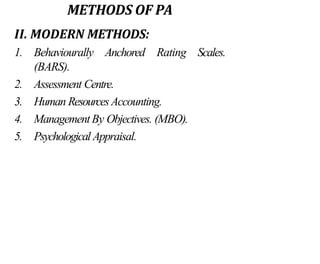
  • 159.
    ⚫Programmed instructions: In recentyear this method has become popular. The subject matter to be learned is presented in a series of carefully planned sequential units. These units are arranged from simple to more complex levels of instruction. This method is expensive and time consuming.
  • 160.
  • 161.
    TRAINING AND DEVELOPMENT ⚫Meaningand definition of training ⚫Difference between training & Development ⚫Objectives of training ⚫Needs and importance of training ⚫Types of training ⚫Steps in training program ⚫Training methods
  • 162.
    ⚫Meaning: Training is theact of increasing the knowledge and skill of an employee for doing a particular job. ⚫Definition: Dale S. Beach defines the training as “organized procedure by which people learn knowledge and/or skills for a definite purpose”.
  • 163.
    DIFFERENCE BETWEEN TRAININGAND DEVELOPMENT Training is distinct from development. Training is a short term process utilizing a systematic and organized procedure by which non-managerial personnel learn technical knowledge and skills for a definite purpose. Development is a long term educational process utilizing a systematic and organized procedure by which personnel learn conceptual and theoretical knowledge for general purpose. Training refers to instructions in technical and mechanical operations like operation of a machine. It is designed primarily for non-managers. It is for a short duration and for a specific job related purpose. Development, on the hand, involves philosophical and theoretical educational concepts and it is designed for managers. It involves broader education and its purpose is long term development.
  • 164.
    Training helps anindividual learn how to perform his present job satisfactorily. Development involves preparing the individual for a future job and growth of individual in all respects. Training is mostly the result of initiatives taken by the management. It is the result of some outside motivation. Development is mostly the result of internal motivation. Development complements training because human resources can exert their full potential only when the learning process goes far beyond simple routine. Training is, thus a reactive process whereas development is a proactive process. Development is future oriented training focusing on the personal growth of the employee.
  • 165.
    OBJECTIVES OFTRAINING: The trainingobjectives are laid down keeping in the view the company’s goals and objective. But the general objective of any training program are as follows: ⚫The basic objectives of training is to help develop capacities and capabilities of the employees both new and old by upgrading their skills and knowledge so that the organization could gainfully avail of services for higher grade professional, technical, sales or production positions from within the organization. ⚫Training aims to help existing employees in improving their level of performance. In case of new employees, training has to provide them with basic knowledge and skills they need for intelligent performance of their specific tasks.
  • 166.
    ⚫The aims oftraining are not only providing new knowledge and hob skills to the employees, but creating in them self consciousness and a greater awareness to recognize their responsibilities and contribute their very best to the organization they serve. ⚫Sometimes, it may not be possible for the management to fill in some important work positions from outside. Under such conditions, the apprenticeship programmes aiming at improving the skills of the present employees come to aid of the company to tide over the position by making available their requirements of the personnel from within the organization.
  • 167.
    ⚫The main objectiveof training is to bring about efficiency and effectiveness in an organization. So that the organization may remain competitive in highly competitive market situations and for the achievements of organizational goals. ⚫Training play a significant role in dynamic companies which are more than often on the run for their survival, to bring about technological changes like automation, highly mechanized and computer oriented systems, which may in their turn creates new problems, new methods, new procedure, new equipments, new skills and knowledge, new jobs, new product and services all these make the functioning of training a must in an organization as otherwise, the employees will find themselves to be helpless to handle new jobs and adapt themselves to the changes, may feel frustrated and compelled to leave their jobs.
  • 168.
    NEEDS AND IMPORTANCEOF TRAINING ⚫ Increased productivity: Training improves the performance of employees. Increased skill and efficiency results in better quantity and quality of production.Atrained worker will handle machines carefully and will use the materials in an economical way. ⚫ Higher employee morale: A trained worker derives happiness and job satisfaction from his work. He feels happy when his performance is up to the mark. This also gives him job security and ego satisfaction. The employees will properly look after a worker who performs well. All these factors will improve employee’s morale.
  • 169.
    ⚫ Less supervision: Thedegree of supervision required for a trained worker will be less. He will not be dependent upon the supervisor for minute details and may carry on his work himself. On the other hand untrained worker will need constant watch he will require the guidance of the supervisor very often.Atrained worker will be most disciplined and independent. He will not any type of interference in his work and may not give any opportunity to the supervisor of complaints. Such workers can take more interest in their work and may contribute significantly in reducing managerial problems of supervision. ⚫ Less wastages: Untrained workers may waste more materials, damage machines and equipments and may cause accidents.Accidents generally occur due to deficiency in the operator and not in the machine.Atrained worker will know the art of operating the machine properly. He will also use the material and other equipments in a systematic way causing less wastages. The control of less wastes will substantially reduce the manufacturing cost. The amount spent of training the workers will provide an asset to the organization
  • 170.
    ⚫ Easy adaptability: Thetechnologically advancements will require new approach to work. The new methods of work are constantly undergoing a change. This will necessitate the adaptability of workers to changing the work environment.Atrained worker can be more adaptive to change than an untrained one. The former can easily new work technique with a little bit of guidance. There may not be any need to employ few workers for running new machines. The present workers will learn new techniques with some sort of orientation. The trained persons will adopt to new situation more easily because they have technical knowledge. ⚫ Reduced turnover and absenteeism: Labour turnover and absenteeism are mainly due to job dissatisfaction. When a worker is properly trained he will take keen interest in his job and can derive satisfaction from it.Asatisfied person may not like to leave his job and try at a new place. Training helps in reducing labour absenteeism by increasing job satisfaction among them.
  • 171.
    ⚫Employee development: Training alsohelps in development of employees. It first helps in locating talent in them and then developing it to the maximum. The adaptability of a worker will help him in working on new and improved jobs. If a worker learns fast, then he will be able to develop his talent and improve his performance. Training gives him an opportunity to show his work also.
  • 172.
    TYPES OF TRAINING Thefollowing types of training are generally in use: ⚫Orientation or induction training ⚫On-the-job-training ⚫Off-the-job-training ⚫Apprenticeship training ⚫Refresher training ⚫Vestibule training
  • 173.
    ⚫Orientation or inductiontraining: This type of training is given to help a new entrant for adapting himself to the new environment. The employee is given a full description of the job he is expected to do. He is also informed about the policies, procedures and rules which are related to his work. Some enterprises have a specific person who gives full information about the organization and job to every new entrant. The newcomer is also taken around the factory and informed about the location of various department and offices. A newcomer will also like to know about his supervisors and subordinates. Orientation training helps him to acquaint himself with his immediate boss and the person who will work under his command. He is also given an organization chart sao that he knows his position in the enterprise in relation to other employees.
  • 174.
    ⚫ On-the-job training: Thisis one of the commonly used type of training. It is also an effective method of training the operative personnel. In this method the worker is trained on the job and at his work place. He get training under the same type of conditions in which he will be working later on. The new worker generally attached supervisor or a senior worker who will tell him the technique of doing that job. When a worker is trained on those very machines on which he will work, then he will adapt more easily to the new working condition. ⚫ Off-the-job training: This type of training can be given in a number of ways. Off-the- job training consists of lectures, conferences, group discussions, case studies, programme instructions, etc. This method is generally used by government and public enterprises.Aschool or an institution is established to provide training to all types of persons. A programme of training is designed to suit the needs of jobs the trainees will occupy. Sometimes different courses are arranged for separate groups of employees.
  • 175.
    Only big enterprisesmayafford to setup separate schools but this method is commonly in use in many concerns.The lecture method or group discussion helps new employees to learn theoretical aspects of the jobs.Various rules, regulations etc. can easily be explained to employees throughlecture system. ⚫Apprenticeship training: In apprenticeship training, aworker is attached to an experienced or senior worker.The worker learns while observing his senior and helping him in the task.The period of apprenticeship is generally long, ranging from two to five years.The trainees are paid only nominal wagesasapprentices during training.This method of training is generally used in technical jobs.Mechanics,electricians, plumbers learn their jobs byworking with trained persons.This is one of the traditional methods of training and is still in use for learning certain jobs.
  • 176.
    Refresher training: Refresher trainingis helpful in acquainting personnel with latest improvements in their work. The changing technological methods require fresh training to existing employees even if they are well trained or qualified. Everybody requires to attend refresher courses to know the latest techniques of doing the work. Such training also helps in refreshing the memory of employees. The introductions of new products may also necessitate fresh training of employees. Vestibule training: The term vestibule training is used to impart training in a class room in the plant. The word meaning of ‘vestibule’ demotes a room between the outdoor and the interior of a building. It means that workers are trained at some place in the factory.
  • 177.
    When large numberof workers are to be given training, then a separate training department is set up. The instructors impart on-the-job training to new workers. This method is similar to that of on-the-job training. The difference is only of place and trainers. In vestibule training, special instructors are appointed for this job while line persons give training in the second method. In the former method, the place of training is different while in ‘on-the-job training’ workers are asked to work at a place where they are supposed to work later on. ADV ANTAGE OFVESTIBULE TRAINING: ⚫Alarge number of persons can be trained at a time. ⚫The instructors are specialist in their fields and are able to impart training in a much better way. Moreover, their job is only training, they acquire better experience of giving training. ⚫The trainees can concentrate on training work only ⚫The line supervisors are not burdened with the task of giving training. They can concentrate on their work without any strain of giving training
  • 178.
    DISADVANTAGES OFVESTIBULE TRAINING: ⚫Thetrainees get training at a place away from their place of work. They are not encountered with the practical difficulties faced at actual work place ⚫The line supervisors start blaming training programmes when some deficiency is found in trainee’s work ⚫This method of training is very costly. A number of machines will be purchased for this purpose and instructors are also required to impact training; small concerns cannot afford this type of training method.
  • 179.
    STEPS IN SYSTEMATICTRAINING PLAN Atraining plan essential involves seven steps namely: ⚫Determining training needs ⚫Establishing training policies ⚫Setting goals and objectives of training ⚫Preparing training budget ⚫Deciding about the training venue ⚫Deciding about the methods and techniques to be deployed in training ⚫Determining methods of evaluating training
  • 180.
    1. Determining trainingneeds: The first step of training is to determine what training, if any, is required. According to Thayer & McGhee model training needs can be identified through the following types of analysis a)Organisational analysis: It involves a study of the entire organisation in terms of its objective, it resources, resource allocation and utilization, growth potential and its environment. Organisation analysis consists of: i) Analysis of objective: This is a study of short term and long-term objectives and the strategies followed at various levels to meet these objectives. General objectives to need to be translate in to specific and operational targets. It is also necessary to continuously review and revise the objectives. ii) Resource utilization analysis: How the various organisational resources viz. financial, physical and human are put to use is the main focus of this analysis. The contributions of various departments are also examined by establishing efficiency indices for each unit.
  • 181.
    iii) Environmental scanning: Inthe analysis, the economic, social, political and technological environment of the organisation is examined. This is necessary to identify the environmental factors which the organisation can influence and the factors which it cannot control. iv) Organisational climate analysis: The climate of an organization reflects the employee’s attitudes. It also represent management’s attitude towards employee development. Without adequate management support and appropriate supervisory styles, a training programme cannot be successful. Analysis of organizational climate can influence and the factors which it cannot control.
  • 182.
    2. Establishing trainingpolicies: Company’s policies play a vital role in the formulation and designing of a training programme. Every organization should have a well established training policy. Such a policy represents the top management’s responsibility for training for its employees and comprises rules and procedures governing the standard and scope of training and development. 3. Setting goals and objectives of training: Once specific training needs have been determined and and policies relating thereto established, stage comes for setting goals and objectives of training for filling these needs. Broadly speaking, The immediate objective of training are to help an employee to improve performance and on his present job. Long range objective are to guide the qualified man in preparations for positions involving greater responsibilities.
  • 183.
    Major types ofgoals and objectives are: i) Operational objectives: Mainly concerned with efficiency in organizational working and outputs such as enhanced sales, reduced costs and improved productivity. ii) Performance objective: Relate to individual performance in terms of both efficiency and quality, organisational’s effective performance within allocated funds. iii) Instructional objectives: pertain to the trainee’s grasp and applicability of the lessons or instructions as received during the learning process, which can generally be evaluated at the end of the training programme by some sort of objective iv) Reaction objectives: these are primarily subjective in nature. Participants being very much alive to the learning situations give expression to their feelings and come out with reactions about the training progammes.
  • 184.
    v) Personal growthobjective: Indicative of stimulating feelings of self confidence, self competence, self image and other aspects of self realization. vi) Innovation or change making objective: these form a very important type of objectives which are generally developmental in nature and have a large effect and return. 4. Preparing training budget: Preparation of training budget is specifially concerned with the allocation of funds to be provided for the training for carrying out the training activities as envisaged in the plan. 5. Deciding about the training venue: The decision about the training venue depends invariably on the type of training to be given. For in the company and On-the-job training, the venue naturally is the plant itself. In the case Off-the- job training and training through external sources, the venue has to be somewhat away from the trainee’s working environments. The venue of the trainng will be the place where the outside agency is located.
  • 185.
    6. Deciding aboutthe methods and technique to be deployed in training: Broadly speaking, the training methods and techniques vary from unorganized system of learning from working colleagues to more systematic methods of instruction through programmed texts. No wonder, training may range from highly specified instructions in the procedures to be adopted while performing a particular job, to every general instruction concerning economy and society. Factors that generally matter in the selection or choice of a particular method or technique for training are: i) Depth of knowledge, nature of the skills called for in particular jobs to be filled. ii) Background of the trainees for assessing their capacities and potential and ascertaining their aptitudes. iii) Various kinds of operative problems confronted by the organisation or for achievement of any other specific organization objective which compel them to bring in use particular methods and techniques.
  • 186.
    iv) Consideration offacilities by way of cost, time, material, equipments etc. As available for number particular training and for particular situation. v) Number of persons to be trained and developed. 7. Determining methods of evaluating training: Evaluating training is fundamentally concerned with the extent of achievement of objectives as set out in the training plan. It is the measurement of the effectiveness of performance after training and collecting useful feedback for future training. The four methods successfully employed for the evaluation of training are: i) Judging and measuring reactions of participants in various aspects as outlined in the training programme.
  • 187.
    ii) Assessing andmeasuring how far the learning has been gainful and effective, that is, what exactly has been achieved by way of new knowledge, understanding and skills by the participants? This is done by means of tests. iii) Evaluating new and different attitudinal and behavioural changes in the performance of the job of the participants as observer by their supervisors themselves, their peers, and the colleagues or associates of the participants. iv) Measuring results or changes in terms of costs, grievances, quality and production.
  • 188.
    METHODS OF TRAINING ⚫On – the – job method • Job rotation • Job instruction • Coaching • Committee assignments ⚫ Off – the – job method • Conference or discussions • Lecture methods • Role playing • Vestibule training • Programmed instruction
  • 189.
    ON THE JOBMETHODS On the job training method are follow as: ⚫Job rotation: This type of training involves the movement of the trainee from one job to another. The trainee receives job knowledge and gains experience from his supervisor or trainer in each of the different job assignments. Through this method of training is common in training managers for general managers position, trainees can also be rotated from job to job in workshop jobs. ⚫Job instruction or training through step by step: This method is also known as training through step by step. Under this method, trainer explains the trainee the way of doing the job. job knowledge & skills and allow him to do the job. The trainer appraises the performance of the trainee provide feedback information and corrects the trainee.
  • 190.
    ⚫Coaching: The trainee isplaced under a particular supervisor functions as a coach in training the individual. The supervisor provides who feedback to the trainee on his performance and offers him some suggestions for improvement. Often the trainee shares some of the duties and responsibilities of the coach and relieves him of his burden. ⚫Committee assignments: Under the committee assignment, a group of trainees are given and asked to solve and actual organizational problem. The trainees solve the problem jointly. It develops team work.
  • 191.
    OFFTHE JOB METHOD Offthe job training method are as follows: ⚫Conference or discussions: It is a method in training the clerical, professional and supervisory personal. This method involves group of people who pose ideas, examine and share facts, ideas and data, test assumptions and draw conclusions, all of which contribute to the improvement of job performance. The participants feel free to speak in small groups ⚫Lecture method: The lecture is traditional and direct method of instructions. The instructor organizes the material and gives it to a group of trainees in the form of a talk. An advantage of lecture method is that it is direct and can be for a large group of trainees.
  • 192.
    ⚫Role playing: It isdefined as a method of human interaction that involves realistic behavior is imaginary situations. This method of training involved action, doing and practice. The participants play the role of certain characters, such as the production manager, mechanical engineer, workers and like. This method is mostly used for developing interpersonal interactions and relations. ⚫Vestibule training: In this method of training, trainee is separated from the job actual work conditions are stimulated in a class room. Material, files and equipments those are used in actual job performance are also used in training. Theory can be related to practice in this method.
  • 193.
    ⚫Programmed instructions: In recentyear this method has become popular. The subject matter to be learned is presented in a series of carefully planned sequential units. These units are arranged from simple to more complex levels of instruction. This method is expensive and time consuming
  • 194.
  • 195.
    PERFORMANCE APPRAISAL • Itis amethodof evaluatingthebehaviour of employeesin theworkspot, normally including both thequantitativeand qualitativeaspects of ý ob performance. • It is asystematic & obý ectiveway of evaluatingboth work-relatedbehaviour andpotential of employees.
  • 196.
    Characteristicsof PA •Thesystematic processofPA involves 3 steps: 1.Settingwork standards 2.Assessing employeesactual performancerelative to thesestandards 3.Offeringfeedback totheemployeetoeliminate deficiencies & improveperformance. • PA is carriedout periodically. • Provideinformationaboutemployeeperformance, worthof theý ob, standards of work etc.
  • 197.
    TYPES OF APPRAISERS •1.Self Appraisal. • 2.360 degreePA. • 3.Supervisors. • 4.Peers. • 5.Subordinates. • 6.Customers/Usersof services. • 7.Consultants.
  • 198.
    When toAppraise? 1.Formal-Systematicappraisals are conductedon aregular basis. (e.g.)every 6 months or annually. 2.lnformal-It is conductedwheneverthe supervisor orpersonnelmanagersfeel it necessary.
  • 199.
    METHODS OF PA I.TRADITIONALMETHODS: 1.Graphic RatingScales(Continuous & DC). 2.Employee Comparison System. (i) Rank OrderSystem (ii)PairedComparison System(iii)Forced Distribution System. 3.Check L ist RatingSystem. (i)SimpleCL . (ii) Weighted CL. (iii) Critical Incident Method. 4.Essay or Freeform Appraisal. 5.Group Appraisal. 6.Confidential Report.
  • 200.
    METHODS OF PA II.MODERN METHODS: 1. Behaviourally Anchored Rating (BARS). 2. AssessmentCentre. 3. Human Resources Accounting. 4. ManagementBy Obýectives.(MBO). 5. Psychological Appraisal. Scales.
  • 201.
    I.TRADITIONAL METHODS: 1. GraphicRatingScales •This is theoldestand widely usedtechnique • Simplest and most popular methodof Performance Appraisal • Graphic ratingscales compareindividual performanceto an absolutestandard. • In this method,ýudgementsabout performanceare recordedon ascale. • Theappraisers aresupplied withprinted forms, onefor eachemployee.
  • 202.
    • These formscontain a number of obýectives, behaviours and trait-based qualities and characters to be rated like quality and volume of work, ýob knowledge, dependability, initiative, attitude etc..., • A rating scale lists traits & a range of performance, values for eachtrait. • The supervisor rates each subordinate by circling or checking the score that best describes employees performancefor eachtrait. • Theassignedvalues arethen totalled. • The selection of factors to be measured on the graphic- ratingscalean important point under thesystem.
  • 203.
    Rank Order System Itis thesimplest andoldest methodof merit-rating. Every employeeis ý udgedas awholewithout distinguishing the rates fromhis performance. A list isthen preparedfor rankingtheworkersin orderoftheirperformanceontheýob.Sothat,an excellent employeeis at thetopandthe pooremployee at thebottom(last line). It permits comparison of all employeein any single ratinggroupregardlessof thetypeof work.
  • 204.
    PairedComparison Method In thismethodevery person is comparedtrait-wise, withother persons, oneat atime, thenumber of times oneperson is comparedwith othersis tallied on a pieceof paper. This numberhelp in yielding rank ordersof employee This methodgivemorereliableratingsystemthan straight rankingmethod. It will besuitable whenonly thenumberof personis small.
  • 205.
    ForcedDistribution Method  Someratters/ PerformanceAppraisers suffer froma constant errori.e. either therateof employeesasgood, averageor poor.  They donot evaluatetheemployeesproperly.  This systemminimizes ratters bias. So that all employees arenot similarly rated.  This systemis basedontheperceptionsthat all employees can bedivided intoFIVE categoriesnamely 1. Outstanding,2.AboveAverage,3.Average,4.Below Average, 5. Poor
  • 206.
     Theratter isaskedtoplace 10%persons in Outstanding 20% persons in AboveAverage 40% persons in Average 20% persons in Below Average 10% persons in Poor Themainideain this systemis tospreadratingsin the number of grade. This methodobviouslyeliminatesthegroupofsubýective ý udgement on thepart of thesupervisors. Besides this systemis easyto understand & administrate
  • 207.
    Num berofPersons 20% 40% 20%10% 10% Poor Below Average Above Outstanding Average Average Forced Distribution ranking is flexible (feasible) for more number of employees.
  • 208.
    Check L istRatingSystem • A list of statements that describes the characteristics andperformanceof employeesontheýob. • Theratter checks toindicatewhether thebehaviour of the employee is POSITIVE or NEGAVTIVE to each statement. • The performance of the employeeis rated on the basis of number of POSITIVE checks. • There arethreetypes of Check List Ranking System whicharegiven as follows
  • 209.
    1. SimpleCheck List • A sampleof Check List maycontain suchquestions • Is theemployeehard working? Yes • Is he/sheisregular on thework? Yes N o No • Does he/sheCo-operateswith his/her supervisor? Yes No • Based onthe answers, theratter ratewhetherthe employeepossesPOSITIVE orNEGATIVE PA
  • 210.
    2. WeightedCheck List • It involves weighting different itemsin thecheck list, having aseries of statementsaboutan individual, to indicate that somearemore important than others. • The weighted checklist, however, is expensive to design,since thechecklist for eachdifferent ýobin theorganisation mustbeproceeded. • It is atimeconsumingprocess.
  • 211.
    3. Critical IncidentMethod o This methodattempts tomeasuretheworkers performancein terms of certain EVENTS or INCIDENTS that occur in thecourseof work. o The assumption is this methodis theperformanceof theemployeeonthehappeningofcritical incidents determines his/her successor failure. o The supervisor keepsarecordof critical incidents at different timesand thenrates onthat basis.
  • 212.
    Essay or FreeFormAppraisal Thismethodrequiresthemanagertowriteashort essaydescribing eachemployee’sperformanceduring theratingperiod. This format emphasises evaluation of overall performance, based on strengths/weakness of employeeperformancerather than specific ýob dimensions. Thesupervisor continuously watches thesubordinates andwritesessay about eachof them.
  • 213.
    GroupAppraisal Employees arerated byan appraisal group, consisting of their supervisor and 3 or 4 other persons whohavesome knowledgeof theperformance. Thesupervisor explains about his group, natureof subordinates, duties etc…, theappraisal groupthen discussesthe standards of performanceof theemployees & thecausesoftheparticularlevelofperformanceand offers suggestionfor future improvement,if any.
  • 214.
    Confidential Reports  Thesupervisorappraises theperformanceof his subordinatesbasedonhis observations, ýudgementandinstitutions.  The superior keepshis ýudgementandreport confidentially.  In otherwords, theappraiser doesnotallow the employeeto know thereportandhis performance.
  • 215.
    BARS It’s acombination ofCI Method andWeighted CL Rating Scales. • Constructionof BARS: The steps are., • 1.Collect Critical Incidents. • 2.Identify PerformanceDimensions, • 3.Reclassification of Incidents. • 4.Assigning Scale Values to theIncidents. • 5.ProducingtheFinal Instrument.
  • 216.
    Assessment Centre This methodofappraisal is first appliedin GermanArmy in 1930. This is notatechniqueof performanceappraisal itself. In fact, it is asystemororganisation, whereassessmentof several individuals isdoneby various expertsby using various techniques. In additiontothemethodsdiscussedsofartherearesome additional methodsarealsoemployedduring appraisal such asroleplaying, casestudies, stimulation exercises, structuredin sight, transactional analysis etc…,
  • 217.
    Human ResourcesAccounting  Itdeals withcost and contribution of human resourcesto theorganisation.  Costoftheemployeesincludescostofmanpower planning, recruitment, selection, induction, placement, training, development,wagesandbenefits etc.  Employeecontribution is themoney valueof employee service which can bemeasuredby labour productivity or valueadded by human resource.  Cost of humanresourcesmaybetaken asstandard.  Employeeperformancecan bemeasuredin terms of employeecontribution totheorganisation.
  • 218.
     Employeeperformancecanbetaken asPOSITIVE whencontribution is morethan thecost  Performanceis viewedas NEGATIVE when the contribution islessthan thecost.
  • 219.
    Management by Obý ectives(MbO) •MbOis a‘processwherebythesuperiorand subordinatemanagersofanorganisationýointly identifyits commongoals,defineeachindividual’s maýorareasof responsibility in termsof result expectedof himand usethesemeasuresof guides for operatingtheunit andassessingthecontribution of its members. • The subordinateand superior ýointly determinegoals tobeaccomplishedduringtheappraisalperiodand what level of performanceis necessaryfor the subordinatetosatisfactorily achievespecificgoals.
  • 220.
     During theappraisalperiod,thesuperiorand subordinateupdateandalter goalsasnecessarydue tochanges in business environment.  Both superior and subordinate ýointly discuss whether thesubordinateachievedthegoalsornot.If not,they shouldidentifythereasonsforderivationlike strike/lock-out, market changeetc.
  • 221.
    Psychological Appraisal • Psychologicalappraisalsareconductedtoassesthe employee’spotential. •Psychological appraisalsconsistsof i. In-depth interviews ii. Psychological tests iii. Consultations and discussions with theemployee iv. Discussions with superiors, subordinatesand peers and v. Reviews of otherevaluations.
  • 222.
     Evaluation isconductedin theareasof i. ii. Employee’sintellectual abilities Emotional stability iii. Motivational responses iv. Reasoningand analytical abilities v. Interpretation and ý udgement skills vi. Sociability vii.Employee’s ability to comprehendthevents and viii.Ability toforeseethefuture
  • 223.
     The Psychologicalappraisalresults areuseful for decision-makingabout i. Employeeplacement, ii. Career-planningand development and iii. Traininganddevelopment
  • 224.
    USES OF PA I.ADMINISTRATIVEUSES: 1.Training. 2.Promotion. 3.Transfers & Discharges. 4.Wage& Salary Administration. 5.HR Research. II.OTHER USES: 1.Self-improvement of theEmployees. 2.Better EmployeeRelations. 3.Records of Performance. 4.Discovery of exceptional talents.
  • 225.
    PROBLEMS OF PA •1.Rating Biases. • 2.Halo Effect. • 3.TheError of Central Tendency. • 4.The Leniency & Strictness. • 5.Personal preýudice. • 6.The RecencyEffect. • 7.Unsatisfactory forms. • 8.Secrecy. • 9.Feedbacksetback. • 10.Based onSubýectivity.
  • 226.
    Dear Students WISH YOUALL SUCCESS THANK YOU ALL….
  • 227.
    Human Resource Management Unit– II Dr. M.S. Balaji
  • 228.
    Job Analysis • Accordingto the U.S. Department of Labour, job analysis as “the process of determining, by observation and study and reporting pertinent information relating to the nature of a specific job. It is the determination of the tasks which comprise the job and of the skills, knowledge, abilities and responsibilities required of the worker of a successful performance and which differentiate one job from all others”
  • 229.
    Process of JobAnalysis 1.Collection of Background Information. 2.Selection of Representative position to be Analysed. 3.Collection of JobAnalysis Data. 4.Developing a Job Description. 5.Developing Job specification. 6. Developing Employee specification.
  • 230.
    Job Analysis Information &Facts Job Description Job Specification
  • 231.
    Job Description Job identification– job, title, location, code, short name. Job summary Brief job contents Authority, responsibility, Hazards etc...,. Relation to other job (Supervisors, Peers, Sub-ordinates) Supervision taken location in hierarchy Machine, Tools, and equipments Condition of work, speed, standing, posture, health, hazards, occupational diseases etc.....,.
  • 232.
    Job Specification • Educationalqualification required to that job • Experience • Training • Initiative • Physical effort • Physical skill • Responsibility • Communication skills • Emotional characteristics • Unusual sensory demands such as vision, smell wearing etc.....,
  • 233.
    Job Description -Definition • A Job Description is “an organized, factual statement of the duties and responsibilities of a specific job”. • In brief, it should tell what is to be done, how it is done and why? • It is a standard of function, in that it defines the appropriate and authorised content of a job.
  • 234.
    Job Specification –Definition • A job specification is “a statement of the minimum acceptable human qualities necessary to perform a job properly.” • In contrast to the job description, it is a standard of personnel and designates the qualities required for acceptable performance.
  • 235.
    Job Evaluation –Definition • Wendel L. French defines “A process of determining the relative work of various jobs within the organization, so that the differential wages may be paid to Jobs of different worth”. • Job Evaluation is defined as the overall activity of involving orderly, systematic methods, and procedure for ranking, grading & weighing of jobs to determine the value of specific jobs in relation to other jobs.
  • 236.
    Types of JobEvaluation Method Quantitative Non – Quantitative Points Rating M Ranking M Job Classification & Grading M Factors Comparison M Simple Ranking Ranking the key jobs Paired comparison Single Factor ranking Method
  • 237.
    Quantitative Techniques 1. PointsRating Method This method of job evaluation should be developed systematically and applied through methodically in order to avoid the anomalies. The important steps in developing the techniques are i. Constituting a representative committee of members from various departments for job evaluation ii. Selecting a sample of jobs and preparing jobs specification and employees descriptions, job specification.
  • 238.
    iii. Selecting anddefining those factors which are related to all jobs are considered to be the most critical in determining the relative degrees of difficulty & responsibility between jobs such as skill, effort, responsibility and job condition. iv. Determining the weight of each factor according to its relative importance. v. Defining each factor specifying the scope & elements of each factor. vi. Dividing each factor into levels and defining each level. vii. Appraise all the jobs and arrive at a composite numerical value for each job. viii.Determining relative value of each level within factors. Factors can be divided into point values by arithmetic or geometric progression
  • 239.
    Factor Comparison Method •The mechanism of this steps involves the following steps: i. Developing job descriptions, job specification or job requirements covering physical requirements, mental, skill requirements, training & experience, responsibility & authority, working conditions etc...............................,. ii. Selecting a number of key jobs: This step is more critical & useful from the point of final evaluation as the other jobs are assigned monetary values based on the fixed wage rates arrived from the key jobs on the basis of negotiations it must clearly divisible into sub-factors & components. This step also involves dividing the job into sub-factors & components.
  • 240.
    iii. The sub-factorsof each key job must be given relative ranks based on their individual contribution to the total job, the sub-factors of two key jobs (for example Welder and Mechanical Engineer) competitive at picture of the ranking two jobs in factor ranking iv. The sub-factors of each of the key jobs, as well as factor evaluation, money worth of each sub-factor of the key jobs is ascertained in order to know the total money value (salary) of each of the key job in monetary value of each of the key jobs (per day) v. It is integrating the monetary value of sub-factors arrived through factor evaluation with those of ranking factors, whether the difference among factors as per the ranking & factor evaluation. vi. The comparing all jobs the same grade or level with the related key job & establishing monetary value to the sub- factors of the various jobs based on the monetary value of sub factors or key jobs.
  • 241.
    Recruitment – Definition •Recruitment is defined as a process to discover the sources of man power to meet the requirements of the staffing schedule of effective measures for attracting man power in adequate numbers selection of the employees & to the to an facilitate effective efficient work force.
  • 242.
    DEFINITION • “The processof searching for prospective employees & stimulating them to apply for jobs in the organisation”-Edwin B. Flippo.
  • 243.
    SUBSYSTEMS OF RECRUITMENT •1.Finding out & developing Sources. • 2.Developing techniques to attract candidates. • 3.Employing the technique. • 4.Stimulating the candidates and making them to apply for jobs.
  • 244.
    Factors affecting Recruitment •INTERNAL FACTORS: • Company’s pay package • Quality of work life • Organizational structure. • Career planning & growth. • Company’s size, growth rate, products/services &Name and fame. • Geographical spread. • Role of trade unions. • Cost of recruitment.
  • 245.
    Factors affecting recruitment •EXTERNALFACTORS: • Socio-economic factors. • Supply & Demand factors. • Employment rate. • Labour market conditions. • Political ,Legal & Govt .,factors viz., SC/ST/BC Reservations &Sons-of-soil • Information system-E. Exchange,Internet.
  • 246.
    RECRUITMENT POLICY • RecruitmentPolicy is derived from the personnel policy of the organisation. • After formulation of Recruitment Policy, management has to decide whether centralise /decentralise the recruitment function. • Centralised Rect.-Commercial Banks. • Decentralised Rect.-Indian Railways (Gr.III and Gr.IV positions). • Both has merits and demerits.
  • 247.
    SOURCES OF RECRUITMENT •2 SOURCES Viz., INTERNAL & EXTERNAL( Traditional& Modern methods) • I.INTERNAL SOURCES: • 1.Present permanent employees. • 2.Present temporary/Casual employees. • 3.Retrenched/Retired employees. • 4.Dependants of deceased, disabled, retired & present employees.
  • 248.
    SOURCES OF RECRUITMENT •II.EXTERNAL SOURCES: • 1.Traditional sources- 1.Advertisements2.Employment exchanges3.Personnel consultants 4.Colleges,Universities and Institutions.5.Recommendations.6.Labour contractors.7.Casual &Unsolicited applicants.
  • 249.
    External sources -Modernsources 1. Campus interview. 2. Walk-in- Interview. 3. Personal consultation. 4. Head Hunting 5. Leasing. 6. E-Recruitment. 7. Data banks. 8. Similar organizations. 9.Trade unions. 10.Outsourcing.
  • 250.
    TECHNIQUES OF RECRUITMENT TraditionalTechnique of Recruitment 1.Campus Recruitment. 2.Public employment exchange. 3.Professional Organizations. 4.Data banks. 5.CasualApplicants. 6. Trade Unions. 7. Private Employees. Modern Technique of Recruitment 1.Walk-in. 2.Consult-in. 3.Head hunting. 4.Body shopping. 5.Business alliances. 6.Tele-Recruitment. 7.ESOP(Employees Stock Ownership Programme). 8.Offering higher pay & facilities.
  • 251.
    Traditional Sources ofRecruitment 1. Campus Recruitment: Inexperience graduate can be got interview, organisation can get inexperienced candidates. 2. Public Employment Exchange: These are provide for collection of information & vacancies. 3. Professional Organizations: It gets complete Bio-data of their members & exchanging information, clarifying doubts etc........, 4. Data Banks: These are like employment exchanges, educational institutes candidates etc. 5. CasualApplicants: Image of the organisations its prompt response participation local activities. 6. Trade Unions: Generally employed or under employed.
  • 252.
    Modern Sources ofRecruitment 1. Walk-in: To attend interview directly 2. Consult in: Encourage the job seekers 3. Head Hunting: The organisation can get senior executive persons. 4. Body Shopping: Training institutes, human resources, possible employment. 5. Mergers &Acquisitions:Ad-hoc basis – hourly, part-time. 6. E-recruitment: The technological revolution and tele-communication mode.
  • 253.
    Sources of RecruitmentUsed by Skill & Level • 1.Unskilled &Semi-skilled. • 2.Skilled. • 3.Professional employees. • 4.Managerial Level.
  • 254.
    DEFINITION FOR SELECTION •Selection is the process of picking individuals who have relevant qualifications to fill jobs in an organisation.The basic purpose is to choose the individual who can most successfully perform the job, from the pool of qualified candidates.
  • 255.
    Essentials of selectionprocedure 1. Authority for selection-some one should have. 2. There must be some standard of personnel with which a prospective employee may be compared ,i.e.,a comprehensive JD & JS should be available beforehand. 3. Sufficient no. of applicants. 4. Scientific selection system. 5. Own/Using SelectionAgencies/Consultants.
  • 256.
    Factors affecting Selection •1.Profile matching. • 2.Organisational & social environment. • 3.Successive hurdles. • 4.Multiple correlation. (A deficiency in one factor can be counter-balanced by an excess amount of another ).Composite test sore index is used.
  • 257.
    SELECTION Process/Stages/Procedure • 1.Reception. •2.Scrutiny ofApplications received. (Clinical, Weighted methods & Biographical inventories). • 3.Preliminary/Screening interview. • 4.BlankApplication forms. • 5.Conucting Tests/Written Examination. (Performance & psychological Tests). • 6.Final Interview. • 7.Group Discussion. • 8.Checking of references/Reference checks. • 9.Medical Examination. • 10.Final Decision/Selection. • 11.Employment/Appointment/Placement & Induction.
  • 258.
    Types of Tests •I.PERFORMANCE TESTS: • 1.Work sampling. • 2.Job knowledge. • 3.Assessment Centres. • II.PSYCHOLOGICALTESTS: • 1.Intelligence Tests. • 2.Aptitude Tests (Mechanical & clerical aptitude, Psychomotor tests). • 3.Interest Tests. • 4.Situatonal Tests (GD, In Basket). • 5.Personality Tests (ThematicApperception Test, Rorchach Inkblot Test etc).
  • 259.
    Types of Interviews •1.Preliminary Interview-(a) Informal Interview (b) Unstructured Interview. • 2.Core Interview-(a) Back ground information Interview (b) Job & Probing I (c) Stress I (d) The GD I(e) Formal & structured I (f) Panel I (g) Depth Interview. • 3.Decision –making Interview.
  • 260.
    PLACEMENT • The candidatereports for the duty & the organisation place him initially in that job for which he is selected. • Generally final placement is decided after the initial training is over on the basis of candidate’s aptitude & performance during the training/probation period. • Probation-6 moths to 2 years.
  • 261.
    PLACEMENT PROCESS • Collectdetails about the employee. • Construct the employee profile. • Match between sub-group profile & Individual’s profile. • Compare sub-group profile to job family profile. • Match between job family profiles & sub- group profiles. • Assign individuals to job family.
  • 262.
    INDUCTION(ORIENTATION) • Introducing thenew employees to the organisation and its policies, procedures & rues, location, surroundings is called Induction. • For adjustment and adaptability. • Process of receiving and welcoming an employee.
  • 263.
    Induction information • 1.Aboutthe Company. • 2.About the Department. • 3.Abou the Superiors, Subordinates etc.
  • 264.
    INDUCTION PROCESS/PROGRAMME • 1.Reprtingfor duty to the HOD. • 2.The HOD welcomes the new employee. • 3.HOD introduce him to Organisational /Branch Head. • 4.O/B Head introduce him to important employees. • 5.HOD introduces to all the employees of Department. • 6.Supervisor introduces to co-workers in that section/unit to the work/job, material, machine etc. • 7.Providing information about duties, responsibilities, rights ,facilities, provisions, welfare measures etc. • 8.Supervisor clarifies the doubts of new employee about the work.
  • 265.
    UNIT 3 CHAPTER 8 TRAININGAND DEVELOPMENT  Meaning and definition of training  Difference between training & Development  Benefits of training  Needs of training  Trainingmethods  Meaning of development  Methods of development (Training and development methods are same) MEANING: Training is the act of increasing the knowledge and skill of an employee for doing a particular job. DEFINITION: Dales S. Beach defines the training as “organized procedure by which people learn knowledge and/or skills for a definite purpose”. DIFFERENCE BETWEEN TRAINING AND DEVELOPMENT Training is distinct from development. Training is a short term process utilizing a systematic and organized procedure by which non-managerial personnel learn technical knowledge and skills for a definite purpose. Development is a long term educational process utilizing a systematic and organized procedure by which personnel learn conceptual and theoretical knowledge for general purpose. Training refers to instructions in technical and mechanical operations like operation of a machine. It is designed primarily for non-managers. It is for a short duration and for a specific job related purpose. Development, on the hand, involves philosophical and theoretical educational concepts and it is designed for managers. It involves broader education and its purpose is long term development. Training helps an individual learn how to perform his present job satisfactorily. Development involves preparing the individual for a future job and growth of individual in all respects. Training is mostly the result of initiatives taken by the management. It is the result of some outside motivation. Development is mostly the result of internal motivation. Development complements training because human resources can exert their full potential only when the learning process goes far beyond simple routine. Training is, thus a reactive process whereas development is a proactive process. Development is future oriented training focusing on the personal growth of the employee.
  • 266.
    OBJECTIVES OF TRAINING: Thetraining objectives are laid down keeping in the view the company’s goals and objective. But the general objective of any training program are as follows:  The basic objectives of training is to help develop capacities and capabilities of the employees both new and old by upgrading their skills and knowledge so that the organisation could gainfully avail of services for higher grade professional, technical, sales or production positions from within the organisation.  Training aims to help existing employees in improving their level of performance. In case of new employees, training has to provide them with basic knowledge and skills they need for intelligent performance of their specific tasks.  The aims of training are not only providing new knowledge and hob skills to the employees, but creating in them self consciousness and a greater awareness to recognize their responsibilities and contribute their very best to the organisation they serve.  Sometimes, it may not be possible for the management to fill in some important work positions from outside. Under such conditions, the apprenticeship programmes aiming at improving the skills of the present employees come to aid of the company to tide over the position by making available their requirements of the personnel from within the organisation.  The main objective of training is to bring about efficiency and effectiveness in an organisation. So that the organisation may remain competitive in highly competitive market situations and for the achievements of organisational goals.  Training play a significant role in dynamic companies which are more than often on the run for their survival, to bring about technological changes like automation, highly mechanized and computer oriented systems, which may in their turn creates new problems, new methods, new procedure, new equipments, new skills and knowledge, new jobs, new product and services all these make the functioning of training a must in an organisation as otherwise, the employees will find themselves to be helpless to handle new jobs and adapt themselves to the changes, may feel frustrated and compelled to leave their jobs. NEEDS AND IMPORTANCE OF TRAINING: Training of employees is essential because work-force is an invaluable asset to an organisation. Training is necessary for the following reasons:  Increased productivity: Training improves the performance of employees. Increased skill and efficiency results in better quantity and quality of production. A trained worker will handle machines carefully and will use the materials in an economical way.  Higher employee morale:
  • 267.
    A trained workerderives happiness and job satisfaction from his work. He feels happy when his performance is up to the mark. This also gives him job security and ego satisfaction. The employees will properly look after a worker who performs well. All these factors will improve employee’s morale.  Less supervision: The degree of supervision required for a trained worker will be less. He will not be dependent upon the supervisor for minute details and may carry on his work himself. On the other hand untrained worker will need constant watch he will require the guidance of the supervisor very often. A trained worker will be most disciplined and independent. He will not any type of interference in his work and may not give any opportunity to the supervisor of complaints. Such workers can take more interest in their work and may contribute significantly in reducing managerial problems of supervision.  Less wastages: Untrained workers may waste more materials, damage machines and equipments and may cause accidents. Accidents generally occur due to deficiency in the operator and not in the machine. A trained worker will know the art of operating the machine properly. He will also use the material and other equipments in a systematic way causing less wastage. The control of less waste will substantially reduce the manufacturing cost. The amount spent of training the workers will provide an asset to the organisation.  Easy adaptability: The technologically advancements will require new approach to work. The new methods of work are constantly undergoing a change. This will necessitate the adaptability of workers to changing the work environment. A trained worker can be more adaptive to change than an untrained one. The former can easily new work technique with a little bit of guidance. There may not be any need to employ few workers for running new machines. The present workers will learn new techniques with some sort of orientation. The trained persons will adapt to new situation more easily because they have technical knowledge.  Reduced turnover and absenteeism: Labour turnover and absenteeism are mainly due to job dissatisfaction. When a worker is properly trained he will take keen interest in his job and can derive satisfaction from it. A satisfied person may not like to leave his job and try at a new place. Training helps in reducing labour absenteeism by increasing job satisfaction among them.  Employee development: Training also helps in development of employees. It first helps in locating talent in them and then developing it to the maximum. The adaptability of a worker will help him in working on new and improved jobs. If a worker learns fast, then he will be able to
  • 268.
    develop his talentand improve his performance. Training gives him an opportunity to show his work also. TYPES OF TRAINING The following types of training are generally in use: 1. Orientation or induction training 2. On-the-job-training 3. Off-the-job-training 4. Apprenticeship training 5. Refresher training 6. Vestibule training Orientation or induction training: This type of training is given to help a new entrant for adapting himself to the new environment. The employee is given a full description of the job he is expected to do. He is also informed about the policies, procedures and rules which are related to his work. Some enterprises have a specific person who gives full information about the organisation and job to every new entrant. The newcomer is also taken around the factory and informed about the location of various department and offices. A newcomer will also like to know about his supervisors and subordinates. Orientation training helps him to acquaint himself with his immediate boss and the person who will work under his command. He is also given an organisation chart so that he knows his position in the enterprise in relation to other employees. On-the-job training: This is one of the commonly used types of training. It is also an effective method of training the operative personnel. In this method the worker is trained on the job and at his work place. He get training under the same type of conditions in which he will be working later on. The new worker generally attached supervisor or a senior worker who will tell him the technique of doing that job. When a worker is trained on those very machines on which he will work, then he will adapt more easily to the new working condition. Off-the-job training: This type of training can be given in a number of ways. Off-the-job training consists of lectures, conferences, group discussions, case studies, programme instructions, etc. This method is generally used by government and public enterprises. A school or an institution is established to provide training to all types of persons. A programme of training is designed to suit the needs of jobs the trainees will occupy. Sometimes different courses are arranged for separate groups of employees. Only big enterprises may afford to setup separate schools but this method is commonly in use in many concerns. The lecture method or group discussion helps new employees to learn theoretical aspects of the jobs. Various rules, regulations etc. can easily be explained to employees through lecture system.
  • 269.
    Apprenticeship training: In apprenticeshiptraining, a worker is attached to an experienced or senior worker. The worker learns while observing his senior and helping him in the task. The period of apprenticeship is generally long, ranging from two to five years. The trainees are paid only nominal wages as apprentices during training. This method of training is generally used in technical jobs. Mechanics, electricians, plumbers learn their jobs by working with trained persons. This is one of the traditional methods of training and is still in use for learning certain jobs. Refresher training: Refresher training is helpful in acquainting personnel with latest improvements in their work. The changing technological methods require fresh training to existing employees even if they are well trained or qualified. Everybody requires to attend refresher courses to know the latest techniques of doing the work. Such training also helps in refreshing the memory of employees. The introductions of new products may also necessitate fresh training of employees. Vestibule training: The term vestibule training is used to impart training in a class room in the plant. The word meaning of ‘vestibule’ demotes a room between the outdoor and the interior of a building. It means that workers are trained at some place in the factory. When large numbers of workers are to be given training, then a separate training department is set up. The instructors impart on-the-job training to new workers. This method is similar to that of on-the-job training. The difference is only of place and trainers. In vestibule training, special instructors are appointed for this job while line persons give training in the second method. In the former method, the place of training is different while in ‘on-the-job training’ workers are asked to work at a place where they are supposed to work later on. ADVANTAGE OF VESTIBULE TRAINING:  A large number of persons can be trained at a time.  The instructors are specialist in their fields and are able to impart training in a much better way. Moreover, their job is only training they acquire better experience of giving training.  The trainees can concentrate on training work only  The line supervisors are not burdened with the task of giving training. They can concentrate on their work without any strain of giving training DISADVANTAGES OF VESTIBULE TRAINING:  The trainees get training at a place away from their place of work. They are not encountered with the practical difficulties faced at actual work place
  • 270.
     The linesupervisors start blaming training programmes when some deficiency is found in trainee’s work  This method of training is very costly. A number of machines will be purchased for this purpose and instructors are also required to impact training; small concerns cannot afford this type of training method. STEPS IN SYSTEMATIC TRAINING PLAN: A training plan essential involves seven steps namely: 1. Determining training needs 2. Establishing training policies 3. Setting goals and objectives of training 4. Preparing training budget 5. Deciding about the training venue 6. Deciding about the methods and techniques to be deployed in training 7. Determining methods of evaluating training. Determining training needs: The first step of training is to determine what training, if any, is required. According to Thayer & McGhee model training needs can me identified through the following types of analysis: a) Organisational analysis: It involves a study of the entire organisation in terms of its objective, it resources, resource allocation and utilization, growth potential and its environment. Organisation analysis consists of: i. Analysis of objective: This is a study of short term and long-term objectives and the strategies followed at various levels to meet these objectives. General objectives to need to be translate in to specific and operational targets. It is also necessary to continuously review and revise the objectives. ii. Resource utilization analysis: How the various organisational resources viz. financial, physical and human are put to use is the main focus of this analysis. The contributions of various departments are also examined by establishing efficiency indices for each unit. iii. Environmental scanning: In the analysis, the economic, social, political and technological environment of the organisation is examined. This is necessary to identify the environmental factors which the organisation can influence and the factors which it cannot control. iv. Organisational climate analysis: The climate of an organization reflects the employee’s attitudes. It also represent management’s attitude towards employee development. Without adequate management support and appropriate supervisory styles, a training programme cannot be successful. Analysis of organizational climate can influence and the factors which it cannot control.
  • 271.
    b) Task orrole analysis: Task analysis is used to determine the training needs of employee’s who are new to their jobs. Particularly with the lower level workers, it is common to hire inexperienced personnel and train them. Here the aim is to develop the skills and knowledge required for effective performance and so training is usually based on task analysis. C) Manpower analysis: In manpower analysis, the persons to be trained and the changes required in the knowledge, skills and aptitudes of an employee are determined. There are three issues to be resolved in this analysis: iii. i. Whether performance is satisfactory and training is required. ii. Whether the employee is capable of being trained and the specific ares in which training is needed. Whether training will improve the employee’s performance on the job. Establishing training policies: Company’s policies play a vital role in the formulation and designing of a training programme. Every organization should have a well established training policy. Such a policy represents the top management’s responsibility for training for its employees and comprises rules and procedures governing the standard and scope of training and development. Setting goals and objectives of training: Once specific training needs have been determined and and policies relating thereto established, stage comes for setting goals and objectives of training for filling these needs. Broadly speaking, The immediate objective of training are to help an employee to improve performance and on his present job. Long range objective are to guide the qualified man in preparations for positions involving greater responsibilities. Major types of goals and objectives are: iii. i. Operational objectives: Mainly concerned with efficiency in organizational working and outputs such as enhanced sales, reduced costs and improved productivity. ii. Performance objective: Relate to individual performance in terms of both efficiency and quality, organisational’s effective performance within allocated funds. Instructional objectives: pertain to the trainee’s grasp and applicability of the lessons or instructions as received during the learning process, which can generally be evaluated at the end of the training programme by some sort of objective iv. Reaction objectives: these are primarily subjective in nature. Participants being very much alive to the learning situations give expression to their feelings and come out with reactions about the training progammes. v. Personal growth objective: Indicative of stimulating feelings of self confidence, self competence, self image and other aspects of self realization.
  • 272.
    vi. Innovation orchange making objective: these form a very important type of objectives which are generally developmental in nature and have a large effect and return. Preparing training budget: Preparation of training budget is specifially concerned with the allocation of funds to be provided for the training for carrying out the training activities as envisaged in the plan. Deciding about the training venue: The decision about the training venue depends invariably on the type of training to be given. For in the company and On-the-job training, the venue naturally is the plant itself. In the case Off-the-job training and training through external sources, the venue has to be somewhat away from the trainee’s working environments. The venue of the trainng will be the place where the outside agency is located. Deciding about the methods and technique to be deployed in training: Broadly speaking, the training methods and techniques vary from unorganized system of learning from working colleagues to more systematic methods of instruction through programmed texts. No wonder, training may range from highly specified instructions in the procedures to be adopted while performing a particular job, to every general instruction concerning economy and society. Factors that generally matter in the selection or choice of a particular method or technique for training are: a) Depth of knowledge, nature of the skills called for in particular jobs to be filled. b) Background of the trainees for assessing their capacities and potential and ascertaining their aptitudes. c) Various kinds of operative problems confronted by the organisation or for achievement of any other specific organization objective which compel them to bring in use particular methods and techniques. d) Consideration of facilities by way of cost, time, material, equipments etc. As available for number particular training and for particular situation. e) Number of persons to be trained and developed. Determining methods of evaluating training: Evaluating training is fundamentally concerned with the extent of achievement of objectives as set out in the training plan. It is the measurement of the effectiveness of performance after training and collecting useful feedback for future training. The four methods successfully employed for the evaluation of training are: i. Judging and measuring reactions of participants in various aspects as outlined in the training programme. ii. Assessing and measuring how far the learning has been gainful and effective, that is, what exactly has been achieved by way of new
  • 273.
    iii. knowledge, understanding andskills by the participants? This is done by means of tests. Evaluating new and different attitudinal and behavioural changes in the performance of the job of the participants as observer by their supervisors themselves, their peers, and the colleagues or associates of the participants. iv. Measuring results or changes in terms of costs, grievances, quality and production. METHODS OF TRAINING: Training methods On – the – job method 1. Job rotation 2. Job instruction 3. Coaching 4. Committee assignments Off – the – job method 1. Conference or discussions 2. Lecture methods 3. Role playing 4. Vestibule training 5. Programmed instruction ON THE JOB METHODS On the job training method are follow as: Job rotation: This type of training involves the movement of the trainee from one job to another. The trainee receives job knowledge and gains experience from his supervisor or trainer in each of the different job assignments. Through this method of training is common in training managers for general manager position, trainees can also be rotated from job to job in workshop jobs. Job instruction or training through step by step: This method is also known as training through step by step. Under this method, trainer explains the trainee the way of doing the job. Job knowledge & skills and allow him to do the job. The trainer appraises the performance of the trainee provide feedback information and corrects the trainee.
  • 274.
    Coaching: The trainee isplaced under a particular supervisor functions as a coach in training the individual. The supervisor provides who feedback to the trainee on his performance and offers him some suggestions for improvement. Often the trainee shares some of the duties and responsibilities of the coach and relieves him of his burden. Committee assignments: Under the committee assignment, a group of trainees are given and asked to solve and actual organisational problem. The trainees solve the problem jointly. It develops team work. OFF THE JOB METHOD Off the job training method are as follows: Conference or discussions: It is a method in training the clerical, professional and supervisory personal. This method involves group of people who pose ideas, examine and share facts, ideas and data, test assumptions and draw conclusions, all of which contribute to the improvement of job performance. The participants feel free to speak in small groups. Lecture method: The lecture is traditional and direct method of instructions. The instructor organizes the material and gives it to a group of trainees in the form of a talk. An advantage of lecture method is that it is direct and can be for a large group of trainees. Role playing: It is defined as a method of human interaction that involves realistic behavior is imaginary situations. This method of training involved action, doing and practice. The participants play the role of certain characters, such as the production manager, mechanical engineer, workers and like. This method is mostly used for developing interpersonal interactions and relations. Vestibule training: In this method of training, trainee is separated from the job actual work conditions are stimulated in a class room. Material, files and equipments those are used in actual job performance are also used in training. Theory can be related to practice in this method. Programmed instructions: In recent year this method has become popular. The subject matter to be learned is presented in a series of carefully planned sequential units. These units are arranged from simple to more complex levels of instruction. This method is expensive and time consuming
  • 275.
  • 276.
    TRAINING AND DEVELOPMENT ⚫Meaningand definition of training ⚫Difference between training & Development ⚫Objectives of training ⚫Needs and importance of training ⚫Types of training ⚫Steps in training program ⚫Training methods
  • 277.
    ⚫Meaning: Training is theact of increasing the knowledge and skill of an employee for doing a particular job. ⚫Definition: Dale S. Beach defines the training as “organized procedure by which people learn knowledge and/or skills for a definite purpose”.
  • 278.
    DIFFERENCE BETWEEN TRAININGAND DEVELOPMENT Training is distinct from development. Training is a short term process utilizing a systematic and organized procedure by which non-managerial personnel learn technical knowledge and skills for a definite purpose. Development is a long term educational process utilizing a systematic and organized procedure by which personnel learn conceptual and theoretical management knowledge for general purpose. Training refers to instructions in technical and mechanical operations like operation of a machine. It is designed primarily for non-managers. It is for a short duration and for a specific job related purpose. Development, on the hand, involves philosophical and theoretical educational management concepts and it is designed for managers. It involves broader education and its purpose is long term development.
  • 279.
    Training helps anindividual learn how to perform his present job satisfactorily. Development involves preparing the individual for a future job and growth of individual in all respects. Training is mostly the result of initiatives taken by the management. It is the result of some outside motivation. Development is mostly the result of internal motivation. Development complements training because human resources can exert their full potential only when the learning process goes far beyond simple routine. Training is, thus a reactive process whereas development is a proactive process. Development is future oriented, training focusing on the personal growth of the employee.
  • 280.
    OBJECTIVES OFTRAINING: The trainingobjectives are laid down keeping in the view the company’s goals and objective. But the general objective of any training program are as follows: ⚫The basic objectives of training is to help develop capacities and capabilities of the employees both new and old by upgrading their skills and knowledge so that the organization could gainfully avail of services for higher grade professional, technical, sales or production positions from within the organization. ⚫Training aims to help existing employees in improving their level of performance. In case of new employees, training has to provide them with basic knowledge and skills they need for intelligent performance of their specific tasks.
  • 281.
    ⚫The aims oftraining are not only providing new knowledge and skills to the employees, but creating in them self consciousness and a greater awareness to recognize their responsibilities and contribute their very best to the organization they serve. ⚫Sometimes, it may not be possible for the management to fill in some important work positions from outside. Under such conditions, the apprenticeship programmes aiming at improving the skills of the present employees come to aid of the company to tide over the position by making available their requirements of the personnel from within the organization.
  • 282.
    ⚫ The mainobjective of training is to bring about efficiency and effectiveness in an organization. So that the organization may remain competitive in highly competitive market situations and for the achievements of organizational goals. ⚫ Training play a significant role in dynamic companies which are more than often on the run for their survival, to bring about technological changes like automation, highly mechanized and computer oriented systems, which may in their turn creates new problems, new methods, new procedure, new equipments, new skills and knowledge, new jobs, new product and services all these make the functioning of training a must in an organization as otherwise, the employees will find themselves to be helpless to handle new jobs and adapt themselves to the changes, may feel frustrated and compelled to leave their jobs.
  • 283.
    NEEDS AND IMPORTANCEOF TRAINING ⚫ Increased productivity: Training improves the performance of employees. Increased skill and efficiency results in better quantity and quality of production.Atrained worker will handle machines carefully and will use the materials in an economical way. ⚫ Higher employee morale: A trained worker derives happiness and job satisfaction from his work. He feels happy when his performance is up to the mark. This also gives him job security and ego satisfaction. The employees will properly look after a worker who performs well. All these factors will improve employee’s morale.
  • 284.
    ⚫ Less supervision: Thedegree of supervision required for a trained worker will be less. He will not be dependent upon the supervisor for minute details and may carry on his work himself. On the other hand untrained worker will need constant watch he will require the guidance of the supervisor very often.Atrained worker will be most disciplined and independent. He will not any type of interference in his work and may not give any opportunity to the supervisor of complaints. Such workers can take more interest in their work and may contribute significantly in reducing managerial problems of supervision. ⚫ Less wastages: Untrained workers may waste more materials, damage machines and equipments and may cause accidents.Accidents generally occur due to deficiency in the operator and not in the machine.Atrained worker will know the art of operating the machine properly. He will also use the material and other equipments in a systematic way causing less wastages. The control of less wastes will substantially reduce the manufacturing cost. The amount spent of training the workers will provide an asset to the organization
  • 285.
    ⚫ Easy adaptability: Thetechnologically advancements will require new approach to work. The new methods of work are constantly undergoing a change. This will necessitate the adaptability of workers to changing the work environment.Atrained worker can be more adaptive to change than an untrained one. The former can easily new work technique with a little bit of guidance. There may not be any need to employ few workers for running new machines. The present workers will learn new techniques with some sort of orientation. The trained persons will adopt to new situation more easily because they have technical knowledge. ⚫ Reduced turnover and absenteeism: Labour turnover and absenteeism are mainly due to job dissatisfaction. When a worker is properly trained he will take keen interest in his job and can derive satisfaction from it.Asatisfied person may not like to leave his job and try at a new place. Training helps in reducing labour absenteeism by increasing job satisfaction among them.
  • 286.
    ⚫Employee development: Training alsohelps in development of employees. It first helps in locating talent in them and then developing it to the maximum. The adaptability of a worker will help him in working on new and improved jobs. If a worker learns fast, then he will be able to develop his talent and improve his performance. Training gives him an opportunity to show his work also.
  • 287.
    TYPES OF TRAINING Thefollowing types of training are generally in use: ⚫Orientation or induction training ⚫On-the-job-training ⚫Off-the-job-training ⚫Apprenticeship training ⚫Refresher training ⚫Vestibule training
  • 288.
    ⚫Orientation or inductiontraining: This type of training is given to help a new entrant for adapting himself to the new environment. The employee is given a full description of the job he is expected to do. He is also informed about the policies, procedures and rules which are related to his work. Some enterprises have a specific person who gives full information about the organization and job to every new entrant. The newcomer is also taken around the factory and informed about the location of various department and offices. Anewcomer will also like to know about his supervisors and subordinates. Orientation training helps him to acquaint himself with his immediate boss and the person who will work under his command. He is also given an organization chart so that he knows his position in the enterprise in relation to other employees.
  • 289.
    ⚫ On-the-job training: Thisis one of the commonly used type of training. It is also an effective method of training the operative personnel. In this method the worker is trained on the job and at his work place. He get training under the same type of conditions in which he will be working later on. The new worker generally attached supervisor or a senior worker who will tell him the technique of doing that job. When a worker is trained on those very machines on which he will work, then he will adapt more easily to the new working condition. ⚫ Off-the-job training: This type of training can be given in a number of ways. Off- the-job training consists of lectures, conferences, group discussions, case studies, programme instructions, etc. This method is generally used by government and public enterprises. A school or an institution is established to provide training to all types of persons.Aprogramme of training is designed to suit the needs of jobs the trainees will occupy. Sometimes different courses are arranged for separate groups of employees.
  • 290.
    Only big enterprisesmayafford to setup separate schools but this method is commonly in use in many concerns.The lecture method or group discussion helps new employees to learn theoretical aspects of the jobs.Various rules, regulations etc. can easily be explained to employees throughlecture system. ⚫Apprenticeship training: In apprenticeship training, a worker is attached to an experienced or senior worker.The worker learns while observing his senior and helping him in the task.The period of apprenticeship is generally long, ranging from two to five years. The trainees are paid only nominal wagesasapprentices during training.This method of training is generally used in technical jobs. Mechanics,electricians, plumbers learn their jobs byworking with trained persons.This is one of the traditional methods of training and is still in use for learning certain jobs.
  • 291.
    Refresher training: Refresher trainingis helpful in acquainting personnel with latest improvements in their work. The changing technological methods require fresh training to existing employees even if they are well trained or qualified. Everybody requires to attend refresher courses to know the latest techniques of doing the work. Such training also helps in refreshing the memory of employees. The introductions of new products may also necessitate fresh training of employees. Vestibule training: The term vestibule training is used to impart training in a class room in the plant. The word meaning of ‘vestibule’ denotes a room between the outdoor and the interior of a building. It means that workers are trained at some place in the factory.
  • 292.
    When large numberof workers are to be given training, then a separate training department is set up. The instructors impart on-the-job training to new workers. This method is similar to that of on-the-job training. The difference is only of place and trainers. In vestibule training, special instructors are appointed for this job while line persons give training in the second method. In the former method, the place of training is different while in ‘on-the-job training’ workers are asked to work at a place where they are supposed to work later on. ADV ANTAGE OFVESTIBULE TRAINING: ⚫Alarge number of persons can be trained at a time. ⚫The instructors are specialist in their fields and are able to impart training in a much better way. Moreover, their job is only training, they acquire better experience of giving training. ⚫The trainees can concentrate on training work only ⚫The line supervisors are not burdened with the task of giving training. They can concentrate on their work without any strain of
  • 293.
    DISADVANTAGES OFVESTIBULE TRAINING: ⚫Thetrainees get training at a place away from their place of work. They are not encountered with the practical difficulties faced at actual work place ⚫The line supervisors start blaming training programmes when some deficiency is found in trainee’s work ⚫This method of training is very costly. A number of machines will be purchased for this purpose and instructors are also required to impact training; small concerns cannot afford this type of training method.
  • 294.
    STEPS IN SYSTEMATICTRAINING PLAN Atraining plan essential involves seven steps namely: ⚫Determining training needs ⚫Establishing training policies ⚫Setting goals and objectives of training ⚫Preparing training budget ⚫Deciding about the training venue ⚫Deciding about the methods and techniques to be deployed in training ⚫Determining methods of evaluating training
  • 295.
    1. Determining trainingneeds: The first step of training is to determine what training, if any, is required. According to Thayer & McGhee model training needs can be identified through the following types of analysis a)Organisational analysis: It involves a study of the entire organisation in terms of its objective, it resources, resource allocation and utilization, growth potential and its environment. Organisation analysis consists of: i) Analysis of objective: This is a study of short term and long-term objectives and the strategies followed at various levels to meet these objectives. General objectives to need to be translate in to specific and operational targets. It is also necessary to continuously review and revise the objectives. ii) Resource utilization analysis: How the various organisational resources viz. financial, physical and human are put to use is the main focus of this analysis. The contributions of various departments are also examined by establishing efficiency indices for each unit.
  • 296.
    iii) Environmental scanning: Inthe analysis, the economic, social, political and technological environment of the organisation is examined. This is necessary to identify the environmental factors which the organisation can influence and the factors which it cannot control. iv) Organisational climate analysis: The climate of an organization reflects the employee’s attitudes. It also represent management’s attitude towards employee development. Without adequate management support and appropriate supervisory styles, a training programme cannot be successful. Analysis of organizational climate can influence and the factors which it cannot control.
  • 297.
    2. Establishing trainingpolicies: Company’s policies play a vital role in the formulation and designing of a training programme. Every organization should have a well established training policy. Such a policy represents the top management’s responsibility for training for its employees and comprises rules and procedures governing the standard and scope of training and development. 3. Setting goals and objectives of training: Once specific training needs have been determined and policies relating thereto established, stage comes for setting goals and objectives of training for filling these needs. Broadly speaking, The immediate objective of training are to help an employee to improve performance and on his present job. Long range objective are to guide the qualified man in preparations for positions involving greater responsibilities.
  • 298.
    Major types ofgoals and objectives are: i) Operational objectives: Mainly concerned with efficiency in organizational working and outputs such as enhanced sales, reduced costs and improved productivity. ii) Performance objective: Relate to individual performance in terms of both efficiency and quality, organisational’s effective performance within allocated funds. iii) Instructional objectives: pertain to the trainee’s grasp and applicability of the lessons or instructions as received during the learning process, which can generally be evaluated at the end of the training programme by some sort of objective iv) Reaction objectives: these are primarily subjective in nature. Participants being very much alive to the learning situations give expression to their feelings and come out with reactions about the training progammes.
  • 299.
    v) Personal growthobjective: Indicative of stimulating feelings of self confidence, self competence, self image and other aspects of self realization. vi) Innovation or change making objective: these form a very important type of objectives which are generally developmental in nature and have a large effect and return. 4. Preparing training budget: Preparation of training budget is specifically concerned with the allocation of funds to be provided for the training for carrying out the training activities as envisaged in the plan. 5. Deciding about the training venue: The decision about the training venue depends invariably on the type of training to be given. For in the company and On-the- job training, the venue naturally is the plant itself. In the case Off-the-job training and training through external sources, the venue has to be somewhat away from the trainee’s working environments. The venue of the training will be the place where the outside agency is located.
  • 300.
    6. Deciding aboutthe methods and technique to be deployed in training: Broadly speaking, the training methods and techniques vary from unorganized system of learning from working colleagues, to more systematic methods of instruction through programmed texts. No wonder, training may range from highly specified instructions in the procedures to be adopted while performing a particular job, to every general instruction concerning economy and society. Factors that generally matter in the selection or choice of a particular method or technique for training are: i) Depth of knowledge, nature of the skills called for in particular jobs to be filled. ii) Background of the trainees for assessing their capacities and potential and ascertaining their aptitudes. iii) Various kinds of operative problems confronted by the organisation or for achievement of any other specific organization objective which compel them to bring in use particular methods and techniques.
  • 301.
    iv) Consideration offacilities by way of cost, time, material, equipments etc. As available for number particular training and for particular situation. v) Number of persons to be trained and developed. 7. Determining methods of evaluating training: Evaluating training is fundamentally concerned with the extent of achievement of objectives as set out in the training plan. It is the measurement of the effectiveness of performance after training and collecting useful feedback for future training. The four methods successfully employed for the evaluation of training are: i) Judging and measuring reactions of participants in various aspects as outlined in the training programme.
  • 302.
    ii) Assessing andmeasuring how far the learning has been gainful and effective, that is, what exactly has been achieved by way of new knowledge, understanding and skills by the participants? This is done by means of tests. iii) Evaluating new and different attitudinal and behavioural changes in the performance of the job of the participants as observer by their supervisors themselves, their peers, and the colleagues or associates of the participants. iv) Measuring results or changes in terms of costs, grievances, quality and production.
  • 303.
    METHODS OF TRAINING ⚫On – the – job method • Job rotation • Job instruction • Coaching • Committee assignments ⚫ Off – the – job method • Conference or discussions • Lecture methods • Role playing • Vestibule training • Programmed instruction
  • 304.
    ON THE JOBMETHODS On the job training method are follow as: ⚫ Job rotation: This type of training involves the movement of the trainee from one job to another. The trainee receives job knowledge and gains experience from his supervisor or trainer in each of the different job assignments. Through this method of training is common in training managers for general managers position, trainees can also be rotated from job to job in workshop jobs. ⚫ Job instruction or training through step by step: This method is also known as training through step by step. Under this method, trainer explains the trainee the way of doing the job. job knowledge & skills and allow him to do the job. The trainer appraises the performance of the trainee provide feedback information and corrects the trainee.
  • 305.
    ⚫Coaching: The trainee isplaced under a particular supervisor functions as a coach in training the individual. The supervisor provides with feedback to the trainee on his performance and offers him some suggestions for improvement. Often the trainee shares some of the duties and responsibilities of the coach and relieves him of his burden. ⚫Committee assignments: Under the committee assignment, a group of trainees are given and asked to solve and actual organizational problem. The trainees solve the problem jointly. It develops team work.
  • 306.
    OFFTHE JOB METHOD Offthe job training method are as follows: ⚫Conference or discussions: It is a method in training the clerical, professional and supervisory personal. This method involves group of people who pose ideas, examine and share facts, ideas and data, test assumptions and draw conclusions, all of which contribute to the improvement of job performance. The participants feel free to speak in small groups ⚫Lecture method: The lecture is traditional and direct method of instructions. The instructor organizes the material and gives it to a group of trainees in the form of a talk. An advantage of lecture method is that it is direct and can be for a large group of trainees.
  • 307.
    ⚫Role playing: It isdefined as a method of human interaction that involves realistic behavior in imaginary situations. This method of training involved action, doing and practice. The participants play the role of certain characters, such as the production manager, mechanical engineer, workers and like. This method is mostly used for developing interpersonal interactions and relations. ⚫Vestibule training: In this method of training, trainee is separated from the job actual work conditions are stimulated in a class room. Material, files and equipments those are used in actual job performance are also used in training. Theory can be related to practice in this method.
  • 308.
    ⚫Programmed instructions: In recentyear this method has become popular. The subject matter to be learned is presented in a series of carefully planned sequential units. These units are arranged from simple to more complex levels of instruction. This method is expensive and time consuming.