HR ACCOUNTING HR AUDITING GLOBAL HRM Presented by Anu Geethu Lasija Sneha Sandeep
HUMAN RESOURCE ACCOUNTING It is the process of identifying and measuring data about human resource and communicating this information to interested parties.
Assumptions of HRA People are valuable resources of an enterprise The utility of manpower is determined by the way in which it is managed Information on investment and value of human resources is useful for decision making
OBJECTIVES Improve quality Helps in decisions regarding investment in HR Providing information regarding the earning potential of HR To assess productivity and profitability Information regarding costs and benefits associated with investment HR
ADVANTAGES It throws light on strength and weakness of existing workforce in an organization. It provides valuable feedback to the managers regarding the effectiveness of HR policies and practices. It helps potential investors to judges company better on strength of human assets utilised therein .

It helps management in taking appropriate decisions regarding the use of human assets in an organization.
LIMITATIONS It is not easy to value the human assets in an organization. HRA is full of measurement problems like ,how should the HR costs be mortised? Employees and unions may not like the idea? There is no empirical evidence to support the idea that HRA is an effective tool to measure the economic value of people to the organization.
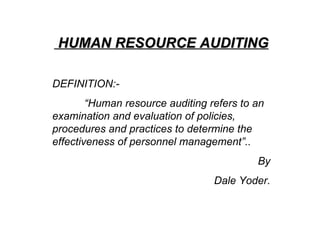
HUMAN RESOURCE AUDITING DEFINITION:- “ Human resource auditing refers to an examination and evaluation of policies, procedures and practices to determine the effectiveness of personnel management”.. By Dale Yoder.
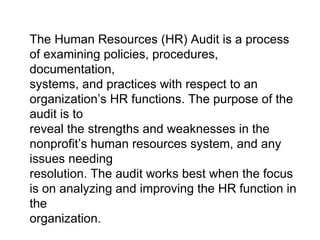
The Human Resources (HR) Audit is a process of examining policies, procedures, documentation, systems, and practices with respect to an organization’s HR functions. The purpose of the audit is to reveal the strengths and weaknesses in the nonprofit’s human resources system, and any issues needing resolution. The audit works best when the focus is on analyzing and improving the HR function in the organization.
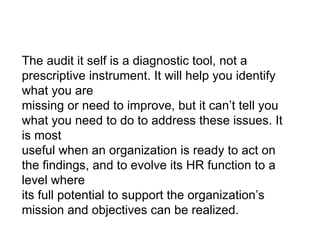
The audit it self is a diagnostic tool, not a prescriptive instrument. It will help you identify what you are missing or need to improve, but it can’t tell you what you need to do to address these issues. It is most useful when an organization is ready to act on the findings, and to evolve its HR function to a level where its full potential to support the organization’s mission and objectives can be realized.
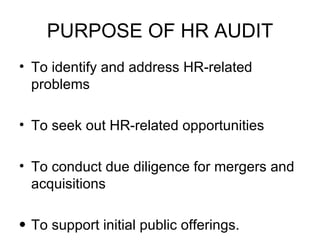
PURPOSE OF HR AUDIT To identify and address HR-related problems  To seek out HR-related opportunities  To conduct due diligence for mergers and acquisitions  To support initial public offerings.
OBJECTIVES OF HR AUDIT To review the organizational system, human resources subsystem in order to find out the efficiency of the organization in attracting and maintaining human resources. To find out effectiveness of various personnel policies and practices. To know how various units are functioning and how they have been able to implement the personnel policies. To review the personnel system in comparison with organizations and modify them to meet the challenges of personnel management.
NEED FOR PERSONNEL AUDIT Increasing size of the organization and personnel in several organizations. Changing philosophy of management towards human resources. Increasing strength and influence of trade unions. Changing human resource management philosophy. Increasing dependence on human resource system and its effective functioning.
Benefits of HR Audit:   It provides the various benefits to the organization. These are:  1.It helps to find out the proper contribution of the HR department towards the organization.  2.Development of the professional image of the HR department of the organization.  3.Reduce the HR cost.  4.Motivation of the HR personnel.
5.Find out the problems and solve them smoothly.  6.Provides timely legal requirement.  7.Sound Performance Appraisal Systems.  8.Systematic job analysis.  9.Smooth adoption of the changing mindset.
GLOBAL HRM
The reasons for the growth of interest in Global hrm are Globalization HRM is the major determinant of success and failure of the organization Rapid growth of small and medium scale organization Networks of personal relationship
HR strategy has the major role in implementation and control in international firms
Types of organizations Global International Transnational Multinational
Global Views the world as a single market operations are controlled centrally from corporate office.
International Uses existing capabilities to expand into foreign market.
Transnational Specialized facilities permits local responsiveness. Complex coordination mechanisms provide global integration
Multinational Several subsidiaries operating as stand-alone business units in multiple countries
Recruitment Recruitment is  the process of finding and  attracting capable applicant for employment. Internal sources External sources
Selection process Selecting Expatriates Begin with self selection Create a candidate pool Assess core skills Assess augmented skills and attributes
Selection methods Interviews Assessment  centers Test
International staffing Home country nationals Host country nationals Third country nationals
Advantages of these sources Host   country nationals less cost Preference of host-country governments Intimate knowledge of environment and culture Language facility
Home country nationals Talent available within company Greater control Company experience Mobility Experience provided to corporate executives
Third country nationals Broad experience  International outlook Multilingualism
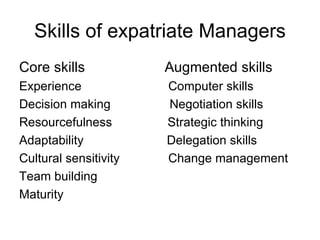
Skills of expatriate Managers Core skills   Augmented skills Experience  Computer skills Decision making  Negotiation skills Resourcefulness  Strategic thinking Adaptability  Delegation skills Cultural sensitivity  Change management Team building Maturity
Skills of the global manager Ability to seize strategic  opportunities Ability to manage highly decentralized organizations Awareness of global issues Sensitivity to issue of diversity Competence in interpersonal relations Skill in building community
Training programs Language Training Cultural Training Assessing and tracking career development Managing personal and Family life
Performance appraisal Who should do Home -country evaluations Host -country evaluations
Feedback Providing feedback in an international setting is clearly a two way street It is given by home country and host country superiors Addition to this an interview conducted by expatriate
Important Issues In Global HRM Current views of the global firm Capabilities for global strategy Implications for delivering the global strategy Investigating cultural diversity
International organizations and labor relations The role of unions Collective-Bargaining in other countries  ILO. Labor participation in management
Bibliography Managing Human Resources Bohlander,  Snell,  Sherman International Human Resource Management Harzing ,Jorisvan Human resource management T.N Chhabra
THANK YOU

Globalhrm

  • 1.
    HR ACCOUNTING HRAUDITING GLOBAL HRM Presented by Anu Geethu Lasija Sneha Sandeep
  • 2.
    HUMAN RESOURCE ACCOUNTINGIt is the process of identifying and measuring data about human resource and communicating this information to interested parties.
  • 3.
    Assumptions of HRAPeople are valuable resources of an enterprise The utility of manpower is determined by the way in which it is managed Information on investment and value of human resources is useful for decision making
  • 4.
    OBJECTIVES Improve qualityHelps in decisions regarding investment in HR Providing information regarding the earning potential of HR To assess productivity and profitability Information regarding costs and benefits associated with investment HR
  • 5.
    ADVANTAGES It throwslight on strength and weakness of existing workforce in an organization. It provides valuable feedback to the managers regarding the effectiveness of HR policies and practices. It helps potential investors to judges company better on strength of human assets utilised therein .
  • 6.
    It helps managementin taking appropriate decisions regarding the use of human assets in an organization.
  • 7.
    LIMITATIONS It isnot easy to value the human assets in an organization. HRA is full of measurement problems like ,how should the HR costs be mortised? Employees and unions may not like the idea? There is no empirical evidence to support the idea that HRA is an effective tool to measure the economic value of people to the organization.
  • 8.
    HUMAN RESOURCE AUDITINGDEFINITION:- “ Human resource auditing refers to an examination and evaluation of policies, procedures and practices to determine the effectiveness of personnel management”.. By Dale Yoder.
  • 9.
    The Human Resources(HR) Audit is a process of examining policies, procedures, documentation, systems, and practices with respect to an organization’s HR functions. The purpose of the audit is to reveal the strengths and weaknesses in the nonprofit’s human resources system, and any issues needing resolution. The audit works best when the focus is on analyzing and improving the HR function in the organization.
  • 10.
    The audit itself is a diagnostic tool, not a prescriptive instrument. It will help you identify what you are missing or need to improve, but it can’t tell you what you need to do to address these issues. It is most useful when an organization is ready to act on the findings, and to evolve its HR function to a level where its full potential to support the organization’s mission and objectives can be realized.
  • 11.
    PURPOSE OF HRAUDIT To identify and address HR-related problems To seek out HR-related opportunities To conduct due diligence for mergers and acquisitions To support initial public offerings.
  • 12.
    OBJECTIVES OF HRAUDIT To review the organizational system, human resources subsystem in order to find out the efficiency of the organization in attracting and maintaining human resources. To find out effectiveness of various personnel policies and practices. To know how various units are functioning and how they have been able to implement the personnel policies. To review the personnel system in comparison with organizations and modify them to meet the challenges of personnel management.
  • 13.
    NEED FOR PERSONNELAUDIT Increasing size of the organization and personnel in several organizations. Changing philosophy of management towards human resources. Increasing strength and influence of trade unions. Changing human resource management philosophy. Increasing dependence on human resource system and its effective functioning.
  • 14.
    Benefits of HRAudit: It provides the various benefits to the organization. These are: 1.It helps to find out the proper contribution of the HR department towards the organization. 2.Development of the professional image of the HR department of the organization. 3.Reduce the HR cost. 4.Motivation of the HR personnel.
  • 15.
    5.Find out theproblems and solve them smoothly. 6.Provides timely legal requirement. 7.Sound Performance Appraisal Systems. 8.Systematic job analysis. 9.Smooth adoption of the changing mindset.
  • 16.
  • 17.
    The reasons forthe growth of interest in Global hrm are Globalization HRM is the major determinant of success and failure of the organization Rapid growth of small and medium scale organization Networks of personal relationship
  • 18.
    HR strategy hasthe major role in implementation and control in international firms
  • 19.
    Types of organizationsGlobal International Transnational Multinational
  • 20.
    Global Views theworld as a single market operations are controlled centrally from corporate office.
  • 21.
    International Uses existingcapabilities to expand into foreign market.
  • 22.
    Transnational Specialized facilitiespermits local responsiveness. Complex coordination mechanisms provide global integration
  • 23.
    Multinational Several subsidiariesoperating as stand-alone business units in multiple countries
  • 24.
    Recruitment Recruitment is the process of finding and attracting capable applicant for employment. Internal sources External sources
  • 25.
    Selection process SelectingExpatriates Begin with self selection Create a candidate pool Assess core skills Assess augmented skills and attributes
  • 26.
    Selection methods InterviewsAssessment centers Test
  • 27.
    International staffing Homecountry nationals Host country nationals Third country nationals
  • 28.
    Advantages of thesesources Host country nationals less cost Preference of host-country governments Intimate knowledge of environment and culture Language facility
  • 29.
    Home country nationalsTalent available within company Greater control Company experience Mobility Experience provided to corporate executives
  • 30.
    Third country nationalsBroad experience International outlook Multilingualism
  • 31.
    Skills of expatriateManagers Core skills Augmented skills Experience Computer skills Decision making Negotiation skills Resourcefulness Strategic thinking Adaptability Delegation skills Cultural sensitivity Change management Team building Maturity
  • 32.
    Skills of theglobal manager Ability to seize strategic opportunities Ability to manage highly decentralized organizations Awareness of global issues Sensitivity to issue of diversity Competence in interpersonal relations Skill in building community
  • 33.
    Training programs LanguageTraining Cultural Training Assessing and tracking career development Managing personal and Family life
  • 34.
    Performance appraisal Whoshould do Home -country evaluations Host -country evaluations
  • 35.
    Feedback Providing feedbackin an international setting is clearly a two way street It is given by home country and host country superiors Addition to this an interview conducted by expatriate
  • 36.
    Important Issues InGlobal HRM Current views of the global firm Capabilities for global strategy Implications for delivering the global strategy Investigating cultural diversity
  • 37.
    International organizations andlabor relations The role of unions Collective-Bargaining in other countries ILO. Labor participation in management
  • 38.
    Bibliography Managing HumanResources Bohlander, Snell, Sherman International Human Resource Management Harzing ,Jorisvan Human resource management T.N Chhabra
  • 39.