






MARIAM ALIA BINTI ZULKIFLI
2013157473
GLOBAL HUMAN RESOURCE
MANAGEMENT
DEFINITION of GLOBAL HRM
 Pol i ci es and pr act i ces r el at ed t o managi ng peopl e i n an
i nt er nat i onal l y or i ent ed or gani zat i on. (I vancevi ch, 2013)
 Pr ocess of empl oyi ng and devel opi ng i n i nt er nat i onal
or gani zat i on whi ch oper at e gl obal l y. (Li nda Maund, 2001)
 Appl yi ng HRM pol i cy f ami l i ar i n domest i c mar ket s t o
i nt er nat i onal wor kf or ce, f or exampl e:
1. Empl oyee devel opment
2. Recr ui t ment and sel ect i on
3. Rewar d and r emuner at i on
4. Pol i ci es and pr act i ces
 The desi gn of syst emat i c act i vi t i es t hat pr ovi de member s of an
or gani zat i on wi t h t he ski l l s necessar y t o meet pr esent and
f ut ur e j ob demands i n a mul t i nat i onal envi r onment . (Gr egor y F.
Pet r anek, 2004)
Culture value
 Culture may be defined in a variety of ways,
according to Kluckhohn (1954) said that culture
represents and defines the society.
 On the other hand, a value, as defined by Rokeach
(1973) is, an enduring belief that a specific mode of
conduct is personally or socially preferable to an
opposite mode of conduct . A value system is an
enduring organization of beliefs concerning preferable
modes of conduct along a continuum of relative
importance.
 Value encompass what people believe to be
preferable and therefore practice.
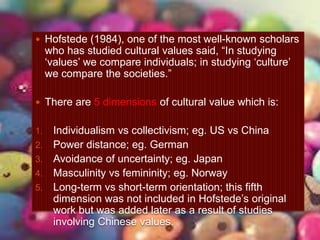
 Hofstede (1984), one of the most well-known scholars
who has studied cultural values said, “In studying
„values‟ we compare individuals; in studying „culture‟
we compare the societies.”
 There are 5 dimensions of cultural value which is:
1. Individualism vs collectivism; eg. US vs China
2. Power distance; eg. German
3. Avoidance of uncertainty; eg. Japan
4. Masculinity vs femininity; eg. Norway
5. Long-term vs short-term orientation; this fifth
dimension was not included in Hofstede‟s original
work but was added later as a result of studies
involving Chinese values.
Multinational Corporations
(MNC) and Global
Corporations (GC)
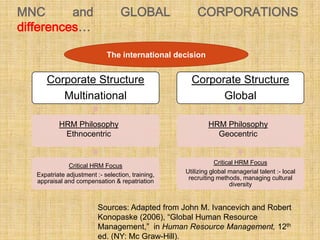
MNC and GLOBAL CORPORATIONS
differences…
Corporate Structure
Multinational
Critical HRM Focus
Expatriate adjustment :- selection, training,
appraisal and compensation & repatriation
Corporate Structure
Global
Critical HRM Focus
Utilizing global managerial talent :- local
recruiting methods, managing cultural
diversity
The international decision
Sources: Adapted from John M. Ivancevich and Robert
Konopaske (2006), “Global Human Resource
Management,” in Human Resource Management, 12th
ed. (NY: Mc Graw-Hill).
HRM Philosophy
Ethnocentric
HRM Philosophy
Geocentric
 Global assignments are becoming increasingly
popular as companies are becoming more
international in their operations. These types of
assignments require employees to temporarily
relocate into one of the company‟s foreign offices. It
involves a full relocation and often lasts between 12
months to 36 months (Briscoe, Schuler &
Claus, 2008).
 According to Mercer‟s 2008/2009 Benefits Survey for
Expatriates and Globally Mobile Employees that
surveyed 243 companies, the no. of employees on
global assignments has grown by more than 90%
between 2005-2008 (Mercer Human Resource
Consulting, 2008).
EXPATRIATE MANAGER in MNC
 “..di f f er ent pat t er ns of human r esour ce
management pr act i ces can be used, dependi ng
on t he t ype of di ver si t y t hat t he
or gani zat i on f aces, and t he speci f i c ef f ect s
t hat i t wi shes t o manage.” (Al cazar , 2012)
 Gl obal i zat i on i s a pr ocess whi ch exposes
soci al act or s t o a wi de ar r ay of
i nt er act i ons and i nst i t ut i onal i nf l uences,
t hat i nt er mi ngl e i n def i ni ng t he i dent i t i es
and cogni t i ve r esour ce act or s can have
access t o, i n or der t o pur sue t hei r
obj ect i ves and t o be i nt egr at ed i n t hei r
soci al cont ext s. (Del mest r i , 2006)
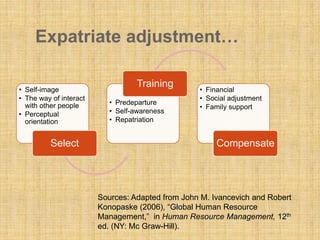
Expatriate adjustment…
• Self-image
• The way of interact
with other people
• Perceptual
orientation
Select
• Predeparture
• Self-awareness
• Repatriation
Training
• Financial
• Social adjustment
• Family support
Compensate
Sources: Adapted from John M. Ivancevich and Robert
Konopaske (2006), “Global Human Resource
Management,” in Human Resource Management, 12th
ed. (NY: Mc Graw-Hill).
GLOBAL TALENT MANAGEMENT in
GC
 According to Gunter (2007), talent management
programs run by the companies feature a strong
emphasis on „high potentials‟ in which specifically
involves attracting, selecting, developing and
retaining high-potential employees.
LABOR RELATIONS
 Bot h of MNC and Gl obal Cor por at i ons
encount er a var i et y of l abor r el at i ons
i ssues t hat ar e di f f er ent f r om pur el y
domest i c oper at i ons.
 Ther e ar e t hr ee mai n per spect i ves t hat
i ncl ude pol i t i cal , cul t ur al and soci al i n
whi ch t hey i mpl y a di f f er ent under st andi ng
of t he sel f -ot her r el at i on i n t he cont ext of
t he gl obal wor l d. (Janssens and St eyaer t ,
2012)
Example of the company with HR best
practices;
FedEx’s Background
 FedEx Corporation is an American global courier
delivery services company headquartered in
Memphis, Tennessee.
 The name “FedEx” is taken from the name of the
company‟s original air division, Federal Express,
which was used from 1973 until 2000.
 Founder: Frederick W. Smith
 Industry: Courier
FedEx HR Practices
 FedEx‟s management focused on providing a
suitable work environment that encouraged
employees to come up with innovative solutions.
 Implement People-Service-Profit (PSP)
philosophy.
 Introduce Survey-Feedback-Action (SFA)
program to improve employee management
relations.
 Create online database:- PRISM
 Recruitment and selection
- Recruited people who are willing to take
risk, entrepreneurial by nature and willing to take up
challenges.
- Develop online job application form: „Career Center‟
 Training and development
- Orientation program, CSRs, courier, service agents, job
knowledge testing program
 Growth opportunities
- Leadership Evaluation and Awareness Process (LEAP)
- Job Change Applicant Tracking System (JCATS)
- Succession Planning Executive Education (SPEED)
 Employee communication and performance
appraisal
- Survey Feedback Action (SFA)
- Guaranteed Fair Treatment Procedure (GFTA)
- Open Door Policy (ODP)
 Employee retention
- Exit interview
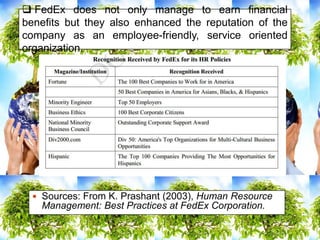
 FedEx does not only manage to earn financial
benefits but they also enhanced the reputation of the
company as an employee-friendly, service oriented
organization.
 Sources: From K. Prashant (2003), Human Resource
Management: Best Practices at FedEx Corporation.
The Conclusion
In my stance, the globalization process has
actually give a huge impact to the organization
nowadays as they need to be more advanced in
tandem with the speed of changing technology
continuously. This kind of situation will force them
to learn and willing to take risk in order to bring
their organization move into the next level while
competing with other organizations. As for that, all
of the organizations must strive to achieve their
target goals and at the same time, still keep pace
with the current globalization wholly.

Global human resource management new

  • 1.
    MARIAM ALIA BINTIZULKIFLI 2013157473 GLOBAL HUMAN RESOURCE MANAGEMENT
  • 2.
    DEFINITION of GLOBALHRM  Pol i ci es and pr act i ces r el at ed t o managi ng peopl e i n an i nt er nat i onal l y or i ent ed or gani zat i on. (I vancevi ch, 2013)  Pr ocess of empl oyi ng and devel opi ng i n i nt er nat i onal or gani zat i on whi ch oper at e gl obal l y. (Li nda Maund, 2001)  Appl yi ng HRM pol i cy f ami l i ar i n domest i c mar ket s t o i nt er nat i onal wor kf or ce, f or exampl e: 1. Empl oyee devel opment 2. Recr ui t ment and sel ect i on 3. Rewar d and r emuner at i on 4. Pol i ci es and pr act i ces  The desi gn of syst emat i c act i vi t i es t hat pr ovi de member s of an or gani zat i on wi t h t he ski l l s necessar y t o meet pr esent and f ut ur e j ob demands i n a mul t i nat i onal envi r onment . (Gr egor y F. Pet r anek, 2004)
  • 3.
    Culture value  Culturemay be defined in a variety of ways, according to Kluckhohn (1954) said that culture represents and defines the society.  On the other hand, a value, as defined by Rokeach (1973) is, an enduring belief that a specific mode of conduct is personally or socially preferable to an opposite mode of conduct . A value system is an enduring organization of beliefs concerning preferable modes of conduct along a continuum of relative importance.  Value encompass what people believe to be preferable and therefore practice.
  • 4.
     Hofstede (1984),one of the most well-known scholars who has studied cultural values said, “In studying „values‟ we compare individuals; in studying „culture‟ we compare the societies.”  There are 5 dimensions of cultural value which is: 1. Individualism vs collectivism; eg. US vs China 2. Power distance; eg. German 3. Avoidance of uncertainty; eg. Japan 4. Masculinity vs femininity; eg. Norway 5. Long-term vs short-term orientation; this fifth dimension was not included in Hofstede‟s original work but was added later as a result of studies involving Chinese values.
  • 5.
    Multinational Corporations (MNC) andGlobal Corporations (GC)
  • 6.
    MNC and GLOBALCORPORATIONS differences… Corporate Structure Multinational Critical HRM Focus Expatriate adjustment :- selection, training, appraisal and compensation & repatriation Corporate Structure Global Critical HRM Focus Utilizing global managerial talent :- local recruiting methods, managing cultural diversity The international decision Sources: Adapted from John M. Ivancevich and Robert Konopaske (2006), “Global Human Resource Management,” in Human Resource Management, 12th ed. (NY: Mc Graw-Hill). HRM Philosophy Ethnocentric HRM Philosophy Geocentric
  • 9.
     Global assignmentsare becoming increasingly popular as companies are becoming more international in their operations. These types of assignments require employees to temporarily relocate into one of the company‟s foreign offices. It involves a full relocation and often lasts between 12 months to 36 months (Briscoe, Schuler & Claus, 2008).  According to Mercer‟s 2008/2009 Benefits Survey for Expatriates and Globally Mobile Employees that surveyed 243 companies, the no. of employees on global assignments has grown by more than 90% between 2005-2008 (Mercer Human Resource Consulting, 2008).
  • 10.
    EXPATRIATE MANAGER inMNC  “..di f f er ent pat t er ns of human r esour ce management pr act i ces can be used, dependi ng on t he t ype of di ver si t y t hat t he or gani zat i on f aces, and t he speci f i c ef f ect s t hat i t wi shes t o manage.” (Al cazar , 2012)  Gl obal i zat i on i s a pr ocess whi ch exposes soci al act or s t o a wi de ar r ay of i nt er act i ons and i nst i t ut i onal i nf l uences, t hat i nt er mi ngl e i n def i ni ng t he i dent i t i es and cogni t i ve r esour ce act or s can have access t o, i n or der t o pur sue t hei r obj ect i ves and t o be i nt egr at ed i n t hei r soci al cont ext s. (Del mest r i , 2006)
  • 11.
    Expatriate adjustment… • Self-image •The way of interact with other people • Perceptual orientation Select • Predeparture • Self-awareness • Repatriation Training • Financial • Social adjustment • Family support Compensate Sources: Adapted from John M. Ivancevich and Robert Konopaske (2006), “Global Human Resource Management,” in Human Resource Management, 12th ed. (NY: Mc Graw-Hill).
  • 12.
    GLOBAL TALENT MANAGEMENTin GC  According to Gunter (2007), talent management programs run by the companies feature a strong emphasis on „high potentials‟ in which specifically involves attracting, selecting, developing and retaining high-potential employees.
  • 13.
    LABOR RELATIONS  Both of MNC and Gl obal Cor por at i ons encount er a var i et y of l abor r el at i ons i ssues t hat ar e di f f er ent f r om pur el y domest i c oper at i ons.  Ther e ar e t hr ee mai n per spect i ves t hat i ncl ude pol i t i cal , cul t ur al and soci al i n whi ch t hey i mpl y a di f f er ent under st andi ng of t he sel f -ot her r el at i on i n t he cont ext of t he gl obal wor l d. (Janssens and St eyaer t , 2012)
  • 14.
    Example of thecompany with HR best practices;
  • 15.
    FedEx’s Background  FedExCorporation is an American global courier delivery services company headquartered in Memphis, Tennessee.  The name “FedEx” is taken from the name of the company‟s original air division, Federal Express, which was used from 1973 until 2000.  Founder: Frederick W. Smith  Industry: Courier
  • 16.
    FedEx HR Practices FedEx‟s management focused on providing a suitable work environment that encouraged employees to come up with innovative solutions.  Implement People-Service-Profit (PSP) philosophy.  Introduce Survey-Feedback-Action (SFA) program to improve employee management relations.  Create online database:- PRISM
  • 17.
     Recruitment andselection - Recruited people who are willing to take risk, entrepreneurial by nature and willing to take up challenges. - Develop online job application form: „Career Center‟  Training and development - Orientation program, CSRs, courier, service agents, job knowledge testing program  Growth opportunities - Leadership Evaluation and Awareness Process (LEAP) - Job Change Applicant Tracking System (JCATS) - Succession Planning Executive Education (SPEED)
  • 18.
     Employee communicationand performance appraisal - Survey Feedback Action (SFA) - Guaranteed Fair Treatment Procedure (GFTA) - Open Door Policy (ODP)  Employee retention - Exit interview
  • 19.
     FedEx doesnot only manage to earn financial benefits but they also enhanced the reputation of the company as an employee-friendly, service oriented organization.  Sources: From K. Prashant (2003), Human Resource Management: Best Practices at FedEx Corporation.
  • 20.
  • 21.
    In my stance,the globalization process has actually give a huge impact to the organization nowadays as they need to be more advanced in tandem with the speed of changing technology continuously. This kind of situation will force them to learn and willing to take risk in order to bring their organization move into the next level while competing with other organizations. As for that, all of the organizations must strive to achieve their target goals and at the same time, still keep pace with the current globalization wholly.