


Subject : Human Resource Management
Topic : Induction
By
A. Raja

Induction can be defined as a process of introducing
the employee who is newly elected to the organization.
According to Michael Armstrong “Induction is the
process of receiving and welcoming an employee when
he first joins a company and giving him basic
information he needs to settle down quickly and happily
and start work”.
 When an employee is given a letter of appointment he
joins the company on duty. The very first thing that the
company does is, introduces the new employee to the
organization and people working there.
Induction
An induction program may be conducted at a particular
centre for all employees or at different places (branches
of the company) for different employees.
Normally the new employee is called together to the
staff training college for the induction program.
The induction starts with an introduction session about
the company, number of branches, a brief history of the
company, number of products, number of countries
operating in, organizational structure, culture, values,
beliefs, the names of top management personnel etc.
Induction Process
Apart from this introductory session there will be
other sessions also like sessions on behavioural
science, soft skill training, sessions on giving details
about the job, salary, bonus, information about
different leaves that can be taken by the employee
about upward mobility in the organization etc.
There are different ways in which sessions can be
conducted i.e. using lecture method, power point
presentation, group discussion, psychological test, roll
play secessions etc.
Objectives of Induction:
 To reduce the initial anxiety all new entrants feel when
they join a new job in a new organisation.
 To familiarize the new employees with the job, people,
work-place, work environment and the organisation.
 To facilitate outsider – insider transition in an
integrated manner.
 To reduce exploitation by the unscrupulous co-
workers.
 To reduce the cultural shock faced in the new
organisation.
Benefits of induction programme :
1. A well-designed induction programme reduces
anxiety, nervousness, and absenteeism and employee
turnover.
2. Induction helps minimize the reality or cultural shock
new employees under go on joining a new organisation.
3. Effective induction also helps integrate the new
employees into the organisation and fosters the feeling of
belongingness to the new organisation.
4. Induction also binds the newcomer and the present
employees in a team.
Importance of Induction:
 A sense of belongingness is created in the mind of the
new employee.
It gives favourable impression about the organization.
It gives chances of increasing loyalty towards the
organization and reduction in the rate of labour turnover.
It leads to regular and honest participation, and timely
completion of the task by the employee.
Continue…
It helps in removal of anxiety, bias and confusion about
the organizational details.
It leads to the development of good and favourable
public image of the company.
Adjustment with peers, seniors and the work assigned
becomes easy.
Requisites of an effective induction programme:
 Receiving new employees:
The new employees need to be duly received by
the organisation. This inculcates a feeling in the new
entrants that they are required in the organisation. Such a
feeling serves as a corner stone to be interested to
integrate into the organisation.
 Determining the new employees need for information:
The central element that guides the designing of
an induction programme is to decide first “What do the
new employees need to know now?”
Continue…
Many a times, the new employees are given information
which is not immediately required but the required one
is not given. Such information lack tends to make the
new comer confused about the job and the organisation.
Therefore, it is important to decide the vital information
a new entrant needs to receive on his joining the
organisation.
 Determining how to present the information:
Having being decided what information
employees want, the next important thing to be decided
is how to present the same to the new employees.
Obviously, the required information needs to be
presented to the new employees in the right form and
manner so as to have its maximum intact on the
employees.
 Delivering induction training by the right instructor:
Much of the effectiveness of an induction programme
depends on who conducts the induction training. This is
because induction training cannot be given by anyone,
but by the right instructor/trainer only. Possession of the
required skill, knowledge and attitude are considered to
be the requisites of a right instructor. Therefore, the
induction programme needs to be conducted by the right
trainer only. If required the trainer be given induction
training before he/she conducts the induction training for
the new entrants to the organisation.
 Evaluating the induction programme:
Like all other training programmes, whether or not
an induction programme is effective is determined by
evaluating the programme. This is necessary to know to
decide whether to continue the programme in future also
or not or whether the programme needs any
improvement in future. In fact, it is the evaluation of the
induction programme that makes the organisation know
whether the amount incurred in induction programme
remains as an expenditure or has turned into an
investment.
B.P. Billimoria has appreciated the benefits of induction
in these words
Induction has a greater significance in a developing
country like India, where the percentage of illiteracy is
very high.
The worker finds himself completely at sea when by
force of circumstances he has to shift from rural
surroundings into an industrial environment.
It is no use trying to push a handbook of certified rules
and regulations into his hands and expecting him to turn
out into a loyal and efficient employee. He needs a short
and simple induction conducted by someone who speaks
his own language.
This will go a long way in reducing turnover and,
above all, in preventing a worker from the likelihood of
falling a prey to subversive elements which thrive on
creating labour unrest by misrepresenting employees to
illiterate employees”.
Contents of induction programme:
The induction programme may be informal or formal
Informal Induction:
This is an unplanned induction programme. This may be
simply an introduction to the new entrant about the job
and organisation. Such type of induction programme is
generally carried out by the medium and small-scale
units. Usually, informal induction programme needs to
be brief- lasting for one hour or so.
Informal induction programme itself may be in the
following two versions:
(i) Supervisory System:
In this system, the immediate job supervisor conducts
the induction programme for the new entrant. The
supervisor briefs the new comer about the job, the
department, introduces to the colleagues, and takes him
round the sections/divisions which are related to his job.
(ii) Buddy or sponsor system:
In the ‘Buddy System’, the immediate supervisor assigns
the responsibility of induction of the new entrant to an
old employee. The old employee acts as friend,
philosopher and guide to the new comer.
In order to introduce the new comer to the job and the
organisation, the guide, i.e., the old employee arranges
meetings with other persons and departments and also
supplies him with relevant documents/literature regard-
ing rules, regulations and other details of the
organisation.
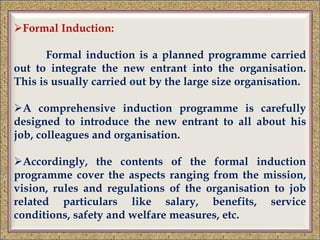
Formal Induction:
Formal induction is a planned programme carried
out to integrate the new entrant into the organisation.
This is usually carried out by the large size organisation.
A comprehensive induction programme is carefully
designed to introduce the new entrant to all about his
job, colleagues and organisation.
Accordingly, the contents of the formal induction
programme cover the aspects ranging from the mission,
vision, rules and regulations of the organisation to job
related particulars like salary, benefits, service
conditions, safety and welfare measures, etc.
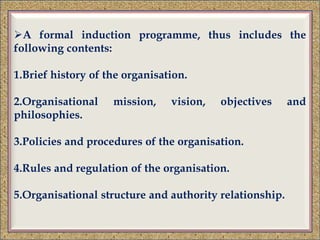
A formal induction programme, thus includes the
following contents:
1.Brief history of the organisation.
2.Organisational mission, vision, objectives and
philosophies.
3.Policies and procedures of the organisation.
4.Rules and regulation of the organisation.
5.Organisational structure and authority relationship.
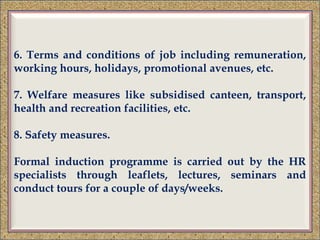
6. Terms and conditions of job including remuneration,
working hours, holidays, promotional avenues, etc.
7. Welfare measures like subsidised canteen, transport,
health and recreation facilities, etc.
8. Safety measures.
Formal induction programme is carried out by the HR
specialists through leaflets, lectures, seminars and
conduct tours for a couple of days/weeks.
Conclusion:
The induction program concludes with the employee
reporting for duty at his respective branch after
induction.
When he reports for duty the senior most people in the
branch takes the new employee around the office and
introduces to all other employees and gives information
about the working of the branch.
The senior people regularly stay in touch with the new
employee in the first week so that he can make the new
employee comfortable and help him to adjust to the
company. After this the company may start a training
program for the new employee.
THANK YOU

Induction Process in Human Resource Management

  • 1.
    Subject : HumanResource Management Topic : Induction By A. Raja
  • 2.
     Induction can bedefined as a process of introducing the employee who is newly elected to the organization. According to Michael Armstrong “Induction is the process of receiving and welcoming an employee when he first joins a company and giving him basic information he needs to settle down quickly and happily and start work”.  When an employee is given a letter of appointment he joins the company on duty. The very first thing that the company does is, introduces the new employee to the organization and people working there. Induction
  • 3.
    An induction programmay be conducted at a particular centre for all employees or at different places (branches of the company) for different employees. Normally the new employee is called together to the staff training college for the induction program. The induction starts with an introduction session about the company, number of branches, a brief history of the company, number of products, number of countries operating in, organizational structure, culture, values, beliefs, the names of top management personnel etc. Induction Process
  • 4.
    Apart from thisintroductory session there will be other sessions also like sessions on behavioural science, soft skill training, sessions on giving details about the job, salary, bonus, information about different leaves that can be taken by the employee about upward mobility in the organization etc. There are different ways in which sessions can be conducted i.e. using lecture method, power point presentation, group discussion, psychological test, roll play secessions etc.
  • 5.
    Objectives of Induction: To reduce the initial anxiety all new entrants feel when they join a new job in a new organisation.  To familiarize the new employees with the job, people, work-place, work environment and the organisation.  To facilitate outsider – insider transition in an integrated manner.  To reduce exploitation by the unscrupulous co- workers.  To reduce the cultural shock faced in the new organisation.
  • 6.
    Benefits of inductionprogramme : 1. A well-designed induction programme reduces anxiety, nervousness, and absenteeism and employee turnover. 2. Induction helps minimize the reality or cultural shock new employees under go on joining a new organisation. 3. Effective induction also helps integrate the new employees into the organisation and fosters the feeling of belongingness to the new organisation. 4. Induction also binds the newcomer and the present employees in a team.
  • 7.
    Importance of Induction: A sense of belongingness is created in the mind of the new employee. It gives favourable impression about the organization. It gives chances of increasing loyalty towards the organization and reduction in the rate of labour turnover. It leads to regular and honest participation, and timely completion of the task by the employee.
  • 8.
    Continue… It helps inremoval of anxiety, bias and confusion about the organizational details. It leads to the development of good and favourable public image of the company. Adjustment with peers, seniors and the work assigned becomes easy.
  • 9.
    Requisites of aneffective induction programme:  Receiving new employees: The new employees need to be duly received by the organisation. This inculcates a feeling in the new entrants that they are required in the organisation. Such a feeling serves as a corner stone to be interested to integrate into the organisation.  Determining the new employees need for information: The central element that guides the designing of an induction programme is to decide first “What do the new employees need to know now?”
  • 10.
    Continue… Many a times,the new employees are given information which is not immediately required but the required one is not given. Such information lack tends to make the new comer confused about the job and the organisation. Therefore, it is important to decide the vital information a new entrant needs to receive on his joining the organisation.  Determining how to present the information: Having being decided what information employees want, the next important thing to be decided is how to present the same to the new employees. Obviously, the required information needs to be presented to the new employees in the right form and manner so as to have its maximum intact on the employees.
  • 11.
     Delivering inductiontraining by the right instructor: Much of the effectiveness of an induction programme depends on who conducts the induction training. This is because induction training cannot be given by anyone, but by the right instructor/trainer only. Possession of the required skill, knowledge and attitude are considered to be the requisites of a right instructor. Therefore, the induction programme needs to be conducted by the right trainer only. If required the trainer be given induction training before he/she conducts the induction training for the new entrants to the organisation.
  • 12.
     Evaluating theinduction programme: Like all other training programmes, whether or not an induction programme is effective is determined by evaluating the programme. This is necessary to know to decide whether to continue the programme in future also or not or whether the programme needs any improvement in future. In fact, it is the evaluation of the induction programme that makes the organisation know whether the amount incurred in induction programme remains as an expenditure or has turned into an investment.
  • 13.
    B.P. Billimoria hasappreciated the benefits of induction in these words Induction has a greater significance in a developing country like India, where the percentage of illiteracy is very high. The worker finds himself completely at sea when by force of circumstances he has to shift from rural surroundings into an industrial environment. It is no use trying to push a handbook of certified rules and regulations into his hands and expecting him to turn out into a loyal and efficient employee. He needs a short and simple induction conducted by someone who speaks his own language.
  • 14.
    This will goa long way in reducing turnover and, above all, in preventing a worker from the likelihood of falling a prey to subversive elements which thrive on creating labour unrest by misrepresenting employees to illiterate employees”.
  • 15.
    Contents of inductionprogramme: The induction programme may be informal or formal Informal Induction: This is an unplanned induction programme. This may be simply an introduction to the new entrant about the job and organisation. Such type of induction programme is generally carried out by the medium and small-scale units. Usually, informal induction programme needs to be brief- lasting for one hour or so.
  • 16.
    Informal induction programmeitself may be in the following two versions: (i) Supervisory System: In this system, the immediate job supervisor conducts the induction programme for the new entrant. The supervisor briefs the new comer about the job, the department, introduces to the colleagues, and takes him round the sections/divisions which are related to his job.
  • 17.
    (ii) Buddy orsponsor system: In the ‘Buddy System’, the immediate supervisor assigns the responsibility of induction of the new entrant to an old employee. The old employee acts as friend, philosopher and guide to the new comer. In order to introduce the new comer to the job and the organisation, the guide, i.e., the old employee arranges meetings with other persons and departments and also supplies him with relevant documents/literature regard- ing rules, regulations and other details of the organisation.
  • 18.
    Formal Induction: Formal inductionis a planned programme carried out to integrate the new entrant into the organisation. This is usually carried out by the large size organisation. A comprehensive induction programme is carefully designed to introduce the new entrant to all about his job, colleagues and organisation. Accordingly, the contents of the formal induction programme cover the aspects ranging from the mission, vision, rules and regulations of the organisation to job related particulars like salary, benefits, service conditions, safety and welfare measures, etc.
  • 19.
    A formal inductionprogramme, thus includes the following contents: 1.Brief history of the organisation. 2.Organisational mission, vision, objectives and philosophies. 3.Policies and procedures of the organisation. 4.Rules and regulation of the organisation. 5.Organisational structure and authority relationship.
  • 20.
    6. Terms andconditions of job including remuneration, working hours, holidays, promotional avenues, etc. 7. Welfare measures like subsidised canteen, transport, health and recreation facilities, etc. 8. Safety measures. Formal induction programme is carried out by the HR specialists through leaflets, lectures, seminars and conduct tours for a couple of days/weeks.
  • 21.
    Conclusion: The induction programconcludes with the employee reporting for duty at his respective branch after induction. When he reports for duty the senior most people in the branch takes the new employee around the office and introduces to all other employees and gives information about the working of the branch. The senior people regularly stay in touch with the new employee in the first week so that he can make the new employee comfortable and help him to adjust to the company. After this the company may start a training program for the new employee.
  • 22.