MEC2213 METAL CUTTING AND
MACHINE
TOOLS
Dr. Serajul Haque
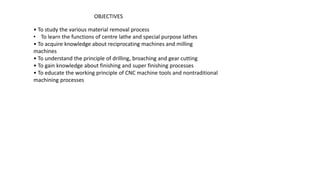
OBJECTIVES
• To study the various material removal process
• To learn the functions of centre lathe and special purpose lathes
• To acquire knowledge about reciprocating machines and milling
machines
• To understand the principle of drilling, broaching and gear cutting
• To gain knowledge about finishing and super finishing processes
• To educate the working principle of CNC machine tools and nontraditional
machining processes
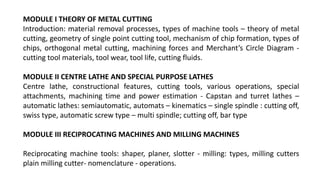
MODULE I THEORY OF METAL CUTTING
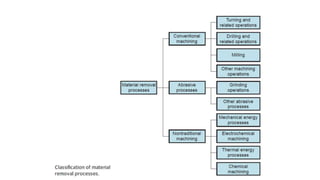
Introduction: material removal processes, types of machine tools – theory of metal
cutting, geometry of single point cutting tool, mechanism of chip formation, types of
chips, orthogonal metal cutting, machining forces and Merchant’s Circle Diagram -
cutting tool materials, tool wear, tool life, cutting fluids.
MODULE II CENTRE LATHE AND SPECIAL PURPOSE LATHES
Centre lathe, constructional features, cutting tools, various operations, special
attachments, machining time and power estimation - Capstan and turret lathes –
automatic lathes: semiautomatic, automats – kinematics – single spindle : cutting off,
swiss type, automatic screw type – multi spindle; cutting off, bar type
MODULE III RECIPROCATING MACHINES AND MILLING MACHINES
Reciprocating machine tools: shaper, planer, slotter - milling: types, milling cutters
plain milling cutter- nomenclature - operations.
MODULE IV DRILLING, BROACHING AND GEAR CUTTING
Hole making: drilling, reaming, boring, tapping – Deep hole Drilling – Broaching
machines: broach construction – push, pull, surface and continuous broaching
machines - Gear cutting: forming, generation, shaping, hobbing – Mechanics of
processes.
MODULE V FINISHING AND SUPER FINISHING PROCESSES
Abrasive processes – Mechanics: grinding wheel – specifications and selection,
types of grinding process – centreless grinding, cylindrical grinding, surface
grinding– honing, lapping, super finishing, polishing and buffing
MODULE VI CNC MACHINE TOOLS AND MODERN MACHINING METHODS
Numerical control (NC) machine tools – CNC: types, construction details, special
features - Advantages and limitations : Abrasive Jet Machining- Ultrasonic
Machining - Electron Beam and Laser Beam Machining
REFERENCES:
1. SERAJUL HAQUE, M.I KHAN , MANUFACTURING SCIENCE, PHI PUBLICATION.
2. Rao, P.N. “Manufacturing Technology”, Metal Cutting and Machine
Tools, Tata McGraw–Hill, New Delhi, 2008
3. Richerd R. Kibbe, John E. Neely, Roland O. Merges and Warren J.
White, “Machine Tool Practices”, Prentice Hall of India, 2003
4. HMT – “Production Technology”, Tata McGraw-Hill, 2001
5. P.C. Sharma, “A Text Book of Production Engineering”, S. Chand
and Co. Ltd, X edition, 2008
6. Hajra Choudry, “Elements of Work Shop Technology – Vol. II”,
Media Promoters. 2007
The material removal processes are a family of shaping
operations in which excess material is removed from
starting work part so that remains is the desired final
geometry.
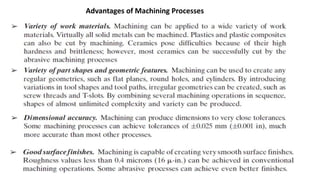
Advantages of Machining Processes
Examples of machine tools are:
Broaching machine
Drill press
Gear shaper
Hone
Lathe
Screw machines
Milling machine
Shear (sheet metal)
Shaper
Saws
Planer
Stewart platform mills
Grinding machines
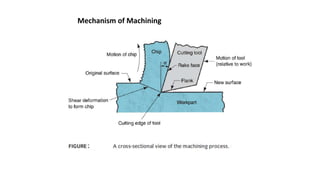
Mechanism of Machining
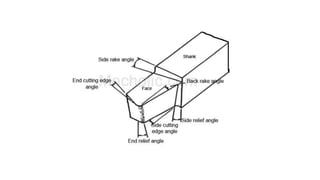
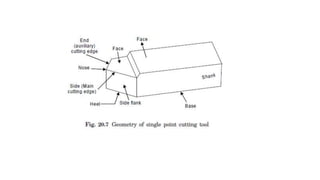
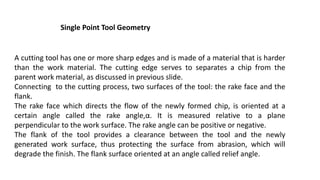
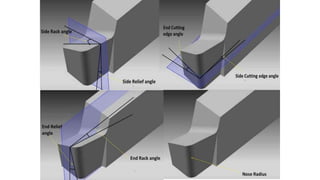
Single Point Tool Geometry
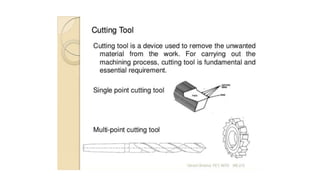
A cutting tool has one or more sharp edges and is made of a material that is harder
than the work material. The cutting edge serves to separates a chip from the
parent work material, as discussed in previous slide.
Connecting to the cutting process, two surfaces of the tool: the rake face and the
flank.
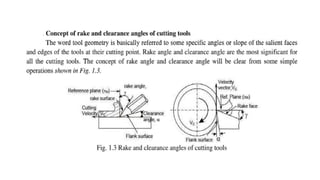
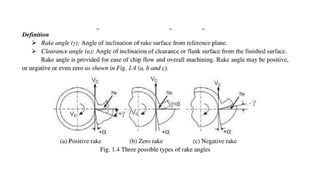
The rake face which directs the flow of the newly formed chip, is oriented at a
certain angle called the rake angle,α. It is measured relative to a plane
perpendicular to the work surface. The rake angle can be positive or negative.
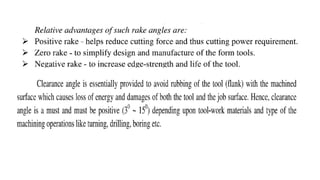
The flank of the tool provides a clearance between the tool and the newly
generated work surface, thus protecting the surface from abrasion, which will
degrade the finish. The flank surface oriented at an angle called relief angle.
https://3dwarehouse.sketchup.com/model/55e26199c6006c99
bff2805bfacb3e4e/Single-Point-Cutting-Tool?hl=en
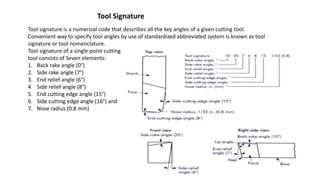
Tool Signature
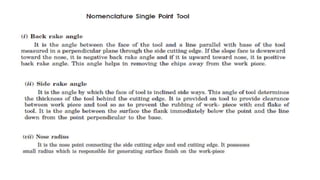
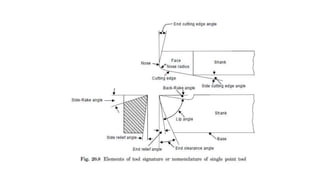
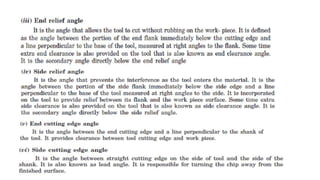
Tool signature is a numerical code that describes all the key angles of a given cutting tool.
Convenient way to specify tool angles by use of standardized abbreviated system is known as tool
signature or tool nomenclature.
Tool signature of a single point cutting
tool consists of Seven elements:
1. Back rake angle (0°)
2. Side rake angle (7°)
3. End relief angle (6°)
4. Side relief angle (8°)
5. End cutting edge angle (15°)
6. Side cutting edge angle (16°) and
7. Nose radius (0.8 mm)
Lecture 1 metal cutting and machine tools unit i

Lecture 1 metal cutting and machine tools unit i

  • 1.
    MEC2213 METAL CUTTINGAND MACHINE TOOLS Dr. Serajul Haque
  • 2.
    OBJECTIVES • To studythe various material removal process • To learn the functions of centre lathe and special purpose lathes • To acquire knowledge about reciprocating machines and milling machines • To understand the principle of drilling, broaching and gear cutting • To gain knowledge about finishing and super finishing processes • To educate the working principle of CNC machine tools and nontraditional machining processes
  • 3.
    MODULE I THEORYOF METAL CUTTING Introduction: material removal processes, types of machine tools – theory of metal cutting, geometry of single point cutting tool, mechanism of chip formation, types of chips, orthogonal metal cutting, machining forces and Merchant’s Circle Diagram - cutting tool materials, tool wear, tool life, cutting fluids. MODULE II CENTRE LATHE AND SPECIAL PURPOSE LATHES Centre lathe, constructional features, cutting tools, various operations, special attachments, machining time and power estimation - Capstan and turret lathes – automatic lathes: semiautomatic, automats – kinematics – single spindle : cutting off, swiss type, automatic screw type – multi spindle; cutting off, bar type MODULE III RECIPROCATING MACHINES AND MILLING MACHINES Reciprocating machine tools: shaper, planer, slotter - milling: types, milling cutters plain milling cutter- nomenclature - operations.
  • 4.
    MODULE IV DRILLING,BROACHING AND GEAR CUTTING Hole making: drilling, reaming, boring, tapping – Deep hole Drilling – Broaching machines: broach construction – push, pull, surface and continuous broaching machines - Gear cutting: forming, generation, shaping, hobbing – Mechanics of processes. MODULE V FINISHING AND SUPER FINISHING PROCESSES Abrasive processes – Mechanics: grinding wheel – specifications and selection, types of grinding process – centreless grinding, cylindrical grinding, surface grinding– honing, lapping, super finishing, polishing and buffing MODULE VI CNC MACHINE TOOLS AND MODERN MACHINING METHODS Numerical control (NC) machine tools – CNC: types, construction details, special features - Advantages and limitations : Abrasive Jet Machining- Ultrasonic Machining - Electron Beam and Laser Beam Machining
  • 5.
    REFERENCES: 1. SERAJUL HAQUE,M.I KHAN , MANUFACTURING SCIENCE, PHI PUBLICATION. 2. Rao, P.N. “Manufacturing Technology”, Metal Cutting and Machine Tools, Tata McGraw–Hill, New Delhi, 2008 3. Richerd R. Kibbe, John E. Neely, Roland O. Merges and Warren J. White, “Machine Tool Practices”, Prentice Hall of India, 2003 4. HMT – “Production Technology”, Tata McGraw-Hill, 2001 5. P.C. Sharma, “A Text Book of Production Engineering”, S. Chand and Co. Ltd, X edition, 2008 6. Hajra Choudry, “Elements of Work Shop Technology – Vol. II”, Media Promoters. 2007
  • 6.
    The material removalprocesses are a family of shaping operations in which excess material is removed from starting work part so that remains is the desired final geometry.
  • 8.
  • 10.
    Examples of machinetools are: Broaching machine Drill press Gear shaper Hone Lathe Screw machines Milling machine Shear (sheet metal) Shaper Saws Planer Stewart platform mills Grinding machines
  • 12.
  • 15.
    Single Point ToolGeometry A cutting tool has one or more sharp edges and is made of a material that is harder than the work material. The cutting edge serves to separates a chip from the parent work material, as discussed in previous slide. Connecting to the cutting process, two surfaces of the tool: the rake face and the flank. The rake face which directs the flow of the newly formed chip, is oriented at a certain angle called the rake angle,α. It is measured relative to a plane perpendicular to the work surface. The rake angle can be positive or negative. The flank of the tool provides a clearance between the tool and the newly generated work surface, thus protecting the surface from abrasion, which will degrade the finish. The flank surface oriented at an angle called relief angle.
  • 22.
  • 24.
    Tool Signature Tool signatureis a numerical code that describes all the key angles of a given cutting tool. Convenient way to specify tool angles by use of standardized abbreviated system is known as tool signature or tool nomenclature. Tool signature of a single point cutting tool consists of Seven elements: 1. Back rake angle (0°) 2. Side rake angle (7°) 3. End relief angle (6°) 4. Side relief angle (8°) 5. End cutting edge angle (15°) 6. Side cutting edge angle (16°) and 7. Nose radius (0.8 mm)