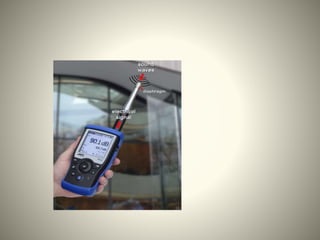
Noise Pollution
Noise
A popular definition of noise is “an undesirable sound” To
what extent a sound can be characterized as noise is, of
course, a personal evaluation.
Sound is the result of mechanical vibrations occurring in
an elastic medium, e.g. air.
When the air starts to pulsate, the variations in air
pressure will spread from the source through the
transfer of energy from molecule to molecule.
The more energy transferred, the higher the sound level.
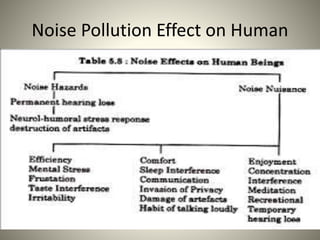
Noise Pollution Effect on Human
Sources of Noise Pollution:
(i) Industrial Sources:
Progress in technology (industrialization) has
resulted in creating noise pollution.
Textile mills, printing presses, engineering
establishments and metal works etc. contribute
heavily towards noise pollution.
In industrial cities like Kolkata, Ludhiana, Kanpur
etc., often the industrial zones are not separated
from the residential zones of the city especially in
the case of small scale industries.
These operate from workshops located on the
ground floors of the residential areas and cause
annoyance, discomfort and irritation to the
residents exposed to the noise that is inevitably
produced.
The situation is much better in modern planned
cities like Chandigarh where the industrial area is
kept away from the residential areas and both are
separated from each other by a sufficiently wide
green belt.
(ii) Transport Vehicles:
Automobile revolution in urban centers has proved to be a big source
of noise pollution.
Increasing traffic has given rise to traffic jams in congested areas
where the repeated hooting of horns by impatient drivers pierce
the ears of all road users.
Noise from airplanes constitutes an increasing serious problem in big
cities like Delhi & Mumbai. Airport situated in the vicinity of
population centres and the air planes pass over residential areas.
Heavy trucks, buses trains, jet-planes, motor-cycles, scooters,
mopeds, jeeps—the list of vehicles is endless but the outcome is
same — noise pollution.
(iii) Household:
The household is an industry in itself and is a source of many
indoor noises such as the banging of doors, noise of playing
children, crying of infants, moving of furniture, loud
conversation of the inhabitants etc.
Besides these are the entertainment equipment in the house,
namely the radio, record-players and television sets.
Domestic gadgets like the mixer-grinders, pressure cookers,
desert coolers, air- conditioners, exhaust fans, vacuum
cleaners, sewing and washing machines are all indoor
sources of noise pollution.
(iv) Public Address System:
In India people need only the slightest of an excuse for using loud
speakers.
The reason may be a religious function, birth, death, marriage,
elections, demonstration, or just commercial advertising. Public
system, therefore, contributes in its own way towards noise
pollution.
(v) Agricultural Machines:
Tractors, thrashers, harvesters, tube wells, powered tillers etc. have all
made agriculture highly mechanical but at the same time highly
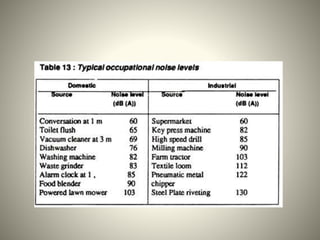
noisy. Noise level 90 dB to 98 dB due to running of farm machines
have been recorded in the state of Punjab.
(vi) Miscellaneous Sources:
The automobile repair shops, construction-
works, blasting, bulldozing, stone crushing etc.
are other sources of noise pollution.
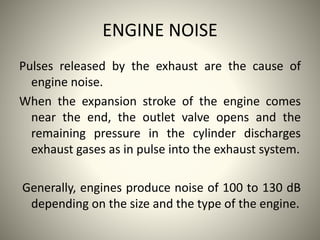
ENGINE NOISE
Pulses released by the exhaust are the cause of
engine noise.
When the expansion stroke of the engine comes
near the end, the outlet valve opens and the
remaining pressure in the cylinder discharges
exhaust gases as in pulse into the exhaust system.
Generally, engines produce noise of 100 to 130 dB
depending on the size and the type of the engine.
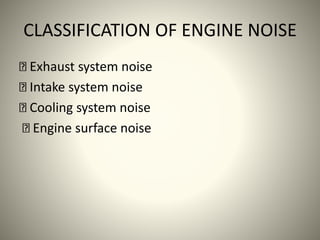
CLASSIFICATION OF ENGINE NOISE
Exhaust system noise
Intake system noise
Cooling system noise
Engine surface noise
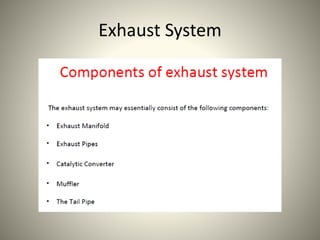
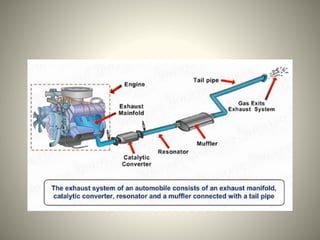
Exhaust System
A catalytic converter is a device that uses a
catalyst to convert three harmful compounds in
car exhaust into breathable compounds.
A resonator installed as part of your car or truck’s exhaust
system serves one main purpose — to resonate. It’s sort of an
echo chamber for your car’s exhaust, preparing all of the loud
noise coming from your engine for the muffler to silence it.
But there is far more science to it than that. The resonator
doesn’t just remove sound, it changes it.
A muffler or silencer is a device for reducing the amount of
noise emitted by the exhaust of an internal combustion
engine.
The tail pipe is end of the final length of exhaust pipe which
ends with just a straight or angled cut where it vents to open
air.
Exhaust system noise
The exhaust system noise includes the noise from exhaust
gas pulses leave the muffler or trail pipe and noise
emitted from vibrating surface of the exhaust system
component.
Noise emitted from the surface of exhaust system
component result from two different type of excitation
force.
Those generated by the pulsating exhaust.
Gas flow and thus transmitted from the vibrating engine
to exhaust system component.
Intake system noise
Intake system noise include generated by the flow of air
through the system air inlet and noise emitted from the
vibrating surface component.
In many instance in engine air cleaner will provide significant
attenuation of intake air noise.
If additional attenuation required, an intake air silencer can
be added to the system.
To minimize intake system surface radiated noise, proper
design, selection and mounting intake system component
are essential.
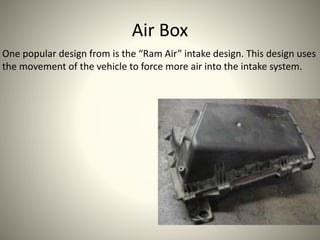
Air Box
One popular design from is the “Ram Air” intake design. This design uses
the movement of the vehicle to force more air into the intake system.
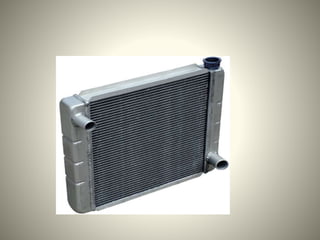
Cooling system noise
Water cooled engine are typically cooled by
using a radiator as a heat exchanger with an
axial flow fan is used to draw cooling air
through the radiator.
Air cooled engine generally used a centrifugal
fan in conjunction with shrouding to direct
cooling air across the engine.
Fan noise consists of both discrete frequency
tones and broad hand noise.
Engine Surface of Noise
• Engine surface noise refers to sound emitted
from vibrating surface of engine component
and accessories and other thus item included
in the engine exhaust.
Classification by Noise Characteristics
Aerodynamic noise.
Combustion noise.
Mechanical noise.
Aerodynamic Noise
• Aerodynamic noise includes exhaust gas and
intake air noise as well as noise generated by
cooling fans, auxiliary fans or any other air
flow.
Combustion Noise
Combustion noise refers to noise generated by
the vibrating surfaces of the engine structure,
engine components and engine accessories
after excitation by combustion forces.
Mechanical Noise
Mechanical noise refers to noise generated by
the vibrating surfaces of the engine
components and engine accessories after
excitation by reciprocating or rotating engine
components.
NOISE MEASUREMENT METHODS
• Noise sources of engine are normally
identified as some cover component as oil
pan, valve cover and front gear cover etc. the
radiated noise sources of diesel engines are
identified with two methods lead covering
technique and noise grid.
• Lead covering technique
• Acoustic intensity techniques (Noise grid)
Lead Covering Technique
Lead covering technique is also called partial exposure
technique and is a traditional noise source
identification technique for engines.
It is still the most reliable, although it is rather costly and
time consuming.
This is simply covering the whole engine or all of the
components with an acoustic high transmission loss
material. It is mounted on fiberglass wool for insulation
and to prevent reverberant buildup to give
considerable noise reduction.
A component is then uncovered and the noise increase is
noted. The process is repeated for each component.
Assignment 1
1. Acoustic Intensity Techniques for noise
measurement of Engine.
2. Different instruments used for noise level
measurements.
3. Effect of POWER OUTPUT,INTAKE MANIFOLD
PRESSURE, COMBUSTION CHAMBER
DEPOSITS, SURFACE TEMPERATURE, on
emissions of HC and CO?
Noise pollution

Noise pollution

  • 1.
  • 2.
    Noise A popular definitionof noise is “an undesirable sound” To what extent a sound can be characterized as noise is, of course, a personal evaluation. Sound is the result of mechanical vibrations occurring in an elastic medium, e.g. air. When the air starts to pulsate, the variations in air pressure will spread from the source through the transfer of energy from molecule to molecule. The more energy transferred, the higher the sound level.
  • 3.
  • 4.
    Sources of NoisePollution: (i) Industrial Sources: Progress in technology (industrialization) has resulted in creating noise pollution. Textile mills, printing presses, engineering establishments and metal works etc. contribute heavily towards noise pollution. In industrial cities like Kolkata, Ludhiana, Kanpur etc., often the industrial zones are not separated from the residential zones of the city especially in the case of small scale industries.
  • 5.
    These operate fromworkshops located on the ground floors of the residential areas and cause annoyance, discomfort and irritation to the residents exposed to the noise that is inevitably produced. The situation is much better in modern planned cities like Chandigarh where the industrial area is kept away from the residential areas and both are separated from each other by a sufficiently wide green belt.
  • 6.
    (ii) Transport Vehicles: Automobilerevolution in urban centers has proved to be a big source of noise pollution. Increasing traffic has given rise to traffic jams in congested areas where the repeated hooting of horns by impatient drivers pierce the ears of all road users. Noise from airplanes constitutes an increasing serious problem in big cities like Delhi & Mumbai. Airport situated in the vicinity of population centres and the air planes pass over residential areas. Heavy trucks, buses trains, jet-planes, motor-cycles, scooters, mopeds, jeeps—the list of vehicles is endless but the outcome is same — noise pollution.
  • 7.
    (iii) Household: The householdis an industry in itself and is a source of many indoor noises such as the banging of doors, noise of playing children, crying of infants, moving of furniture, loud conversation of the inhabitants etc. Besides these are the entertainment equipment in the house, namely the radio, record-players and television sets. Domestic gadgets like the mixer-grinders, pressure cookers, desert coolers, air- conditioners, exhaust fans, vacuum cleaners, sewing and washing machines are all indoor sources of noise pollution.
  • 8.
    (iv) Public AddressSystem: In India people need only the slightest of an excuse for using loud speakers. The reason may be a religious function, birth, death, marriage, elections, demonstration, or just commercial advertising. Public system, therefore, contributes in its own way towards noise pollution. (v) Agricultural Machines: Tractors, thrashers, harvesters, tube wells, powered tillers etc. have all made agriculture highly mechanical but at the same time highly noisy. Noise level 90 dB to 98 dB due to running of farm machines have been recorded in the state of Punjab.
  • 9.
    (vi) Miscellaneous Sources: Theautomobile repair shops, construction- works, blasting, bulldozing, stone crushing etc. are other sources of noise pollution.
  • 11.
    ENGINE NOISE Pulses releasedby the exhaust are the cause of engine noise. When the expansion stroke of the engine comes near the end, the outlet valve opens and the remaining pressure in the cylinder discharges exhaust gases as in pulse into the exhaust system. Generally, engines produce noise of 100 to 130 dB depending on the size and the type of the engine.
  • 12.
    CLASSIFICATION OF ENGINENOISE Exhaust system noise Intake system noise Cooling system noise Engine surface noise
  • 13.
  • 15.
    A catalytic converteris a device that uses a catalyst to convert three harmful compounds in car exhaust into breathable compounds.
  • 17.
    A resonator installedas part of your car or truck’s exhaust system serves one main purpose — to resonate. It’s sort of an echo chamber for your car’s exhaust, preparing all of the loud noise coming from your engine for the muffler to silence it. But there is far more science to it than that. The resonator doesn’t just remove sound, it changes it. A muffler or silencer is a device for reducing the amount of noise emitted by the exhaust of an internal combustion engine. The tail pipe is end of the final length of exhaust pipe which ends with just a straight or angled cut where it vents to open air.
  • 18.
    Exhaust system noise Theexhaust system noise includes the noise from exhaust gas pulses leave the muffler or trail pipe and noise emitted from vibrating surface of the exhaust system component. Noise emitted from the surface of exhaust system component result from two different type of excitation force. Those generated by the pulsating exhaust. Gas flow and thus transmitted from the vibrating engine to exhaust system component.
  • 19.
    Intake system noise Intakesystem noise include generated by the flow of air through the system air inlet and noise emitted from the vibrating surface component. In many instance in engine air cleaner will provide significant attenuation of intake air noise. If additional attenuation required, an intake air silencer can be added to the system. To minimize intake system surface radiated noise, proper design, selection and mounting intake system component are essential.
  • 20.
    Air Box One populardesign from is the “Ram Air” intake design. This design uses the movement of the vehicle to force more air into the intake system.
  • 21.
    Cooling system noise Watercooled engine are typically cooled by using a radiator as a heat exchanger with an axial flow fan is used to draw cooling air through the radiator. Air cooled engine generally used a centrifugal fan in conjunction with shrouding to direct cooling air across the engine. Fan noise consists of both discrete frequency tones and broad hand noise.
  • 23.
    Engine Surface ofNoise • Engine surface noise refers to sound emitted from vibrating surface of engine component and accessories and other thus item included in the engine exhaust.
  • 24.
    Classification by NoiseCharacteristics Aerodynamic noise. Combustion noise. Mechanical noise.
  • 25.
    Aerodynamic Noise • Aerodynamicnoise includes exhaust gas and intake air noise as well as noise generated by cooling fans, auxiliary fans or any other air flow.
  • 26.
    Combustion Noise Combustion noiserefers to noise generated by the vibrating surfaces of the engine structure, engine components and engine accessories after excitation by combustion forces.
  • 27.
    Mechanical Noise Mechanical noiserefers to noise generated by the vibrating surfaces of the engine components and engine accessories after excitation by reciprocating or rotating engine components.
  • 28.
    NOISE MEASUREMENT METHODS •Noise sources of engine are normally identified as some cover component as oil pan, valve cover and front gear cover etc. the radiated noise sources of diesel engines are identified with two methods lead covering technique and noise grid. • Lead covering technique • Acoustic intensity techniques (Noise grid)
  • 29.
    Lead Covering Technique Leadcovering technique is also called partial exposure technique and is a traditional noise source identification technique for engines. It is still the most reliable, although it is rather costly and time consuming. This is simply covering the whole engine or all of the components with an acoustic high transmission loss material. It is mounted on fiberglass wool for insulation and to prevent reverberant buildup to give considerable noise reduction. A component is then uncovered and the noise increase is noted. The process is repeated for each component.
  • 31.
    Assignment 1 1. AcousticIntensity Techniques for noise measurement of Engine. 2. Different instruments used for noise level measurements. 3. Effect of POWER OUTPUT,INTAKE MANIFOLD PRESSURE, COMBUSTION CHAMBER DEPOSITS, SURFACE TEMPERATURE, on emissions of HC and CO?