1
Theory Of Automata and
Formal languages (CS-536)
(Lecture 17)
______________________________________________________
GIMS- PMAS Arid Agriculture University, Gujrat Campus
2
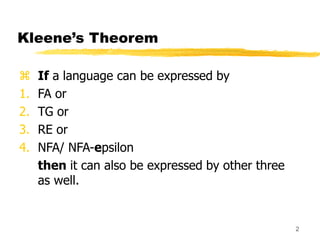
Kleene’s Theorem
 If a language can be expressed by
1. FA or
2. TG or
3. RE or
4. NFA/ NFA-epsilon
then it can also be expressed by other three
as well.
NFA to FA
Method as per discussed in class i.e. from the
notes
3
4
NFA → DFA Construction
 The algorithm is called subset construction.
 In the transition table of an NFA, each entry is
a set of states.
 In DFA, each entry is a single state
5
NFA → DFA Construction
The general idea behind
NFA-to-DFA construction is
that each DFA state
corresponds to a set of
NFA states.
6
NFA → DFA Construction
The DFA uses its state to
keep track of all possible
states the NFA can be in
after reading each input
symbol.
7
NFA → DFA Construction
We will use the following
operations.
e-closure(T):
set of NFA states reachable
from some NFA state s in T
on e-transitions alone.
8
NFA  DFA Construction
move(T,a):
set of NFA states to which
there is a transition on input
a from some NFA state s in
set of states T.
9
NFA → DFA Construction
Before it sees the first input
symbol, NFA can be in
any of the state in the set
e-closure(s0), where s0 is the
start state of the NFA.
10
NFA → DFA Construction
Suppose that exactly the
states in set T are
reachable from s0 on a
given sequence of input
symbols.
11
NFA → DFA Construction
Let a be the next input
symbol.
On seeing a, the NFA can
move to any of the states in
the set move(T,a).
12
NFA → DFA Construction
When we allow for
e-transitions, NFA can be in
any of the states in
e-closure(move(T,a))
after seeing a.
13
Subset Construction
Algorithm:
Input:
NFA N with state set S,
alphabet S, start state
s0, final states F
14
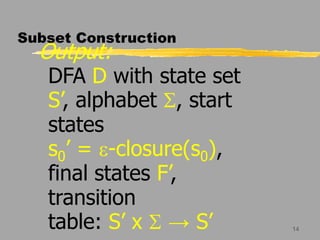
Subset Construction
Output:
DFA D with state set
S’, alphabet S, start
states
s0’ = e-closure(s0),
final states F’,
transition
table: S’ x S → S’
15
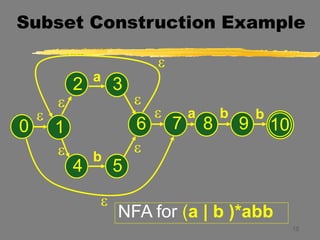
Subset Construction Example
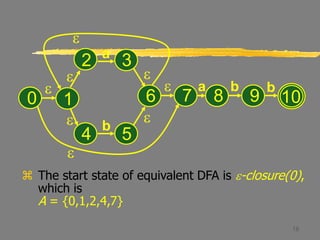
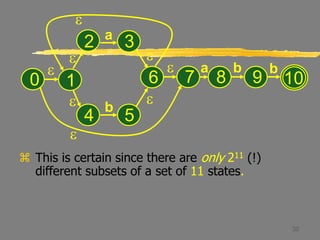
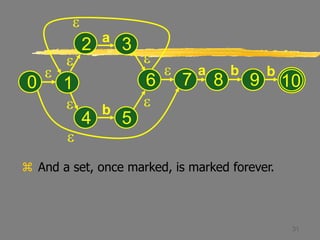
NFA for (a | b )*abb
0
e
e
e e
e
a
b
e
e
1
2 3
4 5
6 8 9
e
7
a b b
10
16
 The start state of equivalent DFA is e-closure(0),
which is
A = {0,1,2,4,7}
e
0
e
e
e e
e
a
b
e
1
2 3
4 5
6 8 9
e
7
a b b
10
e
17
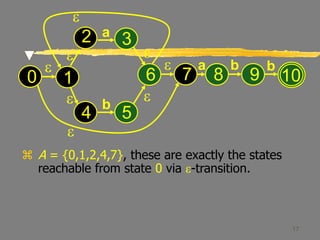
 A = {0,1,2,4,7}, these are exactly the states
reachable from state 0 via e-transition.
e
0
e
e
e e
e
a
b
e
1
2 3
4 5
6 8 9
e
7
a b b
10
e
18
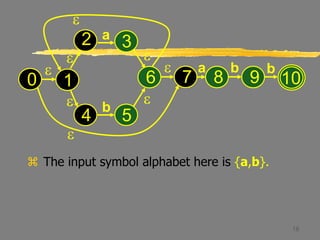
 The input symbol alphabet here is {a,b}.
e
0
e
e
e e
e
a
b
e
1
2 3
4 5
6 8 9
e
7
a b b
10
e
19
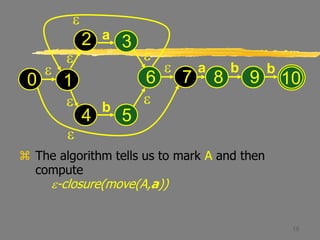
 The algorithm tells us to mark A and then
compute
e-closure(move(A,a))
e
0
e
e
e e
e
a
b
e
1
2 3
4 5
6 8 9
e
7
a b b
10
e
20
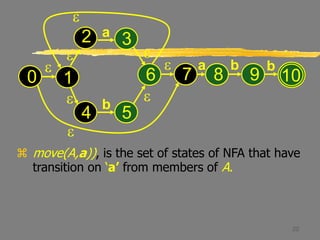
 move(A,a)), is the set of states of NFA that have
transition on ‘a’ from members of A.
e
0
e
e
e e
e
a
b
e
1
2 3
4 5
6 8 9
e
7
a b b
10
e
21
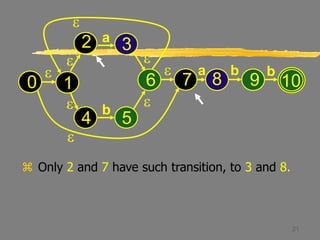
 Only 2 and 7 have such transition, to 3 and 8.
e
0
e
e
e e
e
a
b
e
1
2 3
4 5
6 8 9
e
7
a b b
10
e
22
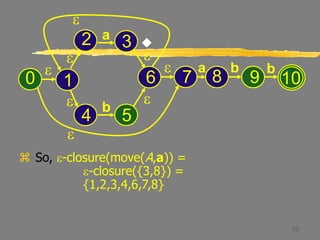
 So, e-closure(move(A,a)) =
e-closure({3,8}) =
{1,2,3,4,6,7,8}
e
0
e
e
e e
e
a
b
e
1
2 3
4 5
6 8 9
e
7
a b b
10
e
23
 Let B = {1,2,3,4,6,7,8}.
 Thus Dtran[A,a] = B
e
0
e
e
e e
e
a
b
e
1
2 3
4 5
6 8 9
e
7
a b b
10
e
24
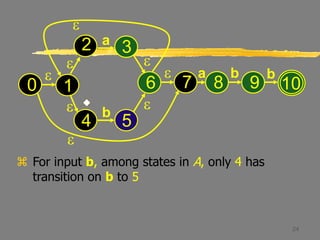
 For input b, among states in A, only 4 has
transition on b to 5
e
0
e
e
e e
e
a
b
e
1
2 3
4 5
6 8 9
e
7
a b b
10
e
25
 C = e-closure({5})
= {1,2,4,5,6,7}
 Thus, Dtran[A,b] = C
e
0
e
e
e e
e
a
b
e
1
2 3
4 5
6 8 9
e
7
a b b
10
e
26
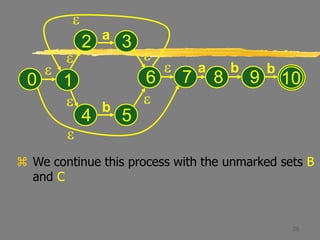
 We continue this process with the unmarked sets B
and C
e
0
e
e
e e
e
a
b
e
1
2 3
4 5
6 8 9
e
7
a b b
10
e
27
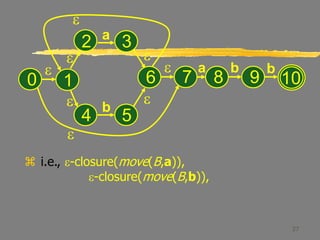
 i.e., e-closure(move(B,a)),
e-closure(move(B,b)),
e
0
e
e
e e
e
a
b
e
1
2 3
4 5
6 8 9
e
7
a b b
10
e
28
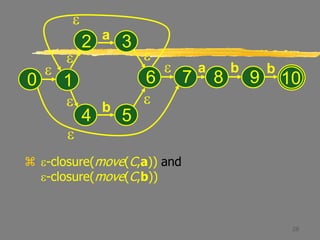
 e-closure(move(C,a)) and
e-closure(move(C,b))
e
0
e
e
e e
e
a
b
e
1
2 3
4 5
6 8 9
e
7
a b b
10
e
29
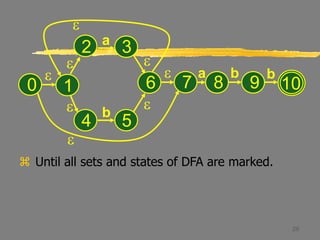
 Until all sets and states of DFA are marked.
e
0
e
e
e e
e
a
b
e
1
2 3
4 5
6 8 9
e
7
a b b
10
e
30
 This is certain since there are only 211 (!)
different subsets of a set of 11 states.
e
0
e
e
e e
e
a
b
e
1
2 3
4 5
6 8 9
e
7
a b b
10
e
31
 And a set, once marked, is marked forever.
e
0
e
e
e e
e
a
b
e
1
2 3
4 5
6 8 9
e
7
a b b
10
e
32
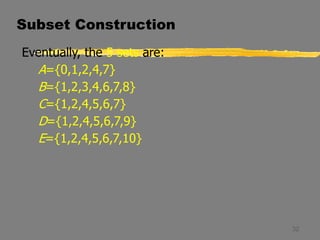
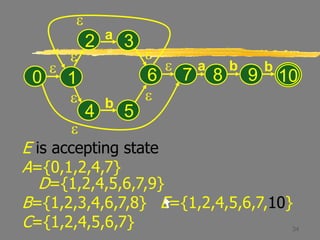
Eventually, the 5 sets are:
A={0,1,2,4,7}
B={1,2,3,4,6,7,8}
C={1,2,4,5,6,7}
D={1,2,4,5,6,7,9}
E={1,2,4,5,6,7,10}
Subset Construction
33
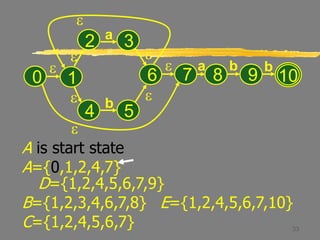
A is start state
A={0,1,2,4,7}
D={1,2,4,5,6,7,9}
B={1,2,3,4,6,7,8} E={1,2,4,5,6,7,10}
C={1,2,4,5,6,7}
e
0
e
e
e e
e
a
b
e
1
2 3
4 5
6 8 9
e
7
a b b
10
e
34
E is accepting state
A={0,1,2,4,7}
D={1,2,4,5,6,7,9}
B={1,2,3,4,6,7,8} E={1,2,4,5,6,7,10}
C={1,2,4,5,6,7}
e
0
e
e
e e
e
a
b
e
1
2 3
4 5
6 8 9
e
7
a b b
10
e
35
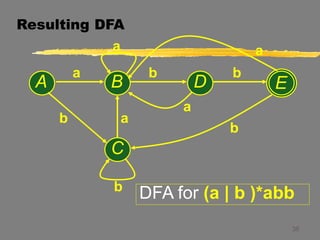
Resulting DFA
DFA for (a | b )*abb
A
a
b a
b b
E
B D
C
a
b
b
a
a
36
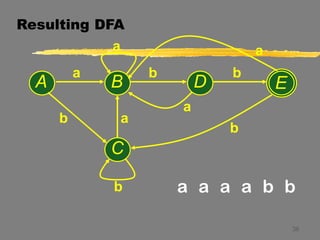
Resulting DFA
A
a
b a
b b
E
B D
C
a
b
b
a
a
a a a
a b b
37
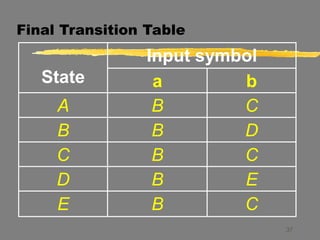
Final Transition Table
State
Input symbol
a b
A B C
B B D
C B C
D B E
E B C

Lecture 17- F19.pdf

  • 1.
    1 Theory Of Automataand Formal languages (CS-536) (Lecture 17) ______________________________________________________ GIMS- PMAS Arid Agriculture University, Gujrat Campus
  • 2.
    2 Kleene’s Theorem  Ifa language can be expressed by 1. FA or 2. TG or 3. RE or 4. NFA/ NFA-epsilon then it can also be expressed by other three as well.
  • 3.
    NFA to FA Methodas per discussed in class i.e. from the notes 3
  • 4.
    4 NFA → DFAConstruction  The algorithm is called subset construction.  In the transition table of an NFA, each entry is a set of states.  In DFA, each entry is a single state
  • 5.
    5 NFA → DFAConstruction The general idea behind NFA-to-DFA construction is that each DFA state corresponds to a set of NFA states.
  • 6.
    6 NFA → DFAConstruction The DFA uses its state to keep track of all possible states the NFA can be in after reading each input symbol.
  • 7.
    7 NFA → DFAConstruction We will use the following operations. e-closure(T): set of NFA states reachable from some NFA state s in T on e-transitions alone.
  • 8.
    8 NFA  DFAConstruction move(T,a): set of NFA states to which there is a transition on input a from some NFA state s in set of states T.
  • 9.
    9 NFA → DFAConstruction Before it sees the first input symbol, NFA can be in any of the state in the set e-closure(s0), where s0 is the start state of the NFA.
  • 10.
    10 NFA → DFAConstruction Suppose that exactly the states in set T are reachable from s0 on a given sequence of input symbols.
  • 11.
    11 NFA → DFAConstruction Let a be the next input symbol. On seeing a, the NFA can move to any of the states in the set move(T,a).
  • 12.
    12 NFA → DFAConstruction When we allow for e-transitions, NFA can be in any of the states in e-closure(move(T,a)) after seeing a.
  • 13.
    13 Subset Construction Algorithm: Input: NFA Nwith state set S, alphabet S, start state s0, final states F
  • 14.
    14 Subset Construction Output: DFA Dwith state set S’, alphabet S, start states s0’ = e-closure(s0), final states F’, transition table: S’ x S → S’
  • 15.
    15 Subset Construction Example NFAfor (a | b )*abb 0 e e e e e a b e e 1 2 3 4 5 6 8 9 e 7 a b b 10
  • 16.
    16  The startstate of equivalent DFA is e-closure(0), which is A = {0,1,2,4,7} e 0 e e e e e a b e 1 2 3 4 5 6 8 9 e 7 a b b 10 e
  • 17.
    17  A ={0,1,2,4,7}, these are exactly the states reachable from state 0 via e-transition. e 0 e e e e e a b e 1 2 3 4 5 6 8 9 e 7 a b b 10 e
  • 18.
    18  The inputsymbol alphabet here is {a,b}. e 0 e e e e e a b e 1 2 3 4 5 6 8 9 e 7 a b b 10 e
  • 19.
    19  The algorithmtells us to mark A and then compute e-closure(move(A,a)) e 0 e e e e e a b e 1 2 3 4 5 6 8 9 e 7 a b b 10 e
  • 20.
    20  move(A,a)), isthe set of states of NFA that have transition on ‘a’ from members of A. e 0 e e e e e a b e 1 2 3 4 5 6 8 9 e 7 a b b 10 e
  • 21.
    21  Only 2and 7 have such transition, to 3 and 8. e 0 e e e e e a b e 1 2 3 4 5 6 8 9 e 7 a b b 10 e
  • 22.
    22  So, e-closure(move(A,a))= e-closure({3,8}) = {1,2,3,4,6,7,8} e 0 e e e e e a b e 1 2 3 4 5 6 8 9 e 7 a b b 10 e
  • 23.
    23  Let B= {1,2,3,4,6,7,8}.  Thus Dtran[A,a] = B e 0 e e e e e a b e 1 2 3 4 5 6 8 9 e 7 a b b 10 e
  • 24.
    24  For inputb, among states in A, only 4 has transition on b to 5 e 0 e e e e e a b e 1 2 3 4 5 6 8 9 e 7 a b b 10 e
  • 25.
    25  C =e-closure({5}) = {1,2,4,5,6,7}  Thus, Dtran[A,b] = C e 0 e e e e e a b e 1 2 3 4 5 6 8 9 e 7 a b b 10 e
  • 26.
    26  We continuethis process with the unmarked sets B and C e 0 e e e e e a b e 1 2 3 4 5 6 8 9 e 7 a b b 10 e
  • 27.
  • 28.
  • 29.
    29  Until allsets and states of DFA are marked. e 0 e e e e e a b e 1 2 3 4 5 6 8 9 e 7 a b b 10 e
  • 30.
    30  This iscertain since there are only 211 (!) different subsets of a set of 11 states. e 0 e e e e e a b e 1 2 3 4 5 6 8 9 e 7 a b b 10 e
  • 31.
    31  And aset, once marked, is marked forever. e 0 e e e e e a b e 1 2 3 4 5 6 8 9 e 7 a b b 10 e
  • 32.
    32 Eventually, the 5sets are: A={0,1,2,4,7} B={1,2,3,4,6,7,8} C={1,2,4,5,6,7} D={1,2,4,5,6,7,9} E={1,2,4,5,6,7,10} Subset Construction
  • 33.
    33 A is startstate A={0,1,2,4,7} D={1,2,4,5,6,7,9} B={1,2,3,4,6,7,8} E={1,2,4,5,6,7,10} C={1,2,4,5,6,7} e 0 e e e e e a b e 1 2 3 4 5 6 8 9 e 7 a b b 10 e
  • 34.
    34 E is acceptingstate A={0,1,2,4,7} D={1,2,4,5,6,7,9} B={1,2,3,4,6,7,8} E={1,2,4,5,6,7,10} C={1,2,4,5,6,7} e 0 e e e e e a b e 1 2 3 4 5 6 8 9 e 7 a b b 10 e
  • 35.
    35 Resulting DFA DFA for(a | b )*abb A a b a b b E B D C a b b a a
  • 36.
    36 Resulting DFA A a b a bb E B D C a b b a a a a a a b b
  • 37.
    37 Final Transition Table State Inputsymbol a b A B C B B D C B C D B E E B C