1
Type Checking
2
Type Checking:
To do type checking a compiler needs to assign a type expression to
each component of the source program. The compiler must then
determine that these type expressions conform to a collection of logical
rules that is called the type system for the source language.
Type checking has the potential for catching errors in programs. In
principle, any check can be done dynamically, if the target code carries
the type of an element along with the value of the element. A sound type
system eliminates the need for dynamic checking for type errors,
because it allows us to determine statically that these errors cannot
occur when the target program runs.
3
Rules for Type Checking
Type checking can take on two forms: synthesis and inference.
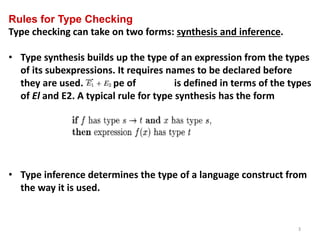
• Type synthesis builds up the type of an expression from the types
of its subexpressions. It requires names to be declared before
they are used. The type of is defined in terms of the types
of El and E2. A typical rule for type synthesis has the form
• Type inference determines the type of a language construct from
the way it is used.
4
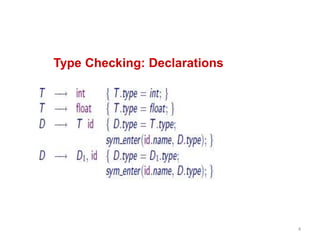
Type Checking: Declarations
5
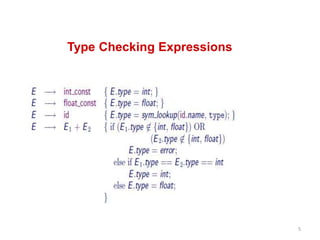
Type Checking Expressions
6
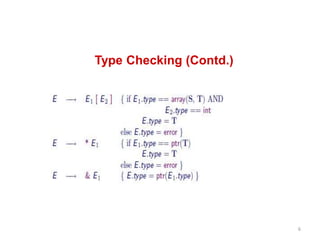
Type Checking (Contd.)
7
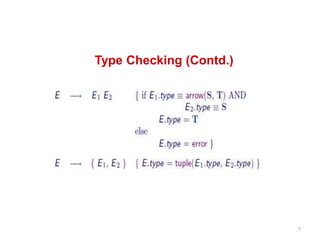
Type Checking (Contd.)
8
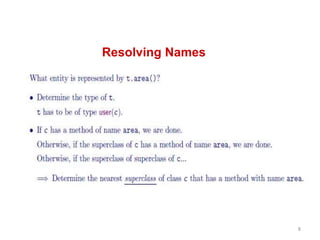
Resolving Names
9
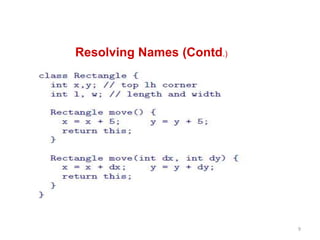
Resolving Names (Contd.)
10
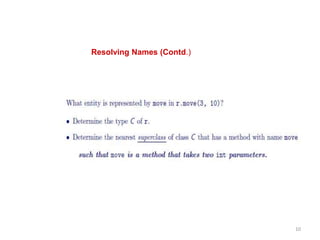
Resolving Names (Contd.)
11
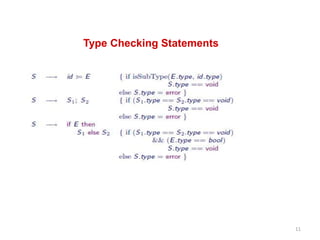
Type Checking Statements
12

Type checking

  • 1.
  • 2.
    2 Type Checking: To dotype checking a compiler needs to assign a type expression to each component of the source program. The compiler must then determine that these type expressions conform to a collection of logical rules that is called the type system for the source language. Type checking has the potential for catching errors in programs. In principle, any check can be done dynamically, if the target code carries the type of an element along with the value of the element. A sound type system eliminates the need for dynamic checking for type errors, because it allows us to determine statically that these errors cannot occur when the target program runs.
  • 3.
    3 Rules for TypeChecking Type checking can take on two forms: synthesis and inference. • Type synthesis builds up the type of an expression from the types of its subexpressions. It requires names to be declared before they are used. The type of is defined in terms of the types of El and E2. A typical rule for type synthesis has the form • Type inference determines the type of a language construct from the way it is used.
  • 4.
  • 5.
  • 6.
  • 7.
  • 8.
  • 9.
  • 10.
  • 11.
  • 12.