Program: Diploma (Mechanical)
Class: TY (ME) Semester: V
Course: Power Plant Engineering
Code: 22566Code: 22566
LECTURE 02:
Unit: 1. Introduction to Power Plant
02
wwwwwwwwwwww....ssssaaaannnnddddiiiippppffffoooouuuunnnnddddaaaattttiiiioooonnnn....oooorrrrggggMechanical Engineering Department, Sandip Polytechnic, NashikMechanical Engineering Department, Sandip Polytechnic, NashikMechanical Engineering Department, Sandip Polytechnic, NashikMechanical Engineering Department, Sandip Polytechnic, Nashik
Name of theName of theName of theName of the Trainer : Prof. Rushikesh Deoram SonarTrainer : Prof. Rushikesh Deoram SonarTrainer : Prof. Rushikesh Deoram SonarTrainer : Prof. Rushikesh Deoram Sonar
Years ofYears ofYears ofYears of Experience : 10Experience : 10Experience : 10Experience : 10
DomainDomainDomainDomain Expertise : Mechanical EngineeringExpertise : Mechanical EngineeringExpertise : Mechanical EngineeringExpertise : Mechanical Engineering
Qualification: M.E. (Design Engineering)Qualification: M.E. (Design Engineering)Qualification: M.E. (Design Engineering)Qualification: M.E. (Design Engineering)
Contact Details:Contact Details:Contact Details:Contact Details:
+91 9890481959+91 9890481959+91 9890481959+91 9890481959
rushikesh.sonar@sandippolytechnic.orgrushikesh.sonar@sandippolytechnic.orgrushikesh.sonar@sandippolytechnic.orgrushikesh.sonar@sandippolytechnic.org
03Unit I: Introduction to Power Plant
UNIT OUTCOMES (UOs) :-
1a. Explain energy conversion in the given power plant.
1b. Identify elements of the given Hydro, Gas, Diesel power plant(s) .
1c. Explain preventive maintenance procedure of the given power plants.
1d. Explain predictive maintenance procedure of the given power plants.
wwwwwwwwwwww....ssssaaaannnnddddiiiippppffffoooouuuunnnnddddaaaattttiiiioooonnnn....oooorrrrggggMechanical Engineering Department, Sandip Polytechnic, NashikMechanical Engineering Department, Sandip Polytechnic, NashikMechanical Engineering Department, Sandip Polytechnic, NashikMechanical Engineering Department, Sandip Polytechnic, Nashik
1d. Explain predictive maintenance procedure of the given power plants.
04Unit I: Introduction to Power Plant
TOPICS COVERED IN LECTURE 01:-
1.1 World and National scenario of demand and supply of energy.
1.2 Introduction to power plants : their importance and types.
1.3 Hydroelectric power plant :1.3 Hydroelectric power plant :1.3 Hydroelectric power plant :1.3 Hydroelectric power plant : Classification, General arrangement, operating principle,
advantages and limitations, maintenance.
TOPICS COVERED IN LECTURE 02:-
wwwwwwwwwwww....ssssaaaannnnddddiiiippppffffoooouuuunnnnddddaaaattttiiiioooonnnn....oooorrrrggggMechanical Engineering Department, Sandip Polytechnic, NashikMechanical Engineering Department, Sandip Polytechnic, NashikMechanical Engineering Department, Sandip Polytechnic, NashikMechanical Engineering Department, Sandip Polytechnic, Nashik
advantages and limitations, maintenance.
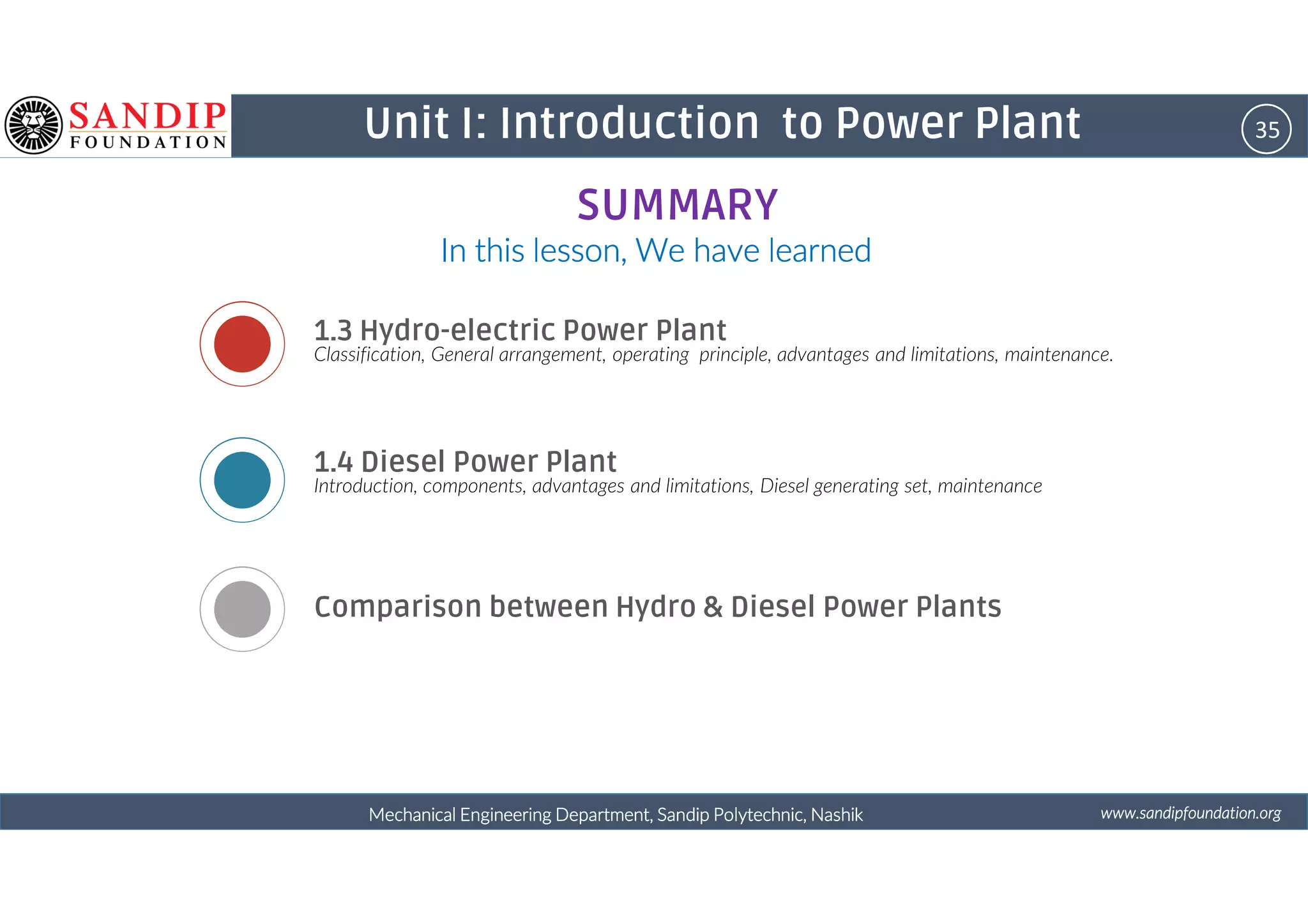
1.4 Diesel power plant:1.4 Diesel power plant:1.4 Diesel power plant:1.4 Diesel power plant: Introduction, components, advantages and limitations, Diesel generating
set, maintenance.
05Unit I: Introduction to Power Plant
1.2 : Power Plants
1.2.1: Definition of Power Plant
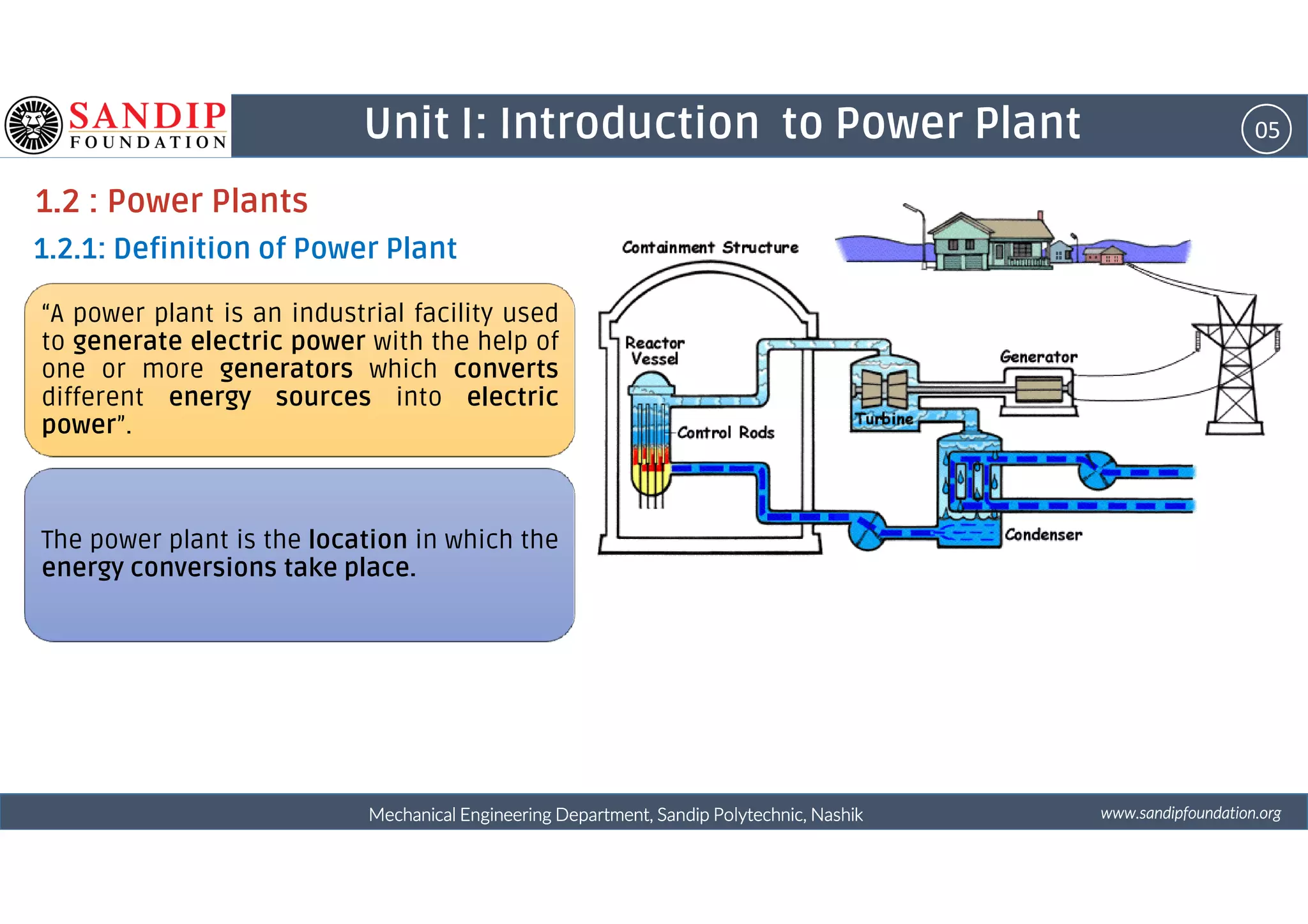
“A power plant is an industrial facility used
to generate electric power with the help of
one or more generators which converts
different energy sources into electric
power”.
wwwwwwwwwwww....ssssaaaannnnddddiiiippppffffoooouuuunnnnddddaaaattttiiiioooonnnn....oooorrrrggggMechanical Engineering Department, Sandip Polytechnic, NashikMechanical Engineering Department, Sandip Polytechnic, NashikMechanical Engineering Department, Sandip Polytechnic, NashikMechanical Engineering Department, Sandip Polytechnic, Nashik
The power plant is the location in which the
energy conversions take place.
06Unit I: Introduction to Power Plant
1.2 : Power Plants
1.2.2: Types of Power Plant
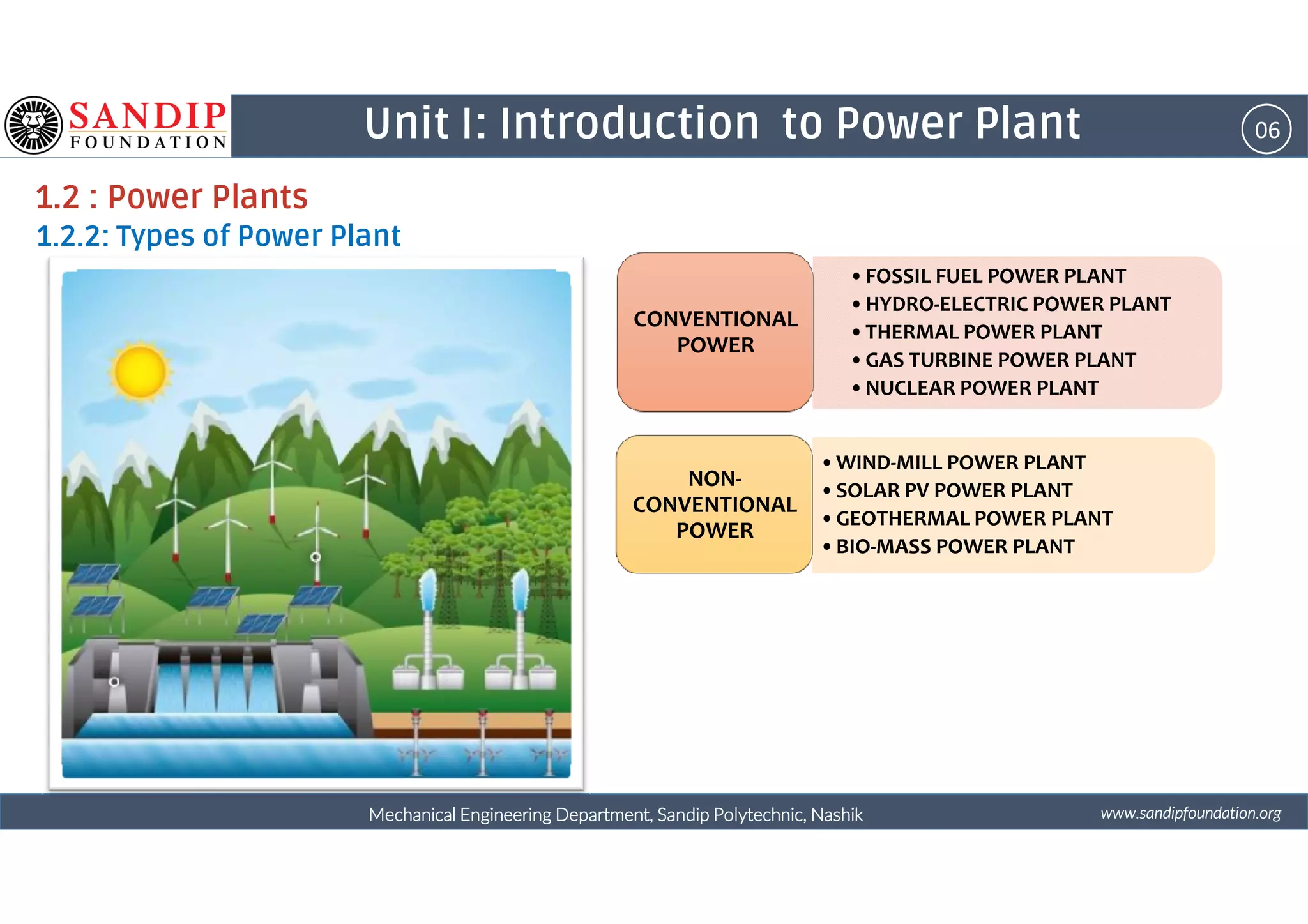
•FOSSIL FUEL POWER PLANT
•HYDRO-ELECTRIC POWER PLANT
•THERMAL POWER PLANT
•GAS TURBINE POWER PLANT
•NUCLEAR POWER PLANT
CONVENTIONAL
POWER
•WIND-MILL POWER PLANT
wwwwwwwwwwww....ssssaaaannnnddddiiiippppffffoooouuuunnnnddddaaaattttiiiioooonnnn....oooorrrrggggMechanical Engineering Department, Sandip Polytechnic, NashikMechanical Engineering Department, Sandip Polytechnic, NashikMechanical Engineering Department, Sandip Polytechnic, NashikMechanical Engineering Department, Sandip Polytechnic, Nashik
•WIND-MILL POWER PLANT
•SOLAR PV POWER PLANT
•GEOTHERMAL POWER PLANT
•BIO-MASS POWER PLANT
NON-
CONVENTIONAL
POWER
07Unit I: Introduction to Power Plant
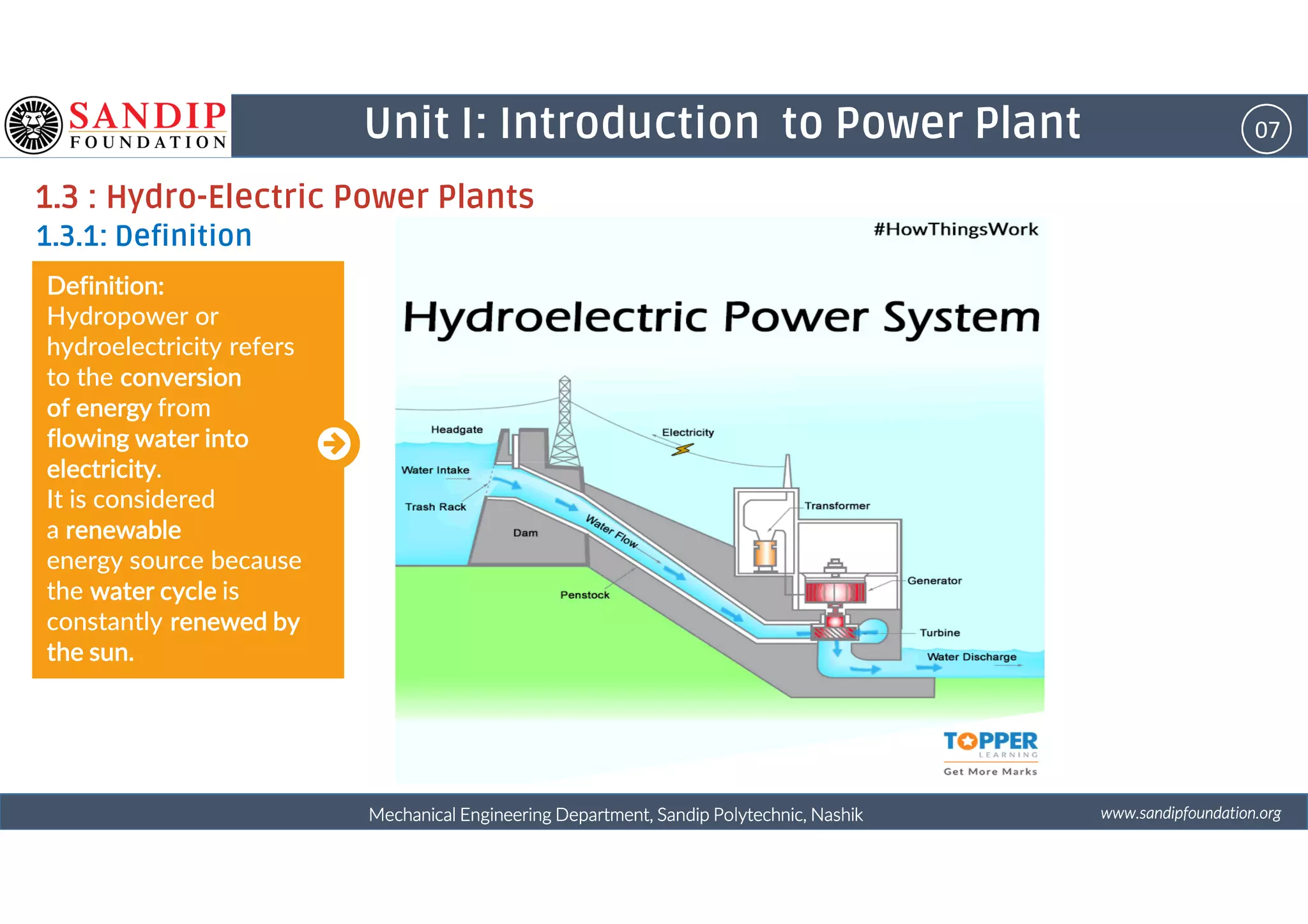
1.3 : Hydro-Electric Power Plants
1.3.1: Definition
Definition:Definition:Definition:Definition:
Hydropower or
hydroelectricity refers
to the conversionconversionconversionconversion
ofofofof energyenergyenergyenergy from
flowingflowingflowingflowing waterwaterwaterwater intointointointo
electricityelectricityelectricityelectricity.
wwwwwwwwwwww....ssssaaaannnnddddiiiippppffffoooouuuunnnnddddaaaattttiiiioooonnnn....oooorrrrggggMechanical Engineering Department, Sandip Polytechnic, NashikMechanical Engineering Department, Sandip Polytechnic, NashikMechanical Engineering Department, Sandip Polytechnic, NashikMechanical Engineering Department, Sandip Polytechnic, Nashik
electricityelectricityelectricityelectricity.
It is considered
a renewablerenewablerenewablerenewable
energy source because
the waterwaterwaterwater cyclecyclecyclecycle is
constantly renewed byrenewed byrenewed byrenewed by
the sun.the sun.the sun.the sun.
08Unit I: Introduction to Power Plant
1.3 : Hydro-Electric Power Plants
1.3.2: Working Principle
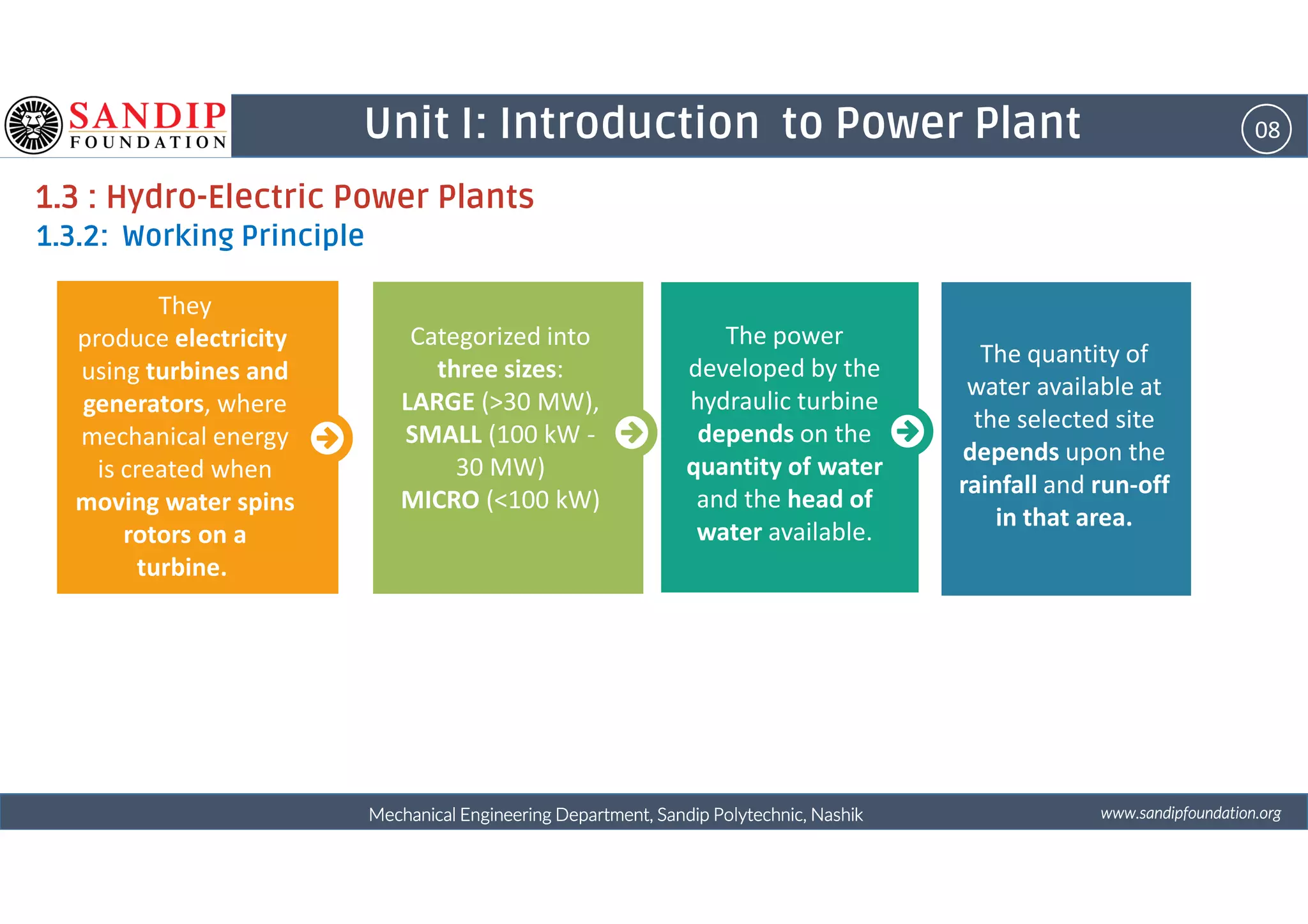
The power
developed by the
hydraulic turbine
depends on the
quantity of water
Categorized into
three sizes:
LARGE (>30 MW),
SMALL (100 kW -
30 MW)
They
produce electricity
using turbines and
generators, where
mechanical energy
is created when
The quantity of
water available at
the selected site
depends upon the
wwwwwwwwwwww....ssssaaaannnnddddiiiippppffffoooouuuunnnnddddaaaattttiiiioooonnnn....oooorrrrggggMechanical Engineering Department, Sandip Polytechnic, NashikMechanical Engineering Department, Sandip Polytechnic, NashikMechanical Engineering Department, Sandip Polytechnic, NashikMechanical Engineering Department, Sandip Polytechnic, Nashik
quantity of water
and the head of
water available.
30 MW)
MICRO (<100 kW)
is created when
moving water spins
rotors on a
turbine.
depends upon the
rainfall and run-off
in that area.
09Unit I: Introduction to Power Plant
wwwwwwwwwwww....ssssaaaannnnddddiiiippppffffoooouuuunnnnddddaaaattttiiiioooonnnn....oooorrrrggggMechanical Engineering Department, Sandip Polytechnic, NashikMechanical Engineering Department, Sandip Polytechnic, NashikMechanical Engineering Department, Sandip Polytechnic, NashikMechanical Engineering Department, Sandip Polytechnic, Nashik
10Unit I: Introduction to Power Plant
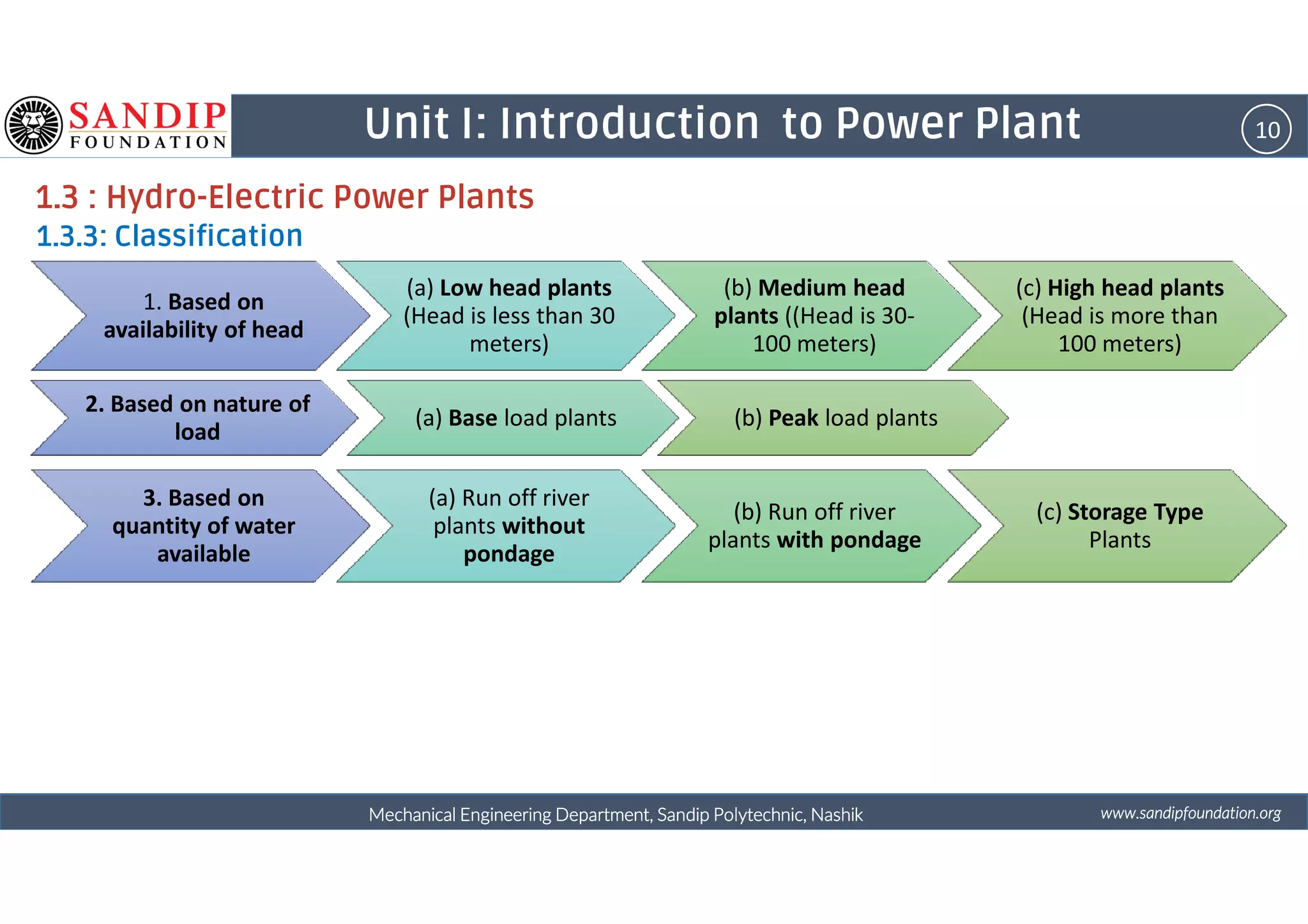
1.3 : Hydro-Electric Power Plants
1.3.3: Classification
1. Based on
availability of head
(a) Low head plants
(Head is less than 30
meters)
(b) Medium head
plants ((Head is 30-
100 meters)
(c) High head plants
(Head is more than
100 meters)
2. Based on nature of
load
(a) Base load plants (b) Peak load plants
wwwwwwwwwwww....ssssaaaannnnddddiiiippppffffoooouuuunnnnddddaaaattttiiiioooonnnn....oooorrrrggggMechanical Engineering Department, Sandip Polytechnic, NashikMechanical Engineering Department, Sandip Polytechnic, NashikMechanical Engineering Department, Sandip Polytechnic, NashikMechanical Engineering Department, Sandip Polytechnic, Nashik
3. Based on
quantity of water
available
(a) Run off river
plants without
pondage
(b) Run off river
plants with pondage
(c) Storage Type
Plants
11Unit I: Introduction to Power Plant
1.3 : Hydro-Electric Power Plants
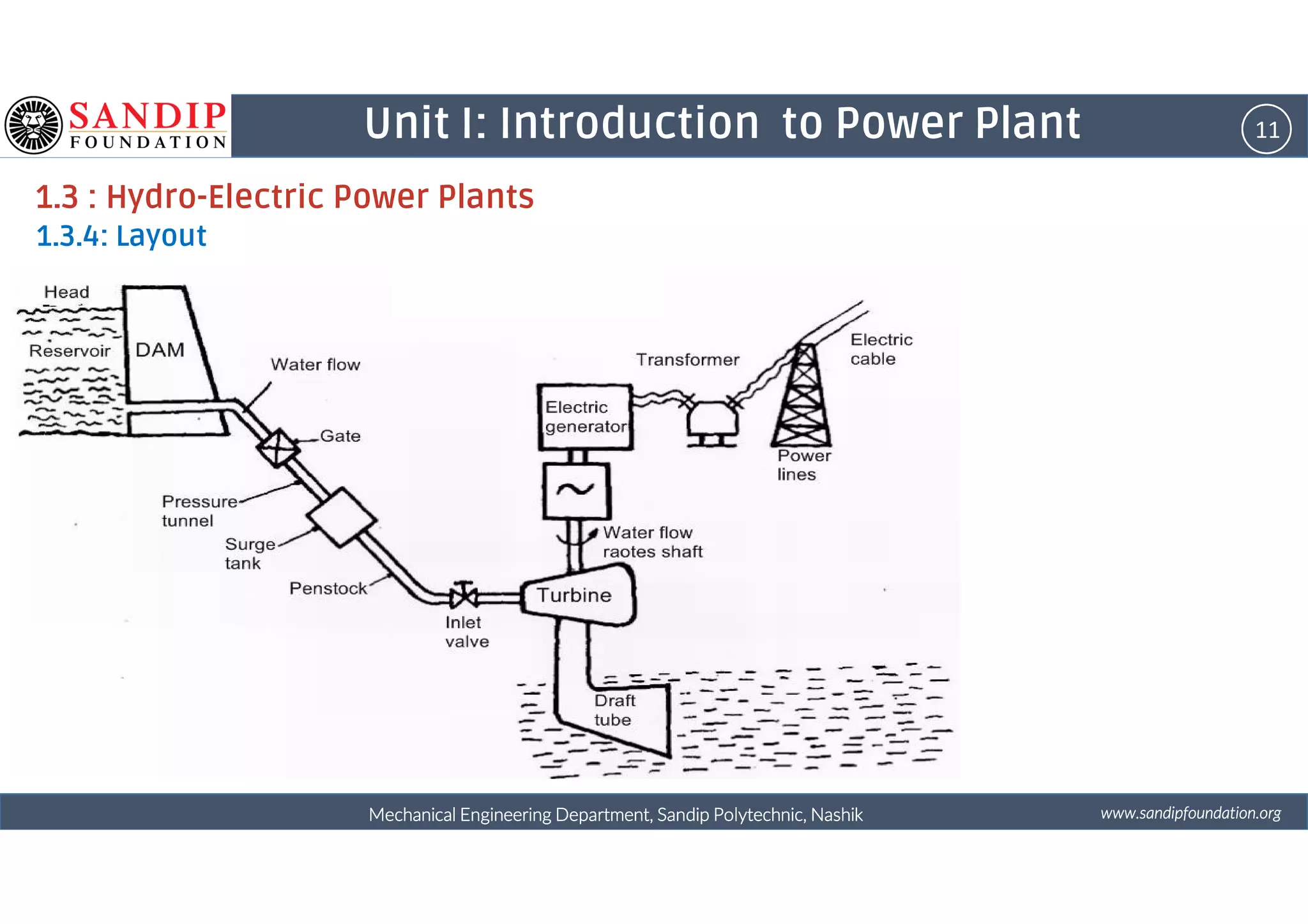
1.3.4: Layout
wwwwwwwwwwww....ssssaaaannnnddddiiiippppffffoooouuuunnnnddddaaaattttiiiioooonnnn....oooorrrrggggMechanical Engineering Department, Sandip Polytechnic, NashikMechanical Engineering Department, Sandip Polytechnic, NashikMechanical Engineering Department, Sandip Polytechnic, NashikMechanical Engineering Department, Sandip Polytechnic, Nashik
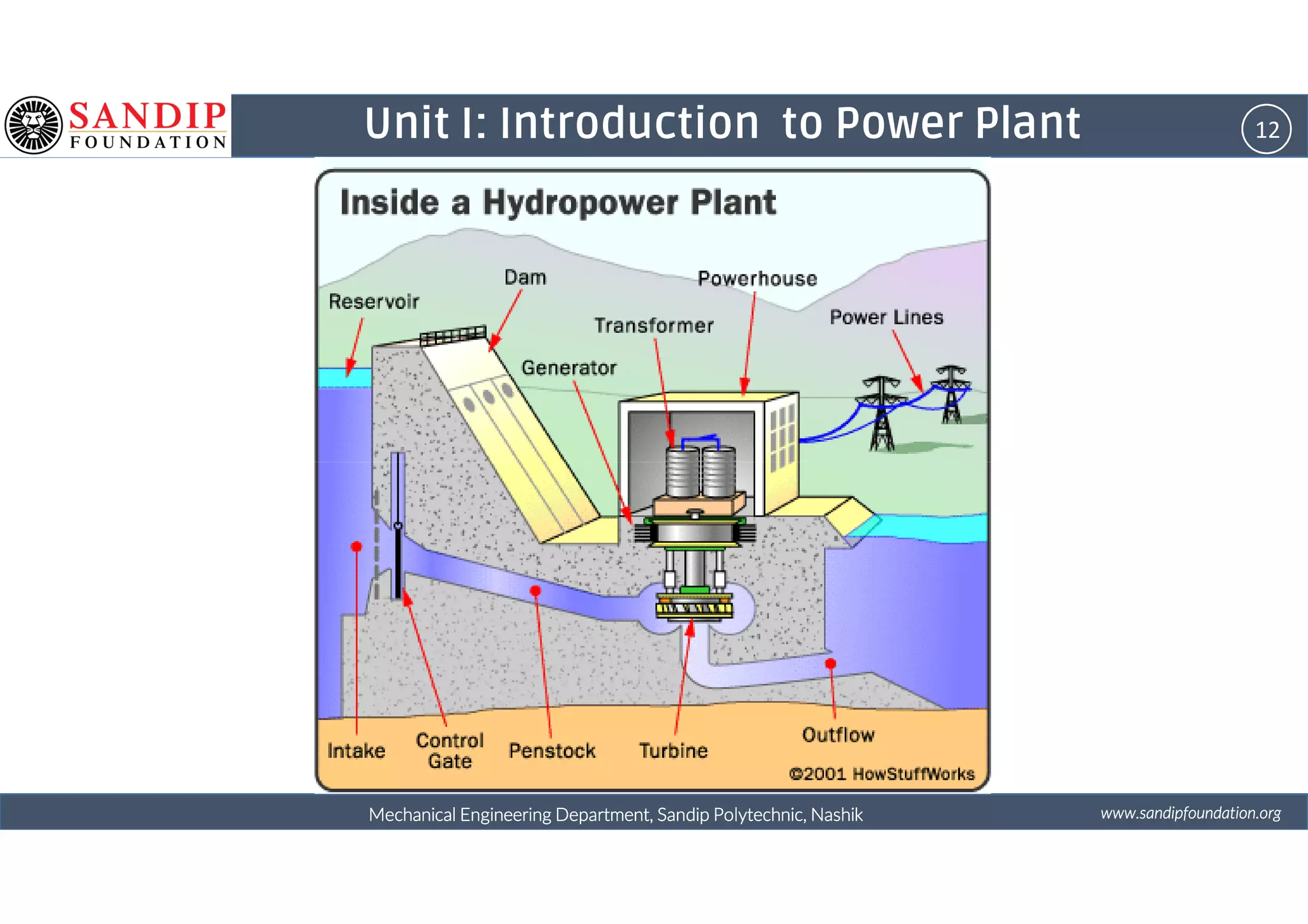
12Unit I: Introduction to Power Plant
wwwwwwwwwwww....ssssaaaannnnddddiiiippppffffoooouuuunnnnddddaaaattttiiiioooonnnn....oooorrrrggggMechanical Engineering Department, Sandip Polytechnic, NashikMechanical Engineering Department, Sandip Polytechnic, NashikMechanical Engineering Department, Sandip Polytechnic, NashikMechanical Engineering Department, Sandip Polytechnic, Nashik
13Unit I: Introduction to Power Plant
1.3 : Hydro-Electric Power Plants
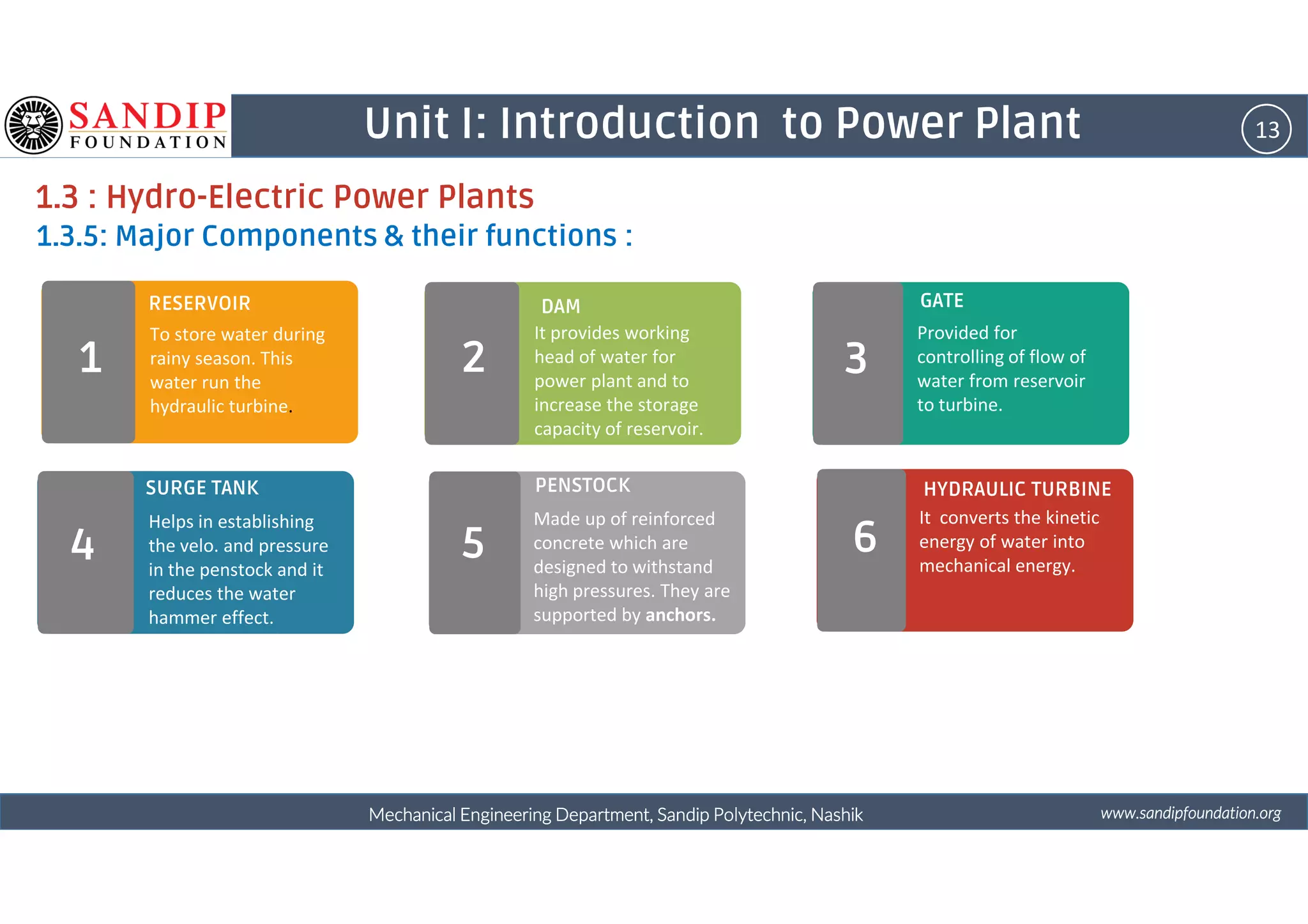
1.3.5: Major Components & their functions :
To store water during
rainy season. This
water run the
hydraulic turbine.
RESERVOIR
It provides working
head of water for
power plant and to
increase the storage
capacity of reservoir.
DAM
Provided for
controlling of flow of
water from reservoir
to turbine.
GATE
1 2 3
wwwwwwwwwwww....ssssaaaannnnddddiiiippppffffoooouuuunnnnddddaaaattttiiiioooonnnn....oooorrrrggggMechanical Engineering Department, Sandip Polytechnic, NashikMechanical Engineering Department, Sandip Polytechnic, NashikMechanical Engineering Department, Sandip Polytechnic, NashikMechanical Engineering Department, Sandip Polytechnic, Nashik
Helps in establishing
the velo. and pressure
in the penstock and it
reduces the water
hammer effect.
SURGE TANK
Made up of reinforced
concrete which are
designed to withstand
high pressures. They are
supported by anchors.
PENSTOCK
It converts the kinetic
energy of water into
mechanical energy.
HYDRAULIC TURBINE
4 5 6
14Unit I: Introduction to Power Plant
1.3 : Hydro-Electric Power Plants
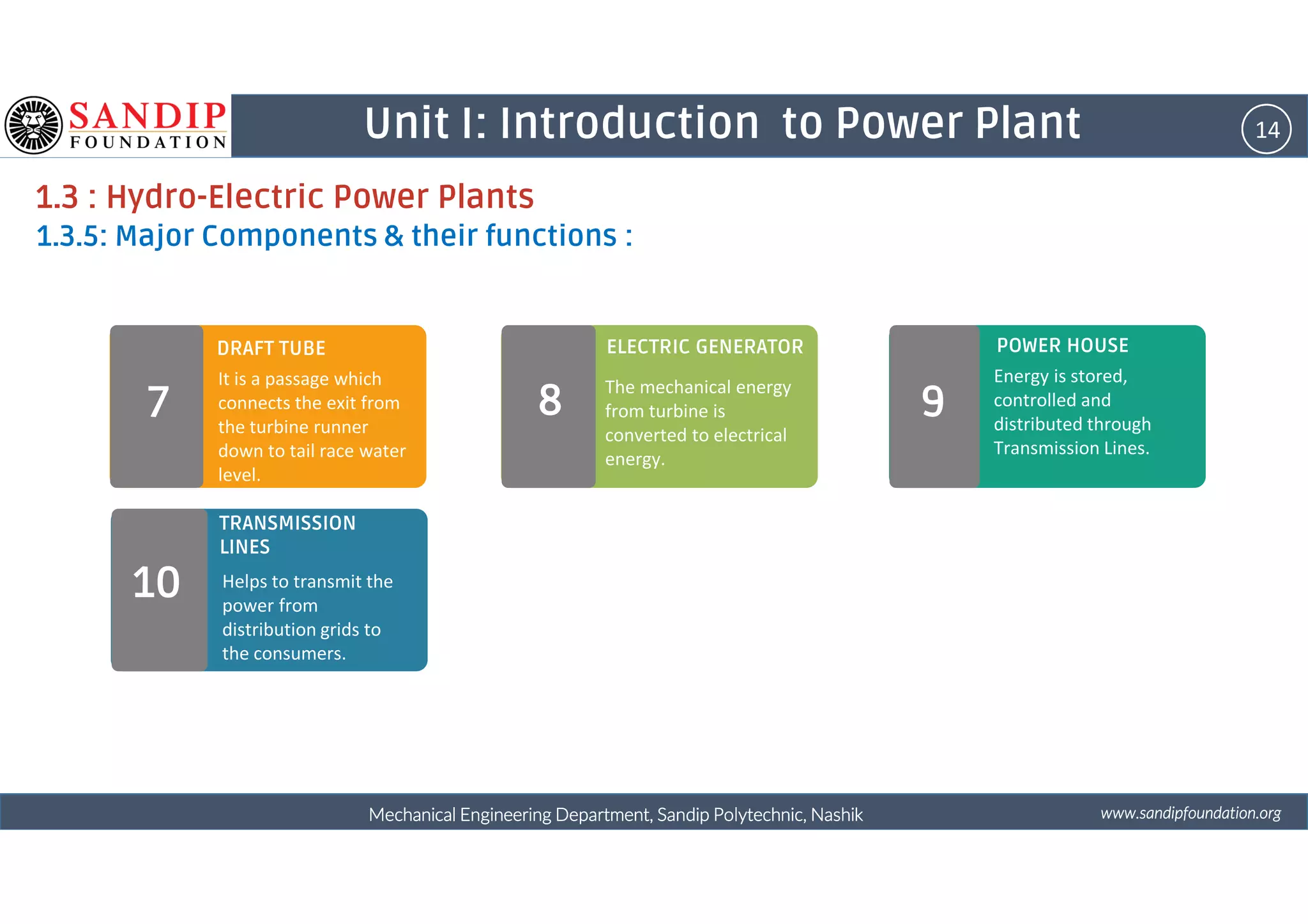
1.3.5: Major Components & their functions :
It is a passage which
connects the exit from
the turbine runner
down to tail race water
DRAFT TUBE
The mechanical energy
from turbine is
converted to electrical
energy.
ELECTRIC GENERATOR
Energy is stored,
controlled and
distributed through
Transmission Lines.
POWER HOUSE
7 8 9
wwwwwwwwwwww....ssssaaaannnnddddiiiippppffffoooouuuunnnnddddaaaattttiiiioooonnnn....oooorrrrggggMechanical Engineering Department, Sandip Polytechnic, NashikMechanical Engineering Department, Sandip Polytechnic, NashikMechanical Engineering Department, Sandip Polytechnic, NashikMechanical Engineering Department, Sandip Polytechnic, Nashik
down to tail race water
level.
energy.
4 5 6
Helps to transmit the
power from
distribution grids to
the consumers.
TRANSMISSION
LINES
10 5 6
15Unit I: Introduction to Power Plant
1.3 : Hydro-Electric Power Plants
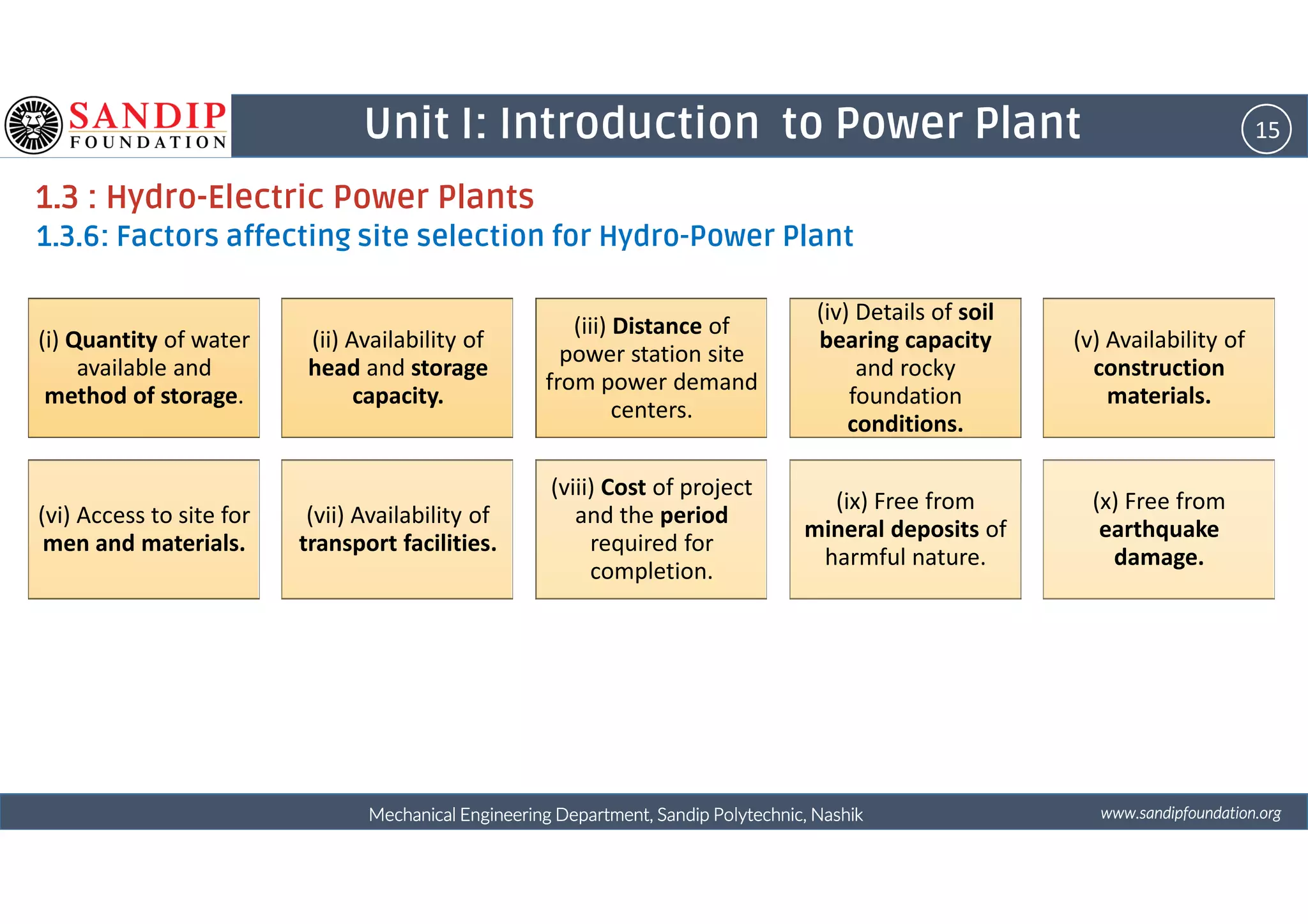
1.3.6: Factors affecting site selection for Hydro-Power Plant
(i) Quantity of water
available and
method of storage.
(ii) Availability of
head and storage
capacity.
(iii) Distance of
power station site
from power demand
centers.
(iv) Details of soil
bearing capacity
and rocky
foundation
conditions.
(v) Availability of
construction
materials.
wwwwwwwwwwww....ssssaaaannnnddddiiiippppffffoooouuuunnnnddddaaaattttiiiioooonnnn....oooorrrrggggMechanical Engineering Department, Sandip Polytechnic, NashikMechanical Engineering Department, Sandip Polytechnic, NashikMechanical Engineering Department, Sandip Polytechnic, NashikMechanical Engineering Department, Sandip Polytechnic, Nashik
4 5 6
(vi) Access to site for
men and materials.
(vii) Availability of
transport facilities.
(viii) Cost of project
and the period
required for
completion.
(ix) Free from
mineral deposits of
harmful nature.
(x) Free from
earthquake
damage.
16Unit I: Introduction to Power Plant
1.3 : Hydro-Electric Power Plants
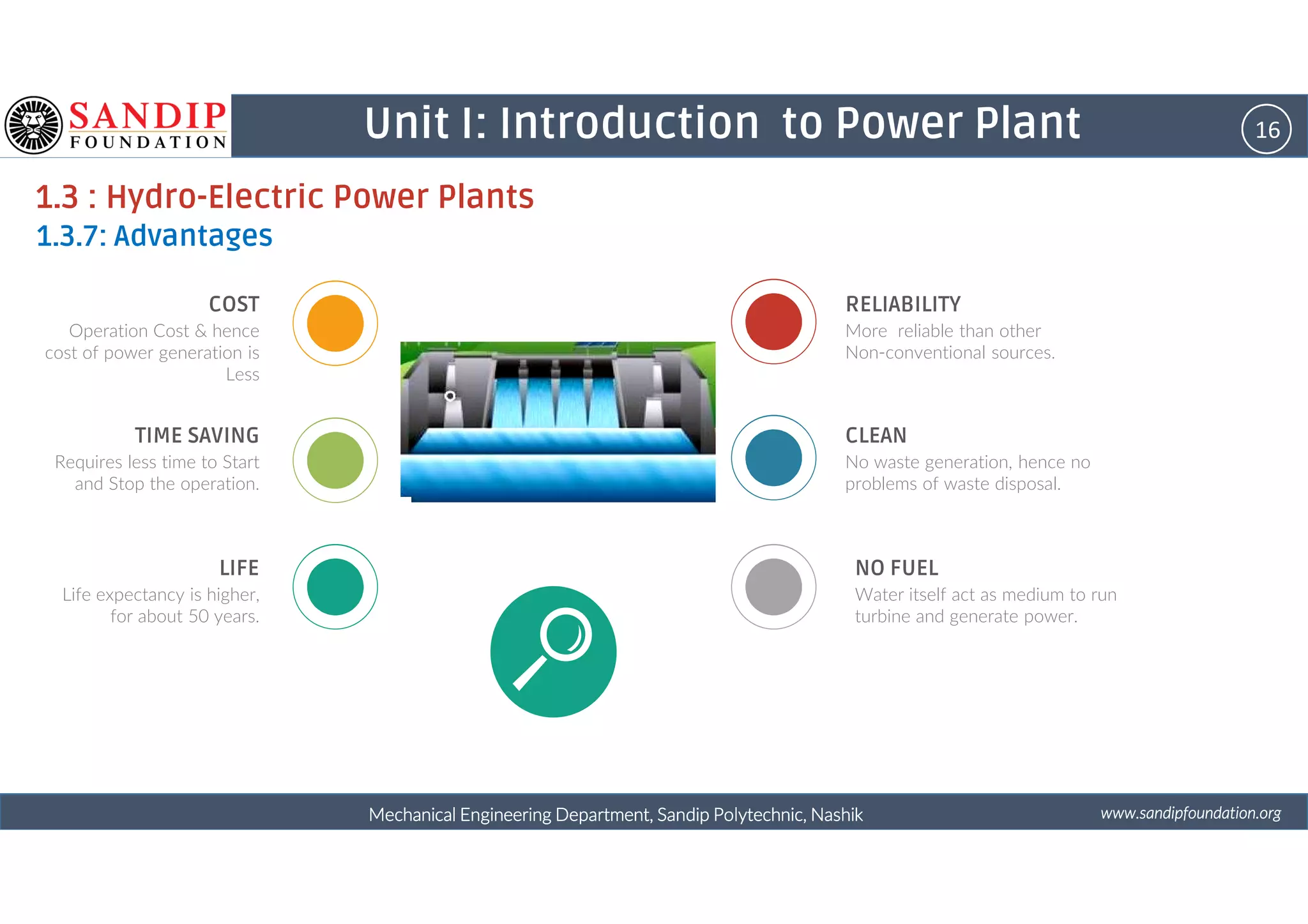
1.3.7: Advantages
COST
Operation Cost & hence
cost of power generation is
Less
TIME SAVING
Requires less time to Start
RELIABILITY
More reliable than other
Non-conventional sources.
CLEAN
No waste generation, hence no
wwwwwwwwwwww....ssssaaaannnnddddiiiippppffffoooouuuunnnnddddaaaattttiiiioooonnnn....oooorrrrggggMechanical Engineering Department, Sandip Polytechnic, NashikMechanical Engineering Department, Sandip Polytechnic, NashikMechanical Engineering Department, Sandip Polytechnic, NashikMechanical Engineering Department, Sandip Polytechnic, Nashik
4
Requires less time to Start
and Stop the operation.
LIFE
Life expectancy is higher,
for about 50 years.
No waste generation, hence no
problems of waste disposal.
NO FUEL
Water itself act as medium to run
turbine and generate power.
17Unit I: Introduction to Power Plant
1.3 : Hydro-Electric Power Plants
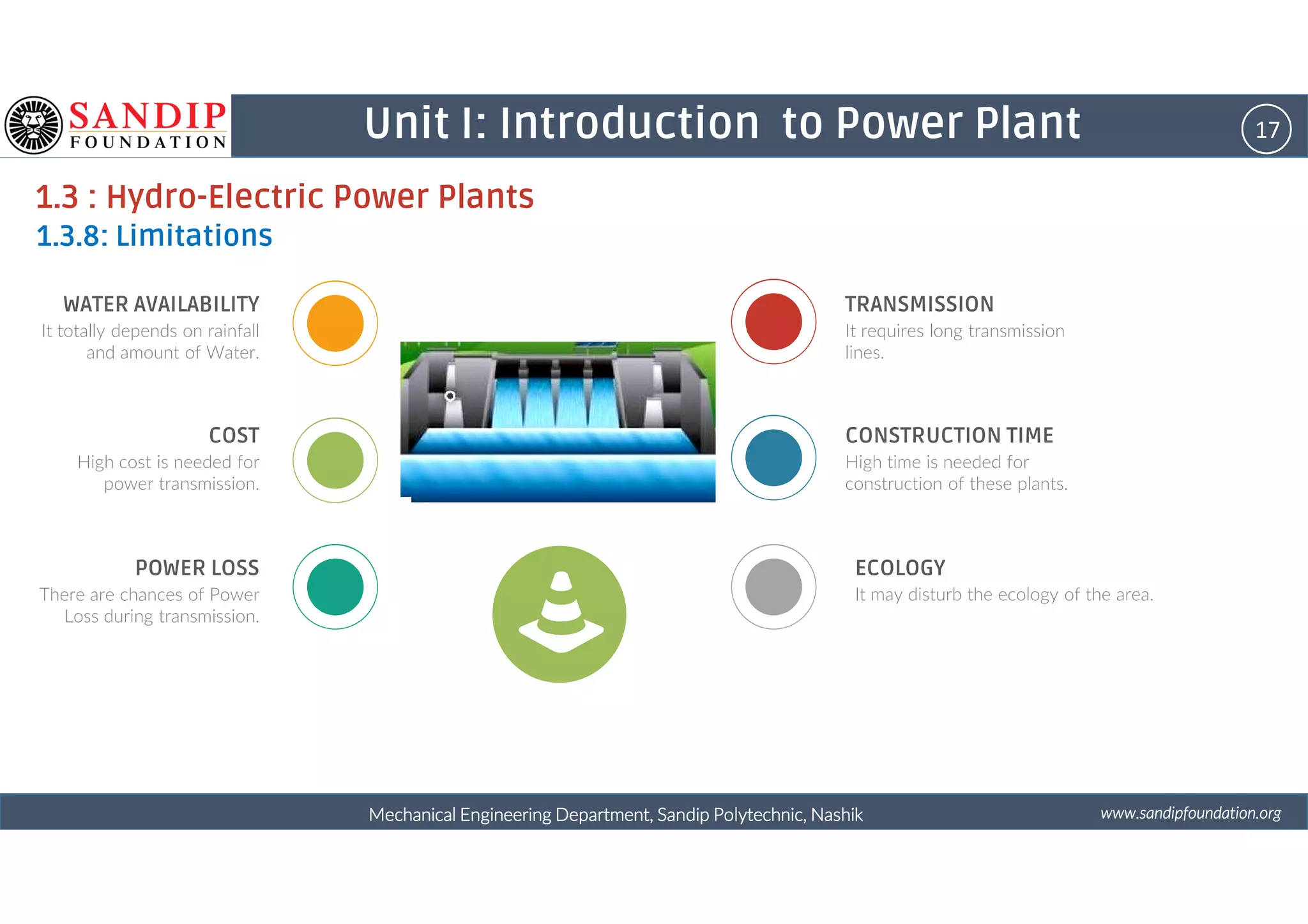
1.3.8: Limitations
WATER AVAILABILITY
It totally depends on rainfall
and amount of Water.
COST
High cost is needed for
TRANSMISSION
It requires long transmission
lines.
CONSTRUCTION TIME
High time is needed for
wwwwwwwwwwww....ssssaaaannnnddddiiiippppffffoooouuuunnnnddddaaaattttiiiioooonnnn....oooorrrrggggMechanical Engineering Department, Sandip Polytechnic, NashikMechanical Engineering Department, Sandip Polytechnic, NashikMechanical Engineering Department, Sandip Polytechnic, NashikMechanical Engineering Department, Sandip Polytechnic, Nashik
4
High cost is needed for
power transmission.
POWER LOSS
There are chances of Power
Loss during transmission.
High time is needed for
construction of these plants.
ECOLOGY
It may disturb the ecology of the area.
18Unit I: Introduction to Power Plant
1.3 : Hydro-Electric Power Plants
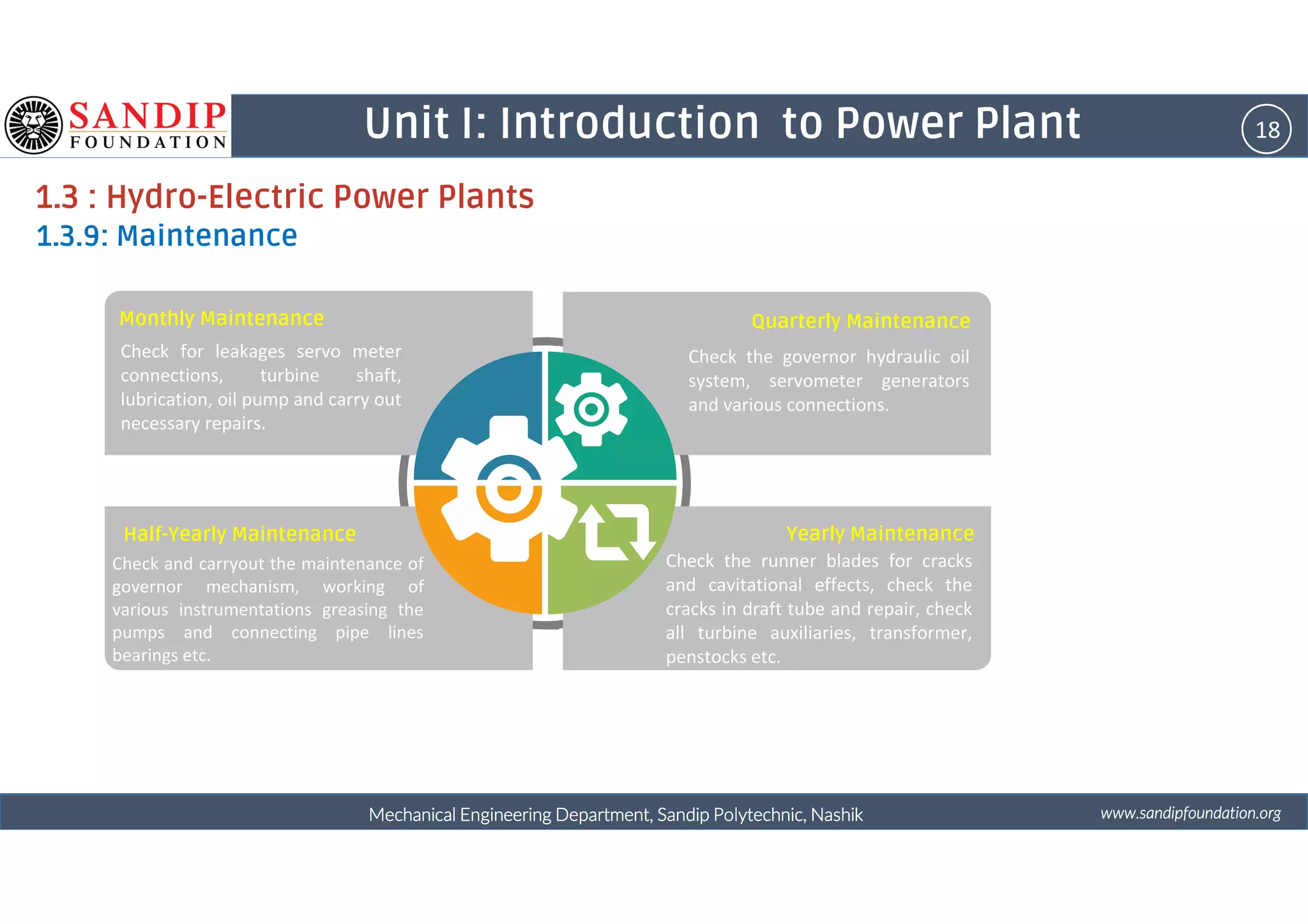
1.3.9: Maintenance
Monthly Maintenance
Check for leakages servo meter
connections, turbine shaft,
lubrication, oil pump and carry out
necessary repairs.
Quarterly Maintenance
Check the governor hydraulic oil
system, servometer generators
and various connections.
wwwwwwwwwwww....ssssaaaannnnddddiiiippppffffoooouuuunnnnddddaaaattttiiiioooonnnn....oooorrrrggggMechanical Engineering Department, Sandip Polytechnic, NashikMechanical Engineering Department, Sandip Polytechnic, NashikMechanical Engineering Department, Sandip Polytechnic, NashikMechanical Engineering Department, Sandip Polytechnic, Nashik
Half-Yearly Maintenance
Check and carryout the maintenance of
governor mechanism, working of
various instrumentations greasing the
pumps and connecting pipe lines
bearings etc.
Yearly Maintenance
Check the runner blades for cracks
and cavitational effects, check the
cracks in draft tube and repair, check
all turbine auxiliaries, transformer,
penstocks etc.
19Unit I: Introduction to Power Plant
1.4 : DIESEL Power Plants
1.4.1: Definition
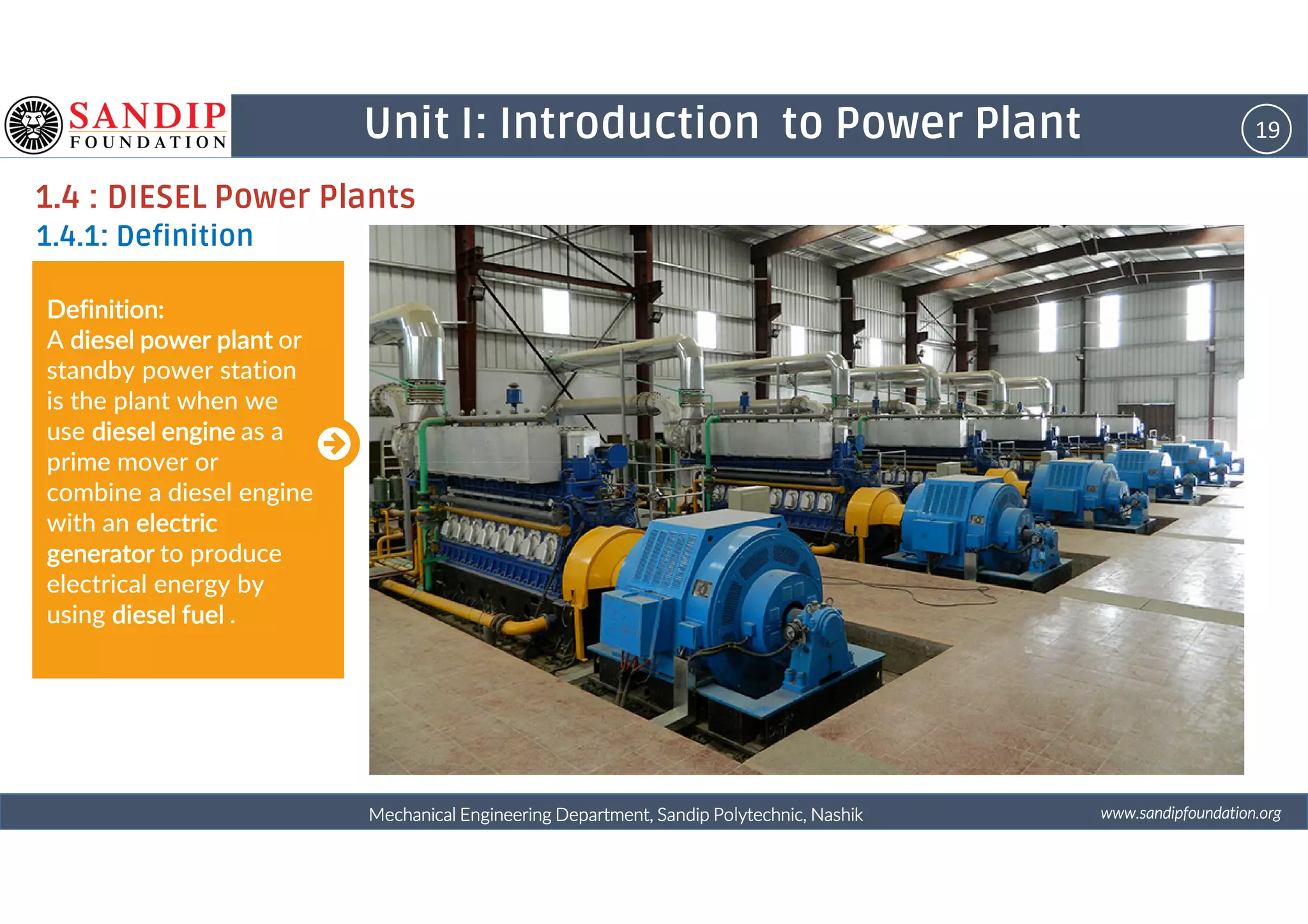
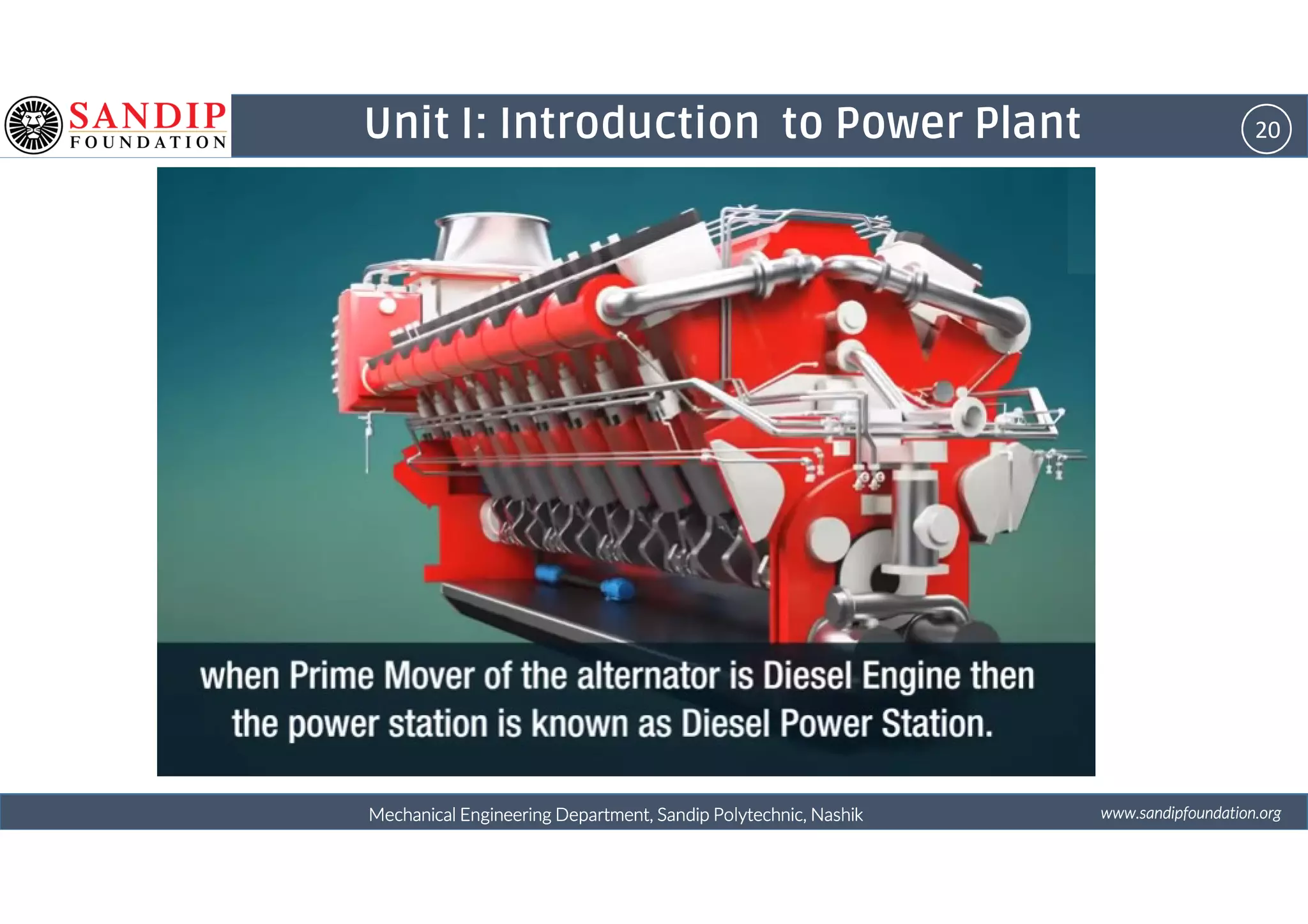
Definition:Definition:Definition:Definition:
A diesel power plantdiesel power plantdiesel power plantdiesel power plant or
standby power station
is the plant when we
use diesel enginediesel enginediesel enginediesel engine as a
prime mover or
wwwwwwwwwwww....ssssaaaannnnddddiiiippppffffoooouuuunnnnddddaaaattttiiiioooonnnn....oooorrrrggggMechanical Engineering Department, Sandip Polytechnic, NashikMechanical Engineering Department, Sandip Polytechnic, NashikMechanical Engineering Department, Sandip Polytechnic, NashikMechanical Engineering Department, Sandip Polytechnic, Nashik
prime mover or
combine a diesel engine
with an electricelectricelectricelectric
generatorgeneratorgeneratorgenerator to produce
electrical energy by
using diesel fueldiesel fueldiesel fueldiesel fuel .
20Unit I: Introduction to Power Plant
wwwwwwwwwwww....ssssaaaannnnddddiiiippppffffoooouuuunnnnddddaaaattttiiiioooonnnn....oooorrrrggggMechanical Engineering Department, Sandip Polytechnic, NashikMechanical Engineering Department, Sandip Polytechnic, NashikMechanical Engineering Department, Sandip Polytechnic, NashikMechanical Engineering Department, Sandip Polytechnic, Nashik
21Unit I: Introduction to Power Plant
1.4 : DIESEL Power Plants
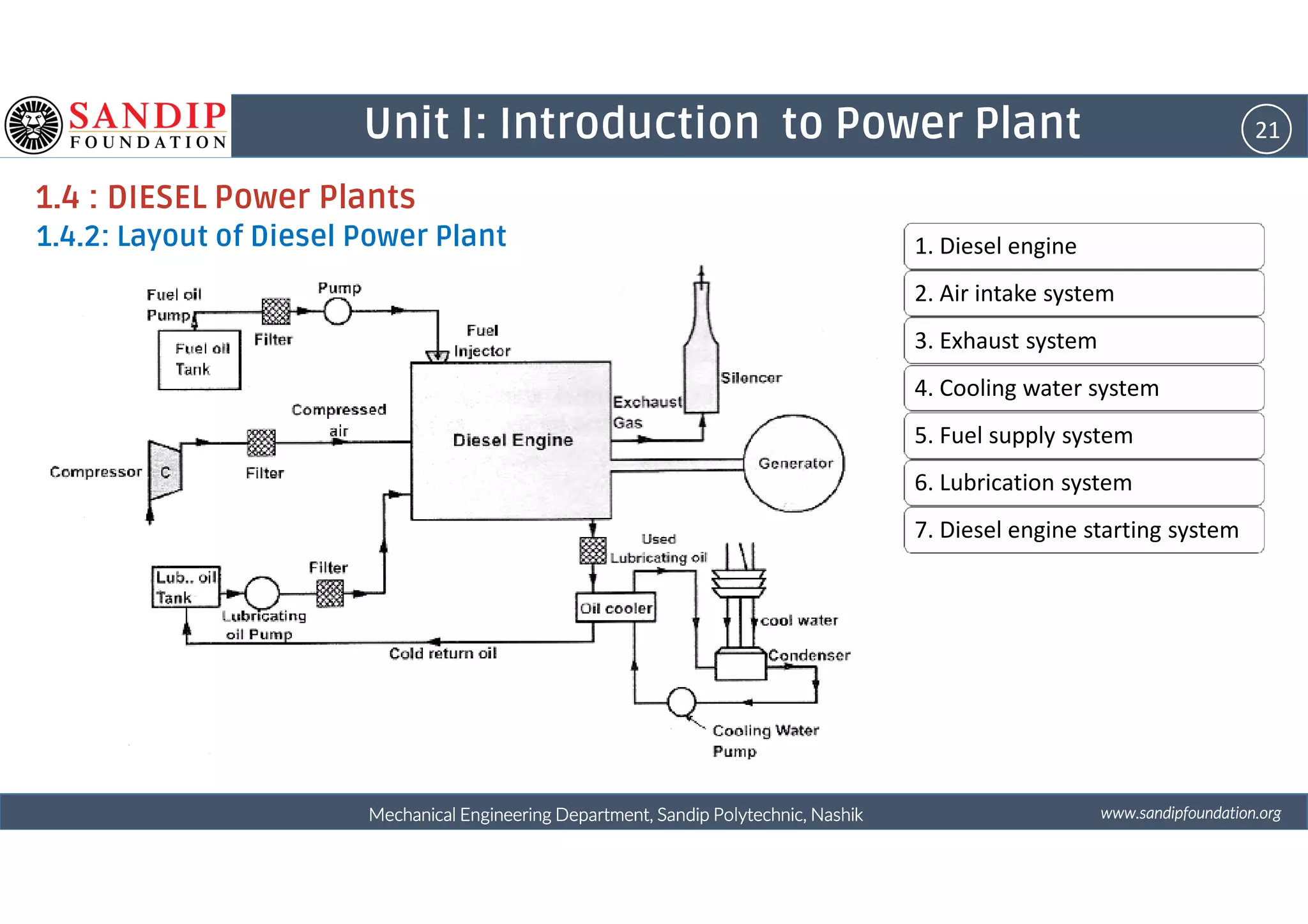
1.4.2: Layout of Diesel Power Plant 1. Diesel engine
2. Air intake system
3. Exhaust system
4. Cooling water system
5. Fuel supply system
wwwwwwwwwwww....ssssaaaannnnddddiiiippppffffoooouuuunnnnddddaaaattttiiiioooonnnn....oooorrrrggggMechanical Engineering Department, Sandip Polytechnic, NashikMechanical Engineering Department, Sandip Polytechnic, NashikMechanical Engineering Department, Sandip Polytechnic, NashikMechanical Engineering Department, Sandip Polytechnic, Nashik
6. Lubrication system
7. Diesel engine starting system
22Unit I: Introduction to Power Plant
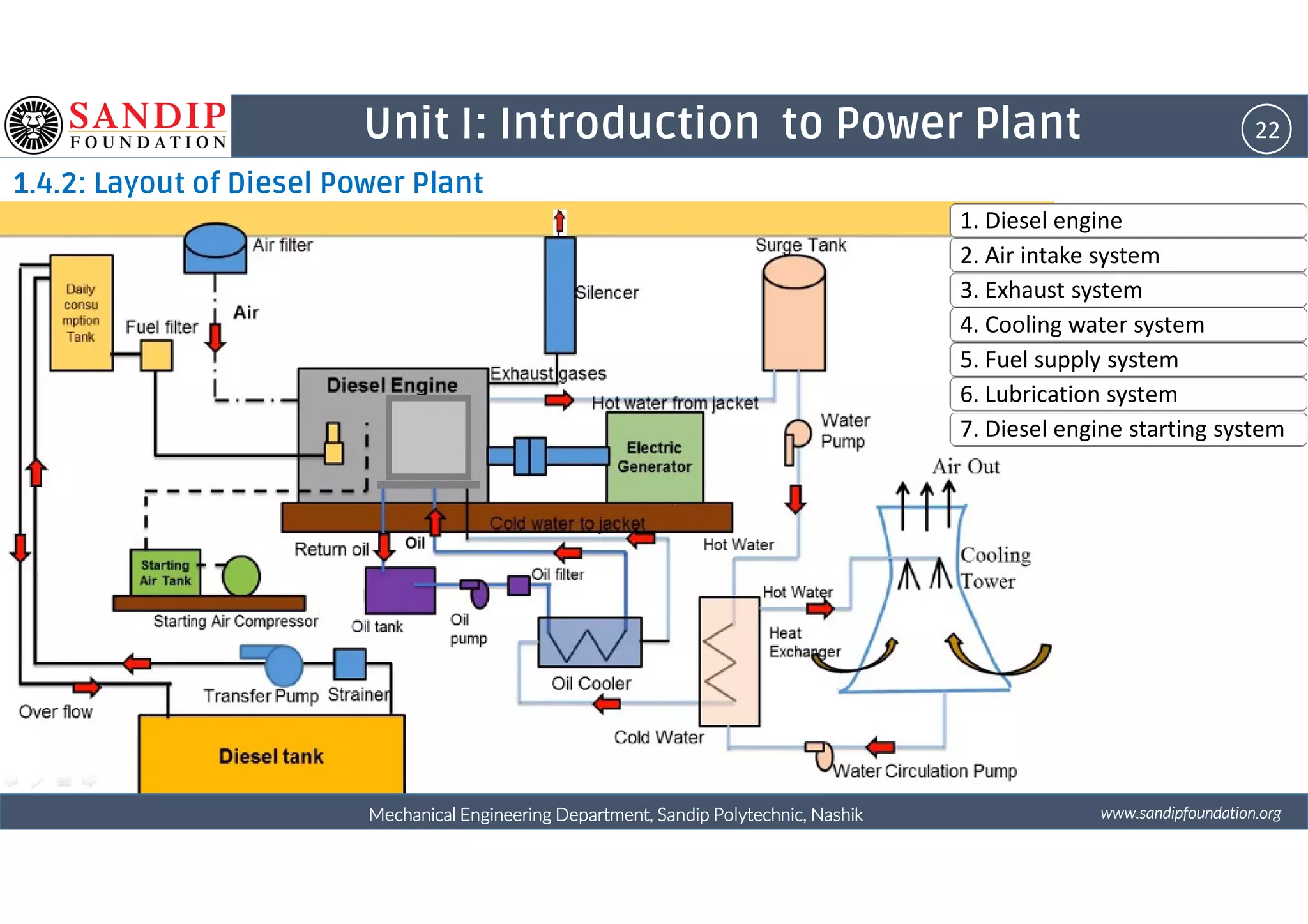
1.4.2: Layout of Diesel Power Plant
1. Diesel engine
2. Air intake system
3. Exhaust system
4. Cooling water system
5. Fuel supply system
6. Lubrication system
7. Diesel engine starting system
wwwwwwwwwwww....ssssaaaannnnddddiiiippppffffoooouuuunnnnddddaaaattttiiiioooonnnn....oooorrrrggggMechanical Engineering Department, Sandip Polytechnic, NashikMechanical Engineering Department, Sandip Polytechnic, NashikMechanical Engineering Department, Sandip Polytechnic, NashikMechanical Engineering Department, Sandip Polytechnic, Nashik
23Unit I: Introduction to Power Plant
1.4 : DIESEL Power Plants
1.4.3: Major Components of Diesel Power Plant
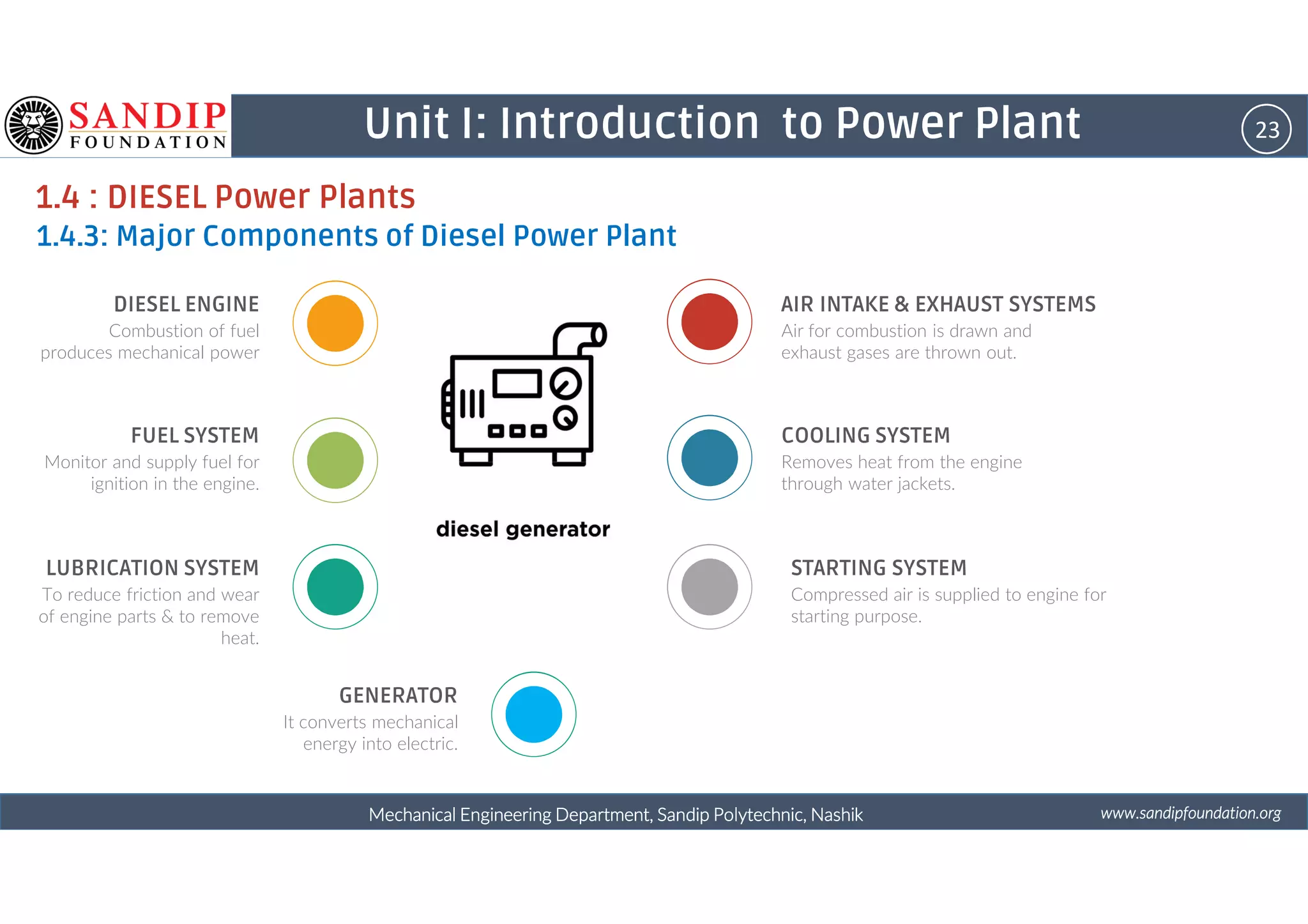
DIESEL ENGINE
Combustion of fuel
produces mechanical power
FUEL SYSTEM
Monitor and supply fuel for
AIR INTAKE & EXHAUST SYSTEMS
Air for combustion is drawn and
exhaust gases are thrown out.
COOLING SYSTEM
Removes heat from the engine
wwwwwwwwwwww....ssssaaaannnnddddiiiippppffffoooouuuunnnnddddaaaattttiiiioooonnnn....oooorrrrggggMechanical Engineering Department, Sandip Polytechnic, NashikMechanical Engineering Department, Sandip Polytechnic, NashikMechanical Engineering Department, Sandip Polytechnic, NashikMechanical Engineering Department, Sandip Polytechnic, Nashik
4
Monitor and supply fuel for
ignition in the engine.
LUBRICATION SYSTEM
To reduce friction and wear
of engine parts & to remove
heat.
Removes heat from the engine
through water jackets.
STARTING SYSTEM
Compressed air is supplied to engine for
starting purpose.
4 GENERATOR
It converts mechanical
energy into electric.
24Unit I: Introduction to Power Plant
wwwwwwwwwwww....ssssaaaannnnddddiiiippppffffoooouuuunnnnddddaaaattttiiiioooonnnn....oooorrrrggggMechanical Engineering Department, Sandip Polytechnic, NashikMechanical Engineering Department, Sandip Polytechnic, NashikMechanical Engineering Department, Sandip Polytechnic, NashikMechanical Engineering Department, Sandip Polytechnic, Nashik
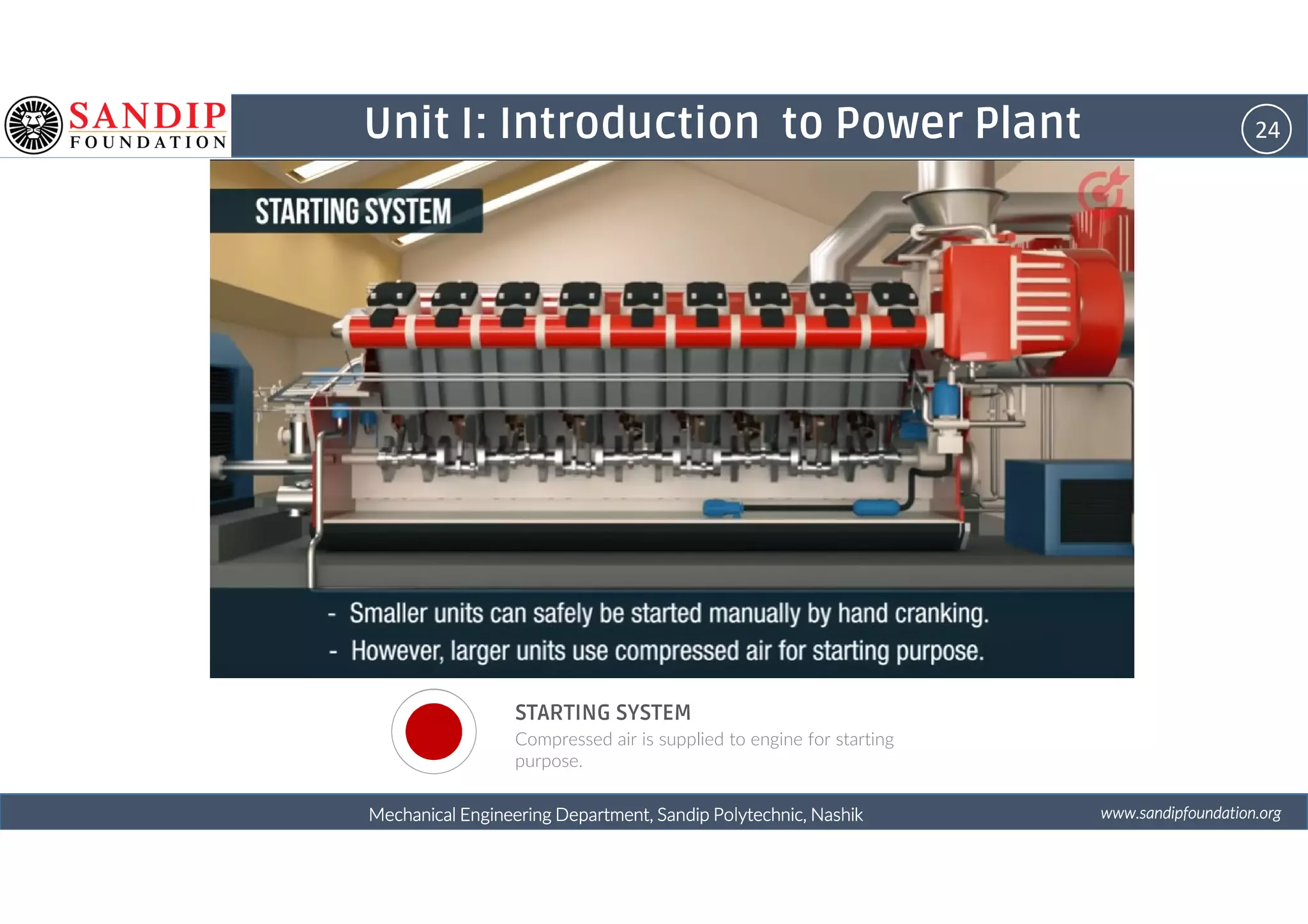
STARTING SYSTEM
Compressed air is supplied to engine for starting
purpose.
25Unit I: Introduction to Power Plant
wwwwwwwwwwww....ssssaaaannnnddddiiiippppffffoooouuuunnnnddddaaaattttiiiioooonnnn....oooorrrrggggMechanical Engineering Department, Sandip Polytechnic, NashikMechanical Engineering Department, Sandip Polytechnic, NashikMechanical Engineering Department, Sandip Polytechnic, NashikMechanical Engineering Department, Sandip Polytechnic, Nashik
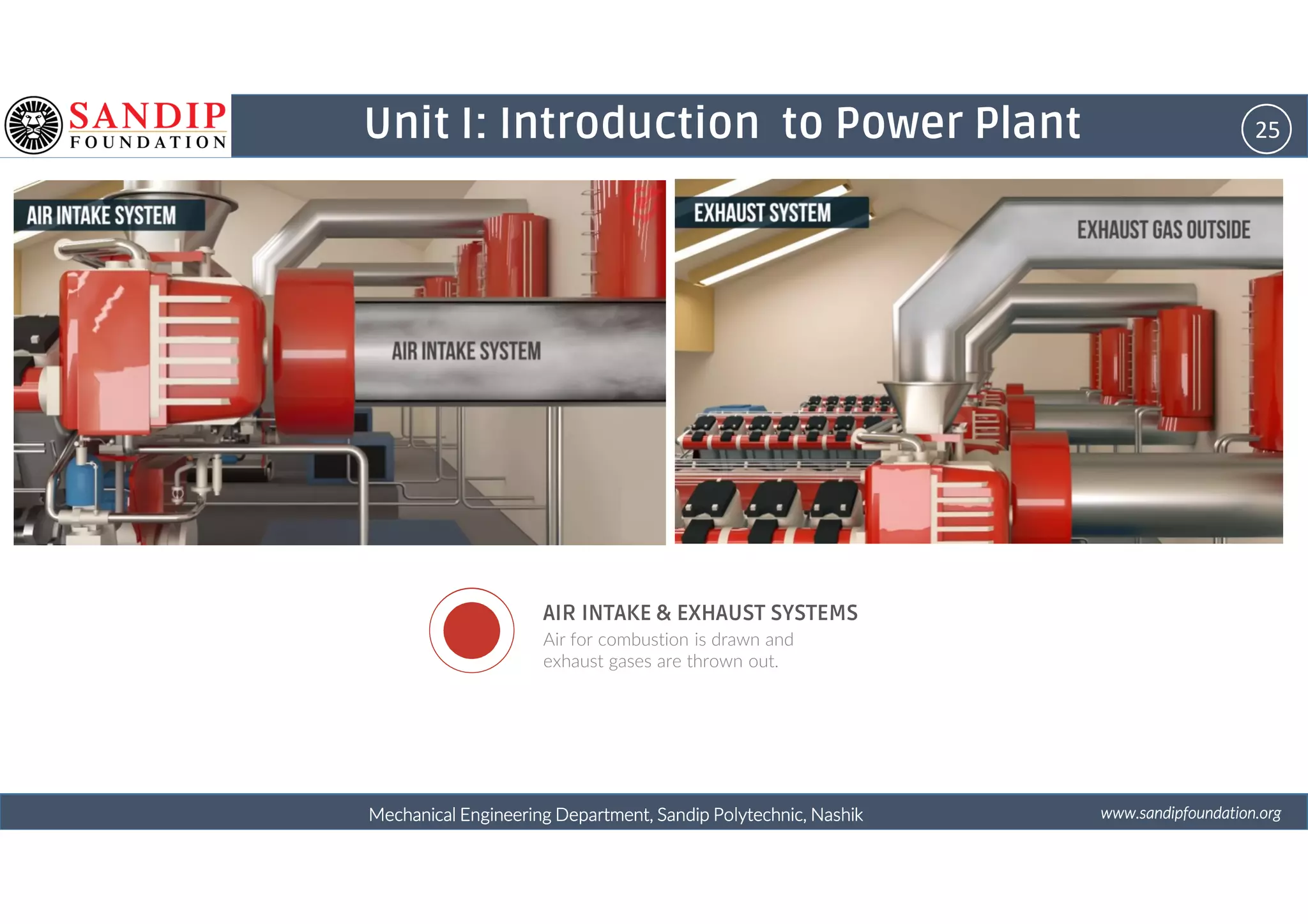
AIR INTAKE & EXHAUST SYSTEMS
Air for combustion is drawn and
exhaust gases are thrown out.
26Unit I: Introduction to Power Plant
wwwwwwwwwwww....ssssaaaannnnddddiiiippppffffoooouuuunnnnddddaaaattttiiiioooonnnn....oooorrrrggggMechanical Engineering Department, Sandip Polytechnic, NashikMechanical Engineering Department, Sandip Polytechnic, NashikMechanical Engineering Department, Sandip Polytechnic, NashikMechanical Engineering Department, Sandip Polytechnic, Nashik
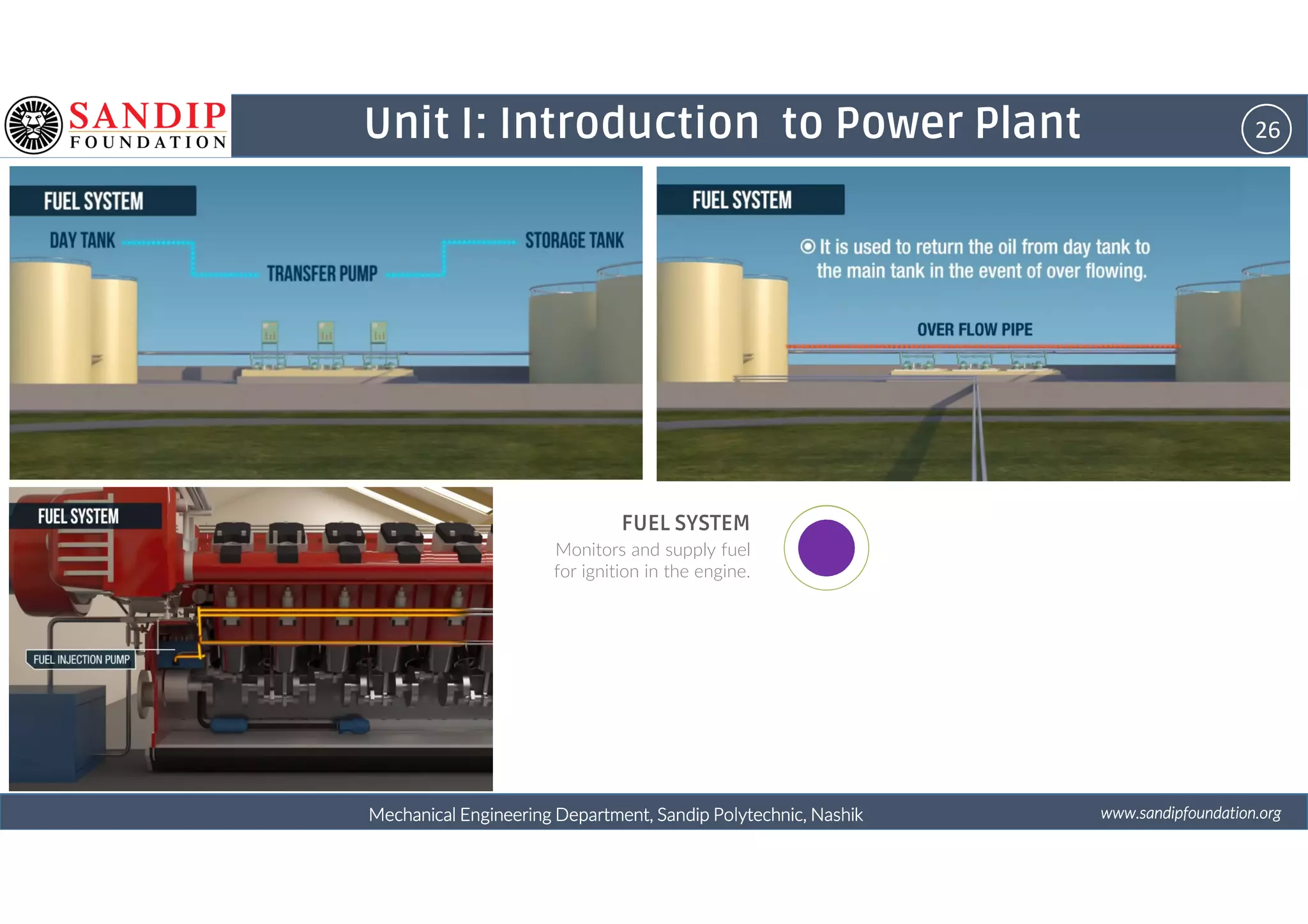
FUEL SYSTEM
Monitors and supply fuel
for ignition in the engine.
27Unit I: Introduction to Power Plant
wwwwwwwwwwww....ssssaaaannnnddddiiiippppffffoooouuuunnnnddddaaaattttiiiioooonnnn....oooorrrrggggMechanical Engineering Department, Sandip Polytechnic, NashikMechanical Engineering Department, Sandip Polytechnic, NashikMechanical Engineering Department, Sandip Polytechnic, NashikMechanical Engineering Department, Sandip Polytechnic, Nashik
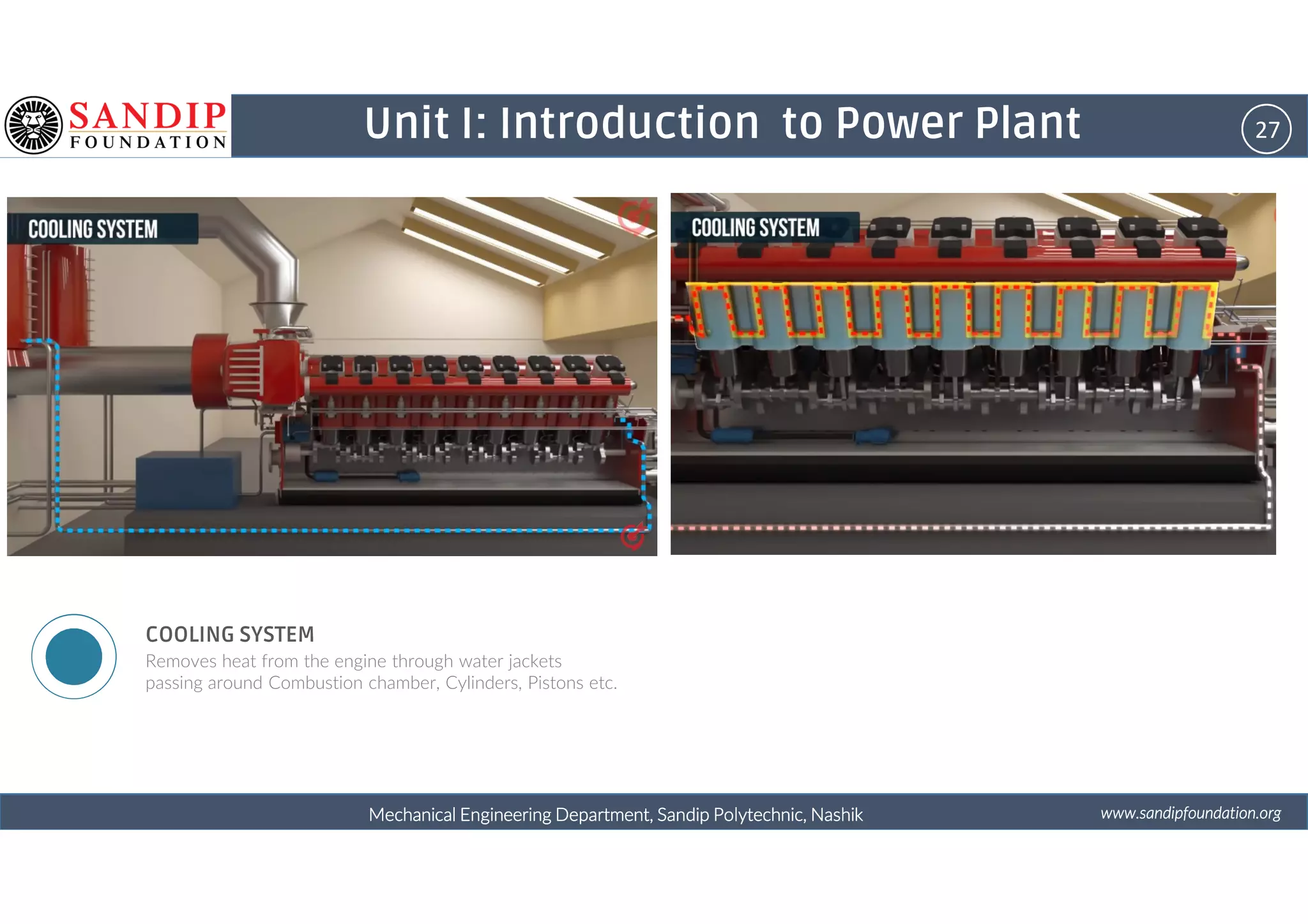
COOLING SYSTEM
Removes heat from the engine through water jackets
passing around Combustion chamber, Cylinders, Pistons etc.
28Unit I: Introduction to Power Plant
wwwwwwwwwwww....ssssaaaannnnddddiiiippppffffoooouuuunnnnddddaaaattttiiiioooonnnn....oooorrrrggggMechanical Engineering Department, Sandip Polytechnic, NashikMechanical Engineering Department, Sandip Polytechnic, NashikMechanical Engineering Department, Sandip Polytechnic, NashikMechanical Engineering Department, Sandip Polytechnic, Nashik
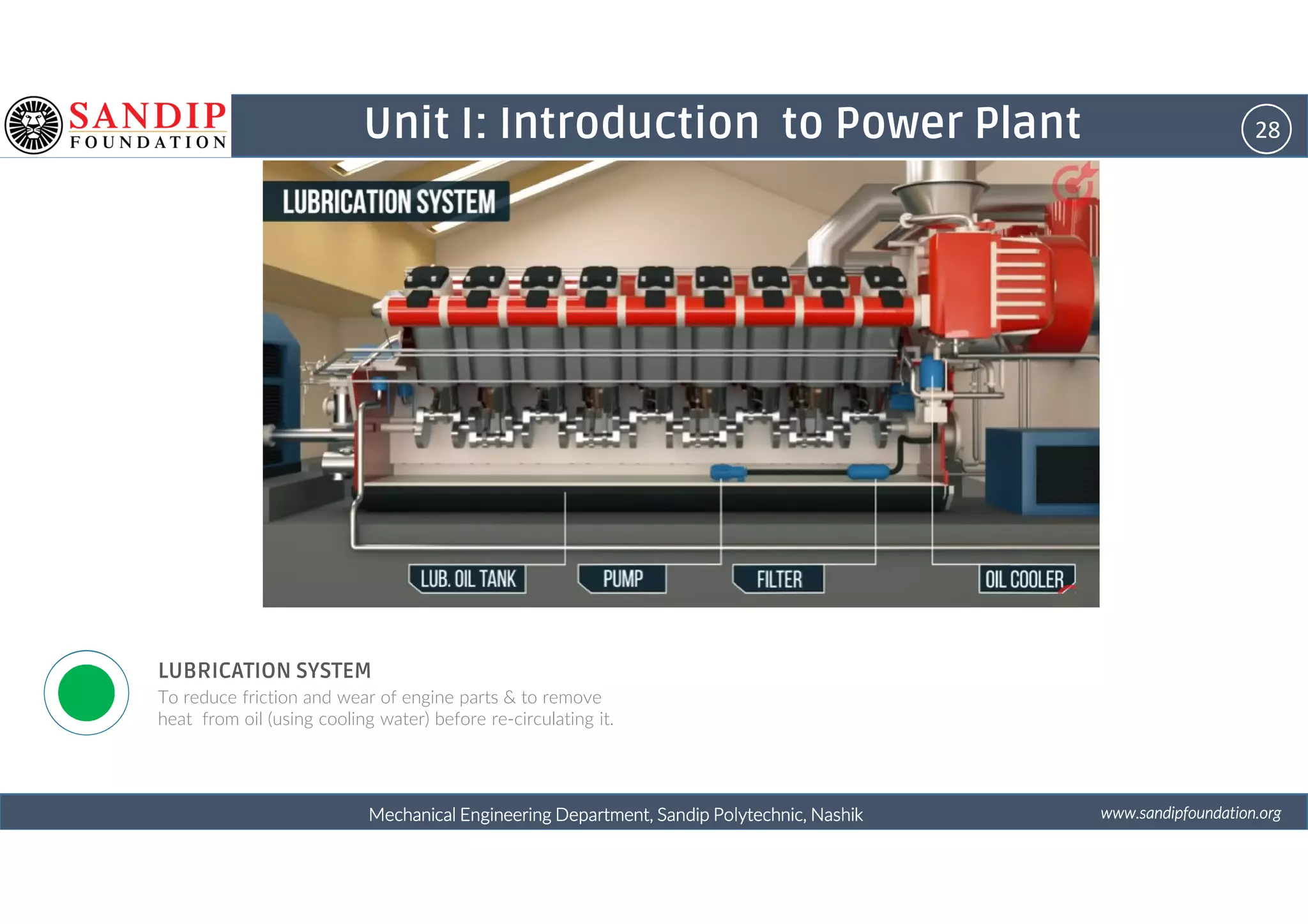
LUBRICATION SYSTEM
To reduce friction and wear of engine parts & to remove
heat from oil (using cooling water) before re-circulating it.
29Unit I: Introduction to Power Plant
1.4 : DIESEL Power Plants
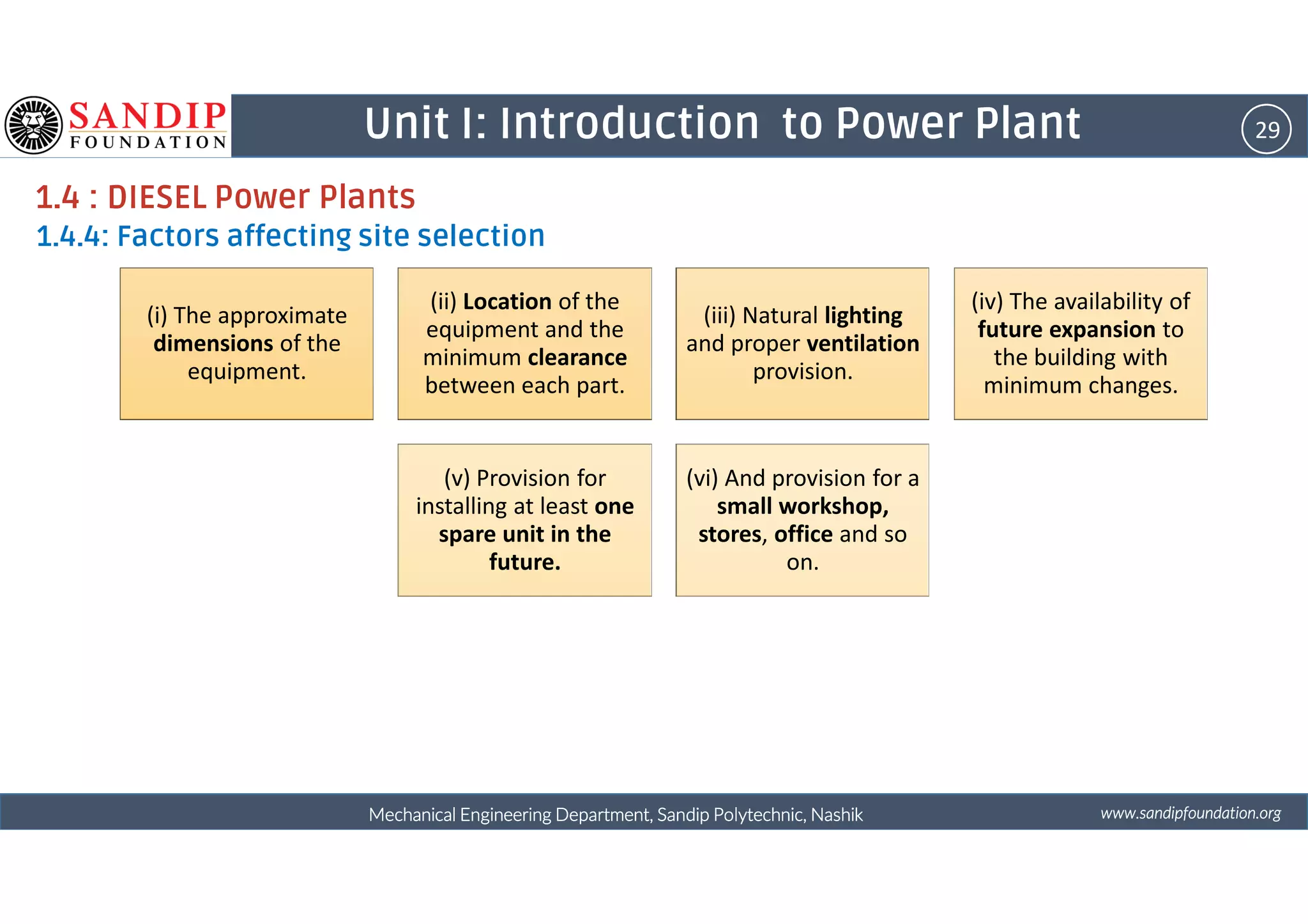
1.4.4: Factors affecting site selection
(i) The approximate
dimensions of the
equipment.
(ii) Location of the
equipment and the
minimum clearance
between each part.
(iii) Natural lighting
and proper ventilation
provision.
(iv) The availability of
future expansion to
the building with
minimum changes.
wwwwwwwwwwww....ssssaaaannnnddddiiiippppffffoooouuuunnnnddddaaaattttiiiioooonnnn....oooorrrrggggMechanical Engineering Department, Sandip Polytechnic, NashikMechanical Engineering Department, Sandip Polytechnic, NashikMechanical Engineering Department, Sandip Polytechnic, NashikMechanical Engineering Department, Sandip Polytechnic, Nashik
4 5 6
(v) Provision for
installing at least one
spare unit in the
future.
(vi) And provision for a
small workshop,
stores, office and so
on.
30Unit I: Introduction to Power Plant
1.4 : DIESEL Power Plants
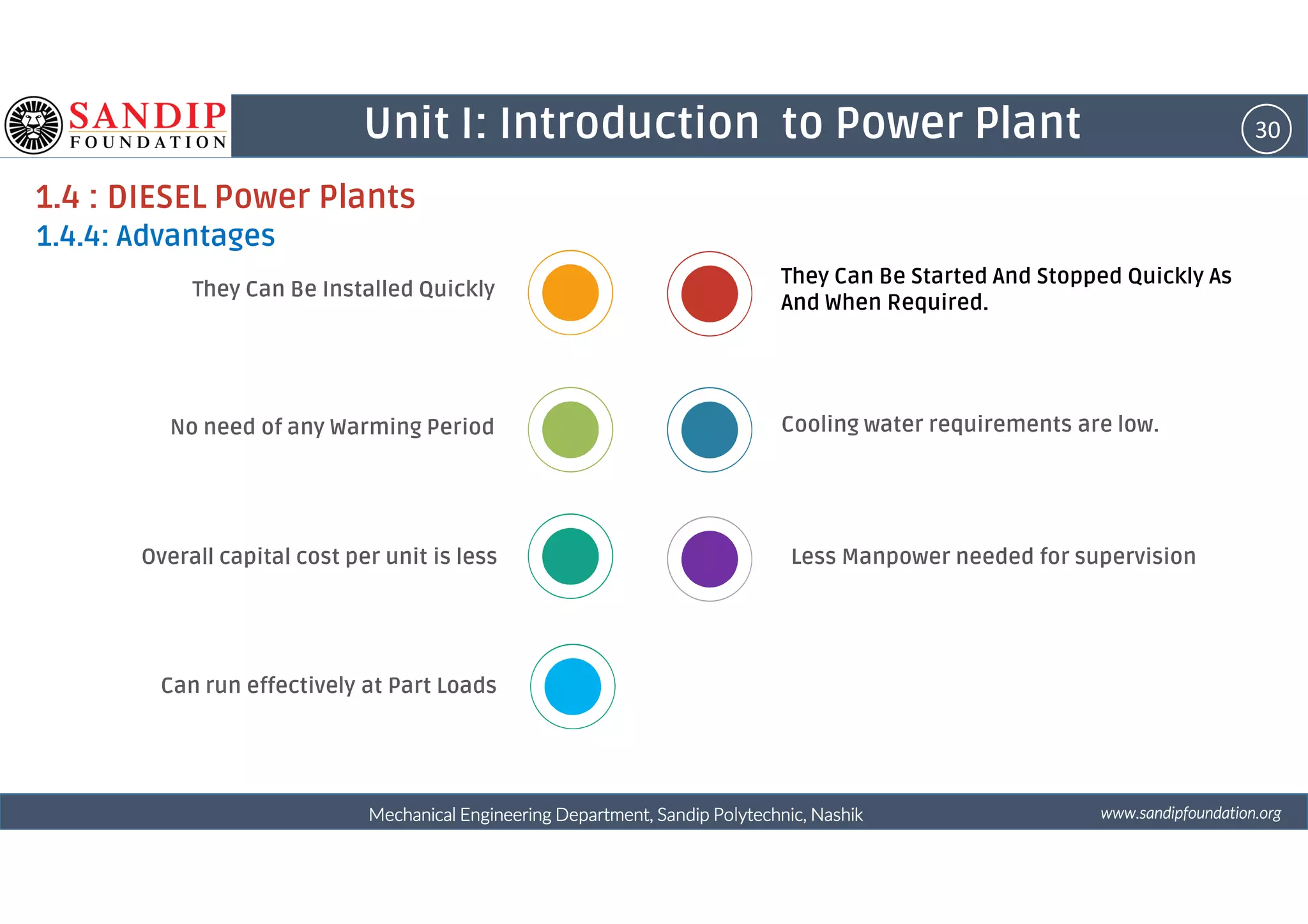
1.4.4: Advantages
They Can Be Installed Quickly
No need of any Warming Period
They Can Be Started And Stopped Quickly As
And When Required.
Cooling water requirements are low.
wwwwwwwwwwww....ssssaaaannnnddddiiiippppffffoooouuuunnnnddddaaaattttiiiioooonnnn....oooorrrrggggMechanical Engineering Department, Sandip Polytechnic, NashikMechanical Engineering Department, Sandip Polytechnic, NashikMechanical Engineering Department, Sandip Polytechnic, NashikMechanical Engineering Department, Sandip Polytechnic, Nashik
4Overall capital cost per unit is less Less Manpower needed for supervision
4Can run effectively at Part Loads
31Unit I: Introduction to Power Plant
1.4 : DIESEL Power Plants
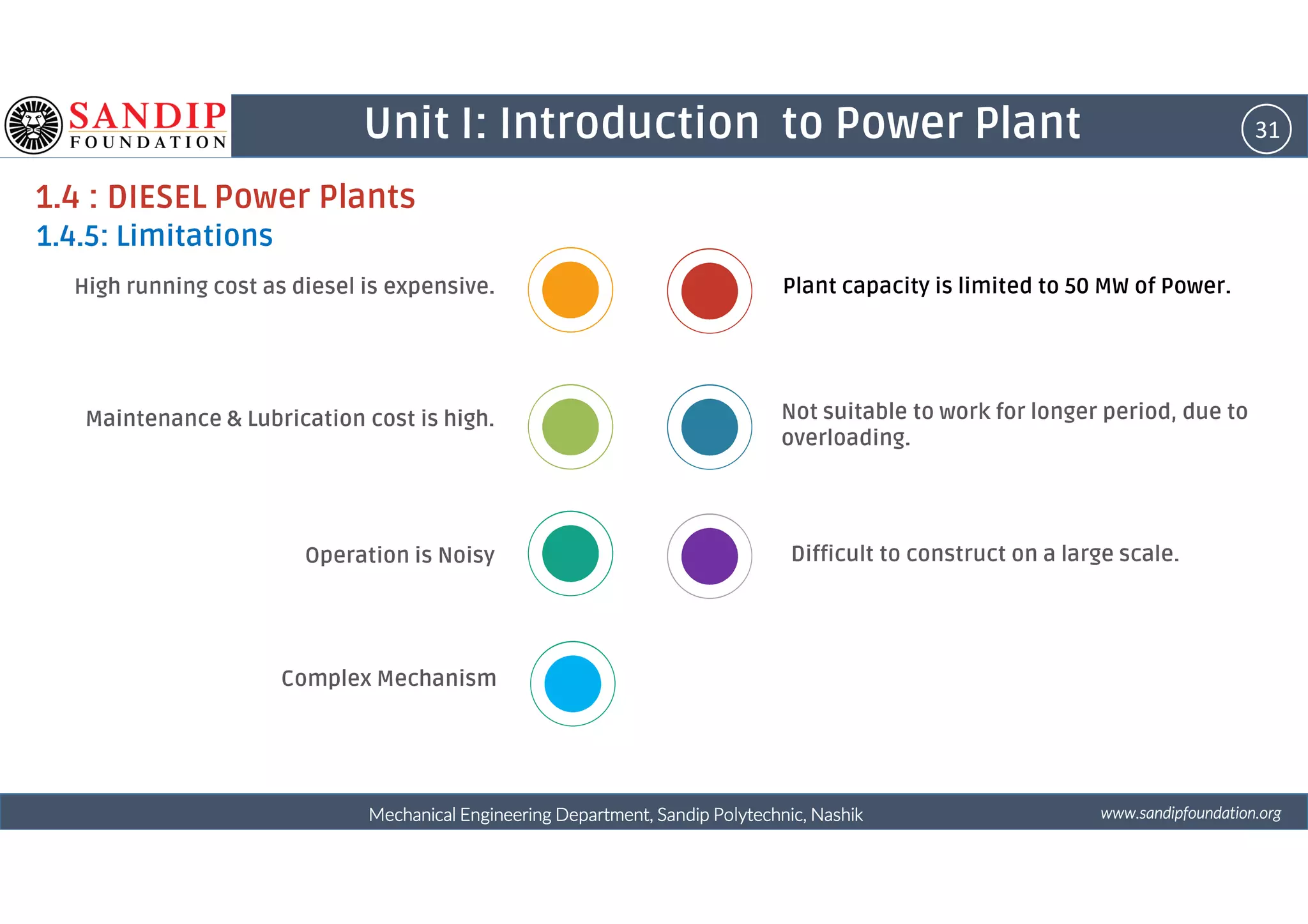
1.4.5: Limitations
High running cost as diesel is expensive.
Maintenance & Lubrication cost is high.
Plant capacity is limited to 50 MW of Power.
Not suitable to work for longer period, due to
overloading.
wwwwwwwwwwww....ssssaaaannnnddddiiiippppffffoooouuuunnnnddddaaaattttiiiioooonnnn....oooorrrrggggMechanical Engineering Department, Sandip Polytechnic, NashikMechanical Engineering Department, Sandip Polytechnic, NashikMechanical Engineering Department, Sandip Polytechnic, NashikMechanical Engineering Department, Sandip Polytechnic, Nashik
4Operation is Noisy Difficult to construct on a large scale.
4Complex Mechanism
32Unit I: Introduction to Power Plant
1.4 : DIESEL Power Plants
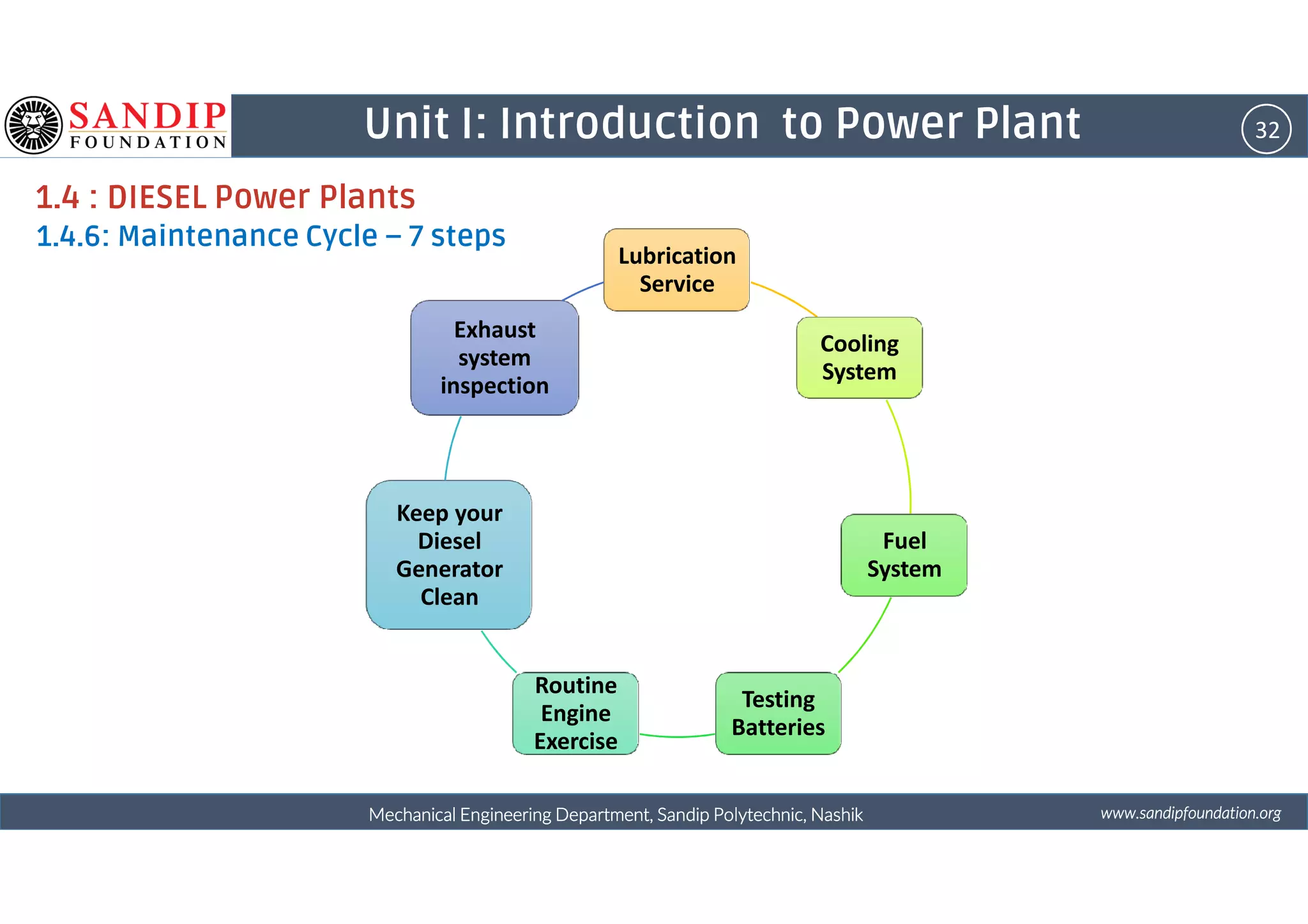
1.4.6: Maintenance Cycle – 7 steps
Lubrication
Service
Cooling
System
Exhaust
system
inspection
wwwwwwwwwwww....ssssaaaannnnddddiiiippppffffoooouuuunnnnddddaaaattttiiiioooonnnn....oooorrrrggggMechanical Engineering Department, Sandip Polytechnic, NashikMechanical Engineering Department, Sandip Polytechnic, NashikMechanical Engineering Department, Sandip Polytechnic, NashikMechanical Engineering Department, Sandip Polytechnic, Nashik
Fuel
System
Testing
Batteries
Routine
Engine
Exercise
Keep your
Diesel
Generator
Clean
33Unit I: Introduction to Power Plant
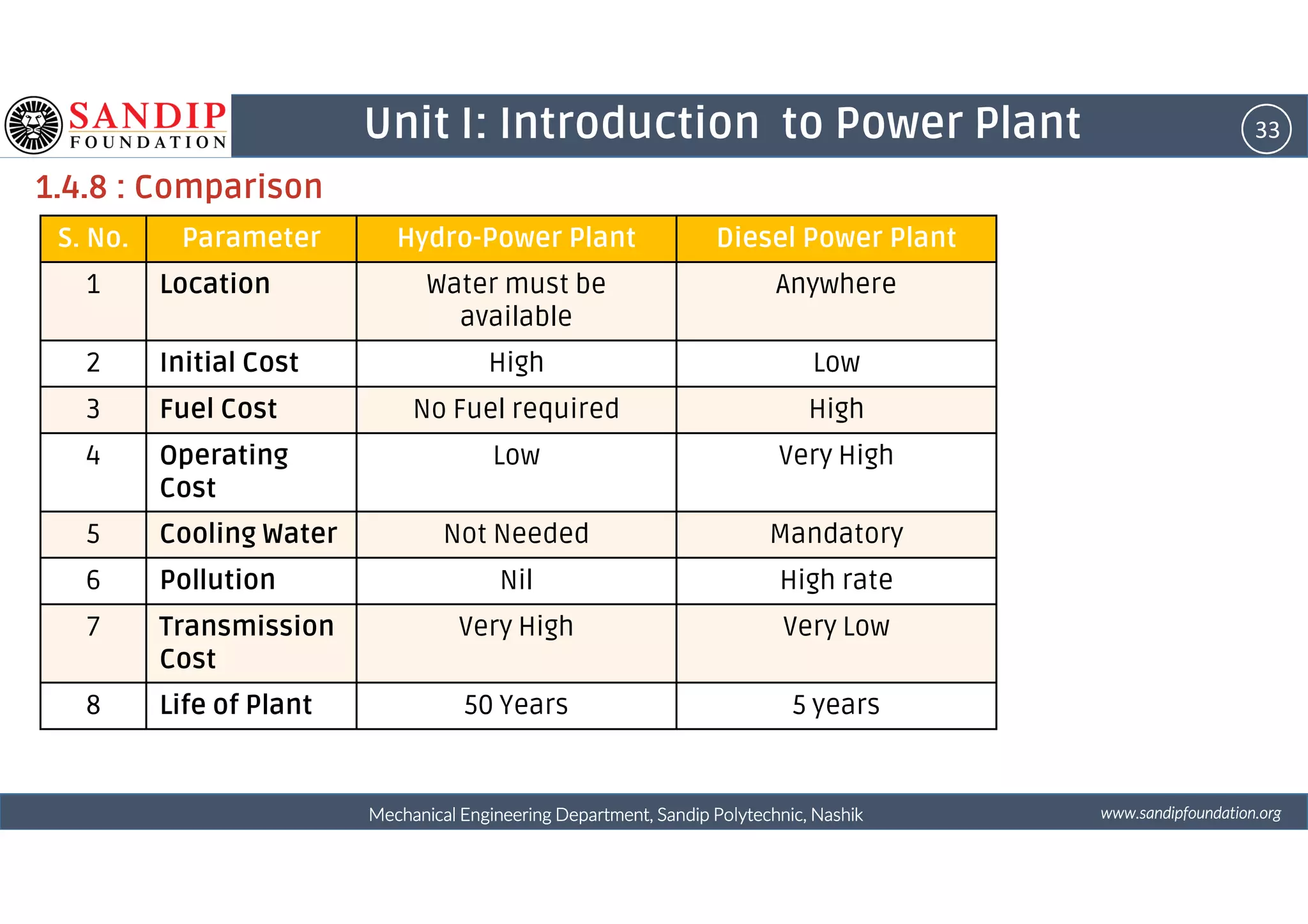
1.4.8 : Comparison
S. No. Parameter Hydro-Power Plant Diesel Power Plant
1 Location Water must be
available
Anywhere
2 Initial Cost High Low
3 Fuel Cost No Fuel required High
4 Operating Low Very High
wwwwwwwwwwww....ssssaaaannnnddddiiiippppffffoooouuuunnnnddddaaaattttiiiioooonnnn....oooorrrrggggMechanical Engineering Department, Sandip Polytechnic, NashikMechanical Engineering Department, Sandip Polytechnic, NashikMechanical Engineering Department, Sandip Polytechnic, NashikMechanical Engineering Department, Sandip Polytechnic, Nashik
4 Operating
Cost
Low Very High
5 Cooling Water Not Needed Mandatory
6 Pollution Nil High rate
7 Transmission
Cost
Very High Very Low
8 Life of Plant 50 Years 5 years
34Unit I: Introduction to Power Plant
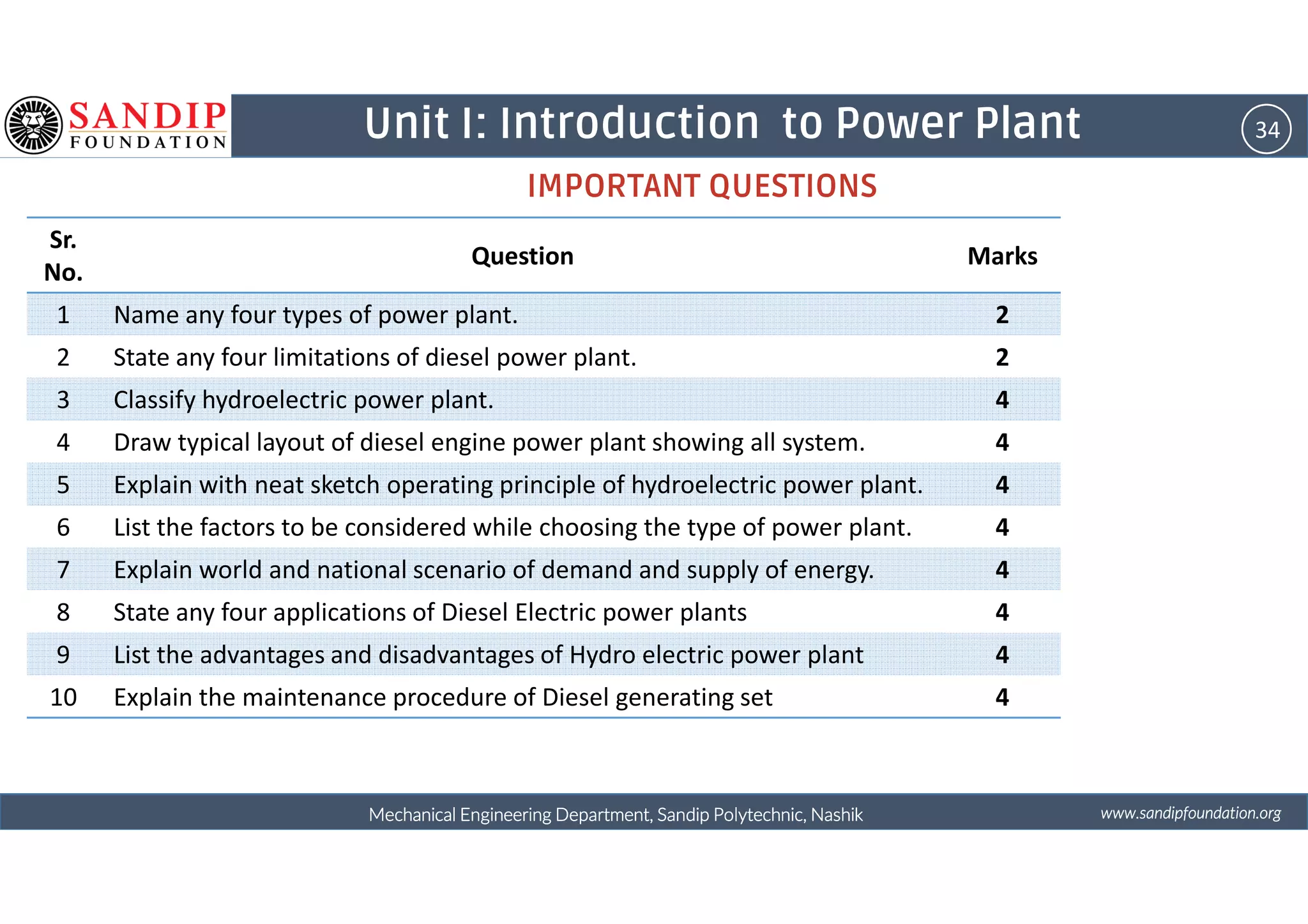
IMPORTANT QUESTIONS
Sr.
No.
Question Marks
1 Name any four types of power plant. 2
2 State any four limitations of diesel power plant. 2
3 Classify hydroelectric power plant. 4
4 Draw typical layout of diesel engine power plant showing all system. 4
wwwwwwwwwwww....ssssaaaannnnddddiiiippppffffoooouuuunnnnddddaaaattttiiiioooonnnn....oooorrrrggggMechanical Engineering Department, Sandip Polytechnic, NashikMechanical Engineering Department, Sandip Polytechnic, NashikMechanical Engineering Department, Sandip Polytechnic, NashikMechanical Engineering Department, Sandip Polytechnic, Nashik
5 Explain with neat sketch operating principle of hydroelectric power plant. 4
6 List the factors to be considered while choosing the type of power plant. 4
7 Explain world and national scenario of demand and supply of energy. 4
8 State any four applications of Diesel Electric power plants 4
9 List the advantages and disadvantages of Hydro electric power plant 4
10 Explain the maintenance procedure of Diesel generating set 4
35Unit I: Introduction to Power Plant
In this lesson, We have learnedIn this lesson, We have learnedIn this lesson, We have learnedIn this lesson, We have learned
1.3 Hydro-electric Power Plant
Classification, General arrangement, operating principle, advantages and limitations, maintenance.
1.4 Diesel Power Plant
SUMMARY
wwwwwwwwwwww....ssssaaaannnnddddiiiippppffffoooouuuunnnnddddaaaattttiiiioooonnnn....oooorrrrggggMechanical Engineering Department, Sandip Polytechnic, NashikMechanical Engineering Department, Sandip Polytechnic, NashikMechanical Engineering Department, Sandip Polytechnic, NashikMechanical Engineering Department, Sandip Polytechnic, Nashik
1.4 Diesel Power Plant
Introduction, components, advantages and limitations, Diesel generating set, maintenance
Comparison between Hydro & Diesel Power Plants
36Unit I: Introduction to Power Plant
Our Next Video Lecture TopicOur Next Video Lecture TopicOur Next Video Lecture TopicOur Next Video Lecture Topic
Unit II. High Pressure Boilers
2.1 Introduction to Boilers, Classification of HPB
wwwwwwwwwwww....ssssaaaannnnddddiiiippppffffoooouuuunnnnddddaaaattttiiiioooonnnn....oooorrrrggggMechanical Engineering Department, Sandip Polytechnic, NashikMechanical Engineering Department, Sandip Polytechnic, NashikMechanical Engineering Department, Sandip Polytechnic, NashikMechanical Engineering Department, Sandip Polytechnic, Nashik
2.2 Construction And Working Principle of Boilers
Till Then Stay Connected,
THANK YOU

Lecture 02_PPE_unit 1_Introduction to Power Plant Engineering

  • 1.
    Program: Diploma (Mechanical) Class:TY (ME) Semester: V Course: Power Plant Engineering Code: 22566Code: 22566 LECTURE 02: Unit: 1. Introduction to Power Plant
  • 2.
    02 wwwwwwwwwwww....ssssaaaannnnddddiiiippppffffoooouuuunnnnddddaaaattttiiiioooonnnn....oooorrrrggggMechanical Engineering Department,Sandip Polytechnic, NashikMechanical Engineering Department, Sandip Polytechnic, NashikMechanical Engineering Department, Sandip Polytechnic, NashikMechanical Engineering Department, Sandip Polytechnic, Nashik Name of theName of theName of theName of the Trainer : Prof. Rushikesh Deoram SonarTrainer : Prof. Rushikesh Deoram SonarTrainer : Prof. Rushikesh Deoram SonarTrainer : Prof. Rushikesh Deoram Sonar Years ofYears ofYears ofYears of Experience : 10Experience : 10Experience : 10Experience : 10 DomainDomainDomainDomain Expertise : Mechanical EngineeringExpertise : Mechanical EngineeringExpertise : Mechanical EngineeringExpertise : Mechanical Engineering Qualification: M.E. (Design Engineering)Qualification: M.E. (Design Engineering)Qualification: M.E. (Design Engineering)Qualification: M.E. (Design Engineering) Contact Details:Contact Details:Contact Details:Contact Details: +91 9890481959+91 9890481959+91 9890481959+91 9890481959 rushikesh.sonar@sandippolytechnic.orgrushikesh.sonar@sandippolytechnic.orgrushikesh.sonar@sandippolytechnic.orgrushikesh.sonar@sandippolytechnic.org
  • 3.
    03Unit I: Introductionto Power Plant UNIT OUTCOMES (UOs) :- 1a. Explain energy conversion in the given power plant. 1b. Identify elements of the given Hydro, Gas, Diesel power plant(s) . 1c. Explain preventive maintenance procedure of the given power plants. 1d. Explain predictive maintenance procedure of the given power plants. wwwwwwwwwwww....ssssaaaannnnddddiiiippppffffoooouuuunnnnddddaaaattttiiiioooonnnn....oooorrrrggggMechanical Engineering Department, Sandip Polytechnic, NashikMechanical Engineering Department, Sandip Polytechnic, NashikMechanical Engineering Department, Sandip Polytechnic, NashikMechanical Engineering Department, Sandip Polytechnic, Nashik 1d. Explain predictive maintenance procedure of the given power plants.
  • 4.
    04Unit I: Introductionto Power Plant TOPICS COVERED IN LECTURE 01:- 1.1 World and National scenario of demand and supply of energy. 1.2 Introduction to power plants : their importance and types. 1.3 Hydroelectric power plant :1.3 Hydroelectric power plant :1.3 Hydroelectric power plant :1.3 Hydroelectric power plant : Classification, General arrangement, operating principle, advantages and limitations, maintenance. TOPICS COVERED IN LECTURE 02:- wwwwwwwwwwww....ssssaaaannnnddddiiiippppffffoooouuuunnnnddddaaaattttiiiioooonnnn....oooorrrrggggMechanical Engineering Department, Sandip Polytechnic, NashikMechanical Engineering Department, Sandip Polytechnic, NashikMechanical Engineering Department, Sandip Polytechnic, NashikMechanical Engineering Department, Sandip Polytechnic, Nashik advantages and limitations, maintenance. 1.4 Diesel power plant:1.4 Diesel power plant:1.4 Diesel power plant:1.4 Diesel power plant: Introduction, components, advantages and limitations, Diesel generating set, maintenance.
  • 5.
    05Unit I: Introductionto Power Plant 1.2 : Power Plants 1.2.1: Definition of Power Plant “A power plant is an industrial facility used to generate electric power with the help of one or more generators which converts different energy sources into electric power”. wwwwwwwwwwww....ssssaaaannnnddddiiiippppffffoooouuuunnnnddddaaaattttiiiioooonnnn....oooorrrrggggMechanical Engineering Department, Sandip Polytechnic, NashikMechanical Engineering Department, Sandip Polytechnic, NashikMechanical Engineering Department, Sandip Polytechnic, NashikMechanical Engineering Department, Sandip Polytechnic, Nashik The power plant is the location in which the energy conversions take place.
  • 6.
    06Unit I: Introductionto Power Plant 1.2 : Power Plants 1.2.2: Types of Power Plant •FOSSIL FUEL POWER PLANT •HYDRO-ELECTRIC POWER PLANT •THERMAL POWER PLANT •GAS TURBINE POWER PLANT •NUCLEAR POWER PLANT CONVENTIONAL POWER •WIND-MILL POWER PLANT wwwwwwwwwwww....ssssaaaannnnddddiiiippppffffoooouuuunnnnddddaaaattttiiiioooonnnn....oooorrrrggggMechanical Engineering Department, Sandip Polytechnic, NashikMechanical Engineering Department, Sandip Polytechnic, NashikMechanical Engineering Department, Sandip Polytechnic, NashikMechanical Engineering Department, Sandip Polytechnic, Nashik •WIND-MILL POWER PLANT •SOLAR PV POWER PLANT •GEOTHERMAL POWER PLANT •BIO-MASS POWER PLANT NON- CONVENTIONAL POWER
  • 7.
    07Unit I: Introductionto Power Plant 1.3 : Hydro-Electric Power Plants 1.3.1: Definition Definition:Definition:Definition:Definition: Hydropower or hydroelectricity refers to the conversionconversionconversionconversion ofofofof energyenergyenergyenergy from flowingflowingflowingflowing waterwaterwaterwater intointointointo electricityelectricityelectricityelectricity. wwwwwwwwwwww....ssssaaaannnnddddiiiippppffffoooouuuunnnnddddaaaattttiiiioooonnnn....oooorrrrggggMechanical Engineering Department, Sandip Polytechnic, NashikMechanical Engineering Department, Sandip Polytechnic, NashikMechanical Engineering Department, Sandip Polytechnic, NashikMechanical Engineering Department, Sandip Polytechnic, Nashik electricityelectricityelectricityelectricity. It is considered a renewablerenewablerenewablerenewable energy source because the waterwaterwaterwater cyclecyclecyclecycle is constantly renewed byrenewed byrenewed byrenewed by the sun.the sun.the sun.the sun.
  • 8.
    08Unit I: Introductionto Power Plant 1.3 : Hydro-Electric Power Plants 1.3.2: Working Principle The power developed by the hydraulic turbine depends on the quantity of water Categorized into three sizes: LARGE (>30 MW), SMALL (100 kW - 30 MW) They produce electricity using turbines and generators, where mechanical energy is created when The quantity of water available at the selected site depends upon the wwwwwwwwwwww....ssssaaaannnnddddiiiippppffffoooouuuunnnnddddaaaattttiiiioooonnnn....oooorrrrggggMechanical Engineering Department, Sandip Polytechnic, NashikMechanical Engineering Department, Sandip Polytechnic, NashikMechanical Engineering Department, Sandip Polytechnic, NashikMechanical Engineering Department, Sandip Polytechnic, Nashik quantity of water and the head of water available. 30 MW) MICRO (<100 kW) is created when moving water spins rotors on a turbine. depends upon the rainfall and run-off in that area.
  • 9.
    09Unit I: Introductionto Power Plant wwwwwwwwwwww....ssssaaaannnnddddiiiippppffffoooouuuunnnnddddaaaattttiiiioooonnnn....oooorrrrggggMechanical Engineering Department, Sandip Polytechnic, NashikMechanical Engineering Department, Sandip Polytechnic, NashikMechanical Engineering Department, Sandip Polytechnic, NashikMechanical Engineering Department, Sandip Polytechnic, Nashik
  • 10.
    10Unit I: Introductionto Power Plant 1.3 : Hydro-Electric Power Plants 1.3.3: Classification 1. Based on availability of head (a) Low head plants (Head is less than 30 meters) (b) Medium head plants ((Head is 30- 100 meters) (c) High head plants (Head is more than 100 meters) 2. Based on nature of load (a) Base load plants (b) Peak load plants wwwwwwwwwwww....ssssaaaannnnddddiiiippppffffoooouuuunnnnddddaaaattttiiiioooonnnn....oooorrrrggggMechanical Engineering Department, Sandip Polytechnic, NashikMechanical Engineering Department, Sandip Polytechnic, NashikMechanical Engineering Department, Sandip Polytechnic, NashikMechanical Engineering Department, Sandip Polytechnic, Nashik 3. Based on quantity of water available (a) Run off river plants without pondage (b) Run off river plants with pondage (c) Storage Type Plants
  • 11.
    11Unit I: Introductionto Power Plant 1.3 : Hydro-Electric Power Plants 1.3.4: Layout wwwwwwwwwwww....ssssaaaannnnddddiiiippppffffoooouuuunnnnddddaaaattttiiiioooonnnn....oooorrrrggggMechanical Engineering Department, Sandip Polytechnic, NashikMechanical Engineering Department, Sandip Polytechnic, NashikMechanical Engineering Department, Sandip Polytechnic, NashikMechanical Engineering Department, Sandip Polytechnic, Nashik
  • 12.
    12Unit I: Introductionto Power Plant wwwwwwwwwwww....ssssaaaannnnddddiiiippppffffoooouuuunnnnddddaaaattttiiiioooonnnn....oooorrrrggggMechanical Engineering Department, Sandip Polytechnic, NashikMechanical Engineering Department, Sandip Polytechnic, NashikMechanical Engineering Department, Sandip Polytechnic, NashikMechanical Engineering Department, Sandip Polytechnic, Nashik
  • 13.
    13Unit I: Introductionto Power Plant 1.3 : Hydro-Electric Power Plants 1.3.5: Major Components & their functions : To store water during rainy season. This water run the hydraulic turbine. RESERVOIR It provides working head of water for power plant and to increase the storage capacity of reservoir. DAM Provided for controlling of flow of water from reservoir to turbine. GATE 1 2 3 wwwwwwwwwwww....ssssaaaannnnddddiiiippppffffoooouuuunnnnddddaaaattttiiiioooonnnn....oooorrrrggggMechanical Engineering Department, Sandip Polytechnic, NashikMechanical Engineering Department, Sandip Polytechnic, NashikMechanical Engineering Department, Sandip Polytechnic, NashikMechanical Engineering Department, Sandip Polytechnic, Nashik Helps in establishing the velo. and pressure in the penstock and it reduces the water hammer effect. SURGE TANK Made up of reinforced concrete which are designed to withstand high pressures. They are supported by anchors. PENSTOCK It converts the kinetic energy of water into mechanical energy. HYDRAULIC TURBINE 4 5 6
  • 14.
    14Unit I: Introductionto Power Plant 1.3 : Hydro-Electric Power Plants 1.3.5: Major Components & their functions : It is a passage which connects the exit from the turbine runner down to tail race water DRAFT TUBE The mechanical energy from turbine is converted to electrical energy. ELECTRIC GENERATOR Energy is stored, controlled and distributed through Transmission Lines. POWER HOUSE 7 8 9 wwwwwwwwwwww....ssssaaaannnnddddiiiippppffffoooouuuunnnnddddaaaattttiiiioooonnnn....oooorrrrggggMechanical Engineering Department, Sandip Polytechnic, NashikMechanical Engineering Department, Sandip Polytechnic, NashikMechanical Engineering Department, Sandip Polytechnic, NashikMechanical Engineering Department, Sandip Polytechnic, Nashik down to tail race water level. energy. 4 5 6 Helps to transmit the power from distribution grids to the consumers. TRANSMISSION LINES 10 5 6
  • 15.
    15Unit I: Introductionto Power Plant 1.3 : Hydro-Electric Power Plants 1.3.6: Factors affecting site selection for Hydro-Power Plant (i) Quantity of water available and method of storage. (ii) Availability of head and storage capacity. (iii) Distance of power station site from power demand centers. (iv) Details of soil bearing capacity and rocky foundation conditions. (v) Availability of construction materials. wwwwwwwwwwww....ssssaaaannnnddddiiiippppffffoooouuuunnnnddddaaaattttiiiioooonnnn....oooorrrrggggMechanical Engineering Department, Sandip Polytechnic, NashikMechanical Engineering Department, Sandip Polytechnic, NashikMechanical Engineering Department, Sandip Polytechnic, NashikMechanical Engineering Department, Sandip Polytechnic, Nashik 4 5 6 (vi) Access to site for men and materials. (vii) Availability of transport facilities. (viii) Cost of project and the period required for completion. (ix) Free from mineral deposits of harmful nature. (x) Free from earthquake damage.
  • 16.
    16Unit I: Introductionto Power Plant 1.3 : Hydro-Electric Power Plants 1.3.7: Advantages COST Operation Cost & hence cost of power generation is Less TIME SAVING Requires less time to Start RELIABILITY More reliable than other Non-conventional sources. CLEAN No waste generation, hence no wwwwwwwwwwww....ssssaaaannnnddddiiiippppffffoooouuuunnnnddddaaaattttiiiioooonnnn....oooorrrrggggMechanical Engineering Department, Sandip Polytechnic, NashikMechanical Engineering Department, Sandip Polytechnic, NashikMechanical Engineering Department, Sandip Polytechnic, NashikMechanical Engineering Department, Sandip Polytechnic, Nashik 4 Requires less time to Start and Stop the operation. LIFE Life expectancy is higher, for about 50 years. No waste generation, hence no problems of waste disposal. NO FUEL Water itself act as medium to run turbine and generate power.
  • 17.
    17Unit I: Introductionto Power Plant 1.3 : Hydro-Electric Power Plants 1.3.8: Limitations WATER AVAILABILITY It totally depends on rainfall and amount of Water. COST High cost is needed for TRANSMISSION It requires long transmission lines. CONSTRUCTION TIME High time is needed for wwwwwwwwwwww....ssssaaaannnnddddiiiippppffffoooouuuunnnnddddaaaattttiiiioooonnnn....oooorrrrggggMechanical Engineering Department, Sandip Polytechnic, NashikMechanical Engineering Department, Sandip Polytechnic, NashikMechanical Engineering Department, Sandip Polytechnic, NashikMechanical Engineering Department, Sandip Polytechnic, Nashik 4 High cost is needed for power transmission. POWER LOSS There are chances of Power Loss during transmission. High time is needed for construction of these plants. ECOLOGY It may disturb the ecology of the area.
  • 18.
    18Unit I: Introductionto Power Plant 1.3 : Hydro-Electric Power Plants 1.3.9: Maintenance Monthly Maintenance Check for leakages servo meter connections, turbine shaft, lubrication, oil pump and carry out necessary repairs. Quarterly Maintenance Check the governor hydraulic oil system, servometer generators and various connections. wwwwwwwwwwww....ssssaaaannnnddddiiiippppffffoooouuuunnnnddddaaaattttiiiioooonnnn....oooorrrrggggMechanical Engineering Department, Sandip Polytechnic, NashikMechanical Engineering Department, Sandip Polytechnic, NashikMechanical Engineering Department, Sandip Polytechnic, NashikMechanical Engineering Department, Sandip Polytechnic, Nashik Half-Yearly Maintenance Check and carryout the maintenance of governor mechanism, working of various instrumentations greasing the pumps and connecting pipe lines bearings etc. Yearly Maintenance Check the runner blades for cracks and cavitational effects, check the cracks in draft tube and repair, check all turbine auxiliaries, transformer, penstocks etc.
  • 19.
    19Unit I: Introductionto Power Plant 1.4 : DIESEL Power Plants 1.4.1: Definition Definition:Definition:Definition:Definition: A diesel power plantdiesel power plantdiesel power plantdiesel power plant or standby power station is the plant when we use diesel enginediesel enginediesel enginediesel engine as a prime mover or wwwwwwwwwwww....ssssaaaannnnddddiiiippppffffoooouuuunnnnddddaaaattttiiiioooonnnn....oooorrrrggggMechanical Engineering Department, Sandip Polytechnic, NashikMechanical Engineering Department, Sandip Polytechnic, NashikMechanical Engineering Department, Sandip Polytechnic, NashikMechanical Engineering Department, Sandip Polytechnic, Nashik prime mover or combine a diesel engine with an electricelectricelectricelectric generatorgeneratorgeneratorgenerator to produce electrical energy by using diesel fueldiesel fueldiesel fueldiesel fuel .
  • 20.
    20Unit I: Introductionto Power Plant wwwwwwwwwwww....ssssaaaannnnddddiiiippppffffoooouuuunnnnddddaaaattttiiiioooonnnn....oooorrrrggggMechanical Engineering Department, Sandip Polytechnic, NashikMechanical Engineering Department, Sandip Polytechnic, NashikMechanical Engineering Department, Sandip Polytechnic, NashikMechanical Engineering Department, Sandip Polytechnic, Nashik
  • 21.
    21Unit I: Introductionto Power Plant 1.4 : DIESEL Power Plants 1.4.2: Layout of Diesel Power Plant 1. Diesel engine 2. Air intake system 3. Exhaust system 4. Cooling water system 5. Fuel supply system wwwwwwwwwwww....ssssaaaannnnddddiiiippppffffoooouuuunnnnddddaaaattttiiiioooonnnn....oooorrrrggggMechanical Engineering Department, Sandip Polytechnic, NashikMechanical Engineering Department, Sandip Polytechnic, NashikMechanical Engineering Department, Sandip Polytechnic, NashikMechanical Engineering Department, Sandip Polytechnic, Nashik 6. Lubrication system 7. Diesel engine starting system
  • 22.
    22Unit I: Introductionto Power Plant 1.4.2: Layout of Diesel Power Plant 1. Diesel engine 2. Air intake system 3. Exhaust system 4. Cooling water system 5. Fuel supply system 6. Lubrication system 7. Diesel engine starting system wwwwwwwwwwww....ssssaaaannnnddddiiiippppffffoooouuuunnnnddddaaaattttiiiioooonnnn....oooorrrrggggMechanical Engineering Department, Sandip Polytechnic, NashikMechanical Engineering Department, Sandip Polytechnic, NashikMechanical Engineering Department, Sandip Polytechnic, NashikMechanical Engineering Department, Sandip Polytechnic, Nashik
  • 23.
    23Unit I: Introductionto Power Plant 1.4 : DIESEL Power Plants 1.4.3: Major Components of Diesel Power Plant DIESEL ENGINE Combustion of fuel produces mechanical power FUEL SYSTEM Monitor and supply fuel for AIR INTAKE & EXHAUST SYSTEMS Air for combustion is drawn and exhaust gases are thrown out. COOLING SYSTEM Removes heat from the engine wwwwwwwwwwww....ssssaaaannnnddddiiiippppffffoooouuuunnnnddddaaaattttiiiioooonnnn....oooorrrrggggMechanical Engineering Department, Sandip Polytechnic, NashikMechanical Engineering Department, Sandip Polytechnic, NashikMechanical Engineering Department, Sandip Polytechnic, NashikMechanical Engineering Department, Sandip Polytechnic, Nashik 4 Monitor and supply fuel for ignition in the engine. LUBRICATION SYSTEM To reduce friction and wear of engine parts & to remove heat. Removes heat from the engine through water jackets. STARTING SYSTEM Compressed air is supplied to engine for starting purpose. 4 GENERATOR It converts mechanical energy into electric.
  • 24.
    24Unit I: Introductionto Power Plant wwwwwwwwwwww....ssssaaaannnnddddiiiippppffffoooouuuunnnnddddaaaattttiiiioooonnnn....oooorrrrggggMechanical Engineering Department, Sandip Polytechnic, NashikMechanical Engineering Department, Sandip Polytechnic, NashikMechanical Engineering Department, Sandip Polytechnic, NashikMechanical Engineering Department, Sandip Polytechnic, Nashik STARTING SYSTEM Compressed air is supplied to engine for starting purpose.
  • 25.
    25Unit I: Introductionto Power Plant wwwwwwwwwwww....ssssaaaannnnddddiiiippppffffoooouuuunnnnddddaaaattttiiiioooonnnn....oooorrrrggggMechanical Engineering Department, Sandip Polytechnic, NashikMechanical Engineering Department, Sandip Polytechnic, NashikMechanical Engineering Department, Sandip Polytechnic, NashikMechanical Engineering Department, Sandip Polytechnic, Nashik AIR INTAKE & EXHAUST SYSTEMS Air for combustion is drawn and exhaust gases are thrown out.
  • 26.
    26Unit I: Introductionto Power Plant wwwwwwwwwwww....ssssaaaannnnddddiiiippppffffoooouuuunnnnddddaaaattttiiiioooonnnn....oooorrrrggggMechanical Engineering Department, Sandip Polytechnic, NashikMechanical Engineering Department, Sandip Polytechnic, NashikMechanical Engineering Department, Sandip Polytechnic, NashikMechanical Engineering Department, Sandip Polytechnic, Nashik FUEL SYSTEM Monitors and supply fuel for ignition in the engine.
  • 27.
    27Unit I: Introductionto Power Plant wwwwwwwwwwww....ssssaaaannnnddddiiiippppffffoooouuuunnnnddddaaaattttiiiioooonnnn....oooorrrrggggMechanical Engineering Department, Sandip Polytechnic, NashikMechanical Engineering Department, Sandip Polytechnic, NashikMechanical Engineering Department, Sandip Polytechnic, NashikMechanical Engineering Department, Sandip Polytechnic, Nashik COOLING SYSTEM Removes heat from the engine through water jackets passing around Combustion chamber, Cylinders, Pistons etc.
  • 28.
    28Unit I: Introductionto Power Plant wwwwwwwwwwww....ssssaaaannnnddddiiiippppffffoooouuuunnnnddddaaaattttiiiioooonnnn....oooorrrrggggMechanical Engineering Department, Sandip Polytechnic, NashikMechanical Engineering Department, Sandip Polytechnic, NashikMechanical Engineering Department, Sandip Polytechnic, NashikMechanical Engineering Department, Sandip Polytechnic, Nashik LUBRICATION SYSTEM To reduce friction and wear of engine parts & to remove heat from oil (using cooling water) before re-circulating it.
  • 29.
    29Unit I: Introductionto Power Plant 1.4 : DIESEL Power Plants 1.4.4: Factors affecting site selection (i) The approximate dimensions of the equipment. (ii) Location of the equipment and the minimum clearance between each part. (iii) Natural lighting and proper ventilation provision. (iv) The availability of future expansion to the building with minimum changes. wwwwwwwwwwww....ssssaaaannnnddddiiiippppffffoooouuuunnnnddddaaaattttiiiioooonnnn....oooorrrrggggMechanical Engineering Department, Sandip Polytechnic, NashikMechanical Engineering Department, Sandip Polytechnic, NashikMechanical Engineering Department, Sandip Polytechnic, NashikMechanical Engineering Department, Sandip Polytechnic, Nashik 4 5 6 (v) Provision for installing at least one spare unit in the future. (vi) And provision for a small workshop, stores, office and so on.
  • 30.
    30Unit I: Introductionto Power Plant 1.4 : DIESEL Power Plants 1.4.4: Advantages They Can Be Installed Quickly No need of any Warming Period They Can Be Started And Stopped Quickly As And When Required. Cooling water requirements are low. wwwwwwwwwwww....ssssaaaannnnddddiiiippppffffoooouuuunnnnddddaaaattttiiiioooonnnn....oooorrrrggggMechanical Engineering Department, Sandip Polytechnic, NashikMechanical Engineering Department, Sandip Polytechnic, NashikMechanical Engineering Department, Sandip Polytechnic, NashikMechanical Engineering Department, Sandip Polytechnic, Nashik 4Overall capital cost per unit is less Less Manpower needed for supervision 4Can run effectively at Part Loads
  • 31.
    31Unit I: Introductionto Power Plant 1.4 : DIESEL Power Plants 1.4.5: Limitations High running cost as diesel is expensive. Maintenance & Lubrication cost is high. Plant capacity is limited to 50 MW of Power. Not suitable to work for longer period, due to overloading. wwwwwwwwwwww....ssssaaaannnnddddiiiippppffffoooouuuunnnnddddaaaattttiiiioooonnnn....oooorrrrggggMechanical Engineering Department, Sandip Polytechnic, NashikMechanical Engineering Department, Sandip Polytechnic, NashikMechanical Engineering Department, Sandip Polytechnic, NashikMechanical Engineering Department, Sandip Polytechnic, Nashik 4Operation is Noisy Difficult to construct on a large scale. 4Complex Mechanism
  • 32.
    32Unit I: Introductionto Power Plant 1.4 : DIESEL Power Plants 1.4.6: Maintenance Cycle – 7 steps Lubrication Service Cooling System Exhaust system inspection wwwwwwwwwwww....ssssaaaannnnddddiiiippppffffoooouuuunnnnddddaaaattttiiiioooonnnn....oooorrrrggggMechanical Engineering Department, Sandip Polytechnic, NashikMechanical Engineering Department, Sandip Polytechnic, NashikMechanical Engineering Department, Sandip Polytechnic, NashikMechanical Engineering Department, Sandip Polytechnic, Nashik Fuel System Testing Batteries Routine Engine Exercise Keep your Diesel Generator Clean
  • 33.
    33Unit I: Introductionto Power Plant 1.4.8 : Comparison S. No. Parameter Hydro-Power Plant Diesel Power Plant 1 Location Water must be available Anywhere 2 Initial Cost High Low 3 Fuel Cost No Fuel required High 4 Operating Low Very High wwwwwwwwwwww....ssssaaaannnnddddiiiippppffffoooouuuunnnnddddaaaattttiiiioooonnnn....oooorrrrggggMechanical Engineering Department, Sandip Polytechnic, NashikMechanical Engineering Department, Sandip Polytechnic, NashikMechanical Engineering Department, Sandip Polytechnic, NashikMechanical Engineering Department, Sandip Polytechnic, Nashik 4 Operating Cost Low Very High 5 Cooling Water Not Needed Mandatory 6 Pollution Nil High rate 7 Transmission Cost Very High Very Low 8 Life of Plant 50 Years 5 years
  • 34.
    34Unit I: Introductionto Power Plant IMPORTANT QUESTIONS Sr. No. Question Marks 1 Name any four types of power plant. 2 2 State any four limitations of diesel power plant. 2 3 Classify hydroelectric power plant. 4 4 Draw typical layout of diesel engine power plant showing all system. 4 wwwwwwwwwwww....ssssaaaannnnddddiiiippppffffoooouuuunnnnddddaaaattttiiiioooonnnn....oooorrrrggggMechanical Engineering Department, Sandip Polytechnic, NashikMechanical Engineering Department, Sandip Polytechnic, NashikMechanical Engineering Department, Sandip Polytechnic, NashikMechanical Engineering Department, Sandip Polytechnic, Nashik 5 Explain with neat sketch operating principle of hydroelectric power plant. 4 6 List the factors to be considered while choosing the type of power plant. 4 7 Explain world and national scenario of demand and supply of energy. 4 8 State any four applications of Diesel Electric power plants 4 9 List the advantages and disadvantages of Hydro electric power plant 4 10 Explain the maintenance procedure of Diesel generating set 4
  • 35.
    35Unit I: Introductionto Power Plant In this lesson, We have learnedIn this lesson, We have learnedIn this lesson, We have learnedIn this lesson, We have learned 1.3 Hydro-electric Power Plant Classification, General arrangement, operating principle, advantages and limitations, maintenance. 1.4 Diesel Power Plant SUMMARY wwwwwwwwwwww....ssssaaaannnnddddiiiippppffffoooouuuunnnnddddaaaattttiiiioooonnnn....oooorrrrggggMechanical Engineering Department, Sandip Polytechnic, NashikMechanical Engineering Department, Sandip Polytechnic, NashikMechanical Engineering Department, Sandip Polytechnic, NashikMechanical Engineering Department, Sandip Polytechnic, Nashik 1.4 Diesel Power Plant Introduction, components, advantages and limitations, Diesel generating set, maintenance Comparison between Hydro & Diesel Power Plants
  • 36.
    36Unit I: Introductionto Power Plant Our Next Video Lecture TopicOur Next Video Lecture TopicOur Next Video Lecture TopicOur Next Video Lecture Topic Unit II. High Pressure Boilers 2.1 Introduction to Boilers, Classification of HPB wwwwwwwwwwww....ssssaaaannnnddddiiiippppffffoooouuuunnnnddddaaaattttiiiioooonnnn....oooorrrrggggMechanical Engineering Department, Sandip Polytechnic, NashikMechanical Engineering Department, Sandip Polytechnic, NashikMechanical Engineering Department, Sandip Polytechnic, NashikMechanical Engineering Department, Sandip Polytechnic, Nashik 2.2 Construction And Working Principle of Boilers Till Then Stay Connected, THANK YOU