Program: Diploma (Mechanical)
Class: TY (ME) Semester: V
Course: Power Plant Engineering
Code: 22566Code: 22566
LECTURE 01:
Unit: 1. Introduction to Power Plant
02
wwwwwwwwwwww....ssssaaaannnnddddiiiippppffffoooouuuunnnnddddaaaattttiiiioooonnnn....oooorrrrggggMechanical Engineering Department, Sandip Polytechnic, NashikMechanical Engineering Department, Sandip Polytechnic, NashikMechanical Engineering Department, Sandip Polytechnic, NashikMechanical Engineering Department, Sandip Polytechnic, Nashik
Name of theName of theName of theName of the Trainer : Prof. Rushikesh Deoram SonarTrainer : Prof. Rushikesh Deoram SonarTrainer : Prof. Rushikesh Deoram SonarTrainer : Prof. Rushikesh Deoram Sonar
Years ofYears ofYears ofYears of Experience : 10Experience : 10Experience : 10Experience : 10
DomainDomainDomainDomain Expertise : Mechanical EngineeringExpertise : Mechanical EngineeringExpertise : Mechanical EngineeringExpertise : Mechanical Engineering
Qualification: M.E. (Design Engineering)Qualification: M.E. (Design Engineering)Qualification: M.E. (Design Engineering)Qualification: M.E. (Design Engineering)
Contact Details:Contact Details:Contact Details:Contact Details:
+91 9890481959+91 9890481959+91 9890481959+91 9890481959
rushikesh.sonar@sandippolytechnic.orgrushikesh.sonar@sandippolytechnic.orgrushikesh.sonar@sandippolytechnic.orgrushikesh.sonar@sandippolytechnic.org
03
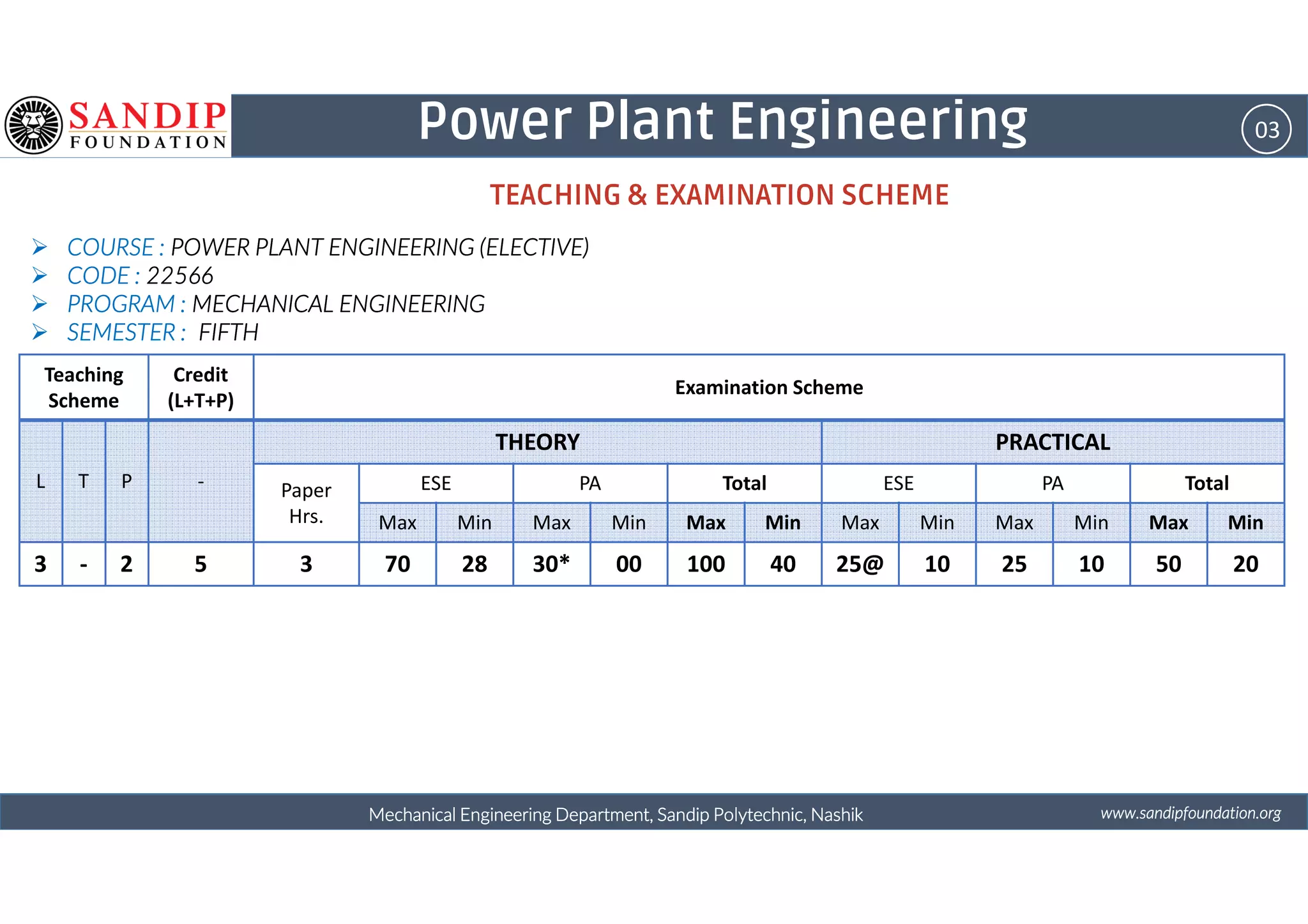
COURSE :COURSE :COURSE :COURSE : POWER PLANT ENGINEERING (ELECTIVE)POWER PLANT ENGINEERING (ELECTIVE)POWER PLANT ENGINEERING (ELECTIVE)POWER PLANT ENGINEERING (ELECTIVE)
CODE :CODE :CODE :CODE : 22566225662256622566
PROGRAM :PROGRAM :PROGRAM :PROGRAM : MECHANICAL ENGINEERINGMECHANICAL ENGINEERINGMECHANICAL ENGINEERINGMECHANICAL ENGINEERING
SEMESTER :SEMESTER :SEMESTER :SEMESTER : FIFTHFIFTHFIFTHFIFTH
Power Plant Engineering
Teaching
Scheme
Credit
(L+T+P)
Examination Scheme
THEORY PRACTICAL
TEACHING & EXAMINATION SCHEME
wwwwwwwwwwww....ssssaaaannnnddddiiiippppffffoooouuuunnnnddddaaaattttiiiioooonnnn....oooorrrrggggMechanical Engineering Department, Sandip Polytechnic, NashikMechanical Engineering Department, Sandip Polytechnic, NashikMechanical Engineering Department, Sandip Polytechnic, NashikMechanical Engineering Department, Sandip Polytechnic, Nashik
L T P - Paper
Hrs.
ESE PA Total ESE PA Total
Max Min Max Min Max Min Max Min Max Min Max Min
3 - 2 5 3 70 28 30* 00 100 40 25@ 10 25 10 50 20
04Power Plant Engineering
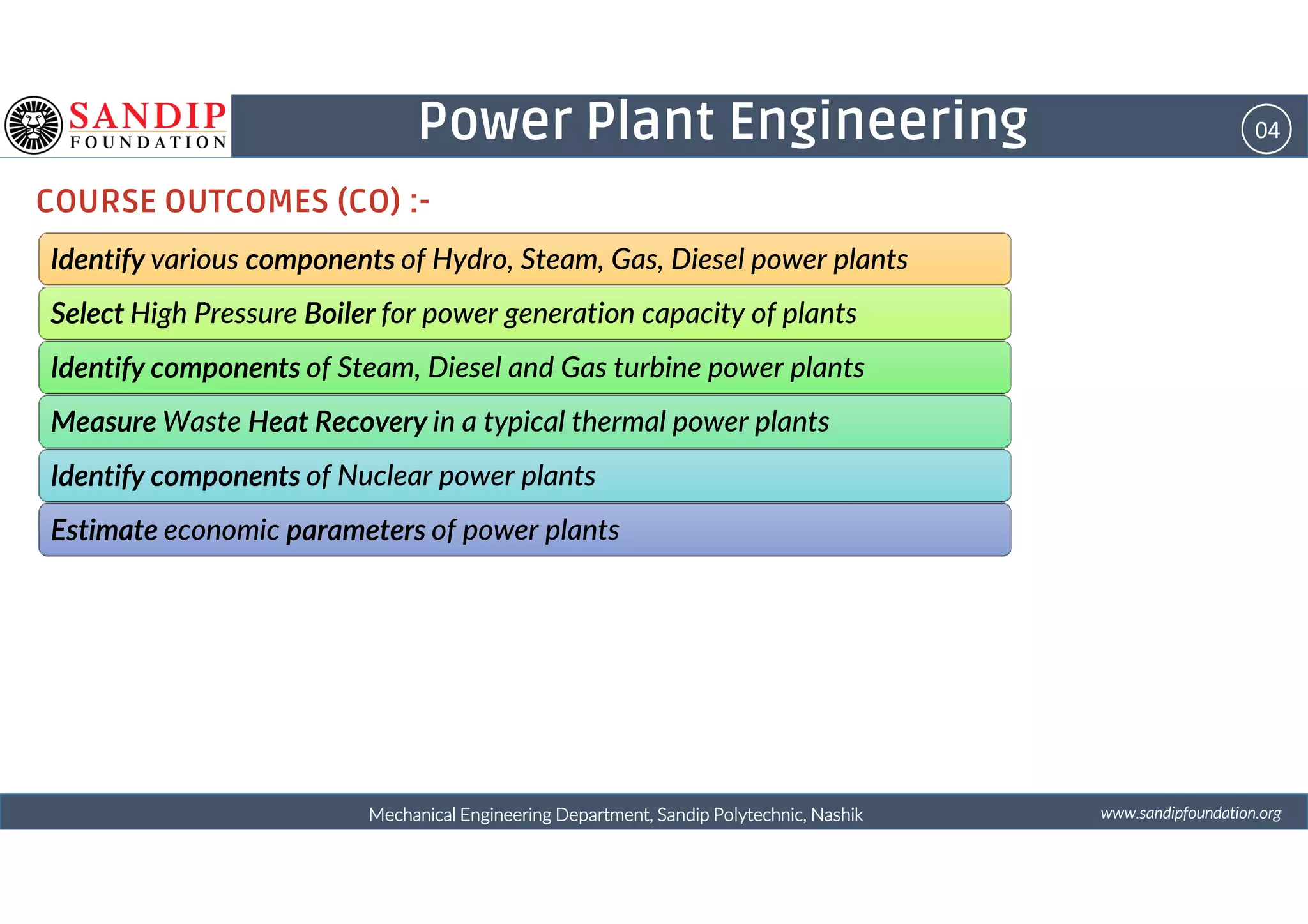
IdentifyIdentifyIdentifyIdentify various componentscomponentscomponentscomponents of Hydro, Steam, Gas, Diesel power plants
SelectSelectSelectSelect High Pressure BoilerBoilerBoilerBoiler for power generation capacity of plants
IdentifyIdentifyIdentifyIdentify componentscomponentscomponentscomponents of Steam, Diesel and Gas turbine power plants
MeasureMeasureMeasureMeasure Waste HeatHeatHeatHeat RecoveryRecoveryRecoveryRecovery in a typical thermal power plants
IdentifyIdentifyIdentifyIdentify componentscomponentscomponentscomponents of Nuclear power plants
COURSE OUTCOMES (CO) :-
wwwwwwwwwwww....ssssaaaannnnddddiiiippppffffoooouuuunnnnddddaaaattttiiiioooonnnn....oooorrrrggggMechanical Engineering Department, Sandip Polytechnic, NashikMechanical Engineering Department, Sandip Polytechnic, NashikMechanical Engineering Department, Sandip Polytechnic, NashikMechanical Engineering Department, Sandip Polytechnic, Nashik
IdentifyIdentifyIdentifyIdentify componentscomponentscomponentscomponents of Nuclear power plants
EstimateEstimateEstimateEstimate economic parametersparametersparametersparameters of power plants
05Unit I: Introduction to Power Plant
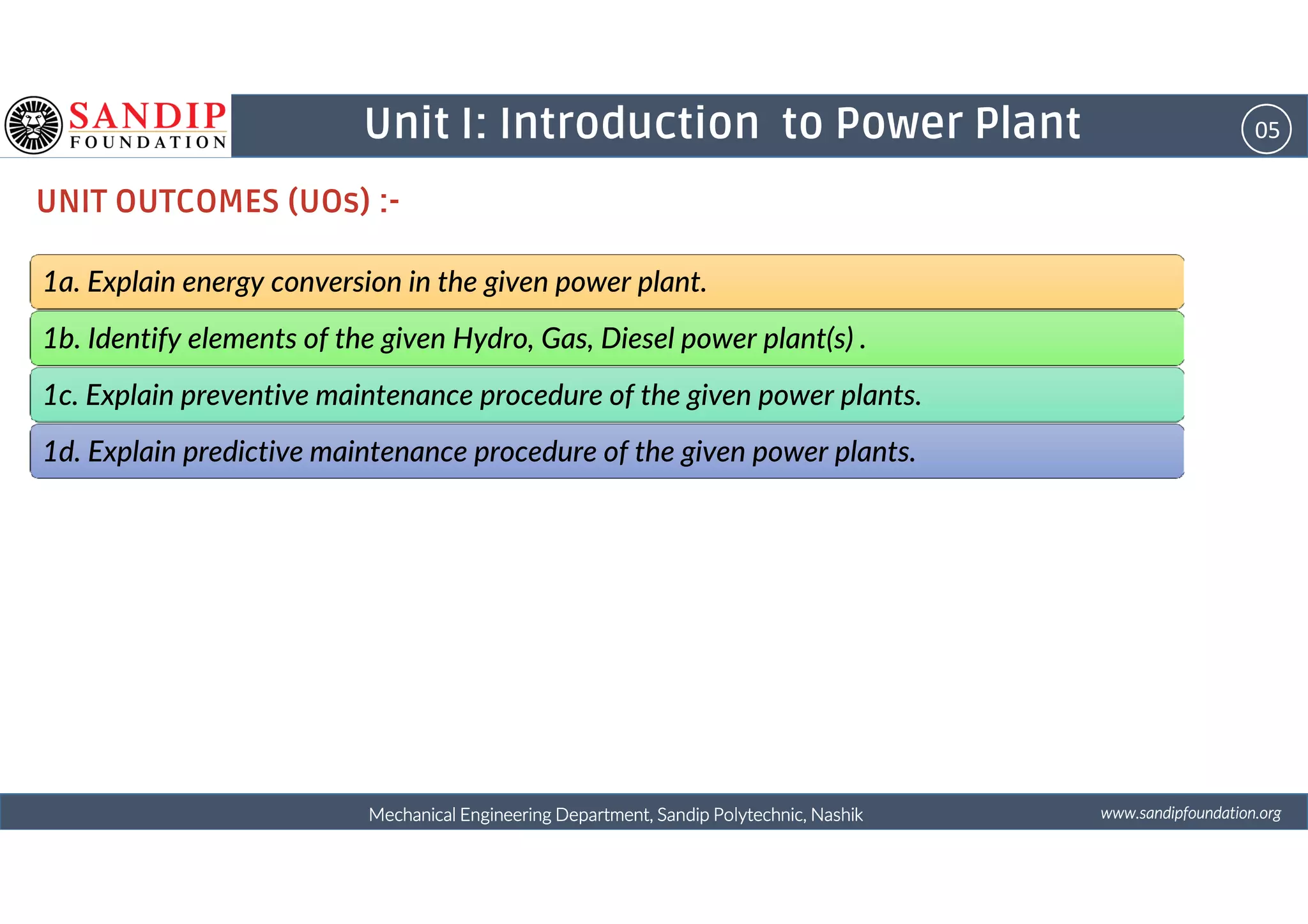
UNIT OUTCOMES (UOs) :-
1a. Explain energy conversion in the given power plant.
1b. Identify elements of the given Hydro, Gas, Diesel power plant(s) .
1c. Explain preventive maintenance procedure of the given power plants.
1d. Explain predictive maintenance procedure of the given power plants.
wwwwwwwwwwww....ssssaaaannnnddddiiiippppffffoooouuuunnnnddddaaaattttiiiioooonnnn....oooorrrrggggMechanical Engineering Department, Sandip Polytechnic, NashikMechanical Engineering Department, Sandip Polytechnic, NashikMechanical Engineering Department, Sandip Polytechnic, NashikMechanical Engineering Department, Sandip Polytechnic, Nashik
1d. Explain predictive maintenance procedure of the given power plants.
06Unit I: Introduction to Power Plant
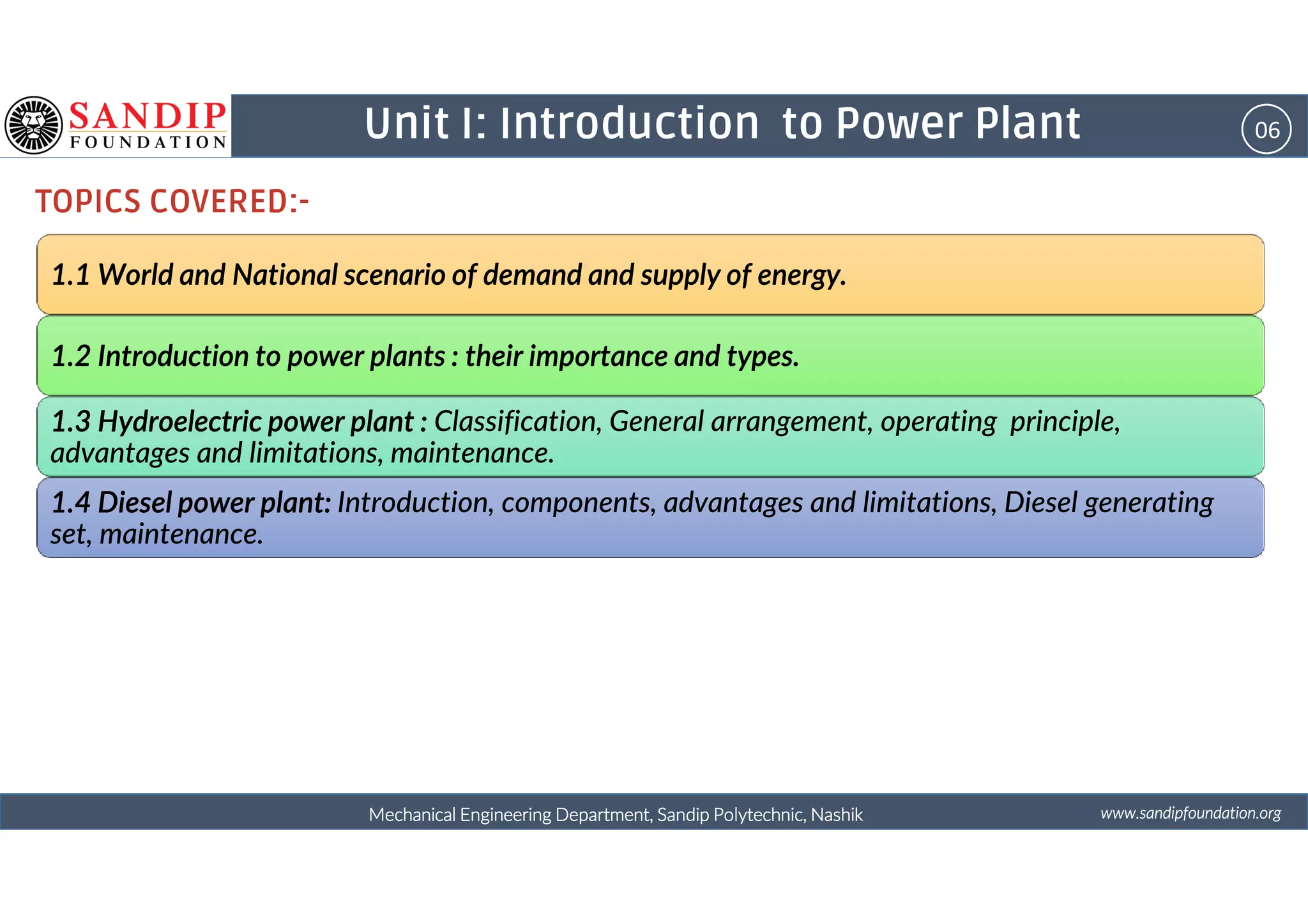
TOPICS COVERED:-
1.1 World and National scenario of demand and supply of energy.1.1 World and National scenario of demand and supply of energy.1.1 World and National scenario of demand and supply of energy.1.1 World and National scenario of demand and supply of energy.
1.2 Introduction to power plants : their importance and types.1.2 Introduction to power plants : their importance and types.1.2 Introduction to power plants : their importance and types.1.2 Introduction to power plants : their importance and types.
1.3 Hydroelectric power plant :1.3 Hydroelectric power plant :1.3 Hydroelectric power plant :1.3 Hydroelectric power plant : Classification, General arrangement, operating principle,
advantages and limitations, maintenance.
wwwwwwwwwwww....ssssaaaannnnddddiiiippppffffoooouuuunnnnddddaaaattttiiiioooonnnn....oooorrrrggggMechanical Engineering Department, Sandip Polytechnic, NashikMechanical Engineering Department, Sandip Polytechnic, NashikMechanical Engineering Department, Sandip Polytechnic, NashikMechanical Engineering Department, Sandip Polytechnic, Nashik
advantages and limitations, maintenance.
1.4 Diesel power plant:1.4 Diesel power plant:1.4 Diesel power plant:1.4 Diesel power plant: Introduction, components, advantages and limitations, Diesel generating
set, maintenance.
07Unit I: Introduction to Power Plant
1.1 World and national scenario of demand and supply of energy.
1.1.1 Energy and Power
NEED OF ENERGY:-
Human beings need energy for their several Life processes.
Essential in transportation, industrial production, Medication etc
wwwwwwwwwwww....ssssaaaannnnddddiiiippppffffoooouuuunnnnddddaaaattttiiiioooonnnn....oooorrrrggggMechanical Engineering Department, Sandip Polytechnic, NashikMechanical Engineering Department, Sandip Polytechnic, NashikMechanical Engineering Department, Sandip Polytechnic, NashikMechanical Engineering Department, Sandip Polytechnic, Nashik
In general, we may say that energy is needed in every walk of life which may appear in various forms.
Therefore, energy may be defined as its capacity to do work in various forms or to produce the
dynamics effect in a body.
08Unit I: Introduction to Power Plant
1.1 World and national scenario of demand and supply of energy.
1.1.1 Energy and Power
NEED OF POWER:-
The power may be defined as the rate of flow of energy.
The power is usually produced in the form of mechanical or electric power.
wwwwwwwwwwww....ssssaaaannnnddddiiiippppffffoooouuuunnnnddddaaaattttiiiioooonnnn....oooorrrrggggMechanical Engineering Department, Sandip Polytechnic, NashikMechanical Engineering Department, Sandip Polytechnic, NashikMechanical Engineering Department, Sandip Polytechnic, NashikMechanical Engineering Department, Sandip Polytechnic, Nashik
The machines and equipments, which are used to produce mechanical or electrical power are called
power plants
E.g., Steam, Nuclear, Hydro, Diesel And Gas Turbine Power Plants.
09Unit I: Introduction to Power Plant
1.1 World and national scenario of demand and supply of energy.
1.1.1 Energy and Power
SIGNIFICANCE OF POWER:-
It plays vital role in industry, agriculture, transportation, human comfort etc.
The per capita consumption of electrical power reflects on the living standards and prosperity of a
nation.
wwwwwwwwwwww....ssssaaaannnnddddiiiippppffffoooouuuunnnnddddaaaattttiiiioooonnnn....oooorrrrggggMechanical Engineering Department, Sandip Polytechnic, NashikMechanical Engineering Department, Sandip Polytechnic, NashikMechanical Engineering Department, Sandip Polytechnic, NashikMechanical Engineering Department, Sandip Polytechnic, Nashik
Any lack of energy will hamper the economic progress of the country.
India also has utilize its natural resources to the maximum extent possible and it has to find new and
efficient ways for producing power.
10Unit I: Introduction to Power Plant
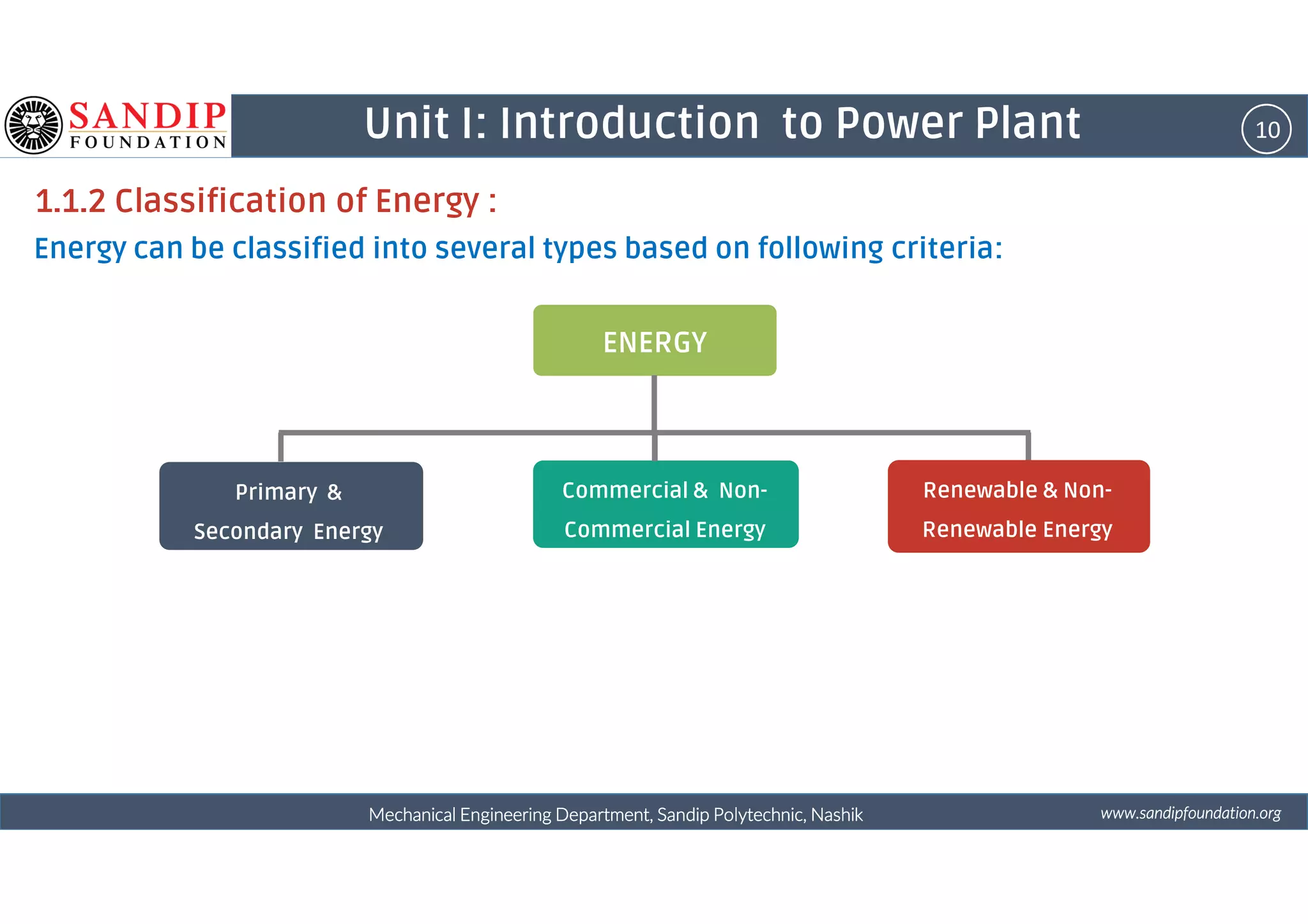
1.1.2 Classification of Energy :
Energy can be classified into several types based on following criteria:
ENERGY
wwwwwwwwwwww....ssssaaaannnnddddiiiippppffffoooouuuunnnnddddaaaattttiiiioooonnnn....oooorrrrggggMechanical Engineering Department, Sandip Polytechnic, NashikMechanical Engineering Department, Sandip Polytechnic, NashikMechanical Engineering Department, Sandip Polytechnic, NashikMechanical Engineering Department, Sandip Polytechnic, Nashik
Commercial & Non-
Commercial Energy
Renewable & Non-
Renewable Energy
Primary &
Secondary Energy
11Unit I: Introduction to Power Plant
1.1.2 Classification of Energy.
1. Primary and Secondary Energy
Primary Energy Sources: Found or stored in nature.
Eg: Coal, oil, natural gas and biomass (such as wood), nuclear energy from radioactive substances,
thermal energy stored in earth’s interior and potential energy due to earth’s gravity.
Secondary Energy Sources: Primary energy sources are mostly converted and then used for
Industrial applications.
wwwwwwwwwwww....ssssaaaannnnddddiiiippppffffoooouuuunnnnddddaaaattttiiiioooonnnn....oooorrrrggggMechanical Engineering Department, Sandip Polytechnic, NashikMechanical Engineering Department, Sandip Polytechnic, NashikMechanical Engineering Department, Sandip Polytechnic, NashikMechanical Engineering Department, Sandip Polytechnic, Nashik
Industrial applications.
Eg: Coal, Oil or Gas converted into steam and electricity used commercially.
12Unit I: Introduction to Power Plant
1.1.2 Classification of Energy.
2. Commercial and Non-Commercial Energy
Commercial Energy Sources: The energy sources that are available in the market for a definite price
are known as commercial energy.
Eg: Electricity, Coal and refined Petroleum products.
Non-Commercial Energy Sources: These energy sources that are not available in the commercial
market for a price.
wwwwwwwwwwww....ssssaaaannnnddddiiiippppffffoooouuuunnnnddddaaaattttiiiioooonnnn....oooorrrrggggMechanical Engineering Department, Sandip Polytechnic, NashikMechanical Engineering Department, Sandip Polytechnic, NashikMechanical Engineering Department, Sandip Polytechnic, NashikMechanical Engineering Department, Sandip Polytechnic, Nashik
market for a price.
Eg: Firewood, Agro waste, Wind Energy For Lifting Water
13Unit I: Introduction to Power Plant
1.1.2 Classification of Energy.
3. Renewable and Non- Renewable Energy
Renewable Energy Sources: It is obtained from sources that are essentially inexhaustible and it can be
harnessed without the release of harmful pollutants.
Eg: Wind, Solar, Geothermal Energy, Tidal & Hydroelectric Power.
Non-Renewable Energy Sources: These energy sources are likely to deplete with time.
wwwwwwwwwwww....ssssaaaannnnddddiiiippppffffoooouuuunnnnddddaaaattttiiiioooonnnn....oooorrrrggggMechanical Engineering Department, Sandip Polytechnic, NashikMechanical Engineering Department, Sandip Polytechnic, NashikMechanical Engineering Department, Sandip Polytechnic, NashikMechanical Engineering Department, Sandip Polytechnic, Nashik
Eg: Conventional Fossil Fuels such as Coal, Oil And Gas
14Unit I: Introduction to Power Plant
1.1.3 : Indian and World Energy Scenario
1. Energy Scenario in India (Analysis by International Energy Agency- www.iea.org)
Recent IEA analysis shows that in 2018, India’s investment in solar PV was greater than in all fossil fuel
sources of electricity generation together.
By December 2019, India had deployed a total of 84 GW of grid-connected renewable electricity capacity.
By comparison, India’s total generating capacity reached 366 GW in 2019.
wwwwwwwwwwww....ssssaaaannnnddddiiiippppffffoooouuuunnnnddddaaaattttiiiioooonnnn....oooorrrrggggMechanical Engineering Department, Sandip Polytechnic, NashikMechanical Engineering Department, Sandip Polytechnic, NashikMechanical Engineering Department, Sandip Polytechnic, NashikMechanical Engineering Department, Sandip Polytechnic, Nashik
reached 366 GW in 2019.
India is making progress towards its target of 175 GW of renewable by 2022.
https://www.iea.org/reports/india-2020
15Unit I: Introduction to Power Plant
1.1.3 : Indian and World Energy Scenario
1. Energy Scenario in India (Analysis by National Statistical Office) www.mospi.gov.in
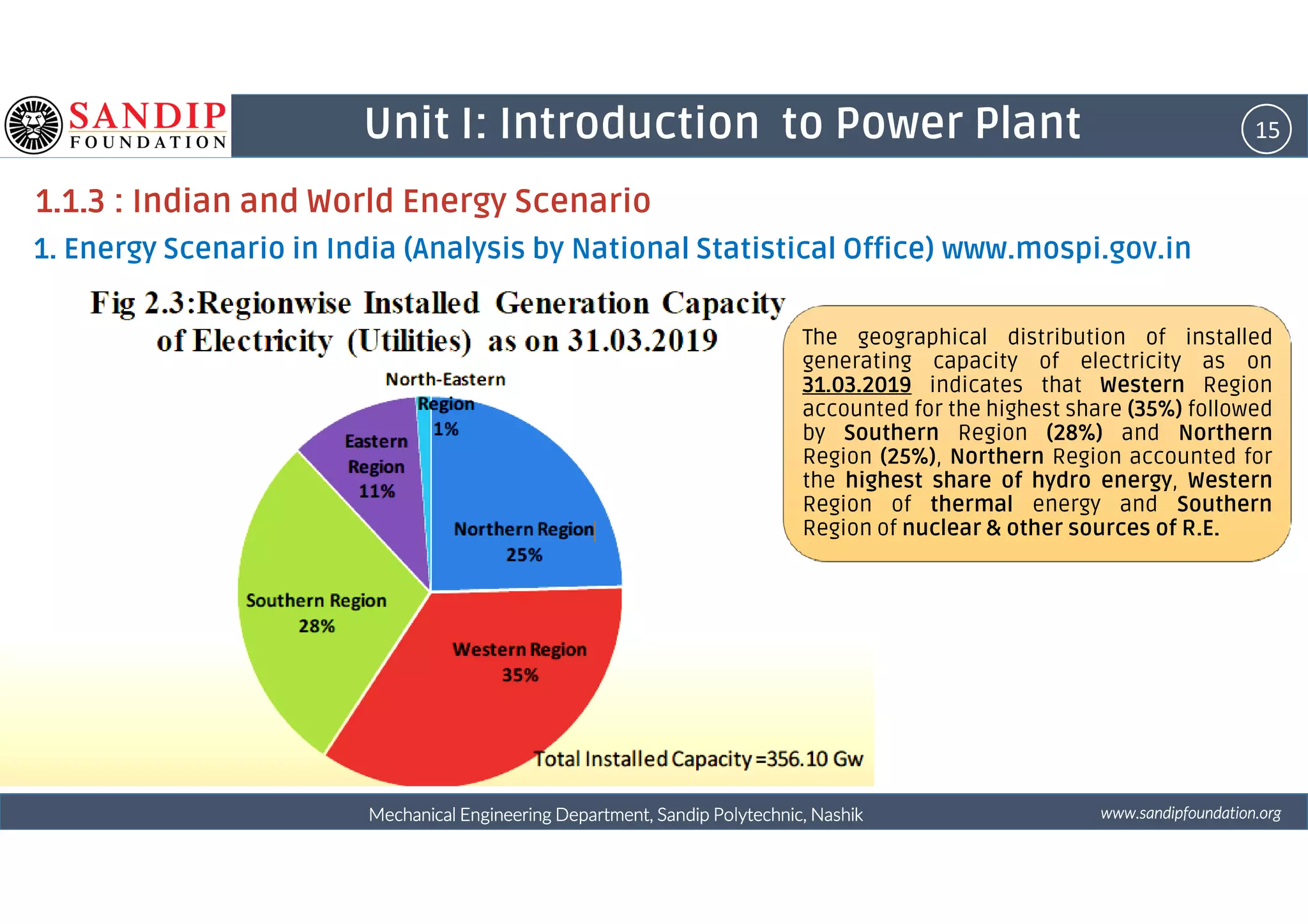
The geographical distribution of installed
generating capacity of electricity as on
31.03.2019 indicates that Western Region
accounted for the highest share (35%) followed
by Southern Region (28%) and Northern
Region (25%), Northern Region accounted for
wwwwwwwwwwww....ssssaaaannnnddddiiiippppffffoooouuuunnnnddddaaaattttiiiioooonnnn....oooorrrrggggMechanical Engineering Department, Sandip Polytechnic, NashikMechanical Engineering Department, Sandip Polytechnic, NashikMechanical Engineering Department, Sandip Polytechnic, NashikMechanical Engineering Department, Sandip Polytechnic, Nashik
Region (25%), Northern Region accounted for
the highest share of hydro energy, Western
Region of thermal energy and Southern
Region of nuclear & other sources of R.E.
16Unit I: Introduction to Power Plant
1.1.3 : Indian and World Energy Scenario
1. Energy Scenario in India (Analysis by National Statistical Office) www.mospi.gov.in
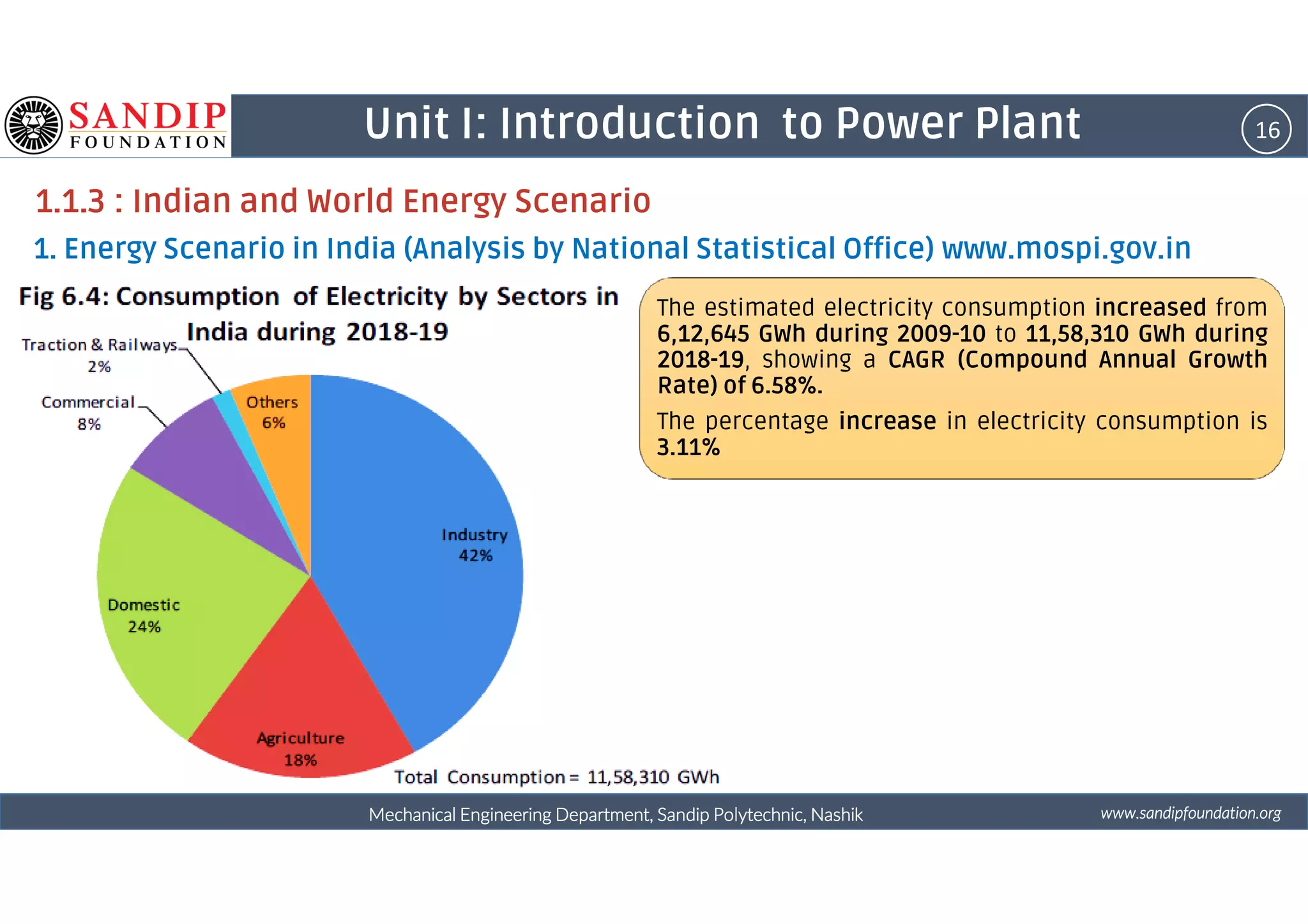
The estimated electricity consumption increased from
6,12,645 GWh during 2009-10 to 11,58,310 GWh during
2018-19, showing a CAGR (Compound Annual Growth
Rate) of 6.58%.
The percentage increase in electricity consumption is
3.11%
wwwwwwwwwwww....ssssaaaannnnddddiiiippppffffoooouuuunnnnddddaaaattttiiiioooonnnn....oooorrrrggggMechanical Engineering Department, Sandip Polytechnic, NashikMechanical Engineering Department, Sandip Polytechnic, NashikMechanical Engineering Department, Sandip Polytechnic, NashikMechanical Engineering Department, Sandip Polytechnic, Nashik
19Unit I: Introduction to Power Plant
wwwwwwwwwwww....ssssaaaannnnddddiiiippppffffoooouuuunnnnddddaaaattttiiiioooonnnn....oooorrrrggggMechanical Engineering Department, Sandip Polytechnic, NashikMechanical Engineering Department, Sandip Polytechnic, NashikMechanical Engineering Department, Sandip Polytechnic, NashikMechanical Engineering Department, Sandip Polytechnic, Nashik
17Unit I: Introduction to Power Plant
1.1.3 : Indian and World Energy Scenario
1. Energy Scenario in India (Analysis by National Statistical Office) www.mospi.gov.in
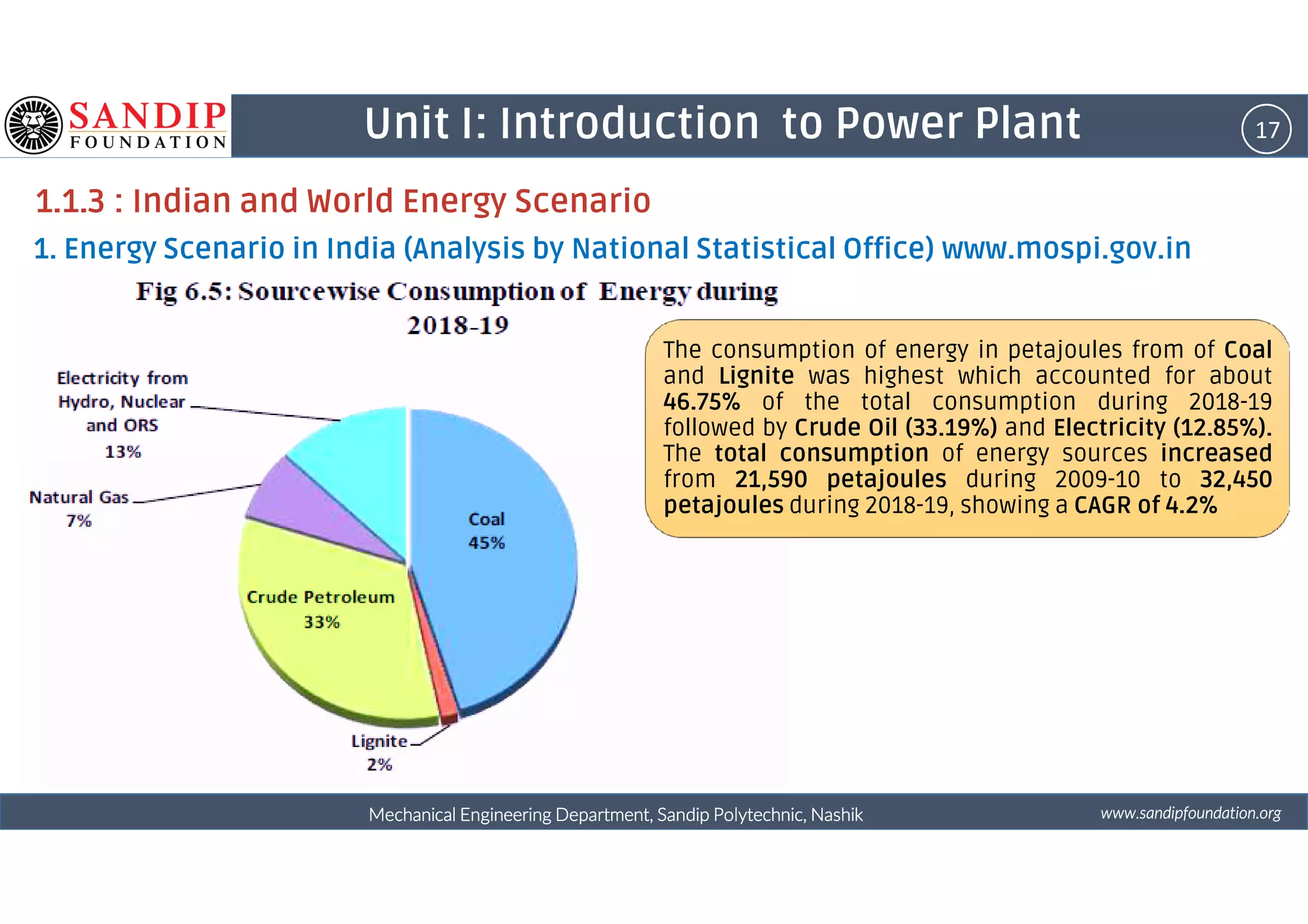
The consumption of energy in petajoules from of Coal
and Lignite was highest which accounted for about
46.75% of the total consumption during 2018-19
followed by Crude Oil (33.19%) and Electricity (12.85%).
The total consumption of energy sources increased
wwwwwwwwwwww....ssssaaaannnnddddiiiippppffffoooouuuunnnnddddaaaattttiiiioooonnnn....oooorrrrggggMechanical Engineering Department, Sandip Polytechnic, NashikMechanical Engineering Department, Sandip Polytechnic, NashikMechanical Engineering Department, Sandip Polytechnic, NashikMechanical Engineering Department, Sandip Polytechnic, Nashik
The total consumption of energy sources increased
from 21,590 petajoules during 2009-10 to 32,450
petajoules during 2018-19, showing a CAGR of 4.2%
18Unit I: Introduction to Power Plant
1.1.3 : Indian and World Energy Scenario
2. Energy Scenario in World (Analysis by International Energy Agency- www.iea.org)
Recent IEA analysis shows that Global energy demand has declined by 3.8% in the first quarter of 2020.
Global coal demand was hit the hardest, falling by almost 8% compared with the first quarter of 2019.
Oil demand was also hit strongly, down nearly 5% in the first quarter
The impact of the pandemic on gas demand was more moderate, at around 2% in the first quarter
wwwwwwwwwwww....ssssaaaannnnddddiiiippppffffoooouuuunnnnddddaaaattttiiiioooonnnn....oooorrrrggggMechanical Engineering Department, Sandip Polytechnic, NashikMechanical Engineering Department, Sandip Polytechnic, NashikMechanical Engineering Department, Sandip Polytechnic, NashikMechanical Engineering Department, Sandip Polytechnic, Nashik
The impact of the pandemic on gas demand was more moderate, at around 2% in the first quarter
Renewables were the only source that posted a growth in demand, driven by larger installed capacity and
priority dispatch.
Electricity demand has been depressed by 20% or more during periods of full lockdown in several countries.
20Unit I: Introduction to Power Plant
1.2 : Power Plants
1.2.1: Definition of Power Plant
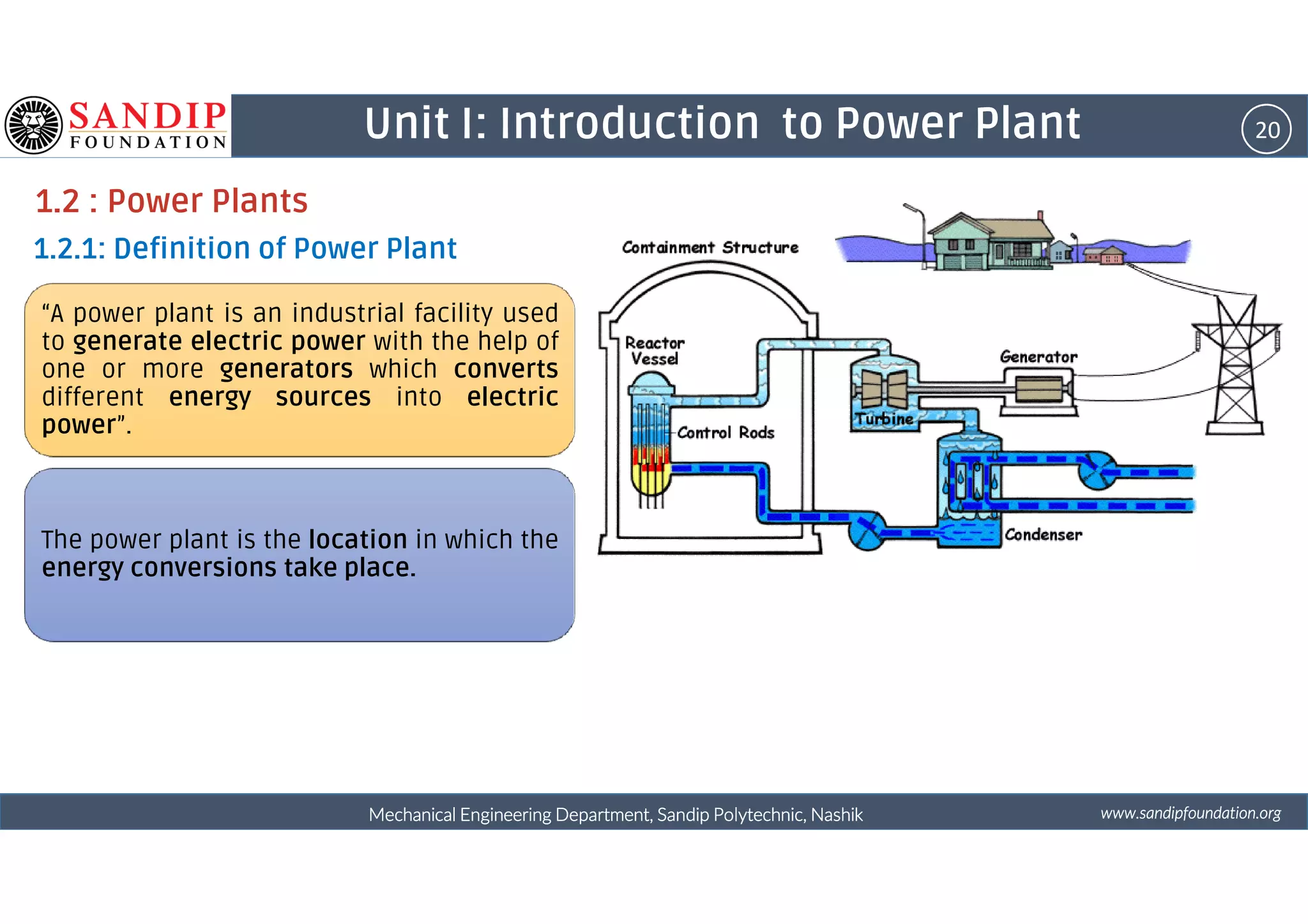
“A power plant is an industrial facility used
to generate electric power with the help of
one or more generators which converts
different energy sources into electric
power”.
wwwwwwwwwwww....ssssaaaannnnddddiiiippppffffoooouuuunnnnddddaaaattttiiiioooonnnn....oooorrrrggggMechanical Engineering Department, Sandip Polytechnic, NashikMechanical Engineering Department, Sandip Polytechnic, NashikMechanical Engineering Department, Sandip Polytechnic, NashikMechanical Engineering Department, Sandip Polytechnic, Nashik
The power plant is the location in which the
energy conversions take place.
21Unit I: Introduction to Power Plant
1.2 : Power Plants
1.2.2: Types of Power Plant
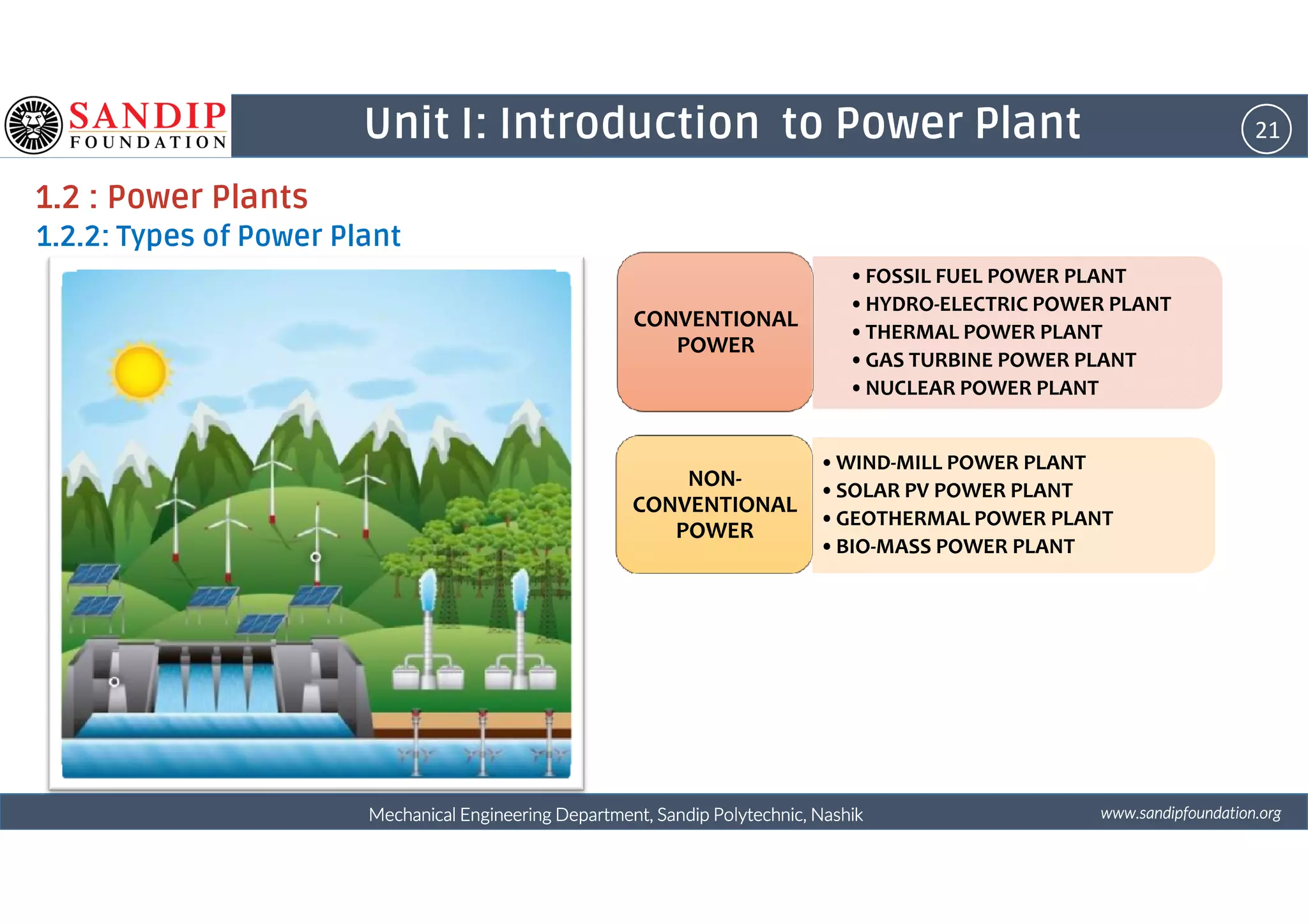
•FOSSIL FUEL POWER PLANT
•HYDRO-ELECTRIC POWER PLANT
•THERMAL POWER PLANT
•GAS TURBINE POWER PLANT
•NUCLEAR POWER PLANT
CONVENTIONAL
POWER
•WIND-MILL POWER PLANT
wwwwwwwwwwww....ssssaaaannnnddddiiiippppffffoooouuuunnnnddddaaaattttiiiioooonnnn....oooorrrrggggMechanical Engineering Department, Sandip Polytechnic, NashikMechanical Engineering Department, Sandip Polytechnic, NashikMechanical Engineering Department, Sandip Polytechnic, NashikMechanical Engineering Department, Sandip Polytechnic, Nashik
•WIND-MILL POWER PLANT
•SOLAR PV POWER PLANT
•GEOTHERMAL POWER PLANT
•BIO-MASS POWER PLANT
NON-
CONVENTIONAL
POWER
22Unit I: Introduction to Power Plant
1.2 : Power Plants
1.2.2: Types of Power Plant
wwwwwwwwwwww....ssssaaaannnnddddiiiippppffffoooouuuunnnnddddaaaattttiiiioooonnnn....oooorrrrggggMechanical Engineering Department, Sandip Polytechnic, NashikMechanical Engineering Department, Sandip Polytechnic, NashikMechanical Engineering Department, Sandip Polytechnic, NashikMechanical Engineering Department, Sandip Polytechnic, Nashik
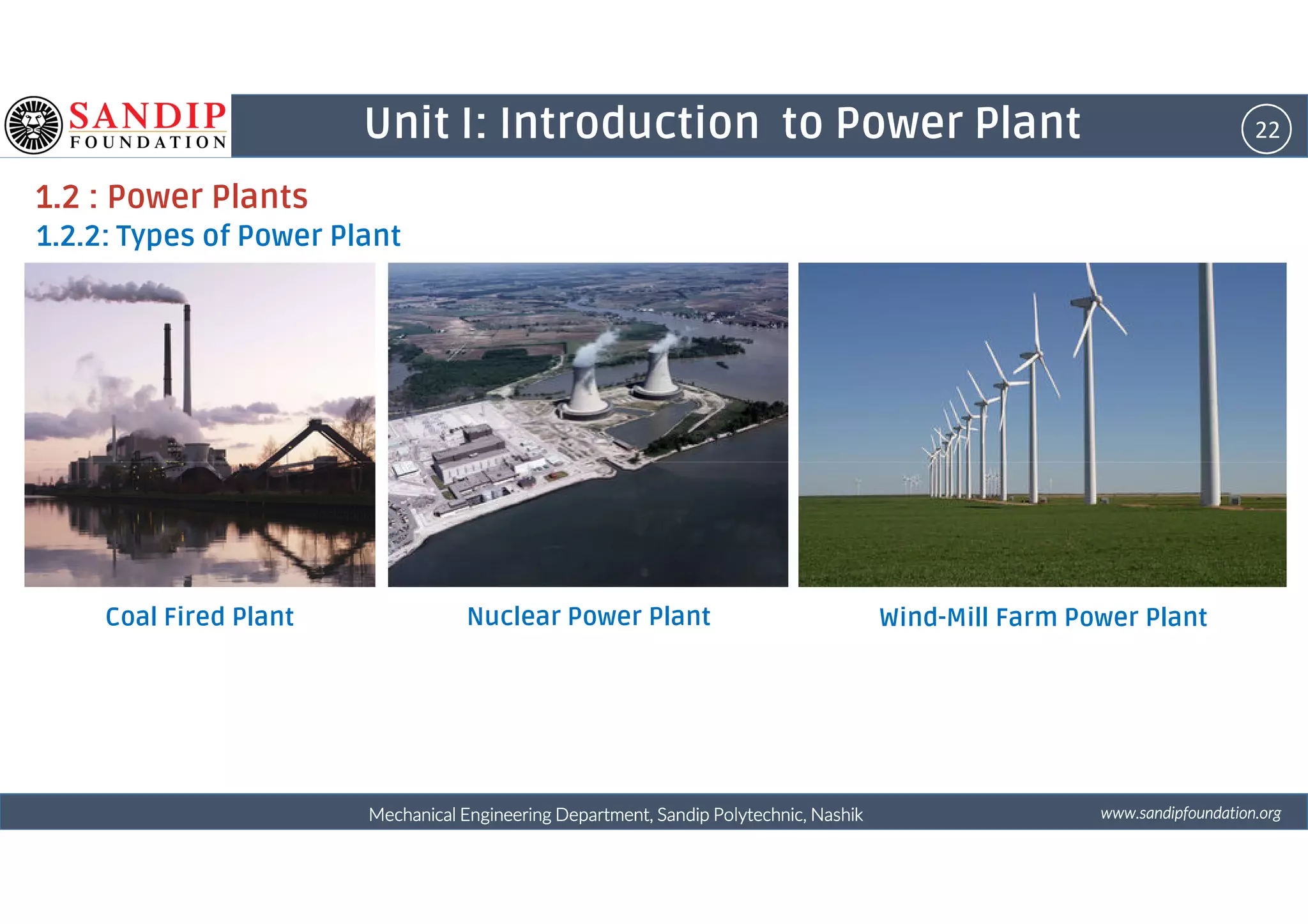
Coal Fired Plant Nuclear Power Plant Wind-Mill Farm Power Plant
23Unit I: Introduction to Power Plant
1.2 : Power Plants
1.2.2: Types of Power Plant
wwwwwwwwwwww....ssssaaaannnnddddiiiippppffffoooouuuunnnnddddaaaattttiiiioooonnnn....oooorrrrggggMechanical Engineering Department, Sandip Polytechnic, NashikMechanical Engineering Department, Sandip Polytechnic, NashikMechanical Engineering Department, Sandip Polytechnic, NashikMechanical Engineering Department, Sandip Polytechnic, Nashik
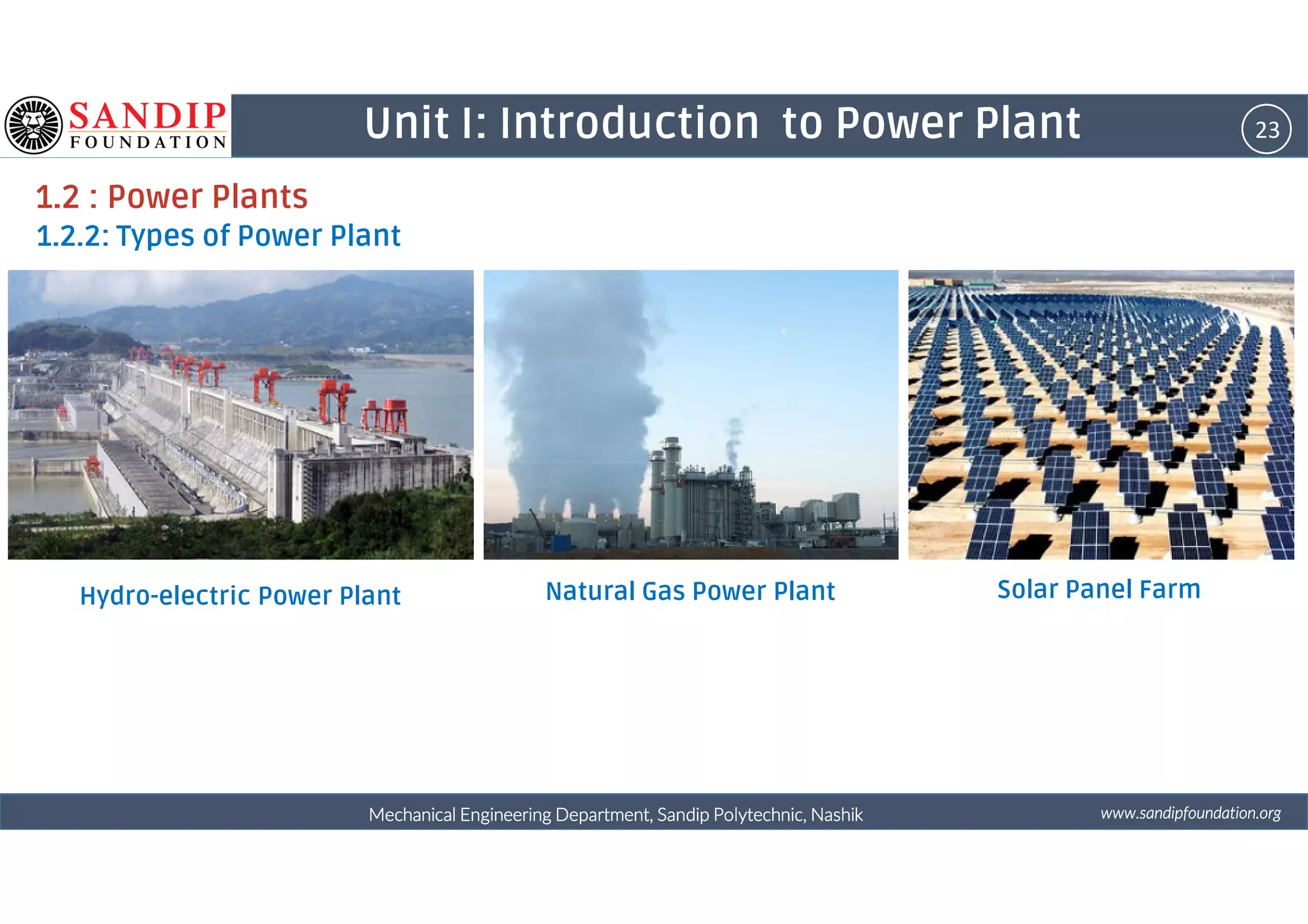
Hydro-electric Power Plant Natural Gas Power Plant Solar Panel Farm
24Unit I: Introduction to Power Plant
1.2 : Power Plants
1.2.3: Importance of Power Plant
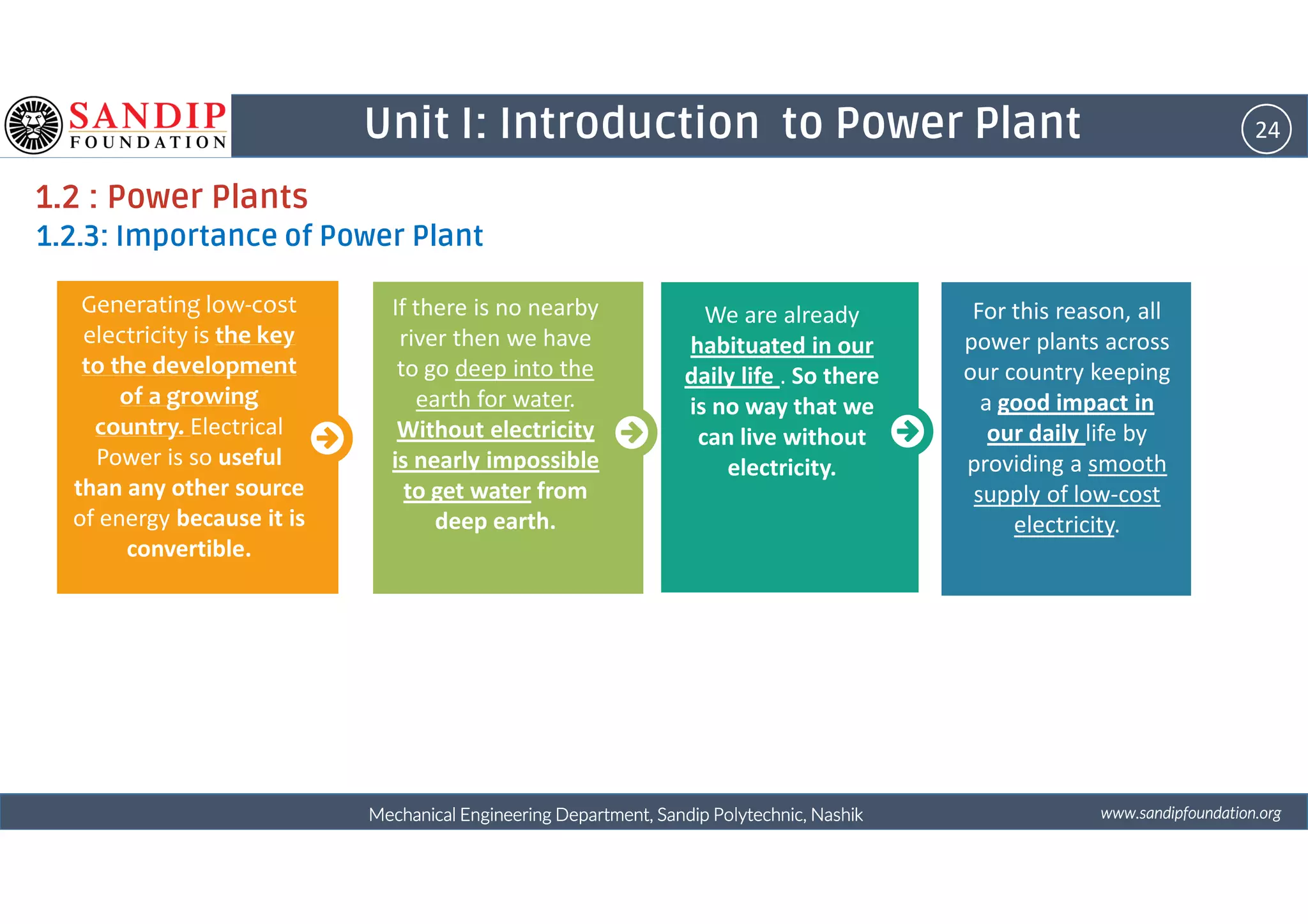
We are already
habituated in our
daily life . So there
is no way that we
can live without
electricity.
If there is no nearby
river then we have
to go deep into the
earth for water.
Without electricity
is nearly impossible
Generating low-cost
electricity is the key
to the development
of a growing
country. Electrical
Power is so useful
For this reason, all
power plants across
our country keeping
a good impact in
our daily life by
providing a smooth
wwwwwwwwwwww....ssssaaaannnnddddiiiippppffffoooouuuunnnnddddaaaattttiiiioooonnnn....oooorrrrggggMechanical Engineering Department, Sandip Polytechnic, NashikMechanical Engineering Department, Sandip Polytechnic, NashikMechanical Engineering Department, Sandip Polytechnic, NashikMechanical Engineering Department, Sandip Polytechnic, Nashik
electricity.is nearly impossible
to get water from
deep earth.
Power is so useful
than any other source
of energy because it is
convertible.
providing a smooth
supply of low-cost
electricity.
25Unit I: Introduction to Power Plant
1.2 : Power Plants
1.2.4: Importance of Electricity
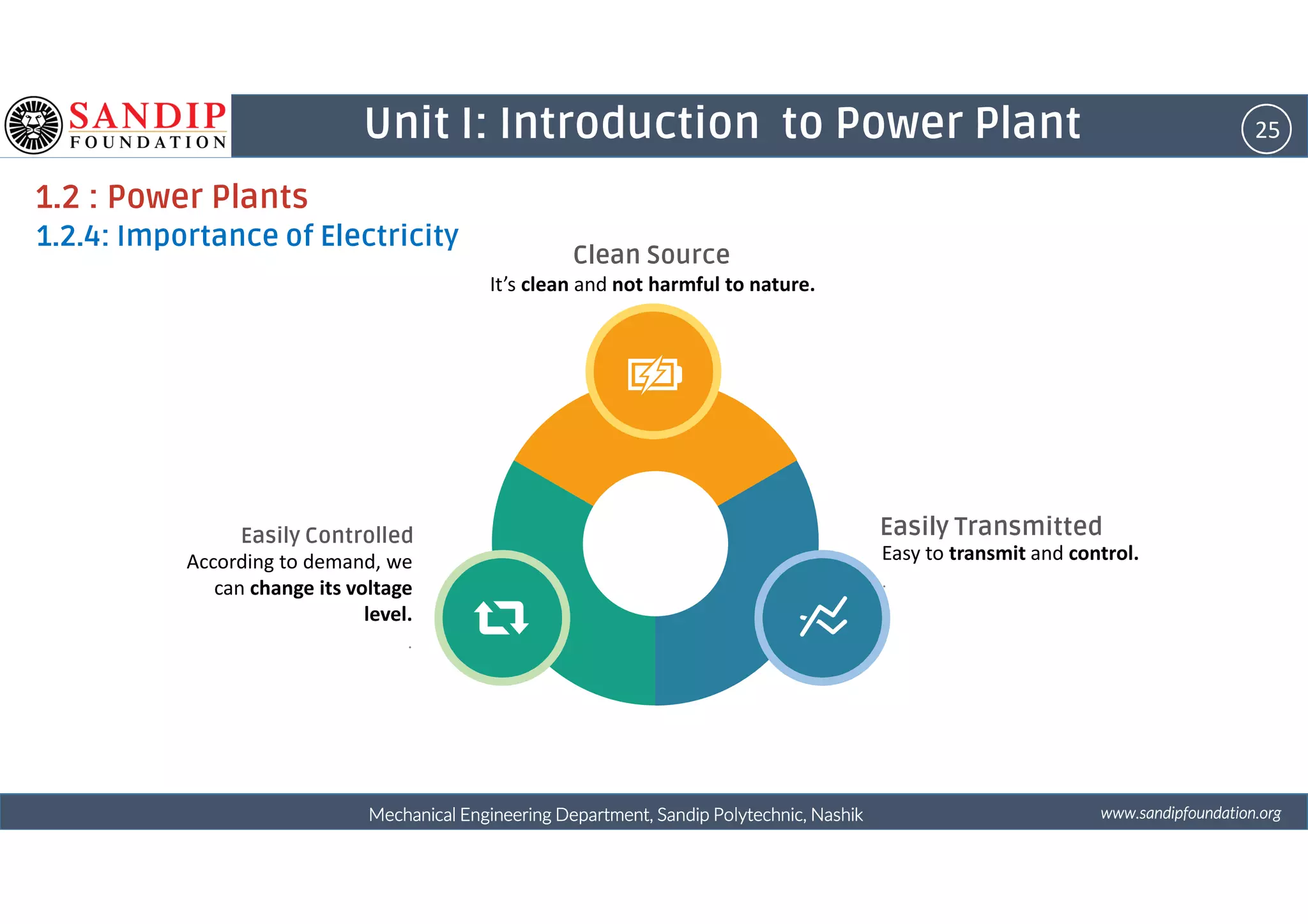
It’s clean and not harmful to nature.
Clean Source
wwwwwwwwwwww....ssssaaaannnnddddiiiippppffffoooouuuunnnnddddaaaattttiiiioooonnnn....oooorrrrggggMechanical Engineering Department, Sandip Polytechnic, NashikMechanical Engineering Department, Sandip Polytechnic, NashikMechanical Engineering Department, Sandip Polytechnic, NashikMechanical Engineering Department, Sandip Polytechnic, Nashik
Easy to transmit and control.
.
Easily Transmitted
According to demand, we
can change its voltage
level.
.
Easily Controlled
26Unit I: Introduction to Power Plant
In this lesson, We have learnedIn this lesson, We have learnedIn this lesson, We have learnedIn this lesson, We have learned
1. Energy and Power
Basics and Need of Energy and Power
2. Indian and World Energy Scenario
SUMMARY
wwwwwwwwwwww....ssssaaaannnnddddiiiippppffffoooouuuunnnnddddaaaattttiiiioooonnnn....oooorrrrggggMechanical Engineering Department, Sandip Polytechnic, NashikMechanical Engineering Department, Sandip Polytechnic, NashikMechanical Engineering Department, Sandip Polytechnic, NashikMechanical Engineering Department, Sandip Polytechnic, Nashik
2. Indian and World Energy Scenario
Analysis and statistics by IEA on energy current year 2020.
3. Power Plants
Definition, Need, Types, Importance etc.
27Unit I: Introduction to Power Plant
Our Next Video Lecture TopicOur Next Video Lecture TopicOur Next Video Lecture TopicOur Next Video Lecture Topic
1.3 Hydro-electric Power Plant
Classification, General arrangement, operating principle, advantages and limitations, maintenance.
1.4 Diesel Power Plant
wwwwwwwwwwww....ssssaaaannnnddddiiiippppffffoooouuuunnnnddddaaaattttiiiioooonnnn....oooorrrrggggMechanical Engineering Department, Sandip Polytechnic, NashikMechanical Engineering Department, Sandip Polytechnic, NashikMechanical Engineering Department, Sandip Polytechnic, NashikMechanical Engineering Department, Sandip Polytechnic, Nashik
1.4 Diesel Power Plant
Introduction, components, advantages and limitations, Diesel generating set, maintenance.
Till Then Stay Connected,
THANK YOU

Lecture 01_PPE_unit 1_Introduction to Power Plant Engineering

  • 1.
    Program: Diploma (Mechanical) Class:TY (ME) Semester: V Course: Power Plant Engineering Code: 22566Code: 22566 LECTURE 01: Unit: 1. Introduction to Power Plant
  • 2.
    02 wwwwwwwwwwww....ssssaaaannnnddddiiiippppffffoooouuuunnnnddddaaaattttiiiioooonnnn....oooorrrrggggMechanical Engineering Department,Sandip Polytechnic, NashikMechanical Engineering Department, Sandip Polytechnic, NashikMechanical Engineering Department, Sandip Polytechnic, NashikMechanical Engineering Department, Sandip Polytechnic, Nashik Name of theName of theName of theName of the Trainer : Prof. Rushikesh Deoram SonarTrainer : Prof. Rushikesh Deoram SonarTrainer : Prof. Rushikesh Deoram SonarTrainer : Prof. Rushikesh Deoram Sonar Years ofYears ofYears ofYears of Experience : 10Experience : 10Experience : 10Experience : 10 DomainDomainDomainDomain Expertise : Mechanical EngineeringExpertise : Mechanical EngineeringExpertise : Mechanical EngineeringExpertise : Mechanical Engineering Qualification: M.E. (Design Engineering)Qualification: M.E. (Design Engineering)Qualification: M.E. (Design Engineering)Qualification: M.E. (Design Engineering) Contact Details:Contact Details:Contact Details:Contact Details: +91 9890481959+91 9890481959+91 9890481959+91 9890481959 rushikesh.sonar@sandippolytechnic.orgrushikesh.sonar@sandippolytechnic.orgrushikesh.sonar@sandippolytechnic.orgrushikesh.sonar@sandippolytechnic.org
  • 3.
    03 COURSE :COURSE :COURSE:COURSE : POWER PLANT ENGINEERING (ELECTIVE)POWER PLANT ENGINEERING (ELECTIVE)POWER PLANT ENGINEERING (ELECTIVE)POWER PLANT ENGINEERING (ELECTIVE) CODE :CODE :CODE :CODE : 22566225662256622566 PROGRAM :PROGRAM :PROGRAM :PROGRAM : MECHANICAL ENGINEERINGMECHANICAL ENGINEERINGMECHANICAL ENGINEERINGMECHANICAL ENGINEERING SEMESTER :SEMESTER :SEMESTER :SEMESTER : FIFTHFIFTHFIFTHFIFTH Power Plant Engineering Teaching Scheme Credit (L+T+P) Examination Scheme THEORY PRACTICAL TEACHING & EXAMINATION SCHEME wwwwwwwwwwww....ssssaaaannnnddddiiiippppffffoooouuuunnnnddddaaaattttiiiioooonnnn....oooorrrrggggMechanical Engineering Department, Sandip Polytechnic, NashikMechanical Engineering Department, Sandip Polytechnic, NashikMechanical Engineering Department, Sandip Polytechnic, NashikMechanical Engineering Department, Sandip Polytechnic, Nashik L T P - Paper Hrs. ESE PA Total ESE PA Total Max Min Max Min Max Min Max Min Max Min Max Min 3 - 2 5 3 70 28 30* 00 100 40 25@ 10 25 10 50 20
  • 4.
    04Power Plant Engineering IdentifyIdentifyIdentifyIdentifyvarious componentscomponentscomponentscomponents of Hydro, Steam, Gas, Diesel power plants SelectSelectSelectSelect High Pressure BoilerBoilerBoilerBoiler for power generation capacity of plants IdentifyIdentifyIdentifyIdentify componentscomponentscomponentscomponents of Steam, Diesel and Gas turbine power plants MeasureMeasureMeasureMeasure Waste HeatHeatHeatHeat RecoveryRecoveryRecoveryRecovery in a typical thermal power plants IdentifyIdentifyIdentifyIdentify componentscomponentscomponentscomponents of Nuclear power plants COURSE OUTCOMES (CO) :- wwwwwwwwwwww....ssssaaaannnnddddiiiippppffffoooouuuunnnnddddaaaattttiiiioooonnnn....oooorrrrggggMechanical Engineering Department, Sandip Polytechnic, NashikMechanical Engineering Department, Sandip Polytechnic, NashikMechanical Engineering Department, Sandip Polytechnic, NashikMechanical Engineering Department, Sandip Polytechnic, Nashik IdentifyIdentifyIdentifyIdentify componentscomponentscomponentscomponents of Nuclear power plants EstimateEstimateEstimateEstimate economic parametersparametersparametersparameters of power plants
  • 5.
    05Unit I: Introductionto Power Plant UNIT OUTCOMES (UOs) :- 1a. Explain energy conversion in the given power plant. 1b. Identify elements of the given Hydro, Gas, Diesel power plant(s) . 1c. Explain preventive maintenance procedure of the given power plants. 1d. Explain predictive maintenance procedure of the given power plants. wwwwwwwwwwww....ssssaaaannnnddddiiiippppffffoooouuuunnnnddddaaaattttiiiioooonnnn....oooorrrrggggMechanical Engineering Department, Sandip Polytechnic, NashikMechanical Engineering Department, Sandip Polytechnic, NashikMechanical Engineering Department, Sandip Polytechnic, NashikMechanical Engineering Department, Sandip Polytechnic, Nashik 1d. Explain predictive maintenance procedure of the given power plants.
  • 6.
    06Unit I: Introductionto Power Plant TOPICS COVERED:- 1.1 World and National scenario of demand and supply of energy.1.1 World and National scenario of demand and supply of energy.1.1 World and National scenario of demand and supply of energy.1.1 World and National scenario of demand and supply of energy. 1.2 Introduction to power plants : their importance and types.1.2 Introduction to power plants : their importance and types.1.2 Introduction to power plants : their importance and types.1.2 Introduction to power plants : their importance and types. 1.3 Hydroelectric power plant :1.3 Hydroelectric power plant :1.3 Hydroelectric power plant :1.3 Hydroelectric power plant : Classification, General arrangement, operating principle, advantages and limitations, maintenance. wwwwwwwwwwww....ssssaaaannnnddddiiiippppffffoooouuuunnnnddddaaaattttiiiioooonnnn....oooorrrrggggMechanical Engineering Department, Sandip Polytechnic, NashikMechanical Engineering Department, Sandip Polytechnic, NashikMechanical Engineering Department, Sandip Polytechnic, NashikMechanical Engineering Department, Sandip Polytechnic, Nashik advantages and limitations, maintenance. 1.4 Diesel power plant:1.4 Diesel power plant:1.4 Diesel power plant:1.4 Diesel power plant: Introduction, components, advantages and limitations, Diesel generating set, maintenance.
  • 7.
    07Unit I: Introductionto Power Plant 1.1 World and national scenario of demand and supply of energy. 1.1.1 Energy and Power NEED OF ENERGY:- Human beings need energy for their several Life processes. Essential in transportation, industrial production, Medication etc wwwwwwwwwwww....ssssaaaannnnddddiiiippppffffoooouuuunnnnddddaaaattttiiiioooonnnn....oooorrrrggggMechanical Engineering Department, Sandip Polytechnic, NashikMechanical Engineering Department, Sandip Polytechnic, NashikMechanical Engineering Department, Sandip Polytechnic, NashikMechanical Engineering Department, Sandip Polytechnic, Nashik In general, we may say that energy is needed in every walk of life which may appear in various forms. Therefore, energy may be defined as its capacity to do work in various forms or to produce the dynamics effect in a body.
  • 8.
    08Unit I: Introductionto Power Plant 1.1 World and national scenario of demand and supply of energy. 1.1.1 Energy and Power NEED OF POWER:- The power may be defined as the rate of flow of energy. The power is usually produced in the form of mechanical or electric power. wwwwwwwwwwww....ssssaaaannnnddddiiiippppffffoooouuuunnnnddddaaaattttiiiioooonnnn....oooorrrrggggMechanical Engineering Department, Sandip Polytechnic, NashikMechanical Engineering Department, Sandip Polytechnic, NashikMechanical Engineering Department, Sandip Polytechnic, NashikMechanical Engineering Department, Sandip Polytechnic, Nashik The machines and equipments, which are used to produce mechanical or electrical power are called power plants E.g., Steam, Nuclear, Hydro, Diesel And Gas Turbine Power Plants.
  • 9.
    09Unit I: Introductionto Power Plant 1.1 World and national scenario of demand and supply of energy. 1.1.1 Energy and Power SIGNIFICANCE OF POWER:- It plays vital role in industry, agriculture, transportation, human comfort etc. The per capita consumption of electrical power reflects on the living standards and prosperity of a nation. wwwwwwwwwwww....ssssaaaannnnddddiiiippppffffoooouuuunnnnddddaaaattttiiiioooonnnn....oooorrrrggggMechanical Engineering Department, Sandip Polytechnic, NashikMechanical Engineering Department, Sandip Polytechnic, NashikMechanical Engineering Department, Sandip Polytechnic, NashikMechanical Engineering Department, Sandip Polytechnic, Nashik Any lack of energy will hamper the economic progress of the country. India also has utilize its natural resources to the maximum extent possible and it has to find new and efficient ways for producing power.
  • 10.
    10Unit I: Introductionto Power Plant 1.1.2 Classification of Energy : Energy can be classified into several types based on following criteria: ENERGY wwwwwwwwwwww....ssssaaaannnnddddiiiippppffffoooouuuunnnnddddaaaattttiiiioooonnnn....oooorrrrggggMechanical Engineering Department, Sandip Polytechnic, NashikMechanical Engineering Department, Sandip Polytechnic, NashikMechanical Engineering Department, Sandip Polytechnic, NashikMechanical Engineering Department, Sandip Polytechnic, Nashik Commercial & Non- Commercial Energy Renewable & Non- Renewable Energy Primary & Secondary Energy
  • 11.
    11Unit I: Introductionto Power Plant 1.1.2 Classification of Energy. 1. Primary and Secondary Energy Primary Energy Sources: Found or stored in nature. Eg: Coal, oil, natural gas and biomass (such as wood), nuclear energy from radioactive substances, thermal energy stored in earth’s interior and potential energy due to earth’s gravity. Secondary Energy Sources: Primary energy sources are mostly converted and then used for Industrial applications. wwwwwwwwwwww....ssssaaaannnnddddiiiippppffffoooouuuunnnnddddaaaattttiiiioooonnnn....oooorrrrggggMechanical Engineering Department, Sandip Polytechnic, NashikMechanical Engineering Department, Sandip Polytechnic, NashikMechanical Engineering Department, Sandip Polytechnic, NashikMechanical Engineering Department, Sandip Polytechnic, Nashik Industrial applications. Eg: Coal, Oil or Gas converted into steam and electricity used commercially.
  • 12.
    12Unit I: Introductionto Power Plant 1.1.2 Classification of Energy. 2. Commercial and Non-Commercial Energy Commercial Energy Sources: The energy sources that are available in the market for a definite price are known as commercial energy. Eg: Electricity, Coal and refined Petroleum products. Non-Commercial Energy Sources: These energy sources that are not available in the commercial market for a price. wwwwwwwwwwww....ssssaaaannnnddddiiiippppffffoooouuuunnnnddddaaaattttiiiioooonnnn....oooorrrrggggMechanical Engineering Department, Sandip Polytechnic, NashikMechanical Engineering Department, Sandip Polytechnic, NashikMechanical Engineering Department, Sandip Polytechnic, NashikMechanical Engineering Department, Sandip Polytechnic, Nashik market for a price. Eg: Firewood, Agro waste, Wind Energy For Lifting Water
  • 13.
    13Unit I: Introductionto Power Plant 1.1.2 Classification of Energy. 3. Renewable and Non- Renewable Energy Renewable Energy Sources: It is obtained from sources that are essentially inexhaustible and it can be harnessed without the release of harmful pollutants. Eg: Wind, Solar, Geothermal Energy, Tidal & Hydroelectric Power. Non-Renewable Energy Sources: These energy sources are likely to deplete with time. wwwwwwwwwwww....ssssaaaannnnddddiiiippppffffoooouuuunnnnddddaaaattttiiiioooonnnn....oooorrrrggggMechanical Engineering Department, Sandip Polytechnic, NashikMechanical Engineering Department, Sandip Polytechnic, NashikMechanical Engineering Department, Sandip Polytechnic, NashikMechanical Engineering Department, Sandip Polytechnic, Nashik Eg: Conventional Fossil Fuels such as Coal, Oil And Gas
  • 14.
    14Unit I: Introductionto Power Plant 1.1.3 : Indian and World Energy Scenario 1. Energy Scenario in India (Analysis by International Energy Agency- www.iea.org) Recent IEA analysis shows that in 2018, India’s investment in solar PV was greater than in all fossil fuel sources of electricity generation together. By December 2019, India had deployed a total of 84 GW of grid-connected renewable electricity capacity. By comparison, India’s total generating capacity reached 366 GW in 2019. wwwwwwwwwwww....ssssaaaannnnddddiiiippppffffoooouuuunnnnddddaaaattttiiiioooonnnn....oooorrrrggggMechanical Engineering Department, Sandip Polytechnic, NashikMechanical Engineering Department, Sandip Polytechnic, NashikMechanical Engineering Department, Sandip Polytechnic, NashikMechanical Engineering Department, Sandip Polytechnic, Nashik reached 366 GW in 2019. India is making progress towards its target of 175 GW of renewable by 2022. https://www.iea.org/reports/india-2020
  • 15.
    15Unit I: Introductionto Power Plant 1.1.3 : Indian and World Energy Scenario 1. Energy Scenario in India (Analysis by National Statistical Office) www.mospi.gov.in The geographical distribution of installed generating capacity of electricity as on 31.03.2019 indicates that Western Region accounted for the highest share (35%) followed by Southern Region (28%) and Northern Region (25%), Northern Region accounted for wwwwwwwwwwww....ssssaaaannnnddddiiiippppffffoooouuuunnnnddddaaaattttiiiioooonnnn....oooorrrrggggMechanical Engineering Department, Sandip Polytechnic, NashikMechanical Engineering Department, Sandip Polytechnic, NashikMechanical Engineering Department, Sandip Polytechnic, NashikMechanical Engineering Department, Sandip Polytechnic, Nashik Region (25%), Northern Region accounted for the highest share of hydro energy, Western Region of thermal energy and Southern Region of nuclear & other sources of R.E.
  • 16.
    16Unit I: Introductionto Power Plant 1.1.3 : Indian and World Energy Scenario 1. Energy Scenario in India (Analysis by National Statistical Office) www.mospi.gov.in The estimated electricity consumption increased from 6,12,645 GWh during 2009-10 to 11,58,310 GWh during 2018-19, showing a CAGR (Compound Annual Growth Rate) of 6.58%. The percentage increase in electricity consumption is 3.11% wwwwwwwwwwww....ssssaaaannnnddddiiiippppffffoooouuuunnnnddddaaaattttiiiioooonnnn....oooorrrrggggMechanical Engineering Department, Sandip Polytechnic, NashikMechanical Engineering Department, Sandip Polytechnic, NashikMechanical Engineering Department, Sandip Polytechnic, NashikMechanical Engineering Department, Sandip Polytechnic, Nashik
  • 17.
    19Unit I: Introductionto Power Plant wwwwwwwwwwww....ssssaaaannnnddddiiiippppffffoooouuuunnnnddddaaaattttiiiioooonnnn....oooorrrrggggMechanical Engineering Department, Sandip Polytechnic, NashikMechanical Engineering Department, Sandip Polytechnic, NashikMechanical Engineering Department, Sandip Polytechnic, NashikMechanical Engineering Department, Sandip Polytechnic, Nashik
  • 18.
    17Unit I: Introductionto Power Plant 1.1.3 : Indian and World Energy Scenario 1. Energy Scenario in India (Analysis by National Statistical Office) www.mospi.gov.in The consumption of energy in petajoules from of Coal and Lignite was highest which accounted for about 46.75% of the total consumption during 2018-19 followed by Crude Oil (33.19%) and Electricity (12.85%). The total consumption of energy sources increased wwwwwwwwwwww....ssssaaaannnnddddiiiippppffffoooouuuunnnnddddaaaattttiiiioooonnnn....oooorrrrggggMechanical Engineering Department, Sandip Polytechnic, NashikMechanical Engineering Department, Sandip Polytechnic, NashikMechanical Engineering Department, Sandip Polytechnic, NashikMechanical Engineering Department, Sandip Polytechnic, Nashik The total consumption of energy sources increased from 21,590 petajoules during 2009-10 to 32,450 petajoules during 2018-19, showing a CAGR of 4.2%
  • 19.
    18Unit I: Introductionto Power Plant 1.1.3 : Indian and World Energy Scenario 2. Energy Scenario in World (Analysis by International Energy Agency- www.iea.org) Recent IEA analysis shows that Global energy demand has declined by 3.8% in the first quarter of 2020. Global coal demand was hit the hardest, falling by almost 8% compared with the first quarter of 2019. Oil demand was also hit strongly, down nearly 5% in the first quarter The impact of the pandemic on gas demand was more moderate, at around 2% in the first quarter wwwwwwwwwwww....ssssaaaannnnddddiiiippppffffoooouuuunnnnddddaaaattttiiiioooonnnn....oooorrrrggggMechanical Engineering Department, Sandip Polytechnic, NashikMechanical Engineering Department, Sandip Polytechnic, NashikMechanical Engineering Department, Sandip Polytechnic, NashikMechanical Engineering Department, Sandip Polytechnic, Nashik The impact of the pandemic on gas demand was more moderate, at around 2% in the first quarter Renewables were the only source that posted a growth in demand, driven by larger installed capacity and priority dispatch. Electricity demand has been depressed by 20% or more during periods of full lockdown in several countries.
  • 20.
    20Unit I: Introductionto Power Plant 1.2 : Power Plants 1.2.1: Definition of Power Plant “A power plant is an industrial facility used to generate electric power with the help of one or more generators which converts different energy sources into electric power”. wwwwwwwwwwww....ssssaaaannnnddddiiiippppffffoooouuuunnnnddddaaaattttiiiioooonnnn....oooorrrrggggMechanical Engineering Department, Sandip Polytechnic, NashikMechanical Engineering Department, Sandip Polytechnic, NashikMechanical Engineering Department, Sandip Polytechnic, NashikMechanical Engineering Department, Sandip Polytechnic, Nashik The power plant is the location in which the energy conversions take place.
  • 21.
    21Unit I: Introductionto Power Plant 1.2 : Power Plants 1.2.2: Types of Power Plant •FOSSIL FUEL POWER PLANT •HYDRO-ELECTRIC POWER PLANT •THERMAL POWER PLANT •GAS TURBINE POWER PLANT •NUCLEAR POWER PLANT CONVENTIONAL POWER •WIND-MILL POWER PLANT wwwwwwwwwwww....ssssaaaannnnddddiiiippppffffoooouuuunnnnddddaaaattttiiiioooonnnn....oooorrrrggggMechanical Engineering Department, Sandip Polytechnic, NashikMechanical Engineering Department, Sandip Polytechnic, NashikMechanical Engineering Department, Sandip Polytechnic, NashikMechanical Engineering Department, Sandip Polytechnic, Nashik •WIND-MILL POWER PLANT •SOLAR PV POWER PLANT •GEOTHERMAL POWER PLANT •BIO-MASS POWER PLANT NON- CONVENTIONAL POWER
  • 22.
    22Unit I: Introductionto Power Plant 1.2 : Power Plants 1.2.2: Types of Power Plant wwwwwwwwwwww....ssssaaaannnnddddiiiippppffffoooouuuunnnnddddaaaattttiiiioooonnnn....oooorrrrggggMechanical Engineering Department, Sandip Polytechnic, NashikMechanical Engineering Department, Sandip Polytechnic, NashikMechanical Engineering Department, Sandip Polytechnic, NashikMechanical Engineering Department, Sandip Polytechnic, Nashik Coal Fired Plant Nuclear Power Plant Wind-Mill Farm Power Plant
  • 23.
    23Unit I: Introductionto Power Plant 1.2 : Power Plants 1.2.2: Types of Power Plant wwwwwwwwwwww....ssssaaaannnnddddiiiippppffffoooouuuunnnnddddaaaattttiiiioooonnnn....oooorrrrggggMechanical Engineering Department, Sandip Polytechnic, NashikMechanical Engineering Department, Sandip Polytechnic, NashikMechanical Engineering Department, Sandip Polytechnic, NashikMechanical Engineering Department, Sandip Polytechnic, Nashik Hydro-electric Power Plant Natural Gas Power Plant Solar Panel Farm
  • 24.
    24Unit I: Introductionto Power Plant 1.2 : Power Plants 1.2.3: Importance of Power Plant We are already habituated in our daily life . So there is no way that we can live without electricity. If there is no nearby river then we have to go deep into the earth for water. Without electricity is nearly impossible Generating low-cost electricity is the key to the development of a growing country. Electrical Power is so useful For this reason, all power plants across our country keeping a good impact in our daily life by providing a smooth wwwwwwwwwwww....ssssaaaannnnddddiiiippppffffoooouuuunnnnddddaaaattttiiiioooonnnn....oooorrrrggggMechanical Engineering Department, Sandip Polytechnic, NashikMechanical Engineering Department, Sandip Polytechnic, NashikMechanical Engineering Department, Sandip Polytechnic, NashikMechanical Engineering Department, Sandip Polytechnic, Nashik electricity.is nearly impossible to get water from deep earth. Power is so useful than any other source of energy because it is convertible. providing a smooth supply of low-cost electricity.
  • 25.
    25Unit I: Introductionto Power Plant 1.2 : Power Plants 1.2.4: Importance of Electricity It’s clean and not harmful to nature. Clean Source wwwwwwwwwwww....ssssaaaannnnddddiiiippppffffoooouuuunnnnddddaaaattttiiiioooonnnn....oooorrrrggggMechanical Engineering Department, Sandip Polytechnic, NashikMechanical Engineering Department, Sandip Polytechnic, NashikMechanical Engineering Department, Sandip Polytechnic, NashikMechanical Engineering Department, Sandip Polytechnic, Nashik Easy to transmit and control. . Easily Transmitted According to demand, we can change its voltage level. . Easily Controlled
  • 26.
    26Unit I: Introductionto Power Plant In this lesson, We have learnedIn this lesson, We have learnedIn this lesson, We have learnedIn this lesson, We have learned 1. Energy and Power Basics and Need of Energy and Power 2. Indian and World Energy Scenario SUMMARY wwwwwwwwwwww....ssssaaaannnnddddiiiippppffffoooouuuunnnnddddaaaattttiiiioooonnnn....oooorrrrggggMechanical Engineering Department, Sandip Polytechnic, NashikMechanical Engineering Department, Sandip Polytechnic, NashikMechanical Engineering Department, Sandip Polytechnic, NashikMechanical Engineering Department, Sandip Polytechnic, Nashik 2. Indian and World Energy Scenario Analysis and statistics by IEA on energy current year 2020. 3. Power Plants Definition, Need, Types, Importance etc.
  • 27.
    27Unit I: Introductionto Power Plant Our Next Video Lecture TopicOur Next Video Lecture TopicOur Next Video Lecture TopicOur Next Video Lecture Topic 1.3 Hydro-electric Power Plant Classification, General arrangement, operating principle, advantages and limitations, maintenance. 1.4 Diesel Power Plant wwwwwwwwwwww....ssssaaaannnnddddiiiippppffffoooouuuunnnnddddaaaattttiiiioooonnnn....oooorrrrggggMechanical Engineering Department, Sandip Polytechnic, NashikMechanical Engineering Department, Sandip Polytechnic, NashikMechanical Engineering Department, Sandip Polytechnic, NashikMechanical Engineering Department, Sandip Polytechnic, Nashik 1.4 Diesel Power Plant Introduction, components, advantages and limitations, Diesel generating set, maintenance. Till Then Stay Connected, THANK YOU