Embedding of bulk piezoelectric
structures in
Low Temperature Co-fired Ceramic
19.12.2014
Maciej Julian Sobocinski
maciej@ee.oulu.fi
Lectio praecursoria
Outline
• Piezoelectric effect
• Low Temperature Co-fired Ceramic
• Objectives of the thesis
• Key results
• Conclusion
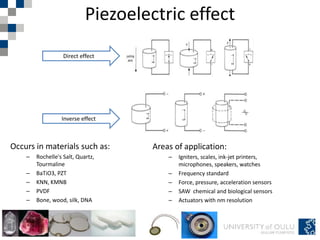
Piezoelectric effect
Occurs in materials such as:
– Rochelle's Salt, Quartz,
Tourmaline
– BaTiO3, PZT
– KNN, KMNB
– PVDF
– Bone, wood, silk, DNA
Areas of application:
– Igniters, scales, ink-jet printers,
microphones, speakers, watches
– Frequency standard
– Force, pressure, acceleration sensors
– SAW chemical and biological sensors
– Actuators with nm resolution
Direct effect
Inverse effect
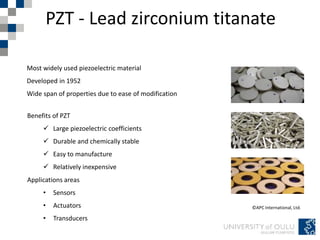
PZT - Lead zirconium titanate
©APC International, Ltd.
Most widely used piezoelectric material
Developed in 1952
Wide span of properties due to ease of modification
Benefits of PZT
 Large piezoelectric coefficients
 Durable and chemically stable
 Easy to manufacture
 Relatively inexpensive
Applications areas
• Sensors
• Actuators
• Transducers
Low Temperature Co-fired Ceramic
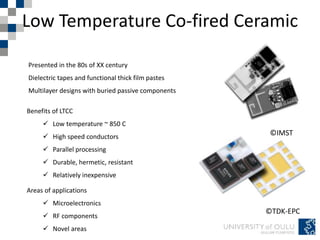
Presented in the 80s of XX century
Dielectric tapes and functional thick film pastes
Multilayer designs with buried passive components
Benefits of LTCC
 Low temperature ~ 850 C
 High speed conductors
 Parallel processing
 Durable, hermetic, resistant
 Relatively inexpensive
©TDK-EPC
©IMST
Areas of applications
 Microelectronics
 RF components
 Novel areas
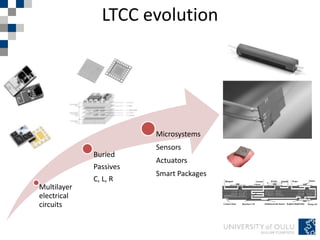
LTCC evolution
Multilayer
electrical
circuits
Buried
Passives
C, L, R
Microsystems
Sensors
Actuators
Smart Packages
Objective of the thesis
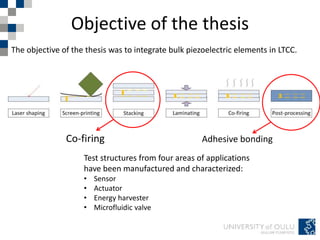
The objective of the thesis was to integrate bulk piezoelectric elements in LTCC.
Test structures from four areas of applications
have been manufactured and characterized:
• Sensor
• Actuator
• Energy harvester
• Microfluidic valve
Adhesive bondingCo-firing
Key results
Co-firing
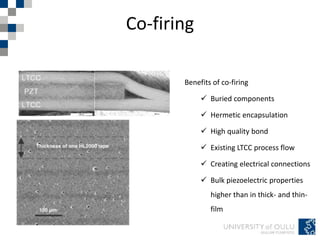
Benefits of co-firing
 Buried components
 Hermetic encapsulation
 High quality bond
 Existing LTCC process flow
 Creating electrical connections
 Bulk piezoelectric properties
higher than in thick- and thin-
film
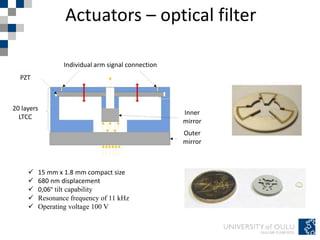
Actuators – optical filter
 15 mm x 1.8 mm compact size
 680 nm displacement
 0,06º tilt capability
 Resonance frequency of 11 kHz
 Operating voltage 100 V
Individual arm signal connection
PZT
20 layers
LTCC
Inner
mirror
Outer
mirror
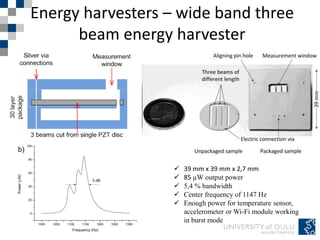
Energy harvesters – wide band three
beam energy harvester
 39 mm x 39 mm x 2,7 mm
 85 µW output power
 5,4 % bandwidth
 Center frequency of 1147 Hz
 Enough power for temperature sensor,
accelerometer or Wi-Fi module working
in burst mode
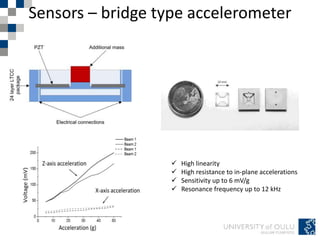
Sensors – bridge type accelerometer
 High linearity
 High resistance to in-plane accelerations
 Sensitivity up to 6 mV/g
 Resonance frequency up to 12 kHz
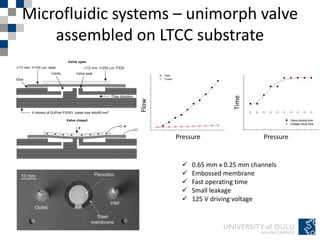
Microfluidic systems – unimorph valve
assembled on LTCC substrate
 0.65 mm x 0.25 mm channels
 Embossed membrane
 Fast operating time
 Small leakage
 125 V driving voltage
Pressure Pressure
Flow
Time
Conclusions
1. Integration of bulk piezoelectric structures and LTCC is
possible
2. Co-firing of bulk PZT structures proved to be efficient way of
integration that complements adhesive bonding.
3. LTCC works excellent as packaging for various piezoelectric
components providing housing and electric circuitry.
4. Integrated piezoelectric bulk components broaden the span
of LTCC applications.
5. Embedded bulk components can have better performance
than thin- or thick-film components on LTCC.
Acknowledgments
Infotech Oulu
Tekniikan Edistämissäätiö
Nokia Scholarship Foundation
Oulun yliopiston tukisäätiö
Thank You for Your attention

Lectio praecursoria New

  • 1.
    Embedding of bulkpiezoelectric structures in Low Temperature Co-fired Ceramic 19.12.2014 Maciej Julian Sobocinski maciej@ee.oulu.fi Lectio praecursoria
  • 2.
    Outline • Piezoelectric effect •Low Temperature Co-fired Ceramic • Objectives of the thesis • Key results • Conclusion
  • 3.
    Piezoelectric effect Occurs inmaterials such as: – Rochelle's Salt, Quartz, Tourmaline – BaTiO3, PZT – KNN, KMNB – PVDF – Bone, wood, silk, DNA Areas of application: – Igniters, scales, ink-jet printers, microphones, speakers, watches – Frequency standard – Force, pressure, acceleration sensors – SAW chemical and biological sensors – Actuators with nm resolution Direct effect Inverse effect
  • 4.
    PZT - Leadzirconium titanate ©APC International, Ltd. Most widely used piezoelectric material Developed in 1952 Wide span of properties due to ease of modification Benefits of PZT  Large piezoelectric coefficients  Durable and chemically stable  Easy to manufacture  Relatively inexpensive Applications areas • Sensors • Actuators • Transducers
  • 5.
    Low Temperature Co-firedCeramic Presented in the 80s of XX century Dielectric tapes and functional thick film pastes Multilayer designs with buried passive components Benefits of LTCC  Low temperature ~ 850 C  High speed conductors  Parallel processing  Durable, hermetic, resistant  Relatively inexpensive ©TDK-EPC ©IMST Areas of applications  Microelectronics  RF components  Novel areas
  • 6.
    LTCC evolution Multilayer electrical circuits Buried Passives C, L,R Microsystems Sensors Actuators Smart Packages
  • 7.
    Objective of thethesis The objective of the thesis was to integrate bulk piezoelectric elements in LTCC. Test structures from four areas of applications have been manufactured and characterized: • Sensor • Actuator • Energy harvester • Microfluidic valve Adhesive bondingCo-firing
  • 8.
  • 9.
    Co-firing Benefits of co-firing Buried components  Hermetic encapsulation  High quality bond  Existing LTCC process flow  Creating electrical connections  Bulk piezoelectric properties higher than in thick- and thin- film
  • 10.
    Actuators – opticalfilter  15 mm x 1.8 mm compact size  680 nm displacement  0,06º tilt capability  Resonance frequency of 11 kHz  Operating voltage 100 V Individual arm signal connection PZT 20 layers LTCC Inner mirror Outer mirror
  • 11.
    Energy harvesters –wide band three beam energy harvester  39 mm x 39 mm x 2,7 mm  85 µW output power  5,4 % bandwidth  Center frequency of 1147 Hz  Enough power for temperature sensor, accelerometer or Wi-Fi module working in burst mode
  • 12.
    Sensors – bridgetype accelerometer  High linearity  High resistance to in-plane accelerations  Sensitivity up to 6 mV/g  Resonance frequency up to 12 kHz
  • 13.
    Microfluidic systems –unimorph valve assembled on LTCC substrate  0.65 mm x 0.25 mm channels  Embossed membrane  Fast operating time  Small leakage  125 V driving voltage Pressure Pressure Flow Time
  • 14.
    Conclusions 1. Integration ofbulk piezoelectric structures and LTCC is possible 2. Co-firing of bulk PZT structures proved to be efficient way of integration that complements adhesive bonding. 3. LTCC works excellent as packaging for various piezoelectric components providing housing and electric circuitry. 4. Integrated piezoelectric bulk components broaden the span of LTCC applications. 5. Embedded bulk components can have better performance than thin- or thick-film components on LTCC.
  • 15.
    Acknowledgments Infotech Oulu Tekniikan Edistämissäätiö NokiaScholarship Foundation Oulun yliopiston tukisäätiö
  • 16.
    Thank You forYour attention

Editor's Notes

  • #3 I will start my presentation with a short introduction about the piezoelectric effect and Low Temperature Co-fired Ceramic – the two main cornerstones of my thesis. This will be followed by stating the objectives of the thesis and presenting key results and finished with drawing conclusions.
  • #4 Deduced that reverse effect should exist Proven by Curie brothers Many natural crystals and man-made materials. But also in bone, wood and DNA Over 100 years of research gave many applications from personal and home equipment, electronics to advanced scientific devices In conclusion piezoelectric effect is constantly present in our life
  • #5 Reasons which made PZT so popular include
  • #7 -started as an answer to growing number of chip interconectors -introcudction of burried passives made it possible to manufacture space saving Systems in a package -nowadays LTCC is being used to develop various
  • #8 -on one hand we could investigate usability of LTCC as advanced packageing method for piezoelectric components -on the other – introduce novel functionality to LTCC In the traditional process flow of LTCC manufacturing two methods of integration were chosen and