Taenia saginata
Beef tapeworm / Hookless
tapeworm
Taeniasis saginata
or
Beef tapeworm infection
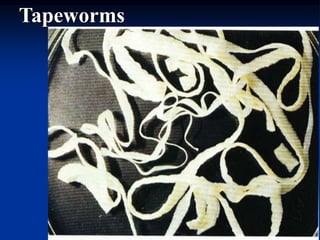
Tapeworms
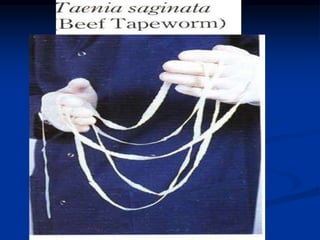
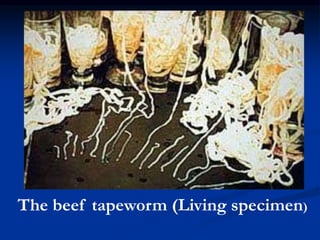
The beef tapeworm (Living specimen)
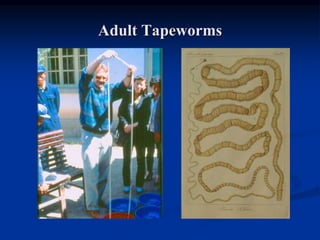
Adult Tapeworms
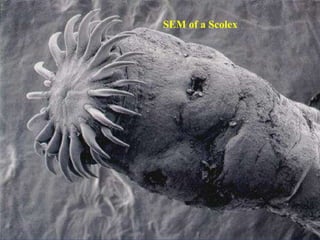
SEM of a Scolex
Epidemiology:
 These cestodes have a worldwide
distribution, but incidence is higher in
developing countries.
 Human infection follows consumption of
raw and undercooked beef.
 Cysticerci can be seen as shiny white spots
in infected beef on visual inspection.
 Former popular practice of prescribing
beef juice or raw beef for debilitated
persons responsible for many infections.
Epidemic factors:
1. Egg or gravid proglottid
contamination of grass and soil.
2. Method of raising domestic
animals.
3. Unhygienic dinning habit of
eating raw or undercooked meat.
Morphology:
 Adult habitat is in the middle third of small
intestine.
 T. saginata can be up to 4 - 6 meters long or
sometimes up to 24 meters and 12 mm
broad.
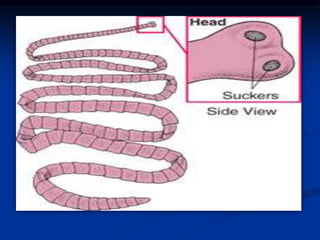
 It has a pear-shaped head (scolex) with
four suckers and a single apical depression,
but no hooks.
 It has a long flat body with 1000-2000
segments (proglottids), of them 1/3-1/2 are
nearly gravid.
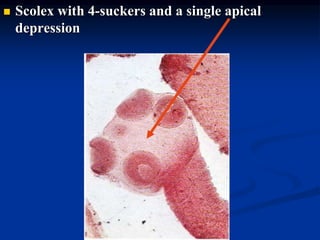
 Scolex with 4-suckers and a single apical
depression
 Only a single specimen
occurs in an infection, but
there may be more. Live
up to 10 years or more.
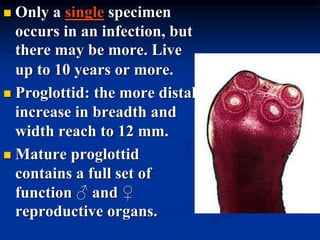
 Proglottid: the more distal
increase in breadth and
width reach to 12 mm.
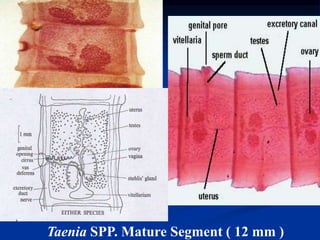
 Mature proglottid
contains a full set of
function ♂ and ♀
reproductive organs.
Taenia SPP. Mature Segment ( 12 mm )
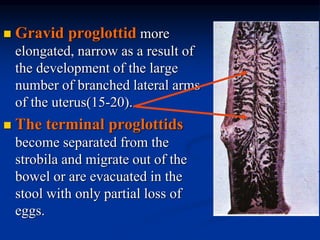
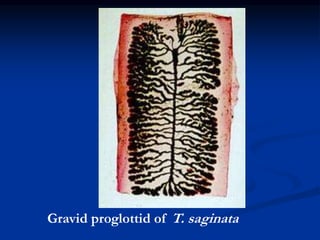
 Gravid proglottid more
elongated, narrow as a result of
the development of the large
number of branched lateral arms
of the uterus(15-20).
 The terminal proglottids
become separated from the
strobila and migrate out of the
bowel or are evacuated in the
stool with only partial loss of
eggs.
Gravid proglottid of T. saginata
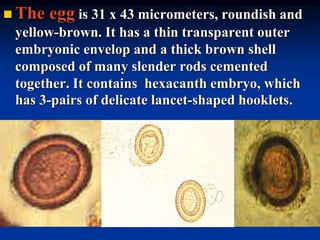
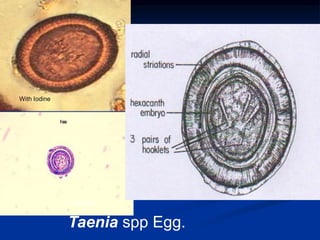
 The egg is 31 x 43 micrometers, roundish and
yellow-brown. It has a thin transparent outer
embryonic envelop and a thick brown shell
composed of many slender rods cemented
together. It contains hexacanth embryo, which
has 3-pairs of delicate lancet-shaped hooklets.
Taenia spp Egg.
With stain
With Iodine
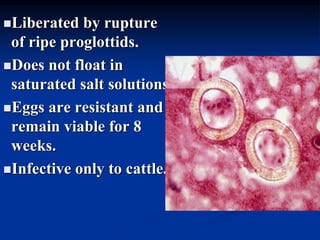
Liberated by rupture
of ripe proglottids.
Does not float in
saturated salt solutions.
Eggs are resistant and
remain viable for 8
weeks.
Infective only to cattle.
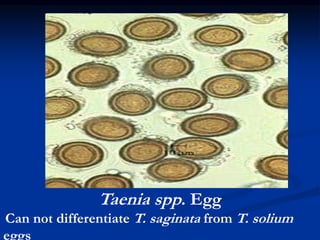
Taenia spp. Egg
Can not differentiate T. saginata from T. solium
eggs
Life cycle:
A tapeworm larval cyst (Cysticercus
bovis) is ingested with poorly cooked
infected meat.
The larva escapes the cyst and passes to
the small intestine (middle third of
intestine) where it attaches to the
mucosa by the scolex suckers.
 The proglottids develop as the worm
matures in 3 - 4 months. The adult may live
in the small intestine as long as 25 years and
pass gravid proglottids with the feces.
 Eggs extruded from the proglottid
contaminate and persist on vegetation for
several days and are consumed by cattle in
which they hatch and form cysticerci.
Man is the only natural definitive host
of T. saginata and the infection results from
eating raw beef.

2_2018_12_15!09_27_25_AM (1).ppt

  • 2.
    Taenia saginata Beef tapeworm/ Hookless tapeworm Taeniasis saginata or Beef tapeworm infection
  • 4.
  • 5.
    The beef tapeworm(Living specimen)
  • 6.
  • 9.
    SEM of aScolex
  • 10.
    Epidemiology:  These cestodeshave a worldwide distribution, but incidence is higher in developing countries.  Human infection follows consumption of raw and undercooked beef.  Cysticerci can be seen as shiny white spots in infected beef on visual inspection.  Former popular practice of prescribing beef juice or raw beef for debilitated persons responsible for many infections.
  • 11.
    Epidemic factors: 1. Eggor gravid proglottid contamination of grass and soil. 2. Method of raising domestic animals. 3. Unhygienic dinning habit of eating raw or undercooked meat.
  • 12.
    Morphology:  Adult habitatis in the middle third of small intestine.  T. saginata can be up to 4 - 6 meters long or sometimes up to 24 meters and 12 mm broad.  It has a pear-shaped head (scolex) with four suckers and a single apical depression, but no hooks.  It has a long flat body with 1000-2000 segments (proglottids), of them 1/3-1/2 are nearly gravid.
  • 14.
     Scolex with4-suckers and a single apical depression
  • 15.
     Only asingle specimen occurs in an infection, but there may be more. Live up to 10 years or more.  Proglottid: the more distal increase in breadth and width reach to 12 mm.  Mature proglottid contains a full set of function ♂ and ♀ reproductive organs.
  • 16.
    Taenia SPP. MatureSegment ( 12 mm )
  • 17.
     Gravid proglottidmore elongated, narrow as a result of the development of the large number of branched lateral arms of the uterus(15-20).  The terminal proglottids become separated from the strobila and migrate out of the bowel or are evacuated in the stool with only partial loss of eggs.
  • 18.
  • 19.
     The eggis 31 x 43 micrometers, roundish and yellow-brown. It has a thin transparent outer embryonic envelop and a thick brown shell composed of many slender rods cemented together. It contains hexacanth embryo, which has 3-pairs of delicate lancet-shaped hooklets.
  • 20.
    Taenia spp Egg. Withstain With Iodine
  • 21.
    Liberated by rupture ofripe proglottids. Does not float in saturated salt solutions. Eggs are resistant and remain viable for 8 weeks. Infective only to cattle.
  • 22.
    Taenia spp. Egg Cannot differentiate T. saginata from T. solium eggs
  • 23.
    Life cycle: A tapewormlarval cyst (Cysticercus bovis) is ingested with poorly cooked infected meat. The larva escapes the cyst and passes to the small intestine (middle third of intestine) where it attaches to the mucosa by the scolex suckers.
  • 24.
     The proglottidsdevelop as the worm matures in 3 - 4 months. The adult may live in the small intestine as long as 25 years and pass gravid proglottids with the feces.  Eggs extruded from the proglottid contaminate and persist on vegetation for several days and are consumed by cattle in which they hatch and form cysticerci. Man is the only natural definitive host of T. saginata and the infection results from eating raw beef.