Queues and Linked Lists 
Queues 
Linked Lists 
Double-Ended Queues
Queues 
… 
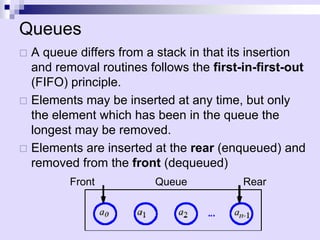
A queue differs from a stack in that its insertion and removal routines follows the first-in-first-out(FIFO) principle. 
… 
Elements may be inserted at any time, but only the element which has been in the queue the longest may be removed. 
… 
Elements are inserted at the rear(enqueued) and removed from the front(dequeued) 
Front 
Rear 
Queue
Queues (2) 
„ 
The queuesupports three fundamental methods: 
… 
New():ADT –Creates an empty queue 
… 
Enqueue(S:ADT, o:element):ADT -Inserts object o at the rear of the queue 
… 
Dequeue(S:ADT):ADT-Removes the object from the front of the queue; an error occurs if the queue is empty 
… 
Front(S:ADT):element -Returns, but does not remove, the front element; an error occurs if the queue is empty
Queues (3) 
„These support methods should also be defined: 
… 
Size(S:ADT):integer 
… 
IsEmpty(S:ADT):boolean 
„ 
Axioms: 
… 
Front(Enqueue(New(), v))= v 
… 
Dequeque(Enqueue(New(), v)) = New() 
… 
Front(Enqueue(Enqueue(Q, w), v)) = Front(Enqueue(Q, w)) 
… 
Dequeue(Enqueue(Enqueue(Q, w), v)) = Enqueue(Dequeue(Enqueue(Q, w)), v)
An Array Implementation 
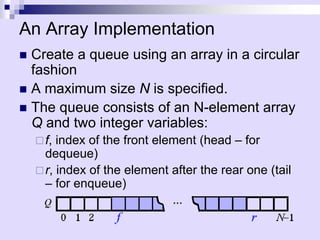
„Create a queue using an array in a circular fashion 
„ 
A maximum size N is specified. 
„ 
The queue consists of an N-element array Q and two integer variables: 
… 
f, index of the front element (head –for dequeue) 
… 
r, index of the element after the rear one (tail –for enqueue)
An Array Implementation (2) 
„“wrapped around” configuration 
„ 
what does f=r mean?
An Array Implementation (3) 
„Pseudo code 
Algorithm size() return(N-f+r) mod N 
Algorithm isEmpty() return(f=r) 
Algorithm front() ifisEmpty() thenreturnQueueemptyexceptionreturnQ[f] 
Algorithm dequeue() ifisEmpty() thenreturn QueueemptyexceptionQ[f] ←nullf←(f+1)modN 
Algorithm enqueue(o) ifsize = N -1 thenreturnQueuefullexceptionQ[r]←or←(r +1)modN
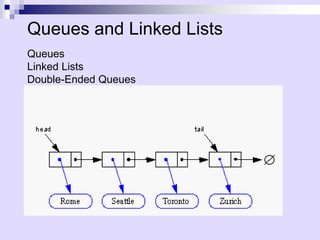
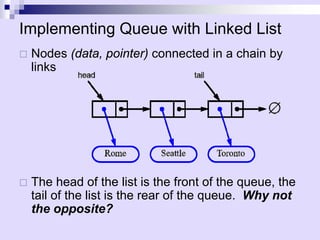
…Nodes (data, pointer)connected in a chain by links 
… 
The head of the list is the front of the queue, the tail of the list is the rear of the queue. Why not the opposite? 
Implementing Queue with Linked List
… 
Dequeue -advance head reference 
… 
Inserting at the head is just as easy 
Linked List Implementation
…Enqueue -create a new node at the tail 
… 
chain it and move the tail reference 
… 
How about removing at the tail? 
Linked List Implementation (2)
Double-Ended Queue 
…A double-ended queue, or deque, supports insertionand deletion from the front and back 
… 
The deque supports six fundamental methods 
… 
InsertFirst(S:ADT, o:element):ADT -Inserts eat the beginning of deque 
… 
InsertLast(S:ADT, o:element):ADT -Inserts eat end of deque 
… 
RemoveFirst(S:ADT):ADT–Removes the first element 
… 
RemoveLast(S:ADT):ADT–Removes the last element 
… 
First(S:ADT):element and Last(S:ADT):element – Returns the first and the last elements
Doubly Linked Lists 
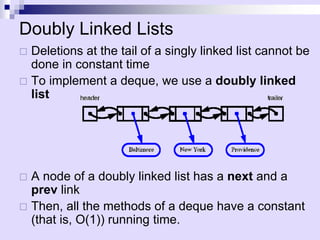
…Deletions at the tail of a singly linked list cannot be done in constant time 
… 
To implement a deque, we use a doubly linked list 
… 
A node of a doubly linked list has a nextand a prevlink 
… 
Then, all the methods of a deque have a constant (that is, O(1)) running time.
Doubly Linked Lists (2) 
…When implementing a doubly linked lists, we addtwo special nodes to the ends of the lists: the headerand trailer nodes 
… 
The header node goes before the first list element.It has a valid next link but a null prev link. 
… 
The trailer node goes after the last element. It has avalid prev reference but a null next reference. 
… 
The header and trailer nodes are sentinelor“dummy” nodes because they do not store elements
Stacks with Deques 
„Implementing ADTs using implementations of other ADTs as building blocks 
Stack Method 
Deque Implementation 
size() 
size() 
isEmpty() 
isEmpty() 
top() 
last() 
push(o) 
insertLast(o) 
pop() 
removeLast()
Queues with Deques 
Queue Method 
Deque Implementation 
size() 
size() 
isEmpty() 
isEmpty() 
front() 
first() 
enqueue(o) 
insertLast(o) 
dequeue() 
removeFirst()
The Adaptor Pattern 
…Using a deque to implement a stack or queue is an example of the adaptor pattern. Adaptor patterns implement a class by using methods of another class 
…In general, adaptor classes specialize general classes 
… 
Two such applications 
…Specialize a general class by changing some methods eg implementing a stack with a deque. 
…Specialize the types of objects used by a general class eg defining an IntegerArrayStackclass that adapts ArrayStackto only store integers.
Circular Lists 
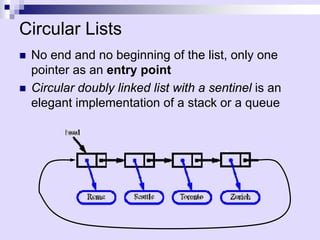
„No end and no beginning of the list, only one pointer as an entry point 
„ 
Circular doubly linked list with a sentinelis an elegant implementation of a stack or a queue
Sequences 
„Vectors 
„ 
Positions 
„ 
Lists 
„ 
General Sequences
The Vector ADT 
A sequence S (with n elements) that supports the following methods: 
… 
elemAtRank(r):Return the element of S with rank r; an error occurs if r < 0 or r > n -1 
… 
replaceAtRank(r,e):Replace the element at rank r with e and return the old element; an error condition occurs if r < 0 or r > n -1 
… 
insertAtRank(r,e):Insert a new element into S which will have rank r; an error occurs if r< 0 or r > n 
… 
removeAtRank(r):Remove from S the element at rank r; an error occurs if r < 0 or r > n -1
Array-Based Implementation 
Algorithm insertAtRank(r,e): 
for i= n –1downto rdo 
S[i+1] ←S[i] 
S[r] ←e 
n ←n + 1 
Algorithm removeAtRank(r): 
e ←S[r] 
for i = rto n -2do 
S[i] ←S[i + 1] 
n ←n -1 
return
Array-Based Implementation (contd.) 
Time complexity of the various methods:
Implem. with a Doubly Linked List 
the list before insertion 
creating a new node for insertion: 
the list after insertion
public void insertAtRank(int rank, Object element) 
throws BoundaryViolationException{ 
if (rank< 0 || rank> size()) 
throw new BoundaryViolationException(“invalid rank”); 
DLNode next= nodeAtRank(rank); 
// the new node will be right before this 
DLNode prev= next.getPrev(); 
// the new node will be right after this 
DLNode node= new DLNode(element, prev, next); 
// new node knows about its next & prev. 
// Now we tell next & prev about the new node. 
next.setPrev(node); 
prev.setNext(node); 
size++; 
} 
Java Implementation
Implementation with a Doubly Linked List 
the list before deletion 
deleting a node 
after deletion
Java Implementation 
public Object removeAtRank(int rank) 
throws BoundaryViolationException{ 
if (rank< 0 || rank> size()-1) 
throw new BoundaryViolationException(“Invalid rank.”); 
DLNode node= nodeAtRank(rank); // node to be removed 
DLNode next= node.getNext(); // node before itDLNode prev= node.getPrev(); // node after it 
prev.setNext(next); 
next.setPrev(prev); 
size--; 
return node.getElement(); 
// returns the element of the deleted node 
}
Java Implementation (contd.) 
private DLNode nodeAtRank(int rank) { 
//auxiliary method to find node of element with given rank 
DLNodenode; 
if (rank<= size()/2) { //scan forward from head 
node= header.getNext(); 
for (int i=0; i< rank; i++) 
node= node.getNext(); 
} else { //scan backward from the tail 
node= trailer.getPrev(); 
for (int i=0; i< size()-rank-1 ; i++) 
node= node.getPrev(); 
} 
return node; 
}
Nodes 
…Linked lists support the efficient execution of node-based operations: 
… 
removeAtNode(Node v) andinsertAfterNode(Node v, Object e), would be O(1). 
… 
However, node-based operations are not meaningful in an array-based implementation because there are no nodes in an array. 
… 
Nodes are implementation-specific. 
… 
Dilemma: 
… 
If we do not define node based operations, we are not taking full advantage of doubly-linked lists. 
… 
If we do define them, we violate the generality of ADTs.
From Nodes to Positions 
…We introduce the PositionADT 
… 
Intuitive notion of “place” of an element. 
… 
Positions have only one method: element(): Returns the element at this position 
… 
Positions are defined relative to other positions (before/after relation) 
… 
Positions are not tied to an element or rank
The List ADT 
…ADT with position-based methods 
… 
generic methods: size(), isEmpty() 
… 
query methods: isFirst(p), isLast(p) 
… 
accessor methods: first(), last(), before(p), after(p) 
… 
update methods 
… 
swapElements(p,q), replaceElement(p,e) 
… 
insertFirst(e), insertLast(e) 
… 
insertBefore(p,e), insertAfter(p,e) 
… 
remove(p) 
… 
each method takes O(1) time if implemented with a doubly linked list
The Sequence ADT 
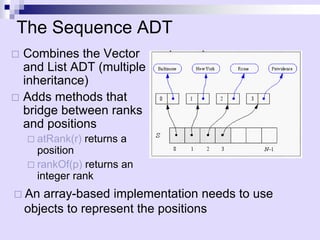
…Combines the Vector and List ADT (multiple inheritance) 
… 
Adds methods that bridge between ranks and positions 
… 
atRank(r) returns a position 
… 
rankOf(p)returns an integer rank 
… 
An array-based implementation needs to use 
objects to represent the positions
Comparison of Sequence Implementations
Iterators 
…Abstraction of the process of scanning through a collection of elements 
… 
Encapsulates the notions of “place” and “next” 
… 
Extends the position ADT 
… 
Generic and specialized iterators 
… 
ObjectIterator: hasNext(), nextObject(), object() 
… 
PositionIterator:nextPosition() 
… 
Useful methods that return iterators: elements(), positions()

Lec3

  • 1.
    Queues and LinkedLists Queues Linked Lists Double-Ended Queues
  • 2.
    Queues … Aqueue differs from a stack in that its insertion and removal routines follows the first-in-first-out(FIFO) principle. … Elements may be inserted at any time, but only the element which has been in the queue the longest may be removed. … Elements are inserted at the rear(enqueued) and removed from the front(dequeued) Front Rear Queue
  • 3.
    Queues (2) „ The queuesupports three fundamental methods: … New():ADT –Creates an empty queue … Enqueue(S:ADT, o:element):ADT -Inserts object o at the rear of the queue … Dequeue(S:ADT):ADT-Removes the object from the front of the queue; an error occurs if the queue is empty … Front(S:ADT):element -Returns, but does not remove, the front element; an error occurs if the queue is empty
  • 4.
    Queues (3) „Thesesupport methods should also be defined: … Size(S:ADT):integer … IsEmpty(S:ADT):boolean „ Axioms: … Front(Enqueue(New(), v))= v … Dequeque(Enqueue(New(), v)) = New() … Front(Enqueue(Enqueue(Q, w), v)) = Front(Enqueue(Q, w)) … Dequeue(Enqueue(Enqueue(Q, w), v)) = Enqueue(Dequeue(Enqueue(Q, w)), v)
  • 5.
    An Array Implementation „Create a queue using an array in a circular fashion „ A maximum size N is specified. „ The queue consists of an N-element array Q and two integer variables: … f, index of the front element (head –for dequeue) … r, index of the element after the rear one (tail –for enqueue)
  • 6.
    An Array Implementation(2) „“wrapped around” configuration „ what does f=r mean?
  • 7.
    An Array Implementation(3) „Pseudo code Algorithm size() return(N-f+r) mod N Algorithm isEmpty() return(f=r) Algorithm front() ifisEmpty() thenreturnQueueemptyexceptionreturnQ[f] Algorithm dequeue() ifisEmpty() thenreturn QueueemptyexceptionQ[f] ←nullf←(f+1)modN Algorithm enqueue(o) ifsize = N -1 thenreturnQueuefullexceptionQ[r]←or←(r +1)modN
  • 8.
    …Nodes (data, pointer)connectedin a chain by links … The head of the list is the front of the queue, the tail of the list is the rear of the queue. Why not the opposite? Implementing Queue with Linked List
  • 9.
    … Dequeue -advancehead reference … Inserting at the head is just as easy Linked List Implementation
  • 10.
    …Enqueue -create anew node at the tail … chain it and move the tail reference … How about removing at the tail? Linked List Implementation (2)
  • 11.
    Double-Ended Queue …Adouble-ended queue, or deque, supports insertionand deletion from the front and back … The deque supports six fundamental methods … InsertFirst(S:ADT, o:element):ADT -Inserts eat the beginning of deque … InsertLast(S:ADT, o:element):ADT -Inserts eat end of deque … RemoveFirst(S:ADT):ADT–Removes the first element … RemoveLast(S:ADT):ADT–Removes the last element … First(S:ADT):element and Last(S:ADT):element – Returns the first and the last elements
  • 12.
    Doubly Linked Lists …Deletions at the tail of a singly linked list cannot be done in constant time … To implement a deque, we use a doubly linked list … A node of a doubly linked list has a nextand a prevlink … Then, all the methods of a deque have a constant (that is, O(1)) running time.
  • 13.
    Doubly Linked Lists(2) …When implementing a doubly linked lists, we addtwo special nodes to the ends of the lists: the headerand trailer nodes … The header node goes before the first list element.It has a valid next link but a null prev link. … The trailer node goes after the last element. It has avalid prev reference but a null next reference. … The header and trailer nodes are sentinelor“dummy” nodes because they do not store elements
  • 15.
    Stacks with Deques „Implementing ADTs using implementations of other ADTs as building blocks Stack Method Deque Implementation size() size() isEmpty() isEmpty() top() last() push(o) insertLast(o) pop() removeLast()
  • 16.
    Queues with Deques Queue Method Deque Implementation size() size() isEmpty() isEmpty() front() first() enqueue(o) insertLast(o) dequeue() removeFirst()
  • 17.
    The Adaptor Pattern …Using a deque to implement a stack or queue is an example of the adaptor pattern. Adaptor patterns implement a class by using methods of another class …In general, adaptor classes specialize general classes … Two such applications …Specialize a general class by changing some methods eg implementing a stack with a deque. …Specialize the types of objects used by a general class eg defining an IntegerArrayStackclass that adapts ArrayStackto only store integers.
  • 18.
    Circular Lists „Noend and no beginning of the list, only one pointer as an entry point „ Circular doubly linked list with a sentinelis an elegant implementation of a stack or a queue
  • 22.
    Sequences „Vectors „ Positions „ Lists „ General Sequences
  • 23.
    The Vector ADT A sequence S (with n elements) that supports the following methods: … elemAtRank(r):Return the element of S with rank r; an error occurs if r < 0 or r > n -1 … replaceAtRank(r,e):Replace the element at rank r with e and return the old element; an error condition occurs if r < 0 or r > n -1 … insertAtRank(r,e):Insert a new element into S which will have rank r; an error occurs if r< 0 or r > n … removeAtRank(r):Remove from S the element at rank r; an error occurs if r < 0 or r > n -1
  • 24.
    Array-Based Implementation AlgorithminsertAtRank(r,e): for i= n –1downto rdo S[i+1] ←S[i] S[r] ←e n ←n + 1 Algorithm removeAtRank(r): e ←S[r] for i = rto n -2do S[i] ←S[i + 1] n ←n -1 return
  • 25.
    Array-Based Implementation (contd.) Time complexity of the various methods:
  • 26.
    Implem. with aDoubly Linked List the list before insertion creating a new node for insertion: the list after insertion
  • 27.
    public void insertAtRank(intrank, Object element) throws BoundaryViolationException{ if (rank< 0 || rank> size()) throw new BoundaryViolationException(“invalid rank”); DLNode next= nodeAtRank(rank); // the new node will be right before this DLNode prev= next.getPrev(); // the new node will be right after this DLNode node= new DLNode(element, prev, next); // new node knows about its next & prev. // Now we tell next & prev about the new node. next.setPrev(node); prev.setNext(node); size++; } Java Implementation
  • 28.
    Implementation with aDoubly Linked List the list before deletion deleting a node after deletion
  • 29.
    Java Implementation publicObject removeAtRank(int rank) throws BoundaryViolationException{ if (rank< 0 || rank> size()-1) throw new BoundaryViolationException(“Invalid rank.”); DLNode node= nodeAtRank(rank); // node to be removed DLNode next= node.getNext(); // node before itDLNode prev= node.getPrev(); // node after it prev.setNext(next); next.setPrev(prev); size--; return node.getElement(); // returns the element of the deleted node }
  • 30.
    Java Implementation (contd.) private DLNode nodeAtRank(int rank) { //auxiliary method to find node of element with given rank DLNodenode; if (rank<= size()/2) { //scan forward from head node= header.getNext(); for (int i=0; i< rank; i++) node= node.getNext(); } else { //scan backward from the tail node= trailer.getPrev(); for (int i=0; i< size()-rank-1 ; i++) node= node.getPrev(); } return node; }
  • 31.
    Nodes …Linked listssupport the efficient execution of node-based operations: … removeAtNode(Node v) andinsertAfterNode(Node v, Object e), would be O(1). … However, node-based operations are not meaningful in an array-based implementation because there are no nodes in an array. … Nodes are implementation-specific. … Dilemma: … If we do not define node based operations, we are not taking full advantage of doubly-linked lists. … If we do define them, we violate the generality of ADTs.
  • 32.
    From Nodes toPositions …We introduce the PositionADT … Intuitive notion of “place” of an element. … Positions have only one method: element(): Returns the element at this position … Positions are defined relative to other positions (before/after relation) … Positions are not tied to an element or rank
  • 33.
    The List ADT …ADT with position-based methods … generic methods: size(), isEmpty() … query methods: isFirst(p), isLast(p) … accessor methods: first(), last(), before(p), after(p) … update methods … swapElements(p,q), replaceElement(p,e) … insertFirst(e), insertLast(e) … insertBefore(p,e), insertAfter(p,e) … remove(p) … each method takes O(1) time if implemented with a doubly linked list
  • 34.
    The Sequence ADT …Combines the Vector and List ADT (multiple inheritance) … Adds methods that bridge between ranks and positions … atRank(r) returns a position … rankOf(p)returns an integer rank … An array-based implementation needs to use objects to represent the positions
  • 35.
    Comparison of SequenceImplementations
  • 36.
    Iterators …Abstraction ofthe process of scanning through a collection of elements … Encapsulates the notions of “place” and “next” … Extends the position ADT … Generic and specialized iterators … ObjectIterator: hasNext(), nextObject(), object() … PositionIterator:nextPosition() … Useful methods that return iterators: elements(), positions()