CS231 Algorithms                                                                 Handout # 15
Prof. Lyn Turbak                                                               October 13, 2001
Wellesley College

                                      Linear Sorting
Reading: CLRS Ch. 8, CLR Ch. 9

The Best Worst-Case Running Time for Comparison-Based Sorts
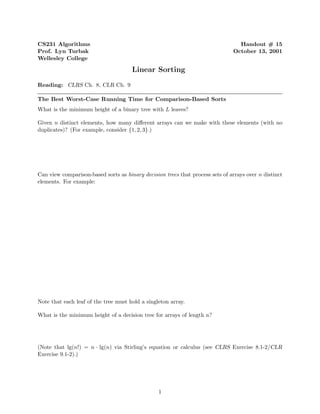
What is the minimum height of a binary tree with L leaves?

Given n distinct elements, how many different arrays can we make with these elements (with no
duplicates)? (For example, consider {1, 2, 3}.)


Can view comparison-based sorts as binary decision trees that process sets of arrays over n distinct
elements. For example:


Note that each leaf of the tree must hold a singleton array.

What is the minimum height of a decision tree for arrays of length n?


(Note that lg(n!) = n · lg(n) via Stirling’s equation or calculus (see CLRS Exercise 8.1-2/CLR
Exercise 9.1-2).)


                                                 1
Digression: Finding the Odd Nugget
Suppose you are given n nuggets, all of which have exactly the same weight, except for one “odd”
one, which may be slightly lighter or heavier than the rest. You are allowed to perform experiments
in which you compare the weights of two collections with k nuggets each: one collection may be <,
=, or > the other. How many experiments do you need to find the odd nugget?

   • Show via a counting argument that 3 experiments is not sufficient for finding the odd nugget
     when n = 14.


   • By case analysis on the first experiment, show via a counting argument that 3 experiments
     is not sufficient for finding the odd nugget when n = 13.


   • It is possible to find the odd nugget with 3 experiments when n = 12. This is left as an
     exercise for the reader.


                                                2
Linear Sorting Algorithms
All comparison-based sorting algorithms have worst-case time Ω(n · lg(n)).
Yet there are linear sorting algorithms – algorithms with worst-case time Θ(n). How can this be?
They’re not comparison-based! They take advantage of some feature of the input. E.g.:

   • The elements are integers in a restricted range, or easily convertible to integers in a restricted
     range (e.g., the letters of the alphabet).

   • The elements have a special probability distribution.


Integer Bucket Sort
Problem: sort n integers taken from the range 1..k.

Example: 4 2 6 3 2 4 2 6 1 2 4

Solution:

     Integer-Bucket-Sort(A,B,k)
          A is input array of length n
            containing keys in range [1..k].
          B is output array of length n.
       Count ← new array(k)
       for i ← 1 to k do
         Count[i] ← O
          Find count of each key in A.
       for j ← 1 to length[A] do
         Count[A[j]] <- Count[A[j]] + 1
          Read out result.
       j ← 1
       for p ← 1 to k do
         for q ← 1 to Count[p]
           B[j] ← p
           j ← j + 1


Can A be the same as B in this algorithm?


                                                  3
Counting Sort (a.k.a. Distribution Counting)
Integer bucket sort has a problem when there is satellite data. E.g., suppose (k, n) pairs a key k
with a satellite integer n:

          (4,1) (2,1) (6,1) (3,1) (2,2) (4,2) (2,3) (6,2) (1,1) (2,4) (4,3)

(Here, it happens that the satellite data for a particular key is sorted left to right, but that’s just
“coincidence”.)

     Counting-Sort(A,B,k)
          A is input array of length n
           containing keys in range [1..k].
          B is output array of length n.
       Count ← new array(k)
       for i ← 1 to k do
         Count[i] ← O
          Find count of each key in A.
       for j ← 1 to length[A] do
         Count[A[j]] <- Count[A[j]] + 1
          Find partial sums of key counts in A.
       for i ← 2 to k do
         Count[i] <- Count[i] + Count[i-1]
          Put elements in final position.
       for j ← length[A] downto 1 do
         B[Count[A[j]] <- A[j]
         Count[A[j]] <- Count[A[j]] - 1


Can A be the same as B in this algorithm?


How much time does Counting-Sort need?


How much space does Counting-Sort need?


Is Counting-Sort stable?


Would Counting-Sort be stable if the for j . . . loop counted up rather than down?


                                                  4
General Bucket Sort
Can’t use counting sort if keys aren’t integers in a given range. What if keys are real numbers in
a given range?
If keys are evenly distributed can use a general bucket sort:

     Step 1: Given n elements, make an array of n buckets, each of which contains an empty
         list.
     Step 2: Insert each element into the list of the bucket chosen by matching its key with
         the result of dividing the range into n equal-sized intervals
     Step3: Use any O(n2 ) sorting algorithm to sort the resulting lists in the buckets.
     Step 4: Read the elements from the lists in order back into the input array.

Example: Sorting 10 numbers between 0 and 1:

     .63
     .75
     .16
     .65
     .61
     .17
     .89
     .92
     .28
     .56


   • In the best case, there is one element per bucket, and running time is Θ(n).

   • In the worst case, all elements end up in same bucket and running time is Θ(n2 ).

   • Assuming evenly distributed keys, can use probability analysis to show average case running
     time is Θ(n). (See CLRS/CLR for details.)


                                                 5
Radix Sort
Problem: Suppose you have a machine that can perform a stable sort on the ith digit of a d-digit
number. How can you use the machine to sort a “pile” of n d-digit numbers?
Example:

        443
        124
        232
        431
        132
        123
        321
        211
        121
        441
        122
        442

To avoid lots of intermediate piles, process digits right-to-left, not left-to-right!

        Radix-Sort(A, d)
          for i ← 1 to d do
            Stable-Sort(A, i)        use digit i for comparison

Any stable sort will do. Counting-Sort is a good candidate since it’s Θ(n + k).
What is the running time for sorting n d-digit numbers, where digits are in the range [1..k]?


Note:

   • If d is constant and k = O(n), then running time of Radix-Sort is Θ(n).

   • In many applications, d = logk (n), so the sort ends up being Θ(n · logk (n)) for a given k.


                                                    6

Linear sorting

  • 1.
    CS231 Algorithms Handout # 15 Prof. Lyn Turbak October 13, 2001 Wellesley College Linear Sorting Reading: CLRS Ch. 8, CLR Ch. 9 The Best Worst-Case Running Time for Comparison-Based Sorts What is the minimum height of a binary tree with L leaves? Given n distinct elements, how many different arrays can we make with these elements (with no duplicates)? (For example, consider {1, 2, 3}.) Can view comparison-based sorts as binary decision trees that process sets of arrays over n distinct elements. For example: Note that each leaf of the tree must hold a singleton array. What is the minimum height of a decision tree for arrays of length n? (Note that lg(n!) = n · lg(n) via Stirling’s equation or calculus (see CLRS Exercise 8.1-2/CLR Exercise 9.1-2).) 1
  • 2.
    Digression: Finding theOdd Nugget Suppose you are given n nuggets, all of which have exactly the same weight, except for one “odd” one, which may be slightly lighter or heavier than the rest. You are allowed to perform experiments in which you compare the weights of two collections with k nuggets each: one collection may be <, =, or > the other. How many experiments do you need to find the odd nugget? • Show via a counting argument that 3 experiments is not sufficient for finding the odd nugget when n = 14. • By case analysis on the first experiment, show via a counting argument that 3 experiments is not sufficient for finding the odd nugget when n = 13. • It is possible to find the odd nugget with 3 experiments when n = 12. This is left as an exercise for the reader. 2
  • 3.
    Linear Sorting Algorithms Allcomparison-based sorting algorithms have worst-case time Ω(n · lg(n)). Yet there are linear sorting algorithms – algorithms with worst-case time Θ(n). How can this be? They’re not comparison-based! They take advantage of some feature of the input. E.g.: • The elements are integers in a restricted range, or easily convertible to integers in a restricted range (e.g., the letters of the alphabet). • The elements have a special probability distribution. Integer Bucket Sort Problem: sort n integers taken from the range 1..k. Example: 4 2 6 3 2 4 2 6 1 2 4 Solution: Integer-Bucket-Sort(A,B,k) A is input array of length n containing keys in range [1..k]. B is output array of length n. Count ← new array(k) for i ← 1 to k do Count[i] ← O Find count of each key in A. for j ← 1 to length[A] do Count[A[j]] <- Count[A[j]] + 1 Read out result. j ← 1 for p ← 1 to k do for q ← 1 to Count[p] B[j] ← p j ← j + 1 Can A be the same as B in this algorithm? 3
  • 4.
    Counting Sort (a.k.a.Distribution Counting) Integer bucket sort has a problem when there is satellite data. E.g., suppose (k, n) pairs a key k with a satellite integer n: (4,1) (2,1) (6,1) (3,1) (2,2) (4,2) (2,3) (6,2) (1,1) (2,4) (4,3) (Here, it happens that the satellite data for a particular key is sorted left to right, but that’s just “coincidence”.) Counting-Sort(A,B,k) A is input array of length n containing keys in range [1..k]. B is output array of length n. Count ← new array(k) for i ← 1 to k do Count[i] ← O Find count of each key in A. for j ← 1 to length[A] do Count[A[j]] <- Count[A[j]] + 1 Find partial sums of key counts in A. for i ← 2 to k do Count[i] <- Count[i] + Count[i-1] Put elements in final position. for j ← length[A] downto 1 do B[Count[A[j]] <- A[j] Count[A[j]] <- Count[A[j]] - 1 Can A be the same as B in this algorithm? How much time does Counting-Sort need? How much space does Counting-Sort need? Is Counting-Sort stable? Would Counting-Sort be stable if the for j . . . loop counted up rather than down? 4
  • 5.
    General Bucket Sort Can’tuse counting sort if keys aren’t integers in a given range. What if keys are real numbers in a given range? If keys are evenly distributed can use a general bucket sort: Step 1: Given n elements, make an array of n buckets, each of which contains an empty list. Step 2: Insert each element into the list of the bucket chosen by matching its key with the result of dividing the range into n equal-sized intervals Step3: Use any O(n2 ) sorting algorithm to sort the resulting lists in the buckets. Step 4: Read the elements from the lists in order back into the input array. Example: Sorting 10 numbers between 0 and 1: .63 .75 .16 .65 .61 .17 .89 .92 .28 .56 • In the best case, there is one element per bucket, and running time is Θ(n). • In the worst case, all elements end up in same bucket and running time is Θ(n2 ). • Assuming evenly distributed keys, can use probability analysis to show average case running time is Θ(n). (See CLRS/CLR for details.) 5
  • 6.
    Radix Sort Problem: Supposeyou have a machine that can perform a stable sort on the ith digit of a d-digit number. How can you use the machine to sort a “pile” of n d-digit numbers? Example: 443 124 232 431 132 123 321 211 121 441 122 442 To avoid lots of intermediate piles, process digits right-to-left, not left-to-right! Radix-Sort(A, d) for i ← 1 to d do Stable-Sort(A, i) use digit i for comparison Any stable sort will do. Counting-Sort is a good candidate since it’s Θ(n + k). What is the running time for sorting n d-digit numbers, where digits are in the range [1..k]? Note: • If d is constant and k = O(n), then running time of Radix-Sort is Θ(n). • In many applications, d = logk (n), so the sort ends up being Θ(n · logk (n)) for a given k. 6