AVL Trees
   AVL Trees


                1
Insertion
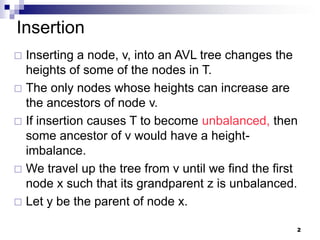
 Inserting a node, v, into an AVL tree changes the
  heights of some of the nodes in T.
 The only nodes whose heights can increase are
  the ancestors of node v.
 If insertion causes T to become unbalanced, then
  some ancestor of v would have a height-
  imbalance.
 We travel up the tree from v until we find the first
  node x such that its grandparent z is unbalanced.
 Let y be the parent of node x.

                                                     2
Insertion (2)
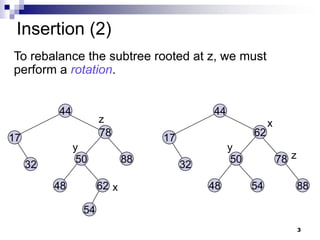
To rebalance the subtree rooted at z, we must
perform a rotation.


          44                                44
                      z                                     x
17                    78          17                   62
               y                                 y
                50           88                   50            78 z
     32                                32

          48          62 x                  48         54              88

                 54
                                                                       3
Rotations
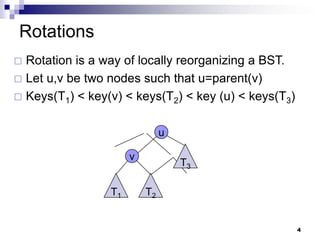
 Rotation is a way of locally reorganizing a BST.
 Let u,v be two nodes such that u=parent(v)
 Keys(T1) < key(v) < keys(T2) < key (u) < keys(T3)


                               u

                      v
                                   T3

                 T1       T2


                                                      4
Insertion
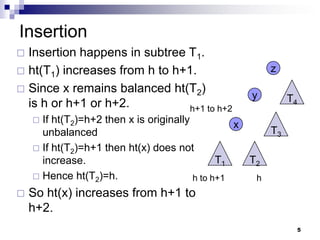
 Insertion happens in subtree T1.
 ht(T1) increases from h to h+1.                          z
 Since x remains balanced ht(T2)
                                                      y         T4
  is h or h+1 or h+2.           h+1 to h+2
     If ht(T2)=h+2 then x is originally          x
      unbalanced                                           T3
     If ht(T2)=h+1 then ht(x) does not
      increase.                                T1     T2
     Hence ht(T2)=h.                    h to h+1      h
   So ht(x) increases from h+1 to
    h+2.
                                                                 5
Insertion(2)
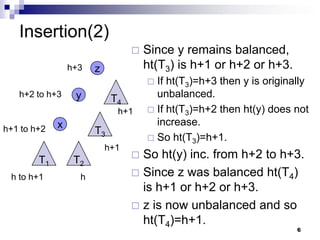
                                    Since y remains balanced,
                 h+3   z             ht(T3) is h+1 or h+2 or h+3.
                                      If ht(T3)=h+3 then y is originally
   h+2 to h+3     y         T4         unbalanced.
                             h+1      If ht(T3)=h+2 then ht(y) does not
             x                         increase.
h+1 to h+2             T3
                                      So ht(T3)=h+1.
                           h+1
        T1        T2              So ht(y) inc. from h+2 to h+3.
 h to h+1          h              Since z was balanced ht(T4)
                                   is h+1 or h+2 or h+3.
                                  z is now unbalanced and so
                                   ht(T4)=h+1.
                                                                      6
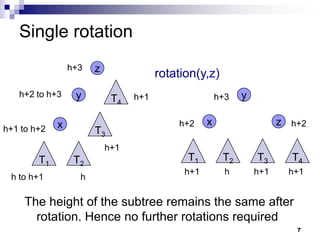
Single rotation
                 h+3   z
                                       rotation(y,z)
   h+2 to h+3     y              h+1                  h+3   y
                            T4

             x                             h+2    x                   z h+2
h+1 to h+2             T3
                           h+1
        T1        T2                         T1        T2       T3      T4
                                            h+1         h       h+1     h+1
 h to h+1          h

     The height of the subtree remains the same after
       rotation. Hence no further rotations required
                                                                         7
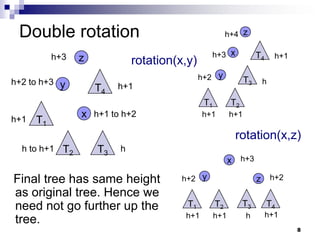
Double rotation                                         h+4 z

           h+3   z                              h+3 x                T4       h+1
                              rotation(x,y)
                                              h+2 y             T3
h+2 to h+3 y                                                             h
                     T4   h+1
                                               T1         T2
                 x h+1 to h+2                 h+1         h+1
h+1   T1
                                                              rotation(x,z)
  h to h+1 T2        T3   h
                                                          x    h+3

Final tree has same height              h+2 y                        z       h+2

as original tree. Hence we
need not go further up the               T1         T2         T3         T4
                                        h+1         h+1         h         h+1
tree.
                                                                                    8
Restructuring
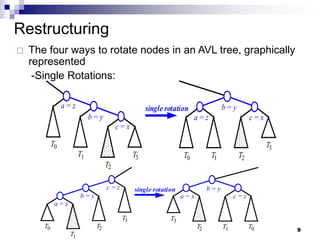
   The four ways to rotate nodes in an AVL tree, graphically
    represented
     -Single Rotations:

                 a=z                               single rotation               b=y
                             b=y                                     a=z                    c=x
                                        c=x

            T0                                                                                    T3
                        T1                    T3                T0          T1         T2
                                   T2

                                   c=z        single rotation              b=y
                        b=y                                     a=x                   c=z
             a=x

                                         T3                T3
       T0                     T2                                      T2         T1         T0         9
                   T1
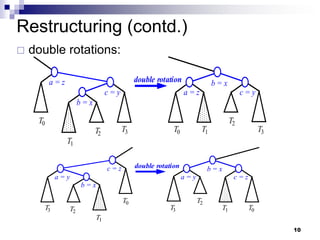
Restructuring (contd.)
   double rotations:

           a=z                              double rotation               b=x
                                 c=y                          a=z                     c=y
                      b=x

     T0                                                                          T2
                            T2         T3                T0          T1                      T3
                 T1


                                 c=z        double rotation              b=x
               a=y                                            a=y                 c=z
                      b=x

                                       T0                           T2
          T3     T2                                    T3                   T1          T0
                            T1
                                                                                                  10
Deletion
 When   deleting a node in a BST, we either
  delete a leaf or a node with only one child.
 In an AVL tree if a node has only one child
  then that child is a leaf.
 Hence in an AVL tree we either delete a
  leaf or the parent of a leaf.
 Hence deletion can be assumed to be at a
  leaf.

                                             11
Deletion(2)
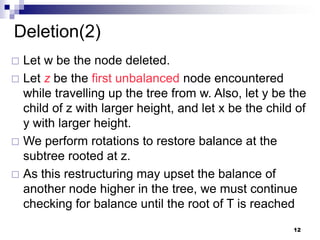
 Let w be the node deleted.
 Let z be the first unbalanced node encountered
  while travelling up the tree from w. Also, let y be the
  child of z with larger height, and let x be the child of
  y with larger height.
 We perform rotations to restore balance at the
  subtree rooted at z.
 As this restructuring may upset the balance of
  another node higher in the tree, we must continue
  checking for balance until the root of T is reached
                                                       12
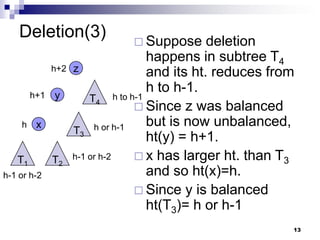
Deletion(3)                 Suppose       deletion
                                    happens in subtree T4
              h+2   z               and its ht. reduces from
        h+1   y
                                    h to h-1.
                        T4 h to h-1
                                   Since z was balanced
    h    x               h or h-1   but is now unbalanced,
                    T3
                                    ht(y) = h+1.
   T1         T2    h-1 or h-2     x has larger ht. than T3
h-1 or h-2                          and so ht(x)=h.
                                   Since y is balanced
                                    ht(T3)= h or h-1
                                                           13
Deletion(4)
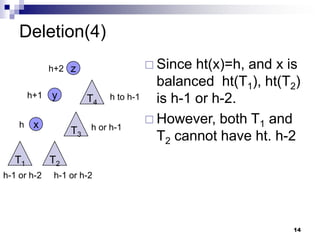
              h+2 z                    Since  ht(x)=h, and x is
                                        balanced ht(T1), ht(T2)
        h+1   y       T4   h to h-1     is h-1 or h-2.
    h    x                             However, both T1 and
                   T3 h or h-1
                                        T2 cannot have ht. h-2
   T1         T2
h-1 or h-2    h-1 or h-2


                                                              14
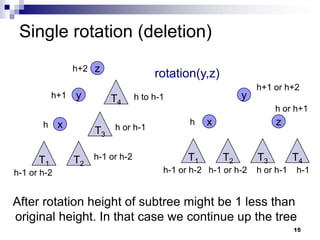
Single rotation (deletion)
                 h+2 z
                                      rotation(y,z)
                                                                h+1 or h+2
           h+1   y        T4     h to h-1                   y
                                                                     h or h+1
       h     x            h or h-1
                                              h    x                 z
                     T3

      T1         T2 h-1 or h-2                T1       T2       T3         T4
h-1 or h-2                              h-1 or h-2 h-1 or h-2   h or h-1   h-1


After rotation height of subtree might be 1 less than
original height. In that case we continue up the tree
                                                                           15
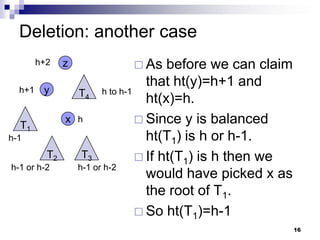
Deletion: another case
        h+2    z             As     before we can claim
                                 that ht(y)=h+1 and
  h+1    y         T4 h to h-1
                                 ht(x)=h.
  T1
               x   h            Since y is balanced
h-1                              ht(T1) is h or h-1.
          T2        T3          If ht(T1) is h then we
h-1 or h-2         h-1 or h-2
                                 would have picked x as
                                 the root of T1.
                                So ht(T1)=h-1
                                                           16
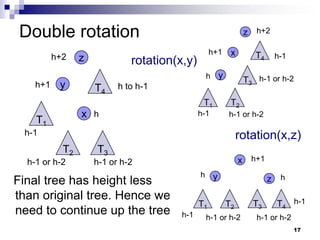
Double rotation                                                       z    h+2

                                                   h+1         x           T4        h-1
          h+2    z            rotation(x,y)
                                                  h       y
                                                                       T3 h-1 or h-2
    h+1    y         T4    h to h-1
                                               T1              T2
                 x h                          h-1             h-1 or h-2
    T1
 h-1                                                               rotation(x,z)
            T2       T3
  h-1 or h-2         h-1 or h-2                                    x       h+1

                                              h       y                               h
Final tree has height less                                                       z
than original tree. Hence we
                                              T1              T2           T3        T4 h-1
need to continue up the tree            h-1       h-1 or h-2                h-1 or h-2
                                                                                           17
Running time of insertion & deletion
 Insertion
   We  perform rotation only once but might have to
    go O(log n) levels to find the unbalanced node.
   So time for insertion is O(log n)

 Deletion
   We  need O(log n) time to delete a node.
   Rebalancing also requires O(log n) time.
   More than one rotation may have to be
    performed.
                                                 18

Lec12

  • 1.
    AVL Trees  AVL Trees 1
  • 2.
    Insertion  Inserting anode, v, into an AVL tree changes the heights of some of the nodes in T.  The only nodes whose heights can increase are the ancestors of node v.  If insertion causes T to become unbalanced, then some ancestor of v would have a height- imbalance.  We travel up the tree from v until we find the first node x such that its grandparent z is unbalanced.  Let y be the parent of node x. 2
  • 3.
    Insertion (2) To rebalancethe subtree rooted at z, we must perform a rotation. 44 44 z x 17 78 17 62 y y 50 88 50 78 z 32 32 48 62 x 48 54 88 54 3
  • 4.
    Rotations  Rotation isa way of locally reorganizing a BST.  Let u,v be two nodes such that u=parent(v)  Keys(T1) < key(v) < keys(T2) < key (u) < keys(T3) u v T3 T1 T2 4
  • 5.
    Insertion  Insertion happensin subtree T1.  ht(T1) increases from h to h+1. z  Since x remains balanced ht(T2) y T4 is h or h+1 or h+2. h+1 to h+2  If ht(T2)=h+2 then x is originally x unbalanced T3  If ht(T2)=h+1 then ht(x) does not increase. T1 T2  Hence ht(T2)=h. h to h+1 h  So ht(x) increases from h+1 to h+2. 5
  • 6.
    Insertion(2)  Since y remains balanced, h+3 z ht(T3) is h+1 or h+2 or h+3.  If ht(T3)=h+3 then y is originally h+2 to h+3 y T4 unbalanced. h+1  If ht(T3)=h+2 then ht(y) does not x increase. h+1 to h+2 T3  So ht(T3)=h+1. h+1 T1 T2  So ht(y) inc. from h+2 to h+3. h to h+1 h  Since z was balanced ht(T4) is h+1 or h+2 or h+3.  z is now unbalanced and so ht(T4)=h+1. 6
  • 7.
    Single rotation h+3 z rotation(y,z) h+2 to h+3 y h+1 h+3 y T4 x h+2 x z h+2 h+1 to h+2 T3 h+1 T1 T2 T1 T2 T3 T4 h+1 h h+1 h+1 h to h+1 h The height of the subtree remains the same after rotation. Hence no further rotations required 7
  • 8.
    Double rotation h+4 z h+3 z h+3 x T4 h+1 rotation(x,y) h+2 y T3 h+2 to h+3 y h T4 h+1 T1 T2 x h+1 to h+2 h+1 h+1 h+1 T1 rotation(x,z) h to h+1 T2 T3 h x h+3 Final tree has same height h+2 y z h+2 as original tree. Hence we need not go further up the T1 T2 T3 T4 h+1 h+1 h h+1 tree. 8
  • 9.
    Restructuring  The four ways to rotate nodes in an AVL tree, graphically represented -Single Rotations: a=z single rotation b=y b=y a=z c=x c=x T0 T3 T1 T3 T0 T1 T2 T2 c=z single rotation b=y b=y a=x c=z a=x T3 T3 T0 T2 T2 T1 T0 9 T1
  • 10.
    Restructuring (contd.)  double rotations: a=z double rotation b=x c=y a=z c=y b=x T0 T2 T2 T3 T0 T1 T3 T1 c=z double rotation b=x a=y a=y c=z b=x T0 T2 T3 T2 T3 T1 T0 T1 10
  • 11.
    Deletion  When deleting a node in a BST, we either delete a leaf or a node with only one child.  In an AVL tree if a node has only one child then that child is a leaf.  Hence in an AVL tree we either delete a leaf or the parent of a leaf.  Hence deletion can be assumed to be at a leaf. 11
  • 12.
    Deletion(2)  Let wbe the node deleted.  Let z be the first unbalanced node encountered while travelling up the tree from w. Also, let y be the child of z with larger height, and let x be the child of y with larger height.  We perform rotations to restore balance at the subtree rooted at z.  As this restructuring may upset the balance of another node higher in the tree, we must continue checking for balance until the root of T is reached 12
  • 13.
    Deletion(3)  Suppose deletion happens in subtree T4 h+2 z and its ht. reduces from h+1 y h to h-1. T4 h to h-1  Since z was balanced h x h or h-1 but is now unbalanced, T3 ht(y) = h+1. T1 T2 h-1 or h-2  x has larger ht. than T3 h-1 or h-2 and so ht(x)=h.  Since y is balanced ht(T3)= h or h-1 13
  • 14.
    Deletion(4) h+2 z  Since ht(x)=h, and x is balanced ht(T1), ht(T2) h+1 y T4 h to h-1 is h-1 or h-2. h x  However, both T1 and T3 h or h-1 T2 cannot have ht. h-2 T1 T2 h-1 or h-2 h-1 or h-2 14
  • 15.
    Single rotation (deletion) h+2 z rotation(y,z) h+1 or h+2 h+1 y T4 h to h-1 y h or h+1 h x h or h-1 h x z T3 T1 T2 h-1 or h-2 T1 T2 T3 T4 h-1 or h-2 h-1 or h-2 h-1 or h-2 h or h-1 h-1 After rotation height of subtree might be 1 less than original height. In that case we continue up the tree 15
  • 16.
    Deletion: another case h+2 z  As before we can claim that ht(y)=h+1 and h+1 y T4 h to h-1 ht(x)=h. T1 x h  Since y is balanced h-1 ht(T1) is h or h-1. T2 T3  If ht(T1) is h then we h-1 or h-2 h-1 or h-2 would have picked x as the root of T1.  So ht(T1)=h-1 16
  • 17.
    Double rotation z h+2 h+1 x T4 h-1 h+2 z rotation(x,y) h y T3 h-1 or h-2 h+1 y T4 h to h-1 T1 T2 x h h-1 h-1 or h-2 T1 h-1 rotation(x,z) T2 T3 h-1 or h-2 h-1 or h-2 x h+1 h y h Final tree has height less z than original tree. Hence we T1 T2 T3 T4 h-1 need to continue up the tree h-1 h-1 or h-2 h-1 or h-2 17
  • 18.
    Running time ofinsertion & deletion  Insertion  We perform rotation only once but might have to go O(log n) levels to find the unbalanced node.  So time for insertion is O(log n)  Deletion  We need O(log n) time to delete a node.  Rebalancing also requires O(log n) time.  More than one rotation may have to be performed. 18