CSCD 300 Data Structures
Donald Shell’s Sorting Algorithm
Originally developed by Bill Clark, modified
by Tom Capaul and Tim Rolfe

1
Shell Sort - Introduction
More properly, Shell’s Sort
Created in 1959 by Donald Shell
Link to a local copy of the article:
Donald Shell, “A High-Speed Sorting
Procedure”, Communications of the ACM
Vol 2, No. 7 (July 1959), 30-32
Originally Shell built his idea on top of
Bubble Sort (link to article flowchart),
but it has since been transported over to
Insertion Sort.
2
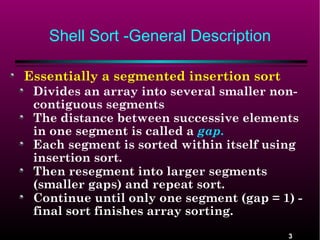
Shell Sort -General Description
Essentially a segmented insertion sort
Divides an array into several smaller noncontiguous segments
The distance between successive elements
in one segment is called a gap.
Each segment is sorted within itself using
insertion sort.
Then resegment into larger segments
(smaller gaps) and repeat sort.
Continue until only one segment (gap = 1) final sort finishes array sorting.
3
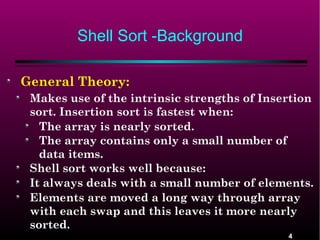
Shell Sort -Background
General Theory:
Makes use of the intrinsic strengths of Insertion
sort. Insertion sort is fastest when:
The array is nearly sorted.
The array contains only a small number of
data items.
Shell sort works well because:
It always deals with a small number of elements.
Elements are moved a long way through array
with each swap and this leaves it more nearly
sorted.
4
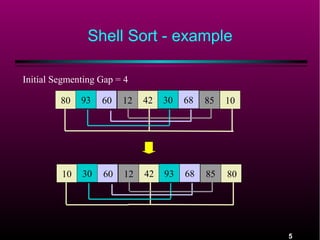
Shell Sort - example
Initial Segmenting Gap = 4
80

93

60

12

42

30

68

85

10

10

30

60

12

42

93

68

85

80

5
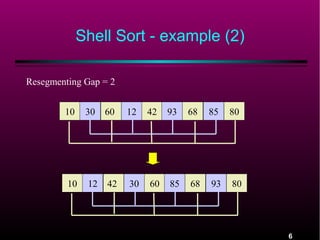
Shell Sort - example (2)
Resegmenting Gap = 2
10

30

60

12

42

93

68

85

80

10

12

42

30

60

85

68

93

80

6
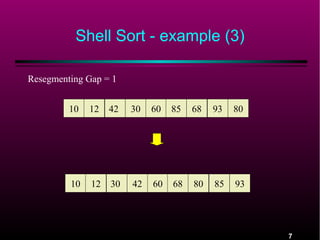
Shell Sort - example (3)
Resegmenting Gap = 1
10

12

42

30

60

85

68

93

80

10

12

30

42

60

68

80

85

93

7
Gap Sequences for Shell Sort
The sequence h1, h2, h3,. . . , ht is a sequence of
increasing integer values which will be used as
a sequence (from right to left) of gap values.
Any sequence will work as long as it is increasing
and h1 = 1.

For any gap value hk we have A[i] <= A[i + hk]
An array A for which this is true is hk sorted.
An array which is hk sorted and is then hk-1
sorted remains hk sorted.
8
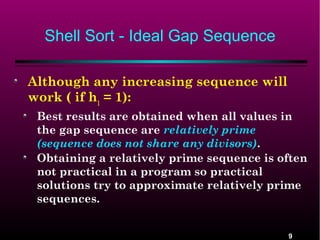
Shell Sort - Ideal Gap Sequence
Although any increasing sequence will
work ( if h1 = 1):
Best results are obtained when all values in
the gap sequence are relatively prime
(sequence does not share any divisors).
Obtaining a relatively prime sequence is often
not practical in a program so practical
solutions try to approximate relatively prime
sequences.

9
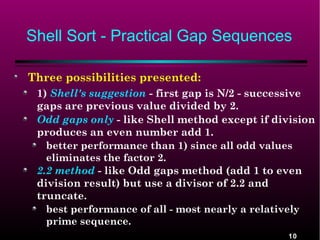
Shell Sort - Practical Gap Sequences
Three possibilities presented:
1) Shell's suggestion - first gap is N/2 - successive
gaps are previous value divided by 2.
Odd gaps only - like Shell method except if division
produces an even number add 1.
better performance than 1) since all odd values
eliminates the factor 2.
2.2 method - like Odd gaps method (add 1 to even
division result) but use a divisor of 2.2 and
truncate.
best performance of all - most nearly a relatively
prime sequence.
10
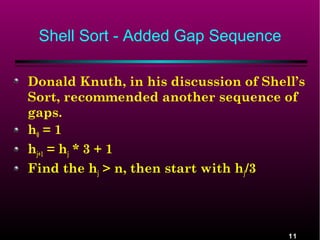
Shell Sort - Added Gap Sequence
Donald Knuth, in his discussion of Shell’s
Sort, recommended another sequence of
gaps.
h0 = 1
hj+1 = hj * 3 + 1
Find the hj > n, then start with hj/3

11
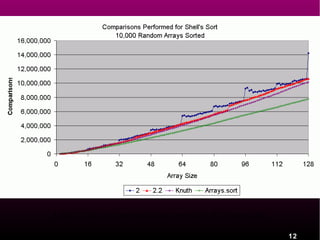
Link to the Java program that generated the above data.
12
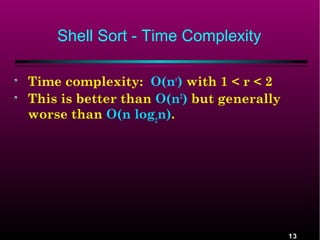
Shell Sort - Time Complexity
Time complexity: O(nr) with 1 < r < 2
This is better than O(n2) but generally
worse than O(n log2n).

13
Shellsort - Code
public static void
shellSort( Comparable[ ] theArray, int n ) {
// shellSort: sort first n items in array theArray
for( int gap = n / 2; gap > 0; gap = gap / 2 )
for( int i = gap; i < n; i++ ) {
Comparable tmp = theArray[ i ];
int j = i;
for( ; j >= gap && tmp.compareTo(theArray[ j - gap ]) < 0 ; j -= gap )
theArray[ j ] = theArray[ j - gap ];
theArray[ j ] = tmp;
}
}

14
ShellSort -Trace (gap = 4)
[0] [1] [2]
theArray 80
n: 9
gap: 4

93

60

[3] [4] [5] [6]

[7]

[8]

12

85

10

42

30

68

i:
j:

for( int gap = n / 2; gap > 0; gap = gap / 2 )
for( int i = gap; i < n; i++ ) {
Comparable tmp = theArray[ i ];
int j = i;
for( ; j >= gap && tmp.compareTo(theArray[ j - gap ]) < 0 ; j -= gap )
theArray[ j ] = theArray[ j - gap ];
theArray[ j ] = tmp;
}

15
ShellSort -Trace (gap = 2)
[0] [1] [2]
theArray

[3] [4] [5] [6]

[7]

[8]

10

12

85

80

n: 9
gap: 2

30

60

42

93

68

i:
j:

for( int gap = n / 2; gap > 0; gap = gap / 2 )
for( int i = gap; i < n; i++ ) {
Comparable tmp = theArray[ i ];
int j = i;
for( ; j >= gap && tmp.compareTo(theArray[ j - gap ]) < 0 ; j -= gap )
theArray[ j ] = theArray[ j - gap ];
theArray[ j ] = tmp;
}

16
ShellSort -Trace (gap = 1)
[0] [1] [2]
theArray

[3] [4] [5] [6]

[7]

[8]

10

30

93

80

n: 9
gap: 1

12

42

60

85

68

i:
j:

for( int gap = n / 2; gap > 0; gap = gap / 2 )
for( int i = gap; i < n; i++ ) {
Comparable tmp = theArray[ i ];
int j = i;
for( ; j >= gap && tmp.compareTo(theArray[ j - gap ]) < 0 ; j -= gap )
theArray[ j ] = theArray[ j - gap ];
theArray[ j ] = tmp;
}

17

Shell sort[1]

  • 1.
    CSCD 300 DataStructures Donald Shell’s Sorting Algorithm Originally developed by Bill Clark, modified by Tom Capaul and Tim Rolfe 1
  • 2.
    Shell Sort -Introduction More properly, Shell’s Sort Created in 1959 by Donald Shell Link to a local copy of the article: Donald Shell, “A High-Speed Sorting Procedure”, Communications of the ACM Vol 2, No. 7 (July 1959), 30-32 Originally Shell built his idea on top of Bubble Sort (link to article flowchart), but it has since been transported over to Insertion Sort. 2
  • 3.
    Shell Sort -GeneralDescription Essentially a segmented insertion sort Divides an array into several smaller noncontiguous segments The distance between successive elements in one segment is called a gap. Each segment is sorted within itself using insertion sort. Then resegment into larger segments (smaller gaps) and repeat sort. Continue until only one segment (gap = 1) final sort finishes array sorting. 3
  • 4.
    Shell Sort -Background GeneralTheory: Makes use of the intrinsic strengths of Insertion sort. Insertion sort is fastest when: The array is nearly sorted. The array contains only a small number of data items. Shell sort works well because: It always deals with a small number of elements. Elements are moved a long way through array with each swap and this leaves it more nearly sorted. 4
  • 5.
    Shell Sort -example Initial Segmenting Gap = 4 80 93 60 12 42 30 68 85 10 10 30 60 12 42 93 68 85 80 5
  • 6.
    Shell Sort -example (2) Resegmenting Gap = 2 10 30 60 12 42 93 68 85 80 10 12 42 30 60 85 68 93 80 6
  • 7.
    Shell Sort -example (3) Resegmenting Gap = 1 10 12 42 30 60 85 68 93 80 10 12 30 42 60 68 80 85 93 7
  • 8.
    Gap Sequences forShell Sort The sequence h1, h2, h3,. . . , ht is a sequence of increasing integer values which will be used as a sequence (from right to left) of gap values. Any sequence will work as long as it is increasing and h1 = 1. For any gap value hk we have A[i] <= A[i + hk] An array A for which this is true is hk sorted. An array which is hk sorted and is then hk-1 sorted remains hk sorted. 8
  • 9.
    Shell Sort -Ideal Gap Sequence Although any increasing sequence will work ( if h1 = 1): Best results are obtained when all values in the gap sequence are relatively prime (sequence does not share any divisors). Obtaining a relatively prime sequence is often not practical in a program so practical solutions try to approximate relatively prime sequences. 9
  • 10.
    Shell Sort -Practical Gap Sequences Three possibilities presented: 1) Shell's suggestion - first gap is N/2 - successive gaps are previous value divided by 2. Odd gaps only - like Shell method except if division produces an even number add 1. better performance than 1) since all odd values eliminates the factor 2. 2.2 method - like Odd gaps method (add 1 to even division result) but use a divisor of 2.2 and truncate. best performance of all - most nearly a relatively prime sequence. 10
  • 11.
    Shell Sort -Added Gap Sequence Donald Knuth, in his discussion of Shell’s Sort, recommended another sequence of gaps. h0 = 1 hj+1 = hj * 3 + 1 Find the hj > n, then start with hj/3 11
  • 12.
    Link to theJava program that generated the above data. 12
  • 13.
    Shell Sort -Time Complexity Time complexity: O(nr) with 1 < r < 2 This is better than O(n2) but generally worse than O(n log2n). 13
  • 14.
    Shellsort - Code publicstatic void shellSort( Comparable[ ] theArray, int n ) { // shellSort: sort first n items in array theArray for( int gap = n / 2; gap > 0; gap = gap / 2 ) for( int i = gap; i < n; i++ ) { Comparable tmp = theArray[ i ]; int j = i; for( ; j >= gap && tmp.compareTo(theArray[ j - gap ]) < 0 ; j -= gap ) theArray[ j ] = theArray[ j - gap ]; theArray[ j ] = tmp; } } 14
  • 15.
    ShellSort -Trace (gap= 4) [0] [1] [2] theArray 80 n: 9 gap: 4 93 60 [3] [4] [5] [6] [7] [8] 12 85 10 42 30 68 i: j: for( int gap = n / 2; gap > 0; gap = gap / 2 ) for( int i = gap; i < n; i++ ) { Comparable tmp = theArray[ i ]; int j = i; for( ; j >= gap && tmp.compareTo(theArray[ j - gap ]) < 0 ; j -= gap ) theArray[ j ] = theArray[ j - gap ]; theArray[ j ] = tmp; } 15
  • 16.
    ShellSort -Trace (gap= 2) [0] [1] [2] theArray [3] [4] [5] [6] [7] [8] 10 12 85 80 n: 9 gap: 2 30 60 42 93 68 i: j: for( int gap = n / 2; gap > 0; gap = gap / 2 ) for( int i = gap; i < n; i++ ) { Comparable tmp = theArray[ i ]; int j = i; for( ; j >= gap && tmp.compareTo(theArray[ j - gap ]) < 0 ; j -= gap ) theArray[ j ] = theArray[ j - gap ]; theArray[ j ] = tmp; } 16
  • 17.
    ShellSort -Trace (gap= 1) [0] [1] [2] theArray [3] [4] [5] [6] [7] [8] 10 30 93 80 n: 9 gap: 1 12 42 60 85 68 i: j: for( int gap = n / 2; gap > 0; gap = gap / 2 ) for( int i = gap; i < n; i++ ) { Comparable tmp = theArray[ i ]; int j = i; for( ; j >= gap && tmp.compareTo(theArray[ j - gap ]) < 0 ; j -= gap ) theArray[ j ] = theArray[ j - gap ]; theArray[ j ] = tmp; } 17