Professional Certificate in
Human Resources Management
Introduction to
Human Resources Management
Mahesh Weeratunge
Certified Professional Marketer
MBA (UK), CPM(APMF), MAPMF, PG. Dip(M) SL, Dip M(SL), MSLIM
Snr. Lecturer, Examiner, Corporate Trainer and Practitioner
What is Human Resources
Management?
 The policies and practices involved in carrying out
the “people” or human resource aspects of a
management position, including recruiting,
screening, training, rewarding, and appraising.
Garry Dassler
 Torrington et al “ It is a series of activities which;
first enables working people and the organisation
which uses their skills to agree about the objective
and nature of their working relationship and
secondly, ensure that the agreement is fulfilled.”
What is Human Resources
Management?
 “ The design, implementation and maintenance of
strategies to manage people for optimum business
performance including the development of policies
and process to support these strategies”
The Charted Institute of Personnel Management
What is Human Resources
Management?
HR creates value by engaging in
activities that produce the employee
behaviors that the company needs to
achieve
its strategic goals.
Why HRM is Important?
 Staff are the largest revenue cost of any organization.
 Staff are a volatile resource, they can leave you any
time.
 Staff are a store of corporate knowledge and the means
of service delivery.
 Retaining and developing good staff allows you to use
skills and develop as a business.
 Individuals should contribute more than they cost.
 In the industry customer care critical and delivered by
staff as representatives.
Myths that keep HR from being a
profession
Old Myths
 People go into HR
because they like
people.
New Realities
HR departments are not
designed to provide
corporate therapy or to act
as social or health-and-
happiness retreats. HR
professionals must create
the practices that make
employees more
Myths that keep HR from being a
profession
Old Myths
 Anyone can do HR.
New Realities
HR activities are based on
theory and research. HR
professionals must master
both theory and practice.
Old Myths
 HR deals with the soft
side of business and
therefore is not
accountable.
New Realities
The impact of HR practices
on business results can and
must be measured. HR
professionals must learn to
translate their work into
financial performance.
Myths that keep HR from being a
profession
Old Myths
 HR focuses on
costs, which must be
controlled.
New Realities
HR practices must create
value by increasing the
intellectual capital within the
firm. HR professionals must
add value, not only reduce
costs.
Myths that keep HR from being a
profession
Old Myths
 HR is full of fads.
New Realities
HR practices have
evolved over time. HR
professionals must see
their current work as
part of an evolutionary
chain and explain their
work with less jargon
and more authority.
Myths that keep HR from being a
profession
Old Myths
 HR is staffed by
nice people.
New Realities
At times, HR practices should
force vigorous debates. HR
professionals should be
confrontative and challenging
as well as supportive.
Myths that keep HR from being a
profession
Old Myths
 HR is HR’s job.
New Realities
HR work is as important to line
managers as are finance,
strategy, and other business
domains. HR professionals
should join with managers in
championing HR issues.
Myths that keep HR from being a
profession
HRM and Management
 HRM is management, but management is more than
HRM.
 HRM is that part of management dealing directly with
people, whereas management also includes marketing
research and development, and accounting and finance.
 Because the purpose of HRM is to improve the productive
contribution of people, it is intimately related to all other
aspects of management.
 Organisations needing to trim overheads or reduce
corporate flab cut HRM.
New Role of a HR Manager
STRATEGIC PARTNER
 HR professionals play a strategic role when they have the ability
to translate business strategy into action. This facilitating role
allows the HR manager to become part of the business team.
ADMINISTRATIVE EXPERT
 To become administrative experts HR professionals must be able
to re-engineer HR activities through the use of technology,
process engineering and total quality management.
New Role of a HR Manager.
Cont…
EMPLOYEE CHAMPION
 The HR professional must be able to relate to and meet the
needs of employees
CHANGE AGENT
 The HR manager needs to serve as a catalyst for change within
the organisation. This can be achieved by leading change in the
HR function and by developing problem-solving communication
and influence skills. In short, the HR manager must know how to
manage change.
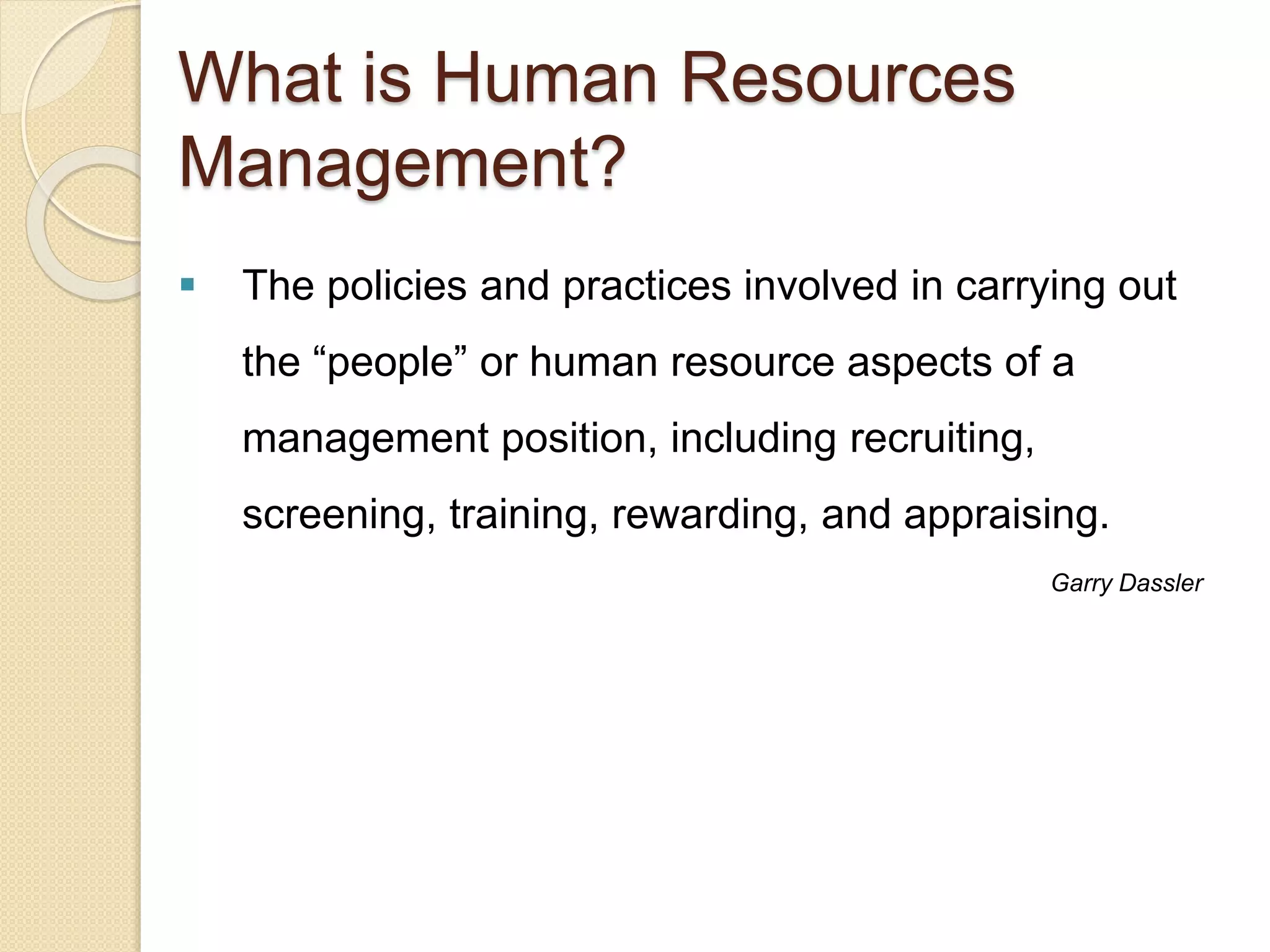
HRM Activities
 Job analysis defines a job in terms of specific tasks
and responsibilities and identifies the abilities, skills
and qualifications needed to perform it successfully.
 Human resource planning or employment planning
is the process by which an organisation attempts to
ensure that it has the right number of qualified people
in the right jobs at the right time.
HRM Activities. Cont….
 Employee recruitment is the process of seeking
and attracting a pool of applicants from which
qualified candidates for job vacancies within an
organisation can be selected.
 Employee selection involves choosing from the
available candidates the individual predicted to be
most likely to perform successfully in the job.
 Performance appraisal is concerned with determining
how well employees are doing their jobs,
communicating that information to the employees and
establishing a plan for performance improvement.
 Training and development activities help employees
learn how to perform their jobs, improve their
performance and prepare themselves for more senior
positions.
HRM Activities. Cont….
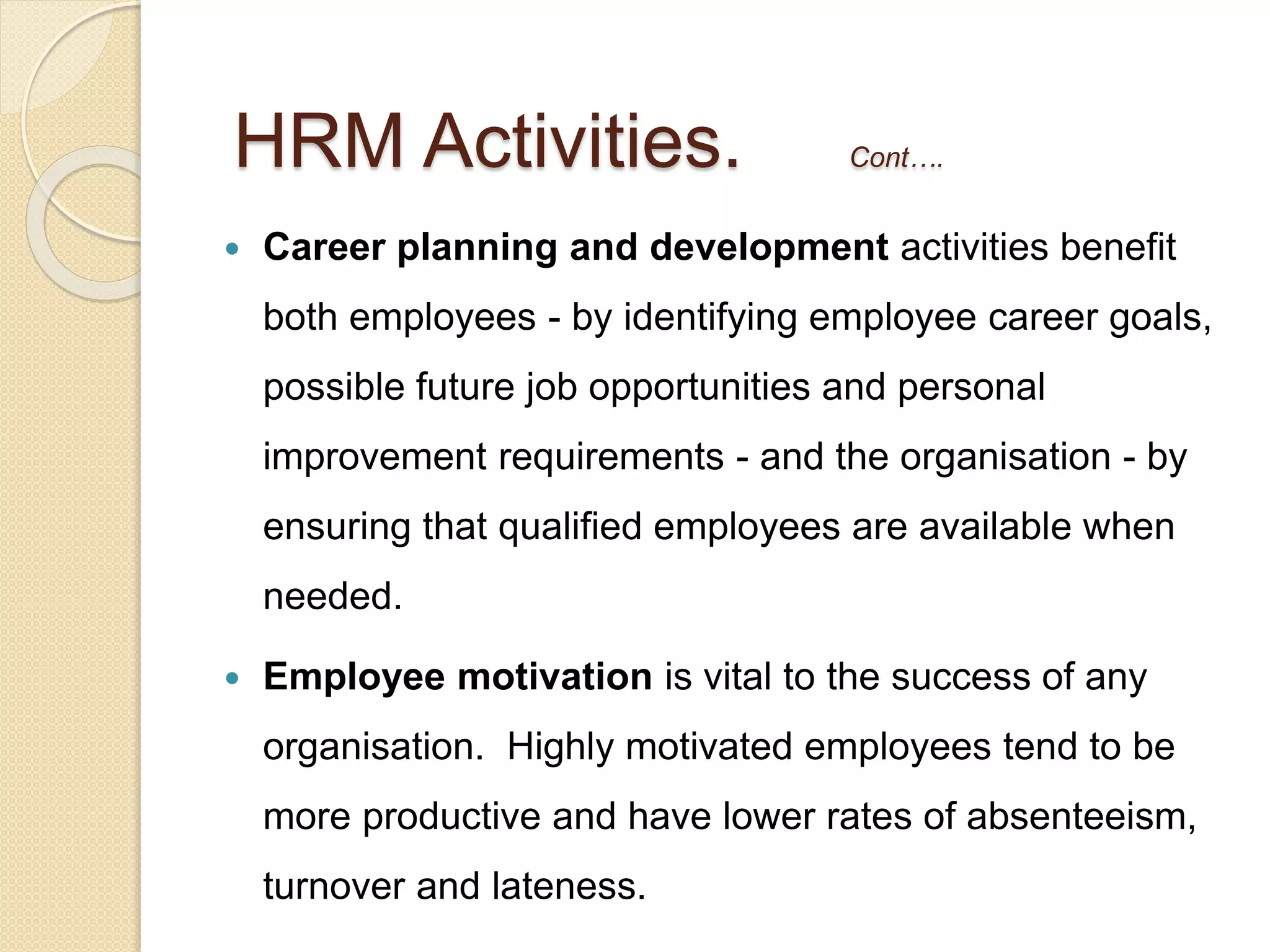
 Career planning and development activities benefit
both employees - by identifying employee career goals,
possible future job opportunities and personal
improvement requirements - and the organisation - by
ensuring that qualified employees are available when
needed.
 Employee motivation is vital to the success of any
organisation. Highly motivated employees tend to be
more productive and have lower rates of absenteeism,
turnover and lateness.
HRM Activities. Cont….
 Compensation refers to the cash rewards, such as the
base salary, bonus, incentive payments and allowances
which employees receive for working in an organisation.
 Benefits are sometimes referred to as indirect or non-
cash compensation.
HRM Activities. Cont….
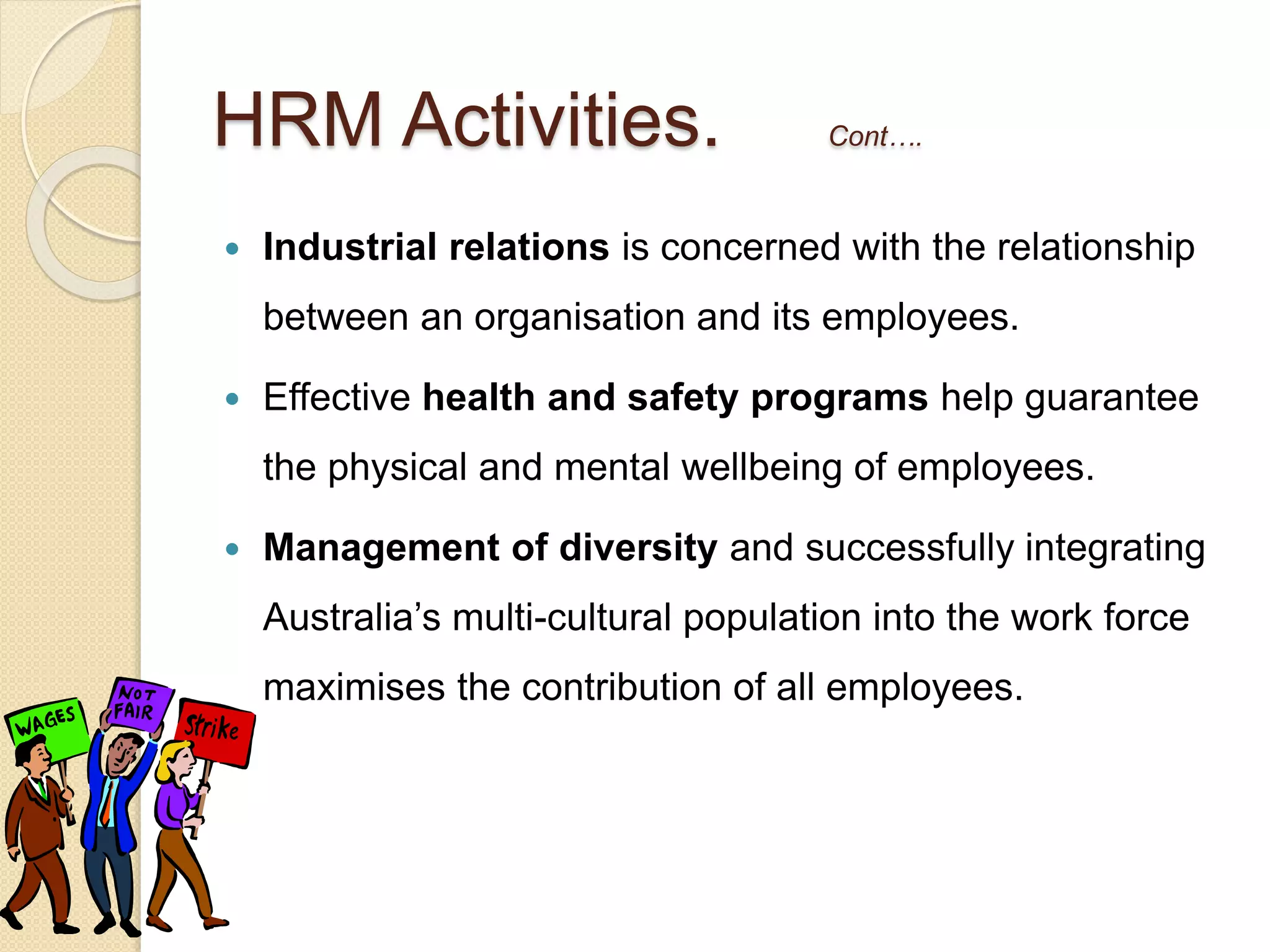
 Industrial relations is concerned with the relationship
between an organisation and its employees.
 Effective health and safety programs help guarantee
the physical and mental wellbeing of employees.
 Management of diversity and successfully integrating
Australia’s multi-cultural population into the work force
maximises the contribution of all employees.
HRM Activities. Cont….
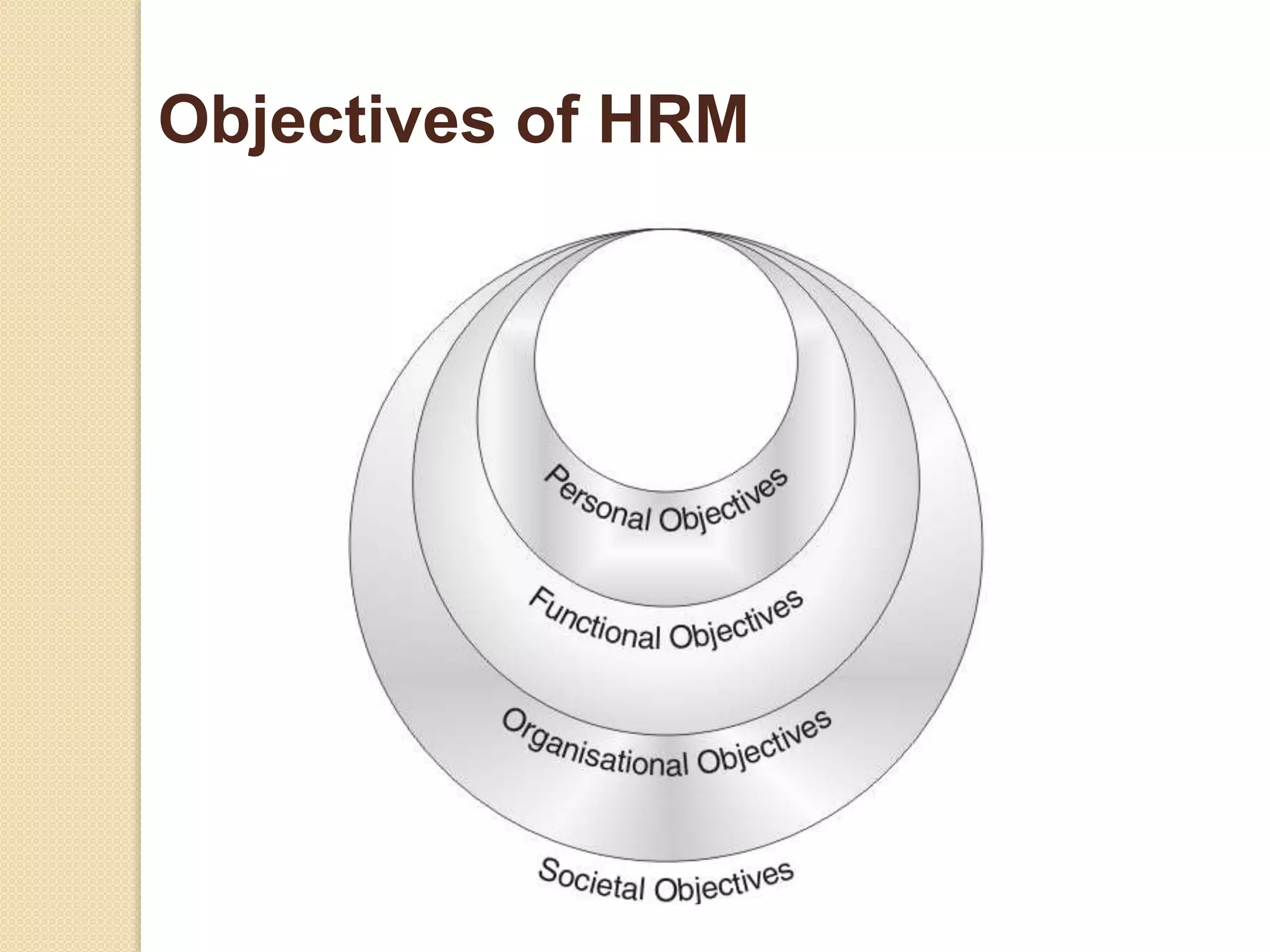
Objectives of HRM
Objectives of the HRM Function
 HRM contributions to organizational effectiveness:
 Helping the organization reach its goals
 Employing workforce skills and abilities efficiently
 Increasing job satisfaction, self-actualization, and quality of
work life
 Communicating HRM policies to all employees
 Maintaining ethical policies and socially responsible behavior
 Managing change to the mutual advantage of individuals,
groups, the enterprise, and the public
Objectives of the HRM Function
 Increasing employees’ job satisfaction and self-actualization
 Employees must feel that the job is right for their abilities and
that they are being treated equitably
 Satisfied employees are not automatically more productive
 However, unsatisfied employees tend to be absent and
quit more often and produce lower-quality work
 Both satisfied and dissatisfied employees can perform equally
in quantitative terms
Objectives of the HRM Function
 Quality of work life (QWL) is a general concept that refers to
several aspects of the job, including:
 Management and supervisory style
 Freedom and autonomy to make decisions on the job
 Satisfactory physical surroundings
 Job safety
 Satisfactory working hours
 Meaningful tasks
 The job and work environment should be structured to meet
as many workers’ needs as possible
Objectives of the HRM Function
 Communicating HRM policies to all employees:
 HRM policies, programs, and procedures must be
communicated fully and effectively
 They must be represented to outsiders
 Top-level managers must understand what HRM can offer
Objectives of the HRM Function
 Maintaining ethical policies and socially responsible
behavior:
 HRM managers must show by example that HRM activities
are fair, truthful, and honorable
 People must not be discriminated against
 Their basic rights must be protected
 These principles should apply to all activities in the HRM
area
Objectives of the HRM Function
 Managing increased urgency and faster cycle times:
 Firms are placing a growing emphasis on:
 Increasing customer service
 Developing new products and services
 Training and educating technicians, managers,
and decision makers
 Shorter cycle times mean less time to:
 Train, educate, and assign managers
 Recruit and select talented people
 Improve the firm’s image
 Learning provides a framework for decreasing
Circumstantial Factors
Internal factors:
 organisational history,
 size,
 structure and location,
 the values, philosophies and management styles of
top management,
 the nature of the workforce,
 the type of industry.
Circumstantial Factors
External factors:
 economic conditions,
 legislative requirements,
 industrial relations
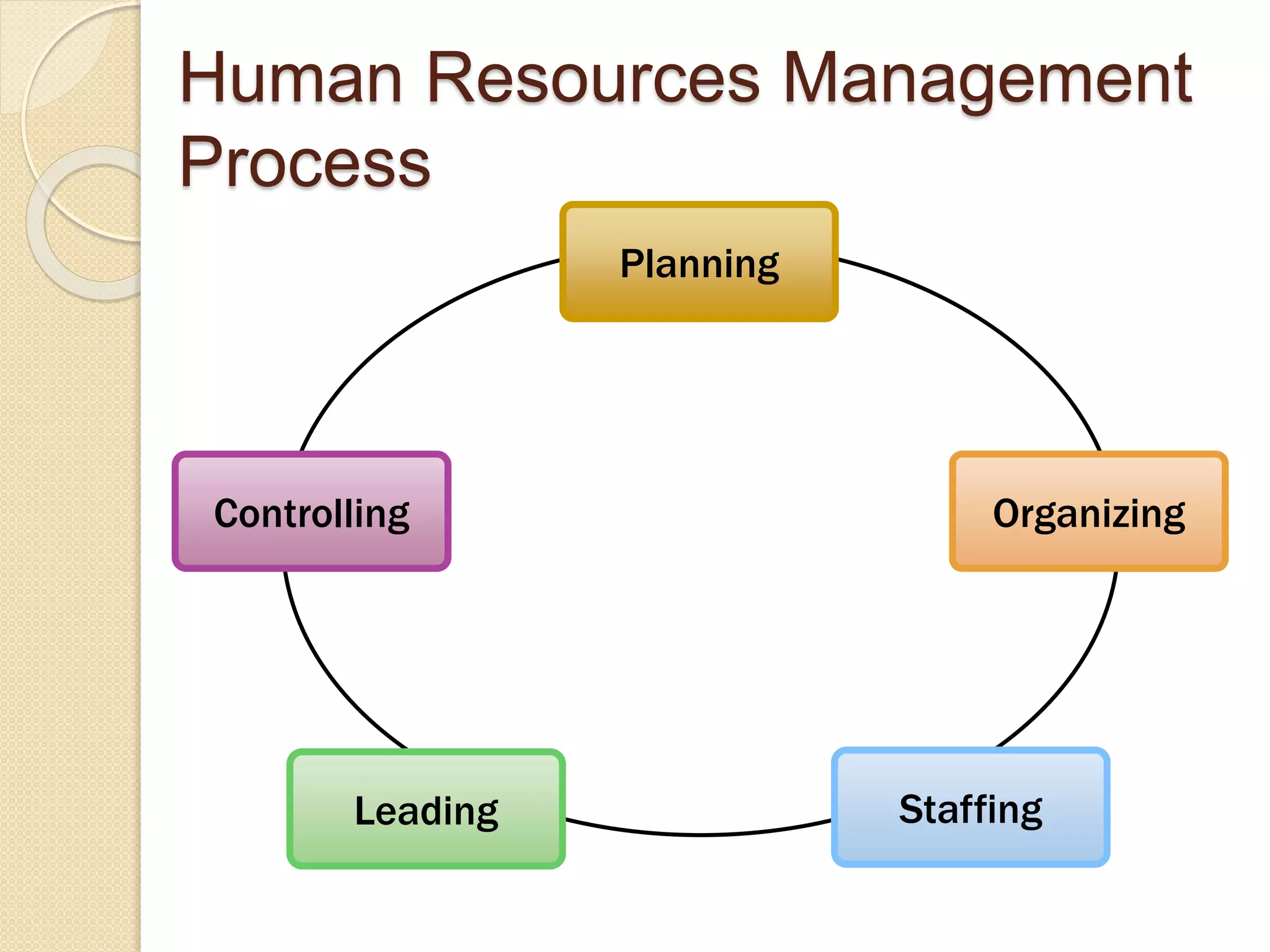
Planning
Organizing
Leading Staffing
Controlling
Human Resources Management
Process
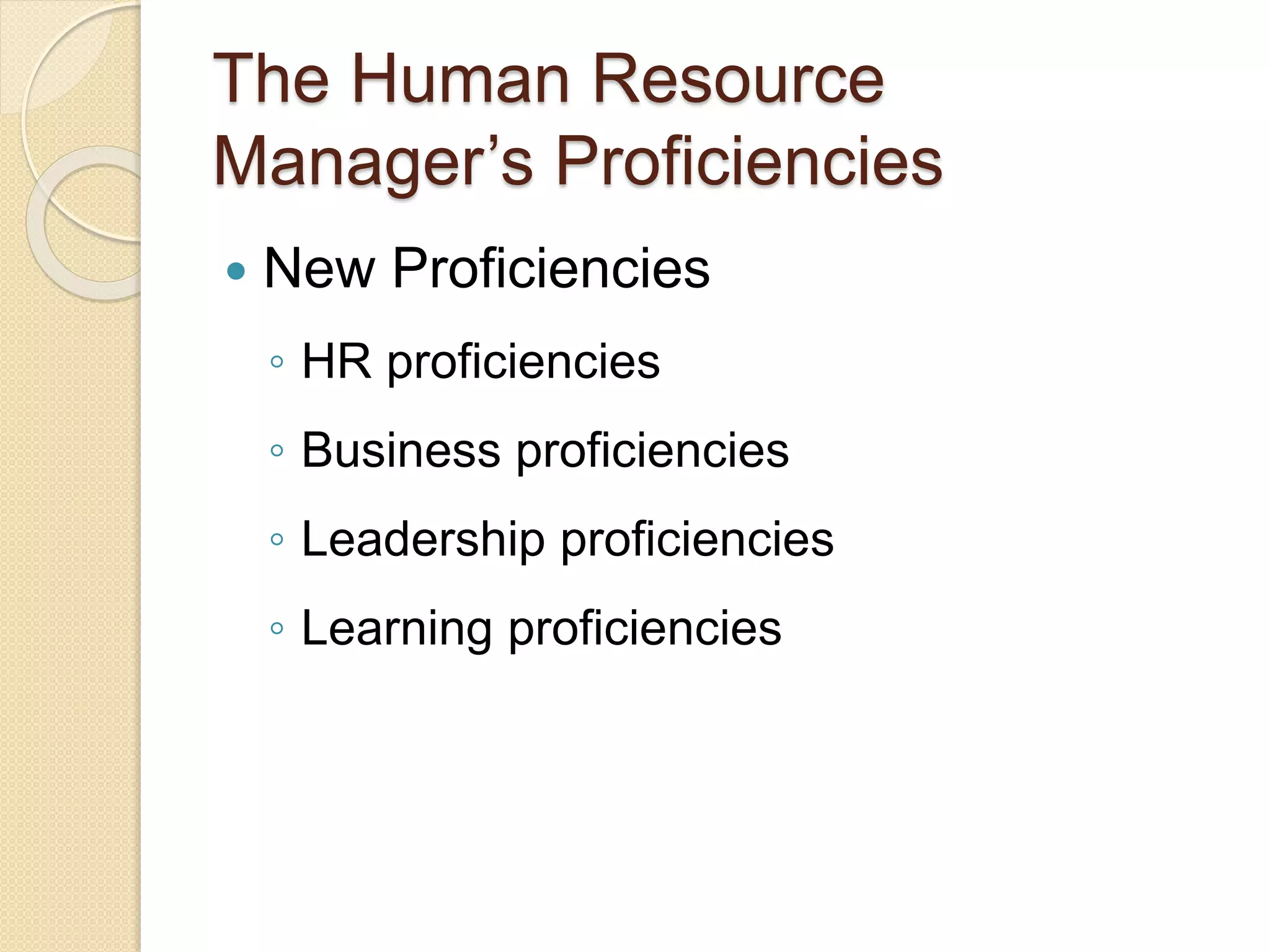
The Human Resource
Manager’s Proficiencies
 New Proficiencies
◦ HR proficiencies
◦ Business proficiencies
◦ Leadership proficiencies
◦ Learning proficiencies
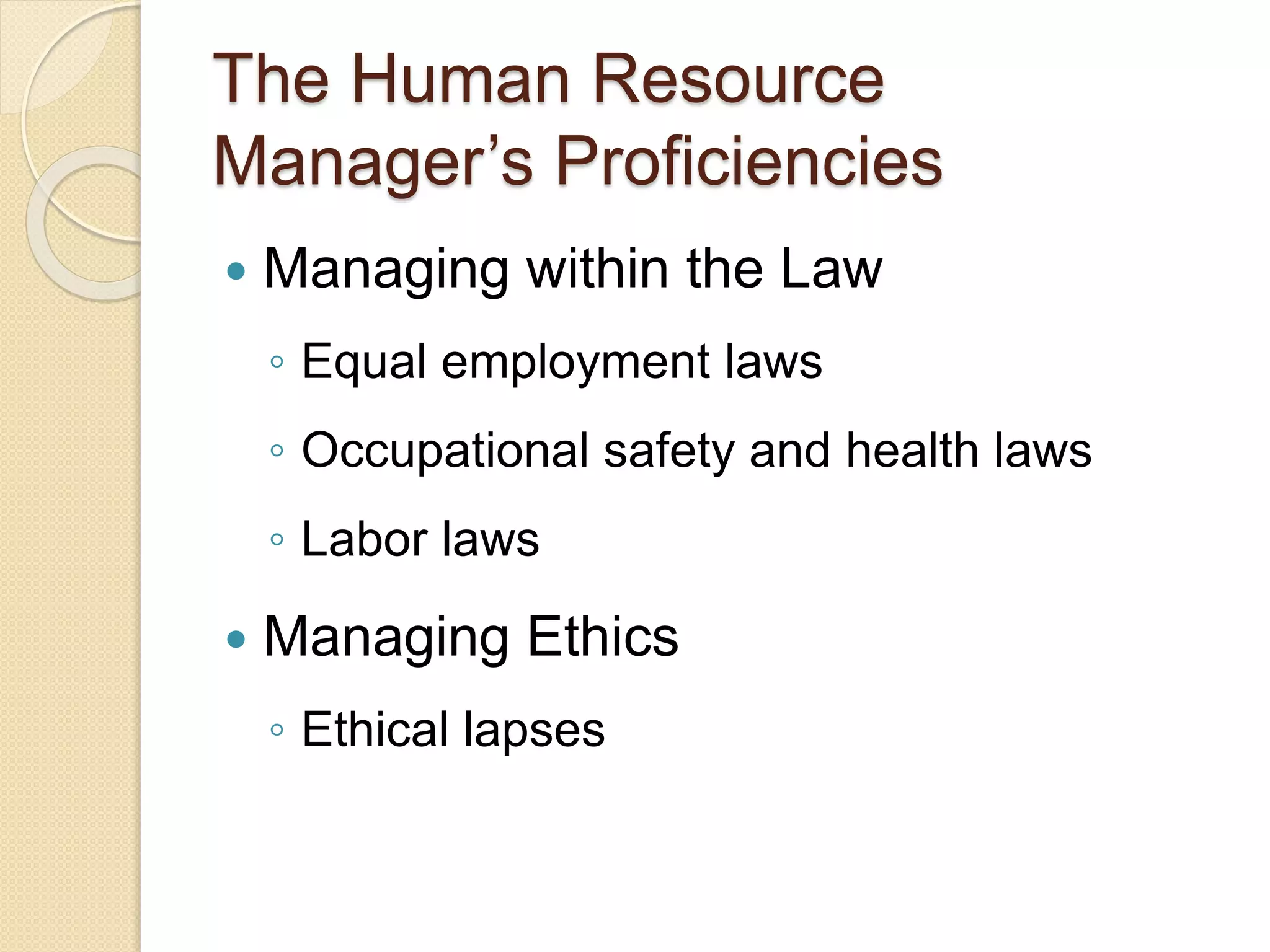
The Human Resource
Manager’s Proficiencies
 Managing within the Law
◦ Equal employment laws
◦ Occupational safety and health laws
◦ Labor laws
 Managing Ethics
◦ Ethical lapses
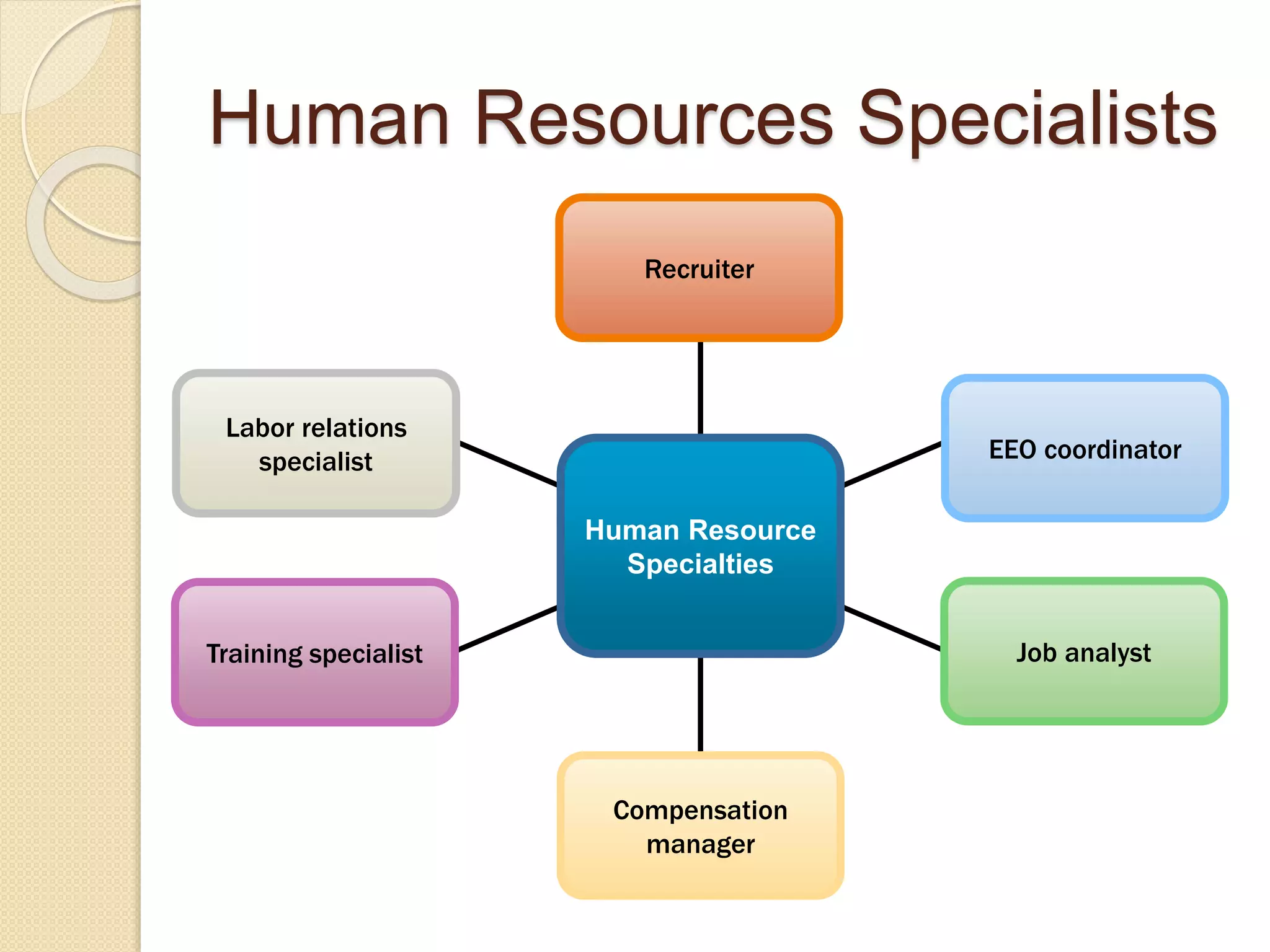
Human Resources Specialists
Recruiter
EEO coordinator
Labor relations
specialist
Training specialist Job analyst
Compensation
manager
Human Resource
Specialties

Basics in HR Management

  • 1.
    Professional Certificate in HumanResources Management Introduction to Human Resources Management Mahesh Weeratunge Certified Professional Marketer MBA (UK), CPM(APMF), MAPMF, PG. Dip(M) SL, Dip M(SL), MSLIM Snr. Lecturer, Examiner, Corporate Trainer and Practitioner
  • 3.
    What is HumanResources Management?  The policies and practices involved in carrying out the “people” or human resource aspects of a management position, including recruiting, screening, training, rewarding, and appraising. Garry Dassler
  • 4.
     Torrington etal “ It is a series of activities which; first enables working people and the organisation which uses their skills to agree about the objective and nature of their working relationship and secondly, ensure that the agreement is fulfilled.” What is Human Resources Management?
  • 5.
     “ Thedesign, implementation and maintenance of strategies to manage people for optimum business performance including the development of policies and process to support these strategies” The Charted Institute of Personnel Management What is Human Resources Management?
  • 6.
    HR creates valueby engaging in activities that produce the employee behaviors that the company needs to achieve its strategic goals.
  • 7.
    Why HRM isImportant?  Staff are the largest revenue cost of any organization.  Staff are a volatile resource, they can leave you any time.  Staff are a store of corporate knowledge and the means of service delivery.  Retaining and developing good staff allows you to use skills and develop as a business.  Individuals should contribute more than they cost.  In the industry customer care critical and delivered by staff as representatives.
  • 8.
    Myths that keepHR from being a profession Old Myths  People go into HR because they like people. New Realities HR departments are not designed to provide corporate therapy or to act as social or health-and- happiness retreats. HR professionals must create the practices that make employees more
  • 9.
    Myths that keepHR from being a profession Old Myths  Anyone can do HR. New Realities HR activities are based on theory and research. HR professionals must master both theory and practice.
  • 10.
    Old Myths  HRdeals with the soft side of business and therefore is not accountable. New Realities The impact of HR practices on business results can and must be measured. HR professionals must learn to translate their work into financial performance. Myths that keep HR from being a profession
  • 11.
    Old Myths  HRfocuses on costs, which must be controlled. New Realities HR practices must create value by increasing the intellectual capital within the firm. HR professionals must add value, not only reduce costs. Myths that keep HR from being a profession
  • 12.
    Old Myths  HRis full of fads. New Realities HR practices have evolved over time. HR professionals must see their current work as part of an evolutionary chain and explain their work with less jargon and more authority. Myths that keep HR from being a profession
  • 13.
    Old Myths  HRis staffed by nice people. New Realities At times, HR practices should force vigorous debates. HR professionals should be confrontative and challenging as well as supportive. Myths that keep HR from being a profession
  • 14.
    Old Myths  HRis HR’s job. New Realities HR work is as important to line managers as are finance, strategy, and other business domains. HR professionals should join with managers in championing HR issues. Myths that keep HR from being a profession
  • 15.
    HRM and Management HRM is management, but management is more than HRM.  HRM is that part of management dealing directly with people, whereas management also includes marketing research and development, and accounting and finance.  Because the purpose of HRM is to improve the productive contribution of people, it is intimately related to all other aspects of management.  Organisations needing to trim overheads or reduce corporate flab cut HRM.
  • 16.
    New Role ofa HR Manager STRATEGIC PARTNER  HR professionals play a strategic role when they have the ability to translate business strategy into action. This facilitating role allows the HR manager to become part of the business team. ADMINISTRATIVE EXPERT  To become administrative experts HR professionals must be able to re-engineer HR activities through the use of technology, process engineering and total quality management.
  • 17.
    New Role ofa HR Manager. Cont… EMPLOYEE CHAMPION  The HR professional must be able to relate to and meet the needs of employees CHANGE AGENT  The HR manager needs to serve as a catalyst for change within the organisation. This can be achieved by leading change in the HR function and by developing problem-solving communication and influence skills. In short, the HR manager must know how to manage change.
  • 18.
    HRM Activities  Jobanalysis defines a job in terms of specific tasks and responsibilities and identifies the abilities, skills and qualifications needed to perform it successfully.  Human resource planning or employment planning is the process by which an organisation attempts to ensure that it has the right number of qualified people in the right jobs at the right time.
  • 19.
    HRM Activities. Cont…. Employee recruitment is the process of seeking and attracting a pool of applicants from which qualified candidates for job vacancies within an organisation can be selected.  Employee selection involves choosing from the available candidates the individual predicted to be most likely to perform successfully in the job.
  • 20.
     Performance appraisalis concerned with determining how well employees are doing their jobs, communicating that information to the employees and establishing a plan for performance improvement.  Training and development activities help employees learn how to perform their jobs, improve their performance and prepare themselves for more senior positions. HRM Activities. Cont….
  • 21.
     Career planningand development activities benefit both employees - by identifying employee career goals, possible future job opportunities and personal improvement requirements - and the organisation - by ensuring that qualified employees are available when needed.  Employee motivation is vital to the success of any organisation. Highly motivated employees tend to be more productive and have lower rates of absenteeism, turnover and lateness. HRM Activities. Cont….
  • 22.
     Compensation refersto the cash rewards, such as the base salary, bonus, incentive payments and allowances which employees receive for working in an organisation.  Benefits are sometimes referred to as indirect or non- cash compensation. HRM Activities. Cont….
  • 23.
     Industrial relationsis concerned with the relationship between an organisation and its employees.  Effective health and safety programs help guarantee the physical and mental wellbeing of employees.  Management of diversity and successfully integrating Australia’s multi-cultural population into the work force maximises the contribution of all employees. HRM Activities. Cont….
  • 24.
  • 25.
    Objectives of theHRM Function  HRM contributions to organizational effectiveness:  Helping the organization reach its goals  Employing workforce skills and abilities efficiently  Increasing job satisfaction, self-actualization, and quality of work life  Communicating HRM policies to all employees  Maintaining ethical policies and socially responsible behavior  Managing change to the mutual advantage of individuals, groups, the enterprise, and the public
  • 26.
    Objectives of theHRM Function  Increasing employees’ job satisfaction and self-actualization  Employees must feel that the job is right for their abilities and that they are being treated equitably  Satisfied employees are not automatically more productive  However, unsatisfied employees tend to be absent and quit more often and produce lower-quality work  Both satisfied and dissatisfied employees can perform equally in quantitative terms
  • 27.
    Objectives of theHRM Function  Quality of work life (QWL) is a general concept that refers to several aspects of the job, including:  Management and supervisory style  Freedom and autonomy to make decisions on the job  Satisfactory physical surroundings  Job safety  Satisfactory working hours  Meaningful tasks  The job and work environment should be structured to meet as many workers’ needs as possible
  • 28.
    Objectives of theHRM Function  Communicating HRM policies to all employees:  HRM policies, programs, and procedures must be communicated fully and effectively  They must be represented to outsiders  Top-level managers must understand what HRM can offer
  • 29.
    Objectives of theHRM Function  Maintaining ethical policies and socially responsible behavior:  HRM managers must show by example that HRM activities are fair, truthful, and honorable  People must not be discriminated against  Their basic rights must be protected  These principles should apply to all activities in the HRM area
  • 30.
    Objectives of theHRM Function  Managing increased urgency and faster cycle times:  Firms are placing a growing emphasis on:  Increasing customer service  Developing new products and services  Training and educating technicians, managers, and decision makers  Shorter cycle times mean less time to:  Train, educate, and assign managers  Recruit and select talented people  Improve the firm’s image  Learning provides a framework for decreasing
  • 31.
    Circumstantial Factors Internal factors: organisational history,  size,  structure and location,  the values, philosophies and management styles of top management,  the nature of the workforce,  the type of industry.
  • 32.
    Circumstantial Factors External factors: economic conditions,  legislative requirements,  industrial relations
  • 33.
  • 34.
    The Human Resource Manager’sProficiencies  New Proficiencies ◦ HR proficiencies ◦ Business proficiencies ◦ Leadership proficiencies ◦ Learning proficiencies
  • 35.
    The Human Resource Manager’sProficiencies  Managing within the Law ◦ Equal employment laws ◦ Occupational safety and health laws ◦ Labor laws  Managing Ethics ◦ Ethical lapses
  • 36.
    Human Resources Specialists Recruiter EEOcoordinator Labor relations specialist Training specialist Job analyst Compensation manager Human Resource Specialties