Ministry of Higher Education and Scientific Research
University of Sulaimani
College of Science
Department of Chemistry
Prepared by:
hazhir esmail, bryar nahman, barez salah
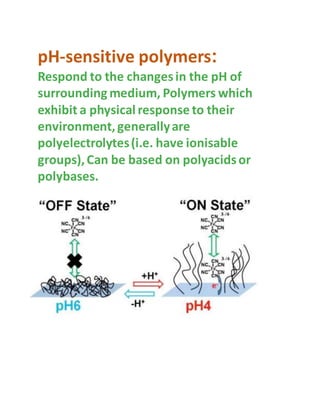
pH-sensitive polymers:
Respond to the changesin the pH of
surrounding medium, Polymers which
exhibit a physical response to their
environment,generallyare
polyelectrolytes(i.e. have ionisable
groups),Can be based on polyacidsor
polybases.
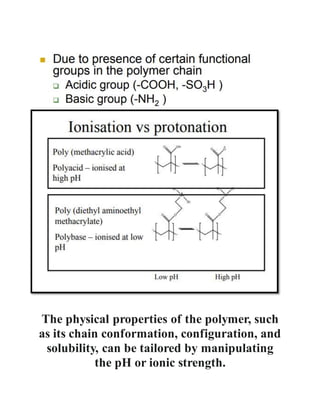
The physical properties of the polymer, such
as its chain conformation, configuration, and
solubility, can be tailored by manipulating
the pH or ionic strength.
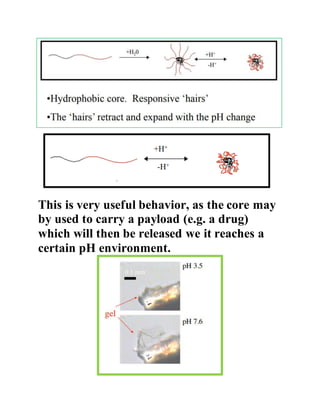
This is very useful behavior, as the core may
by used to carry a payload (e.g. a drug)
which will then be released we it reaches a
certain pH environment.
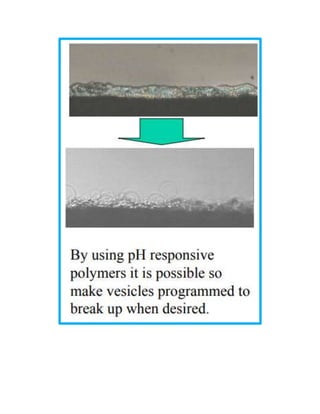
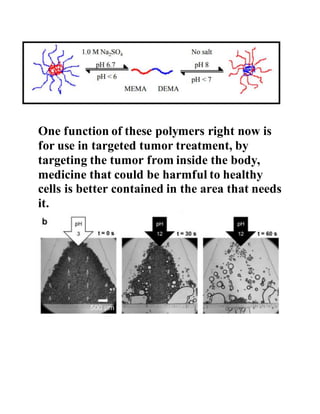
One function of these polymers right now is
for use in targeted tumor treatment, by
targeting the tumor from inside the body,
medicine that could be harmful to healthy
cells is better contained in the area that needs
it.
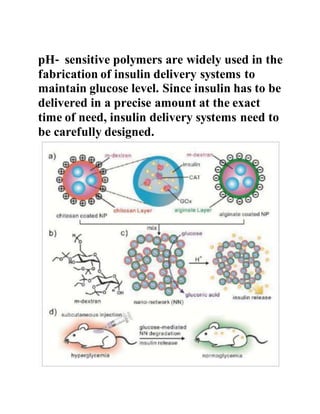
pH‐ sensitive polymers are widely used in the
fabrication of insulin delivery systems to
maintain glucose level. Since insulin has to be
delivered in a precise amount at the exact
time of need, insulin delivery systems need to
be carefully designed.
Living polymerization is often used for making
pH sensitive polymers because molecular weight
distribution of the final polymers can be
controlled. Examplesinclude group transfer
polymerization (GTP)
Degree of swelling
Equal to (swollen weight-deswelled weight)/deswelled
weight *100% and determined by massing polymers
before and after swelling. This indicates how much
the polymer swelled upon a change in pH
Applications
Purification and separation
pH sensitive polymershave been consideredfor use in
membranes. A change in pH could change the ability of
the polymer to let ions through, allowing it to act as a
filter.
Biomedical Use
pH sensitive polymers have been used for drug
delivery. For example, they can be used to
release of insulin.
Surface modification
pH sensitive polymers have been used to modify
the surfaces of materials. For example, they can
be used to change the wettability of a surface.
Conclusion:
• pH sensitive polymers have the possibility
to do great things for some terrible
treatments by targeting the affected area
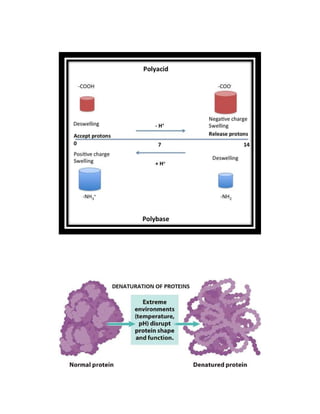
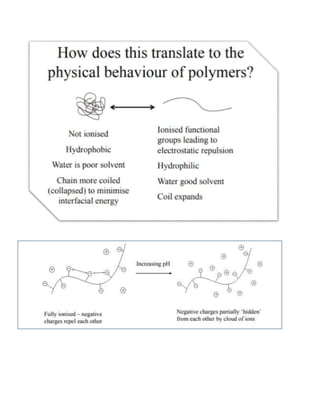
• •Polyelectrolytes can act as pH responsive
polymers providing they can act as weak
acids or bases
• •As the polymer is increasingly ionized, the
polymer expands owing to electrostatic
repulsion between charges.
• •pH responsive polymers have the
potential to be used to create a large
number of devices.
References:
1)Chaturvedi,Kiran; Ganguly, Kuntal;Nadagouda, Mallikarjuna
N.; Aminabhavi,TejrajM. (2013-01-28). "Polymeric hydrogels
for oral insulindelivery". Journal of Controlled Release. 165 (2):
129–138.
2) Popescu, Maria-Teodora;Tsitsilianis,Constantinos;
Papadakis, Christine M.; Adelsberger, Joseph; Balog, Sandor;
Busch, Peter; Hadjiantoniou,Natalie A.;Patrickios, Costas S.
(2012-04-24). "Stimuli-ResponsiveAmphiphilicPolyelectrolyte
HeptablockCopolymer Physical Hydrogels:An Unusual pH-
Response". Macromolecules. 45 (8): 3523–3530.
3) MuzammilI, Li Y, Lei M. Tunablewettabilityand pH-
responsiveness of plasma copolymersof acrylic acid and
octafluorocyclobutane.Plasma Process Polym. 2017;e1700053
4) Meléndez-Ortiz, H Iván;H.C. Varca (2016. "State of the art of
smart polymers: from fundamentalsto final
applications." Polymer Science: research advances, practical
applications and educational aspects. FormatexResearch
Center. pp. 476-487.
5) Kocak, G.; Tuncer, C.; Bütün, V. (2016-12-20). "pH-Responsive
polymers". Polym. Chem. 8 (1): 144–176
6) Dupré de Baubigny, J., Trégouët,C., Salez, T., Pantoustier, N.,
Perrin, P., Reyssat, M. and Monteux,C. (2017). One-Step
Fabricationof pH-Responsive Membranes and Microcapsules
through Interfacial H-Bond Polymer Complexation.Scientific
Reports, 7(1).

pH responsive polymers in polymer chemistry

  • 1.
    Ministry of HigherEducation and Scientific Research University of Sulaimani College of Science Department of Chemistry Prepared by: hazhir esmail, bryar nahman, barez salah
  • 2.
    pH-sensitive polymers: Respond tothe changesin the pH of surrounding medium, Polymers which exhibit a physical response to their environment,generallyare polyelectrolytes(i.e. have ionisable groups),Can be based on polyacidsor polybases.
  • 4.
    The physical propertiesof the polymer, such as its chain conformation, configuration, and solubility, can be tailored by manipulating the pH or ionic strength.
  • 6.
    This is veryuseful behavior, as the core may by used to carry a payload (e.g. a drug) which will then be released we it reaches a certain pH environment.
  • 8.
    One function ofthese polymers right now is for use in targeted tumor treatment, by targeting the tumor from inside the body, medicine that could be harmful to healthy cells is better contained in the area that needs it.
  • 9.
    pH‐ sensitive polymersare widely used in the fabrication of insulin delivery systems to maintain glucose level. Since insulin has to be delivered in a precise amount at the exact time of need, insulin delivery systems need to be carefully designed.
  • 10.
    Living polymerization isoften used for making pH sensitive polymers because molecular weight distribution of the final polymers can be controlled. Examplesinclude group transfer polymerization (GTP) Degree of swelling Equal to (swollen weight-deswelled weight)/deswelled weight *100% and determined by massing polymers before and after swelling. This indicates how much the polymer swelled upon a change in pH Applications Purification and separation pH sensitive polymershave been consideredfor use in membranes. A change in pH could change the ability of the polymer to let ions through, allowing it to act as a filter. Biomedical Use pH sensitive polymers have been used for drug delivery. For example, they can be used to release of insulin. Surface modification pH sensitive polymers have been used to modify the surfaces of materials. For example, they can be used to change the wettability of a surface.
  • 11.
    Conclusion: • pH sensitivepolymers have the possibility to do great things for some terrible treatments by targeting the affected area • •Polyelectrolytes can act as pH responsive polymers providing they can act as weak acids or bases • •As the polymer is increasingly ionized, the polymer expands owing to electrostatic repulsion between charges. • •pH responsive polymers have the potential to be used to create a large number of devices.
  • 12.
    References: 1)Chaturvedi,Kiran; Ganguly, Kuntal;Nadagouda,Mallikarjuna N.; Aminabhavi,TejrajM. (2013-01-28). "Polymeric hydrogels for oral insulindelivery". Journal of Controlled Release. 165 (2): 129–138. 2) Popescu, Maria-Teodora;Tsitsilianis,Constantinos; Papadakis, Christine M.; Adelsberger, Joseph; Balog, Sandor; Busch, Peter; Hadjiantoniou,Natalie A.;Patrickios, Costas S. (2012-04-24). "Stimuli-ResponsiveAmphiphilicPolyelectrolyte HeptablockCopolymer Physical Hydrogels:An Unusual pH- Response". Macromolecules. 45 (8): 3523–3530. 3) MuzammilI, Li Y, Lei M. Tunablewettabilityand pH- responsiveness of plasma copolymersof acrylic acid and octafluorocyclobutane.Plasma Process Polym. 2017;e1700053 4) Meléndez-Ortiz, H Iván;H.C. Varca (2016. "State of the art of smart polymers: from fundamentalsto final applications." Polymer Science: research advances, practical applications and educational aspects. FormatexResearch Center. pp. 476-487. 5) Kocak, G.; Tuncer, C.; Bütün, V. (2016-12-20). "pH-Responsive polymers". Polym. Chem. 8 (1): 144–176 6) Dupré de Baubigny, J., Trégouët,C., Salez, T., Pantoustier, N., Perrin, P., Reyssat, M. and Monteux,C. (2017). One-Step Fabricationof pH-Responsive Membranes and Microcapsules through Interfacial H-Bond Polymer Complexation.Scientific Reports, 7(1).