Pre Spinning Processes
(YM-2012)
M Irfan
Department of Textile Engineering
National Textile University Faisalabad
Reference:
The Rieter Manual of Spinning
Dust removal machines
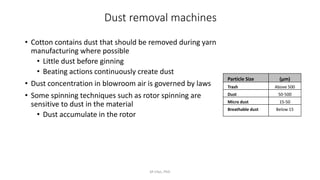
• Cotton contains dust that should be removed during yarn
manufacturing where possible
• Little dust before ginning
• Beating actions continuously create dust
• Dust concentration in blowroom air is governed by laws
• Some spinning techniques such as rotor spinning are
sensitive to dust in the material
• Dust accumulate in the rotor
M Irfan, PhD
Particle Size (µm)
Trash Above 500
Dust 50-500
Micro dust 15-50
Breathable dust Below 15
Dust removal machines
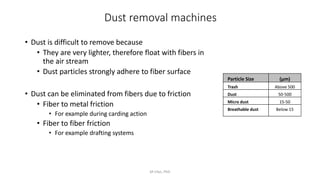
• Dust is difficult to remove because
• They are very lighter, therefore float with fibers in
the air stream
• Dust particles strongly adhere to fiber surface
• Dust can be eliminated from fibers due to friction
• Fiber to metal friction
• For example during carding action
• Fiber to fiber friction
• For example drafting systems
M Irfan, PhD
Particle Size (µm)
Trash Above 500
Dust 50-500
Micro dust 15-50
Breathable dust Below 15
Dust removal in blowroom
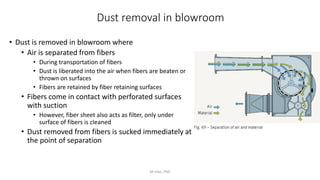
• Dust is removed in blowroom where
• Air is separated from fibers
• During transportation of fibers
• Dust is liberated into the air when fibers are beaten or
thrown on surfaces
• Fibers are retained by fiber retaining surfaces
• Fibers come in contact with perforated surfaces
with suction
• However, fiber sheet also acts as filter, only under
surface of fibers is cleaned
• Dust removed from fibers is sucked immediately at
the point of separation
M Irfan, PhD
Dedusting within transport ducts (by Rieter)
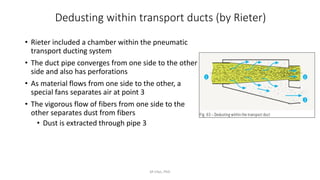
• Rieter included a chamber within the pneumatic
transport ducting system
• The duct pipe converges from one side to the other
side and also has perforations
• As material flows from one side to the other, a
special fans separates air at point 3
• The vigorous flow of fibers from one side to the
other separates dust from fibers
• Dust is extracted through pipe 3
M Irfan, PhD
Trutzschler dedusting machine (Dustex)
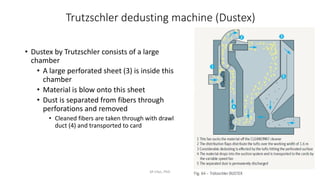
• Dustex by Trutzschler consists of a large
chamber
• A large perforated sheet (3) is inside this
chamber
• Material is blow onto this sheet
• Dust is separated from fibers through
perforations and removed
• Cleaned fibers are taken through with drawl
duct (4) and transported to card
M Irfan, PhD
Metal detection and fire protection
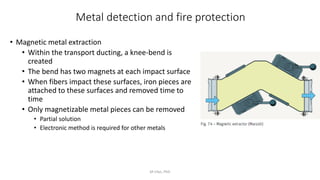
• Magnetic metal extraction
• Within the transport ducting, a knee-bend is
created
• The bend has two magnets at each impact surface
• When fibers impact these surfaces, iron pieces are
attached to these surfaces and removed time to
time
• Only magnetizable metal pieces can be removed
• Partial solution
• Electronic method is required for other metals
M Irfan, PhD
Electronic metal and fire detector
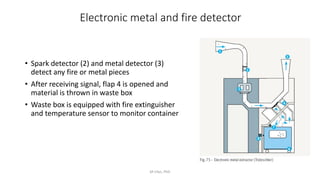
• Spark detector (2) and metal detector (3)
detect any fire or metal pieces
• After receiving signal, flap 4 is opened and
material is thrown in waste box
• Waste box is equipped with fire extinguisher
and temperature sensor to monitor container
M Irfan, PhD
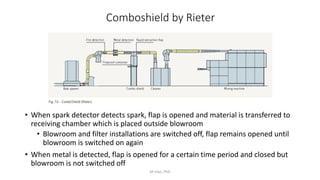
Comboshield by Rieter
• When spark detector detects spark, flap is opened and material is transferred to
receiving chamber which is placed outside blowroom
• Blowroom and filter installations are switched off, flap remains opened until
blowroom is switched on again
• When metal is detected, flap is opened for a certain time period and closed but
blowroom is not switched off
M Irfan, PhD
M Irfan, PhD
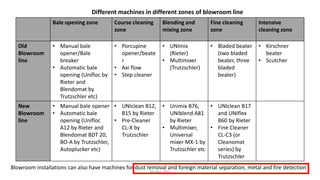
Bale opening zone Course cleaning
zone
Blending and
mixing zone
Fine cleaning
zone
Intensive
cleaning zone
Old
Blowroom
line
• Manual bale
opener/Bale
breaker
• Automatic bale
opening (Unifloc by
Rieter and
Blendomat by
Trutzschler etc)
• Porcupine
opener/beate
r
• Axi flow
• Step cleaner
• UNImix
(Rieter)
• Multimixer
(Trutzschler)
• Bladed beater
(two bladed
beater, three
bladed
beater)
• Kirschner
beater
• Scutcher
New
Blowroom
line
• Manual bale opener
• Automatic bale
opening (Unifloc
A12 by Rieter and
Blendomat BDT 20,
BO-A by Trutzschler,
Autoplucker etc)
• UNIclean B12,
B15 by Rieter
• Pre-Cleaner
CL-X by
Trutzschler
• Unimix B76,
UNIblend A81
by Rieter
• Multimixer,
Universal
mixer MX-1 by
Trutzschler etc
• UNIclean B17
and UNIflex
B60 by Rieter
• Fine Cleaner
CL-C3 (or
Cleanomat
series) by
Trutzschler
Blowroom installations can also have machines for dust removal and foreign material separation, metal and fire detection
Different machines in different zones of blowroom line
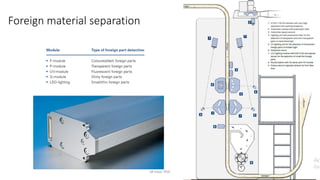
Foreign material separation
M Irfan, PhD
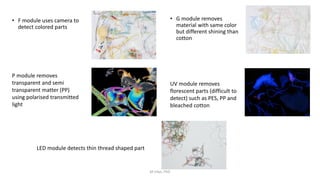
• F module uses camera to
detect colored parts
M Irfan, PhD
• G module removes
material with same color
but different shining than
cotton
P module removes
transparent and semi
transparent matter (PP)
using polarised transmitted
light
UV module removes
florescent parts (difficult to
detect) such as PES, PP and
bleached cotton
LED module detects thin thread shaped part
Feed to the card
• Features
• Should be homogeneous feed from card to card
• Constant feed over longer time periods
• Older method
• Lap feed via scutcher
• Modern method
• Tuft feed via chute feed system
M Irfan, PhD

6. YM-2012 Blow room - 6.pdf

  • 1.
    Pre Spinning Processes (YM-2012) MIrfan Department of Textile Engineering National Textile University Faisalabad Reference: The Rieter Manual of Spinning
  • 2.
    Dust removal machines •Cotton contains dust that should be removed during yarn manufacturing where possible • Little dust before ginning • Beating actions continuously create dust • Dust concentration in blowroom air is governed by laws • Some spinning techniques such as rotor spinning are sensitive to dust in the material • Dust accumulate in the rotor M Irfan, PhD Particle Size (µm) Trash Above 500 Dust 50-500 Micro dust 15-50 Breathable dust Below 15
  • 3.
    Dust removal machines •Dust is difficult to remove because • They are very lighter, therefore float with fibers in the air stream • Dust particles strongly adhere to fiber surface • Dust can be eliminated from fibers due to friction • Fiber to metal friction • For example during carding action • Fiber to fiber friction • For example drafting systems M Irfan, PhD Particle Size (µm) Trash Above 500 Dust 50-500 Micro dust 15-50 Breathable dust Below 15
  • 4.
    Dust removal inblowroom • Dust is removed in blowroom where • Air is separated from fibers • During transportation of fibers • Dust is liberated into the air when fibers are beaten or thrown on surfaces • Fibers are retained by fiber retaining surfaces • Fibers come in contact with perforated surfaces with suction • However, fiber sheet also acts as filter, only under surface of fibers is cleaned • Dust removed from fibers is sucked immediately at the point of separation M Irfan, PhD
  • 5.
    Dedusting within transportducts (by Rieter) • Rieter included a chamber within the pneumatic transport ducting system • The duct pipe converges from one side to the other side and also has perforations • As material flows from one side to the other, a special fans separates air at point 3 • The vigorous flow of fibers from one side to the other separates dust from fibers • Dust is extracted through pipe 3 M Irfan, PhD
  • 6.
    Trutzschler dedusting machine(Dustex) • Dustex by Trutzschler consists of a large chamber • A large perforated sheet (3) is inside this chamber • Material is blow onto this sheet • Dust is separated from fibers through perforations and removed • Cleaned fibers are taken through with drawl duct (4) and transported to card M Irfan, PhD
  • 7.
    Metal detection andfire protection • Magnetic metal extraction • Within the transport ducting, a knee-bend is created • The bend has two magnets at each impact surface • When fibers impact these surfaces, iron pieces are attached to these surfaces and removed time to time • Only magnetizable metal pieces can be removed • Partial solution • Electronic method is required for other metals M Irfan, PhD
  • 8.
    Electronic metal andfire detector • Spark detector (2) and metal detector (3) detect any fire or metal pieces • After receiving signal, flap 4 is opened and material is thrown in waste box • Waste box is equipped with fire extinguisher and temperature sensor to monitor container M Irfan, PhD
  • 9.
    Comboshield by Rieter •When spark detector detects spark, flap is opened and material is transferred to receiving chamber which is placed outside blowroom • Blowroom and filter installations are switched off, flap remains opened until blowroom is switched on again • When metal is detected, flap is opened for a certain time period and closed but blowroom is not switched off M Irfan, PhD
  • 10.
    M Irfan, PhD Baleopening zone Course cleaning zone Blending and mixing zone Fine cleaning zone Intensive cleaning zone Old Blowroom line • Manual bale opener/Bale breaker • Automatic bale opening (Unifloc by Rieter and Blendomat by Trutzschler etc) • Porcupine opener/beate r • Axi flow • Step cleaner • UNImix (Rieter) • Multimixer (Trutzschler) • Bladed beater (two bladed beater, three bladed beater) • Kirschner beater • Scutcher New Blowroom line • Manual bale opener • Automatic bale opening (Unifloc A12 by Rieter and Blendomat BDT 20, BO-A by Trutzschler, Autoplucker etc) • UNIclean B12, B15 by Rieter • Pre-Cleaner CL-X by Trutzschler • Unimix B76, UNIblend A81 by Rieter • Multimixer, Universal mixer MX-1 by Trutzschler etc • UNIclean B17 and UNIflex B60 by Rieter • Fine Cleaner CL-C3 (or Cleanomat series) by Trutzschler Blowroom installations can also have machines for dust removal and foreign material separation, metal and fire detection Different machines in different zones of blowroom line
  • 11.
  • 12.
    • F moduleuses camera to detect colored parts M Irfan, PhD • G module removes material with same color but different shining than cotton P module removes transparent and semi transparent matter (PP) using polarised transmitted light UV module removes florescent parts (difficult to detect) such as PES, PP and bleached cotton LED module detects thin thread shaped part
  • 13.
    Feed to thecard • Features • Should be homogeneous feed from card to card • Constant feed over longer time periods • Older method • Lap feed via scutcher • Modern method • Tuft feed via chute feed system M Irfan, PhD