INSTITUTE OF PHARMACEUTICAL RESEARCH
GLA UNIVERSITY
MATHURA
TOPIC – POLYMER
Presented by: Supervisor:
Chandan Arya Dr. Anuj Garg
M.Pharm 1st Sem
Roll no. 04
POLYMER ?
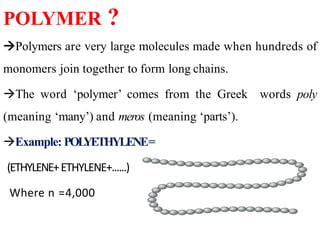
→Polymers are very large molecules made when hundreds of
monomers join together to form long chains.
→The word ‘polymer’ comes from the Greek words poly
(meaning ‘many’) and meros (meaning ‘parts’).
→Example: POL
YETHYLENE=
(ETHYLENE+ETHYLENE+......)
Where n =4,000
MONOMER ?
❖The small individual repeating units/molecules
are known as monomers(means singlepart).
❖Imagine that a monomer can be representedby
the letter O.Then a polymer made of that
monomer would have the structure:
-O-O-O-O-O-O-O-O-O-O-O-O-O-O-O-O-O-O-O-
CLASSIFICATION OF POLYMER
1. By Origin
2. By Monomer
3. ByThermal Response
4. ByMode OfFormation
5. By Structure
6. ByApplication &Physical Properties
7. By Tacticity
ON THE BASIS OF THEIR ORIGIN
❖Natural Polymers
➢Polymers which are isolated from natural
materials are called as natural polymers.
E.g. Silk, Wool, Natural rubber, Cellulose,
Starch, Proteins etc.
❖Semisynthetic Polymers
➢The polymers obtained by simple chemical
treatment of natural polymers to improve their
physical properties like lustrous nature, tensile
strength are called semisynthetic polymers
E.g.Cellulose acetate, Cellulose nitrate
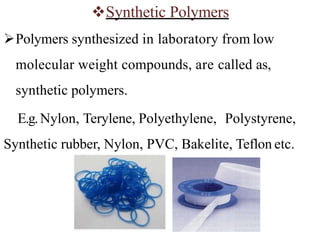
❖Synthetic Polymers
➢Polymers synthesized in laboratory from low
molecular weight compounds, are called as,
synthetic polymers.
E.g.Nylon, Terylene, Polyethylene, Polystyrene,
Synthetic rubber, Nylon, PVC, Bakelite, Teflon etc.
MONOMER
❖Homo Polymers
➢Apolymer consist of identical monomers is
called homo polymer.
E.g.Polyethylene, PVC,Polypropylene, Nylon6
❖Co Polymers
➢Apolymer consist of monomers of different
chemical structure are called copolymers.
E.g.Nylon 6,6
THERMAL RESPONSE
❖Thermoplastic Polymers
➢They are easily moulded in desired shapes by
heating and subsequent cooling at room
temperature.
➢They are soft in hot and hard on colling.
➢They my be linear or branched chain polymers.
E.g. PE,PVC,PS,PP
❖Thermosetting Polymers
➢This polymer is hard and infusible on heating.
➢These are not soft on heating under pressure and
they are not remolded.
➢These are cross linked polymers and are not
reused.
E.g. Bakelite
MODE OF FORMATION
❖Addition Polymers
➢The polymers formed by the addition of
monomers repeatedly without removal of by
products are called addition polymers.
➢These polymers contains all the atoms of
monomers hence their molecular weight are
integral multiple of monomer unit.
E.g. Teflon, Polyethylene, Polypropylene, PVC.
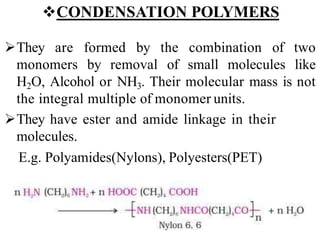
❖CONDENSATION POLYMERS
➢They are formed by the combination of two
monomers by removal of small molecules like
H2O, Alcohol or NH3. Their molecular mass is not
the integral multiple of monomer units.
➢They have ester and amide linkage in their
molecules.
E.g. Polyamides(Nylons), Polyesters(PET)
BY STRUCTURE
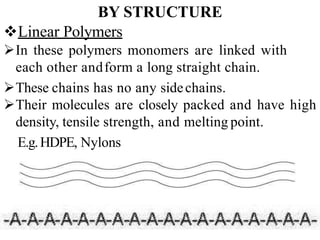
❖Linear Polymers
➢In these polymers monomers are linked with
each other andform a long straight chain.
➢These chains has no any sidechains.
➢Their molecules are closely packed and have high
density, tensile strength, and melting point.
E.g.HDPE, Nylons
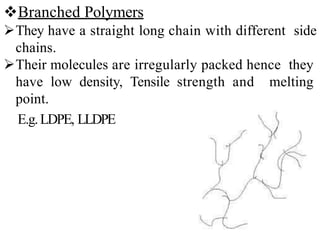
❖Branched Polymers
➢They have a straight long chain with different side
chains.
➢Their molecules are irregularly packed hence they
have low density, Tensile strength and melting
point.
E.g.LDPE, LLDPE
APPLICATION AND PHYSICAL PROPERTIES
❖Fibers
➢If polymer is drawn into long filament like
materiel whose length is at least 100 times it’s
diameter, are said to be converted intofiber.
➢They have high tensile strength because of high
intermolecular attractive force like Hydrogen
bonding.
➢Highly crystalline.
E.g.Nylon, Terylene.
❖Plastics
➢Polymer is shaped into hard and tough utility
articles by application of heat and pressure, is
known as plastics.
➢Here the intermolecular force between
polymeric chains are intermediate between
elastomers and fibers.
➢They are partially crystalline.
E.g.Polystyrene, PVC, PMMA
❖Elastomers
➢They are solids with rubber like elastic
properties.
➢Here the polymeric chains are held together by the
weakest intermolecular forces so they are highly
amorphous in nature.
➢These weak binding forces permit them to be
stretched.
E.g. Natural rubber, BUNA-S, BUNA-N,
Vulcanised rubber
ON THE BASIS OF TACTICITY
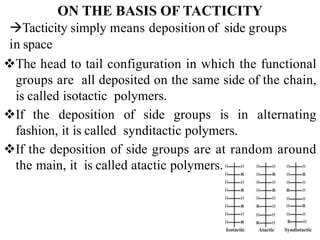
→Tacticity simply means deposition of side groups
in space
❖The head to tail configuration in which the functional
groups are all deposited on the same side of the chain,
is called isotactic polymers.
❖If the deposition of side groups is in alternating
fashion, it is called synditactic polymers.
❖If the deposition of side groups are at random around
the main, it is called atactic polymers.
ON THE BASIS OF PARAMETERS
❖ByCrystallinity
1. Crystalline – Monomers arranged in ordered way.
2. Amorphous – Monomers arranged in random way.
❖ByBackbone Atom
1. Organic – Polymer Backbone is made-up of
carbon atom.
2. Inorganic – Polymer Backbone is made-up of
other atoms
Polymer

Polymer

  • 1.
    INSTITUTE OF PHARMACEUTICALRESEARCH GLA UNIVERSITY MATHURA TOPIC – POLYMER Presented by: Supervisor: Chandan Arya Dr. Anuj Garg M.Pharm 1st Sem Roll no. 04
  • 2.
    POLYMER ? →Polymers arevery large molecules made when hundreds of monomers join together to form long chains. →The word ‘polymer’ comes from the Greek words poly (meaning ‘many’) and meros (meaning ‘parts’). →Example: POL YETHYLENE= (ETHYLENE+ETHYLENE+......) Where n =4,000
  • 3.
    MONOMER ? ❖The smallindividual repeating units/molecules are known as monomers(means singlepart). ❖Imagine that a monomer can be representedby the letter O.Then a polymer made of that monomer would have the structure: -O-O-O-O-O-O-O-O-O-O-O-O-O-O-O-O-O-O-O-
  • 4.
    CLASSIFICATION OF POLYMER 1.By Origin 2. By Monomer 3. ByThermal Response 4. ByMode OfFormation 5. By Structure 6. ByApplication &Physical Properties 7. By Tacticity
  • 5.
    ON THE BASISOF THEIR ORIGIN ❖Natural Polymers ➢Polymers which are isolated from natural materials are called as natural polymers. E.g. Silk, Wool, Natural rubber, Cellulose, Starch, Proteins etc.
  • 6.
    ❖Semisynthetic Polymers ➢The polymersobtained by simple chemical treatment of natural polymers to improve their physical properties like lustrous nature, tensile strength are called semisynthetic polymers E.g.Cellulose acetate, Cellulose nitrate
  • 7.
    ❖Synthetic Polymers ➢Polymers synthesizedin laboratory from low molecular weight compounds, are called as, synthetic polymers. E.g.Nylon, Terylene, Polyethylene, Polystyrene, Synthetic rubber, Nylon, PVC, Bakelite, Teflon etc.
  • 8.
    MONOMER ❖Homo Polymers ➢Apolymer consistof identical monomers is called homo polymer. E.g.Polyethylene, PVC,Polypropylene, Nylon6 ❖Co Polymers ➢Apolymer consist of monomers of different chemical structure are called copolymers. E.g.Nylon 6,6
  • 9.
    THERMAL RESPONSE ❖Thermoplastic Polymers ➢Theyare easily moulded in desired shapes by heating and subsequent cooling at room temperature. ➢They are soft in hot and hard on colling. ➢They my be linear or branched chain polymers. E.g. PE,PVC,PS,PP
  • 10.
    ❖Thermosetting Polymers ➢This polymeris hard and infusible on heating. ➢These are not soft on heating under pressure and they are not remolded. ➢These are cross linked polymers and are not reused. E.g. Bakelite
  • 11.
    MODE OF FORMATION ❖AdditionPolymers ➢The polymers formed by the addition of monomers repeatedly without removal of by products are called addition polymers. ➢These polymers contains all the atoms of monomers hence their molecular weight are integral multiple of monomer unit. E.g. Teflon, Polyethylene, Polypropylene, PVC.
  • 12.
    ❖CONDENSATION POLYMERS ➢They areformed by the combination of two monomers by removal of small molecules like H2O, Alcohol or NH3. Their molecular mass is not the integral multiple of monomer units. ➢They have ester and amide linkage in their molecules. E.g. Polyamides(Nylons), Polyesters(PET)
  • 13.
    BY STRUCTURE ❖Linear Polymers ➢Inthese polymers monomers are linked with each other andform a long straight chain. ➢These chains has no any sidechains. ➢Their molecules are closely packed and have high density, tensile strength, and melting point. E.g.HDPE, Nylons
  • 14.
    ❖Branched Polymers ➢They havea straight long chain with different side chains. ➢Their molecules are irregularly packed hence they have low density, Tensile strength and melting point. E.g.LDPE, LLDPE
  • 15.
    APPLICATION AND PHYSICALPROPERTIES ❖Fibers ➢If polymer is drawn into long filament like materiel whose length is at least 100 times it’s diameter, are said to be converted intofiber. ➢They have high tensile strength because of high intermolecular attractive force like Hydrogen bonding. ➢Highly crystalline. E.g.Nylon, Terylene.
  • 16.
    ❖Plastics ➢Polymer is shapedinto hard and tough utility articles by application of heat and pressure, is known as plastics. ➢Here the intermolecular force between polymeric chains are intermediate between elastomers and fibers. ➢They are partially crystalline. E.g.Polystyrene, PVC, PMMA
  • 17.
    ❖Elastomers ➢They are solidswith rubber like elastic properties. ➢Here the polymeric chains are held together by the weakest intermolecular forces so they are highly amorphous in nature. ➢These weak binding forces permit them to be stretched. E.g. Natural rubber, BUNA-S, BUNA-N, Vulcanised rubber
  • 18.
    ON THE BASISOF TACTICITY →Tacticity simply means deposition of side groups in space ❖The head to tail configuration in which the functional groups are all deposited on the same side of the chain, is called isotactic polymers. ❖If the deposition of side groups is in alternating fashion, it is called synditactic polymers. ❖If the deposition of side groups are at random around the main, it is called atactic polymers.
  • 19.
    ON THE BASISOF PARAMETERS ❖ByCrystallinity 1. Crystalline – Monomers arranged in ordered way. 2. Amorphous – Monomers arranged in random way. ❖ByBackbone Atom 1. Organic – Polymer Backbone is made-up of carbon atom. 2. Inorganic – Polymer Backbone is made-up of other atoms