Mechanics of Fibrous Structure
(TE-3113)
M Irfan
Department of Textile Engineering
National Textile University Faisalabad
Mechanics of yarn structure
P. Schwartz " Structure & Mechanics of Textile Assemblies" (2003)
Book Reference
M Irfan, PhD
Yarn
• A continuous strand made of natural or man
made staple fibers or continuous filaments
suitable to be used for weaving and knitting
purposes
• yarn is an intermediate product
• Yarn is the building block of many textile products
– knit apparels , woven fabric, towels, sheets,
carpets, industrial fabrics etc
M Irfan, PhD
Yarn performance
• Yarn performance criteria varies according to
– End product
– Down stream process
– For example
• (1)spinner’s perspective: a good yarn performance means
appearance, strength, uniformity and lower level of imperfections
But…Spinner is not the end user
• (2) knitters perspective: unwind easily, conform readily to
bending/looping , sheds low fly (low hairiness), soft hand of fabric
(low twist, low bending stiffness), better pilling resistance
M Irfan, PhD
Yarn performance
• Yarn performance
– (3) Weaver’s perspective: can withstand stresses
(strength, flexibility), surface integrity (low hairiness,
high abrasion resistance), defect free fabric (high
evenness, low imperfections, and minimum
contamination)
• Yarn integrity is a key aspect in all applications (here
comes yarn mechanics for exploring and predicting yarn
failure)
M Irfan, PhD
Types of yarn
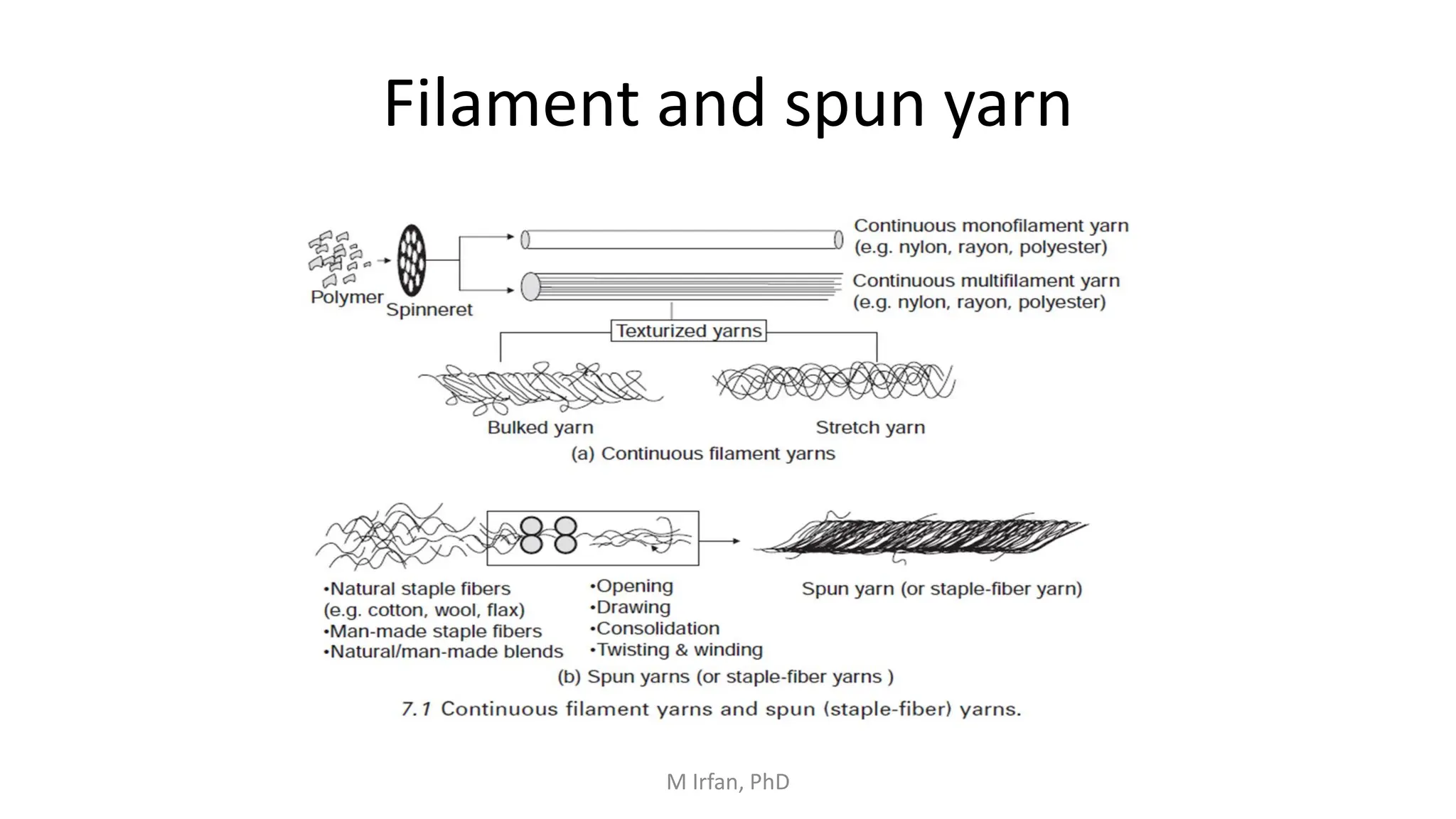
• Two main types
– continuous filament yarns
– spun yarns
• continuous filament yarn:
– multiple filaments are laid side by side in parallel
arrangement
– made by extruding polymer liquid through a spinneret
– Can be monofilament or multifilament
M Irfan, PhD
Filament and spun yarn
M Irfan, PhD
Types of yarn
• Continuous filament yarn
– Structural derivatives via texturizing
• Stretchy yarn
• Bulky yarn
• Staple yarn
– produced from staple fibers of natural or synthetic
sources
– Can be produced using different process
M Irfan, PhD
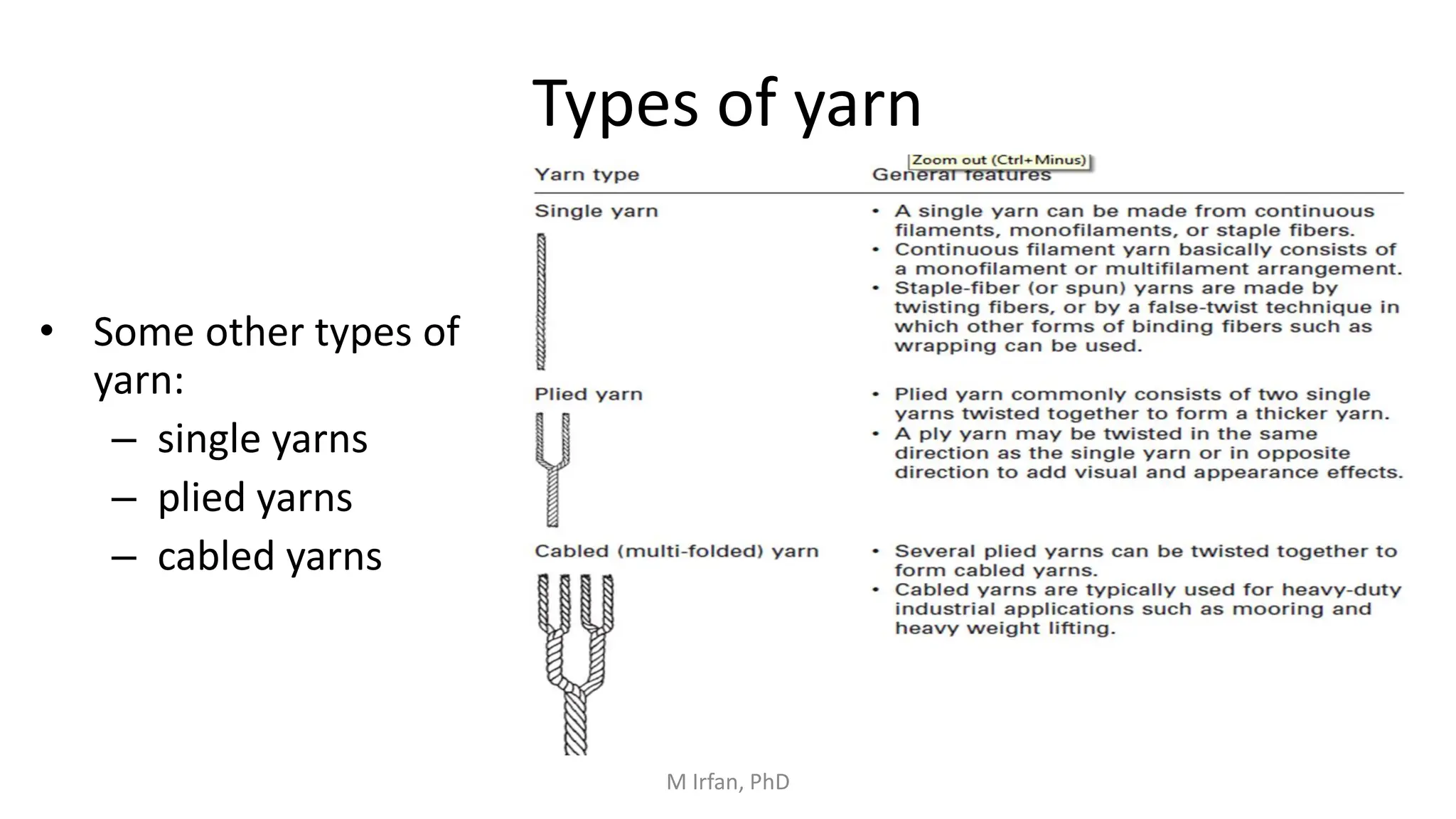
Types of yarn
• Some other types of
yarn:
– single yarns
– plied yarns
– cabled yarns
M Irfan, PhD
Yarn Structure
• Yarn, being the building block of fabric, contributes
to end product performance through three key
structural aspects
– (i) fiber compactness
– (ii) fiber arrangement
– (iii) fiber mobility
M Irfan, PhD
Fiber Compactness
• Fiber compactness contributes to maintain
integrity of yarn structure
• Filament yarn
– Highest compactness
• Lateral forces by outer filaments on inner filaments
• Long inter filament contact
• No air entrapped
– Texturization reduces compactness
• Interfiber spaces increase
M Irfan, PhD
Fiber Compactness
• Spun yarn
– Compactness is due to the lateral forces imposed
by the twist in the spun yarn
– plenty of air pockets inside the yarn structure due
to discrete nature of fibers
M Irfan, PhD
Fiber Compactness
• Higher the fiber compactness
– low yarn compressibility (or low softness), high
strength, low yarn flexibility, low yarn porosity, more
moisture wicking along the yarn surface than along
the fibers in the yarn
• low fiber compactness is likely to result in
– High yarn compressibility (or high softness), high
flexibility, high porosity, and more moisture wicking
along the fibers in the yarn
M Irfan, PhD
Fiber Compactness
• Thus fiber compactness influences strength,
hand, drape, moisture management, and comfort
of fabric
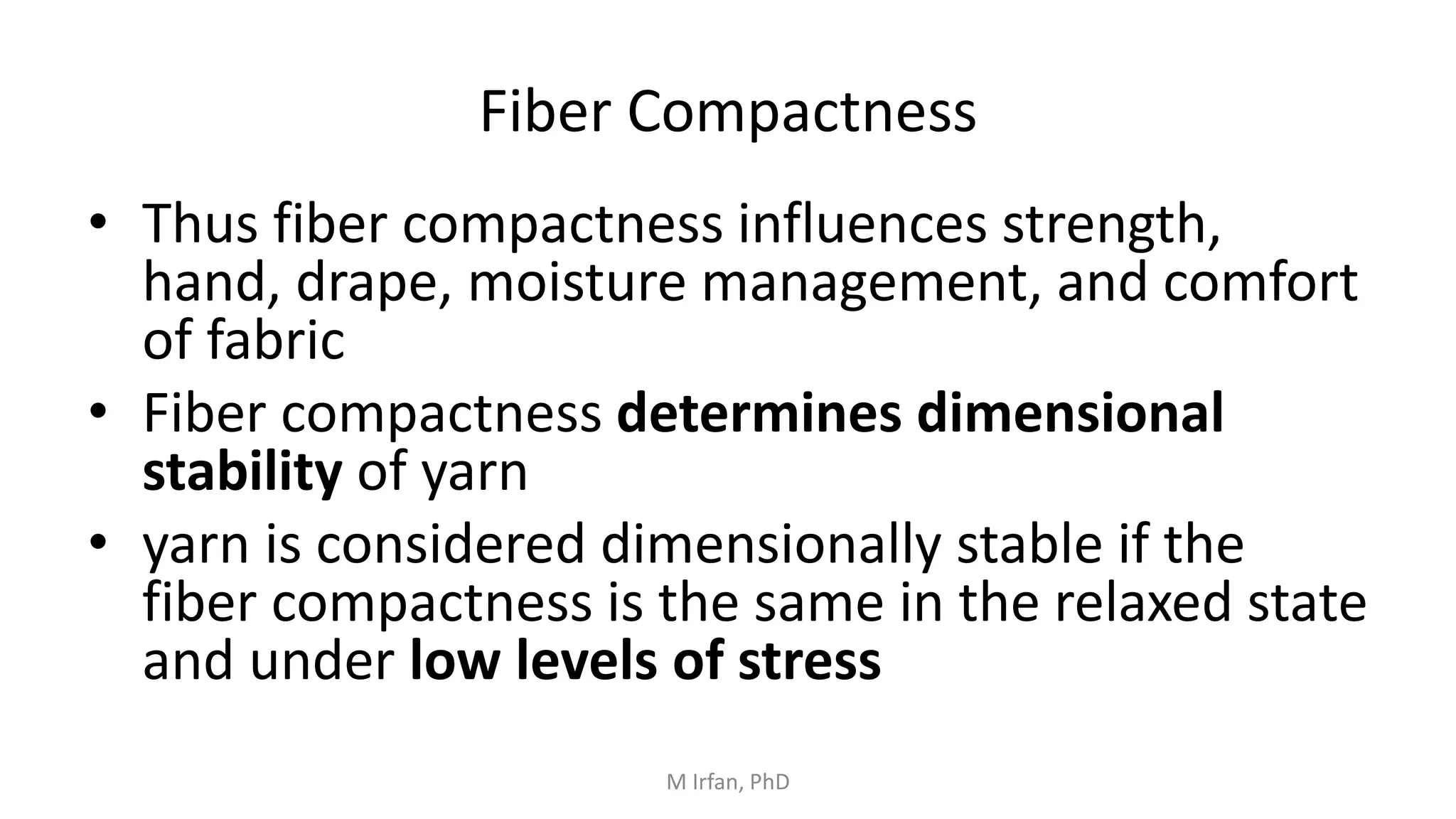
• Fiber compactness determines dimensional
stability of yarn
• yarn is considered dimensionally stable if the
fiber compactness is the same in the relaxed state
and under low levels of stress
M Irfan, PhD
Fiber Compactness
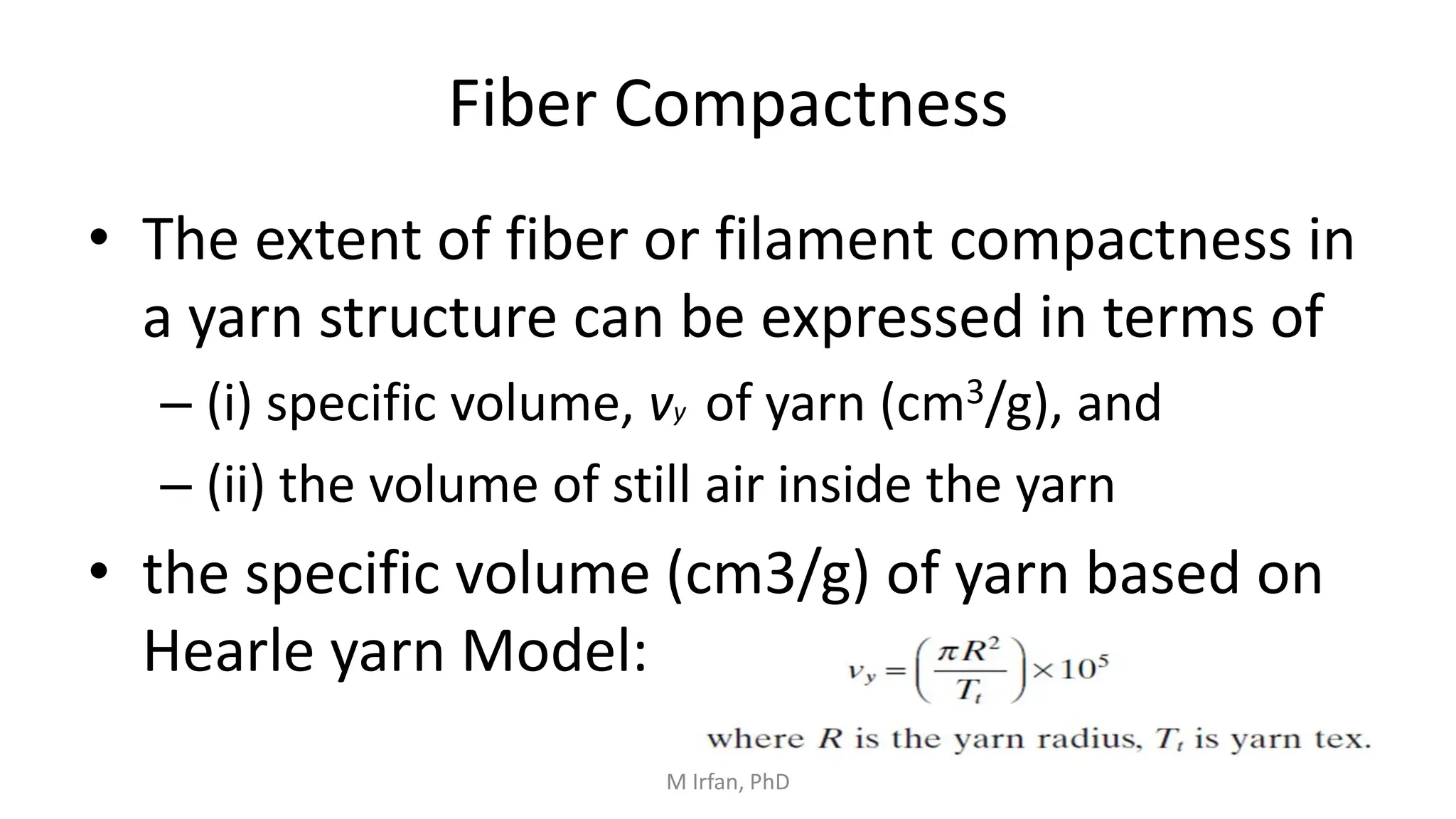
• The extent of fiber or filament compactness in
a yarn structure can be expressed in terms of
– (i) specific volume, vy of yarn (cm3/g), and
– (ii) the volume of still air inside the yarn
• the specific volume (cm3/g) of yarn based on
Hearle yarn Model:
M Irfan, PhD
Fiber Compactness
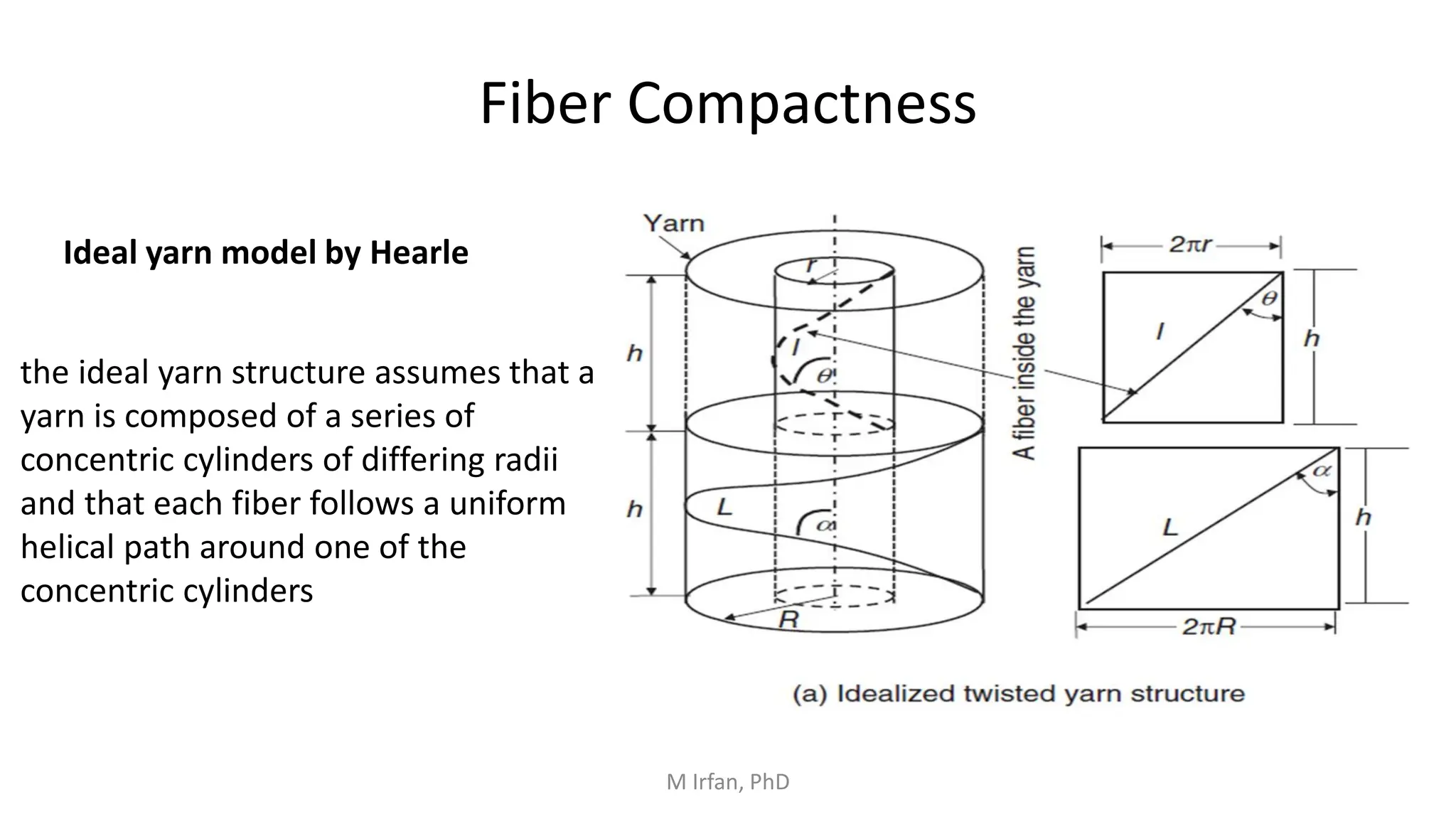
the ideal yarn structure assumes that a
yarn is composed of a series of
concentric cylinders of differing radii
and that each fiber follows a uniform
helical path around one of the
concentric cylinders
Ideal yarn model by Hearle
M Irfan, PhD
Fiber Compactness
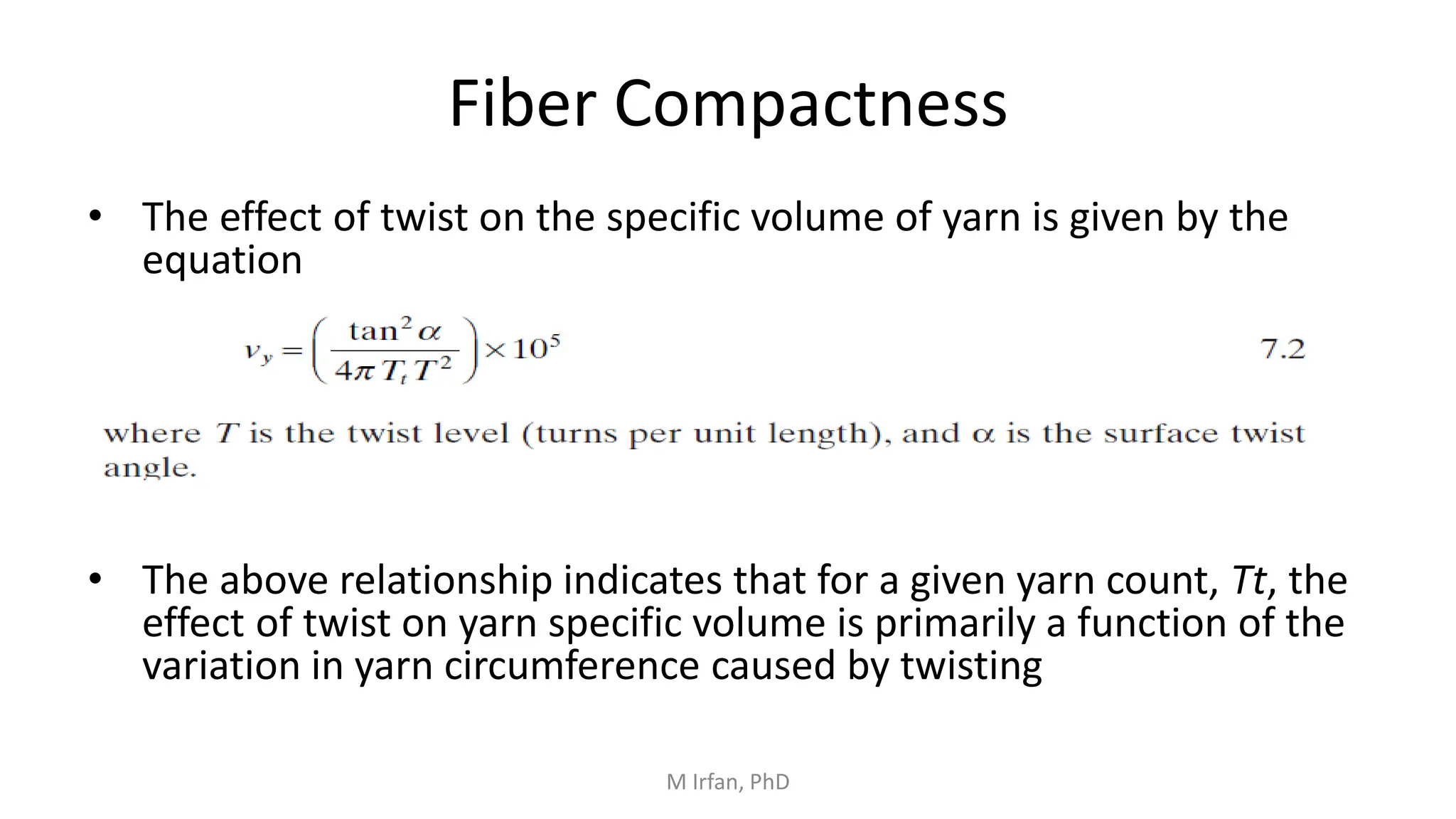
• The effect of twist on the specific volume of yarn is given by the
equation
• The above relationship indicates that for a given yarn count, Tt, the
effect of twist on yarn specific volume is primarily a function of the
variation in yarn circumference caused by twisting
M Irfan, PhD
Fiber Compactness
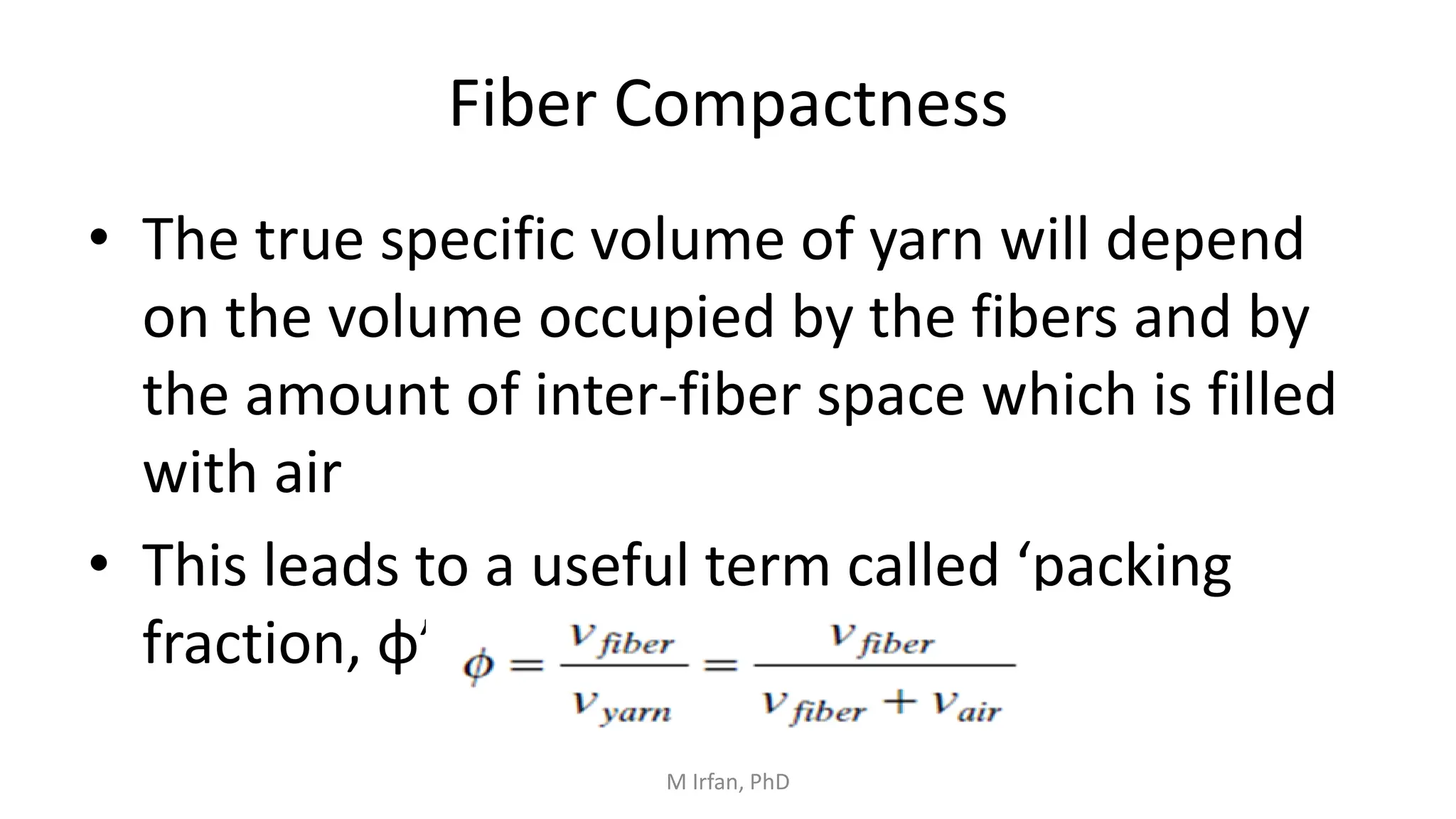
• The true specific volume of yarn will depend
on the volume occupied by the fibers and by
the amount of inter-fiber space which is filled
with air
• This leads to a useful term called ‘packing
fraction, φ’
M Irfan, PhD
Fiber Compactness
• factors influencing fiber compactness in the yarn
– spinning preparatory processes: Combed yarns are
denser than carded yarns
– Spinning method: Ring-spun yarns have substantially
higher density than rotor-spun yarns
– yarn twist: higher the twist level, higher the yarn
density
M Irfan, PhD
Fiber Arrangement and Orientation
• The way fibers are arranged in the yarn structure impacts on a
number of yarn and fabric performance characteristics (yarn
appearance, yarn strength, fabric dimensional stability, and fabric
cover)
• Fiber orientation means the directional arrangement of fibers in
yarn
• Geometrical and mechanical properties of yarn are dependent of
yarn are dependent on fiber orientation
• Filament yarn has the simplest fiber arrangement (parallel filament
arrangement)
– Twisting and texturizing alters fiber/filament arrangement in the yarn
M Irfan, PhD
Fiber Arrangement and Orientation
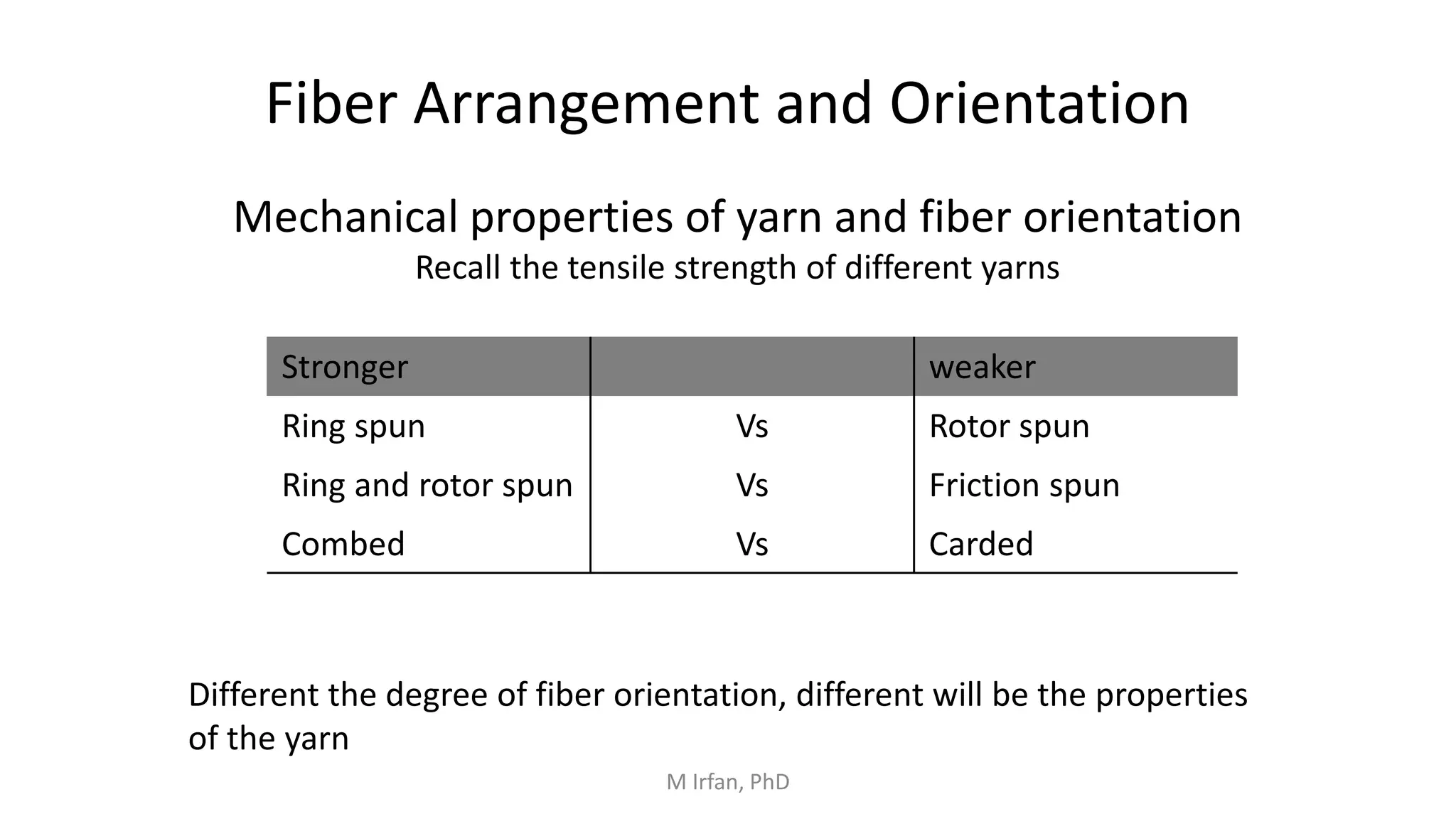
Mechanical properties of yarn and fiber orientation
Recall the tensile strength of different yarns
Stronger weaker
Ring spun Vs Rotor spun
Ring and rotor spun Vs Friction spun
Combed Vs Carded
Different the degree of fiber orientation, different will be the properties
of the yarn
M Irfan, PhD
Fiber Arrangement and Orientation
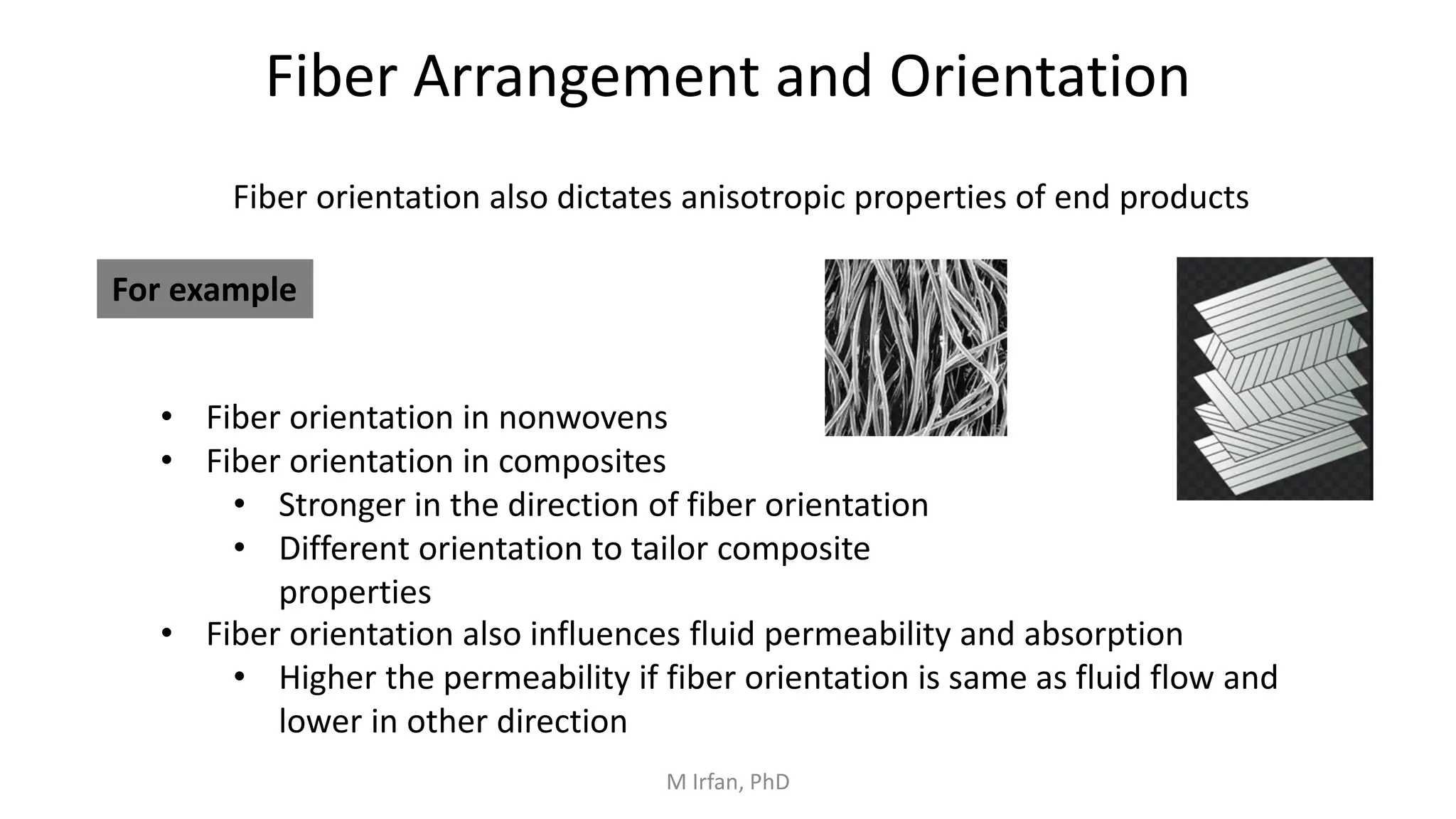
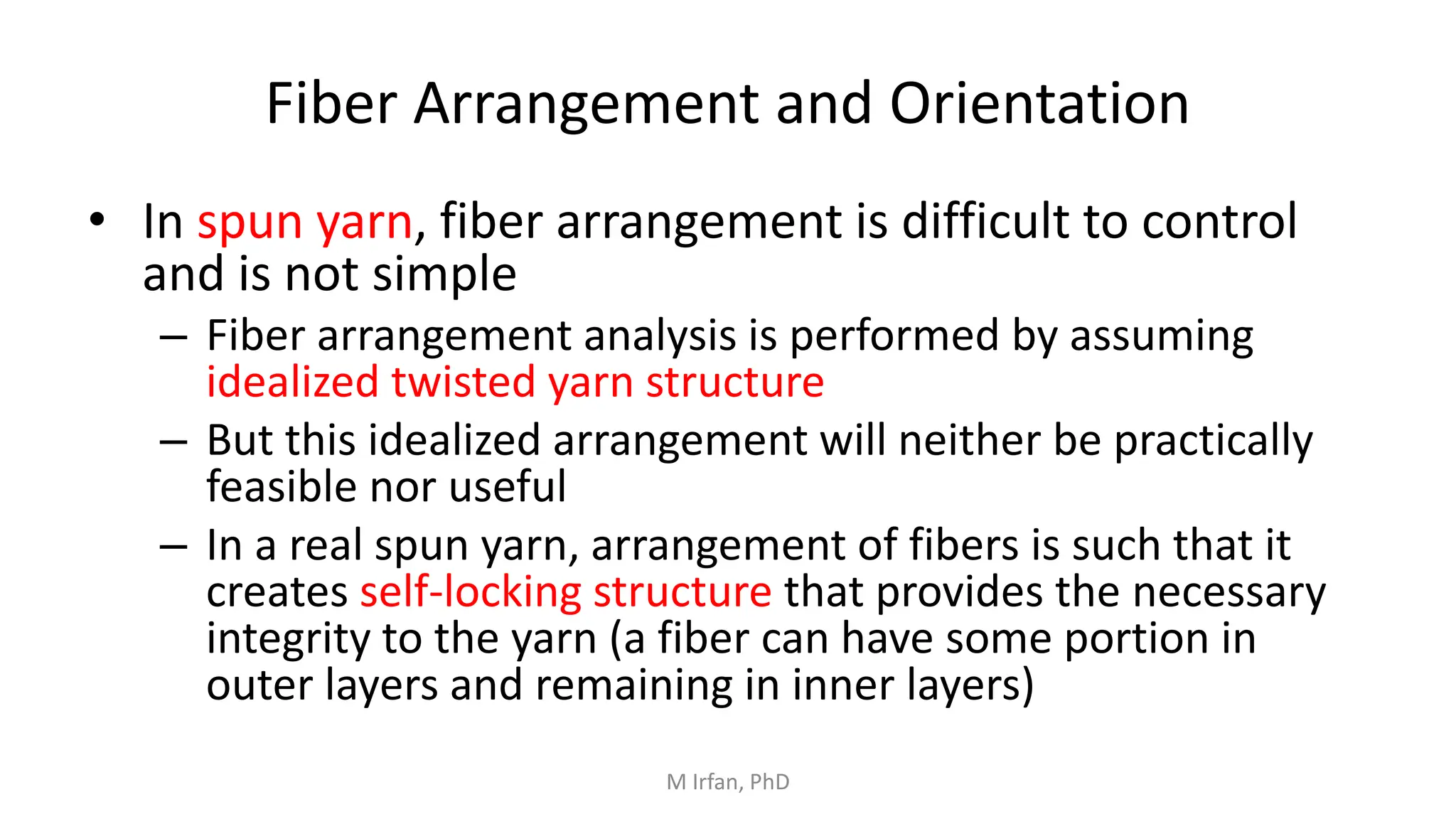
Fiber orientation also dictates anisotropic properties of end products
For example
• Fiber orientation in nonwovens
• Fiber orientation in composites
• Stronger in the direction of fiber orientation
• Different orientation to tailor composite
properties
• Fiber orientation also influences fluid permeability and absorption
• Higher the permeability if fiber orientation is same as fluid flow and
lower in other direction
M Irfan, PhD
Fiber Arrangement and Orientation
• In spun yarn, fiber arrangement is difficult to control
and is not simple
– Fiber arrangement analysis is performed by assuming
idealized twisted yarn structure
– But this idealized arrangement will neither be practically
feasible nor useful
– In a real spun yarn, arrangement of fibers is such that it
creates self-locking structure that provides the necessary
integrity to the yarn (a fiber can have some portion in
outer layers and remaining in inner layers)
M Irfan, PhD
Fiber Arrangement and Orientation
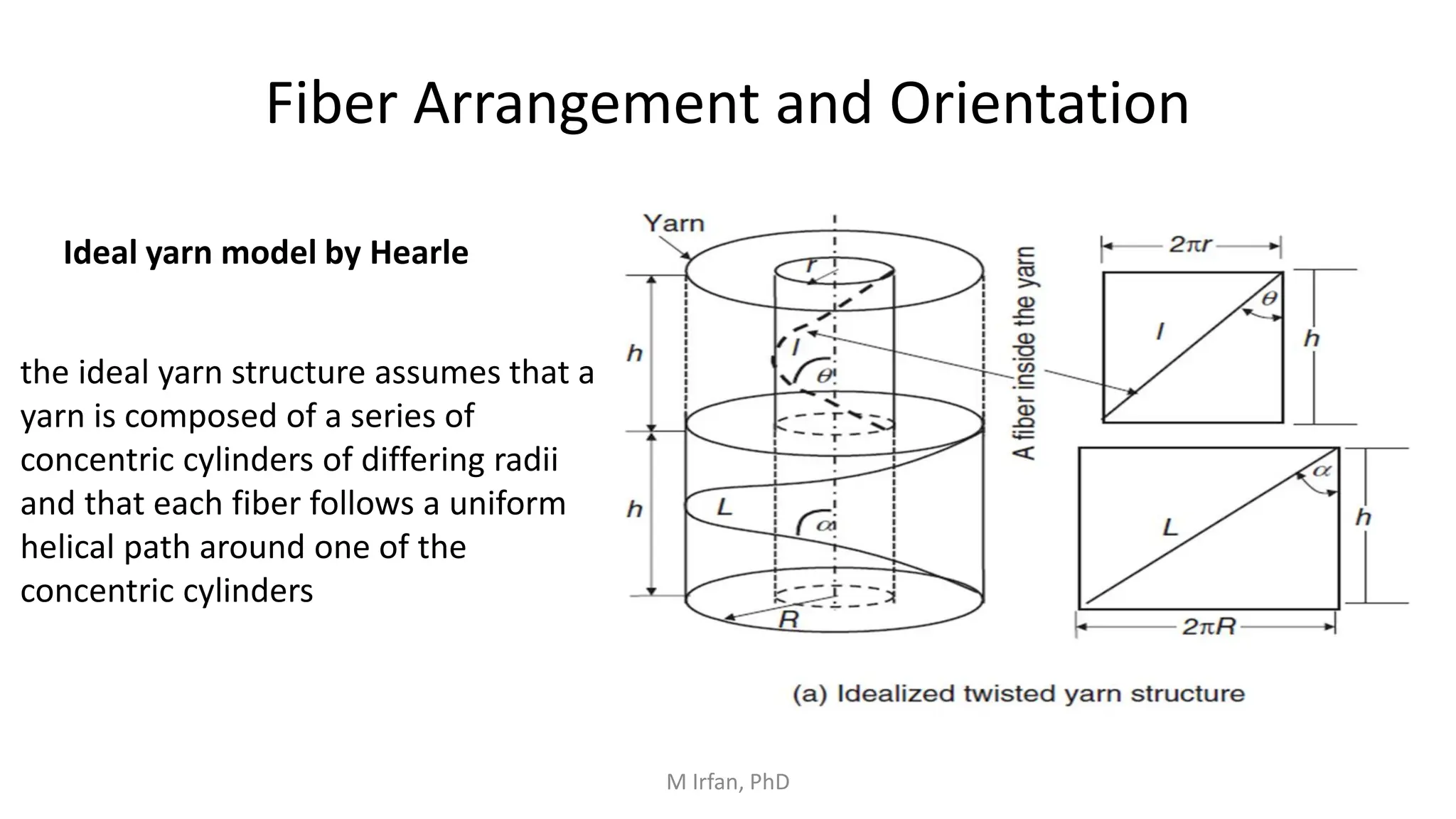
the ideal yarn structure assumes that a
yarn is composed of a series of
concentric cylinders of differing radii
and that each fiber follows a uniform
helical path around one of the
concentric cylinders
Ideal yarn model by Hearle
M Irfan, PhD
Fiber Mobility
• Fiber mobility also determines
dimensional stability of yarns and
fabrics
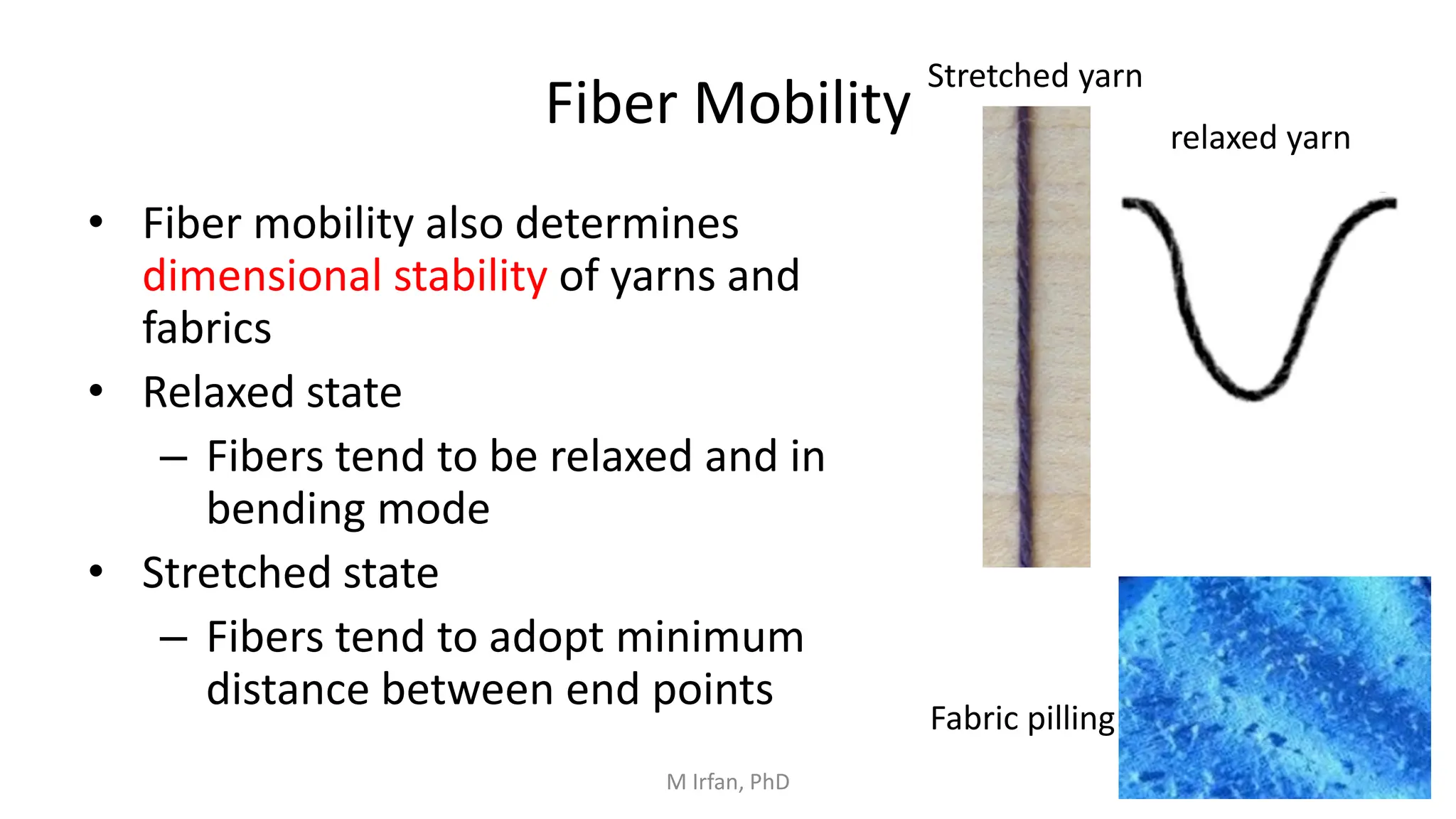
• Relaxed state
– Fibers tend to be relaxed and in
bending mode
• Stretched state
– Fibers tend to adopt minimum
distance between end points
Stretched yarn
relaxed yarn
Fabric pilling
M Irfan, PhD
Fiber Mobility
Importance of fiber mobility
• It influences yarn performance
– During conversion of yarn into fabric (weaving)
• E.g, during soft wool fabric weaving, repetitive tensioning
and rubbing can cause incremental drafting of wool yarn
– During end use of the product by the consumer
(laundering etc)
M Irfan, PhD
Fiber Mobility
Importance of fiber mobility
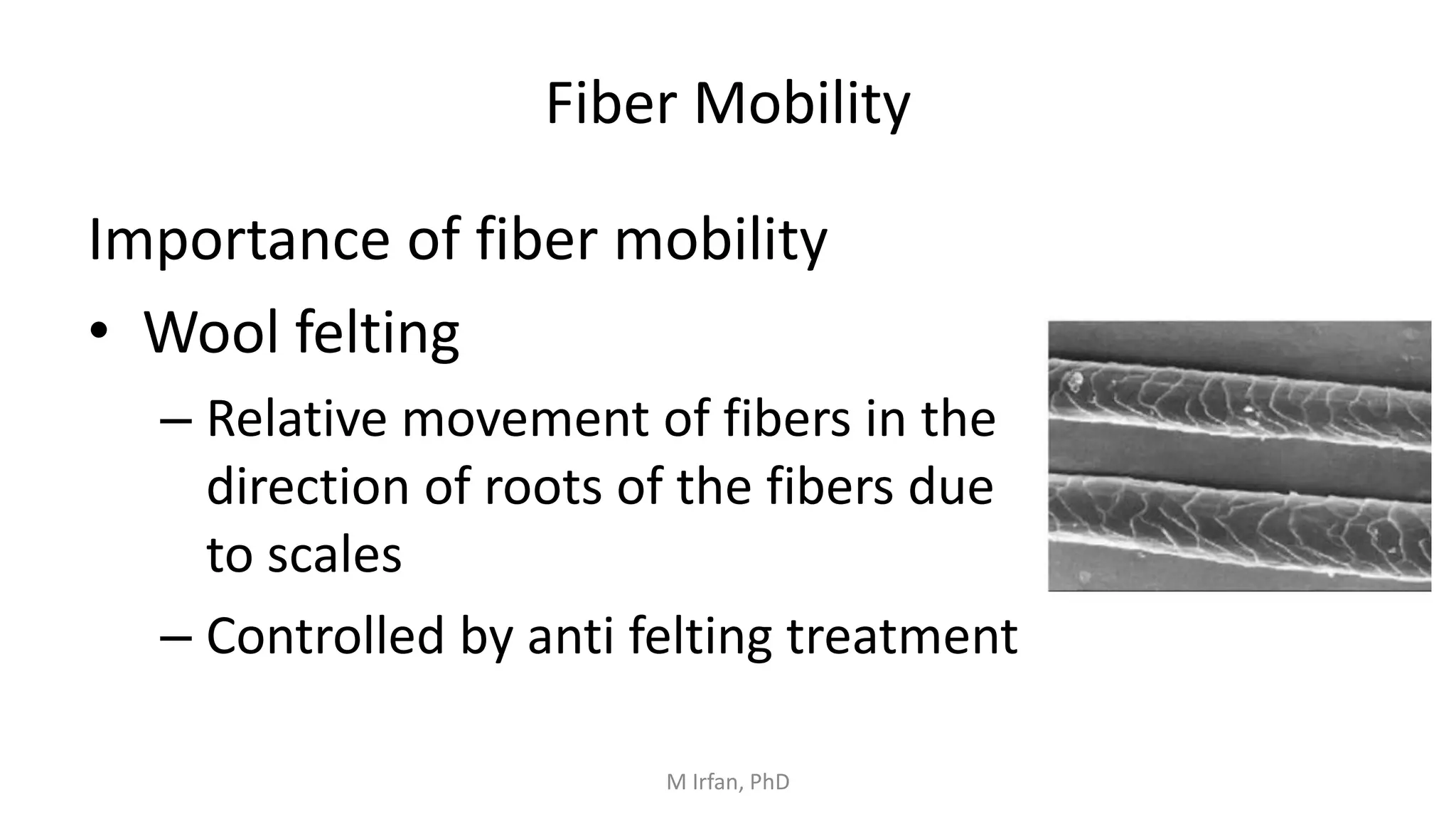
• Wool felting
– Relative movement of fibers in the
direction of roots of the fibers due
to scales
– Controlled by anti felting treatment
M Irfan, PhD
Fiber Mobility
Performance requirements
• User perspective
– Aesthetic and soft handle
• Utility
– Dimensional Stability: resistance to pilling and bagging
• Both these performance requirements are conflicting
– Twisting can increase dimensional stability but reduce
softness
M Irfan, PhD
Fiber Mobility
Understanding fiber mobility
– Fiber movement is considered due to irregular forces on
fabrics during use (laundering etc)
– Fiber movement is considered a diffusion process
leading to greater mixing
– Should not be confused with difference in concentration
• In fact it is Redistribution of fibers within slacker and tighter
M Irfan, PhD
• Factors affecting fiber mobility
– Fiber type, fiber length and fineness
• Shorter fibers are expected to move towards surface
causing hairiness
– Yarn twist, yarn count, fiber blend
– Spinning technique, type of twisting, machine
geometry etc
Fiber Mobility
M Irfan, PhD
Fiber Mobility
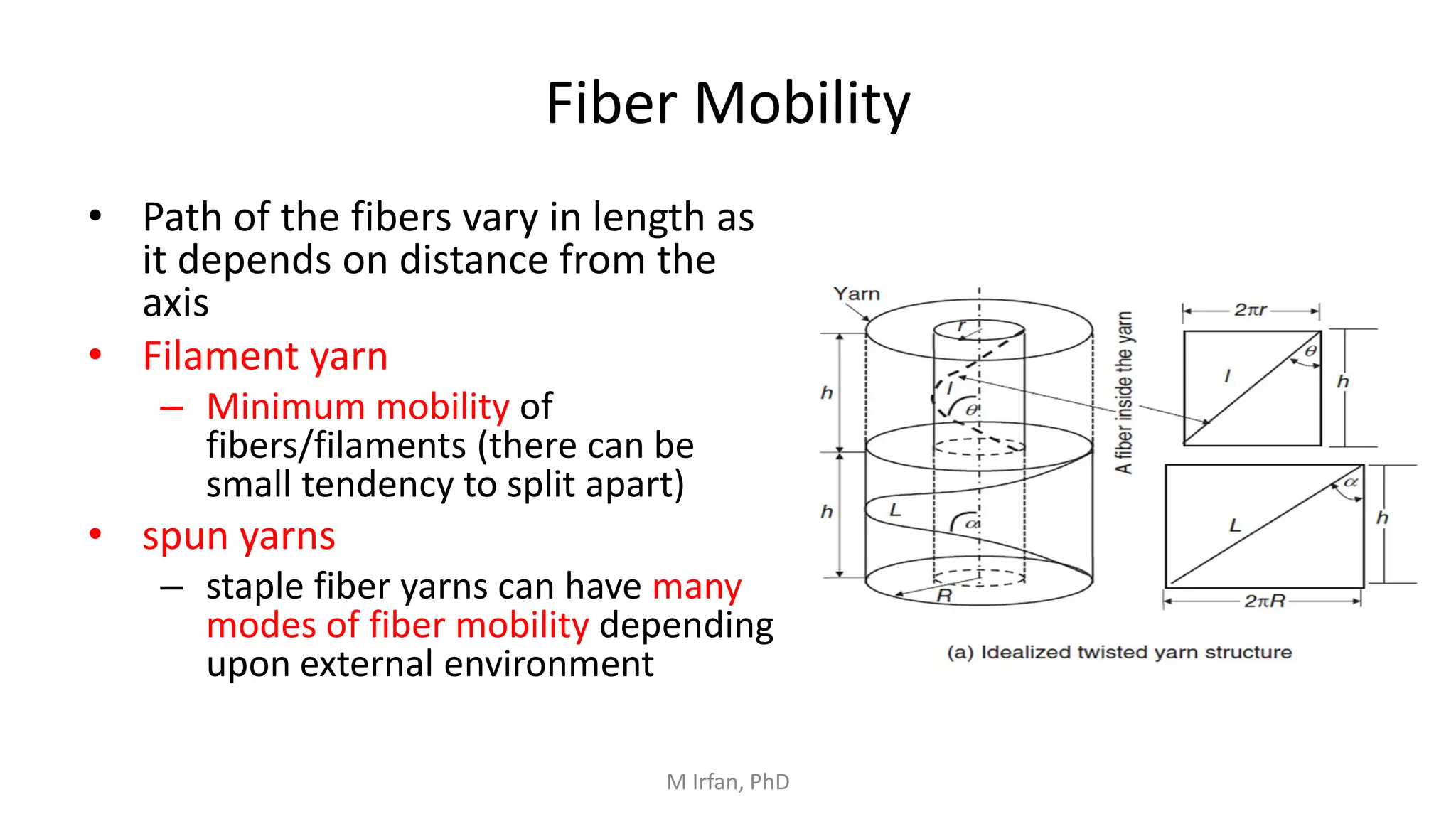
• Path of the fibers vary in length as
it depends on distance from the
axis
• Filament yarn
– Minimum mobility of
fibers/filaments (there can be
small tendency to split apart)
• spun yarns
– staple fiber yarns can have many
modes of fiber mobility depending
upon external environment
M Irfan, PhD
Fiber Mobility
• Greater fiber mobility is observed near the yarn surface:
Fiber mobility is greater for fibers/filaments near the yarn
surface
• In an untwisted continuous filament yarn, filaments in the
outer layer will tend to snag or come loose
• In spun yarns, fiber segments protruding from the yarn
body result in yarn hairiness
– Long protruding fibers will tend to entangle together and hinder
a smooth flow of the yarn during further processing (weaving)
– Yarn hairiness also causes the pilling phenomenon
M Irfan, PhD
Fiber Mobility
• The level of protruding fibers or hairiness on the
yarn surface depends on many factors
– Twist in the yarn
– Spinning preparation methods
– Spinning technique used
– Count of the yarn
• Yarn hairiness can be removed in a process
known as singeing
M Irfan, PhD
Fiber Mobility
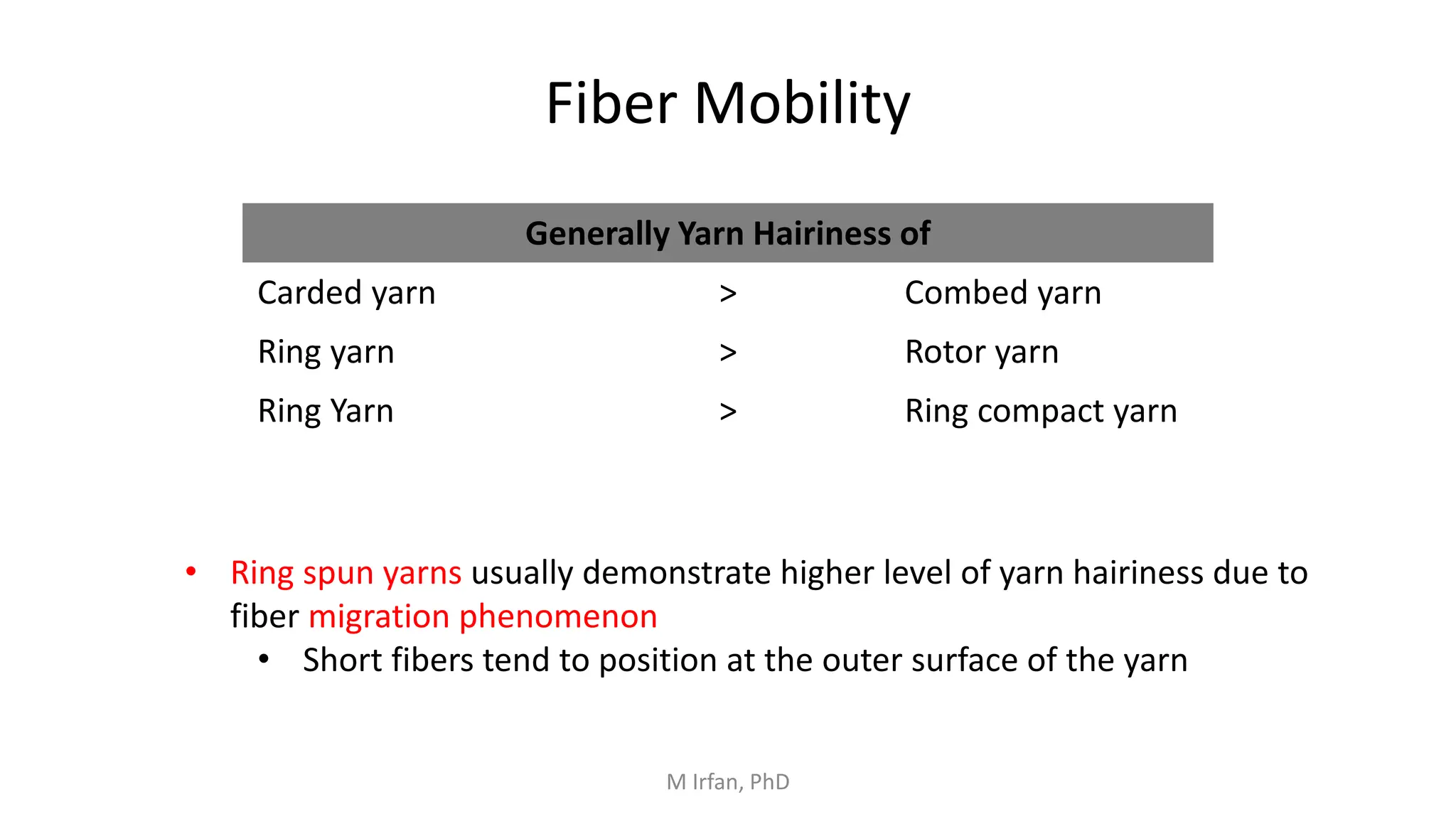
Generally Yarn Hairiness of
Carded yarn > Combed yarn
Ring yarn > Rotor yarn
Ring Yarn > Ring compact yarn
• Ring spun yarns usually demonstrate higher level of yarn hairiness due to
fiber migration phenomenon
• Short fibers tend to position at the outer surface of the yarn
M Irfan, PhD
Fiber Mobility
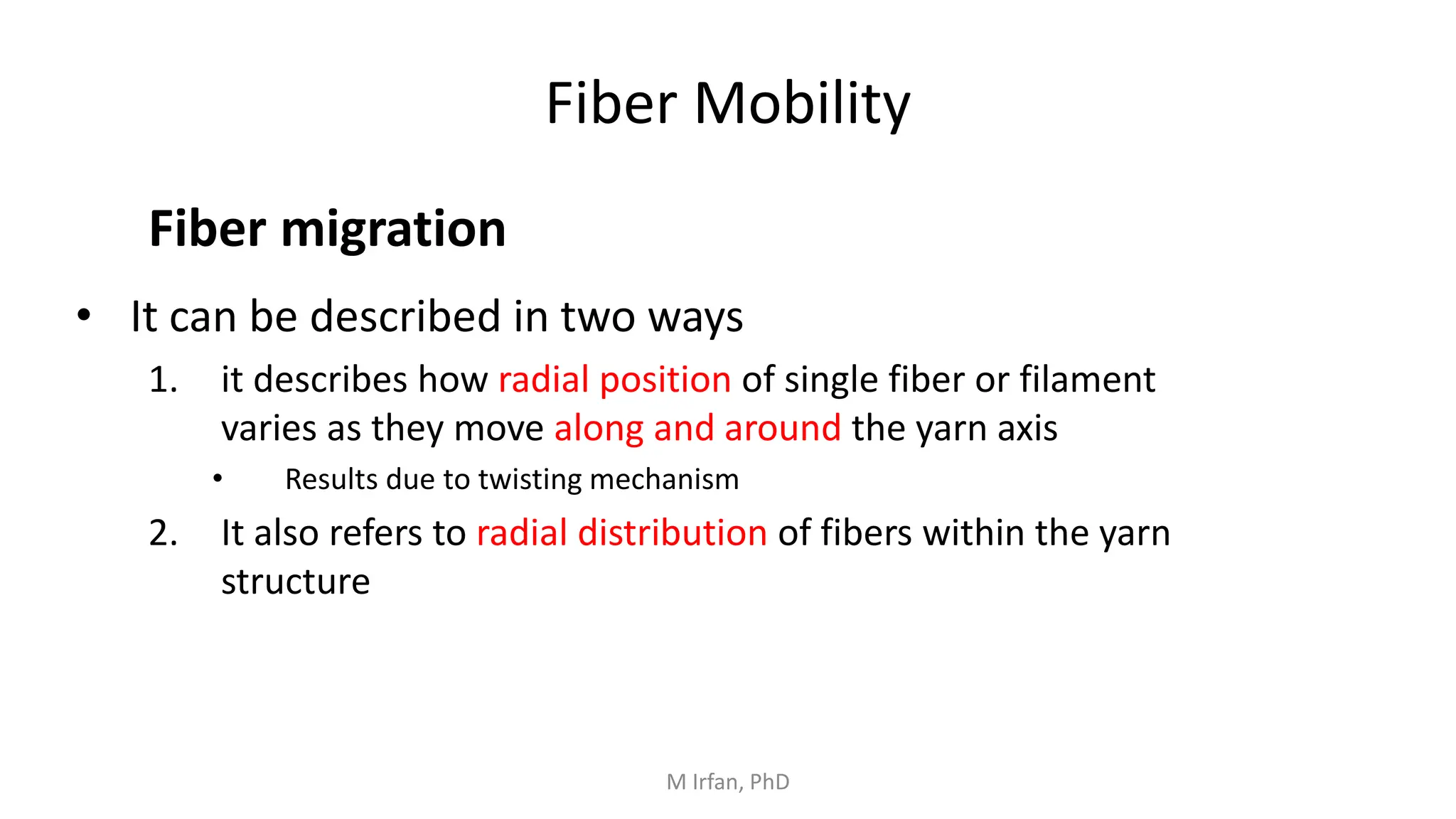
• It can be described in two ways
1. it describes how radial position of single fiber or filament
varies as they move along and around the yarn axis
• Results due to twisting mechanism
2. It also refers to radial distribution of fibers within the yarn
structure
Fiber migration
M Irfan, PhD
Fiber Mobility
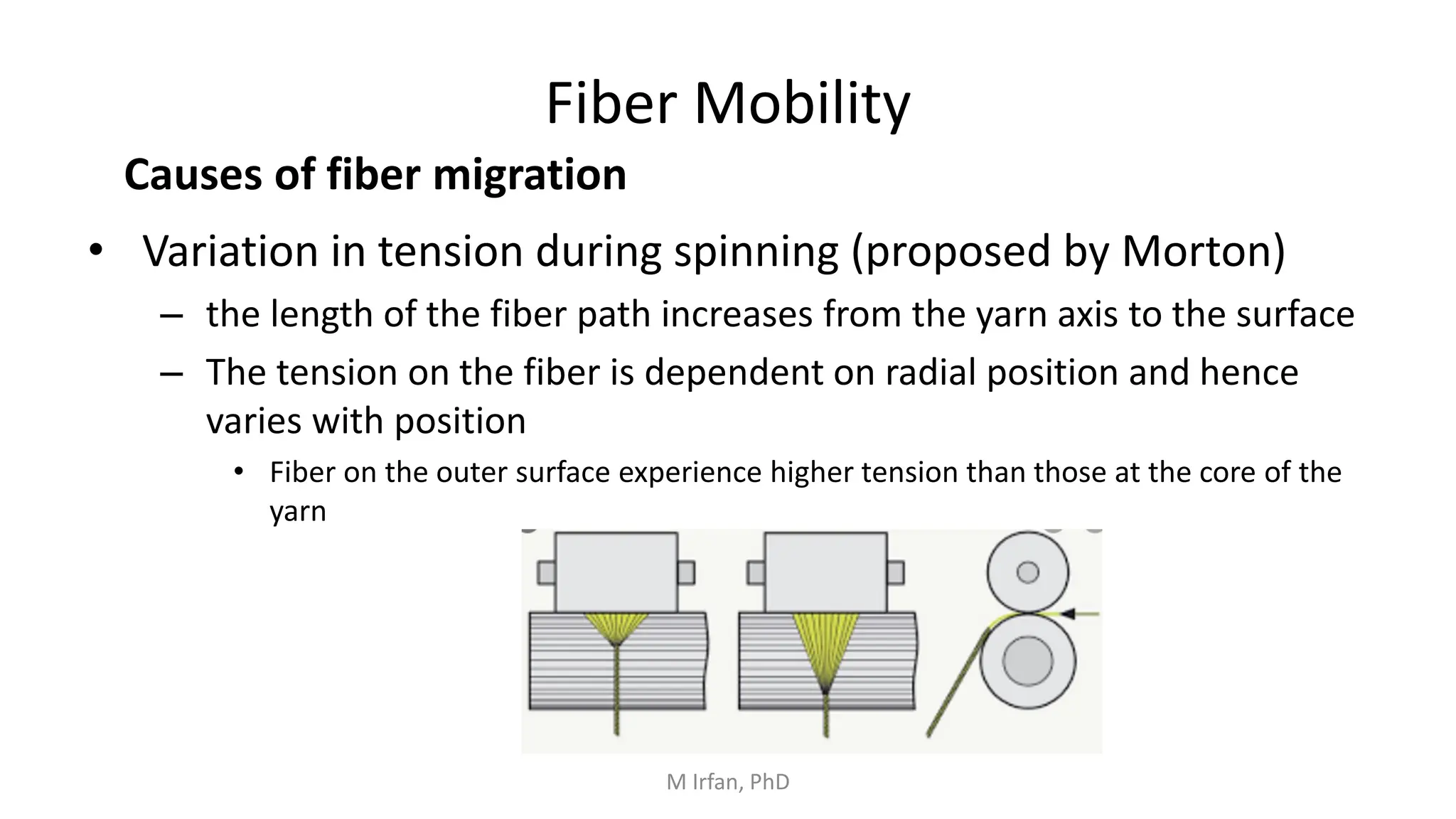
• Variation in tension during spinning (proposed by Morton)
– the length of the fiber path increases from the yarn axis to the surface
– The tension on the fiber is dependent on radial position and hence
varies with position
• Fiber on the outer surface experience higher tension than those at the core of the
yarn
Causes of fiber migration
M Irfan, PhD
Fiber Mobility
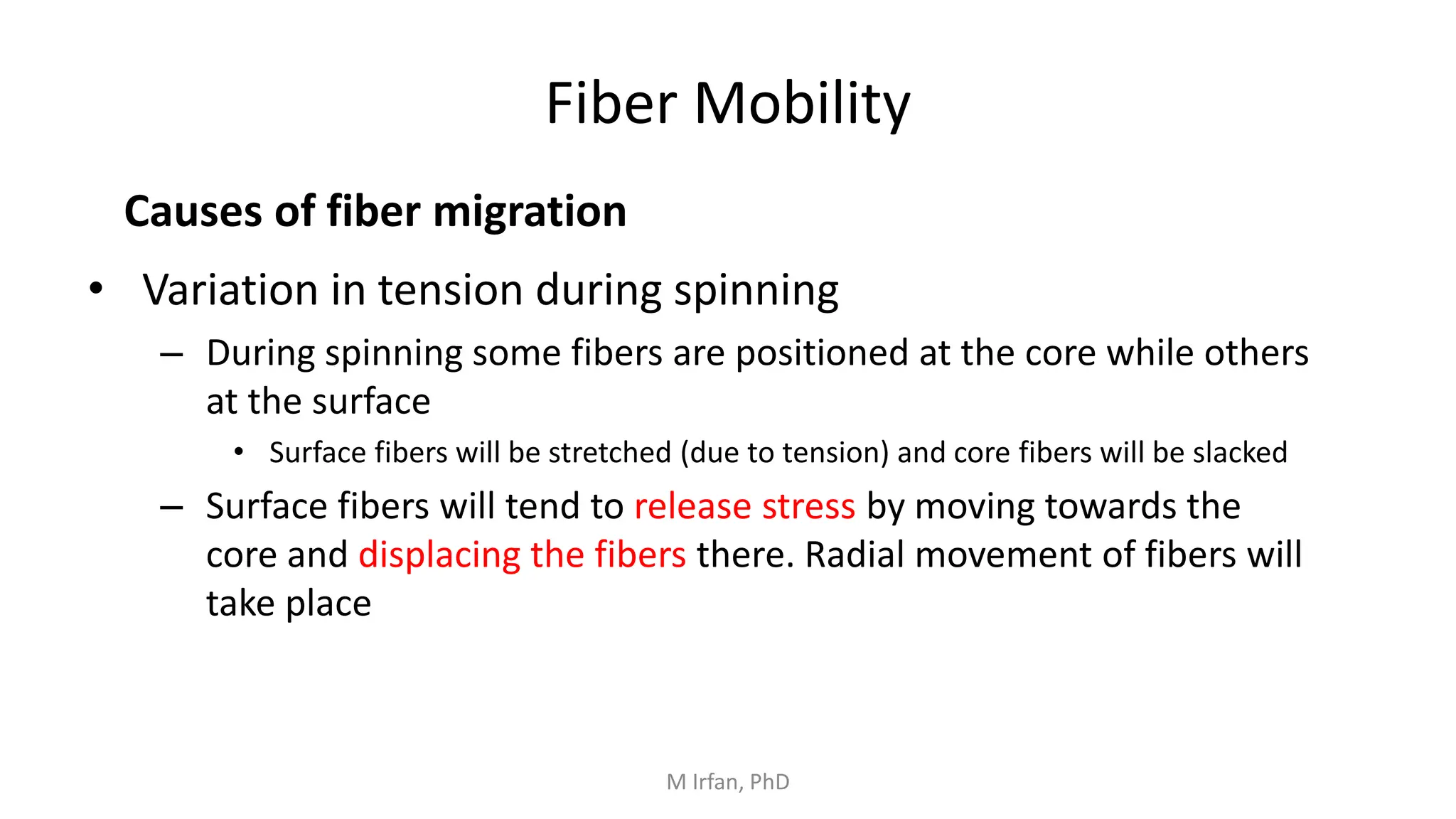
• Variation in tension during spinning
– During spinning some fibers are positioned at the core while others
at the surface
• Surface fibers will be stretched (due to tension) and core fibers will be slacked
– Surface fibers will tend to release stress by moving towards the
core and displacing the fibers there. Radial movement of fibers will
take place
Causes of fiber migration
M Irfan, PhD
Fiber Mobility
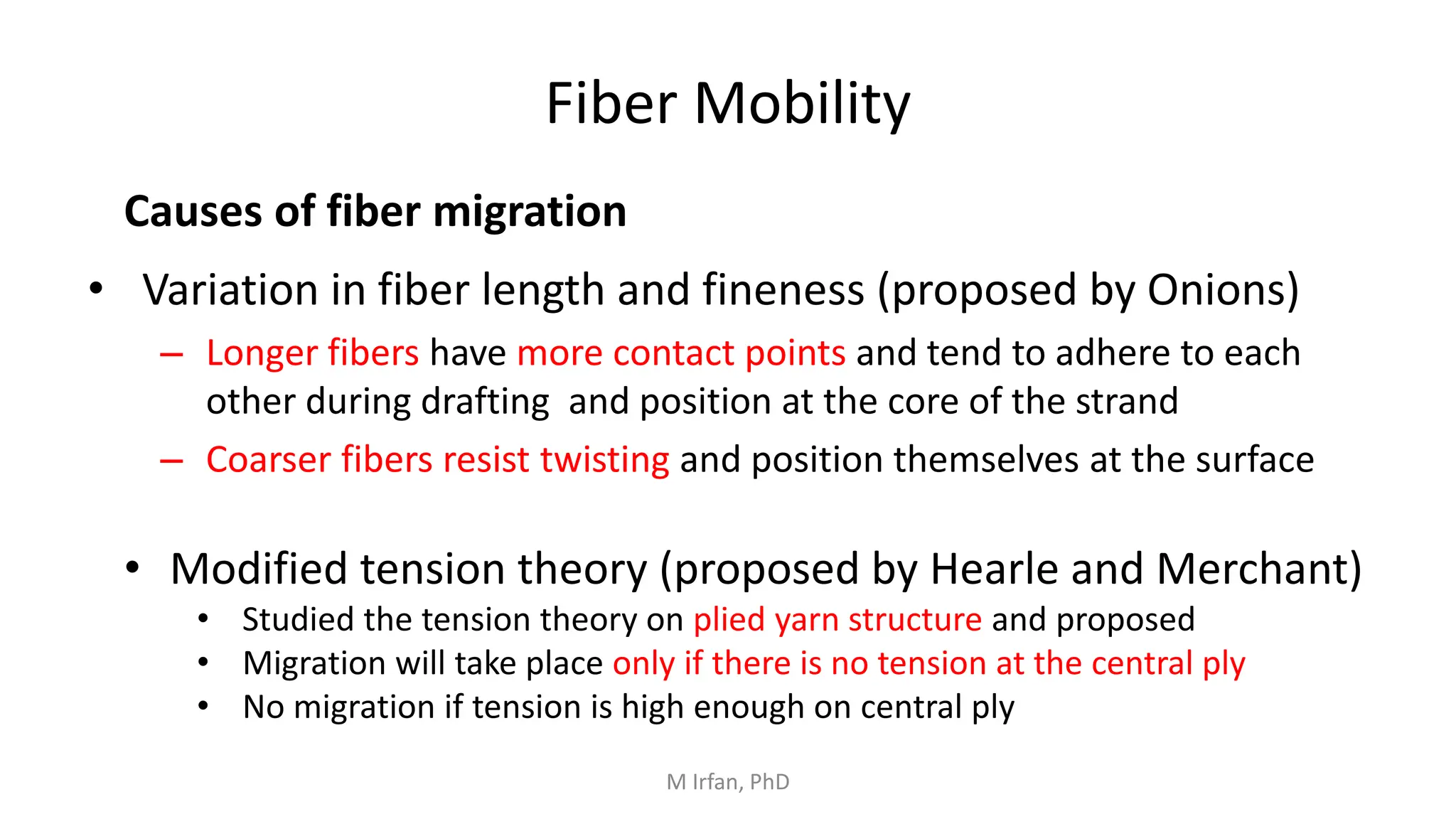
• Variation in fiber length and fineness (proposed by Onions)
– Longer fibers have more contact points and tend to adhere to each
other during drafting and position at the core of the strand
– Coarser fibers resist twisting and position themselves at the surface
Causes of fiber migration
• Modified tension theory (proposed by Hearle and Merchant)
• Studied the tension theory on plied yarn structure and proposed
• Migration will take place only if there is no tension at the central ply
• No migration if tension is high enough on central ply
M Irfan, PhD
Fiber Mobility
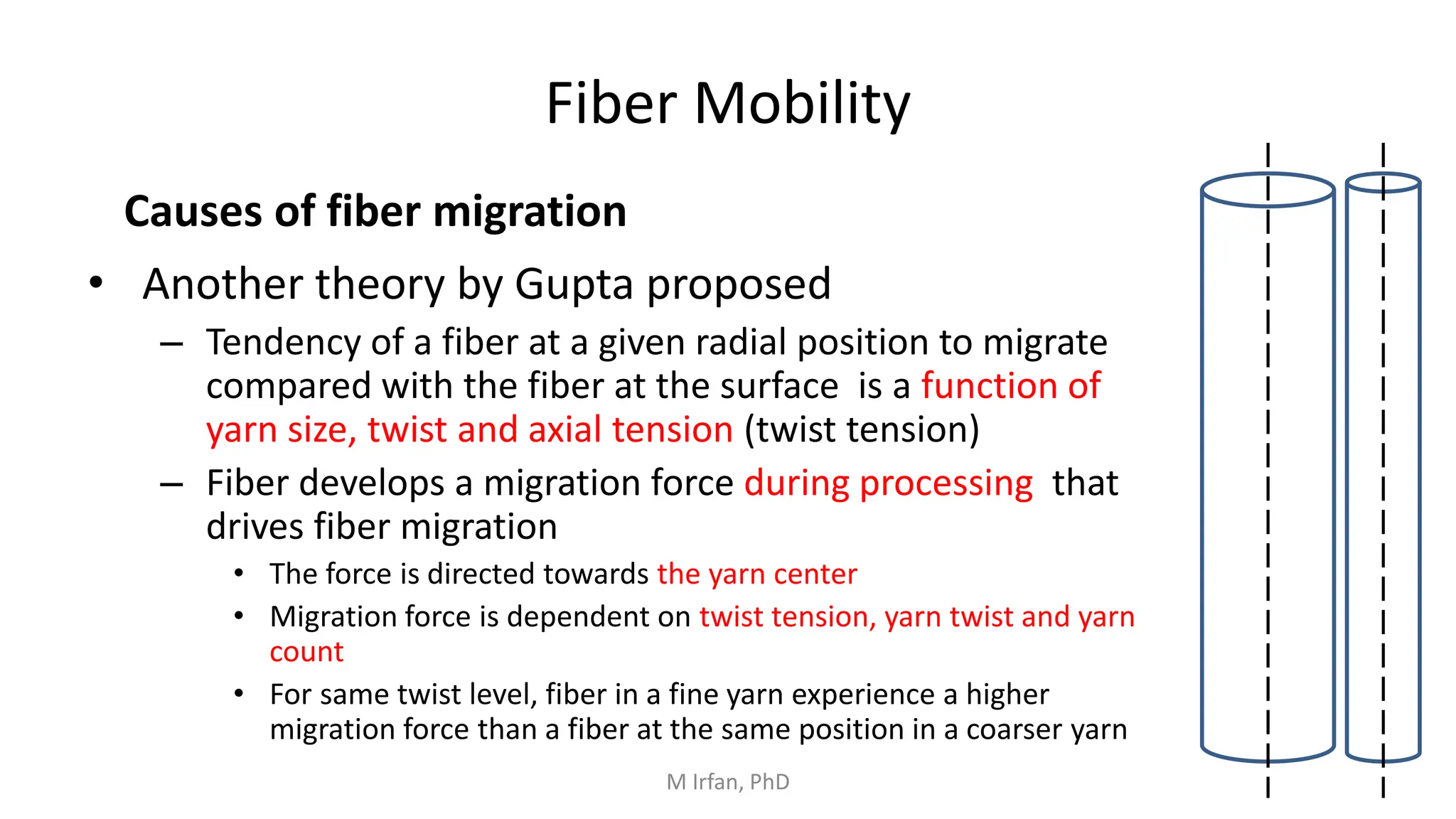
• Another theory by Gupta proposed
– Tendency of a fiber at a given radial position to migrate
compared with the fiber at the surface is a function of
yarn size, twist and axial tension (twist tension)
– Fiber develops a migration force during processing that
drives fiber migration
• The force is directed towards the yarn center
• Migration force is dependent on twist tension, yarn twist and yarn
count
• For same twist level, fiber in a fine yarn experience a higher
migration force than a fiber at the same position in a coarser yarn
Causes of fiber migration
M Irfan, PhD
Fiber Mobility
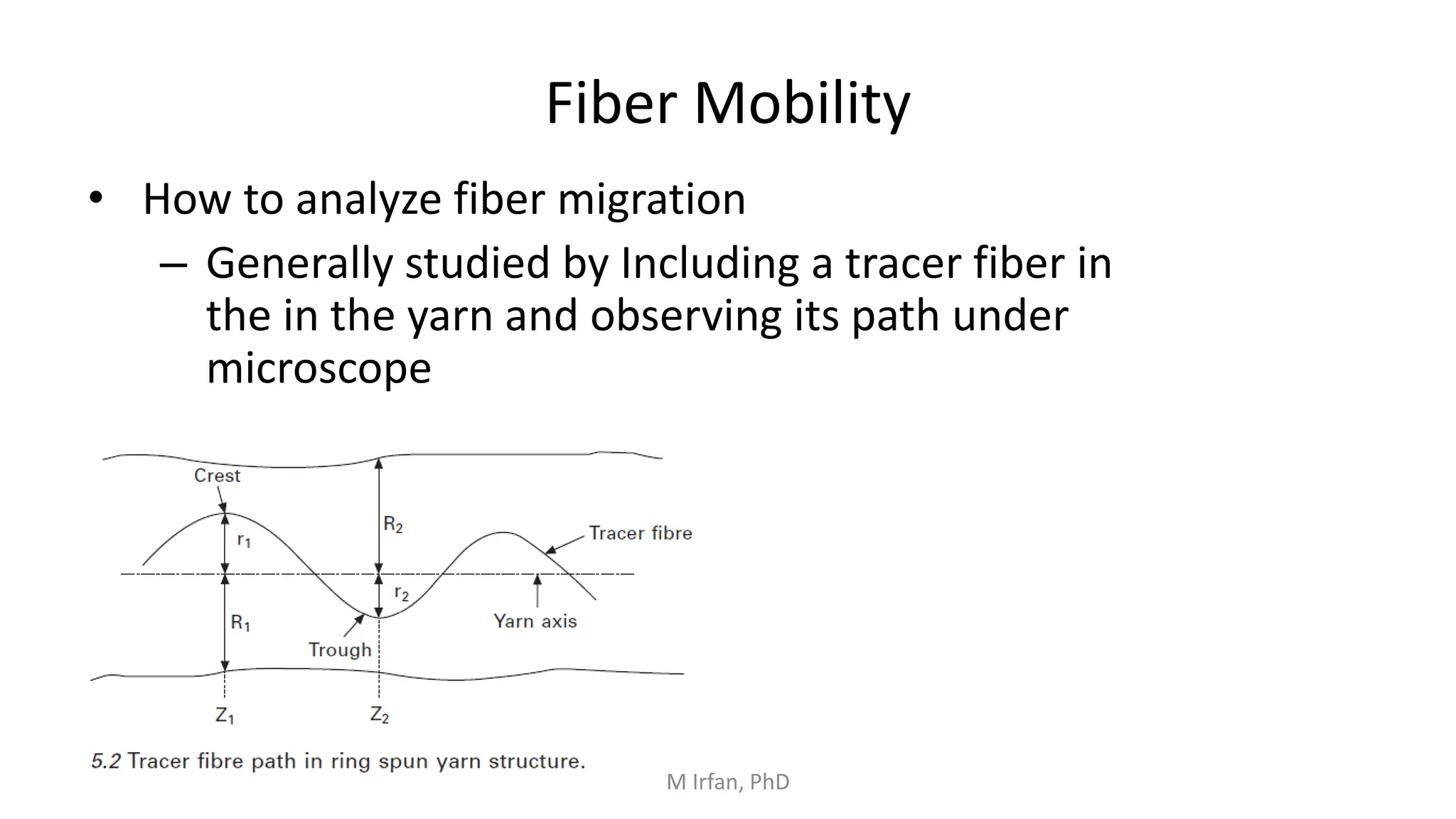
• How to analyze fiber migration
– Generally studied by Including a tracer fiber in
the in the yarn and observing its path under
microscope
M Irfan, PhD
Theoretical treatments of yarn tensile strength
• It is important to understand mechanical behavior of yarn
– This implies understanding structural factors that influence it
• Classical theoretical treatment of yarn mechanics is based on
studies by Hearle for filament yarns
• This analysis/model was extended to accommodate the more
complex spun yarns through analytical and empirical
adjustment for the reduction in tension in the surface layers
of the yarn as a result of using discontinuous fiber segments
or staple fibers
M Irfan, PhD
Filaments
Theoretical treatments of yarn tensile strength
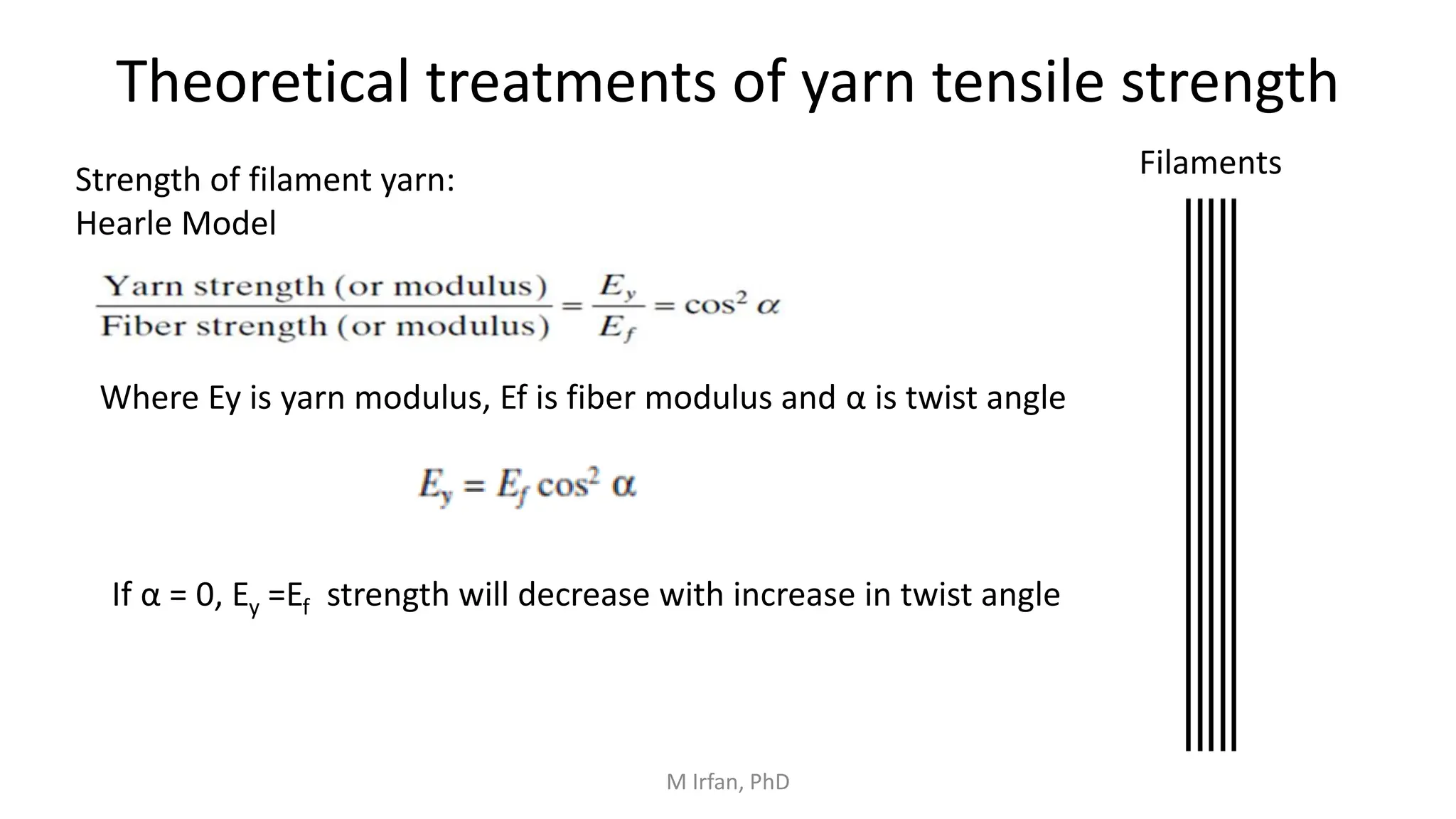
Strength of filament yarn:
Hearle Model
Where Ey is yarn modulus, Ef is fiber modulus and α is twist angle
If α = 0, Ey =Ef strength will decrease with increase in twist angle
M Irfan, PhD
Filaments
Staple fibers
Theoretical treatments of yarn tensile strength
Strength of staple yarns:
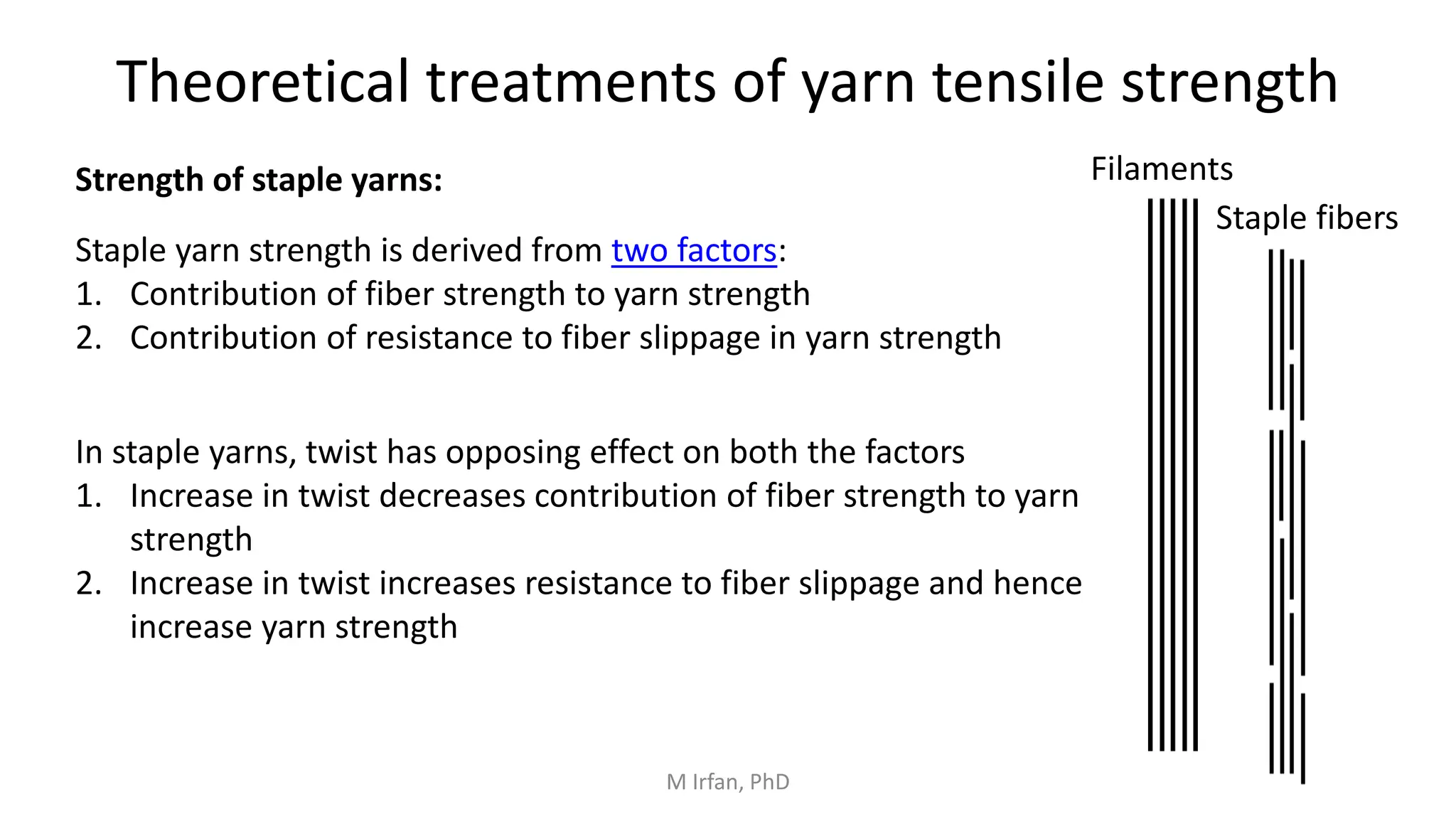
Staple yarn strength is derived from two factors:
1. Contribution of fiber strength to yarn strength
2. Contribution of resistance to fiber slippage in yarn strength
In staple yarns, twist has opposing effect on both the factors
1. Increase in twist decreases contribution of fiber strength to yarn
strength
2. Increase in twist increases resistance to fiber slippage and hence
increase yarn strength
M Irfan, PhD
Filaments
Staple fibers
Theoretical treatments of yarn tensile strength
Strength of staple yarns:
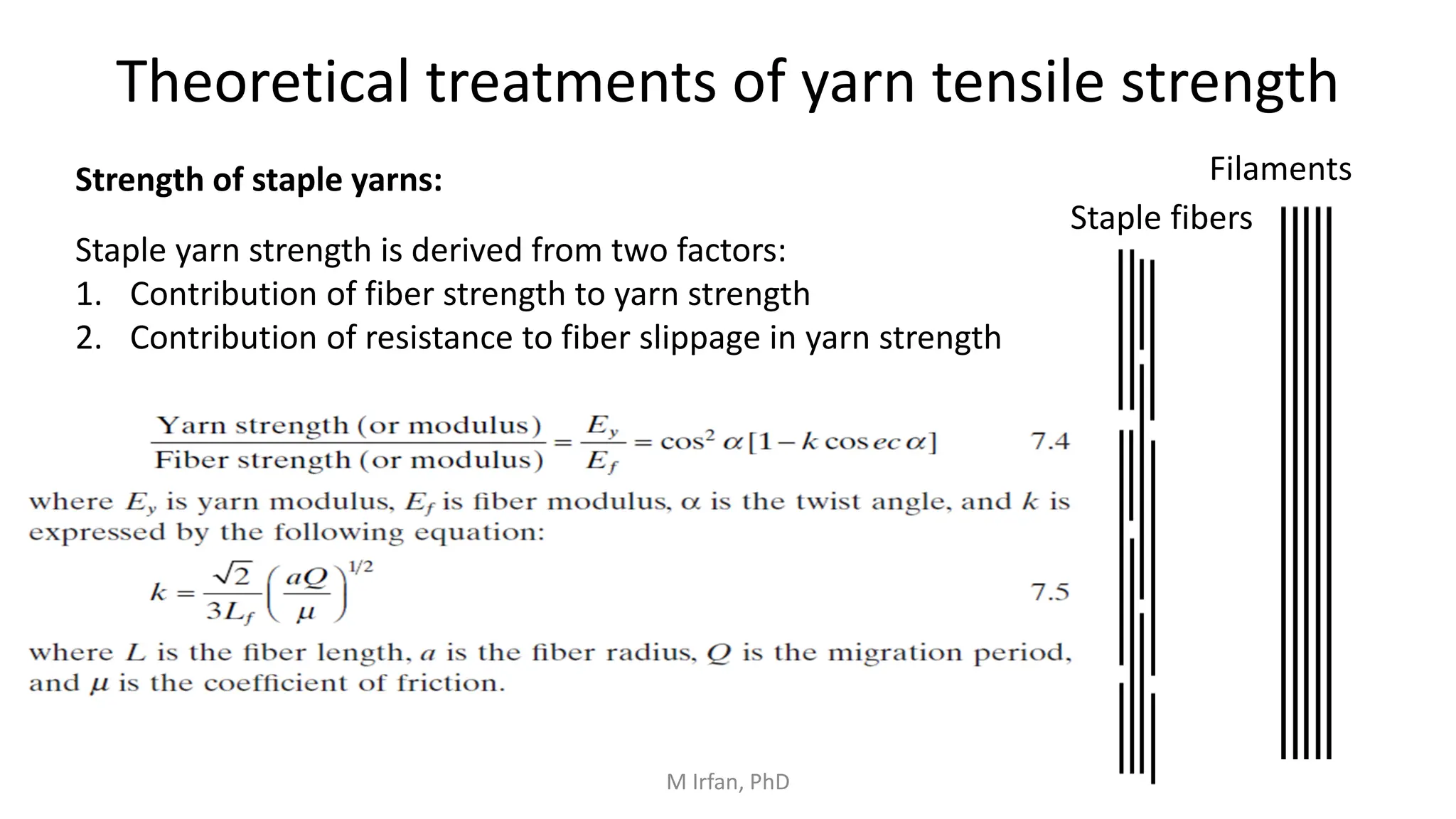
Staple yarn strength is derived from two factors:
1. Contribution of fiber strength to yarn strength
2. Contribution of resistance to fiber slippage in yarn strength
M Irfan, PhD
Theoretical treatments of yarn tensile strength
• This equation is called strength-twist relationship
and has two components which contribute to
strength
– Cos2α: decreases strength with increase in twist
– [1-kcosecα]: increases strength with increase in twist
dependent on value of k
M Irfan, PhD
Theoretical treatments of yarn tensile strength
• How “k” contributes to strength
– Increase in fiber length decreases ‘k’ and increases yarn strength
[due to increase in (1-kcosecα)]
– Increase in fiber diameter (a) increases ‘k’ and decreases yarn
strength [due to decrease in (1-kcosecα)]
– Increase in fiber friction (μ) decreases ‘k’ and increases yarn
strength [due to increase in (1-kcosecα)]
– Increase in fiber migration period (Q) increases ‘k’ and decreases
yarn strength [due to decrease in (1-kcosecα)]
M Irfan, PhD
M Irfan, PhD
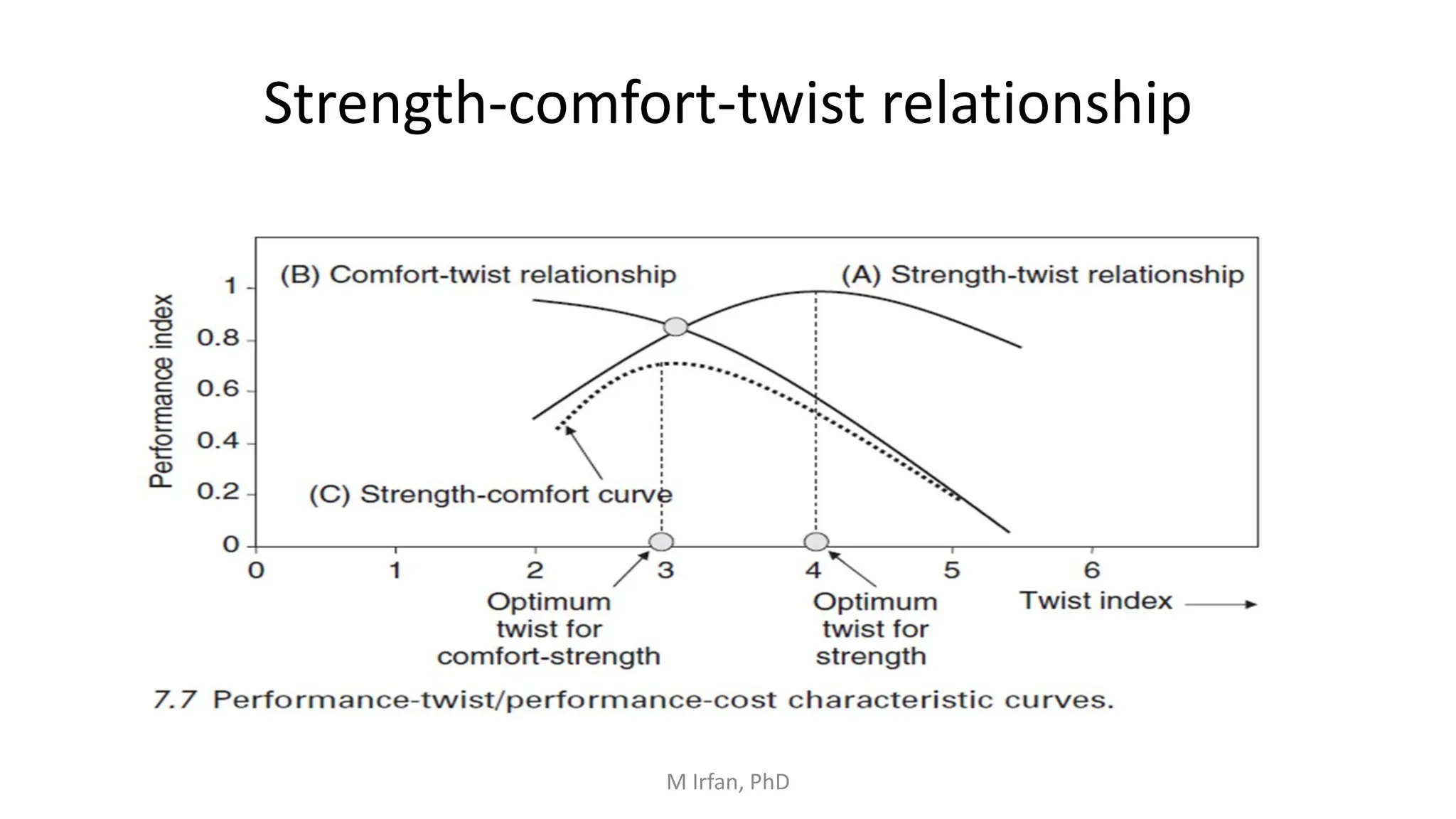
Strength-comfort-twist relationship
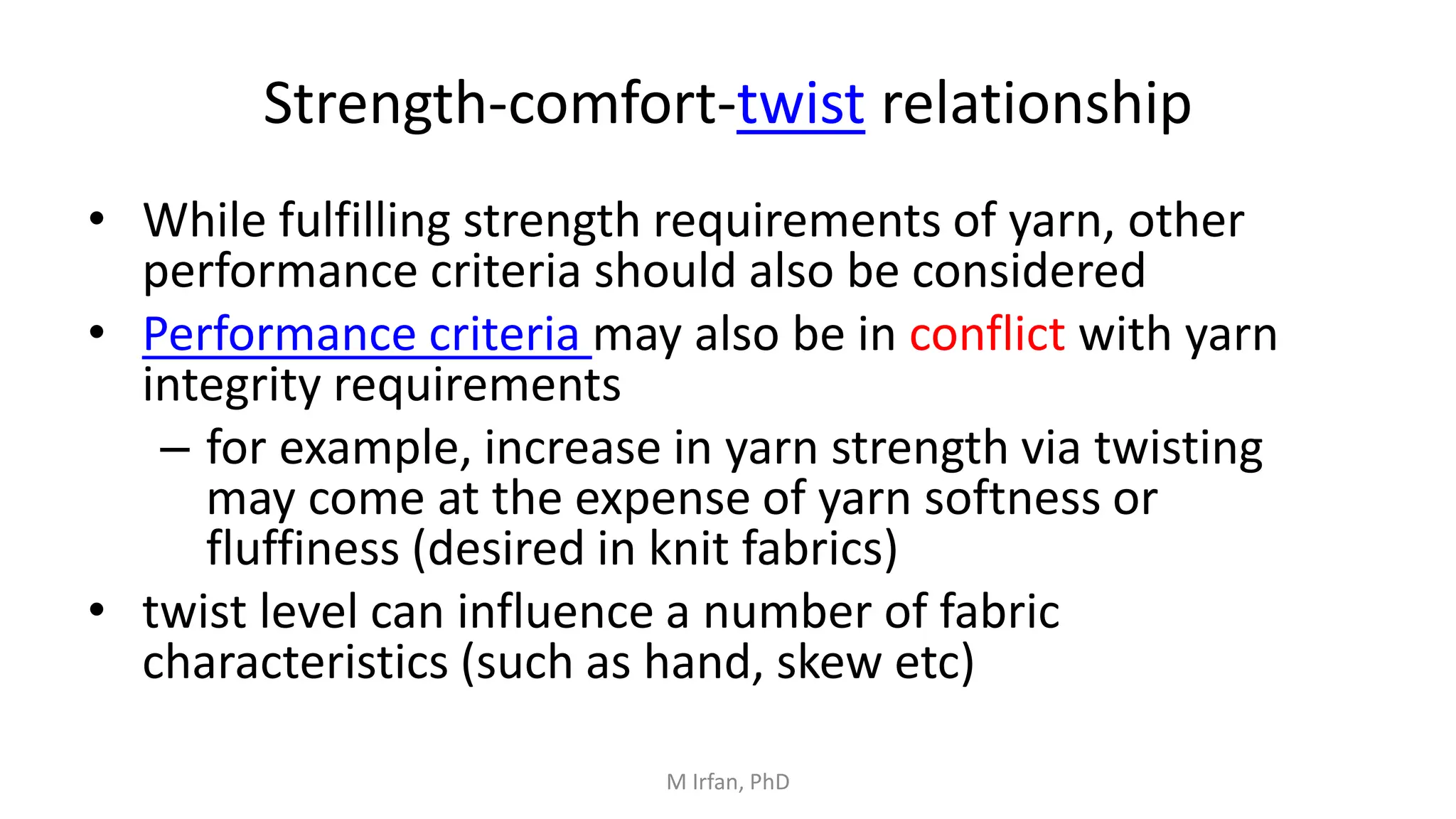
• While fulfilling strength requirements of yarn, other
performance criteria should also be considered
• Performance criteria may also be in conflict with yarn
integrity requirements
– for example, increase in yarn strength via twisting
may come at the expense of yarn softness or
fluffiness (desired in knit fabrics)
• twist level can influence a number of fabric
characteristics (such as hand, skew etc)
M Irfan, PhD
Strength-comfort-twist relationship
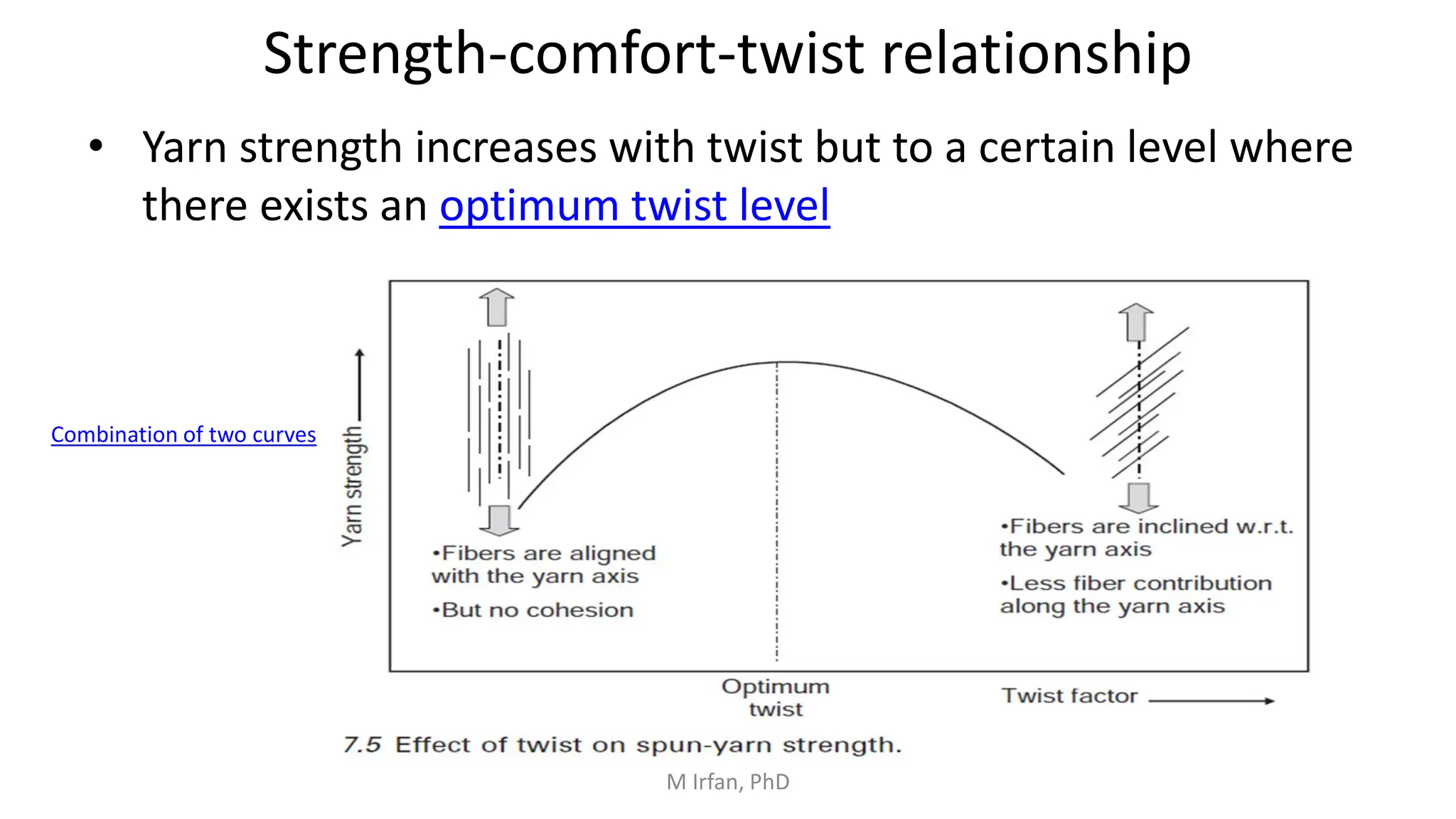
• Yarn strength increases with twist but to a certain level where
there exists an optimum twist level
M Irfan, PhD
Combination of two curves
Strength-comfort-twist relationship
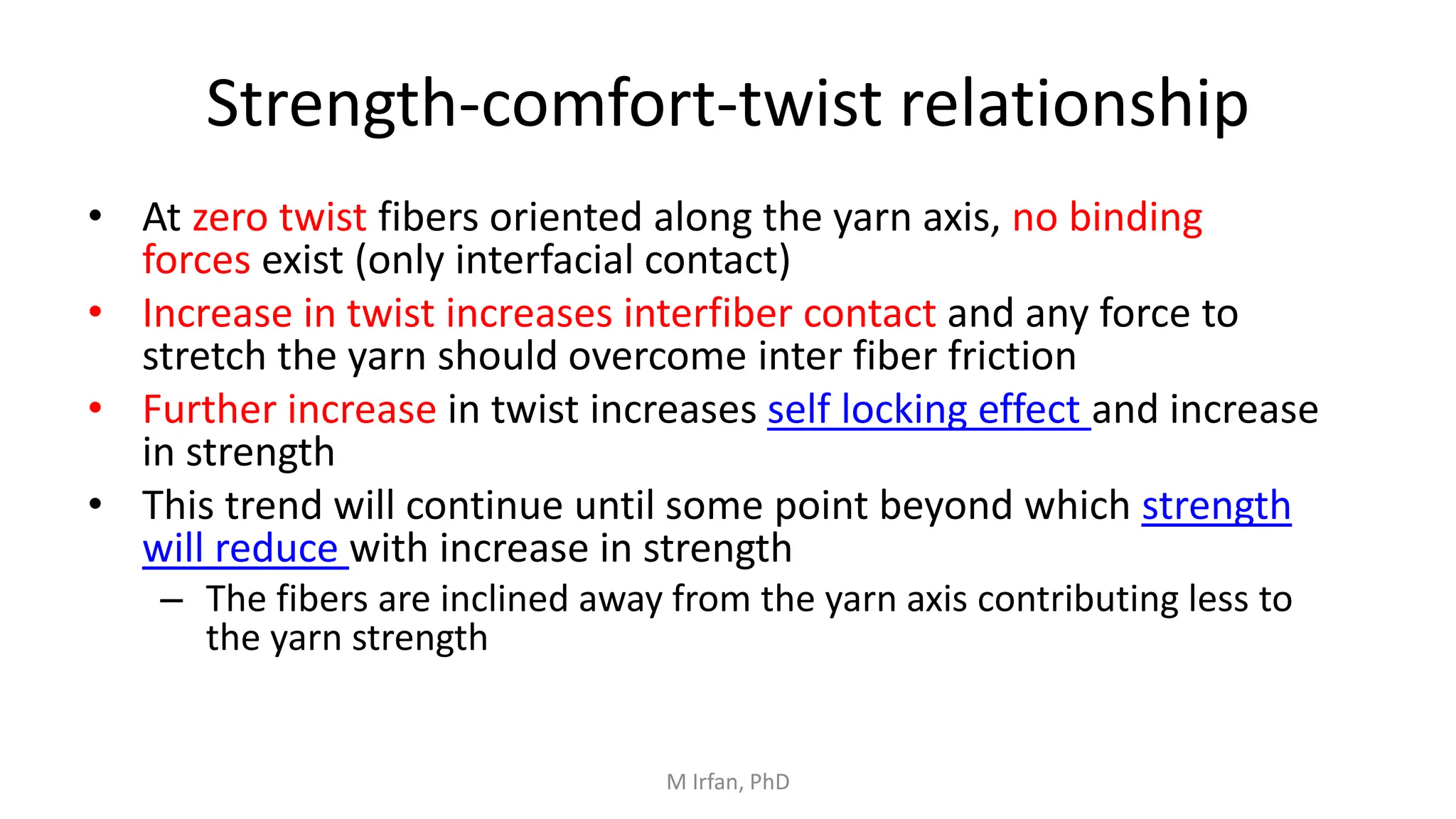
• At zero twist fibers oriented along the yarn axis, no binding
forces exist (only interfacial contact)
• Increase in twist increases interfiber contact and any force to
stretch the yarn should overcome inter fiber friction
• Further increase in twist increases self locking effect and increase
in strength
• This trend will continue until some point beyond which strength
will reduce with increase in strength
– The fibers are inclined away from the yarn axis contributing less to
the yarn strength
M Irfan, PhD
Strength-comfort-twist relationship
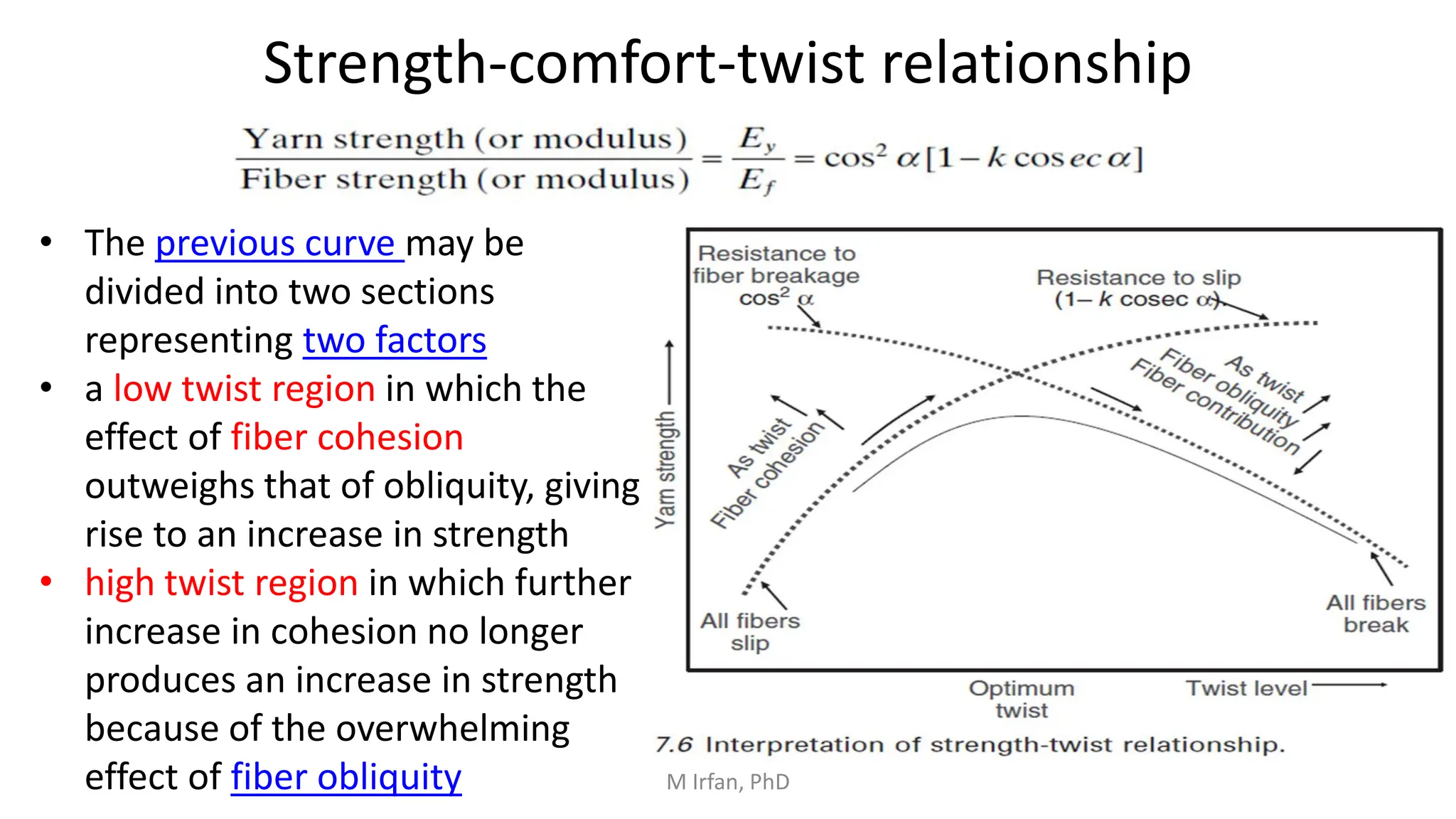
• The previous curve may be
divided into two sections
representing two factors
• a low twist region in which the
effect of fiber cohesion
outweighs that of obliquity, giving
rise to an increase in strength
• high twist region in which further
increase in cohesion no longer
produces an increase in strength
because of the overwhelming
effect of fiber obliquity M Irfan, PhD
Strength-comfort-twist relationship
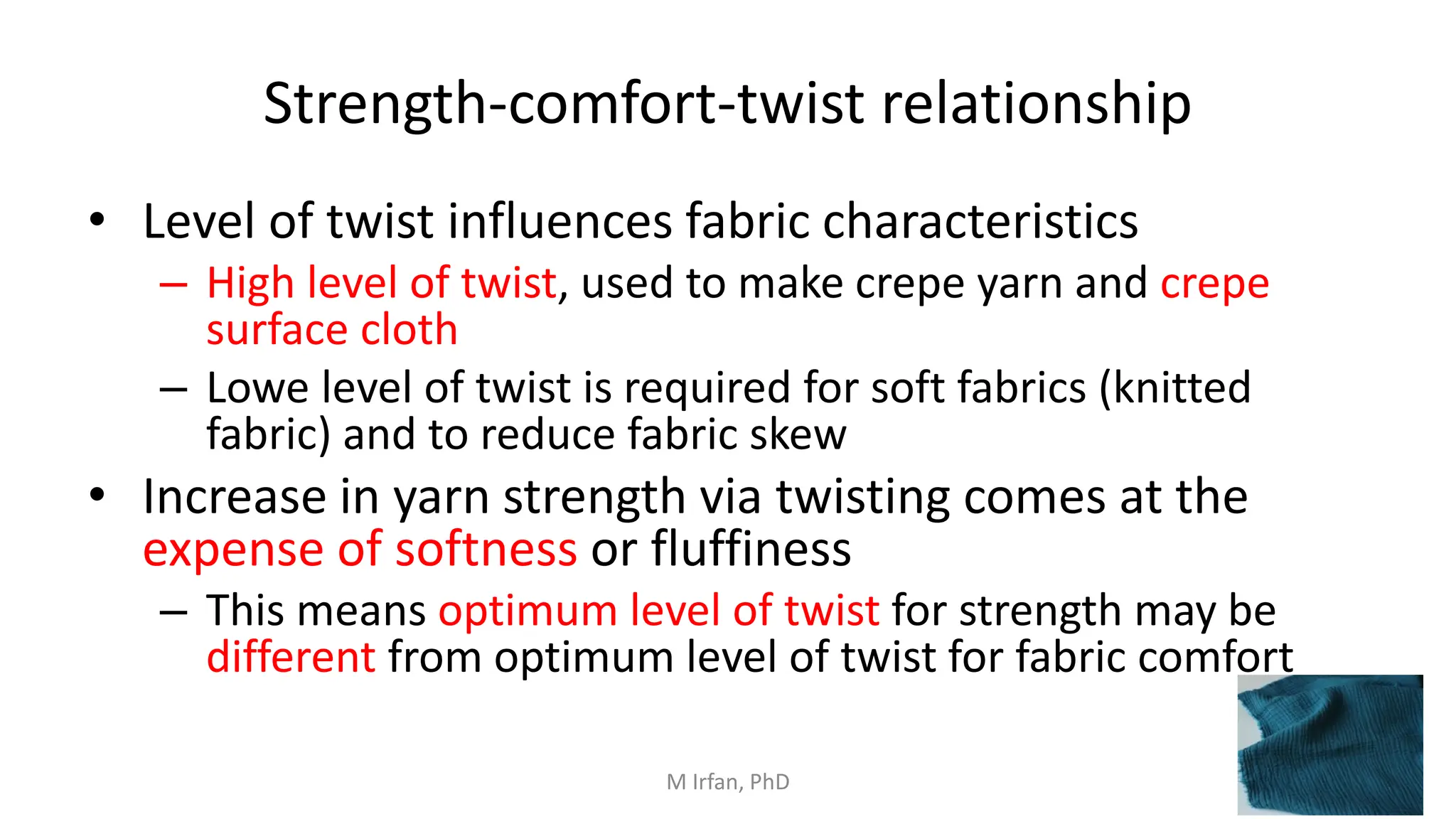
• Level of twist influences fabric characteristics
– High level of twist, used to make crepe yarn and crepe
surface cloth
– Lowe level of twist is required for soft fabrics (knitted
fabric) and to reduce fabric skew
• Increase in yarn strength via twisting comes at the
expense of softness or fluffiness
– This means optimum level of twist for strength may be
different from optimum level of twist for fabric comfort
M Irfan, PhD
Strength-comfort-twist relationship
M Irfan, PhD
Strength-comfort-twist relationship
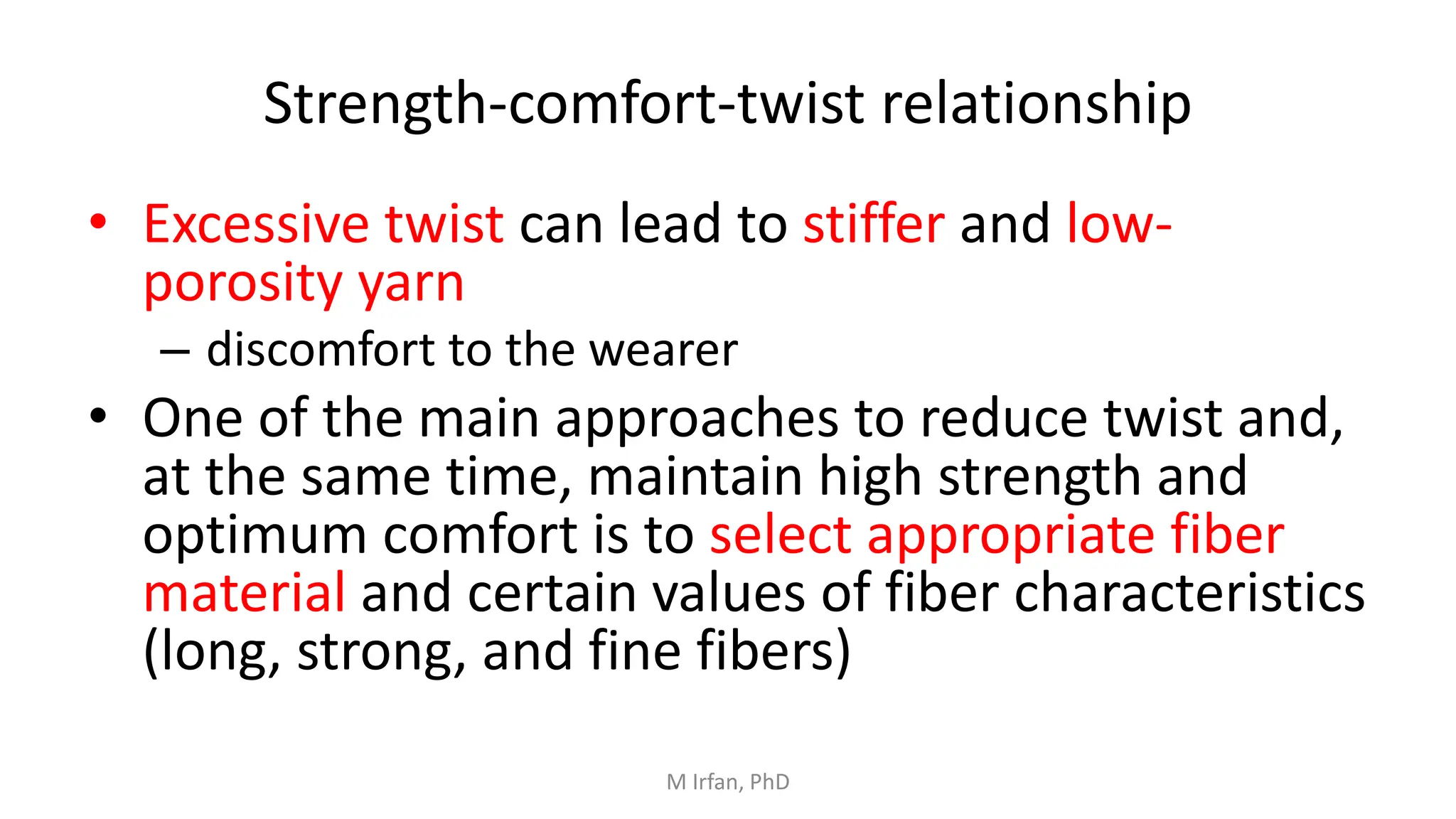
• Excessive twist can lead to stiffer and low-
porosity yarn
– discomfort to the wearer
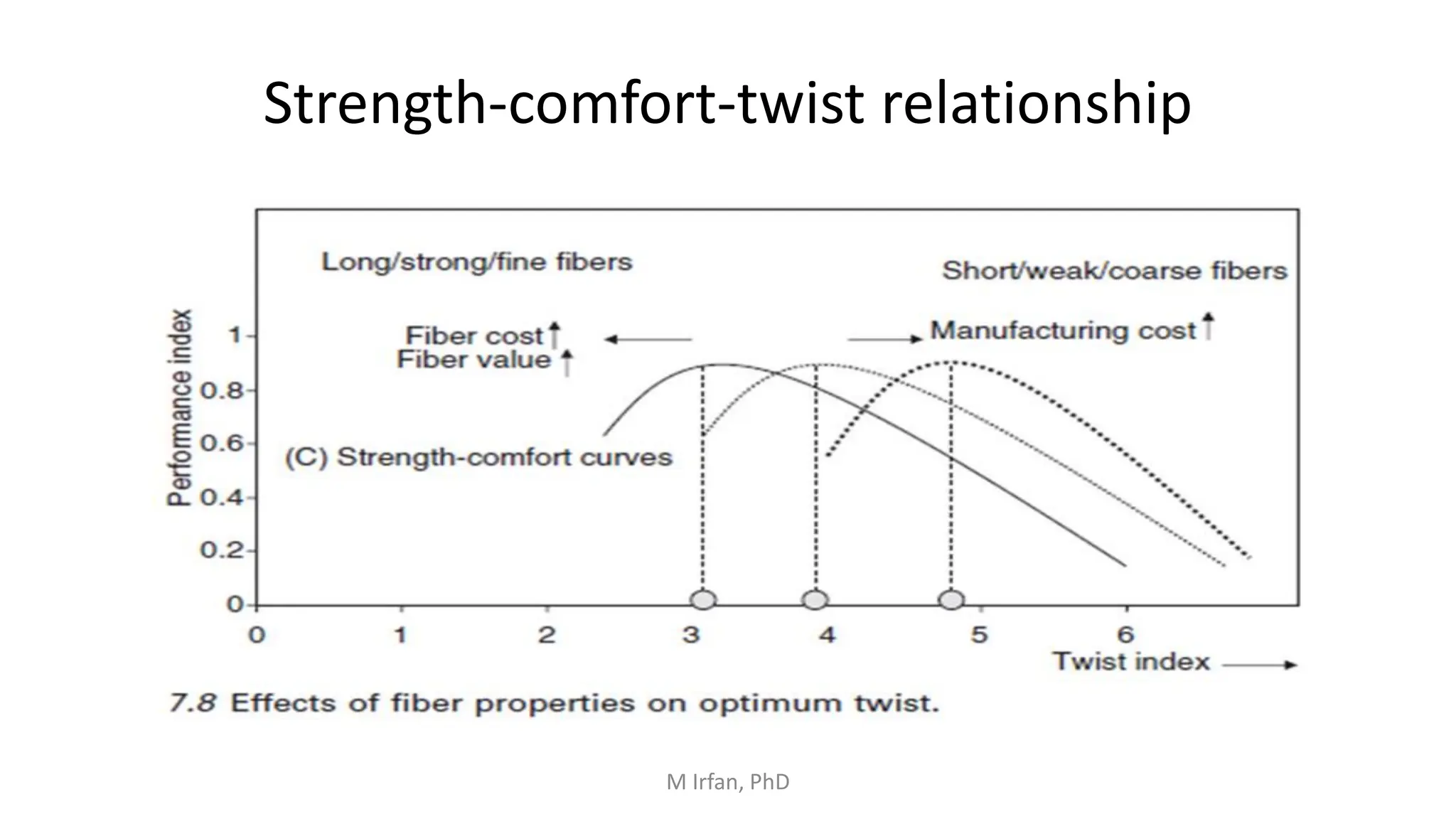
• One of the main approaches to reduce twist and,
at the same time, maintain high strength and
optimum comfort is to select appropriate fiber
material and certain values of fiber characteristics
(long, strong, and fine fibers)
M Irfan, PhD
Strength-comfort-twist relationship
M Irfan, PhD

TE-3113-7.pdf mechanics of fibrous Structure slides

  • 1.
    Mechanics of FibrousStructure (TE-3113) M Irfan Department of Textile Engineering National Textile University Faisalabad
  • 2.
    Mechanics of yarnstructure P. Schwartz " Structure & Mechanics of Textile Assemblies" (2003) Book Reference M Irfan, PhD
  • 3.
    Yarn • A continuousstrand made of natural or man made staple fibers or continuous filaments suitable to be used for weaving and knitting purposes • yarn is an intermediate product • Yarn is the building block of many textile products – knit apparels , woven fabric, towels, sheets, carpets, industrial fabrics etc M Irfan, PhD
  • 4.
    Yarn performance • Yarnperformance criteria varies according to – End product – Down stream process – For example • (1)spinner’s perspective: a good yarn performance means appearance, strength, uniformity and lower level of imperfections But…Spinner is not the end user • (2) knitters perspective: unwind easily, conform readily to bending/looping , sheds low fly (low hairiness), soft hand of fabric (low twist, low bending stiffness), better pilling resistance M Irfan, PhD
  • 5.
    Yarn performance • Yarnperformance – (3) Weaver’s perspective: can withstand stresses (strength, flexibility), surface integrity (low hairiness, high abrasion resistance), defect free fabric (high evenness, low imperfections, and minimum contamination) • Yarn integrity is a key aspect in all applications (here comes yarn mechanics for exploring and predicting yarn failure) M Irfan, PhD
  • 6.
    Types of yarn •Two main types – continuous filament yarns – spun yarns • continuous filament yarn: – multiple filaments are laid side by side in parallel arrangement – made by extruding polymer liquid through a spinneret – Can be monofilament or multifilament M Irfan, PhD
  • 7.
    Filament and spunyarn M Irfan, PhD
  • 8.
    Types of yarn •Continuous filament yarn – Structural derivatives via texturizing • Stretchy yarn • Bulky yarn • Staple yarn – produced from staple fibers of natural or synthetic sources – Can be produced using different process M Irfan, PhD
  • 9.
    Types of yarn •Some other types of yarn: – single yarns – plied yarns – cabled yarns M Irfan, PhD
  • 10.
    Yarn Structure • Yarn,being the building block of fabric, contributes to end product performance through three key structural aspects – (i) fiber compactness – (ii) fiber arrangement – (iii) fiber mobility M Irfan, PhD
  • 11.
    Fiber Compactness • Fibercompactness contributes to maintain integrity of yarn structure • Filament yarn – Highest compactness • Lateral forces by outer filaments on inner filaments • Long inter filament contact • No air entrapped – Texturization reduces compactness • Interfiber spaces increase M Irfan, PhD
  • 12.
    Fiber Compactness • Spunyarn – Compactness is due to the lateral forces imposed by the twist in the spun yarn – plenty of air pockets inside the yarn structure due to discrete nature of fibers M Irfan, PhD
  • 13.
    Fiber Compactness • Higherthe fiber compactness – low yarn compressibility (or low softness), high strength, low yarn flexibility, low yarn porosity, more moisture wicking along the yarn surface than along the fibers in the yarn • low fiber compactness is likely to result in – High yarn compressibility (or high softness), high flexibility, high porosity, and more moisture wicking along the fibers in the yarn M Irfan, PhD
  • 14.
    Fiber Compactness • Thusfiber compactness influences strength, hand, drape, moisture management, and comfort of fabric • Fiber compactness determines dimensional stability of yarn • yarn is considered dimensionally stable if the fiber compactness is the same in the relaxed state and under low levels of stress M Irfan, PhD
  • 15.
    Fiber Compactness • Theextent of fiber or filament compactness in a yarn structure can be expressed in terms of – (i) specific volume, vy of yarn (cm3/g), and – (ii) the volume of still air inside the yarn • the specific volume (cm3/g) of yarn based on Hearle yarn Model: M Irfan, PhD
  • 16.
    Fiber Compactness the idealyarn structure assumes that a yarn is composed of a series of concentric cylinders of differing radii and that each fiber follows a uniform helical path around one of the concentric cylinders Ideal yarn model by Hearle M Irfan, PhD
  • 17.
    Fiber Compactness • Theeffect of twist on the specific volume of yarn is given by the equation • The above relationship indicates that for a given yarn count, Tt, the effect of twist on yarn specific volume is primarily a function of the variation in yarn circumference caused by twisting M Irfan, PhD
  • 18.
    Fiber Compactness • Thetrue specific volume of yarn will depend on the volume occupied by the fibers and by the amount of inter-fiber space which is filled with air • This leads to a useful term called ‘packing fraction, φ’ M Irfan, PhD
  • 19.
    Fiber Compactness • factorsinfluencing fiber compactness in the yarn – spinning preparatory processes: Combed yarns are denser than carded yarns – Spinning method: Ring-spun yarns have substantially higher density than rotor-spun yarns – yarn twist: higher the twist level, higher the yarn density M Irfan, PhD
  • 20.
    Fiber Arrangement andOrientation • The way fibers are arranged in the yarn structure impacts on a number of yarn and fabric performance characteristics (yarn appearance, yarn strength, fabric dimensional stability, and fabric cover) • Fiber orientation means the directional arrangement of fibers in yarn • Geometrical and mechanical properties of yarn are dependent of yarn are dependent on fiber orientation • Filament yarn has the simplest fiber arrangement (parallel filament arrangement) – Twisting and texturizing alters fiber/filament arrangement in the yarn M Irfan, PhD
  • 21.
    Fiber Arrangement andOrientation Mechanical properties of yarn and fiber orientation Recall the tensile strength of different yarns Stronger weaker Ring spun Vs Rotor spun Ring and rotor spun Vs Friction spun Combed Vs Carded Different the degree of fiber orientation, different will be the properties of the yarn M Irfan, PhD
  • 22.
    Fiber Arrangement andOrientation Fiber orientation also dictates anisotropic properties of end products For example • Fiber orientation in nonwovens • Fiber orientation in composites • Stronger in the direction of fiber orientation • Different orientation to tailor composite properties • Fiber orientation also influences fluid permeability and absorption • Higher the permeability if fiber orientation is same as fluid flow and lower in other direction M Irfan, PhD
  • 23.
    Fiber Arrangement andOrientation • In spun yarn, fiber arrangement is difficult to control and is not simple – Fiber arrangement analysis is performed by assuming idealized twisted yarn structure – But this idealized arrangement will neither be practically feasible nor useful – In a real spun yarn, arrangement of fibers is such that it creates self-locking structure that provides the necessary integrity to the yarn (a fiber can have some portion in outer layers and remaining in inner layers) M Irfan, PhD
  • 24.
    Fiber Arrangement andOrientation the ideal yarn structure assumes that a yarn is composed of a series of concentric cylinders of differing radii and that each fiber follows a uniform helical path around one of the concentric cylinders Ideal yarn model by Hearle M Irfan, PhD
  • 25.
    Fiber Mobility • Fibermobility also determines dimensional stability of yarns and fabrics • Relaxed state – Fibers tend to be relaxed and in bending mode • Stretched state – Fibers tend to adopt minimum distance between end points Stretched yarn relaxed yarn Fabric pilling M Irfan, PhD
  • 26.
    Fiber Mobility Importance offiber mobility • It influences yarn performance – During conversion of yarn into fabric (weaving) • E.g, during soft wool fabric weaving, repetitive tensioning and rubbing can cause incremental drafting of wool yarn – During end use of the product by the consumer (laundering etc) M Irfan, PhD
  • 27.
    Fiber Mobility Importance offiber mobility • Wool felting – Relative movement of fibers in the direction of roots of the fibers due to scales – Controlled by anti felting treatment M Irfan, PhD
  • 28.
    Fiber Mobility Performance requirements •User perspective – Aesthetic and soft handle • Utility – Dimensional Stability: resistance to pilling and bagging • Both these performance requirements are conflicting – Twisting can increase dimensional stability but reduce softness M Irfan, PhD
  • 29.
    Fiber Mobility Understanding fibermobility – Fiber movement is considered due to irregular forces on fabrics during use (laundering etc) – Fiber movement is considered a diffusion process leading to greater mixing – Should not be confused with difference in concentration • In fact it is Redistribution of fibers within slacker and tighter M Irfan, PhD
  • 30.
    • Factors affectingfiber mobility – Fiber type, fiber length and fineness • Shorter fibers are expected to move towards surface causing hairiness – Yarn twist, yarn count, fiber blend – Spinning technique, type of twisting, machine geometry etc Fiber Mobility M Irfan, PhD
  • 31.
    Fiber Mobility • Pathof the fibers vary in length as it depends on distance from the axis • Filament yarn – Minimum mobility of fibers/filaments (there can be small tendency to split apart) • spun yarns – staple fiber yarns can have many modes of fiber mobility depending upon external environment M Irfan, PhD
  • 32.
    Fiber Mobility • Greaterfiber mobility is observed near the yarn surface: Fiber mobility is greater for fibers/filaments near the yarn surface • In an untwisted continuous filament yarn, filaments in the outer layer will tend to snag or come loose • In spun yarns, fiber segments protruding from the yarn body result in yarn hairiness – Long protruding fibers will tend to entangle together and hinder a smooth flow of the yarn during further processing (weaving) – Yarn hairiness also causes the pilling phenomenon M Irfan, PhD
  • 33.
    Fiber Mobility • Thelevel of protruding fibers or hairiness on the yarn surface depends on many factors – Twist in the yarn – Spinning preparation methods – Spinning technique used – Count of the yarn • Yarn hairiness can be removed in a process known as singeing M Irfan, PhD
  • 34.
    Fiber Mobility Generally YarnHairiness of Carded yarn > Combed yarn Ring yarn > Rotor yarn Ring Yarn > Ring compact yarn • Ring spun yarns usually demonstrate higher level of yarn hairiness due to fiber migration phenomenon • Short fibers tend to position at the outer surface of the yarn M Irfan, PhD
  • 35.
    Fiber Mobility • Itcan be described in two ways 1. it describes how radial position of single fiber or filament varies as they move along and around the yarn axis • Results due to twisting mechanism 2. It also refers to radial distribution of fibers within the yarn structure Fiber migration M Irfan, PhD
  • 36.
    Fiber Mobility • Variationin tension during spinning (proposed by Morton) – the length of the fiber path increases from the yarn axis to the surface – The tension on the fiber is dependent on radial position and hence varies with position • Fiber on the outer surface experience higher tension than those at the core of the yarn Causes of fiber migration M Irfan, PhD
  • 37.
    Fiber Mobility • Variationin tension during spinning – During spinning some fibers are positioned at the core while others at the surface • Surface fibers will be stretched (due to tension) and core fibers will be slacked – Surface fibers will tend to release stress by moving towards the core and displacing the fibers there. Radial movement of fibers will take place Causes of fiber migration M Irfan, PhD
  • 38.
    Fiber Mobility • Variationin fiber length and fineness (proposed by Onions) – Longer fibers have more contact points and tend to adhere to each other during drafting and position at the core of the strand – Coarser fibers resist twisting and position themselves at the surface Causes of fiber migration • Modified tension theory (proposed by Hearle and Merchant) • Studied the tension theory on plied yarn structure and proposed • Migration will take place only if there is no tension at the central ply • No migration if tension is high enough on central ply M Irfan, PhD
  • 39.
    Fiber Mobility • Anothertheory by Gupta proposed – Tendency of a fiber at a given radial position to migrate compared with the fiber at the surface is a function of yarn size, twist and axial tension (twist tension) – Fiber develops a migration force during processing that drives fiber migration • The force is directed towards the yarn center • Migration force is dependent on twist tension, yarn twist and yarn count • For same twist level, fiber in a fine yarn experience a higher migration force than a fiber at the same position in a coarser yarn Causes of fiber migration M Irfan, PhD
  • 40.
    Fiber Mobility • Howto analyze fiber migration – Generally studied by Including a tracer fiber in the in the yarn and observing its path under microscope M Irfan, PhD
  • 41.
    Theoretical treatments ofyarn tensile strength • It is important to understand mechanical behavior of yarn – This implies understanding structural factors that influence it • Classical theoretical treatment of yarn mechanics is based on studies by Hearle for filament yarns • This analysis/model was extended to accommodate the more complex spun yarns through analytical and empirical adjustment for the reduction in tension in the surface layers of the yarn as a result of using discontinuous fiber segments or staple fibers M Irfan, PhD
  • 42.
    Filaments Theoretical treatments ofyarn tensile strength Strength of filament yarn: Hearle Model Where Ey is yarn modulus, Ef is fiber modulus and α is twist angle If α = 0, Ey =Ef strength will decrease with increase in twist angle M Irfan, PhD
  • 43.
    Filaments Staple fibers Theoretical treatmentsof yarn tensile strength Strength of staple yarns: Staple yarn strength is derived from two factors: 1. Contribution of fiber strength to yarn strength 2. Contribution of resistance to fiber slippage in yarn strength In staple yarns, twist has opposing effect on both the factors 1. Increase in twist decreases contribution of fiber strength to yarn strength 2. Increase in twist increases resistance to fiber slippage and hence increase yarn strength M Irfan, PhD
  • 44.
    Filaments Staple fibers Theoretical treatmentsof yarn tensile strength Strength of staple yarns: Staple yarn strength is derived from two factors: 1. Contribution of fiber strength to yarn strength 2. Contribution of resistance to fiber slippage in yarn strength M Irfan, PhD
  • 45.
    Theoretical treatments ofyarn tensile strength • This equation is called strength-twist relationship and has two components which contribute to strength – Cos2α: decreases strength with increase in twist – [1-kcosecα]: increases strength with increase in twist dependent on value of k M Irfan, PhD
  • 46.
    Theoretical treatments ofyarn tensile strength • How “k” contributes to strength – Increase in fiber length decreases ‘k’ and increases yarn strength [due to increase in (1-kcosecα)] – Increase in fiber diameter (a) increases ‘k’ and decreases yarn strength [due to decrease in (1-kcosecα)] – Increase in fiber friction (μ) decreases ‘k’ and increases yarn strength [due to increase in (1-kcosecα)] – Increase in fiber migration period (Q) increases ‘k’ and decreases yarn strength [due to decrease in (1-kcosecα)] M Irfan, PhD
  • 47.
  • 48.
    Strength-comfort-twist relationship • Whilefulfilling strength requirements of yarn, other performance criteria should also be considered • Performance criteria may also be in conflict with yarn integrity requirements – for example, increase in yarn strength via twisting may come at the expense of yarn softness or fluffiness (desired in knit fabrics) • twist level can influence a number of fabric characteristics (such as hand, skew etc) M Irfan, PhD
  • 49.
    Strength-comfort-twist relationship • Yarnstrength increases with twist but to a certain level where there exists an optimum twist level M Irfan, PhD Combination of two curves
  • 50.
    Strength-comfort-twist relationship • Atzero twist fibers oriented along the yarn axis, no binding forces exist (only interfacial contact) • Increase in twist increases interfiber contact and any force to stretch the yarn should overcome inter fiber friction • Further increase in twist increases self locking effect and increase in strength • This trend will continue until some point beyond which strength will reduce with increase in strength – The fibers are inclined away from the yarn axis contributing less to the yarn strength M Irfan, PhD
  • 51.
    Strength-comfort-twist relationship • Theprevious curve may be divided into two sections representing two factors • a low twist region in which the effect of fiber cohesion outweighs that of obliquity, giving rise to an increase in strength • high twist region in which further increase in cohesion no longer produces an increase in strength because of the overwhelming effect of fiber obliquity M Irfan, PhD
  • 52.
    Strength-comfort-twist relationship • Levelof twist influences fabric characteristics – High level of twist, used to make crepe yarn and crepe surface cloth – Lowe level of twist is required for soft fabrics (knitted fabric) and to reduce fabric skew • Increase in yarn strength via twisting comes at the expense of softness or fluffiness – This means optimum level of twist for strength may be different from optimum level of twist for fabric comfort M Irfan, PhD
  • 53.
  • 54.
    Strength-comfort-twist relationship • Excessivetwist can lead to stiffer and low- porosity yarn – discomfort to the wearer • One of the main approaches to reduce twist and, at the same time, maintain high strength and optimum comfort is to select appropriate fiber material and certain values of fiber characteristics (long, strong, and fine fibers) M Irfan, PhD
  • 55.