Project
Management
Project Scope Management
By Qadir Nawaz Abbasi
Mechanical Engineering Dept:
MUET SZAB Campus
Khairpur Mir’s
May, 2018
Did your project ask for
this?
…And end up building this
instead?
Why does it happen?
Welcome to Project Scope Management!
 Scope refers to all the work involved in creating the products
of the project and the processes used to create them. It
defines what is or is not to be done
 Deliverables are products produced as part of a project, such
as hardware or software, planning documents, or meeting
minutes
 The project team and stakeholders must have the same
understanding of what products will be produced as a result of
a project and how they’ll be produced
What is Project Scope Management?
The complete understanding of and management of, exactly what is to
be delivered and what is not to be delivered within the project.
Project Scope Management Processes
 Scope planning: deciding how the scope will be defined,
verified, and controlled
 Scope definition: reviewing the project charter and
preliminary scope statement and adding more information
as requirements are developed and change requests are
approved
 Creating the WBS: subdividing the major project
deliverables into smaller, more manageable components
 Scope verification: formalizing acceptance of the project
scope by key project stakeholders
 Scope control: controlling changes to project scope which
impact project cost and time goals
Scope Planning and the Scope Management
Plan
 The scope management plan is a document that includes
descriptions of how the team will prepare the project
scope statement, create the WBS, verify completion of the
project deliverables, and control requests for changes to
the project scope
 Key inputs include the project charter, preliminary scope
statement, and project management plan
 It should be reviewed with the project sponsor to make
sure the approach meets expectations
WhatWent Right?
 Many financial service companies use customer relationship
management (CRM) systems to improve their understanding of
and responsiveness to customers
 A senior management team at the Canadian money
management company Dynamic Mutual Funds (DMF) launched
an enterprise-wide, national program to build and manage its
customer relationships
 They needed a faster and more organized, highly participative
approach, so they proposed a new seven-step concept called
project scope design
What Went Right?
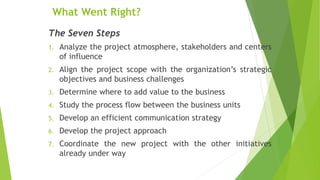
The Seven Steps
1. Analyze the project atmosphere, stakeholders and centers
of influence
2. Align the project scope with the organization’s strategic
objectives and business challenges
3. Determine where to add value to the business
4. Study the process flow between the business units
5. Develop an efficient communication strategy
6. Develop the project approach
7. Coordinate the new project with the other initiatives
already under way
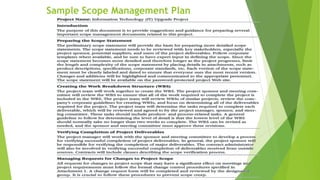
Sample Scope Management Plan
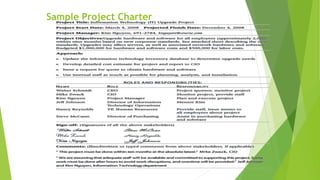
Sample Project Charter
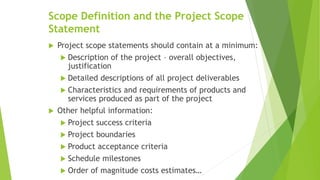
Scope Definition and the Project Scope
Statement
 Project scope statements should contain at a minimum:
 Description of the project – overall objectives,
justification
 Detailed descriptions of all project deliverables
 Characteristics and requirements of products and
services produced as part of the project
 Other helpful information:
 Project success criteria
 Project boundaries
 Product acceptance criteria
 Schedule milestones
 Order of magnitude costs estimates…
Scope Verification
 It is very difficult to create a good scope statement and
WBS for a project
 It is even more difficult to verify project scope and
minimize scope changes
 Scope verification involves formal acceptance of the
completed project scope by the stakeholders
 Acceptance is often achieved by a customer inspection and
then sign-off on key deliverables
What Went Wrong?
 A project scope that is too broad and grandiose can cause
severe problems
 In 2001, McDonald’s fast-food chain initiated a project
to create an intranet that would connect its
headquarters with all of its restaurants to provide
detailed operational information in real time; after
spending $170 million on consultants and initial
implementation planning, McDonald’s realized that the
project was too much to handle and terminated it
Scope Control
 Scope control involves controlling changes to the project scope
 Goals of scope control are to:
 Influence the factors that cause scope changes
 Assure changes are processed according to procedures
developed as part of integrated change control
 Manage changes when they occur
 Tools for performing scope control include a change control
system and configuration management
 Variance is the difference between planned and actual
performance
Best Practices for Avoiding Scope Problems
1. Keep the scope realistic: Don’t make projects so large
that they can’t be completed; break large projects down
into a series of smaller ones
2. Involve users in project scope management: Assign key
users to the project team and give them ownership of
requirements definition and scope verification
3. Use off-the-shelf hardware and software whenever
possible: Many IT people enjoy using the latest and
greatest technology, but business needs, not technology
trends, must take priority
4. Follow good project management processes: As described,
there are well-defined processes for managing project
scope and others aspects of projects
Suggestions for Improving User Input
 Develop a good project selection process and insist that
sponsors are from the user organization
 Have users on the project team in important roles
 Have regular meetings with defined agendas, and have
users sign off on key deliverables presented at meetings
 Deliver something to users and sponsors on a regular basis
 Don’t promise to deliver when you know you can’t
 Co-locate users with developers
Suggestions for Reducing Incomplete and
Changing Requirements
 Develop and follow a requirements management process
 Use techniques such as prototyping, use case modeling,
and JAD to get more user involvement
 Put all requirements in writing, keep them current and
readily available
 Create a requirements management database for
documenting and controlling requirements (CASE tools)
Suggestions for Reducing Incomplete and
Changing Requirements
 Provide adequate testing and conduct testing
throughout the project life cycle
 Review changes from a systems perspective
 Project scope changes must include associated cost and
schedule changes
 Focus on approved scope goals and don’t get side tracked
 Emphasize completion dates to help focus on what’s
most important
 What should we drop in order to add something new?
 Allocate resources specifically for handling change
requests / enhancements like NWA did with ResNet

Lec 08 project scope_management

  • 1.
    Project Management Project Scope Management ByQadir Nawaz Abbasi Mechanical Engineering Dept: MUET SZAB Campus Khairpur Mir’s May, 2018
  • 2.
    Did your projectask for this? …And end up building this instead? Why does it happen?
  • 3.
    Welcome to ProjectScope Management!  Scope refers to all the work involved in creating the products of the project and the processes used to create them. It defines what is or is not to be done  Deliverables are products produced as part of a project, such as hardware or software, planning documents, or meeting minutes  The project team and stakeholders must have the same understanding of what products will be produced as a result of a project and how they’ll be produced What is Project Scope Management? The complete understanding of and management of, exactly what is to be delivered and what is not to be delivered within the project.
  • 4.
    Project Scope ManagementProcesses  Scope planning: deciding how the scope will be defined, verified, and controlled  Scope definition: reviewing the project charter and preliminary scope statement and adding more information as requirements are developed and change requests are approved  Creating the WBS: subdividing the major project deliverables into smaller, more manageable components  Scope verification: formalizing acceptance of the project scope by key project stakeholders  Scope control: controlling changes to project scope which impact project cost and time goals
  • 5.
    Scope Planning andthe Scope Management Plan  The scope management plan is a document that includes descriptions of how the team will prepare the project scope statement, create the WBS, verify completion of the project deliverables, and control requests for changes to the project scope  Key inputs include the project charter, preliminary scope statement, and project management plan  It should be reviewed with the project sponsor to make sure the approach meets expectations
  • 6.
    WhatWent Right?  Manyfinancial service companies use customer relationship management (CRM) systems to improve their understanding of and responsiveness to customers  A senior management team at the Canadian money management company Dynamic Mutual Funds (DMF) launched an enterprise-wide, national program to build and manage its customer relationships  They needed a faster and more organized, highly participative approach, so they proposed a new seven-step concept called project scope design
  • 7.
    What Went Right? TheSeven Steps 1. Analyze the project atmosphere, stakeholders and centers of influence 2. Align the project scope with the organization’s strategic objectives and business challenges 3. Determine where to add value to the business 4. Study the process flow between the business units 5. Develop an efficient communication strategy 6. Develop the project approach 7. Coordinate the new project with the other initiatives already under way
  • 8.
  • 9.
  • 10.
    Scope Definition andthe Project Scope Statement  Project scope statements should contain at a minimum:  Description of the project – overall objectives, justification  Detailed descriptions of all project deliverables  Characteristics and requirements of products and services produced as part of the project  Other helpful information:  Project success criteria  Project boundaries  Product acceptance criteria  Schedule milestones  Order of magnitude costs estimates…
  • 11.
    Scope Verification  Itis very difficult to create a good scope statement and WBS for a project  It is even more difficult to verify project scope and minimize scope changes  Scope verification involves formal acceptance of the completed project scope by the stakeholders  Acceptance is often achieved by a customer inspection and then sign-off on key deliverables
  • 12.
    What Went Wrong? A project scope that is too broad and grandiose can cause severe problems  In 2001, McDonald’s fast-food chain initiated a project to create an intranet that would connect its headquarters with all of its restaurants to provide detailed operational information in real time; after spending $170 million on consultants and initial implementation planning, McDonald’s realized that the project was too much to handle and terminated it
  • 13.
    Scope Control  Scopecontrol involves controlling changes to the project scope  Goals of scope control are to:  Influence the factors that cause scope changes  Assure changes are processed according to procedures developed as part of integrated change control  Manage changes when they occur  Tools for performing scope control include a change control system and configuration management  Variance is the difference between planned and actual performance
  • 14.
    Best Practices forAvoiding Scope Problems 1. Keep the scope realistic: Don’t make projects so large that they can’t be completed; break large projects down into a series of smaller ones 2. Involve users in project scope management: Assign key users to the project team and give them ownership of requirements definition and scope verification 3. Use off-the-shelf hardware and software whenever possible: Many IT people enjoy using the latest and greatest technology, but business needs, not technology trends, must take priority 4. Follow good project management processes: As described, there are well-defined processes for managing project scope and others aspects of projects
  • 15.
    Suggestions for ImprovingUser Input  Develop a good project selection process and insist that sponsors are from the user organization  Have users on the project team in important roles  Have regular meetings with defined agendas, and have users sign off on key deliverables presented at meetings  Deliver something to users and sponsors on a regular basis  Don’t promise to deliver when you know you can’t  Co-locate users with developers
  • 16.
    Suggestions for ReducingIncomplete and Changing Requirements  Develop and follow a requirements management process  Use techniques such as prototyping, use case modeling, and JAD to get more user involvement  Put all requirements in writing, keep them current and readily available  Create a requirements management database for documenting and controlling requirements (CASE tools)
  • 17.
    Suggestions for ReducingIncomplete and Changing Requirements  Provide adequate testing and conduct testing throughout the project life cycle  Review changes from a systems perspective  Project scope changes must include associated cost and schedule changes  Focus on approved scope goals and don’t get side tracked  Emphasize completion dates to help focus on what’s most important  What should we drop in order to add something new?  Allocate resources specifically for handling change requests / enhancements like NWA did with ResNet