“To start with the greatest name of Almighty
Allah. Most gracious and merciful, whose
bounties are unbounded, whose benevolence is
everlasting, whose blessings are uncountable,
whose being is eternal, whose mercy is unlimited,
whose provisions are un-ending, and whose Love
is our life, whose worship is our faith.
“Design, Fabrication & simulation of
mixed mode solar dehydrator for date
palm ”
2
Outline
 Introduction
 Problem Statement
 Aims & Objectives
 Literature Review
 Design & Material Selection
 Working Mechanism
 Components of Solar Dehydrator
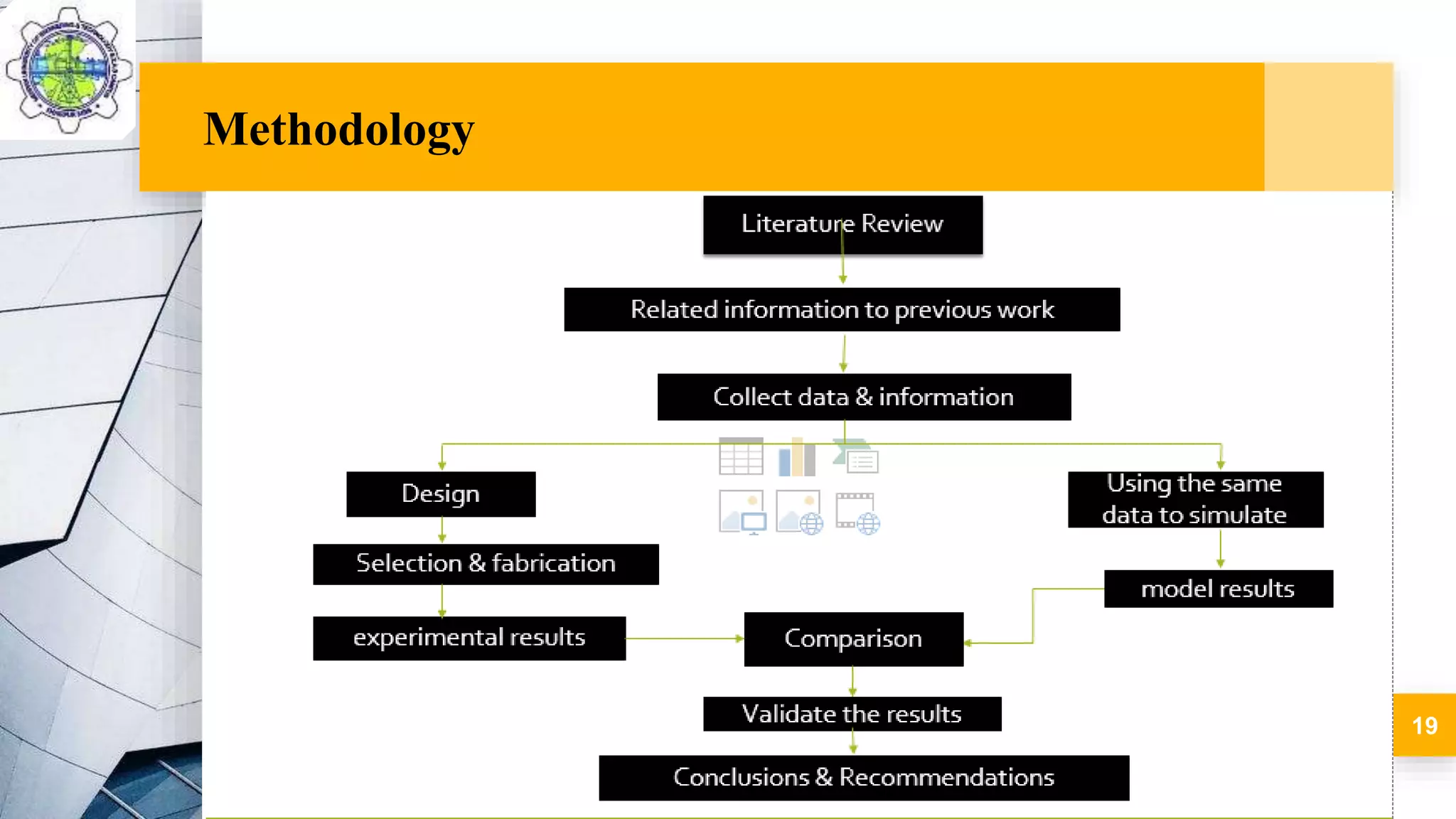
 Methodology
 Results
 Conclusion and Recommendation
 References 3
Introduction
• Drying process is one of the oldest method used to remove the
moisture content from the natural product.
• It is simplest and economical method on a large scale drying because
of cheaper cost as compared to drying machine.
• But it is estimated that about 30-40 percent of the commodity is wasted
due to insufficient post-harvest treatment.
• If solar dryers are used to remove excess moisture from the product
before storage, their quality during storage will not deteriorate and
infestation of insects will be reduced
• Similarly, large quantities of excess vegetables and fruits, which are
now being wasted, could be solar-dried for use during off-season in a
controlled manner
4
• There are different types of solar dryers, such as direct drying (solar box
dryer), indirect drying (solar cabinet dryer), mixed mode drying (solar
tunnel dryer) or hybrid drying (hybrid solar/biomass cabinet dryer).
• Food materials and crops are very sensitive to the drying condition. very
short duration with high speed drying would cause a quality of dried
product will be reduced due to over or under dry. Thus , the selection of
drying temperature is one of the most important thing to ensure the
color, texture, flavor, and value of product will not degrade.
• Khairpur Mir’s district is famous because of political, historical and fruit
date palm. Date fruit of khairpur Mir’s district is called diamond of
khairpur Mir’s due to its fertile soil and geographical location. The date
Palm phoenix dactylifera is one of the fruit which is cultivated in large
quantity in khairpur Mir’s.
Introduction (continue…)
5
Problem Statement
Khairpur district approximately produced 90% of dates in Sindh Pakistan.
Dates convert into Chuhara by open sun drying method.
However, there are some disadvantages by using this method.
1. Rain can spoil the product
2. Wind
3. Attack of insect and fungus
4. Dust and moisture
5. Lost of product due to birds and animals
6
Aims & Objectives
▪ Design and fabrication of Mixed mode solar dehydrator.
▪ Experimentally setup and conduction system.
▪ Simulation of same dehydrator in computer using SOLIDWORKS software.
▪ Validate the results.
7
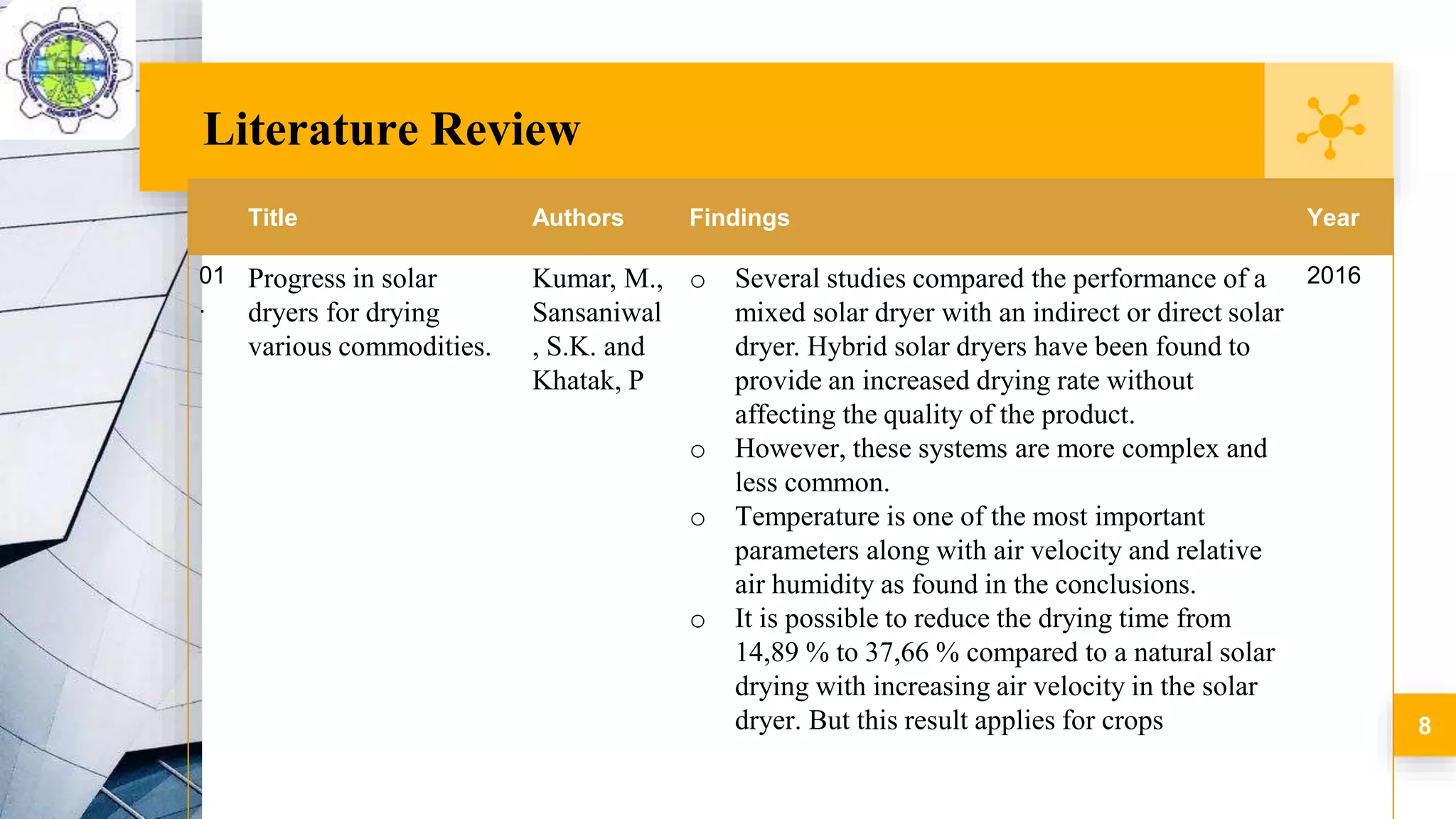
Literature Review
8
Title Authors Findings Year
01
.
Progress in solar
dryers for drying
various commodities.
Kumar, M.,
Sansaniwal
, S.K. and
Khatak, P
o Several studies compared the performance of a
mixed solar dryer with an indirect or direct solar
dryer. Hybrid solar dryers have been found to
provide an increased drying rate without
affecting the quality of the product.
o However, these systems are more complex and
less common.
o Temperature is one of the most important
parameters along with air velocity and relative
air humidity as found in the conclusions.
o It is possible to reduce the drying time from
14,89 % to 37,66 % compared to a natural solar
drying with increasing air velocity in the solar
dryer. But this result applies for crops
2016
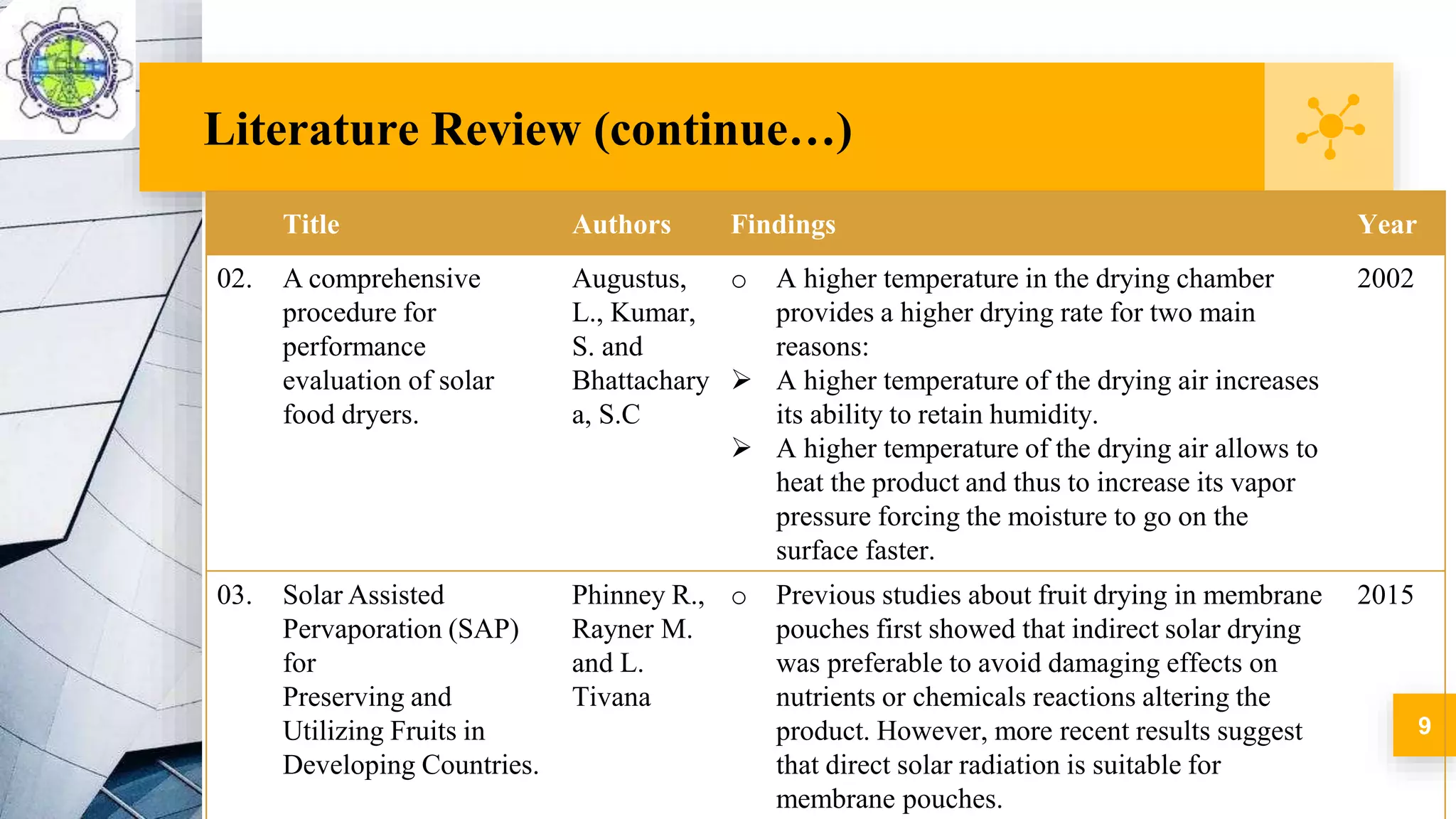
Literature Review (continue…)
9
Title Authors Findings Year
02. A comprehensive
procedure for
performance
evaluation of solar
food dryers.
Augustus,
L., Kumar,
S. and
Bhattachary
a, S.C
o A higher temperature in the drying chamber
provides a higher drying rate for two main
reasons:
 A higher temperature of the drying air increases
its ability to retain humidity.
 A higher temperature of the drying air allows to
heat the product and thus to increase its vapor
pressure forcing the moisture to go on the
surface faster.
2002
03. Solar Assisted
Pervaporation (SAP)
for
Preserving and
Utilizing Fruits in
Developing Countries.
Phinney R.,
Rayner M.
and L.
Tivana
o Previous studies about fruit drying in membrane
pouches first showed that indirect solar drying
was preferable to avoid damaging effects on
nutrients or chemicals reactions altering the
product. However, more recent results suggest
that direct solar radiation is suitable for
membrane pouches.
2015
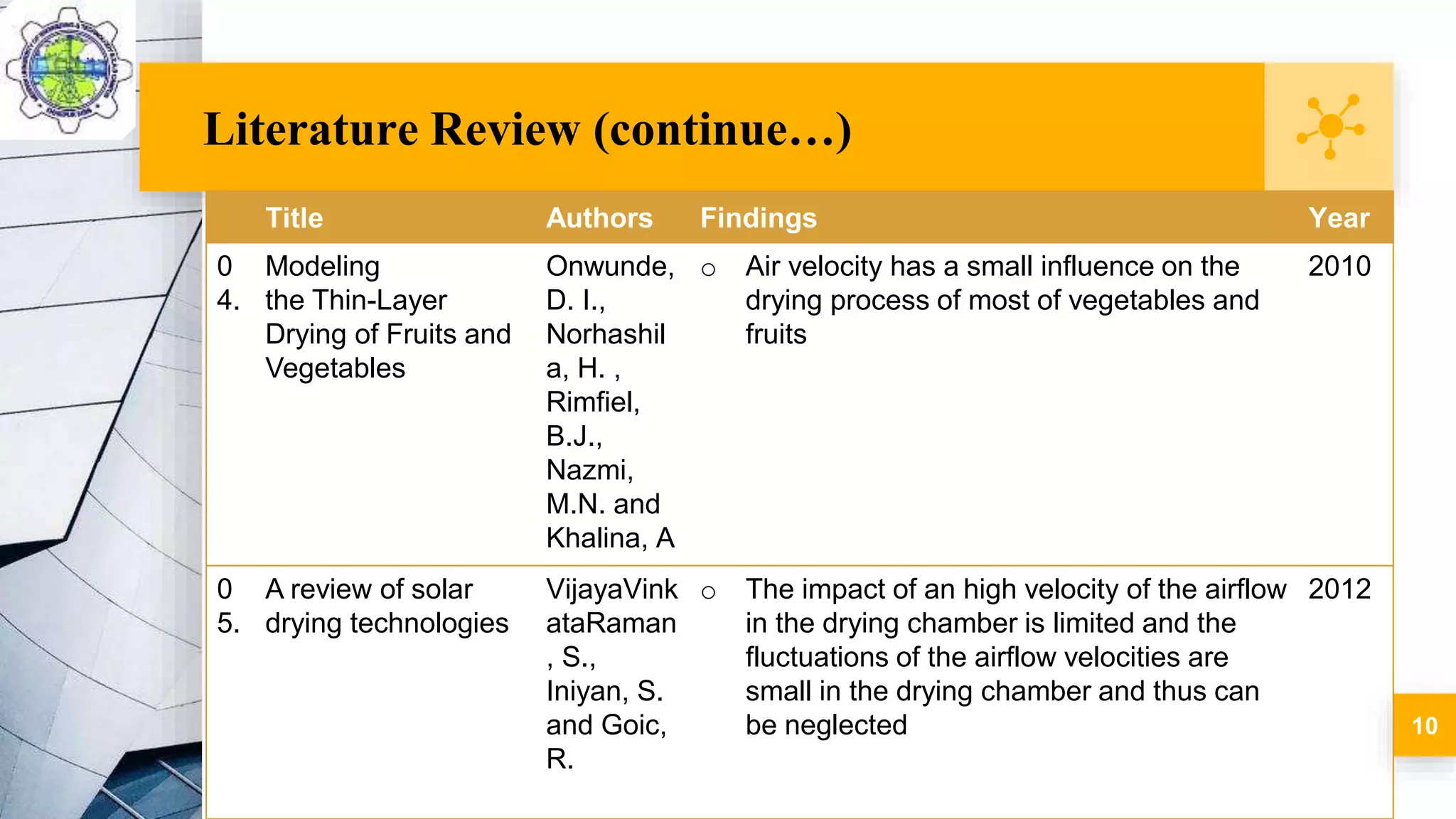
Literature Review (continue…)
10
Title Authors Findings Year
0
4.
Modeling
the Thin-Layer
Drying of Fruits and
Vegetables
Onwunde,
D. I.,
Norhashil
a, H. ,
Rimfiel,
B.J.,
Nazmi,
M.N. and
Khalina, A
o Air velocity has a small influence on the
drying process of most of vegetables and
fruits
2010
0
5.
A review of solar
drying technologies
VijayaVink
ataRaman
, S.,
Iniyan, S.
and Goic,
R.
o The impact of an high velocity of the airflow
in the drying chamber is limited and the
fluctuations of the airflow velocities are
small in the drying chamber and thus can
be neglected
2012
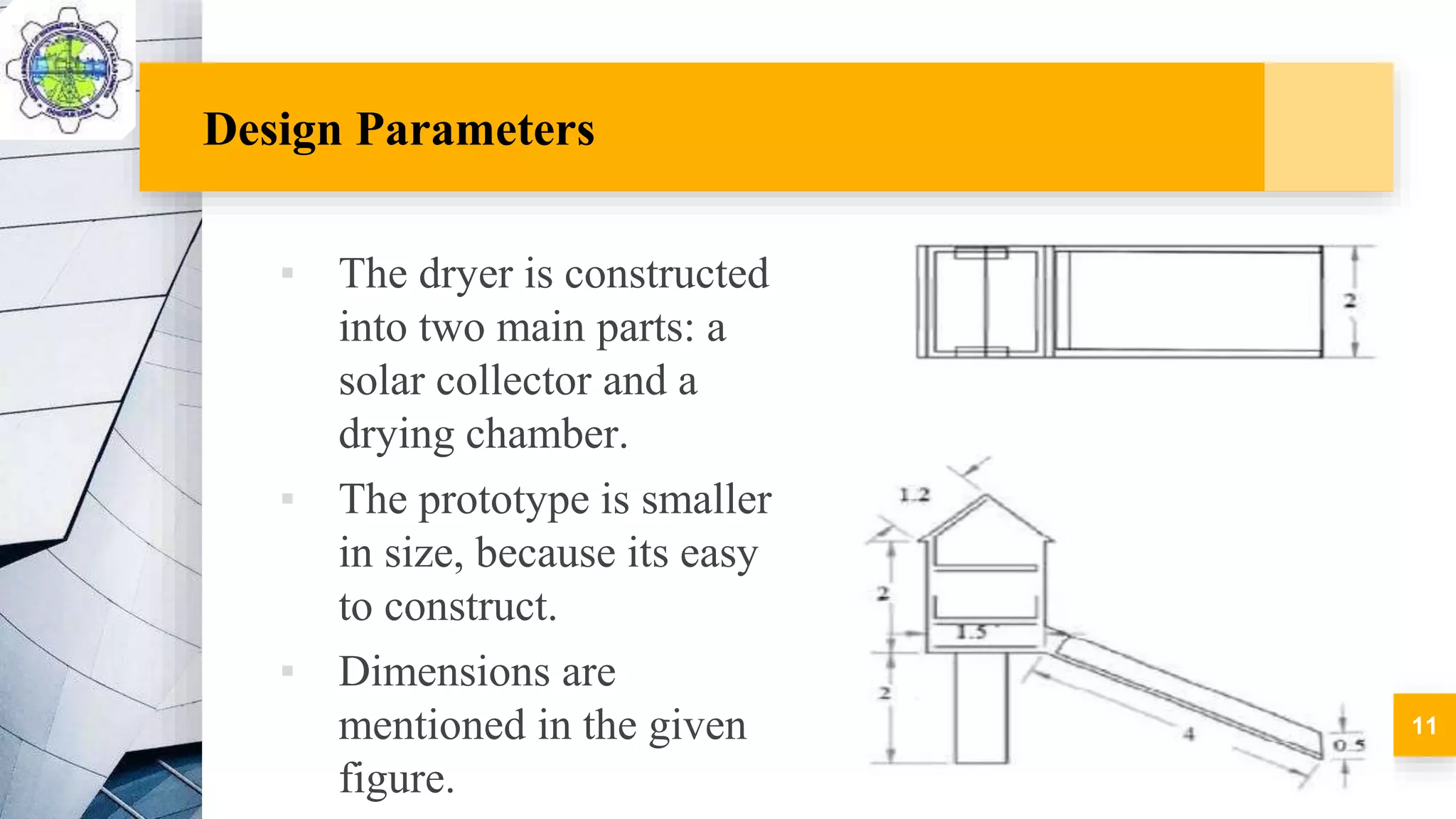
Design Parameters
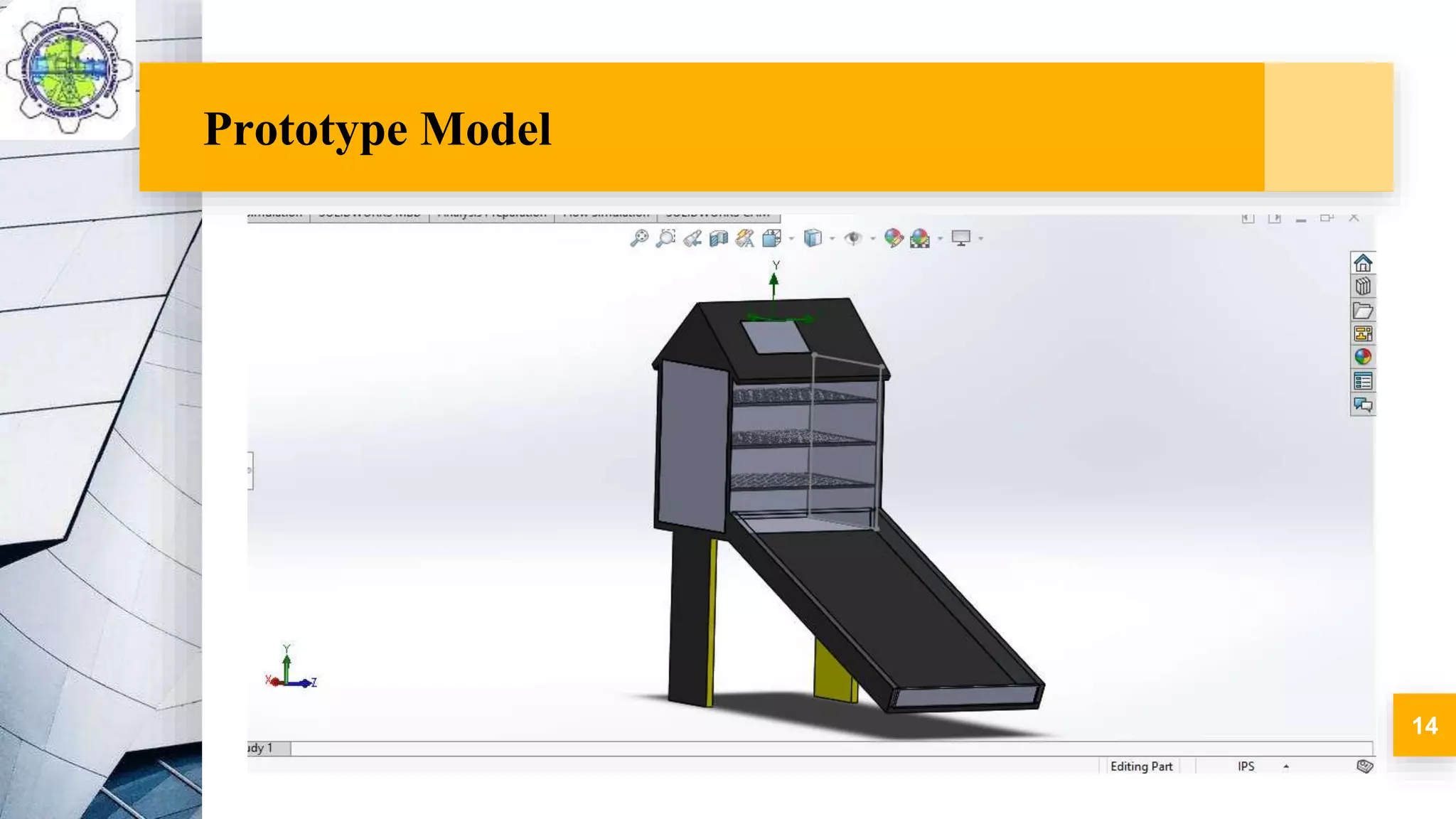
▪ The dryer is constructed
into two main parts: a
solar collector and a
drying chamber.
▪ The prototype is smaller
in size, because its easy
to construct.
▪ Dimensions are
mentioned in the given
figure.
11
Material Selection
The whole structure of solar dehydrator is made up of:
▪ Glass
▪ Stainless steel sheet absorber
▪ Wood
▪ Metal wire (in tray)
12
Working Mechanism
▪ The working principle of the solar dryer is based upon the use
of solar radiation.
▪ The glass absorbs when the sun's radiation G (W/m2) hits on its
glass part. Then another part of the solar radiation will be
reflected (depending on the coefficient of reflection Rp) and the
remaining part will be transmitted through the glass depending
on the coefficient of transmission τp.
▪ Depending on the absorption coefficient αabs the radiation is
then absorbed by the absorber and reflected depending on the
Rabs.
▪ Air flows through the collector to the drying chamber due to
the less density. 13
Prototype Model
14
Components of solar dryer
The solar dryer has three main parts.
▪ Air Heater (solar collector)
▪ Drying trays and
▪ Drying cabinet.
15
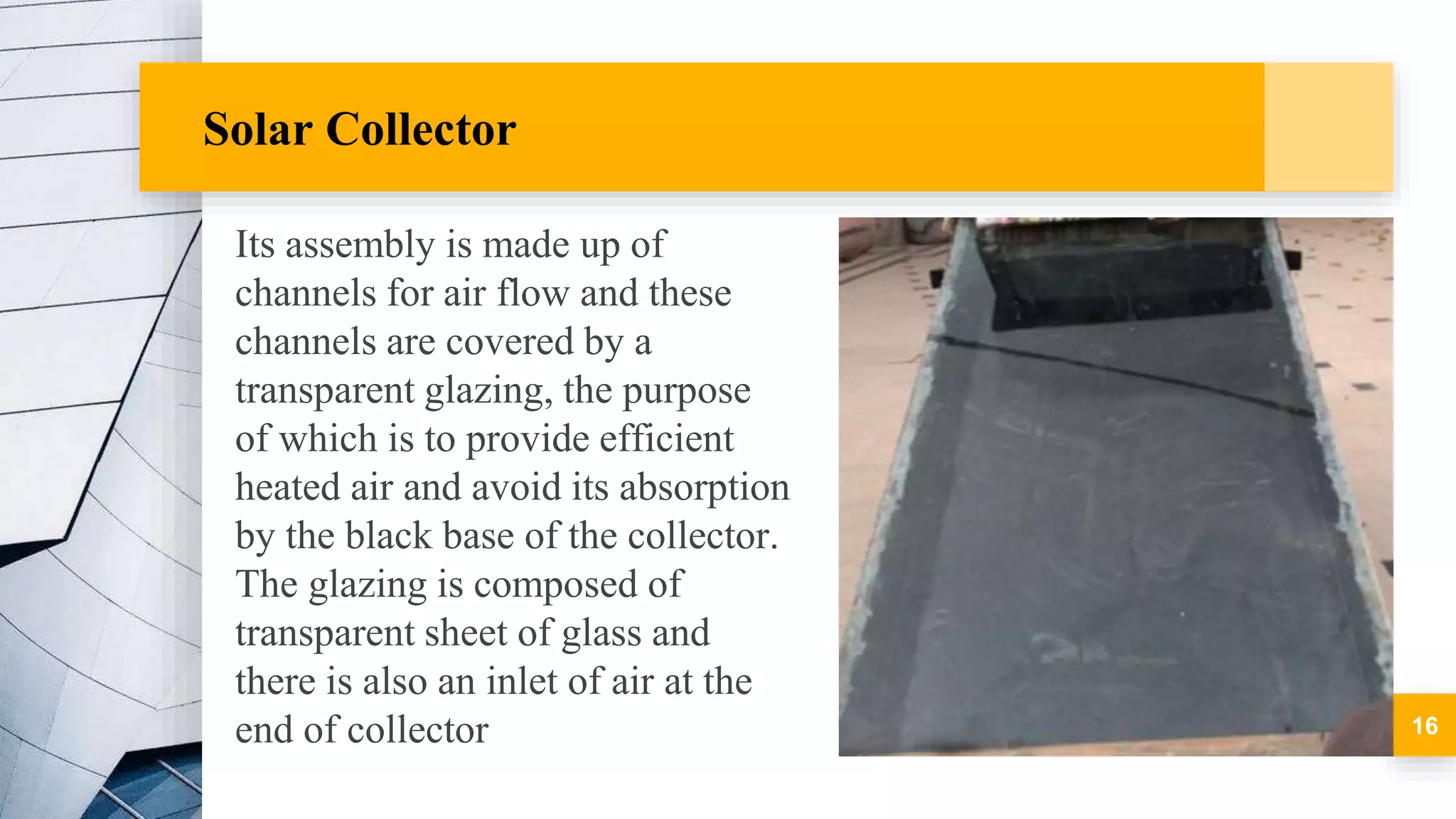
Solar Collector
Its assembly is made up of
channels for air flow and these
channels are covered by a
transparent glazing, the purpose
of which is to provide efficient
heated air and avoid its absorption
by the black base of the collector.
The glazing is composed of
transparent sheet of glass and
there is also an inlet of air at the
end of collector 16
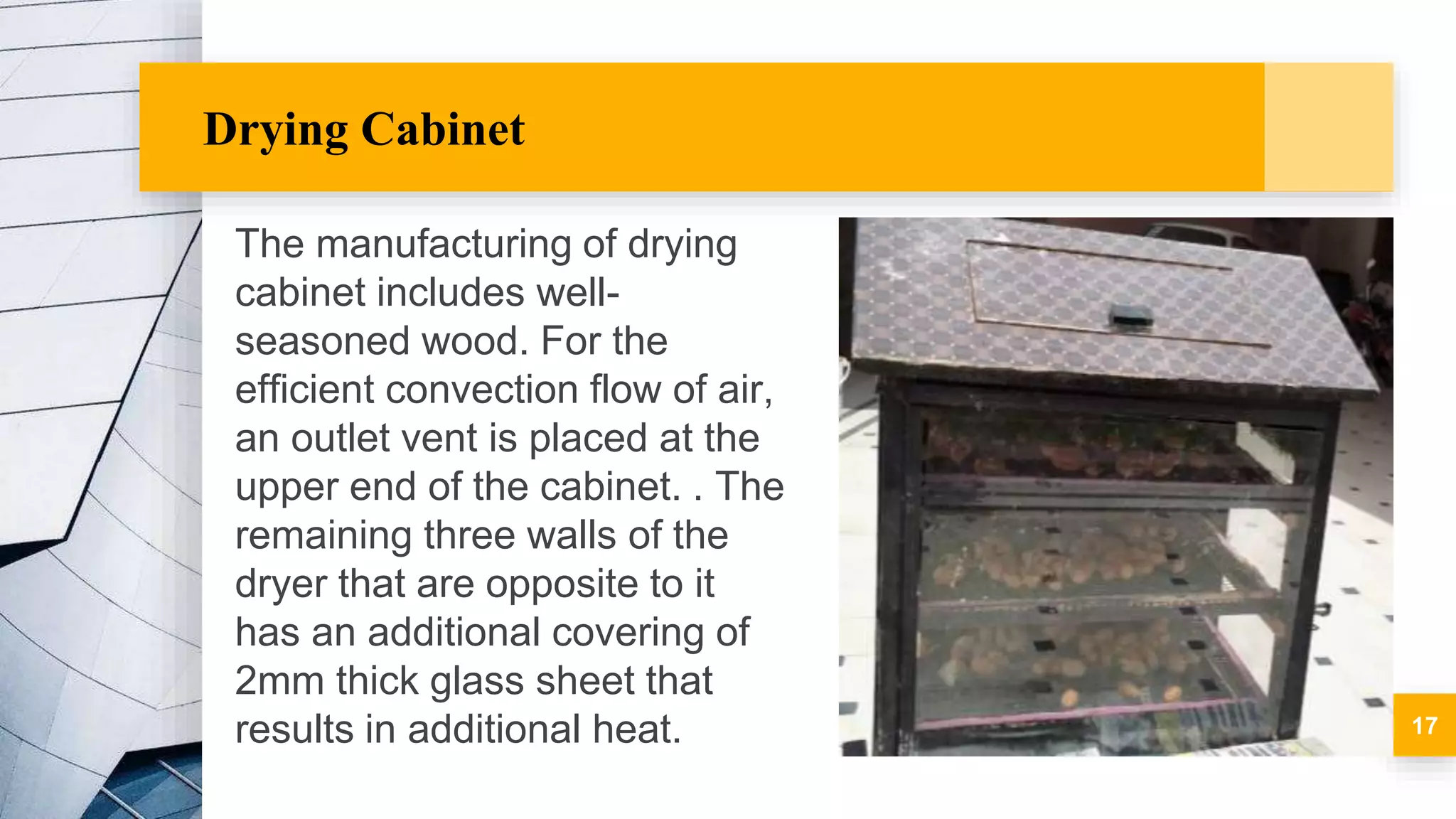
Drying Cabinet
The manufacturing of drying
cabinet includes well-
seasoned wood. For the
efficient convection flow of air,
an outlet vent is placed at the
upper end of the cabinet. . The
remaining three walls of the
dryer that are opposite to it
has an additional covering of
2mm thick glass sheet that
results in additional heat. 17
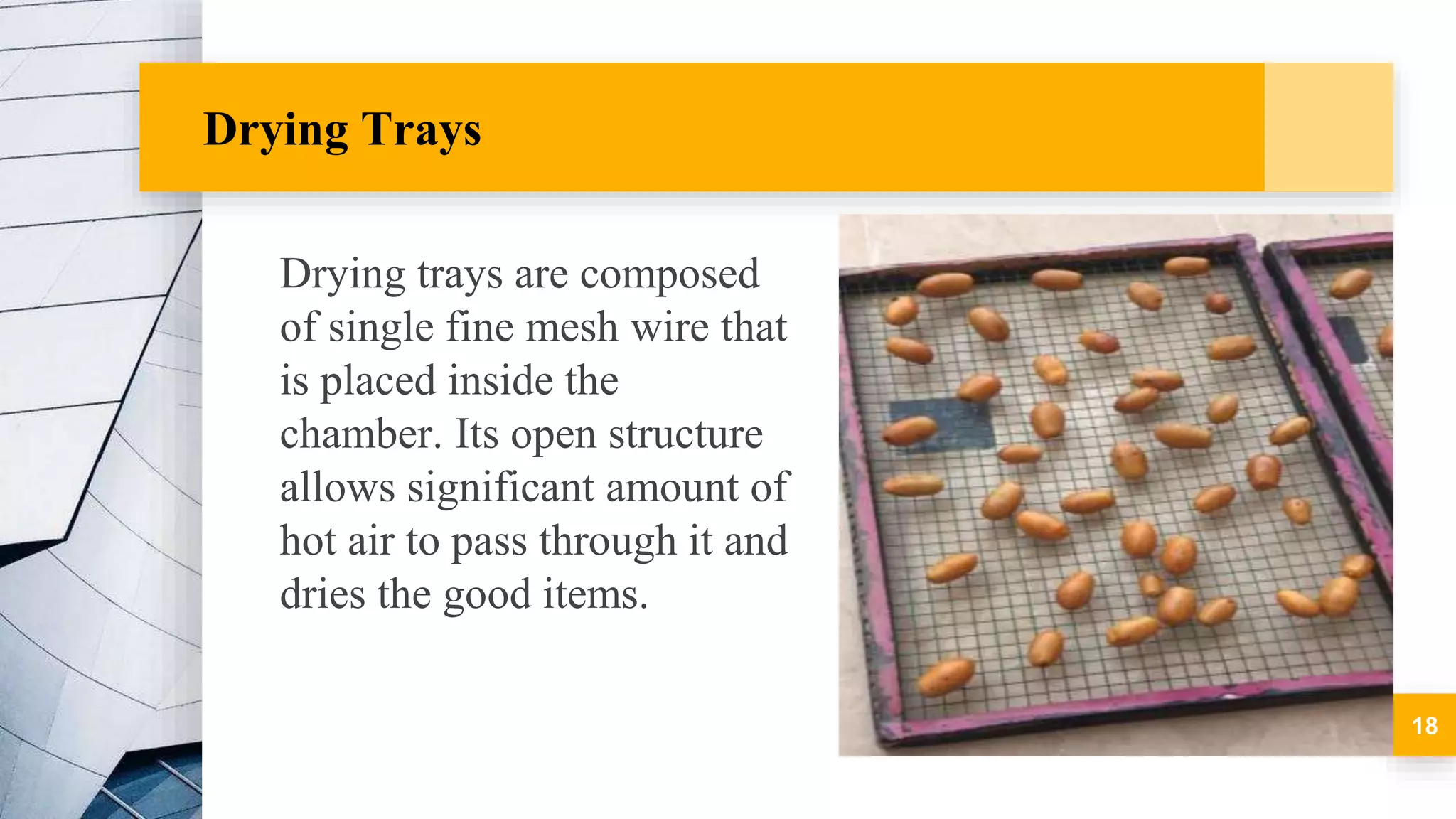
Drying Trays
Drying trays are composed
of single fine mesh wire that
is placed inside the
chamber. Its open structure
allows significant amount of
hot air to pass through it and
dries the good items.
18
Methodology
19
Results
• The solar dryer loaded test was performed on a 1.5 kg boiled
dates basis. During this test, only solar energy was used for
drying as heat source. Each hour interval was recorded as to
ambient temperature, moisture, dryer temperature and collector
output temperature while the weight was also recorded in a
dryer.
20
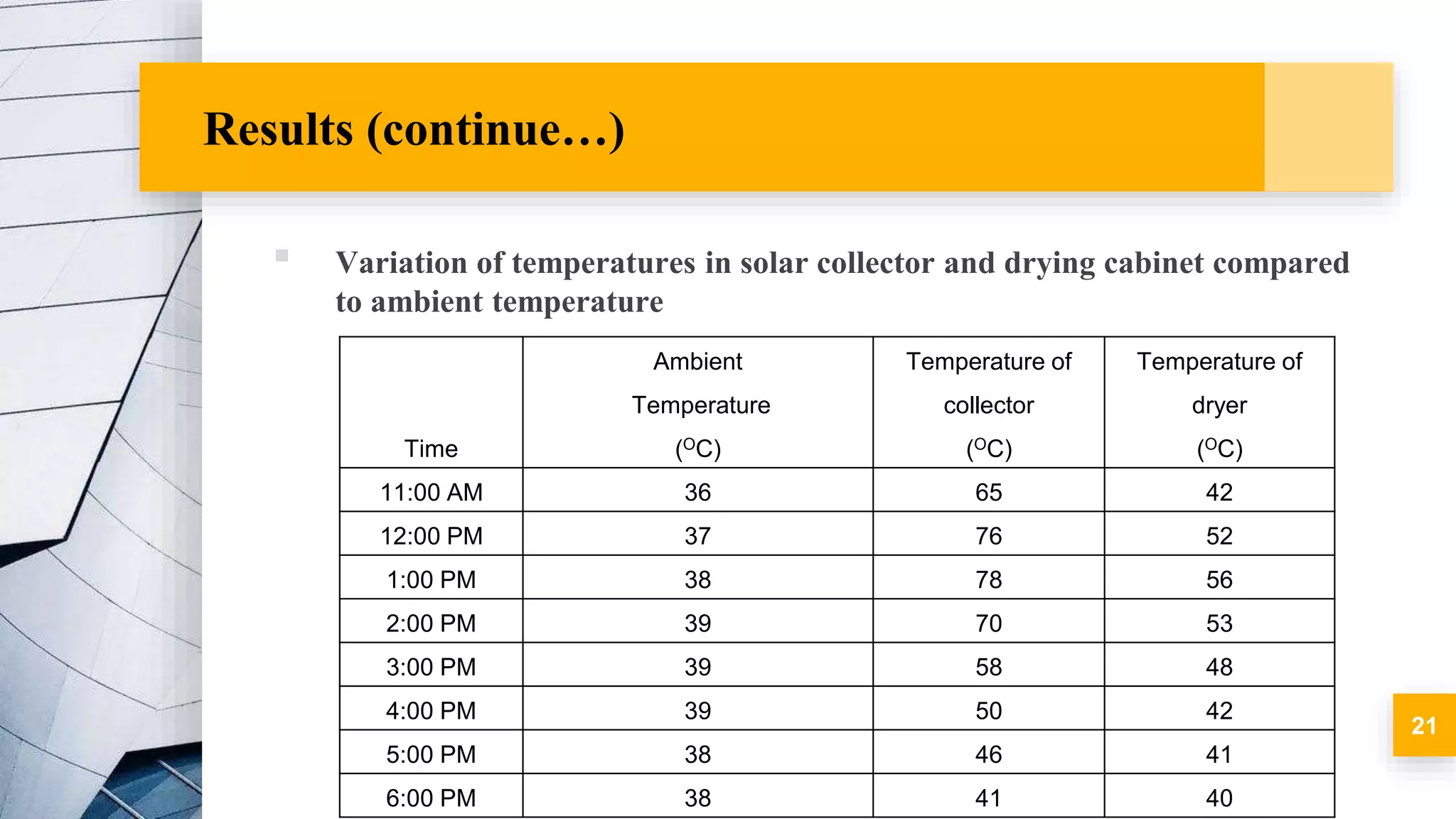
Results (continue…)
▪ Variation of temperatures in solar collector and drying cabinet compared
to ambient temperature
21
Time
Ambient
Temperature
(OC)
Temperature of
collector
(OC)
Temperature of
dryer
(OC)
11:00 AM 36 65 42
12:00 PM 37 76 52
1:00 PM 38 78 56
2:00 PM 39 70 53
3:00 PM 39 58 48
4:00 PM 39 50 42
5:00 PM 38 46 41
6:00 PM 38 41 40
Results (continue…)
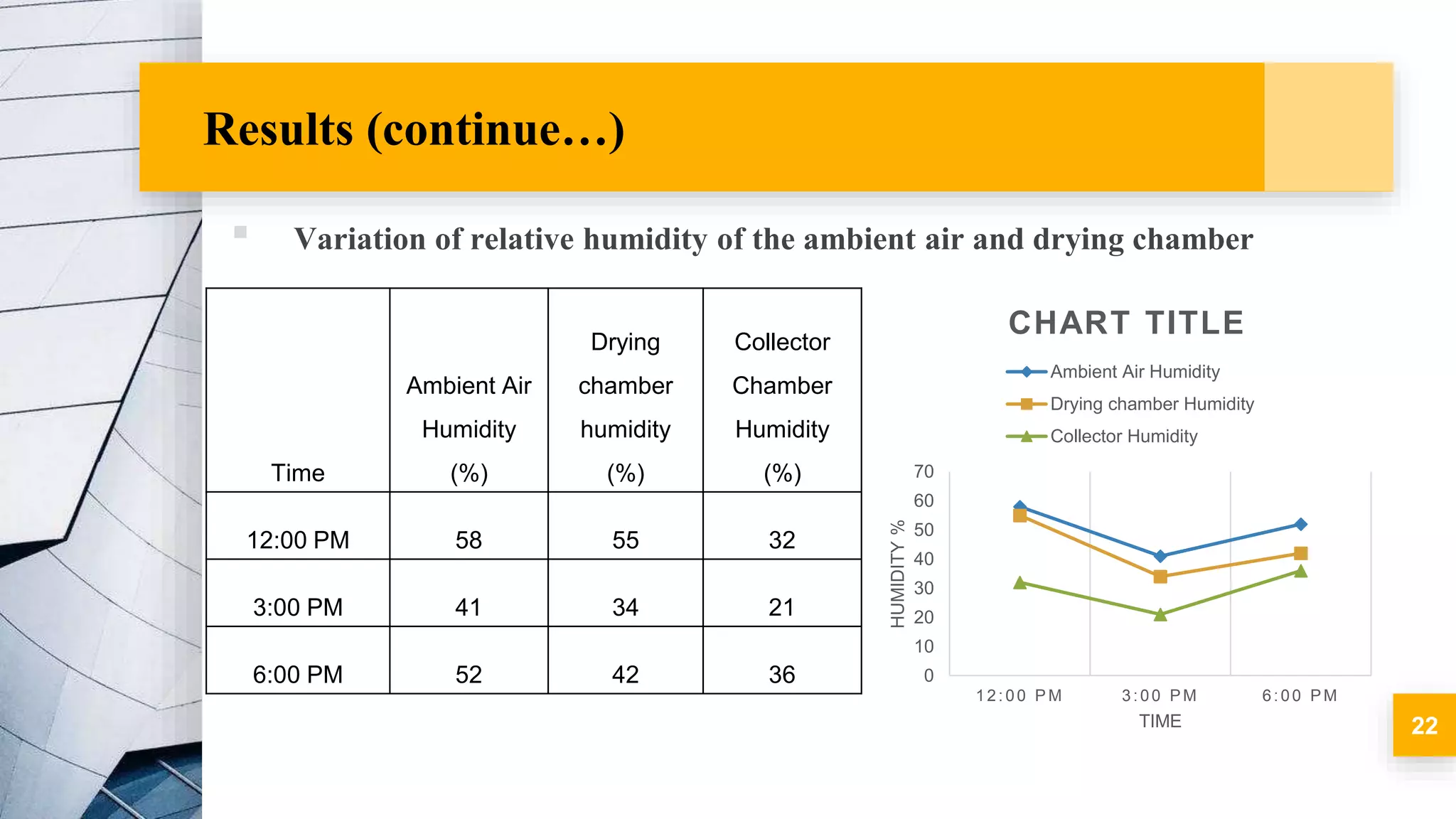
▪ Variation of relative humidity of the ambient air and drying chamber
22
Time
Ambient Air
Humidity
(%)
Drying
chamber
humidity
(%)
Collector
Chamber
Humidity
(%)
12:00 PM 58 55 32
3:00 PM 41 34 21
6:00 PM 52 42 36 0
10
20
30
40
50
60
70
12: 00 P M 3: 00 P M 6: 00 P M
HUMIDITY%
TIME
CHART TITLE
Ambient Air Humidity
Drying chamber Humidity
Collector Humidity
Results (continue…)
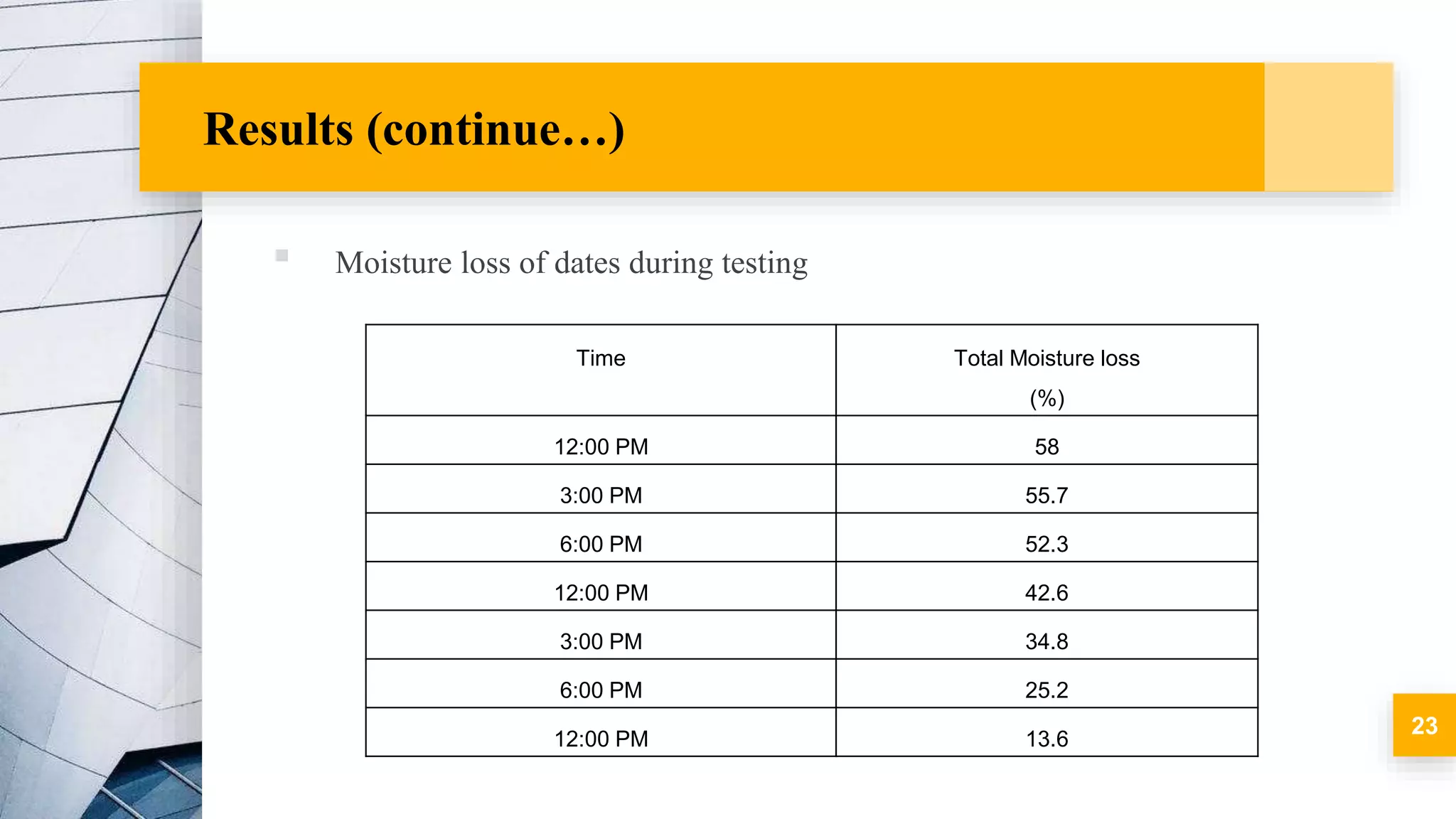
▪ Moisture loss of dates during testing
23
Time Total Moisture loss
(%)
12:00 PM 58
3:00 PM 55.7
6:00 PM 52.3
12:00 PM 42.6
3:00 PM 34.8
6:00 PM 25.2
12:00 PM 13.6
Results (continue…)
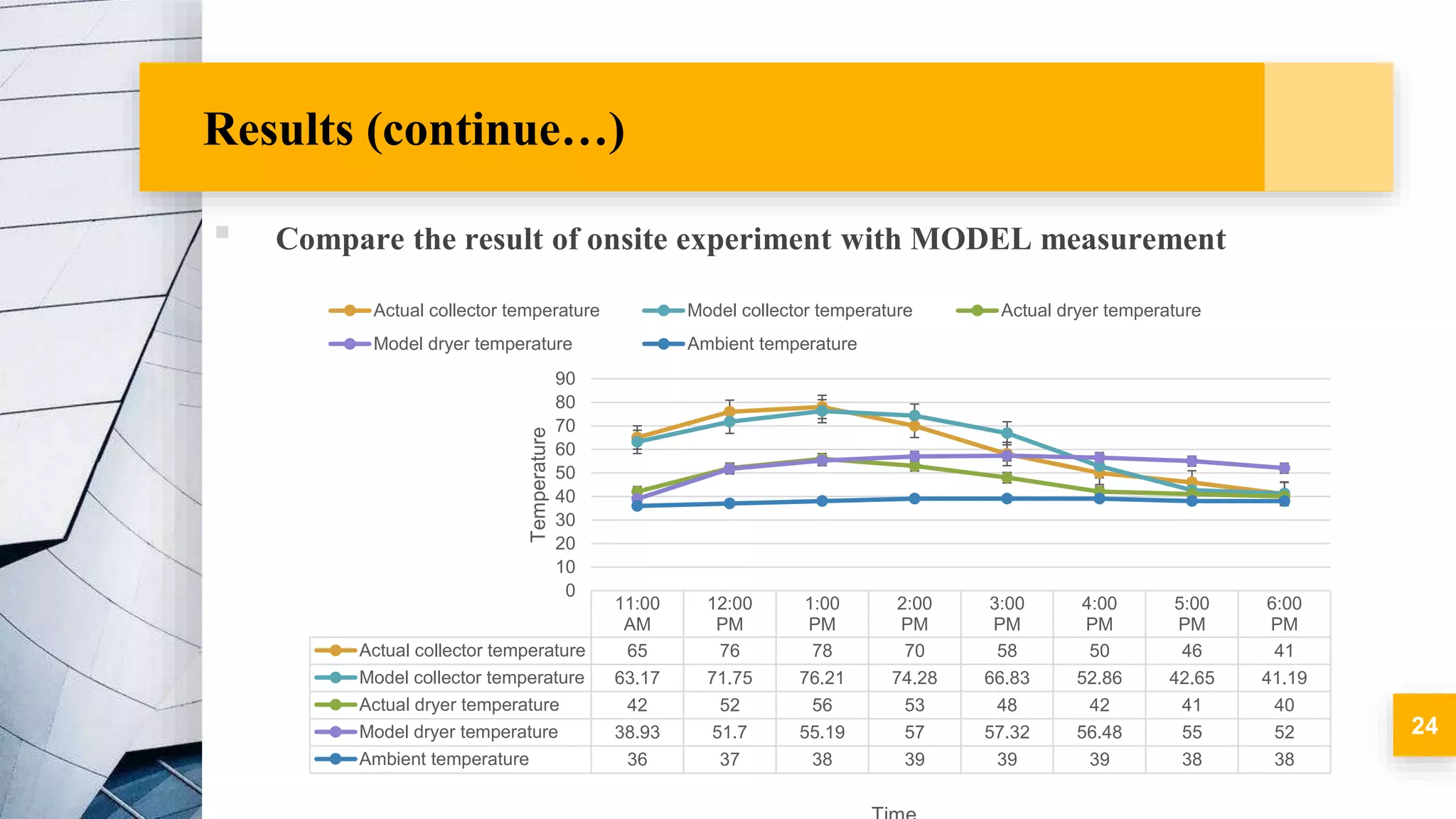
▪ Compare the result of onsite experiment with MODEL measurement
24
11:00
AM
12:00
PM
1:00
PM
2:00
PM
3:00
PM
4:00
PM
5:00
PM
6:00
PM
Actual collector temperature 65 76 78 70 58 50 46 41
Model collector temperature 63.17 71.75 76.21 74.28 66.83 52.86 42.65 41.19
Actual dryer temperature 42 52 56 53 48 42 41 40
Model dryer temperature 38.93 51.7 55.19 57 57.32 56.48 55 52
Ambient temperature 36 37 38 39 39 39 38 38
0
10
20
30
40
50
60
70
80
90
Temperature
Actual collector temperature Model collector temperature Actual dryer temperature
Model dryer temperature Ambient temperature
Results (continue…)
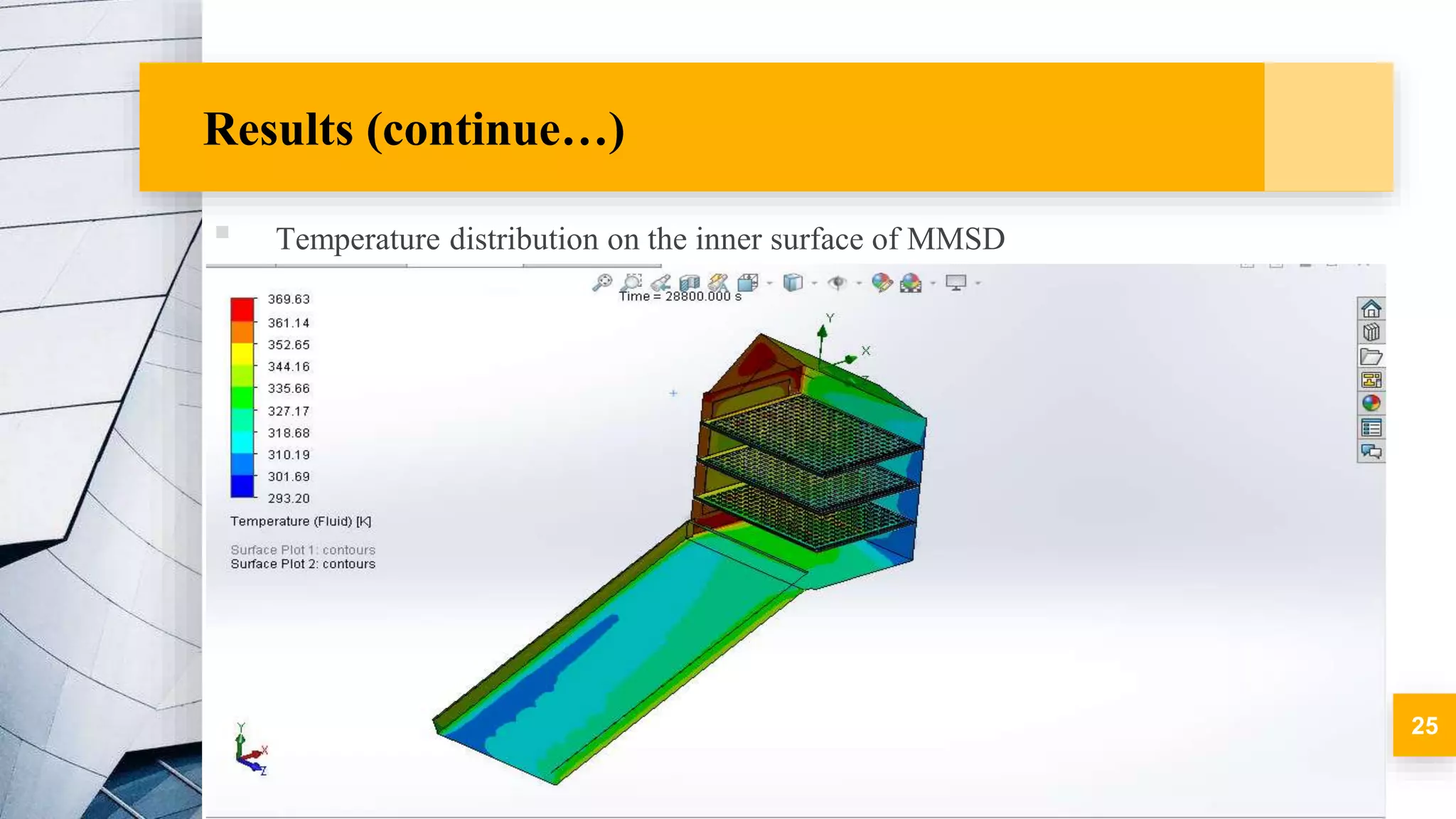
▪ Temperature distribution on the inner surface of MMSD
25
Results (continue…)
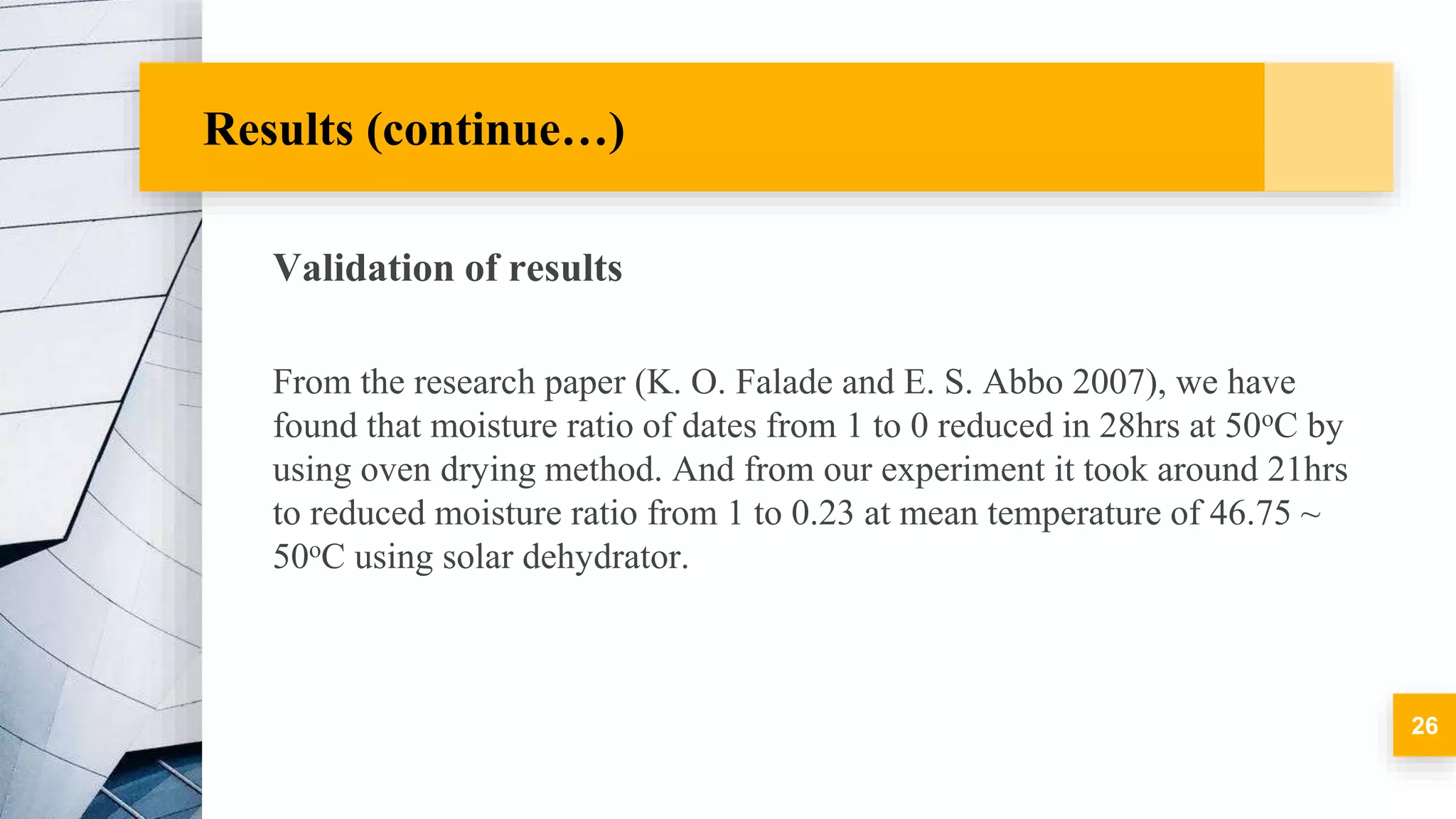
Validation of results
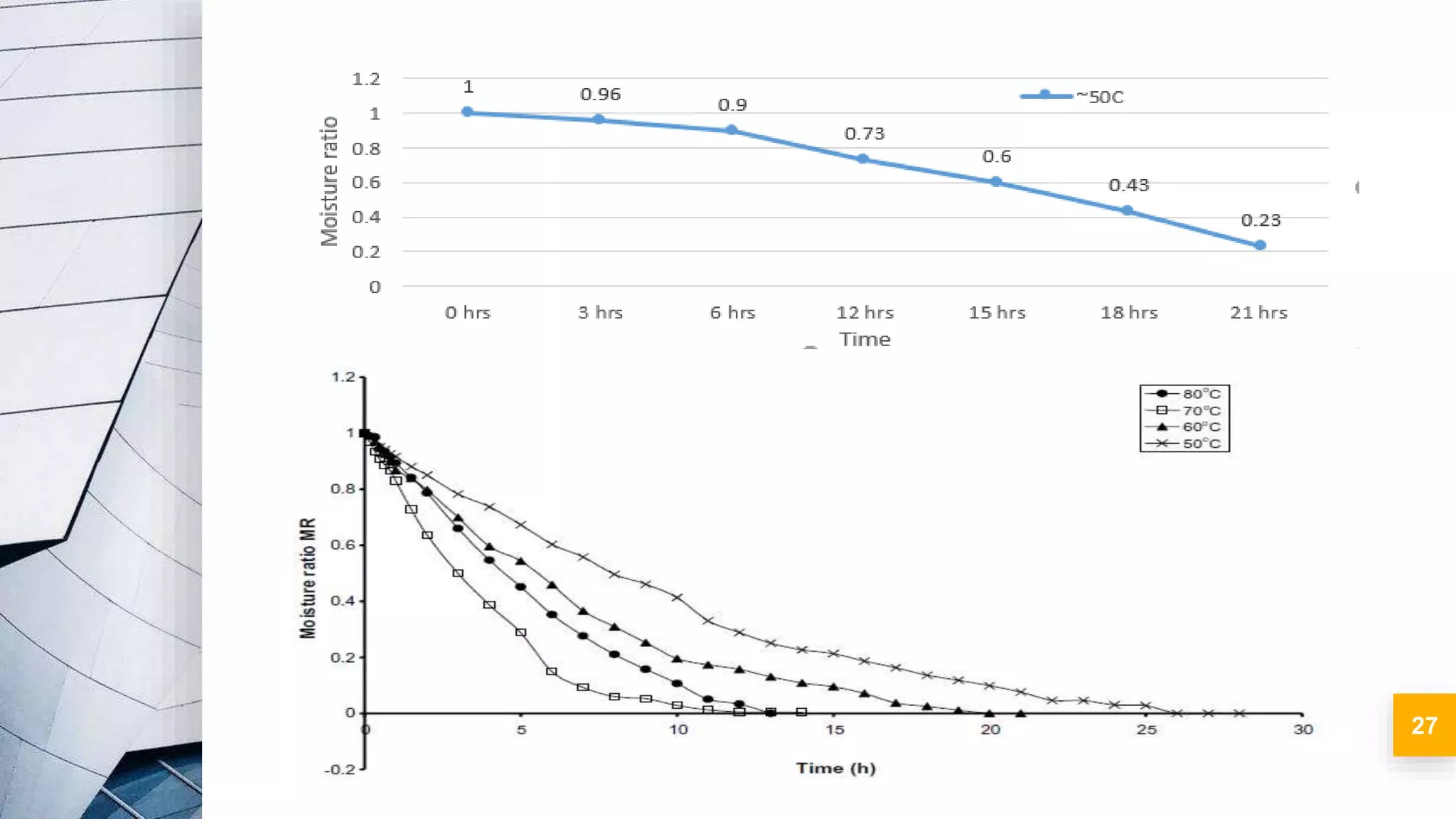
From the research paper (K. O. Falade and E. S. Abbo 2007), we have
found that moisture ratio of dates from 1 to 0 reduced in 28hrs at 50oC by
using oven drying method. And from our experiment it took around 21hrs
to reduced moisture ratio from 1 to 0.23 at mean temperature of 46.75 ~
50oC using solar dehydrator.
26
27
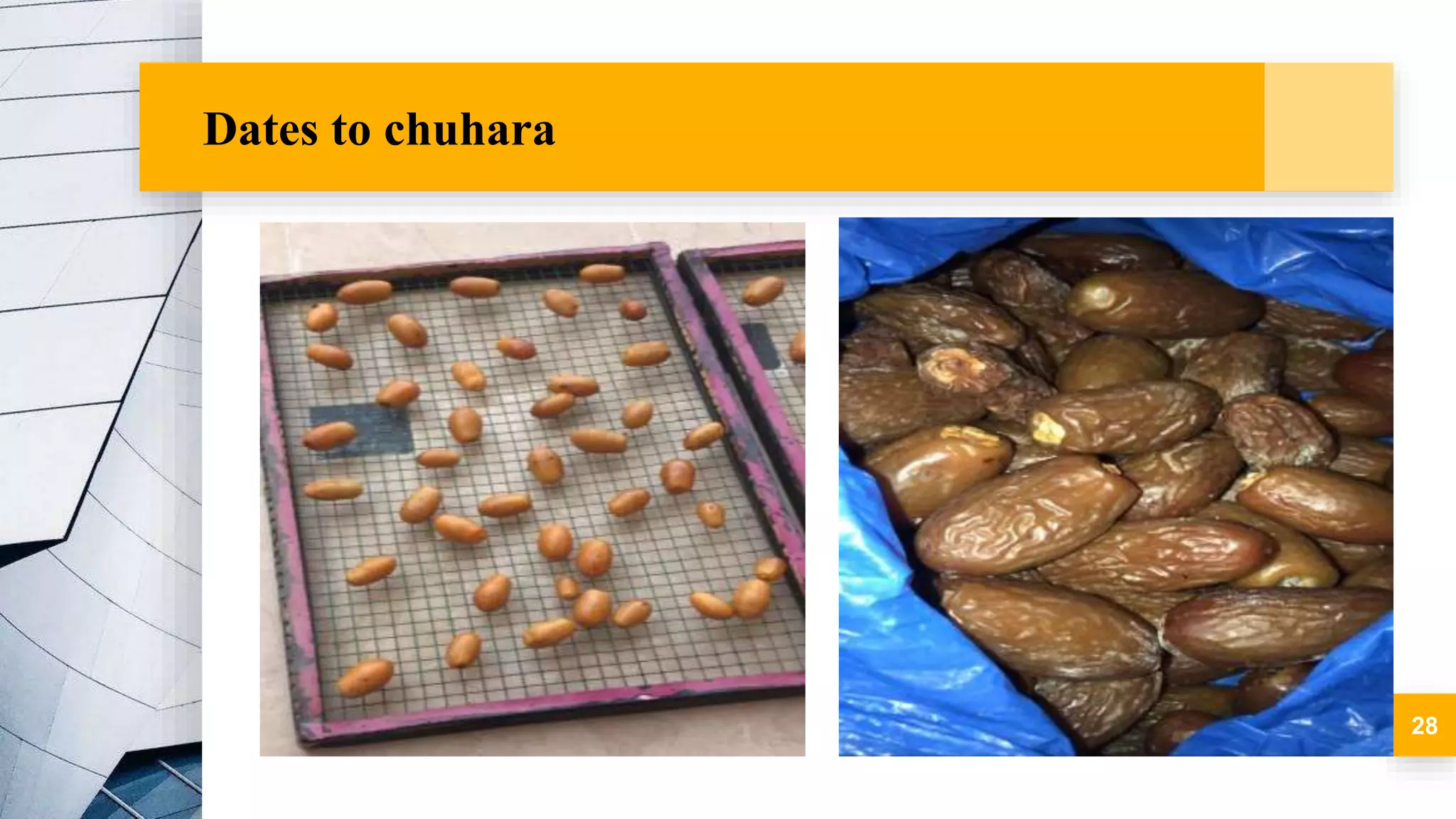
Dates to chuhara
28
CONCLUSION
The research work has been concluded as:
▪ MMSD provides maximum temperature up to 78 OC at 1.00-2.00 PM as
compared to conventional drying method.
▪ Moisture content is reduced from 58% to 13.6% in dates to Chohara.
▪ Moisture removed up to 76.5% to convert dates into Chohara.
▪ MMSD takes less time (average 3 days) to convert dates into Chohara as
compared to conventional drying method (7-8 day-s),
▪ Less labors required
▪ MMSD required less space for drying.
29
RECOMMENDATIONS
The performance of existing solar food dryers can still be improved upon especially in
the aspect of reducing the drying time considering the following aspects.
▪ Increasing the size of the solar collector that can increase the storage capacity
thus reduce drying time.
▪ MMSD fruit dryer can further be modified to use blower and other good collector
heat to surpass the performance
▪ The modeling work could be improved by making more measurements on the
actual solar dryers varying the weather condition (temperature, relative humidity,
irradiation) to study the influence of the weather on the dryers’ performances.
30
References
Kumar, M., Sansaniwal, S.K. and Khatak, P. (2016). “Progress in solar dryers for
drying various commodities”.
Augustus, L., Kumar, S. and Bhattacharya, S.C. (2002). “A comprehensive procedure
for performance evaluation of solar food dryers”.
Phinney R., Rayner M. and L. Tivana (2015). “Solar Assisted Pervaporation (SAP) for
Preserving and Utilizing Fruits in Developing Countries”.
Onwunde, D. I., Norhashila, H. , Rimfiel, B.J., Nazmi, M.N. and Khalina, A. (2010).
“Modeling the Thin-Layer Drying of Fruits and Vegetables : A review”.
VijayaVinkataRaman, S., Iniyan, S. and Goic, R. (2012). “A review of solar drying
technologies”.
K. O. Falade and E. S. Abbo, “Air-drying and rehydration characteristics of date palm
(Phoenix dactylifera L.) fruits,” J. Food Eng., vol. 79, no. 2, pp. 724–730, Mar. 2007,
doi: 10.1016/j.jfoodeng.2006.01.081.
31
32
THANKS

Design, fabrication & simulation of mixed mode solar dehydrator for date palm

  • 1.
    “To start withthe greatest name of Almighty Allah. Most gracious and merciful, whose bounties are unbounded, whose benevolence is everlasting, whose blessings are uncountable, whose being is eternal, whose mercy is unlimited, whose provisions are un-ending, and whose Love is our life, whose worship is our faith.
  • 2.
    “Design, Fabrication &simulation of mixed mode solar dehydrator for date palm ” 2
  • 3.
    Outline  Introduction  ProblemStatement  Aims & Objectives  Literature Review  Design & Material Selection  Working Mechanism  Components of Solar Dehydrator  Methodology  Results  Conclusion and Recommendation  References 3
  • 4.
    Introduction • Drying processis one of the oldest method used to remove the moisture content from the natural product. • It is simplest and economical method on a large scale drying because of cheaper cost as compared to drying machine. • But it is estimated that about 30-40 percent of the commodity is wasted due to insufficient post-harvest treatment. • If solar dryers are used to remove excess moisture from the product before storage, their quality during storage will not deteriorate and infestation of insects will be reduced • Similarly, large quantities of excess vegetables and fruits, which are now being wasted, could be solar-dried for use during off-season in a controlled manner 4
  • 5.
    • There aredifferent types of solar dryers, such as direct drying (solar box dryer), indirect drying (solar cabinet dryer), mixed mode drying (solar tunnel dryer) or hybrid drying (hybrid solar/biomass cabinet dryer). • Food materials and crops are very sensitive to the drying condition. very short duration with high speed drying would cause a quality of dried product will be reduced due to over or under dry. Thus , the selection of drying temperature is one of the most important thing to ensure the color, texture, flavor, and value of product will not degrade. • Khairpur Mir’s district is famous because of political, historical and fruit date palm. Date fruit of khairpur Mir’s district is called diamond of khairpur Mir’s due to its fertile soil and geographical location. The date Palm phoenix dactylifera is one of the fruit which is cultivated in large quantity in khairpur Mir’s. Introduction (continue…) 5
  • 6.
    Problem Statement Khairpur districtapproximately produced 90% of dates in Sindh Pakistan. Dates convert into Chuhara by open sun drying method. However, there are some disadvantages by using this method. 1. Rain can spoil the product 2. Wind 3. Attack of insect and fungus 4. Dust and moisture 5. Lost of product due to birds and animals 6
  • 7.
    Aims & Objectives ▪Design and fabrication of Mixed mode solar dehydrator. ▪ Experimentally setup and conduction system. ▪ Simulation of same dehydrator in computer using SOLIDWORKS software. ▪ Validate the results. 7
  • 8.
    Literature Review 8 Title AuthorsFindings Year 01 . Progress in solar dryers for drying various commodities. Kumar, M., Sansaniwal , S.K. and Khatak, P o Several studies compared the performance of a mixed solar dryer with an indirect or direct solar dryer. Hybrid solar dryers have been found to provide an increased drying rate without affecting the quality of the product. o However, these systems are more complex and less common. o Temperature is one of the most important parameters along with air velocity and relative air humidity as found in the conclusions. o It is possible to reduce the drying time from 14,89 % to 37,66 % compared to a natural solar drying with increasing air velocity in the solar dryer. But this result applies for crops 2016
  • 9.
    Literature Review (continue…) 9 TitleAuthors Findings Year 02. A comprehensive procedure for performance evaluation of solar food dryers. Augustus, L., Kumar, S. and Bhattachary a, S.C o A higher temperature in the drying chamber provides a higher drying rate for two main reasons:  A higher temperature of the drying air increases its ability to retain humidity.  A higher temperature of the drying air allows to heat the product and thus to increase its vapor pressure forcing the moisture to go on the surface faster. 2002 03. Solar Assisted Pervaporation (SAP) for Preserving and Utilizing Fruits in Developing Countries. Phinney R., Rayner M. and L. Tivana o Previous studies about fruit drying in membrane pouches first showed that indirect solar drying was preferable to avoid damaging effects on nutrients or chemicals reactions altering the product. However, more recent results suggest that direct solar radiation is suitable for membrane pouches. 2015
  • 10.
    Literature Review (continue…) 10 TitleAuthors Findings Year 0 4. Modeling the Thin-Layer Drying of Fruits and Vegetables Onwunde, D. I., Norhashil a, H. , Rimfiel, B.J., Nazmi, M.N. and Khalina, A o Air velocity has a small influence on the drying process of most of vegetables and fruits 2010 0 5. A review of solar drying technologies VijayaVink ataRaman , S., Iniyan, S. and Goic, R. o The impact of an high velocity of the airflow in the drying chamber is limited and the fluctuations of the airflow velocities are small in the drying chamber and thus can be neglected 2012
  • 11.
    Design Parameters ▪ Thedryer is constructed into two main parts: a solar collector and a drying chamber. ▪ The prototype is smaller in size, because its easy to construct. ▪ Dimensions are mentioned in the given figure. 11
  • 12.
    Material Selection The wholestructure of solar dehydrator is made up of: ▪ Glass ▪ Stainless steel sheet absorber ▪ Wood ▪ Metal wire (in tray) 12
  • 13.
    Working Mechanism ▪ Theworking principle of the solar dryer is based upon the use of solar radiation. ▪ The glass absorbs when the sun's radiation G (W/m2) hits on its glass part. Then another part of the solar radiation will be reflected (depending on the coefficient of reflection Rp) and the remaining part will be transmitted through the glass depending on the coefficient of transmission τp. ▪ Depending on the absorption coefficient αabs the radiation is then absorbed by the absorber and reflected depending on the Rabs. ▪ Air flows through the collector to the drying chamber due to the less density. 13
  • 14.
  • 15.
    Components of solardryer The solar dryer has three main parts. ▪ Air Heater (solar collector) ▪ Drying trays and ▪ Drying cabinet. 15
  • 16.
    Solar Collector Its assemblyis made up of channels for air flow and these channels are covered by a transparent glazing, the purpose of which is to provide efficient heated air and avoid its absorption by the black base of the collector. The glazing is composed of transparent sheet of glass and there is also an inlet of air at the end of collector 16
  • 17.
    Drying Cabinet The manufacturingof drying cabinet includes well- seasoned wood. For the efficient convection flow of air, an outlet vent is placed at the upper end of the cabinet. . The remaining three walls of the dryer that are opposite to it has an additional covering of 2mm thick glass sheet that results in additional heat. 17
  • 18.
    Drying Trays Drying traysare composed of single fine mesh wire that is placed inside the chamber. Its open structure allows significant amount of hot air to pass through it and dries the good items. 18
  • 19.
  • 20.
    Results • The solardryer loaded test was performed on a 1.5 kg boiled dates basis. During this test, only solar energy was used for drying as heat source. Each hour interval was recorded as to ambient temperature, moisture, dryer temperature and collector output temperature while the weight was also recorded in a dryer. 20
  • 21.
    Results (continue…) ▪ Variationof temperatures in solar collector and drying cabinet compared to ambient temperature 21 Time Ambient Temperature (OC) Temperature of collector (OC) Temperature of dryer (OC) 11:00 AM 36 65 42 12:00 PM 37 76 52 1:00 PM 38 78 56 2:00 PM 39 70 53 3:00 PM 39 58 48 4:00 PM 39 50 42 5:00 PM 38 46 41 6:00 PM 38 41 40
  • 22.
    Results (continue…) ▪ Variationof relative humidity of the ambient air and drying chamber 22 Time Ambient Air Humidity (%) Drying chamber humidity (%) Collector Chamber Humidity (%) 12:00 PM 58 55 32 3:00 PM 41 34 21 6:00 PM 52 42 36 0 10 20 30 40 50 60 70 12: 00 P M 3: 00 P M 6: 00 P M HUMIDITY% TIME CHART TITLE Ambient Air Humidity Drying chamber Humidity Collector Humidity
  • 23.
    Results (continue…) ▪ Moistureloss of dates during testing 23 Time Total Moisture loss (%) 12:00 PM 58 3:00 PM 55.7 6:00 PM 52.3 12:00 PM 42.6 3:00 PM 34.8 6:00 PM 25.2 12:00 PM 13.6
  • 24.
    Results (continue…) ▪ Comparethe result of onsite experiment with MODEL measurement 24 11:00 AM 12:00 PM 1:00 PM 2:00 PM 3:00 PM 4:00 PM 5:00 PM 6:00 PM Actual collector temperature 65 76 78 70 58 50 46 41 Model collector temperature 63.17 71.75 76.21 74.28 66.83 52.86 42.65 41.19 Actual dryer temperature 42 52 56 53 48 42 41 40 Model dryer temperature 38.93 51.7 55.19 57 57.32 56.48 55 52 Ambient temperature 36 37 38 39 39 39 38 38 0 10 20 30 40 50 60 70 80 90 Temperature Actual collector temperature Model collector temperature Actual dryer temperature Model dryer temperature Ambient temperature
  • 25.
    Results (continue…) ▪ Temperaturedistribution on the inner surface of MMSD 25
  • 26.
    Results (continue…) Validation ofresults From the research paper (K. O. Falade and E. S. Abbo 2007), we have found that moisture ratio of dates from 1 to 0 reduced in 28hrs at 50oC by using oven drying method. And from our experiment it took around 21hrs to reduced moisture ratio from 1 to 0.23 at mean temperature of 46.75 ~ 50oC using solar dehydrator. 26
  • 27.
  • 28.
  • 29.
    CONCLUSION The research workhas been concluded as: ▪ MMSD provides maximum temperature up to 78 OC at 1.00-2.00 PM as compared to conventional drying method. ▪ Moisture content is reduced from 58% to 13.6% in dates to Chohara. ▪ Moisture removed up to 76.5% to convert dates into Chohara. ▪ MMSD takes less time (average 3 days) to convert dates into Chohara as compared to conventional drying method (7-8 day-s), ▪ Less labors required ▪ MMSD required less space for drying. 29
  • 30.
    RECOMMENDATIONS The performance ofexisting solar food dryers can still be improved upon especially in the aspect of reducing the drying time considering the following aspects. ▪ Increasing the size of the solar collector that can increase the storage capacity thus reduce drying time. ▪ MMSD fruit dryer can further be modified to use blower and other good collector heat to surpass the performance ▪ The modeling work could be improved by making more measurements on the actual solar dryers varying the weather condition (temperature, relative humidity, irradiation) to study the influence of the weather on the dryers’ performances. 30
  • 31.
    References Kumar, M., Sansaniwal,S.K. and Khatak, P. (2016). “Progress in solar dryers for drying various commodities”. Augustus, L., Kumar, S. and Bhattacharya, S.C. (2002). “A comprehensive procedure for performance evaluation of solar food dryers”. Phinney R., Rayner M. and L. Tivana (2015). “Solar Assisted Pervaporation (SAP) for Preserving and Utilizing Fruits in Developing Countries”. Onwunde, D. I., Norhashila, H. , Rimfiel, B.J., Nazmi, M.N. and Khalina, A. (2010). “Modeling the Thin-Layer Drying of Fruits and Vegetables : A review”. VijayaVinkataRaman, S., Iniyan, S. and Goic, R. (2012). “A review of solar drying technologies”. K. O. Falade and E. S. Abbo, “Air-drying and rehydration characteristics of date palm (Phoenix dactylifera L.) fruits,” J. Food Eng., vol. 79, no. 2, pp. 724–730, Mar. 2007, doi: 10.1016/j.jfoodeng.2006.01.081. 31
  • 32.