[Insert project title, e.g. “Cosmo Inc.”]: Project Scope
Statement[Insert learner name]Capella UniversityProject Scope
Statement
Note: Any work not explicitly included in the Project Scope
Statement is implicitly excluded from the project.
Project Name
Prepared By
Date
(MM/DD/YYYY)Version History (insert rows as
needed):VersionDateComments
1.0
1. Executive Summary
Provide below a brief overview of this project (for example,
project purpose and justification).
Note: In any instance where there is a discrepancy between the
Project Charter and the Project Scope Statement, the latter is
considered authoritative.2. Business Objectives2.1 Product
Description (
Solution
)
2.2 Business Objectives
3. Project Description
For each area below, provide sufficient detail to define this
project adequately.3.1 Project Scope
Includes (list deliverables):
Does not include:
3.2 Dependencies (External and Internal)
3.3 Assumptions
3.4 Constraints
4. Project MilestonesTarget Date
Project Start
Project Complete
5. Project Approach
Briefly describe how each of the following will be handled.
Provide links to relevant documents as appropriate. 5.1 Change
Management
5.2 Communication Management
5.3 Quality Management
5.4 Resource Management
5.5 Critical Success Factors
5.6 Risk Management
5.7 Project Organization
6. AuthorizationsThe Project Scope Statement is approved by
the:
Project Sponsor
Project Manager
Project performance baseline changes will be approved by the:
Project Sponsor
Project Manager
Project deliverables will be approved and accepted by the:
Project Sponsor
Key Stakeholders
7. Project Scope Statement ApprovalProject Name
Project Manager
The purpose of this document is to provide a vehicle for
documenting the initial planning efforts for the project. It is
used to reach a satisfactory level of mutual agreement between
the Project Manager and the Project Sponsors and Owners with
respect to the objectives and scope of the project before
significant resources are committed and expenses incurred.
I have reviewed the information contained in this Project Scope
Statement and agree:NameRoleSignatureDate
The signatures above indicate an understanding of the purpose
and content of this document by those signing it. By signing
this document, they agree to this as the formal Project Scope
Statement document.
References
2
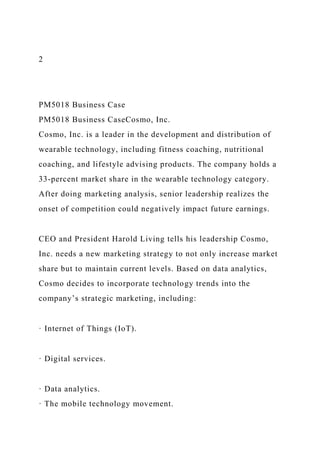
PM5018 Business Case
PM5018 Business CaseCosmo, Inc.
Cosmo, Inc. is a leader in the development and distribution of
wearable technology, including fitness coaching, nutritional
coaching, and lifestyle advising products. The company holds a
33-percent market share in the wearable technology category.
After doing marketing analysis, senior leadership realizes the
onset of competition could negatively impact future earnings.
CEO and President Harold Living tells his leadership Cosmo,
Inc. needs a new marketing strategy to not only increase market
share but to maintain current levels. Based on data analytics,
Cosmo decides to incorporate technology trends into the
company’s strategic marketing, including:
· Internet of Things (IoT).
· Digital services.
· Data analytics.
· The mobile technology movement.
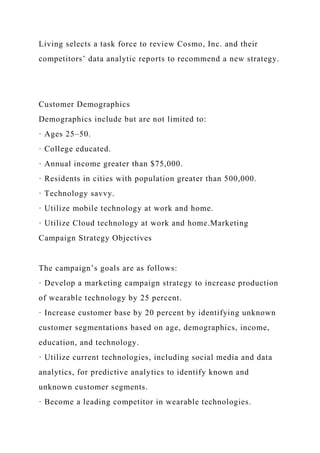
Living selects a task force to review Cosmo, Inc. and their
competitors’ data analytic reports to recommend a new strategy.
Customer Demographics
Demographics include but are not limited to:
· Ages 25–50.
· College educated.
· Annual income greater than $75,000.
· Residents in cities with population greater than 500,000.
· Technology savvy.
· Utilize mobile technology at work and home.
· Utilize Cloud technology at work and home.Marketing
Campaign Strategy Objectives
The campaign’s goals are as follows:
· Develop a marketing campaign strategy to increase production
of wearable technology by 25 percent.
· Increase customer base by 20 percent by identifying unknown
customer segmentations based on age, demographics, income,
education, and technology.
· Utilize current technologies, including social media and data
analytics, for predictive analytics to identify known and
unknown customer segments.
· Become a leading competitor in wearable technologies.
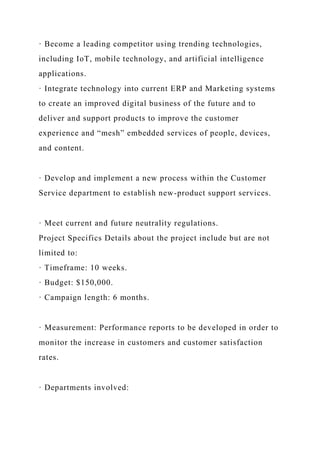
· Become a leading competitor using trending technologies,
including IoT, mobile technology, and artificial intelligence
applications.
· Integrate technology into current ERP and Marketing systems
to create an improved digital business of the future and to
deliver and support products to improve the customer
experience and “mesh” embedded services of people, devices,
and content.
· Develop and implement a new process within the Customer
Service department to establish new-product support services.
· Meet current and future neutrality regulations.
Project Specifics Details about the project include but are not
limited to:
· Timeframe: 10 weeks.
· Budget: $150,000.
· Campaign length: 6 months.
· Measurement: Performance reports to be developed in order to
monitor the increase in customers and customer satisfaction
rates.
· Departments involved:
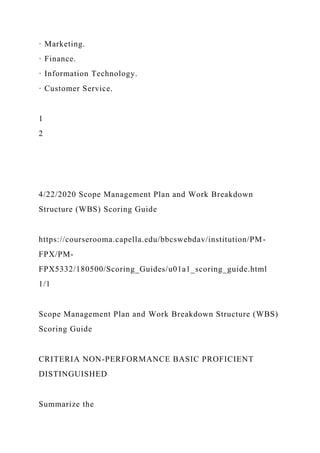
· Marketing.
· Finance.
· Information Technology.
· Customer Service.
1
2
4/22/2020 Scope Management Plan and Work Breakdown
Structure (WBS) Scoring Guide
https://courserooma.capella.edu/bbcswebdav/institution/PM-
FPX/PM-
FPX5332/180500/Scoring_Guides/u01a1_scoring_guide.html
1/1
Scope Management Plan and Work Breakdown Structure (WBS)
Scoring Guide
CRITERIA NON-PERFORMANCE BASIC PROFICIENT
DISTINGUISHED
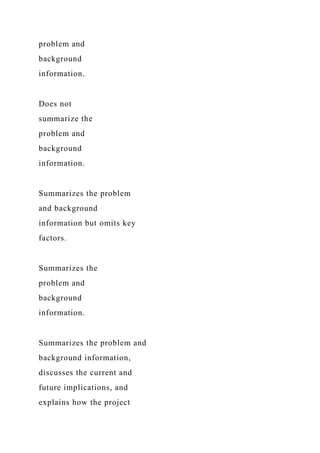
Summarize the
problem and
background
information.
Does not
summarize the
problem and
background
information.
Summarizes the problem
and background
information but omits key
factors.
Summarizes the
problem and
background
information.
Summarizes the problem and
background information,
discusses the current and
future implications, and
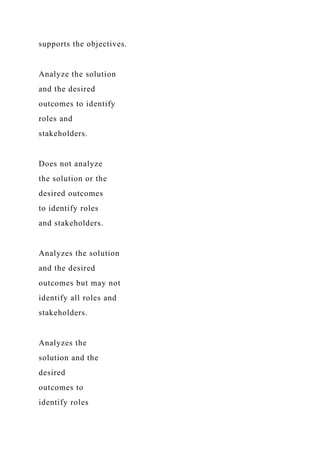
explains how the project
supports the objectives.
Analyze the solution
and the desired
outcomes to identify
roles and
stakeholders.
Does not analyze
the solution or the
desired outcomes
to identify roles
and stakeholders.
Analyzes the solution
and the desired
outcomes but may not
identify all roles and
stakeholders.
Analyzes the
solution and the
desired
outcomes to
identify roles
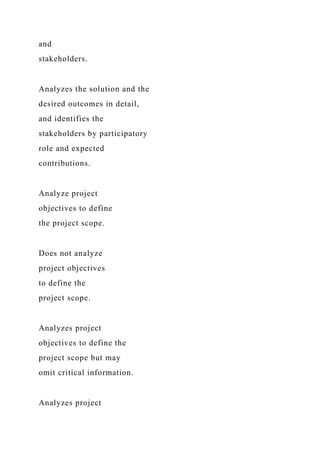
and
stakeholders.
Analyzes the solution and the
desired outcomes in detail,
and identifies the
stakeholders by participatory
role and expected
contributions.
Analyze project
objectives to define
the project scope.
Does not analyze
project objectives
to define the
project scope.
Analyzes project
objectives to define the
project scope but may
omit critical information.
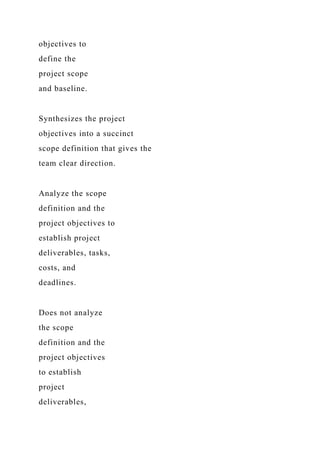
Analyzes project
objectives to
define the
project scope
and baseline.
Synthesizes the project
objectives into a succinct
scope definition that gives the
team clear direction.
Analyze the scope
definition and the
project objectives to
establish project
deliverables, tasks,
costs, and
deadlines.
Does not analyze
the scope
definition and the
project objectives
to establish
project
deliverables,
tasks, costs, and
deadlines.
Analyzes the scope
definition and the project
objectives to establish
project deliverables,
however, tasks, costs,
and deadlines may not
be clearly defined.
Analyzes the
scope definition
and the project
objectives to
establish project
deliverables,
tasks, costs,
and deadlines.
Analyze the scope definition
and the project objectives to
establish clearly defined
costs and deadlines;
deliverables and tasks are
defined by order of
importance and role.
Analyze project
roles,
responsibilities, and
reporting
relationships to
create a staffing
management plan
and WBS diagram.
Does not analyze
project roles,
responsibilities,
and reporting
relationships to
create a staffing
management
plan and WBS
diagram.
Analyzes project roles,
responsibilities, and
reporting relationships,
and creates a staffing
management plan and a
WBS diagram, but the
plan or diagram contains
errors or omissions.
Analyzes project
roles,
responsibilities,
and reporting
relationships to
create a staffing
management
plan and WBS
diagram.
Synthesizes project roles,
responsibilities, and reporting
relationships to create a
staffing management plan
and WBS diagram in a
cohesive document that
establishes clear
accountability and maximum
flexibility.
Requirements
Microsoft Project is the recommended software tool for this
course due to its wide industry acceptance and its use in many
project management professional roles. If you have not already
done so, follow the instructions provided through the links
below to download and install software or register for an
account, as required.
1. If you have a Capella MS Imagine account, go to Step 2.
Otherwise, see the instructions for registering an account at MS
Imagine – Registration.
2. Log into the Capella Microsoft Imagine WebStore.
3. Identify the version of MS Project that is compatible with
your operating system.
4. Download and install.
If you encounter any difficulties in the download and
installation process, post a detailed question in the Ask Your
Faculty Discussion in the menu dropdown when you click the
image of your faculty. They should be able to help you or point
you in the right direction for the answers you need.
Using Project in this course helps prepare you for future
professional PM roles and responsibilities. Please use Project
for tasks the software supports. If you have access to other tools
such as Microsoft Visio, PowerPoint, and Word, or other project
management software you believe may still meet the
requirements of this course, please discuss your selected
alternative with faculty.
Part 1: Scope Management Plan
Using the PMBOK® Guide and the Project Scope Statement
Template [DOC], develop your Project Scope Management Plan,
including the following:
1. Executive Summary – Provides a brief overview of this
project (for example, project purpose and justification):
. Organization.
. Specific problems with quantitative metrics.
. Overall solutions.
. High-level timeframe.
. High-level budget.
. Known risks and impacts.
· Business Objectives – Ensures traceability in the project.
Business goals and objectives are linked back to the vision, and
each project objective is also linked to the business vision.
Business objectives—the business measures of project
success—relate to cost, time, and quality. Examples include:
. "Increase productivity by 30 percent."
. "Lower costs by 15 percent."
. "Reduce regulatory fees by $1 million."
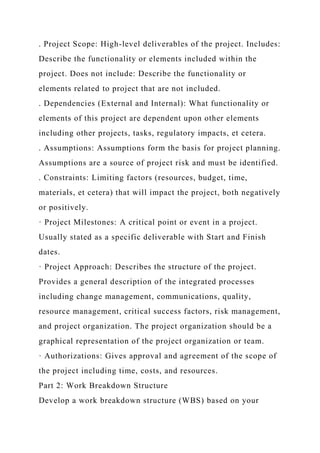
· Project Description – Describes the proposed solution and
helps define how the project supports the business objectives.
. Project Scope: High-level deliverables of the project. Includes:
Describe the functionality or elements included within the
project. Does not include: Describe the functionality or
elements related to project that are not included.
. Dependencies (External and Internal): What functionality or
elements of this project are dependent upon other elements
including other projects, tasks, regulatory impacts, et cetera.
. Assumptions: Assumptions form the basis for project planning.
Assumptions are a source of project risk and must be identified.
. Constraints: Limiting factors (resources, budget, time,
materials, et cetera) that will impact the project, both negatively
or positively.
· Project Milestones: A critical point or event in a project.
Usually stated as a specific deliverable with Start and Finish
dates.
· Project Approach: Describes the structure of the project.
Provides a general description of the integrated processes
including change management, communications, quality,
resource management, critical success factors, risk management,
and project organization. The project organization should be a
graphical representation of the project organization or team.
· Authorizations: Gives approval and agreement of the scope of
the project including time, costs, and resources.
Part 2: Work Breakdown Structure
Develop a work breakdown structure (WBS) based on your
selected project. Your WBS should:
· Include, at a minimum, four levels.
· Be independent of or minimally interfacing with other
dependent elements.
· Be integrated so the total project can be understood.
· Be measurable, in terms of progress.
Preparation
Use the software of your choice to develop the deliverables for
this assessment.
This assessment has two parts and two deliverables:
1. Part A – Using the Project Scope Statement Template [DOC],
include the following in your Project Scope Management Plan.
2. Part B – Work Breakdown Structure (WBS):
. Develop a work breakdown schedule. This includes an
introduction and graphical representation of the totality of work
identified in the Project Scope. Note:You may create graphical
examples in Microsoft Word, PowerPoint, or Visio and save
them as a GIF or graphical image.
. Analyze project roles, responsibilities, and reporting
relationships to develop a staffing management plan.
Deliverable Format
· References: Use scholarly or academic sources where
applicable. There is no set number of references required for
this assessment.
· Format:
. Use the provided Project Scope Statement Template [DOC].
. Use Microsoft Word, Visio, or Powerpoint to develop the WBS
document
. Follow the corresponding Academic and Professional
Document Guidelines, including single-spaced paragraphs. The
Project Scope and WBS are professional documents.
. Use APA style and format for references and in-text citations.
· Length: Utilize the template, including the title page and
References page.

[Insert project title, e.g. Cosmo Inc.”] Project Scope State.docx

  • 1.
    [Insert project title,e.g. “Cosmo Inc.”]: Project Scope Statement[Insert learner name]Capella UniversityProject Scope Statement Note: Any work not explicitly included in the Project Scope Statement is implicitly excluded from the project. Project Name Prepared By Date (MM/DD/YYYY)Version History (insert rows as needed):VersionDateComments 1.0 1. Executive Summary Provide below a brief overview of this project (for example, project purpose and justification). Note: In any instance where there is a discrepancy between the Project Charter and the Project Scope Statement, the latter is
  • 2.
    considered authoritative.2. BusinessObjectives2.1 Product Description ( Solution ) 2.2 Business Objectives 3. Project Description For each area below, provide sufficient detail to define this project adequately.3.1 Project Scope Includes (list deliverables): Does not include: 3.2 Dependencies (External and Internal) 3.3 Assumptions 3.4 Constraints 4. Project MilestonesTarget Date Project Start
  • 3.
    Project Complete 5. ProjectApproach Briefly describe how each of the following will be handled. Provide links to relevant documents as appropriate. 5.1 Change Management 5.2 Communication Management 5.3 Quality Management 5.4 Resource Management 5.5 Critical Success Factors 5.6 Risk Management 5.7 Project Organization 6. AuthorizationsThe Project Scope Statement is approved by the: Project Sponsor Project Manager Project performance baseline changes will be approved by the:
  • 4.
    Project Sponsor Project Manager Projectdeliverables will be approved and accepted by the: Project Sponsor Key Stakeholders 7. Project Scope Statement ApprovalProject Name Project Manager The purpose of this document is to provide a vehicle for documenting the initial planning efforts for the project. It is used to reach a satisfactory level of mutual agreement between the Project Manager and the Project Sponsors and Owners with respect to the objectives and scope of the project before significant resources are committed and expenses incurred. I have reviewed the information contained in this Project Scope Statement and agree:NameRoleSignatureDate
  • 5.
    The signatures aboveindicate an understanding of the purpose and content of this document by those signing it. By signing this document, they agree to this as the formal Project Scope Statement document. References
  • 6.
    2 PM5018 Business Case PM5018Business CaseCosmo, Inc. Cosmo, Inc. is a leader in the development and distribution of wearable technology, including fitness coaching, nutritional coaching, and lifestyle advising products. The company holds a 33-percent market share in the wearable technology category. After doing marketing analysis, senior leadership realizes the onset of competition could negatively impact future earnings. CEO and President Harold Living tells his leadership Cosmo, Inc. needs a new marketing strategy to not only increase market share but to maintain current levels. Based on data analytics, Cosmo decides to incorporate technology trends into the company’s strategic marketing, including: · Internet of Things (IoT). · Digital services. · Data analytics. · The mobile technology movement.
  • 7.
    Living selects atask force to review Cosmo, Inc. and their competitors’ data analytic reports to recommend a new strategy. Customer Demographics Demographics include but are not limited to: · Ages 25–50. · College educated. · Annual income greater than $75,000. · Residents in cities with population greater than 500,000. · Technology savvy. · Utilize mobile technology at work and home. · Utilize Cloud technology at work and home.Marketing Campaign Strategy Objectives The campaign’s goals are as follows: · Develop a marketing campaign strategy to increase production of wearable technology by 25 percent. · Increase customer base by 20 percent by identifying unknown customer segmentations based on age, demographics, income, education, and technology. · Utilize current technologies, including social media and data analytics, for predictive analytics to identify known and unknown customer segments. · Become a leading competitor in wearable technologies.
  • 8.
    · Become aleading competitor using trending technologies, including IoT, mobile technology, and artificial intelligence applications. · Integrate technology into current ERP and Marketing systems to create an improved digital business of the future and to deliver and support products to improve the customer experience and “mesh” embedded services of people, devices, and content. · Develop and implement a new process within the Customer Service department to establish new-product support services. · Meet current and future neutrality regulations. Project Specifics Details about the project include but are not limited to: · Timeframe: 10 weeks. · Budget: $150,000. · Campaign length: 6 months. · Measurement: Performance reports to be developed in order to monitor the increase in customers and customer satisfaction rates. · Departments involved:
  • 9.
    · Marketing. · Finance. ·Information Technology. · Customer Service. 1 2 4/22/2020 Scope Management Plan and Work Breakdown Structure (WBS) Scoring Guide https://courserooma.capella.edu/bbcswebdav/institution/PM- FPX/PM- FPX5332/180500/Scoring_Guides/u01a1_scoring_guide.html 1/1 Scope Management Plan and Work Breakdown Structure (WBS) Scoring Guide CRITERIA NON-PERFORMANCE BASIC PROFICIENT DISTINGUISHED Summarize the
  • 10.
    problem and background information. Does not summarizethe problem and background information. Summarizes the problem and background information but omits key factors. Summarizes the problem and background information. Summarizes the problem and background information, discusses the current and future implications, and explains how the project
  • 11.
    supports the objectives. Analyzethe solution and the desired outcomes to identify roles and stakeholders. Does not analyze the solution or the desired outcomes to identify roles and stakeholders. Analyzes the solution and the desired outcomes but may not identify all roles and stakeholders. Analyzes the solution and the desired outcomes to identify roles
  • 12.
    and stakeholders. Analyzes the solutionand the desired outcomes in detail, and identifies the stakeholders by participatory role and expected contributions. Analyze project objectives to define the project scope. Does not analyze project objectives to define the project scope. Analyzes project objectives to define the project scope but may omit critical information. Analyzes project
  • 13.
    objectives to define the projectscope and baseline. Synthesizes the project objectives into a succinct scope definition that gives the team clear direction. Analyze the scope definition and the project objectives to establish project deliverables, tasks, costs, and deadlines. Does not analyze the scope definition and the project objectives to establish project deliverables,
  • 14.
    tasks, costs, and deadlines. Analyzesthe scope definition and the project objectives to establish project deliverables, however, tasks, costs, and deadlines may not be clearly defined. Analyzes the scope definition and the project objectives to establish project deliverables, tasks, costs, and deadlines. Analyze the scope definition and the project objectives to establish clearly defined costs and deadlines; deliverables and tasks are
  • 15.
    defined by orderof importance and role. Analyze project roles, responsibilities, and reporting relationships to create a staffing management plan and WBS diagram. Does not analyze project roles, responsibilities, and reporting relationships to create a staffing management plan and WBS diagram. Analyzes project roles, responsibilities, and reporting relationships,
  • 16.
    and creates astaffing management plan and a WBS diagram, but the plan or diagram contains errors or omissions. Analyzes project roles, responsibilities, and reporting relationships to create a staffing management plan and WBS diagram. Synthesizes project roles, responsibilities, and reporting relationships to create a staffing management plan and WBS diagram in a cohesive document that establishes clear accountability and maximum flexibility.
  • 17.
    Requirements Microsoft Project isthe recommended software tool for this course due to its wide industry acceptance and its use in many project management professional roles. If you have not already done so, follow the instructions provided through the links below to download and install software or register for an account, as required. 1. If you have a Capella MS Imagine account, go to Step 2. Otherwise, see the instructions for registering an account at MS Imagine – Registration. 2. Log into the Capella Microsoft Imagine WebStore. 3. Identify the version of MS Project that is compatible with your operating system. 4. Download and install. If you encounter any difficulties in the download and installation process, post a detailed question in the Ask Your Faculty Discussion in the menu dropdown when you click the image of your faculty. They should be able to help you or point you in the right direction for the answers you need. Using Project in this course helps prepare you for future professional PM roles and responsibilities. Please use Project for tasks the software supports. If you have access to other tools such as Microsoft Visio, PowerPoint, and Word, or other project
  • 18.
    management software youbelieve may still meet the requirements of this course, please discuss your selected alternative with faculty. Part 1: Scope Management Plan Using the PMBOK® Guide and the Project Scope Statement Template [DOC], develop your Project Scope Management Plan, including the following: 1. Executive Summary – Provides a brief overview of this project (for example, project purpose and justification): . Organization. . Specific problems with quantitative metrics. . Overall solutions. . High-level timeframe. . High-level budget. . Known risks and impacts. · Business Objectives – Ensures traceability in the project. Business goals and objectives are linked back to the vision, and each project objective is also linked to the business vision. Business objectives—the business measures of project success—relate to cost, time, and quality. Examples include: . "Increase productivity by 30 percent." . "Lower costs by 15 percent." . "Reduce regulatory fees by $1 million." · Project Description – Describes the proposed solution and helps define how the project supports the business objectives.
  • 19.
    . Project Scope:High-level deliverables of the project. Includes: Describe the functionality or elements included within the project. Does not include: Describe the functionality or elements related to project that are not included. . Dependencies (External and Internal): What functionality or elements of this project are dependent upon other elements including other projects, tasks, regulatory impacts, et cetera. . Assumptions: Assumptions form the basis for project planning. Assumptions are a source of project risk and must be identified. . Constraints: Limiting factors (resources, budget, time, materials, et cetera) that will impact the project, both negatively or positively. · Project Milestones: A critical point or event in a project. Usually stated as a specific deliverable with Start and Finish dates. · Project Approach: Describes the structure of the project. Provides a general description of the integrated processes including change management, communications, quality, resource management, critical success factors, risk management, and project organization. The project organization should be a graphical representation of the project organization or team. · Authorizations: Gives approval and agreement of the scope of the project including time, costs, and resources. Part 2: Work Breakdown Structure Develop a work breakdown structure (WBS) based on your
  • 20.
    selected project. YourWBS should: · Include, at a minimum, four levels. · Be independent of or minimally interfacing with other dependent elements. · Be integrated so the total project can be understood. · Be measurable, in terms of progress. Preparation Use the software of your choice to develop the deliverables for this assessment. This assessment has two parts and two deliverables: 1. Part A – Using the Project Scope Statement Template [DOC], include the following in your Project Scope Management Plan. 2. Part B – Work Breakdown Structure (WBS): . Develop a work breakdown schedule. This includes an introduction and graphical representation of the totality of work identified in the Project Scope. Note:You may create graphical examples in Microsoft Word, PowerPoint, or Visio and save them as a GIF or graphical image. . Analyze project roles, responsibilities, and reporting relationships to develop a staffing management plan. Deliverable Format · References: Use scholarly or academic sources where applicable. There is no set number of references required for this assessment. · Format:
  • 21.
    . Use theprovided Project Scope Statement Template [DOC]. . Use Microsoft Word, Visio, or Powerpoint to develop the WBS document . Follow the corresponding Academic and Professional Document Guidelines, including single-spaced paragraphs. The Project Scope and WBS are professional documents. . Use APA style and format for references and in-text citations. · Length: Utilize the template, including the title page and References page.