Faculty of Engineering
Ain Shams University
Mohammed Ibrahim
3/10/2017 1
MDP: Mechatronics (2)
Lecture 04:
Actuator Selection
Mini-Project Next Week Submission Plan
Mini project submission plan
Wk # Task Submission Date by
email
5 Report contents
1. Project problem
2. System requirements
3. Conceptual design and brainstorming for finding solutions and
ideas for the project problem
4. Evaluating and decision making for best solutions
5. System design and layout
15/03/2017
Submitted by email to:
1- Dr. Shady: shady_ahmed87@hotmail.com
2- Eng. Kerollois: k.nashaat.kn@gmail.com
3- Mohammed Ibrahim: mohammed.awad@eng.asu.edu.eg
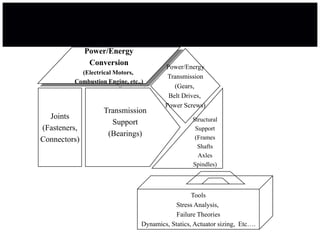
Power/Energy
Conversion
(Electrical Motors,
Combustion Engine, etc..)
Power/Energy
Transmission
(Gears,
Belt Drives,
Power Screws)
Transmission
Support
(Bearings)
Joints
(Fasteners,
Connectors)
Structural
Support
(Frames
Shafts
Axles
Spindles)
Tools
Stress Analysis,
Failure Theories
Dynamics, Statics, Actuator sizing, Etc….
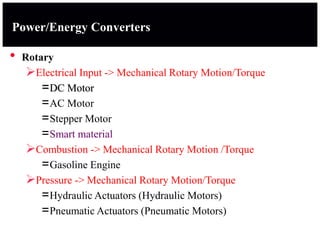
Power/Energy Converters
• Rotary
Electrical Input -> Mechanical Rotary Motion/Torque
=DC Motor
=AC Motor
=Stepper Motor
=Smart material
Combustion -> Mechanical Rotary Motion /Torque
=Gasoline Engine
Pressure -> Mechanical Rotary Motion/Torque
=Hydraulic Actuators (Hydraulic Motors)
=Pneumatic Actuators (Pneumatic Motors)
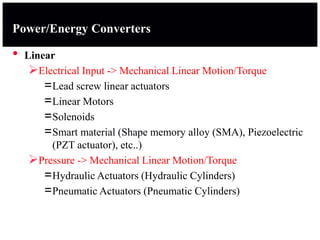
Power/Energy Converters
• Linear
Electrical Input -> Mechanical Linear Motion/Torque
=Lead screw linear actuators
=Linear Motors
=Solenoids
=Smart material (Shape memory alloy (SMA), Piezoelectric
(PZT actuator), etc..)
Pressure -> Mechanical Linear Motion/Torque
=Hydraulic Actuators (Hydraulic Cylinders)
=Pneumatic Actuators (Pneumatic Cylinders)
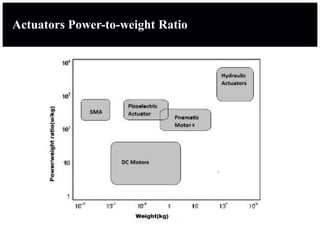
Actuators Power-to-weight Ratio
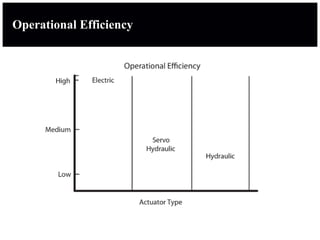
Operational Efficiency
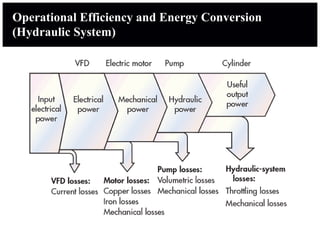
Operational Efficiency and Energy Conversion
(Hydraulic System)
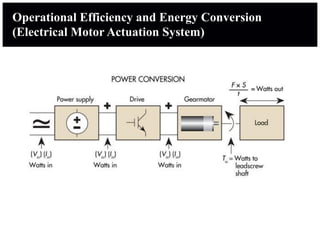
Operational Efficiency and Energy Conversion
(Electrical Motor Actuation System)
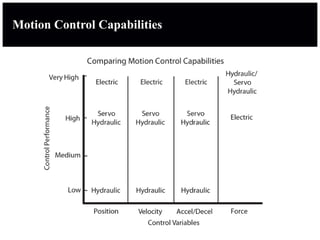
Motion Control Capabilities
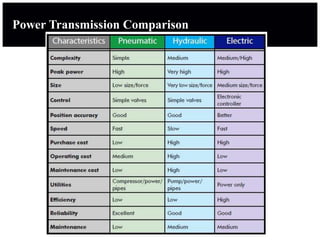
Power Transmission Comparison
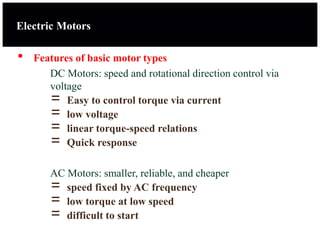
• Features of basic motor types
DC Motors: speed and rotational direction control via
voltage
= Easy to control torque via current
= low voltage
= linear torque-speed relations
= Quick response
AC Motors: smaller, reliable, and cheaper
= speed fixed by AC frequency
= low torque at low speed
= difficult to start
Electric Motors
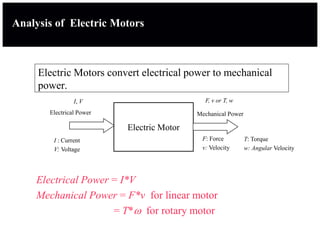
Analysis of Electric Motors
Electric Motors convert electrical power to mechanical
power.
Electric Motor
Electrical Power
I, V
Mechanical Power
F, v or T, w
I : Current
V: Voltage
F: Force
v: Velocity
T: Torque
w: Angular Velocity
Electrical Power = I*V
Mechanical Power = F*v for linear motor
= T*w for rotary motor
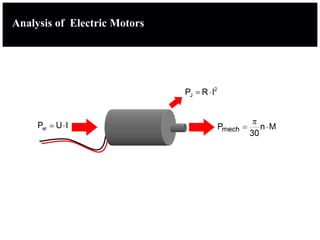
Analysis of Electric Motors
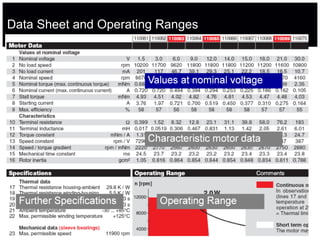
Data Sheet and Operating Ranges
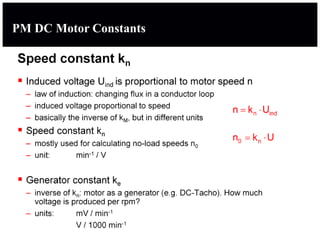
PM DC Motor Constants
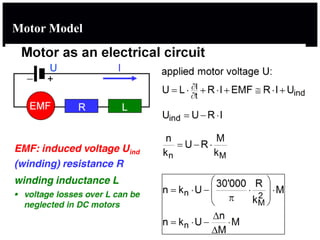
Motor Model
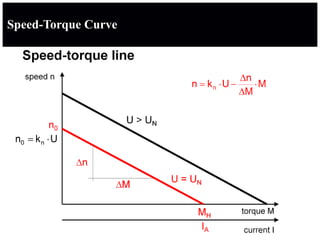
Speed-Torque Curve
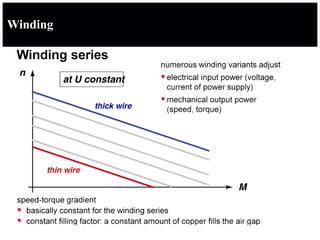
Winding
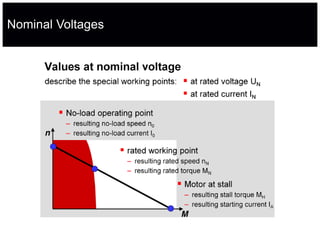
Nominal Voltages
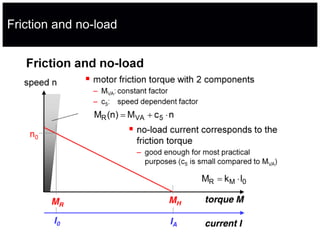
Friction and no-load
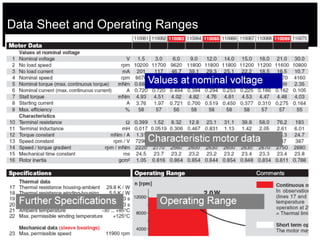
Data Sheet and Operating Ranges
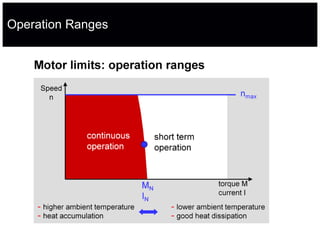
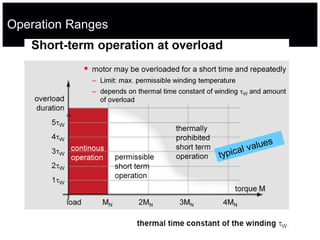
Operation Ranges
Operation Ranges
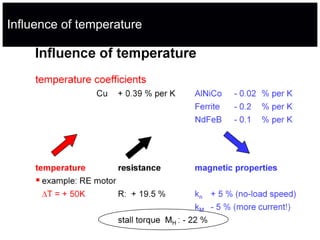
Influence of temperature
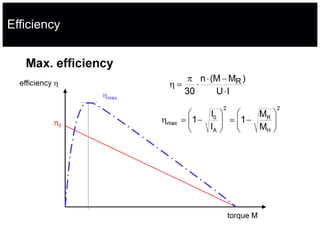
Efficiency
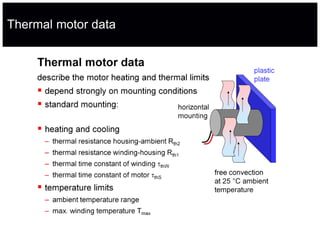
Thermal motor data
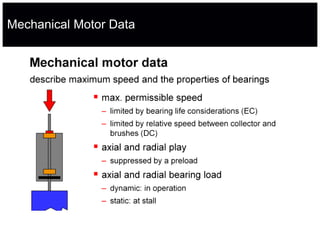
Mechanical Motor Data
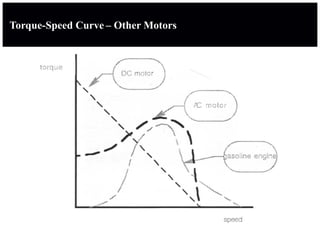
Torque-Speed Curve – Other Motors
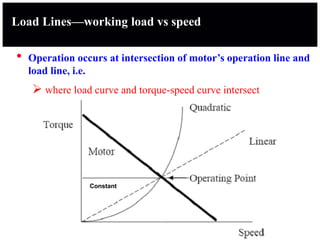
• Operation occurs at intersection of motor’s operation line and
load line, i.e.
 where load curve and torque-speed curve intersect
Constant
Load Lines—working load vs speed
Operating
Two main operations regions:
I. Start Up Torque
Torque required to change speed in a motor.
=Normally used for starting a motor from a dead stop.
=Inertia and required response time is important.
II. Operating Torque
Torque required to operate motor at constant speed.
=Since motor is operating at a constant speed, inertia is
not as important as the driven load.
Operating Torque Example
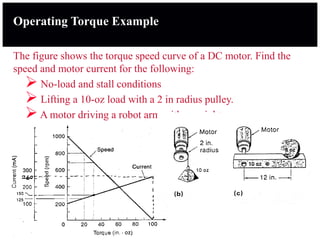
The figure shows the torque speed curve of a DC motor. Find the
speed and motor current for the following:
 No-load and stall conditions
 Lifting a 10-oz load with a 2 in radius pulley.
A motor driving a robot arm with a weight.
Operating Torque Example – Solution
(a)
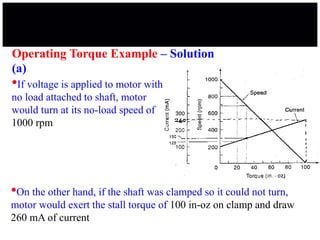
•If voltage is applied to motor with
no load attached to shaft, motor
would turn at its no-load speed of
1000 rpm
•On the other hand, if the shaft was clamped so it could not turn,
motor would exert the stall torque of 100 in-oz on clamp and draw
260 mA of current
Operating Torque Example – Solution
(b)
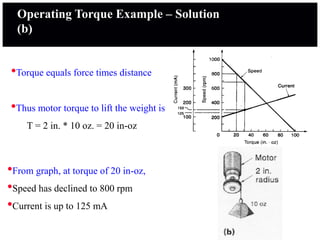
•Torque equals force times distance
•Thus motor torque to lift the weight is
T = 2 in. * 10 oz. = 20 in-oz
•From graph, at torque of 20 in-oz,
•Speed has declined to 800 rpm
•Current is up to 125 mA
Operating Torque Example – Solution
(c)
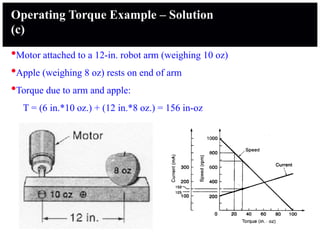
•Motor attached to a 12-in. robot arm (weighing 10 oz)
•Apple (weighing 8 oz) rests on end of arm
•Torque due to arm and apple:
T = (6 in.*10 oz.) + (12 in.*8 oz.) = 156 in-oz
Operating Torque Example – Solution
(c)
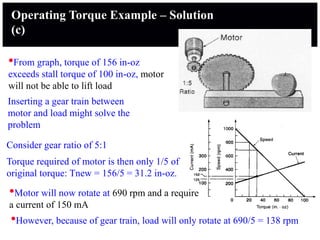
•From graph, torque of 156 in-oz
exceeds stall torque of 100 in-oz, motor
will not be able to lift load
Consider gear ratio of 5:1
Torque required of motor is then only 1/5 of
original torque: Tnew = 156/5 = 31.2 in-oz.
Inserting a gear train between
motor and load might solve the
problem
•Motor will now rotate at 690 rpm and a require
a current of 150 mA
•However, because of gear train, load will only rotate at 690/5 = 138 rpm
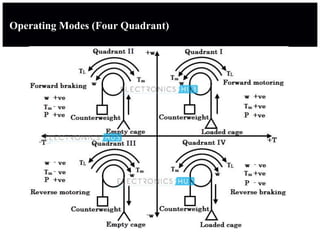
Operating Modes (Four Quadrant)
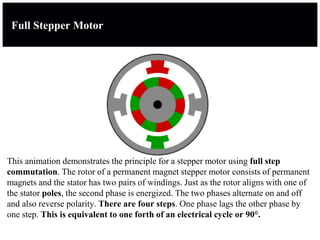
Full Stepper Motor
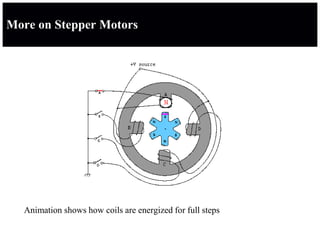
This animation demonstrates the principle for a stepper motor using full step
commutation. The rotor of a permanent magnet stepper motor consists of permanent
magnets and the stator has two pairs of windings. Just as the rotor aligns with one of
the stator poles, the second phase is energized. The two phases alternate on and off
and also reverse polarity. There are four steps. One phase lags the other phase by
one step. This is equivalent to one forth of an electrical cycle or 90°.
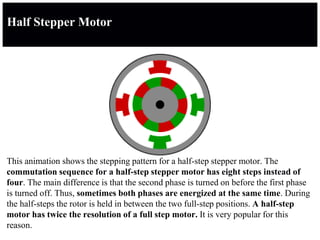
Half Stepper Motor
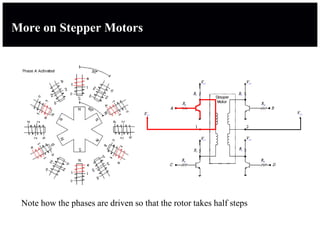
This animation shows the stepping pattern for a half-step stepper motor. The
commutation sequence for a half-step stepper motor has eight steps instead of
four. The main difference is that the second phase is turned on before the first phase
is turned off. Thus, sometimes both phases are energized at the same time. During
the half-steps the rotor is held in between the two full-step positions. A half-step
motor has twice the resolution of a full step motor. It is very popular for this
reason.
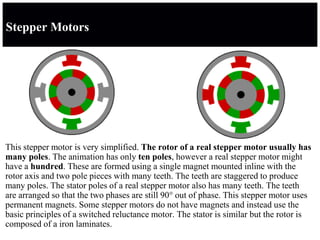
Stepper Motors
This stepper motor is very simplified. The rotor of a real stepper motor usually has
many poles. The animation has only ten poles, however a real stepper motor might
have a hundred. These are formed using a single magnet mounted inline with the
rotor axis and two pole pieces with many teeth. The teeth are staggered to produce
many poles. The stator poles of a real stepper motor also has many teeth. The teeth
are arranged so that the two phases are still 90° out of phase. This stepper motor uses
permanent magnets. Some stepper motors do not have magnets and instead use the
basic principles of a switched reluctance motor. The stator is similar but the rotor is
composed of a iron laminates.
More on Stepper Motors
Note how the phases are driven so that the rotor takes half steps
More on Stepper Motors
Animation shows how coils are energized for full steps
More on Stepper Motors
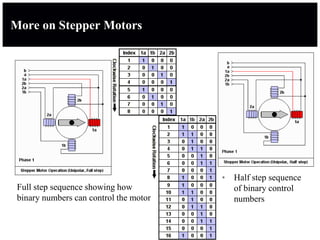
Full step sequence showing how
binary numbers can control the motor
• Half step sequence
of binary control
numbers
Stepper Motor Applications
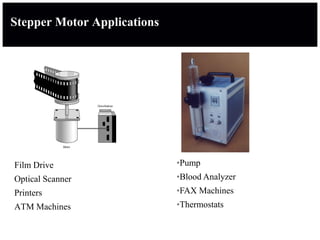
Film Drive
Optical Scanner
Printers
ATM Machines
•Pump
•Blood Analyzer
•FAX Machines
•Thermostats
Stepper Motor Characteristics
Open loop
The motors response to digital input pulses provides open-loop
control, making the motor simpler and less costly to control.
Brushless
Very reliable since there are no contact brushes in the motor.
Therefore the life of the motor is simply dependant on the life of the
bearing.
Incremental steps/changes
The rotation angle of the motor is proportional to the input pulse.
Speed increases -> torque decreases
Disadvantages of stepper motors
There are two main disadvantages of stepper motors:
 Resonance can occur if not properly controlled.
This can be seen as a sudden loss or drop in torque at certain speeds which can result in
missed steps or loss of synchronism. It occurs when the input step pulse rate coincides with
the natural oscillation frequency of the rotor. Resonance can be minimised by using half
stepping or microstepping.
 Not easy to operate at extremely high speeds.
46
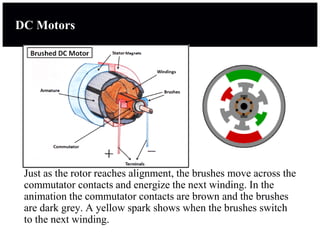
DC Motors
Just as the rotor reaches alignment, the brushes move across the
commutator contacts and energize the next winding. In the
animation the commutator contacts are brown and the brushes
are dark grey. A yellow spark shows when the brushes switch
to the next winding.
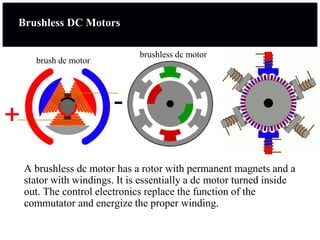
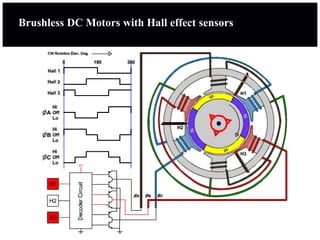
Brushless DC Motors
A brushless dc motor has a rotor with permanent magnets and a
stator with windings. It is essentially a dc motor turned inside
out. The control electronics replace the function of the
commutator and energize the proper winding.
brush dc motor
brushless dc motor
Brushless DC Motors with Hall effect sensors
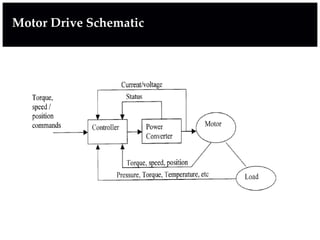
Motor Drive Schematic
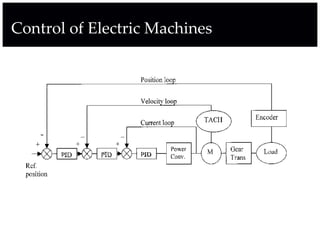
Control of Electric Machines
Questions
Questions
3/10/2017 52

Lec 04(actuators).pdf

  • 1.
    Faculty of Engineering AinShams University Mohammed Ibrahim 3/10/2017 1 MDP: Mechatronics (2) Lecture 04: Actuator Selection
  • 2.
    Mini-Project Next WeekSubmission Plan Mini project submission plan Wk # Task Submission Date by email 5 Report contents 1. Project problem 2. System requirements 3. Conceptual design and brainstorming for finding solutions and ideas for the project problem 4. Evaluating and decision making for best solutions 5. System design and layout 15/03/2017 Submitted by email to: 1- Dr. Shady: shady_ahmed87@hotmail.com 2- Eng. Kerollois: k.nashaat.kn@gmail.com 3- Mohammed Ibrahim: mohammed.awad@eng.asu.edu.eg
  • 3.
    Power/Energy Conversion (Electrical Motors, Combustion Engine,etc..) Power/Energy Transmission (Gears, Belt Drives, Power Screws) Transmission Support (Bearings) Joints (Fasteners, Connectors) Structural Support (Frames Shafts Axles Spindles) Tools Stress Analysis, Failure Theories Dynamics, Statics, Actuator sizing, Etc….
  • 4.
    Power/Energy Converters • Rotary ElectricalInput -> Mechanical Rotary Motion/Torque =DC Motor =AC Motor =Stepper Motor =Smart material Combustion -> Mechanical Rotary Motion /Torque =Gasoline Engine Pressure -> Mechanical Rotary Motion/Torque =Hydraulic Actuators (Hydraulic Motors) =Pneumatic Actuators (Pneumatic Motors)
  • 5.
    Power/Energy Converters • Linear ElectricalInput -> Mechanical Linear Motion/Torque =Lead screw linear actuators =Linear Motors =Solenoids =Smart material (Shape memory alloy (SMA), Piezoelectric (PZT actuator), etc..) Pressure -> Mechanical Linear Motion/Torque =Hydraulic Actuators (Hydraulic Cylinders) =Pneumatic Actuators (Pneumatic Cylinders)
  • 6.
  • 7.
  • 8.
    Operational Efficiency andEnergy Conversion (Hydraulic System)
  • 9.
    Operational Efficiency andEnergy Conversion (Electrical Motor Actuation System)
  • 10.
  • 11.
  • 12.
    • Features ofbasic motor types DC Motors: speed and rotational direction control via voltage = Easy to control torque via current = low voltage = linear torque-speed relations = Quick response AC Motors: smaller, reliable, and cheaper = speed fixed by AC frequency = low torque at low speed = difficult to start Electric Motors
  • 13.
    Analysis of ElectricMotors Electric Motors convert electrical power to mechanical power. Electric Motor Electrical Power I, V Mechanical Power F, v or T, w I : Current V: Voltage F: Force v: Velocity T: Torque w: Angular Velocity Electrical Power = I*V Mechanical Power = F*v for linear motor = T*w for rotary motor
  • 14.
  • 15.
    Data Sheet andOperating Ranges
  • 16.
    PM DC MotorConstants
  • 17.
  • 18.
  • 19.
  • 20.
  • 21.
  • 22.
    Data Sheet andOperating Ranges
  • 23.
  • 24.
  • 25.
  • 26.
  • 27.
  • 28.
  • 29.
  • 30.
    • Operation occursat intersection of motor’s operation line and load line, i.e.  where load curve and torque-speed curve intersect Constant Load Lines—working load vs speed
  • 31.
    Operating Two main operationsregions: I. Start Up Torque Torque required to change speed in a motor. =Normally used for starting a motor from a dead stop. =Inertia and required response time is important. II. Operating Torque Torque required to operate motor at constant speed. =Since motor is operating at a constant speed, inertia is not as important as the driven load.
  • 32.
    Operating Torque Example Thefigure shows the torque speed curve of a DC motor. Find the speed and motor current for the following:  No-load and stall conditions  Lifting a 10-oz load with a 2 in radius pulley. A motor driving a robot arm with a weight.
  • 33.
    Operating Torque Example– Solution (a) •If voltage is applied to motor with no load attached to shaft, motor would turn at its no-load speed of 1000 rpm •On the other hand, if the shaft was clamped so it could not turn, motor would exert the stall torque of 100 in-oz on clamp and draw 260 mA of current
  • 34.
    Operating Torque Example– Solution (b) •Torque equals force times distance •Thus motor torque to lift the weight is T = 2 in. * 10 oz. = 20 in-oz •From graph, at torque of 20 in-oz, •Speed has declined to 800 rpm •Current is up to 125 mA
  • 35.
    Operating Torque Example– Solution (c) •Motor attached to a 12-in. robot arm (weighing 10 oz) •Apple (weighing 8 oz) rests on end of arm •Torque due to arm and apple: T = (6 in.*10 oz.) + (12 in.*8 oz.) = 156 in-oz
  • 36.
    Operating Torque Example– Solution (c) •From graph, torque of 156 in-oz exceeds stall torque of 100 in-oz, motor will not be able to lift load Consider gear ratio of 5:1 Torque required of motor is then only 1/5 of original torque: Tnew = 156/5 = 31.2 in-oz. Inserting a gear train between motor and load might solve the problem •Motor will now rotate at 690 rpm and a require a current of 150 mA •However, because of gear train, load will only rotate at 690/5 = 138 rpm
  • 37.
  • 38.
    Full Stepper Motor Thisanimation demonstrates the principle for a stepper motor using full step commutation. The rotor of a permanent magnet stepper motor consists of permanent magnets and the stator has two pairs of windings. Just as the rotor aligns with one of the stator poles, the second phase is energized. The two phases alternate on and off and also reverse polarity. There are four steps. One phase lags the other phase by one step. This is equivalent to one forth of an electrical cycle or 90°.
  • 39.
    Half Stepper Motor Thisanimation shows the stepping pattern for a half-step stepper motor. The commutation sequence for a half-step stepper motor has eight steps instead of four. The main difference is that the second phase is turned on before the first phase is turned off. Thus, sometimes both phases are energized at the same time. During the half-steps the rotor is held in between the two full-step positions. A half-step motor has twice the resolution of a full step motor. It is very popular for this reason.
  • 40.
    Stepper Motors This steppermotor is very simplified. The rotor of a real stepper motor usually has many poles. The animation has only ten poles, however a real stepper motor might have a hundred. These are formed using a single magnet mounted inline with the rotor axis and two pole pieces with many teeth. The teeth are staggered to produce many poles. The stator poles of a real stepper motor also has many teeth. The teeth are arranged so that the two phases are still 90° out of phase. This stepper motor uses permanent magnets. Some stepper motors do not have magnets and instead use the basic principles of a switched reluctance motor. The stator is similar but the rotor is composed of a iron laminates.
  • 41.
    More on StepperMotors Note how the phases are driven so that the rotor takes half steps
  • 42.
    More on StepperMotors Animation shows how coils are energized for full steps
  • 43.
    More on StepperMotors Full step sequence showing how binary numbers can control the motor • Half step sequence of binary control numbers
  • 44.
    Stepper Motor Applications FilmDrive Optical Scanner Printers ATM Machines •Pump •Blood Analyzer •FAX Machines •Thermostats
  • 45.
    Stepper Motor Characteristics Openloop The motors response to digital input pulses provides open-loop control, making the motor simpler and less costly to control. Brushless Very reliable since there are no contact brushes in the motor. Therefore the life of the motor is simply dependant on the life of the bearing. Incremental steps/changes The rotation angle of the motor is proportional to the input pulse. Speed increases -> torque decreases
  • 46.
    Disadvantages of steppermotors There are two main disadvantages of stepper motors:  Resonance can occur if not properly controlled. This can be seen as a sudden loss or drop in torque at certain speeds which can result in missed steps or loss of synchronism. It occurs when the input step pulse rate coincides with the natural oscillation frequency of the rotor. Resonance can be minimised by using half stepping or microstepping.  Not easy to operate at extremely high speeds. 46
  • 47.
    DC Motors Just asthe rotor reaches alignment, the brushes move across the commutator contacts and energize the next winding. In the animation the commutator contacts are brown and the brushes are dark grey. A yellow spark shows when the brushes switch to the next winding.
  • 48.
    Brushless DC Motors Abrushless dc motor has a rotor with permanent magnets and a stator with windings. It is essentially a dc motor turned inside out. The control electronics replace the function of the commutator and energize the proper winding. brush dc motor brushless dc motor
  • 49.
    Brushless DC Motorswith Hall effect sensors
  • 50.
  • 51.
  • 52.