Faculty of Engineering
Ain Shams University
Mohammed Ibrahim
2/16/2017 1
MDP: Mechatronics (2)
Lecture 01: Mini-Projects and
Introduction to Mechatronics
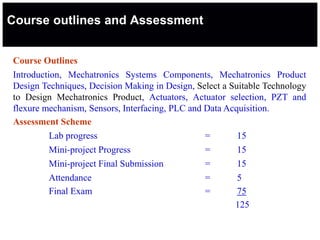
Course outlines and Assessment
Course Outlines
Introduction, Mechatronics Systems Components, Mechatronics Product
Design Techniques, Decision Making in Design, Select a Suitable Technology
to Design Mechatronics Product, Actuators, Actuator selection, PZT and
flexure mechanism, Sensors, Interfacing, PLC and Data Acquisition.
Assessment Scheme
Lab progress = 15
Mini-project Progress = 15
Mini-project Final Submission = 15
Attendance = 5
Final Exam = 75
125
Course outlines, Assessment and Textbook
Course Notes
Lecture Slides handed out to students
Essential Books (Text Books)
 VDI 2206 standard guide, “Design methodology for mechatronic
systems”, German, 2004 .
 D. Shetty and R. Kolk, “Mechatronic System Design”, Cengage
Learning, 2nd Edition, 2011.
 Sabri Cetinkunt, “Mechatronics with Experiments”, Wiley, 2015.
Mini-Projects
 Objectives of the mini-project :
 To provide students with a realistic overview of the mechatronics system
design.
 To enable students to apply the state-of-the-art methodologies and
techniques in designing of mechatronic systems.
 To work in team.
 To practice mechatronics configuration as an engineering discipline.
Examples of mini-projects
 Examples of mini-projects:
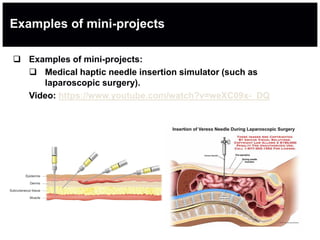
 Medical haptic needle insertion simulator (such as
laparoscopic surgery).
Video: https://www.youtube.com/watch?v=weXC09x-_DQ
Examples of mini-projects
 Examples of mini-projects:
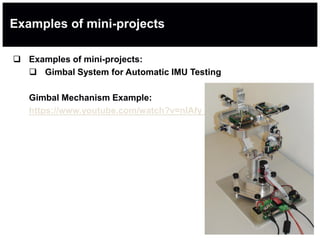
 Gimbal System for Automatic IMU Testing
Gimbal Mechanism Example:
https://www.youtube.com/watch?v=nlAfy_ha57M
Examples of mini-projects
 Examples of mini-projects:
 Active perception with array of tactile sensor
Video 1
https://www.youtube.com/watch?v=HxBOjJg55y4
Examples of mini-projects
 Examples of mini-projects:
 Soft robotics gripper for handling irregular shapes
Video 1
https://www.youtube.com/watch?v=gI0tzsO8xwc
Examples of mini-projects
 Examples of mini-projects:
 Adaptive bionic gripper (inspired from nature)
Video 1
https://www.youtube.com/watch?v=90cXfaFM4O8
Examples of mini-projects
 Examples of mini-projects:
 Flex shape gripper (inspired from nature)
Video 1
https://www.youtube.com/watch?v=m7l-87r4oOY
Examples
 Examples of mini-projects:
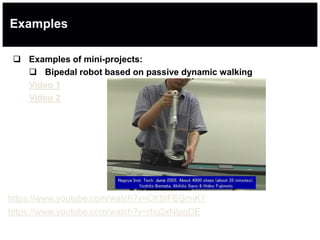
 Bipedal robot based on passive dynamic walking
Video 1
Video 2
https://www.youtube.com/watch?v=CK8IFEGmiKY
https://www.youtube.com/watch?v=rhu2xNIpgDE
Examples
 Examples of mini-projects:
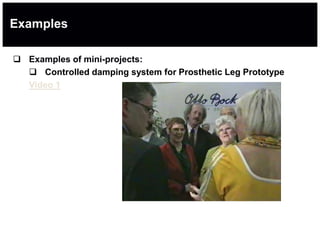
 Controlled damping system for Prosthetic Leg Prototype
Video 1
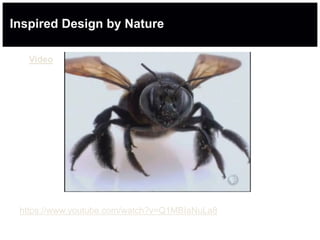
Inspired Design by Nature
Video
https://www.youtube.com/watch?v=Q1MBIaNuLa8
What is Mechatronics?
Mechatronics Background
 The word mechatronics was first introduced by the senior engineer of
a Japanese company; Yaskawa, in 1969, as a combination of
"mecha" of mechanisms and "tronics" of electronics, and the company
was granted trademark rights on the word in 1971.
 The word soon received broad acceptance in industry and, in order to
allow its free use, Yaskawa decided to abandon his rights on the word
in 1982.
 The most commonly used one emphasizes synergy: Mechatronics is
synergistic integration of mechanical engineering, electronics and
intelligent computer control in design and manufacture of products
and processes.
Mechatronics Background
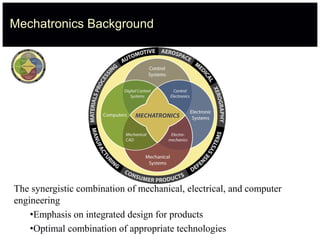
The synergistic combination of mechanical, electrical, and computer
engineering
•Emphasis on integrated design for products
•Optimal combination of appropriate technologies
Mechatronics Background
 The word has taken a wider meaning since then, and is now widely
used as a technical jargon word to describe a philosophical idea in
engineering technology, more than technology itself.
Mechatronic is multifaced engineering context to enhance
engineers’ decision making skills and problem solving of
engineering problems.
 Mechatronics is a design philosophy: an integrating approach to
engineering design.
 Mechatronics is a methodology used for the optimal design of inter-
disciplinary products.
 Through a mechanism of simulating interdisciplinary ideas and
techniques, mechatronics provides ideal conditions to raise the
synergy, thereby providing a catalytic effect for the new solutions to
technically complex situations.
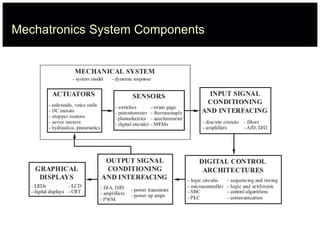
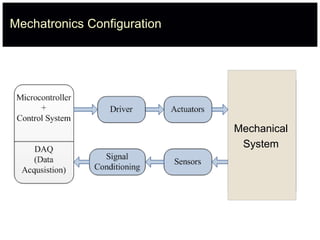
Mechatronics System Components
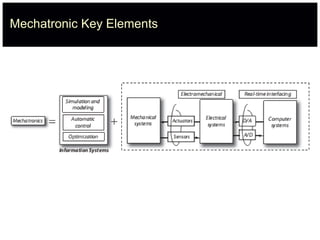
Mechatronic Key Elements
Mechatronics Configuration
Mechanical
System
Advancements in Mechatronics
 Mechatronic products have become increasingly dominant in every
aspect of commercial marketplace as technologies, electronics, and
computers continue to be developed.
 Presently major commercial markets for mechatronic products are
in the form:
 Automobiles industry,
 aeronautical/astronautical systems (Aircraft and rocket
technologies),
 biological systems.
 Advancements in mechatronics in the areas of automobile
engineering, biotechnology, and aircraft and rocket engineering, have
given rise to specialized disciplines of:
 Autotronics ,
 Bionics (Biomechatronics),
 and avionics.
Advancements in Mechatronics
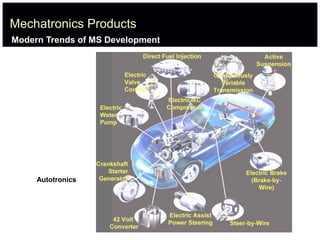
 Autotronics:
 The primary motivation for adopting mechatronic systems in
automobiles is to make automobiles safer, more comfortable,
fuel efficient, and less polluting systems.
 Smart vehicles are based on an extensive use of mechatronic
systems to detect the environment or road conditions.
 The design and production of mechatronic systems for
automobiles that perform at extreme environmental conditions
presents a major challenge to engineers.
 Application of mechatronic systems in automobiles is in the
following major areas:
 Safety
 Engine and power train
 Comfort and convenience
 Vehicle diagnostics and health monitoring
Advancements in Mechatronics
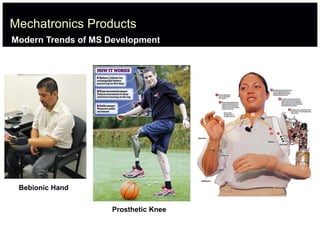
 Bionics (Biomechatronics):
 Biomechatronic is defined as a system that integrates
mechanisms, sensors, actuators, power supplies, control and
embedded systems, which are the main components of
mechatronics systems, to use with biological systems.
 Biomechatronic is using mechatronics concept to imitate
biological systems, e.g.: human, animal and bird.
 Bionics is poised to have significant stake in mechatronic sensors
market in the near future.
 Biosensors are extensively used in analytical chemistry and
biomedical care as well as genetic engineering. These sensors
usually involve biological molecules such as antibodies or
enzymes, which interact with analyses that are to be detected.
Advancements in Mechatronics
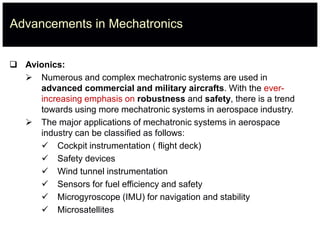
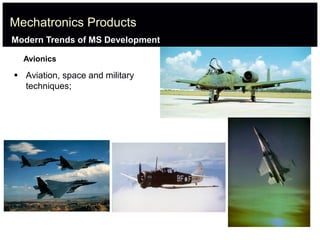
 Avionics:
 Numerous and complex mechatronic systems are used in
advanced commercial and military aircrafts. With the ever-
increasing emphasis on robustness and safety, there is a trend
towards using more mechatronic systems in aerospace industry.
 The major applications of mechatronic systems in aerospace
industry can be classified as follows:
 Cockpit instrumentation ( flight deck)
 Safety devices
 Wind tunnel instrumentation
 Sensors for fuel efficiency and safety
 Microgyroscope (IMU) for navigation and stability
 Microsatellites
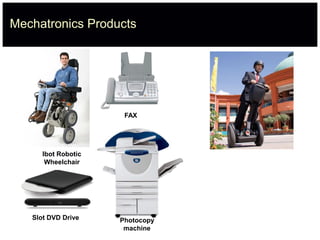
Mechatronics Products
Ibot Robotic
Wheelchair
Slot DVD Drive
FAX
Photocopy
machine
Mechatronics Products
Autotronics
Modern Trends of MS Development
Mechatronics Products
Prosthetic Knee
Bebionic Hand
Modern Trends of MS Development
Mechatronics Products
Avionics
 Aviation, space and military
techniques;
Modern Trends of MS Development
Mechatronic System Design
 The mechatronic design methodology is based on a concurrent
(instead of sequential) approach to discipline design, resulting in
products with more synergy.
 The branch of engineering called systems engineering uses a
concurrent approach for preliminary design. In a way, mechatronics
is an extension of the system engineering approach, but it is
supplemented with information systems to guide the design and is
applied at all stages of design (not just the preliminary design step).
 Mechatronics is a synergy in the integration of mechanical, electrical,
and computer systems with information systems for the design and
manufacture of products and processes. The synergy is generated by
the right combination of parameters; the final product can be better
than just the sum of its parts.
 Mechatronic products exhibit performance characteristics that were
previously difficult to achieve without the synergistic
combination.
Mechatronic System Design
 Mechatronic system design supports the concepts of concurrent
engineering.
 In the designing of a mechatronic product, it is necessary that the
knowledge and necessary information be coordinated amongst
different expert groups.
 Concurrent engineering is a design approach in which the design and
manufacture of a product are merged in a special way. It is the idea
that people can do a better job if they cooperate to achieve a common
goal. It has been influenced partly by the recognition that many of the
high costs in manufacturing are decided at the product design
stage itself.
Mechatronic System Design
 The characteristics of concurrent engineering are:
 Better definition of the product without late changes.
 Design for manufacturing and assembly undertaken in the early
design stage.
 Process on how the product development is well defined.
 Better cost estimates.
 Decrease in the barriers between design and manufacturing.
 However, the lack of a common interface language has made the
information exchange in concurrent engineering difficult.
 Successful implementation of concurrent engineering is possible by
coordinating an adequate exchange of information and dealing with
organizational barriers to cross-functional cooperation.
 Using concurrent engineering principles as a guide, the designed
product is likely to meet the basic requirements (High quality,
Robustness, Low cost, Time to market, and Customer satisfaction)
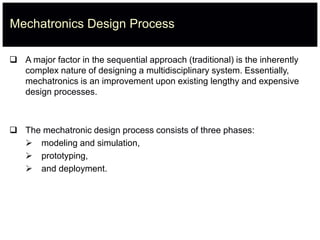
Mechatronics Design Process
 A major factor in the sequential approach (traditional) is the inherently
complex nature of designing a multidisciplinary system. Essentially,
mechatronics is an improvement upon existing lengthy and expensive
design processes.
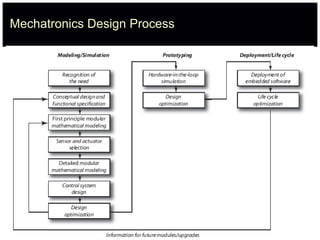
 The mechatronic design process consists of three phases:
 modeling and simulation,
 prototyping,
 and deployment.
Mechatronics Design Process
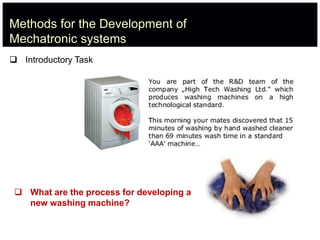
Methods for the Development of
Mechatronic systems
 Introductory Task
 What are the process for developing a
new washing machine?
1- Pre-Study Process
 Basics and Analysis: What is it all about?
 Developing a washing machine which uses a technique similar to
hand washing. A product like this would be more efficient and
ecological and would operate on lower costs.
 Study of Product, Customer and Market
 Product: A washing machine with this technology has the potential
to be faster, more ecological and more cost-efficient.
 Market: In a first step, the target market is Europe, Northern
America and Japan, households in well-developed countries.
 Customer: In the beginning, the target group will consist of people
with average (or high) income and a sense for cost-efficiency and
ecology.
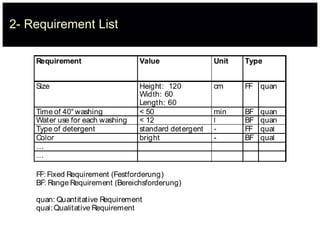
2- Requirement List
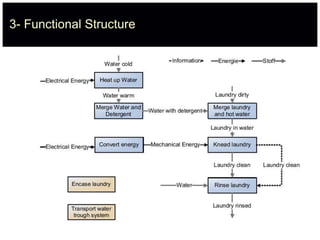
3- Functional Structure
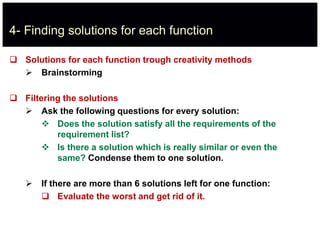
4- Finding solutions for each function
 Solutions for each function trough creativity methods
 Brainstorming
 Filtering the solutions
 Ask the following questions for every solution:
 Does the solution satisfy all the requirements of the
requirement list?
 Is there a solution which is really similar or even the
same? Condense them to one solution.
 If there are more than 6 solutions left for one function:
 Evaluate the worst and get rid of it.
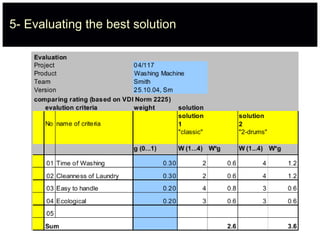
5- Evaluating the best solution
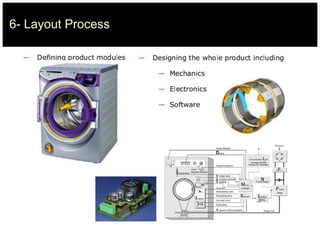
6- Layout Process
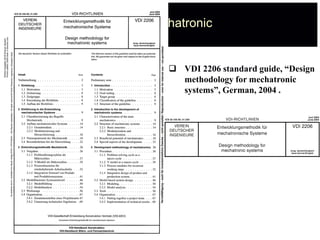
Design Methodology for Mechatronic
Systems
 VDI 2206 standard guide, “Design
methodology for mechatronic
systems”, German, 2004 .
Design Procedures
 Main procedures:
 Requirements.
 System design.
 Domain specific design.
 System integration.
 Modeling and model analysis.
 Assurance of properties.
Questions
Questions
2/16/2017 43

Lec 01(introduction) Mechatronic systems

  • 1.
    Faculty of Engineering AinShams University Mohammed Ibrahim 2/16/2017 1 MDP: Mechatronics (2) Lecture 01: Mini-Projects and Introduction to Mechatronics
  • 2.
    Course outlines andAssessment Course Outlines Introduction, Mechatronics Systems Components, Mechatronics Product Design Techniques, Decision Making in Design, Select a Suitable Technology to Design Mechatronics Product, Actuators, Actuator selection, PZT and flexure mechanism, Sensors, Interfacing, PLC and Data Acquisition. Assessment Scheme Lab progress = 15 Mini-project Progress = 15 Mini-project Final Submission = 15 Attendance = 5 Final Exam = 75 125
  • 3.
    Course outlines, Assessmentand Textbook Course Notes Lecture Slides handed out to students Essential Books (Text Books)  VDI 2206 standard guide, “Design methodology for mechatronic systems”, German, 2004 .  D. Shetty and R. Kolk, “Mechatronic System Design”, Cengage Learning, 2nd Edition, 2011.  Sabri Cetinkunt, “Mechatronics with Experiments”, Wiley, 2015.
  • 4.
    Mini-Projects  Objectives ofthe mini-project :  To provide students with a realistic overview of the mechatronics system design.  To enable students to apply the state-of-the-art methodologies and techniques in designing of mechatronic systems.  To work in team.  To practice mechatronics configuration as an engineering discipline.
  • 5.
    Examples of mini-projects Examples of mini-projects:  Medical haptic needle insertion simulator (such as laparoscopic surgery). Video: https://www.youtube.com/watch?v=weXC09x-_DQ
  • 6.
    Examples of mini-projects Examples of mini-projects:  Gimbal System for Automatic IMU Testing Gimbal Mechanism Example: https://www.youtube.com/watch?v=nlAfy_ha57M
  • 7.
    Examples of mini-projects Examples of mini-projects:  Active perception with array of tactile sensor Video 1 https://www.youtube.com/watch?v=HxBOjJg55y4
  • 8.
    Examples of mini-projects Examples of mini-projects:  Soft robotics gripper for handling irregular shapes Video 1 https://www.youtube.com/watch?v=gI0tzsO8xwc
  • 9.
    Examples of mini-projects Examples of mini-projects:  Adaptive bionic gripper (inspired from nature) Video 1 https://www.youtube.com/watch?v=90cXfaFM4O8
  • 10.
    Examples of mini-projects Examples of mini-projects:  Flex shape gripper (inspired from nature) Video 1 https://www.youtube.com/watch?v=m7l-87r4oOY
  • 11.
    Examples  Examples ofmini-projects:  Bipedal robot based on passive dynamic walking Video 1 Video 2 https://www.youtube.com/watch?v=CK8IFEGmiKY https://www.youtube.com/watch?v=rhu2xNIpgDE
  • 12.
    Examples  Examples ofmini-projects:  Controlled damping system for Prosthetic Leg Prototype Video 1
  • 13.
    Inspired Design byNature Video https://www.youtube.com/watch?v=Q1MBIaNuLa8
  • 14.
  • 15.
    Mechatronics Background  Theword mechatronics was first introduced by the senior engineer of a Japanese company; Yaskawa, in 1969, as a combination of "mecha" of mechanisms and "tronics" of electronics, and the company was granted trademark rights on the word in 1971.  The word soon received broad acceptance in industry and, in order to allow its free use, Yaskawa decided to abandon his rights on the word in 1982.  The most commonly used one emphasizes synergy: Mechatronics is synergistic integration of mechanical engineering, electronics and intelligent computer control in design and manufacture of products and processes.
  • 16.
    Mechatronics Background The synergisticcombination of mechanical, electrical, and computer engineering •Emphasis on integrated design for products •Optimal combination of appropriate technologies
  • 17.
    Mechatronics Background  Theword has taken a wider meaning since then, and is now widely used as a technical jargon word to describe a philosophical idea in engineering technology, more than technology itself. Mechatronic is multifaced engineering context to enhance engineers’ decision making skills and problem solving of engineering problems.  Mechatronics is a design philosophy: an integrating approach to engineering design.  Mechatronics is a methodology used for the optimal design of inter- disciplinary products.  Through a mechanism of simulating interdisciplinary ideas and techniques, mechatronics provides ideal conditions to raise the synergy, thereby providing a catalytic effect for the new solutions to technically complex situations.
  • 18.
  • 19.
  • 20.
  • 21.
    Advancements in Mechatronics Mechatronic products have become increasingly dominant in every aspect of commercial marketplace as technologies, electronics, and computers continue to be developed.  Presently major commercial markets for mechatronic products are in the form:  Automobiles industry,  aeronautical/astronautical systems (Aircraft and rocket technologies),  biological systems.  Advancements in mechatronics in the areas of automobile engineering, biotechnology, and aircraft and rocket engineering, have given rise to specialized disciplines of:  Autotronics ,  Bionics (Biomechatronics),  and avionics.
  • 22.
    Advancements in Mechatronics Autotronics:  The primary motivation for adopting mechatronic systems in automobiles is to make automobiles safer, more comfortable, fuel efficient, and less polluting systems.  Smart vehicles are based on an extensive use of mechatronic systems to detect the environment or road conditions.  The design and production of mechatronic systems for automobiles that perform at extreme environmental conditions presents a major challenge to engineers.  Application of mechatronic systems in automobiles is in the following major areas:  Safety  Engine and power train  Comfort and convenience  Vehicle diagnostics and health monitoring
  • 23.
    Advancements in Mechatronics Bionics (Biomechatronics):  Biomechatronic is defined as a system that integrates mechanisms, sensors, actuators, power supplies, control and embedded systems, which are the main components of mechatronics systems, to use with biological systems.  Biomechatronic is using mechatronics concept to imitate biological systems, e.g.: human, animal and bird.  Bionics is poised to have significant stake in mechatronic sensors market in the near future.  Biosensors are extensively used in analytical chemistry and biomedical care as well as genetic engineering. These sensors usually involve biological molecules such as antibodies or enzymes, which interact with analyses that are to be detected.
  • 24.
    Advancements in Mechatronics Avionics:  Numerous and complex mechatronic systems are used in advanced commercial and military aircrafts. With the ever- increasing emphasis on robustness and safety, there is a trend towards using more mechatronic systems in aerospace industry.  The major applications of mechatronic systems in aerospace industry can be classified as follows:  Cockpit instrumentation ( flight deck)  Safety devices  Wind tunnel instrumentation  Sensors for fuel efficiency and safety  Microgyroscope (IMU) for navigation and stability  Microsatellites
  • 25.
  • 26.
  • 27.
    Mechatronics Products Prosthetic Knee BebionicHand Modern Trends of MS Development
  • 28.
    Mechatronics Products Avionics  Aviation,space and military techniques; Modern Trends of MS Development
  • 29.
    Mechatronic System Design The mechatronic design methodology is based on a concurrent (instead of sequential) approach to discipline design, resulting in products with more synergy.  The branch of engineering called systems engineering uses a concurrent approach for preliminary design. In a way, mechatronics is an extension of the system engineering approach, but it is supplemented with information systems to guide the design and is applied at all stages of design (not just the preliminary design step).  Mechatronics is a synergy in the integration of mechanical, electrical, and computer systems with information systems for the design and manufacture of products and processes. The synergy is generated by the right combination of parameters; the final product can be better than just the sum of its parts.  Mechatronic products exhibit performance characteristics that were previously difficult to achieve without the synergistic combination.
  • 30.
    Mechatronic System Design Mechatronic system design supports the concepts of concurrent engineering.  In the designing of a mechatronic product, it is necessary that the knowledge and necessary information be coordinated amongst different expert groups.  Concurrent engineering is a design approach in which the design and manufacture of a product are merged in a special way. It is the idea that people can do a better job if they cooperate to achieve a common goal. It has been influenced partly by the recognition that many of the high costs in manufacturing are decided at the product design stage itself.
  • 31.
    Mechatronic System Design The characteristics of concurrent engineering are:  Better definition of the product without late changes.  Design for manufacturing and assembly undertaken in the early design stage.  Process on how the product development is well defined.  Better cost estimates.  Decrease in the barriers between design and manufacturing.  However, the lack of a common interface language has made the information exchange in concurrent engineering difficult.  Successful implementation of concurrent engineering is possible by coordinating an adequate exchange of information and dealing with organizational barriers to cross-functional cooperation.  Using concurrent engineering principles as a guide, the designed product is likely to meet the basic requirements (High quality, Robustness, Low cost, Time to market, and Customer satisfaction)
  • 32.
    Mechatronics Design Process A major factor in the sequential approach (traditional) is the inherently complex nature of designing a multidisciplinary system. Essentially, mechatronics is an improvement upon existing lengthy and expensive design processes.  The mechatronic design process consists of three phases:  modeling and simulation,  prototyping,  and deployment.
  • 33.
  • 34.
    Methods for theDevelopment of Mechatronic systems  Introductory Task  What are the process for developing a new washing machine?
  • 35.
    1- Pre-Study Process Basics and Analysis: What is it all about?  Developing a washing machine which uses a technique similar to hand washing. A product like this would be more efficient and ecological and would operate on lower costs.  Study of Product, Customer and Market  Product: A washing machine with this technology has the potential to be faster, more ecological and more cost-efficient.  Market: In a first step, the target market is Europe, Northern America and Japan, households in well-developed countries.  Customer: In the beginning, the target group will consist of people with average (or high) income and a sense for cost-efficiency and ecology.
  • 36.
  • 37.
  • 38.
    4- Finding solutionsfor each function  Solutions for each function trough creativity methods  Brainstorming  Filtering the solutions  Ask the following questions for every solution:  Does the solution satisfy all the requirements of the requirement list?  Is there a solution which is really similar or even the same? Condense them to one solution.  If there are more than 6 solutions left for one function:  Evaluate the worst and get rid of it.
  • 39.
    5- Evaluating thebest solution
  • 40.
  • 41.
    Design Methodology forMechatronic Systems  VDI 2206 standard guide, “Design methodology for mechatronic systems”, German, 2004 .
  • 42.
    Design Procedures  Mainprocedures:  Requirements.  System design.  Domain specific design.  System integration.  Modeling and model analysis.  Assurance of properties.
  • 43.