WELCOME
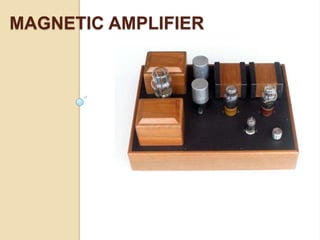
MAGNETIC AMPLIFIER
Contents
 Introduction
 History
 Amplifier
 Magnetic amplifier
 Saturable reactor
 Principal of magnetic amplifier
 Working of magnetic amplifier
 Application, strength & limitation
 Uses in radio, aircraft & computing
 Conclusion
INTRODUCTION
1.An electromagnetic device for amplifying
electrical signal
3. A magnetic amplifier uses the principle of
transformers along with the concept of magnetic
saturation of the core.
2.Does not require any moveable part
4. The magnetic amplifier has certain advantages
over
a)high efficiency
b)reliability
c)ruggedness
HISTORY
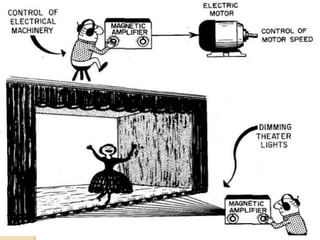
1. Developed as early as 1885 in united state
2. At that time mainly used for electric machinery and
theater lighting
3. During world war II Germans used it in long range
rockets to regulate frequency output of an a.c.
generator
4. Early time its uses as early development of voice
transmission by radio.
Amplifier
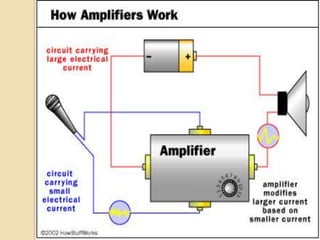
1. An electronic amplifier is an electronic device that
increases the power of a signal.
2. It does this by taking energy from a power supply
and controlling the output to match the input signal
shape but with a larger amplitude.
3. an amplifier modulates the output of the power
supply.
4. There are four basic types of electronic amplifier:-
a) voltage amplifier b)current amplifier
c)Transconductance amplifier
d)Transresistance amplifier
Magnetic
amplifier
1.The magnetic amplifier is an electromagnetic
device for amplifying electrical signals
2. The magnetic amplifier was invented early in
the 20th century
3.It was used as an alternative to vacuum tube
amplifiers where robustness and high current
capacity were required.
4. World War 2 Germany used this type of
amplifier, and it was used for instance in the V-2
rocket.
5.The magnetic amplifier was most prominent in
power control and low-frequency signal
The saturable reactor
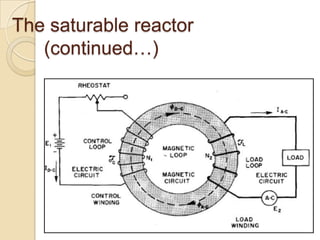
 The saturable reactor is the device from which
the magnetic amplifier has been fundamentally
developed.
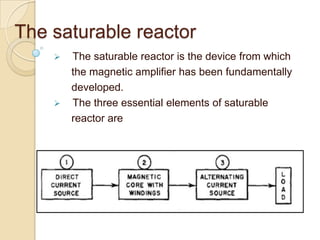
 The three essential elements of saturable
reactor are
The saturable reactor
(continued…)
Principal of magnetic
amplifier
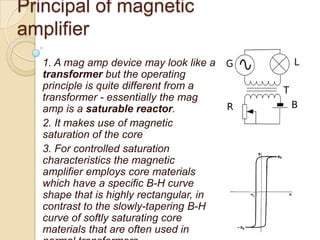
1. A mag amp device may look like a
transformer but the operating
principle is quite different from a
transformer - essentially the mag
amp is a saturable reactor.
2. It makes use of magnetic
saturation of the core
3. For controlled saturation
characteristics the magnetic
amplifier employs core materials
which have a specific B-H curve
shape that is highly rectangular, in
contrast to the slowly-tapering B-H
curve of softly saturating core
materials that are often used in
Working
1.The typical magnetic amplifier consists of two
physically separate but similar transformer magnetic
cores each of which has two windings - a control
winding and an AC winding.
2. A small DC current from a low impedance source is
fed into the series-connected control windings. The AC
windings may be connected either in series or in
parallel, the configurations resulting in different types
of mag amps.
3.The amount of control current fed into the control
winding sets the point in the AC winding waveform at
which either core will saturate. In saturation, the AC
winding on the saturated core will go from a high
impedance state ("off") into a very low impedance state
("on") - that is, the control current controls at which
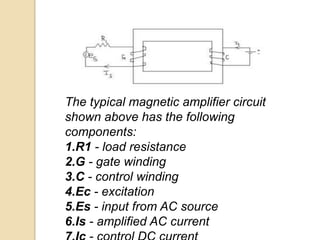
The typical magnetic amplifier circuit
shown above has the following
components:
1.R1 - load resistance
2.G - gate winding
3.C - control winding
4.Ec - excitation
5.Es - input from AC source
6.Is - amplified AC current
Application
 As modulation and control amplifiers in the early
development of voice transmission by radio.
 As voice modulator and magnetic amplifiers were used
in the keying circuits of large high-frequency
alternators used for radio communications.
 To regulate the speed of Alexanderson alternators to
maintain the accuracy of the transmitted radio
frequency.
 Magnetic amplifiers useful for control of lighting
circuits, for stage lighting and for advertising signs.
 Saturable reactor amplifiers were used for control of
power to industrial furnaces.
Strength
 a static device with no moving parts
 no wear-out mechanism
 has a good tolerance to mechanical shock and vibration.
 It requires no warm-up time.
 Multiple isolated signals may be summed by additional control
windings on the magnetic cores.
 The windings of a magnetic amplifier have a higher tolerance
to momentary overloads than comparable solid-state devices.
 The magnetic amplifier is also used as a transducer in
applications such as current measurement and the flux gate
compass
Limitations
 The gain available from a single stage is limited and low
compared to electronic amplifiers.
 Frequency response of a high gain amplifier is limited to
about one-tenth the excitation frequency
 Solid-state amplifiers can be more compact and efficient
than magnetic amplifiers.
 The bias and feedback windings are not unilateral, and
may couple energy back from the controlled circuit into the
control circuit.
 This complicates the design of multistage amplifiers when
compared with electronic devices.
Usage in radio
Magnetic amplifiers were used voice modulation.
The alternator's frequency limits were rather low to
where a frequency multiplier had to be utilized to
generate higher radio frequencies than the alternator
was capable of producing.
Even so, early magnetic amplifiers incorporating
powdered-iron cores were incapable of producing radio
frequencies above approximately 200 kHz.
Usage in aircraft
 Magnetic amplifiers were used in aircraft systems
(avionics ) before the advent of high reliability
semiconductors.
 They were important in implementing early auto land
systems
 for the control of its engine air intakes before
subsequent development of a replacement system using
digital electronics.
Usage in
computing
 Magnetic amplifiers were widely studied during
the 1950s as a potential switching element for
mainframe computers.
 Mag amps could be used to sum several inputs in
a single core, which was very useful in the
arithmetic logic unit (ALU).
 The mag amp was able to combine the
advantages of tubes and transistors in an era
when the latter were expensive and unreliable.
conclusion
 Although, magnetic amplifier is an outdated
technology in present trend, It is the first
device
which can replace fragile vacuum tube in
almost
all its function.
 It has good mechanical strength and
maintenance
free.
THANK YOU

Magnetic amplifier final

  • 1.
  • 2.
  • 3.
    Contents  Introduction  History Amplifier  Magnetic amplifier  Saturable reactor  Principal of magnetic amplifier  Working of magnetic amplifier  Application, strength & limitation  Uses in radio, aircraft & computing  Conclusion
  • 4.
    INTRODUCTION 1.An electromagnetic devicefor amplifying electrical signal 3. A magnetic amplifier uses the principle of transformers along with the concept of magnetic saturation of the core. 2.Does not require any moveable part 4. The magnetic amplifier has certain advantages over a)high efficiency b)reliability c)ruggedness
  • 5.
    HISTORY 1. Developed asearly as 1885 in united state 2. At that time mainly used for electric machinery and theater lighting 3. During world war II Germans used it in long range rockets to regulate frequency output of an a.c. generator 4. Early time its uses as early development of voice transmission by radio.
  • 7.
    Amplifier 1. An electronicamplifier is an electronic device that increases the power of a signal. 2. It does this by taking energy from a power supply and controlling the output to match the input signal shape but with a larger amplitude. 3. an amplifier modulates the output of the power supply. 4. There are four basic types of electronic amplifier:- a) voltage amplifier b)current amplifier c)Transconductance amplifier d)Transresistance amplifier
  • 9.
    Magnetic amplifier 1.The magnetic amplifieris an electromagnetic device for amplifying electrical signals 2. The magnetic amplifier was invented early in the 20th century 3.It was used as an alternative to vacuum tube amplifiers where robustness and high current capacity were required. 4. World War 2 Germany used this type of amplifier, and it was used for instance in the V-2 rocket. 5.The magnetic amplifier was most prominent in power control and low-frequency signal
  • 10.
    The saturable reactor The saturable reactor is the device from which the magnetic amplifier has been fundamentally developed.  The three essential elements of saturable reactor are
  • 11.
  • 12.
    Principal of magnetic amplifier 1.A mag amp device may look like a transformer but the operating principle is quite different from a transformer - essentially the mag amp is a saturable reactor. 2. It makes use of magnetic saturation of the core 3. For controlled saturation characteristics the magnetic amplifier employs core materials which have a specific B-H curve shape that is highly rectangular, in contrast to the slowly-tapering B-H curve of softly saturating core materials that are often used in
  • 13.
    Working 1.The typical magneticamplifier consists of two physically separate but similar transformer magnetic cores each of which has two windings - a control winding and an AC winding. 2. A small DC current from a low impedance source is fed into the series-connected control windings. The AC windings may be connected either in series or in parallel, the configurations resulting in different types of mag amps. 3.The amount of control current fed into the control winding sets the point in the AC winding waveform at which either core will saturate. In saturation, the AC winding on the saturated core will go from a high impedance state ("off") into a very low impedance state ("on") - that is, the control current controls at which
  • 14.
    The typical magneticamplifier circuit shown above has the following components: 1.R1 - load resistance 2.G - gate winding 3.C - control winding 4.Ec - excitation 5.Es - input from AC source 6.Is - amplified AC current
  • 15.
    Application  As modulationand control amplifiers in the early development of voice transmission by radio.  As voice modulator and magnetic amplifiers were used in the keying circuits of large high-frequency alternators used for radio communications.  To regulate the speed of Alexanderson alternators to maintain the accuracy of the transmitted radio frequency.  Magnetic amplifiers useful for control of lighting circuits, for stage lighting and for advertising signs.  Saturable reactor amplifiers were used for control of power to industrial furnaces.
  • 16.
    Strength  a staticdevice with no moving parts  no wear-out mechanism  has a good tolerance to mechanical shock and vibration.  It requires no warm-up time.  Multiple isolated signals may be summed by additional control windings on the magnetic cores.  The windings of a magnetic amplifier have a higher tolerance to momentary overloads than comparable solid-state devices.  The magnetic amplifier is also used as a transducer in applications such as current measurement and the flux gate compass
  • 17.
    Limitations  The gainavailable from a single stage is limited and low compared to electronic amplifiers.  Frequency response of a high gain amplifier is limited to about one-tenth the excitation frequency  Solid-state amplifiers can be more compact and efficient than magnetic amplifiers.  The bias and feedback windings are not unilateral, and may couple energy back from the controlled circuit into the control circuit.  This complicates the design of multistage amplifiers when compared with electronic devices.
  • 18.
    Usage in radio Magneticamplifiers were used voice modulation. The alternator's frequency limits were rather low to where a frequency multiplier had to be utilized to generate higher radio frequencies than the alternator was capable of producing. Even so, early magnetic amplifiers incorporating powdered-iron cores were incapable of producing radio frequencies above approximately 200 kHz.
  • 19.
    Usage in aircraft Magnetic amplifiers were used in aircraft systems (avionics ) before the advent of high reliability semiconductors.  They were important in implementing early auto land systems  for the control of its engine air intakes before subsequent development of a replacement system using digital electronics.
  • 20.
    Usage in computing  Magneticamplifiers were widely studied during the 1950s as a potential switching element for mainframe computers.  Mag amps could be used to sum several inputs in a single core, which was very useful in the arithmetic logic unit (ALU).  The mag amp was able to combine the advantages of tubes and transistors in an era when the latter were expensive and unreliable.
  • 21.
    conclusion  Although, magneticamplifier is an outdated technology in present trend, It is the first device which can replace fragile vacuum tube in almost all its function.  It has good mechanical strength and maintenance free.
  • 22.