PROJECT
MANAGEMENT
CIVIL ENGINEERING
Learning Outcome 01
At the end of this session students must be able to:
Identify viable projects in the field of Civil Engineering
1.1 identify potential projects.
1.2 carryout project research.
1.3 analyze project viability.
1.4 hold design meetings
1.5 carryout project reviews
“Project” WHAT REALLY IS A PROJECT
 A project is an endeavor that is undertaken to produce the results that are
expected from the requesting party.
 A project may be design only, construction only or a combination of design
and construction.
 A project consists of three components: scope, budget and schedule
(Project triple constraints)
 Projects are temporal in nature and have definitive start dates and definitive end
dates. The project is completed when its goals and objectives are accomplished (by
producing deliverables) to the satisfaction of the stakeholders.
 Sometimes projects end when it’s determined that the goals and objectives cannot
be accomplished or when the product, service, or result of the project is no longer
needed and the project is canceled.
 Projects exist to bring about a product, service, or result that didn’t exist before
(innovation).
 This might include tangible products, components of other products, services such
as consulting or project management, and business functions that support the
organization.
 Projects might also produce a result or an outcome, such as a document that details
the findings of a research study. In this sense, a project is unique. However, don’t be
confused by the term unique. For example (project example)………......
PROJECT CHARACTERISTICS
A project has several characteristics:
 Projects are unique.
 Projects are temporary in nature and have a definite beginning and ending date.
 Projects are completed when the project goals are achieved or it’s determined the
project is no longer viable.
 A successful project is one that meets the expectations of your stakeholders.
 Projects initiate change in the organization.
 Projects bring about business value creation.
Viable Projects in Civil Engineering
 Research in groups and discuss as a class
PROJECT MANAGEMENT
 Project management is a collection of processes that includes initiating a new
project, planning, putting the project management plan into action, and measuring
progress and performance.
 It involves identifying the project requirements, establishing project objectives,
balancing constraints, and taking the needs and expectations of the key
stakeholders into consideration.
 Planning is one of the most important functions you’ll perform during the course
of a project. It sets the standard for the remainder of the project’s life and is used
to track future project performance
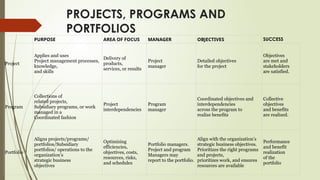
PROJECTS, PROGRAMS AND
PORTFOLIOS
PURPOSE AREA OF FOCUS MANAGER OBJECTIVES SUCCESS
Project
Applies and uses
Project management processes,
knowledge,
and skills
Delivery of
products,
services, or results
Project
manager
Detailed objectives
for the project
Objectives
are met and
stakeholders
are satisfied.
Program
Collections of
related projects,
Subsidiary programs, or work
managed in a
Coordinated fashion
Project
interdependencies
Program
manager
Coordinated objectives and
interdependencies
across the program to
realize benefits
Collective
objectives
and benefits
are realized.
Portfolio
Aligns projects/programs/
portfolios/Subsidiary
portfolios/ operations to the
organization’s
strategic business
objectives
Optimizing
efficiencies,
objectives, costs,
resources, risks,
and schedules
Portfolio managers.
Project and program
Managers may
report to the portfolio.
Align with the organization’s
strategic business objectives.
Prioritizes the right programs
and projects,
prioritizes work, and ensures
resources are available
Performance
and benefit
realization
of the
portfolio
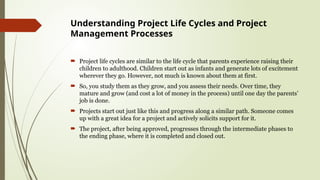
Understanding Project Life Cycles and Project
Management Processes
 Project life cycles are similar to the life cycle that parents experience raising their
children to adulthood. Children start out as infants and generate lots of excitement
wherever they go. However, not much is known about them at first.
 So, you study them as they grow, and you assess their needs. Over time, they
mature and grow (and cost a lot of money in the process) until one day the parents’
job is done.
 Projects start out just like this and progress along a similar path. Someone comes
up with a great idea for a project and actively solicits support for it.
 The project, after being approved, progresses through the intermediate phases to
the ending phase, where it is completed and closed out.
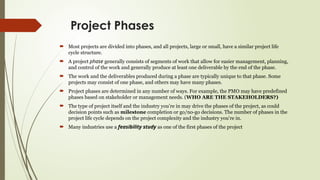
Project Phases
 Most projects are divided into phases, and all projects, large or small, have a similar project life
cycle structure.
 A project phase generally consists of segments of work that allow for easier management, planning,
and control of the work and generally produce at least one deliverable by the end of the phase.
 The work and the deliverables produced during a phase are typically unique to that phase. Some
projects may consist of one phase, and others may have many phases.
 Project phases are determined in any number of ways. For example, the PMO may have predefined
phases based on stakeholder or management needs. (WHO ARE THE STAKEHOLDERS?)
 The type of project itself and the industry you’re in may drive the phases of the project, as could
decision points such as milestone completion or go/no-go decisions. The number of phases in the
project life cycle depends on the project complexity and the industry you’re in.
 Many industries use a feasibility study as one of the first phases of the project
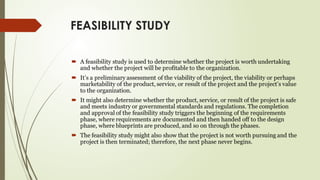
FEASIBILITY STUDY
TYPES OF PROJECT FEASIBILITY
KEY COMPONENTS
 Technical feasibility Assessing whether the project can be completed with
existing technology and resources.
 Financial feasibility Evaluating the project’s financial viability, including costs,
funding and potential returns.
 Operational feasibility Examining whether the project can be integrated into
existing business operations and processes.
 Schedule feasibility Determining whether the project can be completed within
the proposed timeline.
 Legal Feasibility Ensuring the project complies with relevant laws, regulations,
and permits.
IMPORTANCE OF A PROJECT
FEASIBILITY STUDY
 Informed decision making
 Risk reduction
 Resource Optimization
 Time and cost savings
 Enhanced Project Planning
 Compliance and Regulatory Approval
 Reduced Project Abandoned
Phase Reviews

Project phases evolve through the life cycle in a series of phase sequences called
handoffs, or technical transfers. For projects that consist of sequential phases, the
end of one phase typically marks the beginning of the next.
 A phase review should be held at the end of each phase. This allows the project
manager, stakeholders, and project sponsor the opportunity to determine whether
the project should continue to the next phase.
 They will examine the progress performance to date against the project charter,
the business case, the project management plan, and the benefits management
plan. As each phase is completed, it’s handed off to the next phase.
 For example, as we’ve discussed, a deliverable produced in the beginning phase of a
project might be the feasibility study.
 Producing, verifying, and accepting the feasibility study will signify the ending of
this phase of the project. The successful conclusion of one phase does not guarantee
authorization to begin the next phase.
 Let’s say our feasibility study was performed for a construction project. The study
showed that environmental impacts of a serious nature would result if the
construction project were undertaken at the proposed location.
 Based on this information, a go or no-go decision can be made at the end of the
phase. Phase reviews give the project manager the ability to discover, address, and
take corrective action against errors discovered during the phase.
Phase Completion
 You will recognize phase completion because each phase has a
specific deliverable, or multiple deliverables, that marks the end of
the phase.
 A deliverable is an output that must be produced, verified, and
approved to bring the phase, life-cycle process, or project to
completion.
 Deliverables are unique and verifiable and may be tangible or
intangible, such as the ability to carry out a service.
 Deliverables might also include things such as design documents,
project budgets, blueprints, project schedules, prototypes, etc.
Multi-phased Projects
 Projects may consist of one or more phases. The phases of a project are often performed
sequentially, but there are situations where performing phases concurrently, or overlapping the
start date of a sequential phase, can benefit the project.
 Multiple phases allow the team to analyze project performance and take action in concurrent
and later phases to correct or prevent the problems that occurred previously.
 According to the PMBOK® Guide, there are three ways project life-cycle phases could be
performed:
 Sequential- One phase must finish before the next phase can begin.
 Iterative- More than one phase is being performed at the same time (running concurrently).
 Overlapping- One phase starts before the prior phase completes.
 Sometimes phases are overlapped to shorten or compress the project schedule. This is called fast tracking. Fast
tracking means that a later phase is started prior to completing and approving the phase, or phases, that comes before
it. This technique is used to shorten the overall duration of the project.
Project Life Cycles
 All the collective phases the project progresses through from the start of the project until the
end are called the project life cycle. Project life cycles are similar for all projects regardless of
their size or complexity.
 The phases that occur within the project life cycle are sequential and sometimes overlap each
other, as we discussed in the previous section. Most projects consist of the following life-
cycle :
 Beginning the project
 Planning and organizing the work of the project
 Performing the work of the project
 Closing out the project
 A development life cycle consists of the phases of the project associated with producing the
product, service, or result of the project. A development life cycle is performed within the
project life cycle.
Project Life Cycle Categories
1. Predictive Life Cycle (Also Known as Plan-Driven Life Cycle or Waterfall)
 The project scope is defined at the beginning of the project and changes are monitored
closely.
 If changes are made, you must revisit and modify project plans and formally accept the
changes to the scope and subsequent project management plan.
 The work of each phase is usually distinct and not repeated in other phases. Schedules
and budgets are defined early in the life cycle as well.
 Each phase has an emphasis on a different portion of the project activities, and different
project management process groups are performed during each phase.
2. Adaptive Life Cycles (Also Known as Agile or
Change-Driven Life Cycle)
 Adaptive life cycles are incremental or iterative. The scope is defined at the beginning of
an iteration (predetermined periods of time) and is progressively elaborated over future
iterations.
 Choose this method when active participation of your stakeholders is required
throughout the project, when you are not certain of all the requirements at the
beginning of the project, or when you work in a changing environment.
 This life cycle produces deliverables, or portions of deliverables, in short periods of time.
 Each iteration must produce something that is ready for release at the end of the time
period, and as such, the time period and the resources are fixed.
 All iterations require the Planning process group, and most will perform all of the
project management process groups.
Project Life Cycle Characteristics
 Project phases are performed within a project life cycle, as mentioned earlier. Project life
cycles typically consist of initiating the project, performing the work of the project etc. As
a result, most projects have the following characteristics in common:
 In the beginning of the project life cycle, when the project is initiated, costs are low, and
few team members are assigned to the project.
 As the project progresses, costs and staffing increase and then taper off at closing.
 The potential that the project will come to a successful ending is lowest at the beginning
of the project its chance for success increases as the project progresses through its phases
and life-cycle stages.
 Risk is highest at the beginning of the project and gradually decreases the closer the
project comes to completion.
 Stakeholders have the greatest chance of influencing the project and the characteristics of
the product, service, or result of the project in the beginning phases and have less and
less influence as the project progresses.
 This same phenomenon exists within the project management processes as well.
Life-cycle differences
Highly predictive (Waterfall) Hybrid Highly adaptive (Agile)
Requirements Detailed specifications
High-level planning and iterative
refinements
Progressively elaborated
Risk and costs Reduced due to detailed plans
Reduced through iterative evolution of
initial high-level plans
Reduced by progressively elaborating
the requirements
Stakeholders
Heavily involved in gathering and
documenting requirements. Involvement
tapers off as project progresses.
More involvement than highly predictive
approach and less involvement than
highly adaptive approach
Continuous involvement and frequent
feedback
Initiating Performed once for the project or phase
May be performed once with high-level
objectives and elaborated as project
progresses
Performed regularly throughout the
project. Relies heavily on customer
knowledge
Planning
Once the plan is approved, changes that
impact scope, time, or budget are
controlled and minimized.
High-level plan developed and
elaborated as project progresses
Progressive elaboration of scope based
on continuous feedback
Executing
Performed all at once after requirements
are defined and project plan is approved
Work is performed as requirements are
defined.
Managed using iterations and sprint
review. Small components of work
delivered in each iteration
Monitoring and Controlling
Focus is on constraining changes that
impact scope, budget, or schedule.
Varies from minimal changes to
welcoming changes
Changes welcome. Track and monitor
work using the backlog.
Closing Close out the project or phase.
May close the phase or continue in an
iterative approach
Continually address highest business
value items first.
Project Management Process Groups
 Project management processes organize and describe the work of the project. The
PMBOKÂŽ Guide describes five process groups used to accomplish this end.
 These processes are performed by people and are interrelated and dependent on
one another
 These are the five project management process groups:
 Initiating
 Planning
 Executing
 Monitoring and Controlling
 Closing
 All these process groups have individual processes that collectively make
up the group.
 For example, the Initiating process group has two processes called
Develop Project Charter and Identify Stakeholders. Collectively, these
process groups including all their individual processes make up the
project management process.
 Projects or each phase of a project, start with the Initiating process and
progress through all the processes in the Planning process group, the
Executing process group, and so on, until the project is successfully
completed or it’s canceled.
 All projects must complete the Closing processes, even if a project is
killed
Project Phases vs. Project Management Process
Groups
 Don’t confuse project phases and project life cycles with the project management
process groups. Project phases and life cycles describe how the work associated
with the product of the project will be completed.
 For example, a construction project might have phases such as feasibility study,
design, build, inspection, and turnover.
 The five project management process groups (Initiating, Planning, Executing,
Monitoring and Controlling, and Closing) organize and describe how the project
activities will be conducted in order to meet the project requirements.
 These processes are generally performed for each phase of a large project.
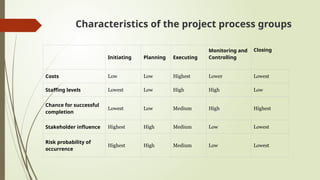
Characteristics of the project process groups
Initiating Planning Executing
Monitoring and
Controlling
Closing
Costs Low Low Highest Lower Lowest
Staffing levels Lowest Low High High Low
Chance for successful
completion
Lowest Low Medium High Highest
Stakeholder influence Highest High Medium Low Lowest
Risk probability of
occurrence
Highest High Medium Low Lowest
The Process Flow
 You should not think of the five process groups as onetime processes that are
performed as discrete elements. Rather, these processes interact and overlap with
each other.
 They are iterative and might be revisited and revised several times as the project is
refined throughout its life.
 This process of going back through the process groups is called an iterative process.
The conclusion of each process group allows the project manager and stakeholders to
re-examine the business needs of the project and determine whether the project is
satisfying those needs and it is another opportunity to make a go or no-go decision.
 Keep in mind that during phases of a project, the Closing process group outputs can
provide inputs to the Initiating process group.
 For example, once the feasibility study discussed earlier is accepted or closed, it
becomes an input to the Initiating process group of the design phase.
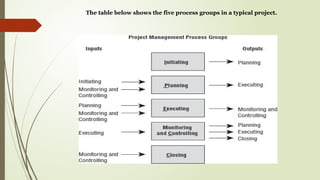
The table below shows the five process groups in a typical project.
ASSIGNMENT 1(GROUP PRESENTATIONS)
a) ILLUSTRATE EACH PROJECT MANAGEMENT PROCESS GROUP AND ALL THE
PROCESSES THAT MAKE UP THESE GROUPS (25)
b) FORMULATE A TABLE OF ALL THE PROCESSES, THEIR INPUTS, THEIR TOOLS AND
TECHNIQUES, THEIR OUTPUTS, AND THE KNOWLEDGE AREA IN WHICH THEY EACH
BELONG (25)
c) HIGHLIGHT THE NEED AND IMPORTANCE OF APPROPRIATE DATA IN A PROJECT AS
WELL AS THE TYPE OF DATA REQUIRED (25)
d) Explain the processes of developing and managing the Project
Management Office (PMO), including the PMO functions. (25)
e) PROJECT SCOPE MANAGEMENT AND ITS ELEMENTS
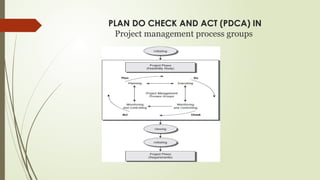
PLAN DO CHECK AND ACT (PDCA) IN
Project management process groups
Agile Project Management
 Agile project management is a method of managing projects in small, incremental portions of
work that can be easily assigned, easily managed, and completed within a short period of time called
an iteration or sprint. Iterations or sprints (the terms are interchangeable) are always time-bound.
 Typically, a sprint is a two week period but can be any short period of time defined and agreed on by
the team. The goal of a sprint is to produce a deliverable, or a tangible portion of a deliverable, by
the end of the sprint.
 An Agile project management approach allows the team to quickly adapt to new requirements and
allows for the continual assessment of the goals, deliverables, and functionality of the product,
service, or result of the project.
 Agile is used in civil projects for similar reasons. The development team can quickly adapt to
changes and new or refined functionality requests.
 Small deliverables are completed in a limited time frame.
 In a highly predictive or waterfall approach, the software program is defined in infinite detail
before any coding starts. In this approach, it is very difficult to change requirements or incorporate
new ideas.
 Agile is a highly iterative approach where requirements can be continually
defined and refined based on continuous feedback from the product owner.
 (RESEARCH FURTHER ON AGILE PROJECT MANAGEMENT-READ Manifesto for Agile, http://agilemanifesto.org/)
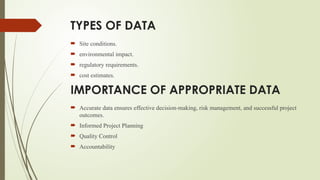
TYPES OF DATA
 Site conditions.
 environmental impact.
 regulatory requirements.
 cost estimates.
IMPORTANCE OF APPROPRIATE DATA
 Accurate data ensures effective decision-making, risk management, and successful project
outcomes.
 Informed Project Planning
 Quality Control
 Accountability
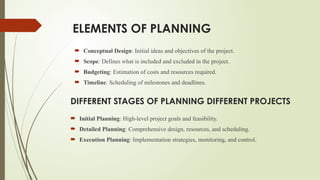
ELEMENTS OF PLANNING
 Initial Planning: High-level project goals and feasibility.
 Detailed Planning: Comprehensive design, resources, and scheduling.
 Execution Planning: Implementation strategies, monitoring, and control.
DIFFERENT STAGES OF PLANNING DIFFERENT PROJECTS
 Conceptual Design: Initial ideas and objectives of the project.
 Scope: Defines what is included and excluded in the project.
 Budgeting: Estimation of costs and resources required.
 Timeline: Scheduling of milestones and deadlines.
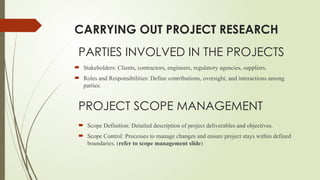
PROJECT SCOPE MANAGEMENT
 Scope Definition: Detailed description of project deliverables and objectives.
 Scope Control: Processes to manage changes and ensure project stays within defined
boundaries. (refer to scope management slide)
CARRYING OUT PROJECT RESEARCH
PARTIES INVOLVED IN THE PROJECTS
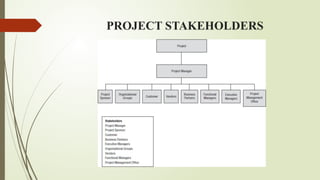
 Stakeholders: Clients, contractors, engineers, regulatory agencies, suppliers.
 Roles and Responsibilities: Define contributions, oversight, and interactions among
parties.
Stakeholders
 A project is successful when it achieves its objectives by producing deliverables that meet the expectations of
the stakeholders.
 Stakeholders are those folks (or organizations) with a vested interest in your project. They may be active or
passive as far as participation on the project goes, but the one thing they all have in common is that each of
them has something to either gain or lose as a result of the project.
 Stakeholder identification is not a onetime process. You should continue to ask fellow team members and
stakeholders if other stakeholders should be a part of the project.
 Key stakeholders can make or break the success of a project. Even if all the deliverables are met and the
objectives are satisfied, if your key stakeholders aren’t happy, nobody is happy.
 The project sponsor, generally an executive in the organization with the authority to assign resources and
enforce decisions regarding the project, is a stakeholder.
 The project sponsor generally serves as the tie-breaking decision maker and is one of the people on your
escalation path.
 The project sponsor is also the person who approves the project charter and gives the project manager the
authority to commence with the project.
PROJECT STAKEHOLDERS
 Many times, stakeholders have conflicting interests. It’s the project
manager’s responsibility to understand these conflicts and try to
resolve them.
 It’s also the project manager’s responsibility to manage stakeholder
expectations.
 Be certain to identify and meet with all key stakeholders early in the
project to understand their expectations, needs, and constraints.
 When in doubt, you should always resolve stakeholder conflicts in
favor of the customer.
ANALYZE PROJECT VIABILITY
Study the Relevance of the Project in a Specific Environment
 Environmental Impact Assessment: Assess how the project affects and fits within the local
environment and community.
 Social and Economic Benefits: Evaluate potential benefits and impacts on local economy
and society.
 Methods: Inspections, testing, adherence to standards.
 Application: Implement procedures to monitor and maintain quality throughout the project
lifecycle.
EXPLAIN THE RELEVANCE OF SPECIFICATION IN QUALITY
CONTROL
HOLD DESIGN MEETINGS
UNDERSTAND DIFFERENT PROJECT REQUIREMENTS
 Requirement Gathering: Collecting input from stakeholders to understand needs and
expectations.
 Requirement Analysis: Ensuring project requirements are clearly defined and feasible.
Project Scope Management
 Documentation: Clear and detailed scope statements.
 Adjustments: Procedures to handle scope changes and manage impacts.
Cost Management
 Budgeting: Preparing and managing the project budget.
 Cost Control: Monitoring expenses, avoiding cost overruns, and implementing cost-saving
measures.
CARRY OUT PROJECT REVIEW
Interpret Project Documents
 Types: Project plans, contracts, specifications, and reports.
 Usage: Understanding and utilizing documents for effective project management and
decision-making.
Study the Bill of Quantities (BOQ)
 Definition: A detailed list of quantities of materials and labor required.
 Purpose: Assists in budgeting, procurement, and resource management.
SUMMARY
projects exist to bring about a unique product, service, or result. Projects are temporary in nature and have definite beginning and ending dates.
 Stakeholders are those people or organizations that have a vested interest in the outcome of the project. Stakeholders include people such as the
project sponsor, the customer, key management personnel, operations managers, the project manager, contractors, suppliers, and more.
Projects are considered complete when the project meets or exceeds the expectations of the stakeholders.
 Project management is a discipline that brings together a set of tools and techniques to describe, organize, and monitor the work of project
activities. Project managers are the ones responsible for carrying out these activities. Projects might be organized into programs or portfolios
and might be managed centrally by a PMO.
 Project managers have a wide variety of skills. They should be versed not only in the field they’re working in but in general management skills as
well. Communication is the most important skill a project manager will use in the course of a project.
 Organizational structures come in a variety of forms, such as functional, project-oriented, and matrix. Functional organizations are traditional,
with hierarchical reporting structures. Project managers have little to no authority in this kind of organization. Project-oriented organizations
are structured around project work, and personnel report to project managers. Project managers have full authority in this organizational
structure. Matrix organizations are a combination of the functional and project-oriented. A project manager’s authority varies depending on the
structure of the matrix, be it a weak matrix, a balanced matrix, or a strong matrix.
 A project manager’s authority level, ability to manage the project budget, and availability of staff are also influenced by the project manager’s
interactions within the hierarchy of management (strategic, middle, and operations management) and the project management maturity level
of the organization.
 All projects have one or more phases and the progression of phases from the beginning to the end of the project is known as a project life cycle.
There are also development life cycles that can occur within a project life cycle.
 The Agile project management methodology is a method of managing projects in small, incremental portions of work that can be easily
assigned, easily managed, and completed within a short period of time called an iteration or sprint. The Scrum master, also known as the team
facilitator, project manager, project lead, or team coach helps the team to manage and organize work. Sprint planning meetings are held with
the Scrum master, product owner, and team members, who choose items from the backlog list to work on in the upcoming sprint. Daily
standups are held with team members, and the retrospective meeting is held at the end of the sprint to discuss the work completed and what
work will be carried over to the next sprint.
 The project management process groups are performed throughout the project’s life cycle. The process groups described in the PMBOK® Guide
are Initiating, Planning, Executing, Monitoring and Controlling, and Closing.
the end
thank you!

CIVIL PROJECT MANAGEMENT-2.pptx...civil engineering

  • 1.
  • 2.
    Learning Outcome 01 Atthe end of this session students must be able to: Identify viable projects in the field of Civil Engineering 1.1 identify potential projects. 1.2 carryout project research. 1.3 analyze project viability. 1.4 hold design meetings 1.5 carryout project reviews
  • 3.
    “Project” WHAT REALLYIS A PROJECT  A project is an endeavor that is undertaken to produce the results that are expected from the requesting party.  A project may be design only, construction only or a combination of design and construction.  A project consists of three components: scope, budget and schedule (Project triple constraints)
  • 4.
     Projects aretemporal in nature and have definitive start dates and definitive end dates. The project is completed when its goals and objectives are accomplished (by producing deliverables) to the satisfaction of the stakeholders.  Sometimes projects end when it’s determined that the goals and objectives cannot be accomplished or when the product, service, or result of the project is no longer needed and the project is canceled.  Projects exist to bring about a product, service, or result that didn’t exist before (innovation).  This might include tangible products, components of other products, services such as consulting or project management, and business functions that support the organization.  Projects might also produce a result or an outcome, such as a document that details the findings of a research study. In this sense, a project is unique. However, don’t be confused by the term unique. For example (project example)………......
  • 5.
    PROJECT CHARACTERISTICS A projecthas several characteristics:  Projects are unique.  Projects are temporary in nature and have a definite beginning and ending date.  Projects are completed when the project goals are achieved or it’s determined the project is no longer viable.  A successful project is one that meets the expectations of your stakeholders.  Projects initiate change in the organization.  Projects bring about business value creation.
  • 6.
    Viable Projects inCivil Engineering  Research in groups and discuss as a class
  • 7.
    PROJECT MANAGEMENT  Projectmanagement is a collection of processes that includes initiating a new project, planning, putting the project management plan into action, and measuring progress and performance.  It involves identifying the project requirements, establishing project objectives, balancing constraints, and taking the needs and expectations of the key stakeholders into consideration.  Planning is one of the most important functions you’ll perform during the course of a project. It sets the standard for the remainder of the project’s life and is used to track future project performance
  • 8.
    PROJECTS, PROGRAMS AND PORTFOLIOS PURPOSEAREA OF FOCUS MANAGER OBJECTIVES SUCCESS Project Applies and uses Project management processes, knowledge, and skills Delivery of products, services, or results Project manager Detailed objectives for the project Objectives are met and stakeholders are satisfied. Program Collections of related projects, Subsidiary programs, or work managed in a Coordinated fashion Project interdependencies Program manager Coordinated objectives and interdependencies across the program to realize benefits Collective objectives and benefits are realized. Portfolio Aligns projects/programs/ portfolios/Subsidiary portfolios/ operations to the organization’s strategic business objectives Optimizing efficiencies, objectives, costs, resources, risks, and schedules Portfolio managers. Project and program Managers may report to the portfolio. Align with the organization’s strategic business objectives. Prioritizes the right programs and projects, prioritizes work, and ensures resources are available Performance and benefit realization of the portfolio
  • 9.
    Understanding Project LifeCycles and Project Management Processes  Project life cycles are similar to the life cycle that parents experience raising their children to adulthood. Children start out as infants and generate lots of excitement wherever they go. However, not much is known about them at first.  So, you study them as they grow, and you assess their needs. Over time, they mature and grow (and cost a lot of money in the process) until one day the parents’ job is done.  Projects start out just like this and progress along a similar path. Someone comes up with a great idea for a project and actively solicits support for it.  The project, after being approved, progresses through the intermediate phases to the ending phase, where it is completed and closed out.
  • 10.
    Project Phases  Mostprojects are divided into phases, and all projects, large or small, have a similar project life cycle structure.  A project phase generally consists of segments of work that allow for easier management, planning, and control of the work and generally produce at least one deliverable by the end of the phase.  The work and the deliverables produced during a phase are typically unique to that phase. Some projects may consist of one phase, and others may have many phases.  Project phases are determined in any number of ways. For example, the PMO may have predefined phases based on stakeholder or management needs. (WHO ARE THE STAKEHOLDERS?)  The type of project itself and the industry you’re in may drive the phases of the project, as could decision points such as milestone completion or go/no-go decisions. The number of phases in the project life cycle depends on the project complexity and the industry you’re in.  Many industries use a feasibility study as one of the first phases of the project
  • 11.
  • 12.
    TYPES OF PROJECTFEASIBILITY KEY COMPONENTS  Technical feasibility Assessing whether the project can be completed with existing technology and resources.  Financial feasibility Evaluating the project’s financial viability, including costs, funding and potential returns.  Operational feasibility Examining whether the project can be integrated into existing business operations and processes.  Schedule feasibility Determining whether the project can be completed within the proposed timeline.  Legal Feasibility Ensuring the project complies with relevant laws, regulations, and permits.
  • 13.
    IMPORTANCE OF APROJECT FEASIBILITY STUDY  Informed decision making  Risk reduction  Resource Optimization  Time and cost savings  Enhanced Project Planning  Compliance and Regulatory Approval  Reduced Project Abandoned
  • 14.
    Phase Reviews  Project phasesevolve through the life cycle in a series of phase sequences called handoffs, or technical transfers. For projects that consist of sequential phases, the end of one phase typically marks the beginning of the next.  A phase review should be held at the end of each phase. This allows the project manager, stakeholders, and project sponsor the opportunity to determine whether the project should continue to the next phase.  They will examine the progress performance to date against the project charter, the business case, the project management plan, and the benefits management plan. As each phase is completed, it’s handed off to the next phase.
  • 15.
     For example,as we’ve discussed, a deliverable produced in the beginning phase of a project might be the feasibility study.  Producing, verifying, and accepting the feasibility study will signify the ending of this phase of the project. The successful conclusion of one phase does not guarantee authorization to begin the next phase.  Let’s say our feasibility study was performed for a construction project. The study showed that environmental impacts of a serious nature would result if the construction project were undertaken at the proposed location.  Based on this information, a go or no-go decision can be made at the end of the phase. Phase reviews give the project manager the ability to discover, address, and take corrective action against errors discovered during the phase.
  • 16.
    Phase Completion  Youwill recognize phase completion because each phase has a specific deliverable, or multiple deliverables, that marks the end of the phase.  A deliverable is an output that must be produced, verified, and approved to bring the phase, life-cycle process, or project to completion.  Deliverables are unique and verifiable and may be tangible or intangible, such as the ability to carry out a service.  Deliverables might also include things such as design documents, project budgets, blueprints, project schedules, prototypes, etc.
  • 17.
    Multi-phased Projects  Projectsmay consist of one or more phases. The phases of a project are often performed sequentially, but there are situations where performing phases concurrently, or overlapping the start date of a sequential phase, can benefit the project.  Multiple phases allow the team to analyze project performance and take action in concurrent and later phases to correct or prevent the problems that occurred previously.  According to the PMBOK® Guide, there are three ways project life-cycle phases could be performed:  Sequential- One phase must finish before the next phase can begin.  Iterative- More than one phase is being performed at the same time (running concurrently).  Overlapping- One phase starts before the prior phase completes.  Sometimes phases are overlapped to shorten or compress the project schedule. This is called fast tracking. Fast tracking means that a later phase is started prior to completing and approving the phase, or phases, that comes before it. This technique is used to shorten the overall duration of the project.
  • 18.
    Project Life Cycles All the collective phases the project progresses through from the start of the project until the end are called the project life cycle. Project life cycles are similar for all projects regardless of their size or complexity.  The phases that occur within the project life cycle are sequential and sometimes overlap each other, as we discussed in the previous section. Most projects consist of the following life- cycle :  Beginning the project  Planning and organizing the work of the project  Performing the work of the project  Closing out the project  A development life cycle consists of the phases of the project associated with producing the product, service, or result of the project. A development life cycle is performed within the project life cycle.
  • 19.
    Project Life CycleCategories 1. Predictive Life Cycle (Also Known as Plan-Driven Life Cycle or Waterfall)  The project scope is defined at the beginning of the project and changes are monitored closely.  If changes are made, you must revisit and modify project plans and formally accept the changes to the scope and subsequent project management plan.  The work of each phase is usually distinct and not repeated in other phases. Schedules and budgets are defined early in the life cycle as well.  Each phase has an emphasis on a different portion of the project activities, and different project management process groups are performed during each phase.
  • 20.
    2. Adaptive LifeCycles (Also Known as Agile or Change-Driven Life Cycle)  Adaptive life cycles are incremental or iterative. The scope is defined at the beginning of an iteration (predetermined periods of time) and is progressively elaborated over future iterations.  Choose this method when active participation of your stakeholders is required throughout the project, when you are not certain of all the requirements at the beginning of the project, or when you work in a changing environment.  This life cycle produces deliverables, or portions of deliverables, in short periods of time.  Each iteration must produce something that is ready for release at the end of the time period, and as such, the time period and the resources are fixed.  All iterations require the Planning process group, and most will perform all of the project management process groups.
  • 21.
    Project Life CycleCharacteristics  Project phases are performed within a project life cycle, as mentioned earlier. Project life cycles typically consist of initiating the project, performing the work of the project etc. As a result, most projects have the following characteristics in common:  In the beginning of the project life cycle, when the project is initiated, costs are low, and few team members are assigned to the project.  As the project progresses, costs and staffing increase and then taper off at closing.  The potential that the project will come to a successful ending is lowest at the beginning of the project its chance for success increases as the project progresses through its phases and life-cycle stages.  Risk is highest at the beginning of the project and gradually decreases the closer the project comes to completion.  Stakeholders have the greatest chance of influencing the project and the characteristics of the product, service, or result of the project in the beginning phases and have less and less influence as the project progresses.  This same phenomenon exists within the project management processes as well.
  • 22.
    Life-cycle differences Highly predictive(Waterfall) Hybrid Highly adaptive (Agile) Requirements Detailed specifications High-level planning and iterative refinements Progressively elaborated Risk and costs Reduced due to detailed plans Reduced through iterative evolution of initial high-level plans Reduced by progressively elaborating the requirements Stakeholders Heavily involved in gathering and documenting requirements. Involvement tapers off as project progresses. More involvement than highly predictive approach and less involvement than highly adaptive approach Continuous involvement and frequent feedback Initiating Performed once for the project or phase May be performed once with high-level objectives and elaborated as project progresses Performed regularly throughout the project. Relies heavily on customer knowledge Planning Once the plan is approved, changes that impact scope, time, or budget are controlled and minimized. High-level plan developed and elaborated as project progresses Progressive elaboration of scope based on continuous feedback Executing Performed all at once after requirements are defined and project plan is approved Work is performed as requirements are defined. Managed using iterations and sprint review. Small components of work delivered in each iteration Monitoring and Controlling Focus is on constraining changes that impact scope, budget, or schedule. Varies from minimal changes to welcoming changes Changes welcome. Track and monitor work using the backlog. Closing Close out the project or phase. May close the phase or continue in an iterative approach Continually address highest business value items first.
  • 23.
    Project Management ProcessGroups  Project management processes organize and describe the work of the project. The PMBOK® Guide describes five process groups used to accomplish this end.  These processes are performed by people and are interrelated and dependent on one another  These are the five project management process groups:  Initiating  Planning  Executing  Monitoring and Controlling  Closing
  • 24.
     All theseprocess groups have individual processes that collectively make up the group.  For example, the Initiating process group has two processes called Develop Project Charter and Identify Stakeholders. Collectively, these process groups including all their individual processes make up the project management process.  Projects or each phase of a project, start with the Initiating process and progress through all the processes in the Planning process group, the Executing process group, and so on, until the project is successfully completed or it’s canceled.  All projects must complete the Closing processes, even if a project is killed
  • 25.
    Project Phases vs.Project Management Process Groups  Don’t confuse project phases and project life cycles with the project management process groups. Project phases and life cycles describe how the work associated with the product of the project will be completed.  For example, a construction project might have phases such as feasibility study, design, build, inspection, and turnover.  The five project management process groups (Initiating, Planning, Executing, Monitoring and Controlling, and Closing) organize and describe how the project activities will be conducted in order to meet the project requirements.  These processes are generally performed for each phase of a large project.
  • 26.
    Characteristics of theproject process groups Initiating Planning Executing Monitoring and Controlling Closing Costs Low Low Highest Lower Lowest Staffing levels Lowest Low High High Low Chance for successful completion Lowest Low Medium High Highest Stakeholder influence Highest High Medium Low Lowest Risk probability of occurrence Highest High Medium Low Lowest
  • 27.
    The Process Flow You should not think of the five process groups as onetime processes that are performed as discrete elements. Rather, these processes interact and overlap with each other.  They are iterative and might be revisited and revised several times as the project is refined throughout its life.  This process of going back through the process groups is called an iterative process. The conclusion of each process group allows the project manager and stakeholders to re-examine the business needs of the project and determine whether the project is satisfying those needs and it is another opportunity to make a go or no-go decision.  Keep in mind that during phases of a project, the Closing process group outputs can provide inputs to the Initiating process group.  For example, once the feasibility study discussed earlier is accepted or closed, it becomes an input to the Initiating process group of the design phase.
  • 28.
    The table belowshows the five process groups in a typical project.
  • 29.
    ASSIGNMENT 1(GROUP PRESENTATIONS) a)ILLUSTRATE EACH PROJECT MANAGEMENT PROCESS GROUP AND ALL THE PROCESSES THAT MAKE UP THESE GROUPS (25) b) FORMULATE A TABLE OF ALL THE PROCESSES, THEIR INPUTS, THEIR TOOLS AND TECHNIQUES, THEIR OUTPUTS, AND THE KNOWLEDGE AREA IN WHICH THEY EACH BELONG (25) c) HIGHLIGHT THE NEED AND IMPORTANCE OF APPROPRIATE DATA IN A PROJECT AS WELL AS THE TYPE OF DATA REQUIRED (25) d) Explain the processes of developing and managing the Project Management Office (PMO), including the PMO functions. (25) e) PROJECT SCOPE MANAGEMENT AND ITS ELEMENTS
  • 30.
    PLAN DO CHECKAND ACT (PDCA) IN Project management process groups
  • 31.
  • 32.
     Agile projectmanagement is a method of managing projects in small, incremental portions of work that can be easily assigned, easily managed, and completed within a short period of time called an iteration or sprint. Iterations or sprints (the terms are interchangeable) are always time-bound.  Typically, a sprint is a two week period but can be any short period of time defined and agreed on by the team. The goal of a sprint is to produce a deliverable, or a tangible portion of a deliverable, by the end of the sprint.  An Agile project management approach allows the team to quickly adapt to new requirements and allows for the continual assessment of the goals, deliverables, and functionality of the product, service, or result of the project.  Agile is used in civil projects for similar reasons. The development team can quickly adapt to changes and new or refined functionality requests.  Small deliverables are completed in a limited time frame.  In a highly predictive or waterfall approach, the software program is defined in infinite detail before any coding starts. In this approach, it is very difficult to change requirements or incorporate new ideas.  Agile is a highly iterative approach where requirements can be continually defined and refined based on continuous feedback from the product owner.  (RESEARCH FURTHER ON AGILE PROJECT MANAGEMENT-READ Manifesto for Agile, http://agilemanifesto.org/)
  • 33.
    TYPES OF DATA Site conditions.  environmental impact.  regulatory requirements.  cost estimates. IMPORTANCE OF APPROPRIATE DATA  Accurate data ensures effective decision-making, risk management, and successful project outcomes.  Informed Project Planning  Quality Control  Accountability
  • 34.
    ELEMENTS OF PLANNING Initial Planning: High-level project goals and feasibility.  Detailed Planning: Comprehensive design, resources, and scheduling.  Execution Planning: Implementation strategies, monitoring, and control. DIFFERENT STAGES OF PLANNING DIFFERENT PROJECTS  Conceptual Design: Initial ideas and objectives of the project.  Scope: Defines what is included and excluded in the project.  Budgeting: Estimation of costs and resources required.  Timeline: Scheduling of milestones and deadlines.
  • 35.
    PROJECT SCOPE MANAGEMENT Scope Definition: Detailed description of project deliverables and objectives.  Scope Control: Processes to manage changes and ensure project stays within defined boundaries. (refer to scope management slide) CARRYING OUT PROJECT RESEARCH PARTIES INVOLVED IN THE PROJECTS  Stakeholders: Clients, contractors, engineers, regulatory agencies, suppliers.  Roles and Responsibilities: Define contributions, oversight, and interactions among parties.
  • 36.
    Stakeholders  A projectis successful when it achieves its objectives by producing deliverables that meet the expectations of the stakeholders.  Stakeholders are those folks (or organizations) with a vested interest in your project. They may be active or passive as far as participation on the project goes, but the one thing they all have in common is that each of them has something to either gain or lose as a result of the project.  Stakeholder identification is not a onetime process. You should continue to ask fellow team members and stakeholders if other stakeholders should be a part of the project.  Key stakeholders can make or break the success of a project. Even if all the deliverables are met and the objectives are satisfied, if your key stakeholders aren’t happy, nobody is happy.  The project sponsor, generally an executive in the organization with the authority to assign resources and enforce decisions regarding the project, is a stakeholder.  The project sponsor generally serves as the tie-breaking decision maker and is one of the people on your escalation path.  The project sponsor is also the person who approves the project charter and gives the project manager the authority to commence with the project.
  • 37.
  • 38.
     Many times,stakeholders have conflicting interests. It’s the project manager’s responsibility to understand these conflicts and try to resolve them.  It’s also the project manager’s responsibility to manage stakeholder expectations.  Be certain to identify and meet with all key stakeholders early in the project to understand their expectations, needs, and constraints.  When in doubt, you should always resolve stakeholder conflicts in favor of the customer.
  • 39.
    ANALYZE PROJECT VIABILITY Studythe Relevance of the Project in a Specific Environment  Environmental Impact Assessment: Assess how the project affects and fits within the local environment and community.  Social and Economic Benefits: Evaluate potential benefits and impacts on local economy and society.  Methods: Inspections, testing, adherence to standards.  Application: Implement procedures to monitor and maintain quality throughout the project lifecycle. EXPLAIN THE RELEVANCE OF SPECIFICATION IN QUALITY CONTROL
  • 40.
    HOLD DESIGN MEETINGS UNDERSTANDDIFFERENT PROJECT REQUIREMENTS  Requirement Gathering: Collecting input from stakeholders to understand needs and expectations.  Requirement Analysis: Ensuring project requirements are clearly defined and feasible. Project Scope Management  Documentation: Clear and detailed scope statements.  Adjustments: Procedures to handle scope changes and manage impacts. Cost Management  Budgeting: Preparing and managing the project budget.  Cost Control: Monitoring expenses, avoiding cost overruns, and implementing cost-saving measures.
  • 41.
    CARRY OUT PROJECTREVIEW Interpret Project Documents  Types: Project plans, contracts, specifications, and reports.  Usage: Understanding and utilizing documents for effective project management and decision-making. Study the Bill of Quantities (BOQ)  Definition: A detailed list of quantities of materials and labor required.  Purpose: Assists in budgeting, procurement, and resource management.
  • 42.
    SUMMARY projects exist tobring about a unique product, service, or result. Projects are temporary in nature and have definite beginning and ending dates.  Stakeholders are those people or organizations that have a vested interest in the outcome of the project. Stakeholders include people such as the project sponsor, the customer, key management personnel, operations managers, the project manager, contractors, suppliers, and more. Projects are considered complete when the project meets or exceeds the expectations of the stakeholders.  Project management is a discipline that brings together a set of tools and techniques to describe, organize, and monitor the work of project activities. Project managers are the ones responsible for carrying out these activities. Projects might be organized into programs or portfolios and might be managed centrally by a PMO.  Project managers have a wide variety of skills. They should be versed not only in the field they’re working in but in general management skills as well. Communication is the most important skill a project manager will use in the course of a project.  Organizational structures come in a variety of forms, such as functional, project-oriented, and matrix. Functional organizations are traditional, with hierarchical reporting structures. Project managers have little to no authority in this kind of organization. Project-oriented organizations are structured around project work, and personnel report to project managers. Project managers have full authority in this organizational structure. Matrix organizations are a combination of the functional and project-oriented. A project manager’s authority varies depending on the structure of the matrix, be it a weak matrix, a balanced matrix, or a strong matrix.  A project manager’s authority level, ability to manage the project budget, and availability of staff are also influenced by the project manager’s interactions within the hierarchy of management (strategic, middle, and operations management) and the project management maturity level of the organization.  All projects have one or more phases and the progression of phases from the beginning to the end of the project is known as a project life cycle. There are also development life cycles that can occur within a project life cycle.  The Agile project management methodology is a method of managing projects in small, incremental portions of work that can be easily assigned, easily managed, and completed within a short period of time called an iteration or sprint. The Scrum master, also known as the team facilitator, project manager, project lead, or team coach helps the team to manage and organize work. Sprint planning meetings are held with the Scrum master, product owner, and team members, who choose items from the backlog list to work on in the upcoming sprint. Daily standups are held with team members, and the retrospective meeting is held at the end of the sprint to discuss the work completed and what work will be carried over to the next sprint.  The project management process groups are performed throughout the project’s life cycle. The process groups described in the PMBOK® Guide are Initiating, Planning, Executing, Monitoring and Controlling, and Closing.
  • 43.