The Project Cycle
 Introduction
• Project management is a diverse discipline essential for successfully
executing tasks within organizations, spanning from small-scale
initiatives to large-scale endeavors. Central to effective project
management is understanding the concept of the project life cycle.
• The project life cycle serves as a roadmap, guiding project teams
through a series of phases from inception to completion. Each phase
encompasses specific activities, deliverables, and objectives,
contributing to the overall success of the project.
• By comprehensively understanding and navigating through the
project life cycle, organizations can streamline processes, mitigate
risks, optimize resource utilization, and achieve desired outcomes.
 What is a project
 A project is a temporary endeavor
undertaken to create a unique product,
service, or result.
 A project is a unique endeavor to produce
a set of deliverables within clearly
specified time, cost, and quality
constraints.
 Project characteristics:
Projects are different from standard business operational
activities as they:
• Are unique in nature.
• Have a defined time scale
• Have approved budget
• Have limited resources.
 Project Management:
Project management is application of knowledge, skills, tools,
and techniques to project activities to achieve project
requirements. Project management is accomplished through the
application and integration of the project management processes
of initiating, planning, executing, and closing (project cycle).
 The project life cycle?
What is a project life cycle?
• Project lifecycle is a collection of project phases
which are divided and assigned for the purpose of its
appropriate control, management and operation.
• Project lifecycle is the series of phases that a project
passes through from its initiation to its closure.
 The project life cycle?
Project phases:
A project phase is a collection of logically related
project activities that result in the completion of one or
more deliverable.
 The project life cycle
Project phases:
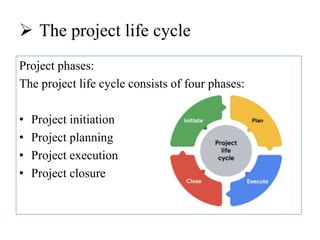
The project life cycle consists of four phases:
• Project initiation
• Project planning
• Project execution
• Project closure
 The project life cycle
Project initiation:
The first phase of a project is the initiation
phase. Key activities during this phase may
include:
 Develop a business case:
o A description of a problem
o List of available options to resolve the problem
o List of costs and benefits associated with each
solution option
o A recommended solution option for approval
 The project life cycle
Project initiation:
 Undertake a feasibility study:
o The purpose of feasibility study is to assess the likelihood of each
alternative solutions option achieving the benefit outlined in the
business case.
o Investigate whether the forecast costs are reasonable, the solution
is achievable, The risks are acceptable
 The project life cycle
Project initiation:
 Establish the term of reference:
o The term of reference define the vision, objectives, scope and deliverable for
the new project.
o They also describe the organization structure, activities, resources and funding.
 Appoint the project team:
The project manager creates a detailed job description for each role in the
project team, and recruits people in to each role based on their relevant skills and
experience.
 The project life cycle
Project initiation:
 Setup a project office:
The project office is the physical environment within which the team is based.
 Perform a phase review:
At the end of initiation phase, a phase review is performed.
 The project life cycle
Project planning:
During the planning phase, detailed planning is undertaken to
ensure that the activities performed during the execution
phase of the project are properly sequenced, resourced,
executed, and controlled.
 The project life cycle
Project planning:
The activities undertaken during the planning phase:
 The project life cycle
Project execution:
• The execution phase is typically the longest phase of
the project in terms of duration.
• During this phase the deliverables are physically
constructed and present to the customer for acceptance
 The project life cycle
Project closure:
• Following the acceptance of all project deliverables by
customer, the project will have met its objectives and be
ready for closure.
• Project closure is the last phase in the project life cycle,
and must be conducted formally so that the business
benefits delivered by the project are fully realized by
customer.
 The project life cycle
Project closure:
The project closure activities:
I. Perform project closure:
• Determining whether all of the project completion criteria have been met.
• Identifying any outstanding project activities
• Handing over all project deliverables and documentation to the customer
• Cancelling supplier contract
• Communicating the closure of the project to all stakeholder and interested
parties
 The project life cycle
Project closure:
The project closure activities:
II. Review project completion:
The final stage of a project involves an independent review to assess its
success based on its performance against predefined objectives.
 The project life cycle
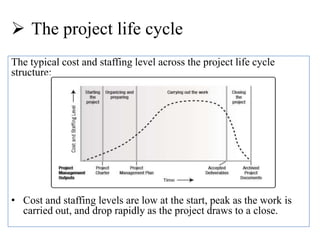
The typical cost and staffing level across the project life cycle
structure:
• Cost and staffing levels are low at the start, peak as the work is
carried out, and drop rapidly as the project draws to a close.
 The project life cycle
The project life cycle structure (ideal vs typical):
 Types of project life cycle
There are several types of project life cycles, each suited
to different project requirements, goals, and
environments. Here are some common types:
• Predictive (or Waterfall) Life Cycle
• Iterative Life Cycle
• Incremental Life Cycle
• Adaptive (or Agile) Life Cycle
 Types of project life cycle
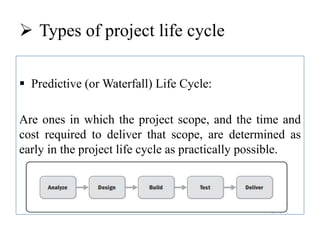
 Predictive (or Waterfall) Life Cycle:
Are ones in which the project scope, and the time and
cost required to deliver that scope, are determined as
early in the project life cycle as practically possible.
 Types of project life cycle
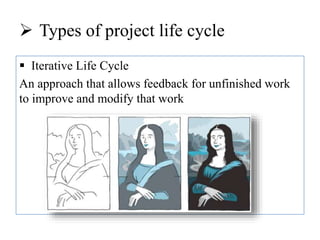
 Iterative Life Cycle
An approach that allows feedback for unfinished work
to improve and modify that work
 Types of project life cycle
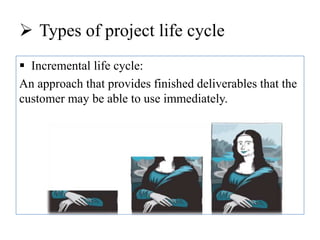
 Incremental life cycle:
An approach that provides finished deliverables that the
customer may be able to use immediately.
 Types of project life cycle
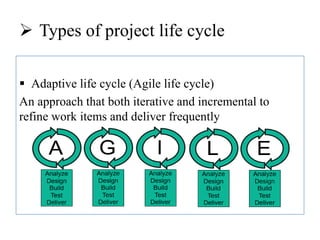
 Adaptive life cycle (Agile life cycle)
An approach that both iterative and incremental to
refine work items and deliver frequently
 Benefits of a project lifecycle:
• It provides a structure for project delivery.
• Its improves communication between team members.
• It enables progress to be tracked across the
organization.
• It provides for the progressive evolution of the
project.
• Its provides a structure for project delivery.
 Conclusion
• Understanding and adhering to the project life cycle
is essential for ensuring clear objectives, efficient
resource allocation, effective risk management,
stakeholder satisfaction, and overall project success.
• Adopting the project life cycle not only provides a
structured framework but also encourages
collaboration, transparency, and adaptability, crucial
elements for navigating the complexities of projects.
Presentation about project life cycle .pptx

Presentation about project life cycle .pptx

  • 1.
  • 2.
     Introduction • Projectmanagement is a diverse discipline essential for successfully executing tasks within organizations, spanning from small-scale initiatives to large-scale endeavors. Central to effective project management is understanding the concept of the project life cycle. • The project life cycle serves as a roadmap, guiding project teams through a series of phases from inception to completion. Each phase encompasses specific activities, deliverables, and objectives, contributing to the overall success of the project. • By comprehensively understanding and navigating through the project life cycle, organizations can streamline processes, mitigate risks, optimize resource utilization, and achieve desired outcomes.
  • 3.
     What isa project  A project is a temporary endeavor undertaken to create a unique product, service, or result.  A project is a unique endeavor to produce a set of deliverables within clearly specified time, cost, and quality constraints.
  • 4.
     Project characteristics: Projectsare different from standard business operational activities as they: • Are unique in nature. • Have a defined time scale • Have approved budget • Have limited resources.
  • 5.
     Project Management: Projectmanagement is application of knowledge, skills, tools, and techniques to project activities to achieve project requirements. Project management is accomplished through the application and integration of the project management processes of initiating, planning, executing, and closing (project cycle).
  • 6.
     The projectlife cycle? What is a project life cycle? • Project lifecycle is a collection of project phases which are divided and assigned for the purpose of its appropriate control, management and operation. • Project lifecycle is the series of phases that a project passes through from its initiation to its closure.
  • 7.
     The projectlife cycle? Project phases: A project phase is a collection of logically related project activities that result in the completion of one or more deliverable.
  • 8.
     The projectlife cycle Project phases: The project life cycle consists of four phases: • Project initiation • Project planning • Project execution • Project closure
  • 9.
     The projectlife cycle Project initiation: The first phase of a project is the initiation phase. Key activities during this phase may include:  Develop a business case: o A description of a problem o List of available options to resolve the problem o List of costs and benefits associated with each solution option o A recommended solution option for approval
  • 10.
     The projectlife cycle Project initiation:  Undertake a feasibility study: o The purpose of feasibility study is to assess the likelihood of each alternative solutions option achieving the benefit outlined in the business case. o Investigate whether the forecast costs are reasonable, the solution is achievable, The risks are acceptable
  • 11.
     The projectlife cycle Project initiation:  Establish the term of reference: o The term of reference define the vision, objectives, scope and deliverable for the new project. o They also describe the organization structure, activities, resources and funding.  Appoint the project team: The project manager creates a detailed job description for each role in the project team, and recruits people in to each role based on their relevant skills and experience.
  • 12.
     The projectlife cycle Project initiation:  Setup a project office: The project office is the physical environment within which the team is based.  Perform a phase review: At the end of initiation phase, a phase review is performed.
  • 13.
     The projectlife cycle Project planning: During the planning phase, detailed planning is undertaken to ensure that the activities performed during the execution phase of the project are properly sequenced, resourced, executed, and controlled.
  • 14.
     The projectlife cycle Project planning: The activities undertaken during the planning phase:
  • 15.
     The projectlife cycle Project execution: • The execution phase is typically the longest phase of the project in terms of duration. • During this phase the deliverables are physically constructed and present to the customer for acceptance
  • 16.
     The projectlife cycle Project closure: • Following the acceptance of all project deliverables by customer, the project will have met its objectives and be ready for closure. • Project closure is the last phase in the project life cycle, and must be conducted formally so that the business benefits delivered by the project are fully realized by customer.
  • 17.
     The projectlife cycle Project closure: The project closure activities: I. Perform project closure: • Determining whether all of the project completion criteria have been met. • Identifying any outstanding project activities • Handing over all project deliverables and documentation to the customer • Cancelling supplier contract • Communicating the closure of the project to all stakeholder and interested parties
  • 18.
     The projectlife cycle Project closure: The project closure activities: II. Review project completion: The final stage of a project involves an independent review to assess its success based on its performance against predefined objectives.
  • 19.
     The projectlife cycle The typical cost and staffing level across the project life cycle structure: • Cost and staffing levels are low at the start, peak as the work is carried out, and drop rapidly as the project draws to a close.
  • 20.
     The projectlife cycle The project life cycle structure (ideal vs typical):
  • 21.
     Types ofproject life cycle There are several types of project life cycles, each suited to different project requirements, goals, and environments. Here are some common types: • Predictive (or Waterfall) Life Cycle • Iterative Life Cycle • Incremental Life Cycle • Adaptive (or Agile) Life Cycle
  • 22.
     Types ofproject life cycle  Predictive (or Waterfall) Life Cycle: Are ones in which the project scope, and the time and cost required to deliver that scope, are determined as early in the project life cycle as practically possible.
  • 23.
     Types ofproject life cycle  Iterative Life Cycle An approach that allows feedback for unfinished work to improve and modify that work
  • 24.
     Types ofproject life cycle  Incremental life cycle: An approach that provides finished deliverables that the customer may be able to use immediately.
  • 25.
     Types ofproject life cycle  Adaptive life cycle (Agile life cycle) An approach that both iterative and incremental to refine work items and deliver frequently
  • 26.
     Benefits ofa project lifecycle: • It provides a structure for project delivery. • Its improves communication between team members. • It enables progress to be tracked across the organization. • It provides for the progressive evolution of the project. • Its provides a structure for project delivery.
  • 27.
     Conclusion • Understandingand adhering to the project life cycle is essential for ensuring clear objectives, efficient resource allocation, effective risk management, stakeholder satisfaction, and overall project success. • Adopting the project life cycle not only provides a structured framework but also encourages collaboration, transparency, and adaptability, crucial elements for navigating the complexities of projects.