University of the Philippines
                            College of Education
                            Educational Technology Department
                            EDTECH101


       Learning Theories that Influence
          Utilization of Instructional
                Media Resources


Ferdinand B. Pitagan, PhD
 Professor of Education
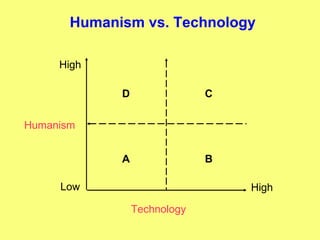
Humanism vs. Technology

     High

             D                C

Humanism


             A                B

     Low                          High

                 Technology
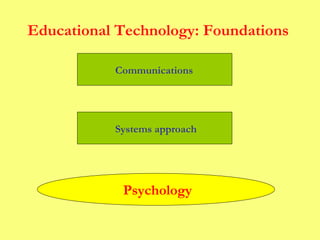
Educational Technology: Foundations

           Communications


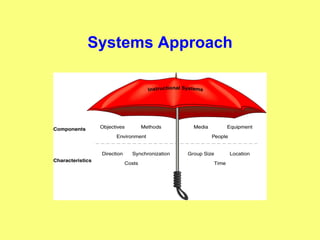
           Systems approach


            Psychology
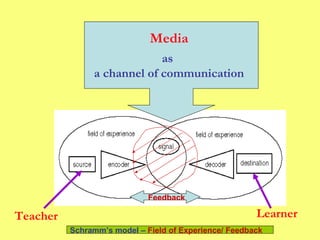
Media
                            as
               a channel of communication


                             Feedback

Teacher                                                Learner
          Schramm’s model – Field of Experience/ Feedback
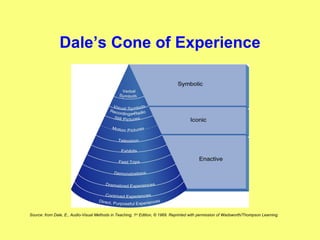
Dale’s Cone of Experience


Source: from Dale, E., Audio-Visual Methods in Teaching, 1st Edition, © 1969. Reprinted with permission of Wadsworth/Thompson Learning.
Systems Approach
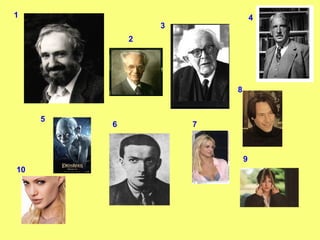
1                                4
                 3
             2


                         8


     5
         6           7


                             9
10
Psychology


•   Behaviorism
•   Cognitivism
•   Constructivism
Behaviorism

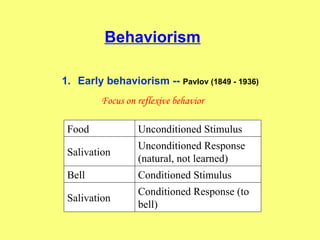
1. Early behaviorism -- Pavlov (1849 - 1936)
        Focus on reflexive behavior

 Food            Unconditioned Stimulus
                 Unconditioned Response
 Salivation
                 (natural, not learned)
 Bell            Conditioned Stimulus
                 Conditioned Response (to
 Salivation
                 bell)
Behaviorism


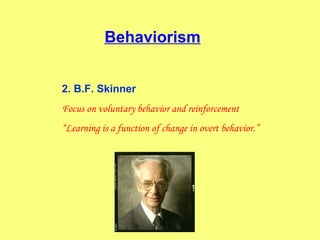
2. B.F. Skinner
Focus on voluntary behavior and reinforcement
“Learning is a function of change in overt behavior.”
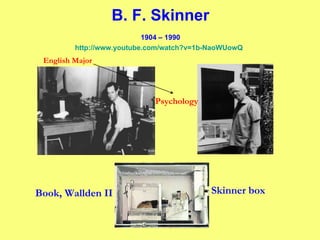
B. F. Skinner
                           1904 – 1990
         http://www.youtube.com/watch?v=1b-NaoWUowQ 
 English Major


                            Psychology


Book, Wallden II                          Skinner box
Behaviorism

“--- A person comes under the control of a stimulating
   environment, responds to subtle properties of that
   environment, and responds to it in many complex
   ways because of the consequences contingent upon
   earlier responses.---- ”


(Operant Conditioning)  
   http://www.youtube.com/watch?v=I_ctJqjlrHA 
6) Initial behavior –
7) Consequences (reinforcement/punishment) –
8) Next behavior
Behaviorism
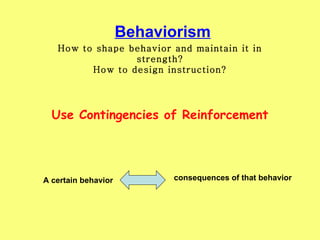
   How to shape behavior and maintain it in
                 strength?
         How to design instruction?


  Use Contingencies of Reinforcement


A certain behavior         consequences of that behavior
Behaviorism

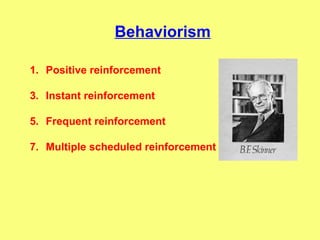
1. Positive reinforcement

3. Instant reinforcement

5. Frequent reinforcement

7. Multiple scheduled reinforcement
Behaviorism

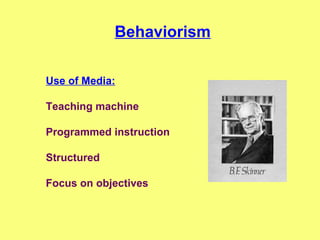
Use of Media:

Teaching machine

Programmed instruction

Structured

Focus on objectives
Cognitivism


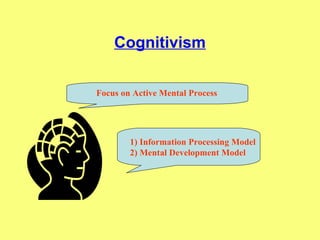
Focus on Active Mental Process


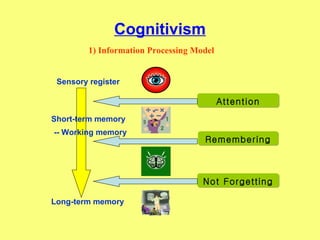
        1) Information Processing Model
        2) Mental Development Model
Cognitivism
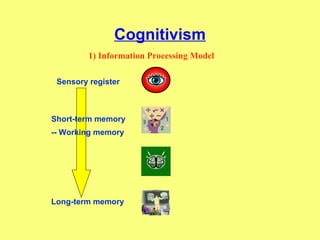
         1) Information Processing Model

 Sensory register


Short-term memory
-- Working memory


Long-term memory
Cognitivism
         1) Information Processing Model


 Sensory register

                                           Attention
Short-term memory
-- Working memory
                                     Remembering


                                     Not Forgetting

Long-term memory
Cognitivism
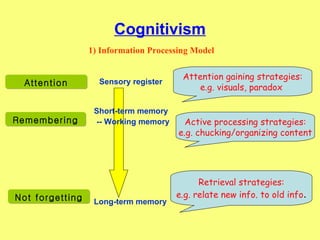
                 1) Information Processing Model

                                        Attention gaining strategies:
 Attention         Sensory register
                                            e.g. visuals, paradox

                  Short-term memory
Remembering       -- Working memory      Active processing strategies:
                                       e.g. chucking/organizing content


                                            Retrieval strategies:
Not forgetting                        e.g. relate new info. to old info.
                  Long-term memory
Cognitivism
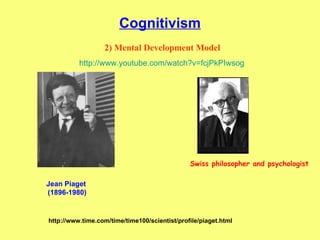
                  2) Mental Development Model
          http://www.youtube.com/watch?v=fcjPkPIwsog 


                                               Swiss philosopher and psychologist

Jean Piaget
(1896-1980)


http://www.time.com/time/time100/scientist/profile/piaget.html
Cognitivism
                    2) Mental Development Model


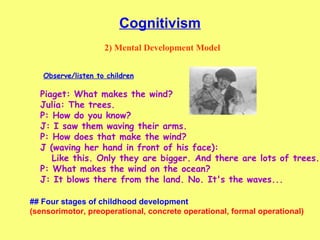
   Observe/listen to children

  Piaget: What makes the wind?
  Julia: The trees.
  P: How do you know?
  J: I saw them waving their arms.
  P: How does that make the wind?
  J (waving her hand in front of his face):
     Like this. Only they are bigger. And there are lots of trees.
  P: What makes the wind on the ocean?
  J: It blows there from the land. No. It's the waves...

## Four stages of childhood development
(sensorimotor, preoperational, concrete operational, formal operational)
Cognitivism
                2) Mental Development Model


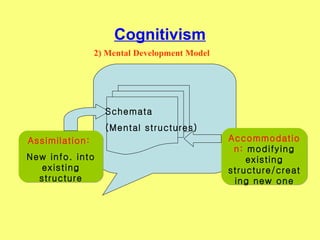
                  Schemata
                  (Mental structures)
Assimilation:                                 Accommodatio
                                               n: modifying
New info. into                                    existing
   existing                                   structure/creat
  structure                                    ing new one
Cognitivism
            2) Mental Development Model


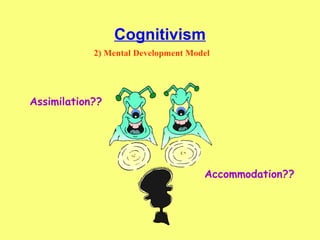
Assimilation??


                                     Accommodation??
Cognitivism
                2) Mental Development Model


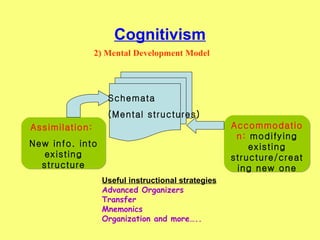
                   Schemata
                   (Mental structures)
Assimilation:                                      Accommodatio
                                                    n: modifying
New info. into                                         existing
   existing                                        structure/creat
  structure                                         ing new one
                 Useful instructional strategies
                 Advanced Organizers
                 Transfer
                 Mnemonics
                 Organization and more…..
Constructivism
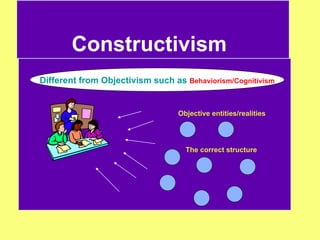
Different from Objectivism such as Behaviorism/Cognitivism


                                  Objective entities/realities


                                    The correct structure
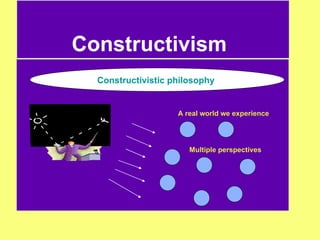
Constructivism
  Constructivistic philosophy


                    A real world we experience


                       Multiple perspectives
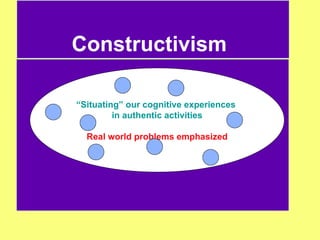
Constructivism

“Situating” our cognitive experiences
         in authentic activities

  Real world problems emphasized
Constructivism

• Learning: ????

• Teaching: ????
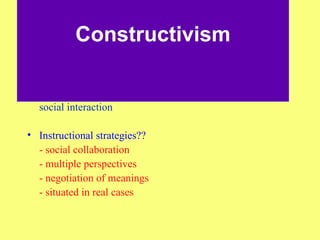
Constructivism

• Learning: based on experience/ construction of meaning/
  social interaction

• Instructional strategies??
  - social collaboration
  - multiple perspectives
  - negotiation of meanings
  - situated in real cases
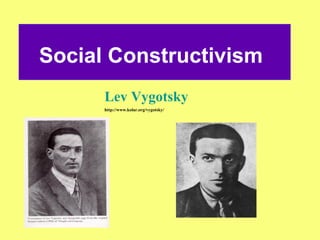
Social Constructivism
      Lev Vygotsky
      http://www.kolar.org/vygotsky/
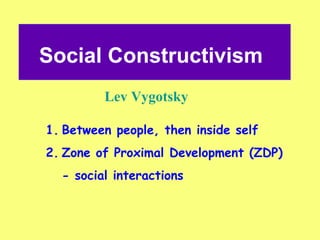
Social Constructivism
         Lev Vygotsky

1. Between people, then inside self
2. Zone of Proximal Development (ZDP)
  - social interactions
Remember!!
                 (A. Bednar, et al. )

 “Instructional design and development must be

   based upon some theory of learning and/or

cognition; effective design is possible only if the

developer has developed reflexive awareness of

  the theoretical basis underlying the design.”
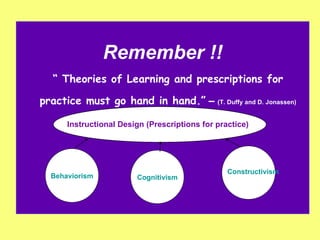
Remember !!
   “ Theories of Learning and prescriptions for

practice must go hand in hand.” – (T. Duffy and D. Jonassen)

      Instructional Design (Prescriptions for practice)


                                                 Constructivism
  Behaviorism           Cognitivism
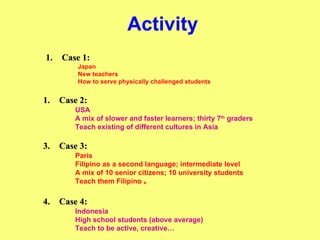
Activity
1.   Case 1:
         Japan
         New teachers
         How to serve physically challenged students


1.   Case 2:
        USA
        A mix of slower and faster learners; thirty 7th graders
        Teach existing of different cultures in Asia

3.   Case 3:
        Paris
        Filipino as a second language; intermediate level
        A mix of 10 senior citizens; 10 university students
        Teach them Filipino 。

4.   Case 4:
        Indonesia
        High school students (above average)
        Teach to be active, creative…
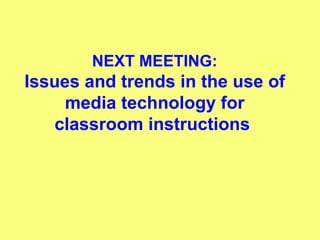
NEXT MEETING:
Issues and trends in the use of
     media technology for
   classroom instructions