Behaviorism
     vs.
 Cognitivism

Theories of Learning


           By: Elva V. Gonzalez
The foundations of
Behaviorism were built on the
 work of Watson and B.F.Skinner,
               and
Cognitivism were built on the work
 of Vygotsky, Dewey, Piaget and
 Bruner.
Behaviorism

a theory that it’s perspective
may be defined as a change of
    behavior as a result of
   experience-that can be
         measured.
Cognitivism

        a theory that it’s
perspective is a change in mental
      representations and
  associations brought about by
           experiences.
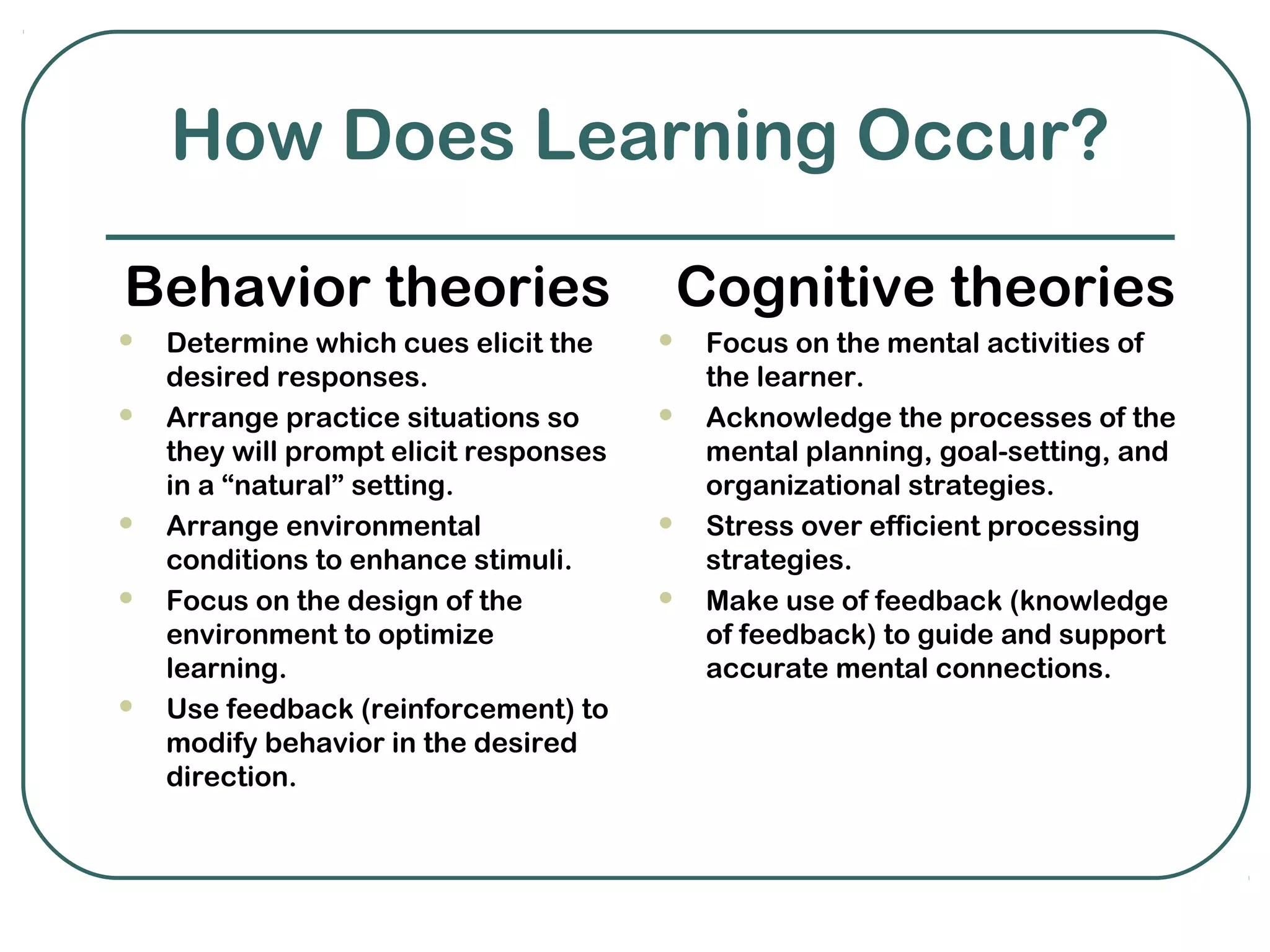
How Does Learning Occur?

Behavior theories                       Cognitive theories
   Determine which cues elicit the        Focus on the mental activities of
    desired responses.                      the learner.
   Arrange practice situations so         Acknowledge the processes of the
    they will prompt elicit responses       mental planning, goal-setting, and
    in a “natural” setting.                 organizational strategies.
   Arrange environmental                  Stress over efficient processing
    conditions to enhance stimuli.          strategies.
   Focus on the design of the             Make use of feedback (knowledge
    environment to optimize                 of feedback) to guide and support
    learning.                               accurate mental connections.
   Use feedback (reinforcement) to
    modify behavior in the desired
    direction.
Behaviorism and
       Cognitivism

are both a good way of teaching
     and learning processes,
    however, there are some
   differences between them
    which is very significant.
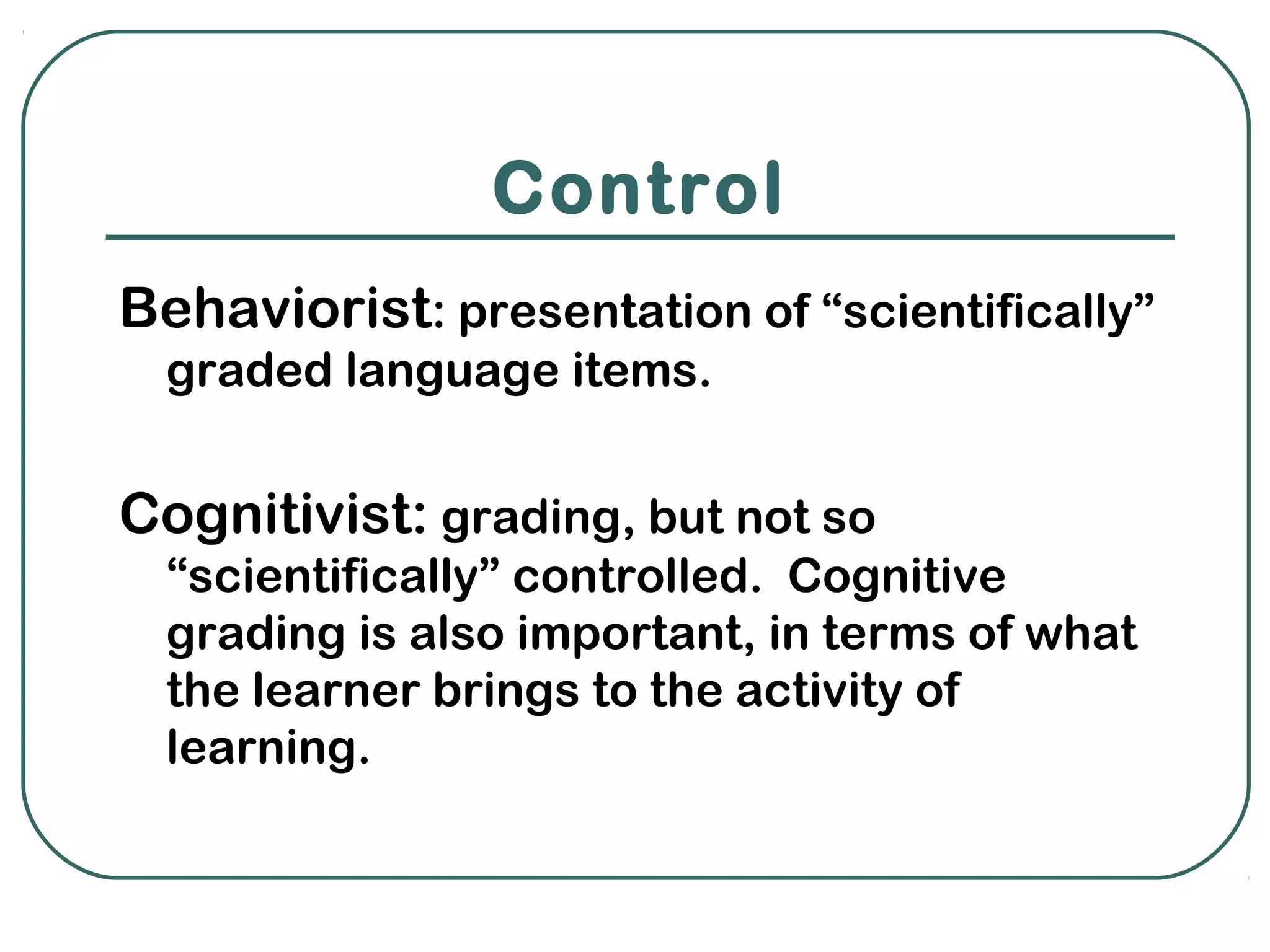
Control
Behaviorist: presentation of “scientifically”
  graded language items.


Cognitivist: grading, but not so
  “scientifically” controlled. Cognitive
  grading is also important, in terms of what
  the learner brings to the activity of
  learning.
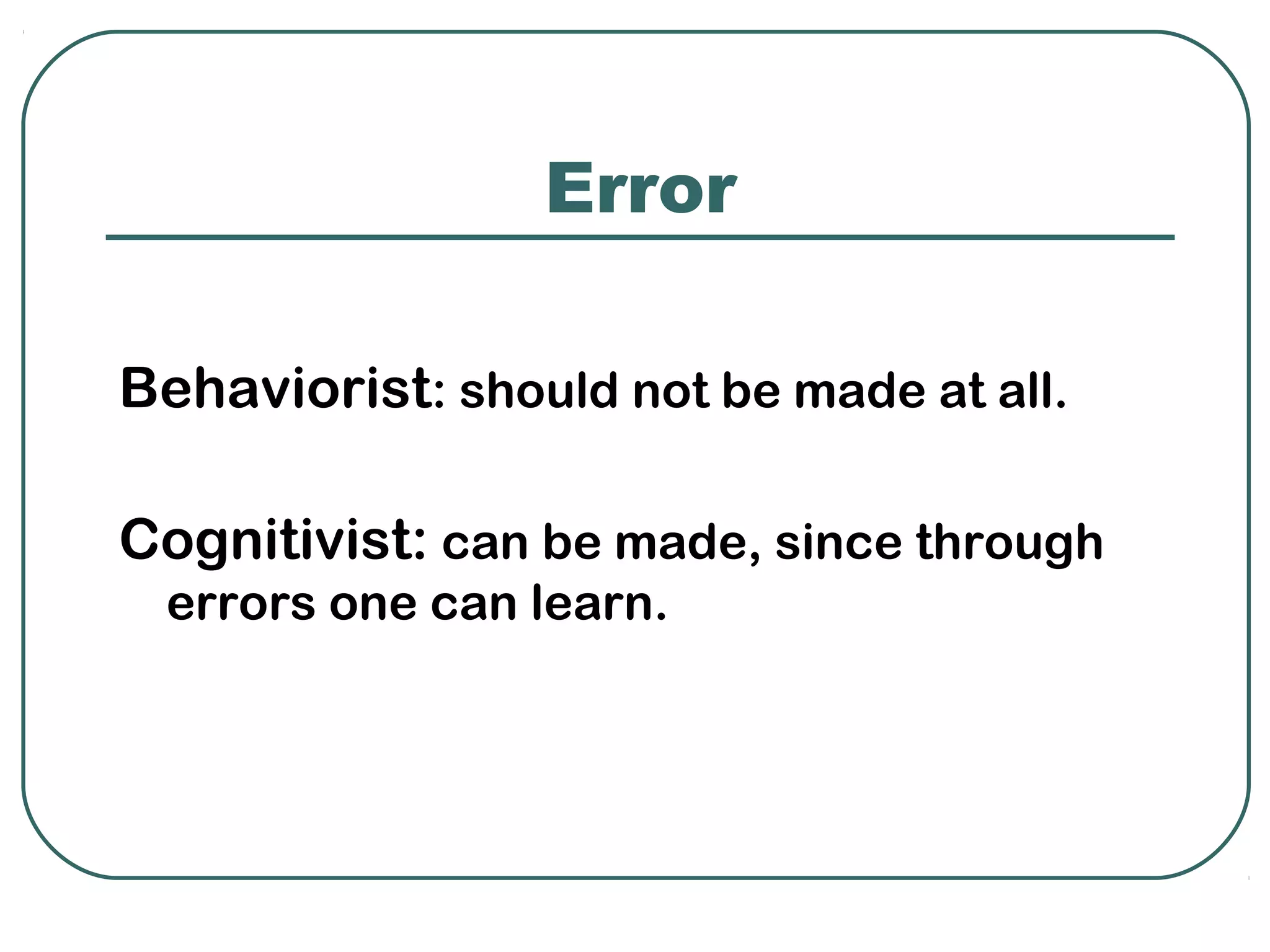
Error

Behaviorist: should not be made at all.

Cognitivist: can be made, since through
 errors one can learn.
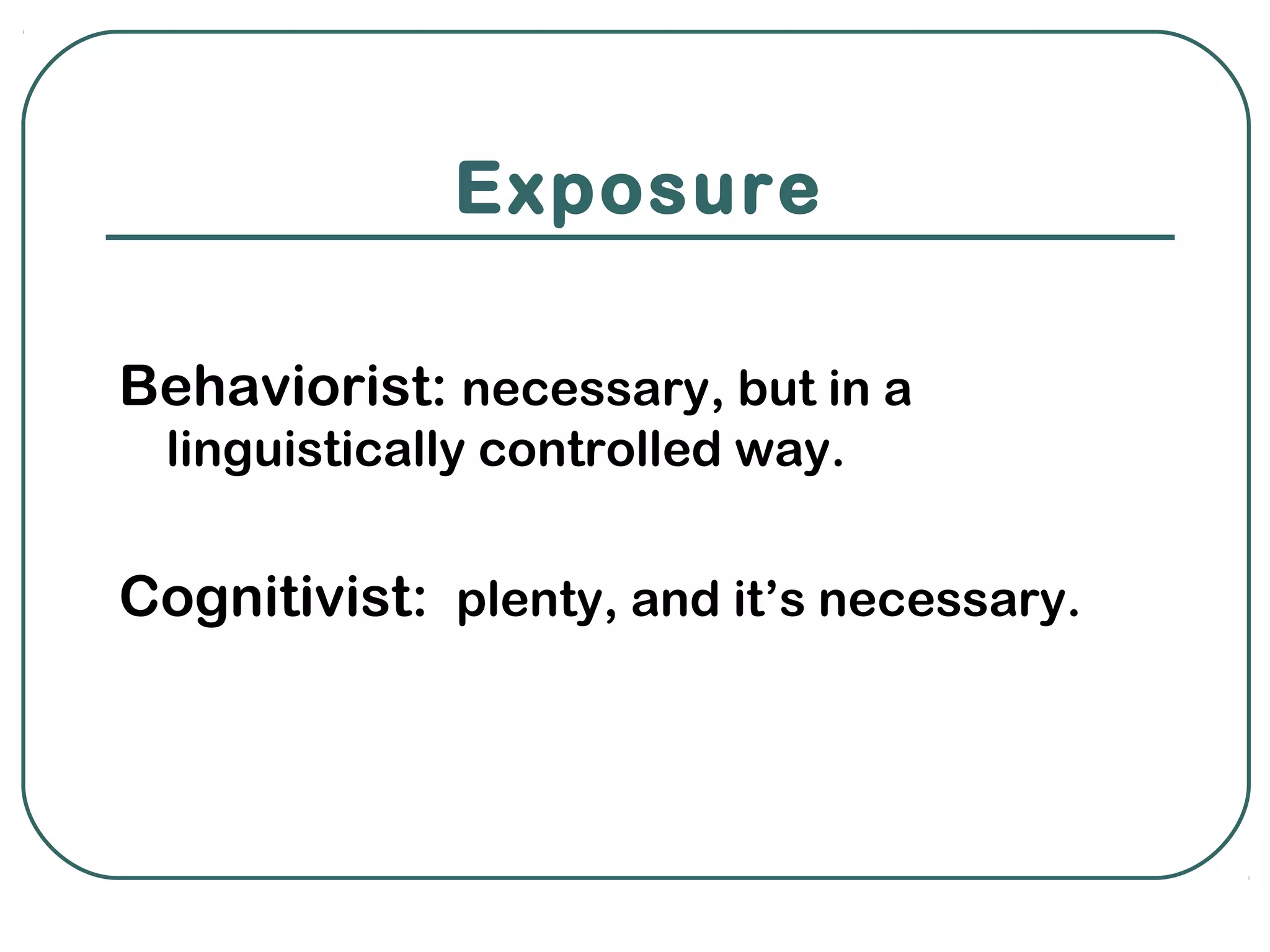
Exposure

Behaviorist: necessary, but in a
 linguistically controlled way.


Cognitivist: plenty, and it’s necessary.
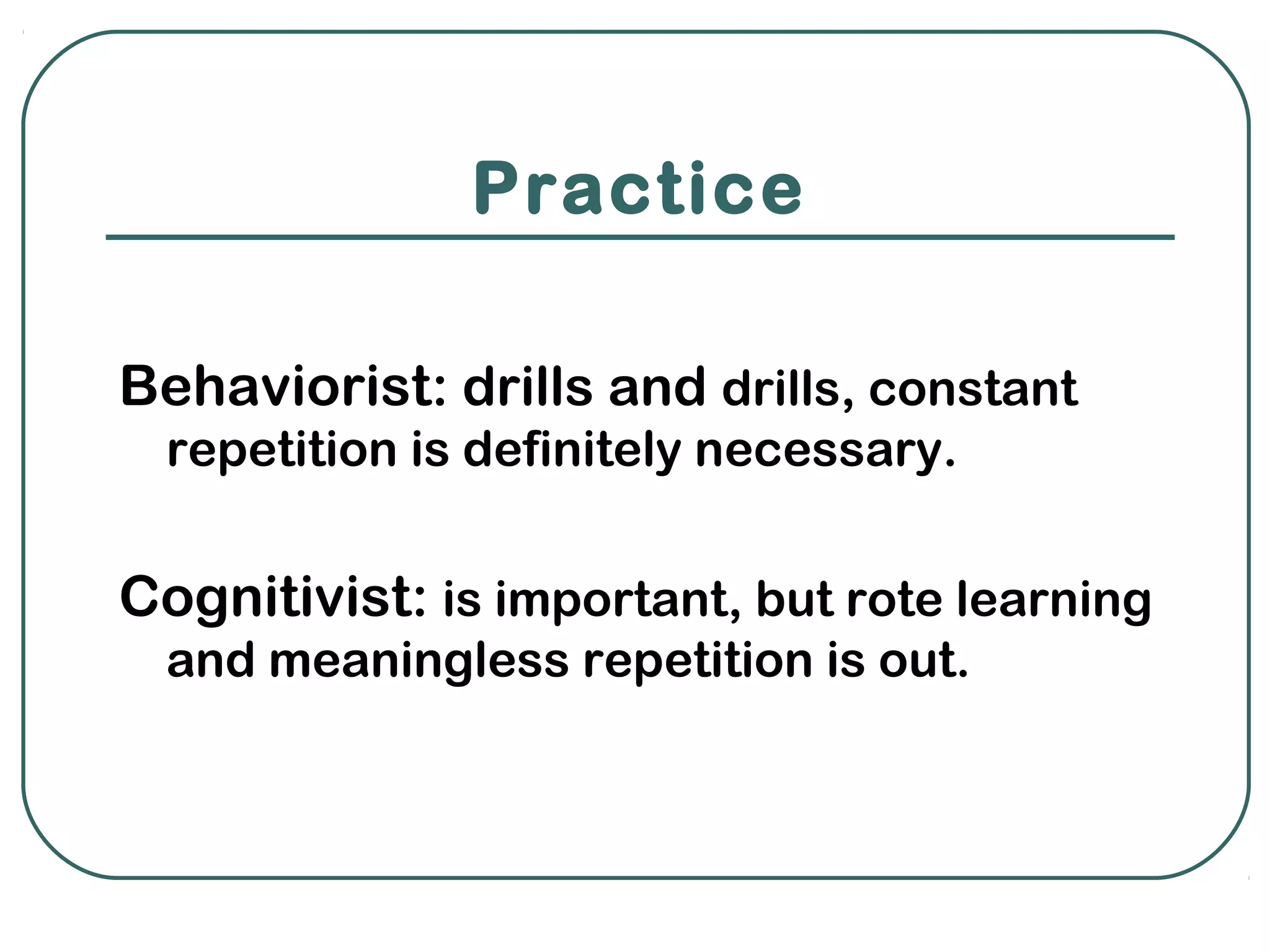
Practice

Behaviorist: drills and drills, constant
  repetition is definitely necessary.


Cognitivist: is important, but rote learning
  and meaningless repetition is out.
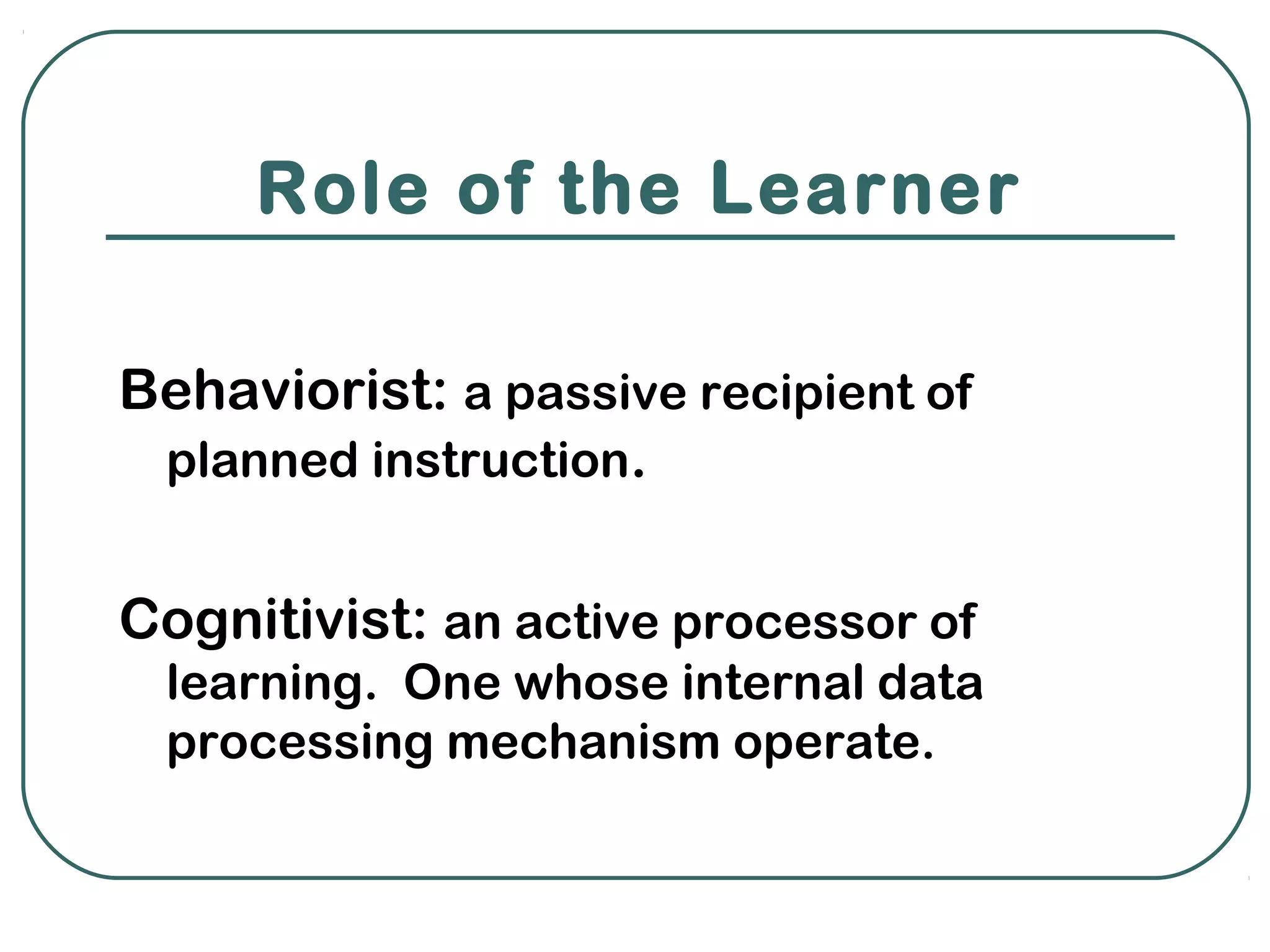
Role of the Learner

Behaviorist: a passive recipient of
 planned instruction.


Cognitivist: an active processor of
 learning. One whose internal data
 processing mechanism operate.
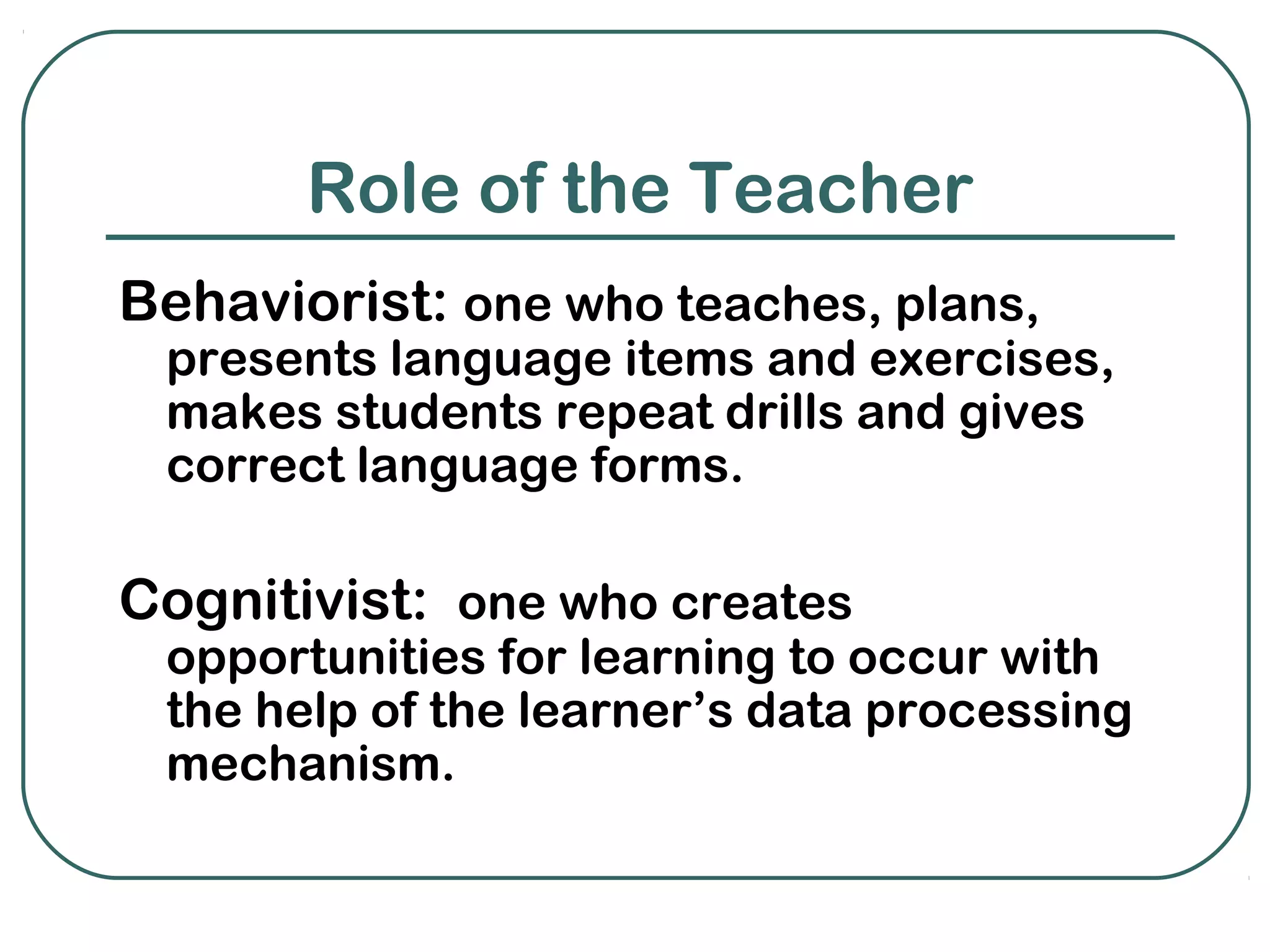
Role of the Teacher
Behaviorist: one who teaches, plans,
 presents language items and exercises,
 makes students repeat drills and gives
 correct language forms.

Cognitivist: one who creates
 opportunities for learning to occur with
 the help of the learner’s data processing
 mechanism.
The Language Syllabus
Behaviorist: based on the structures and
 vocabulary of language presented
 systematically.


Cognitivist: could be less systematically
 presented structures and vocabulary,
 functions, notions, situations, and
 cognitive functions.
Grading of Items
Behaviorist: Strict, clear, step by step
  (lock-step method)


Cognitivist: no so definite, since the
  individual language learner is involved.
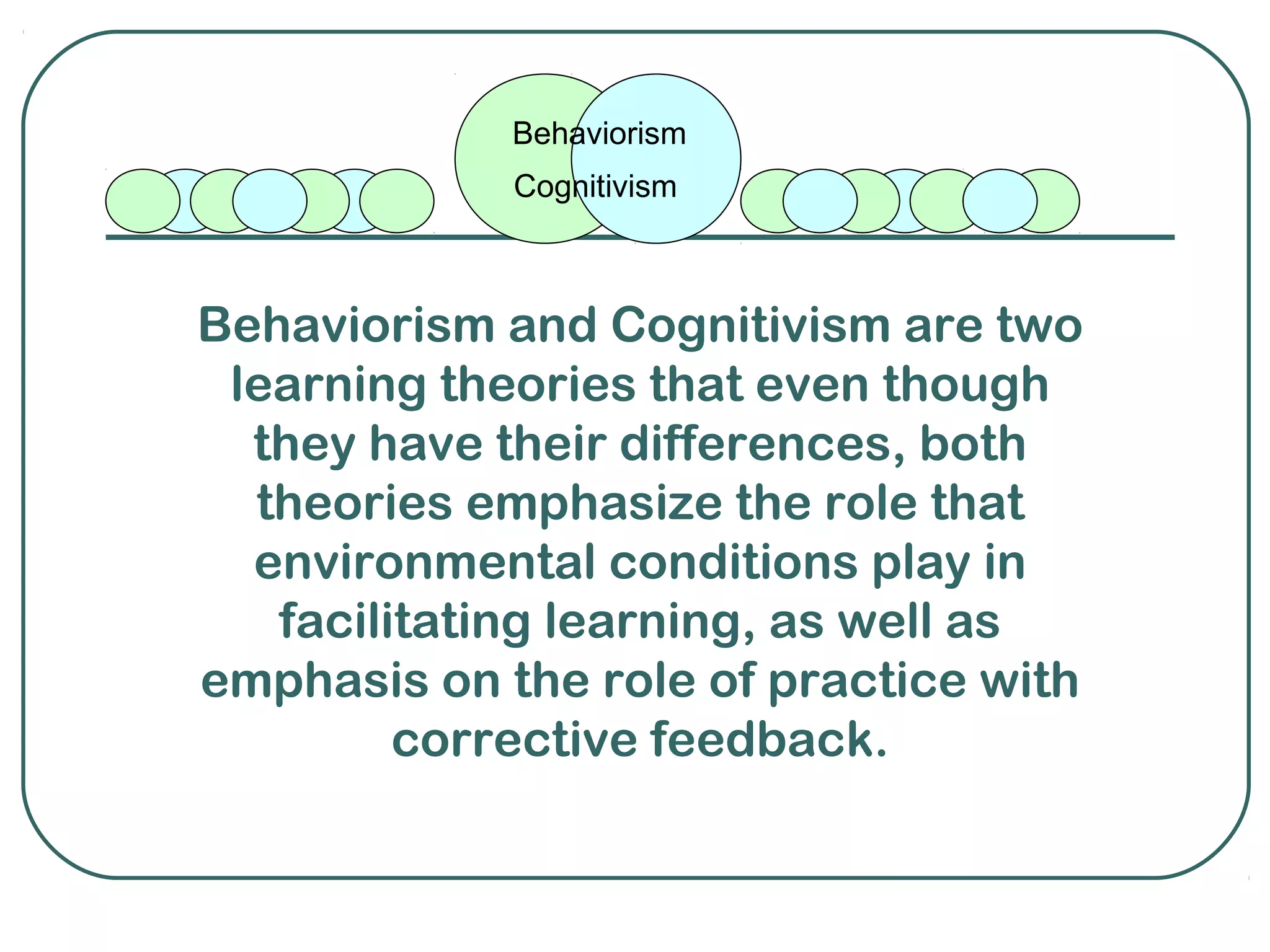
Behaviorism
             Cognitivism


Behaviorism and Cognitivism are two
 learning theories that even though
  they have their differences, both
  theories emphasize the role that
  environmental conditions play in
   facilitating learning, as well as
emphasis on the role of practice with
         corrective feedback.
References
Abbie Brown & Timothy D. Green (2006), The Essentials of Instructional Design.,

    Pearson Education , Inc. Upper Saddle River, New Jersey
http://www.forerunner.com/forerunner/X0497_DeMar_Behaviorism.html

What is Behaviorism? By Kendra Van Wagner
   http://psychology.about.com/od/behavioralpsychology/f/behaviorism/htm

http://geocities.com/learningenviornments/learningenvironments.html

Linguistics Valleys: theory of Teaching: Behaviorism and Cognitivism
    http://linguisticsearch.blogspot.com/2006/12/theory-of-teachingbehaviorism.htm

Cognitive Theories of Learning http://www.personal/psu/edu/users/w/x/wxh139/cognitive_1.htm

Learning-Theories (2008) http://www.learning-theories.com/cognitive.html

1998-2008 Funderstanding http://funderstanding.com/content/behavirism

Behaviorism & Cognitivism- antonio alonso

  • 1.
    Behaviorism vs. Cognitivism Theories of Learning By: Elva V. Gonzalez
  • 2.
    The foundations of Behaviorismwere built on the work of Watson and B.F.Skinner, and Cognitivism were built on the work of Vygotsky, Dewey, Piaget and Bruner.
  • 3.
    Behaviorism a theory thatit’s perspective may be defined as a change of behavior as a result of experience-that can be measured.
  • 4.
    Cognitivism a theory that it’s perspective is a change in mental representations and associations brought about by experiences.
  • 5.
    How Does LearningOccur? Behavior theories Cognitive theories  Determine which cues elicit the  Focus on the mental activities of desired responses. the learner.  Arrange practice situations so  Acknowledge the processes of the they will prompt elicit responses mental planning, goal-setting, and in a “natural” setting. organizational strategies.  Arrange environmental  Stress over efficient processing conditions to enhance stimuli. strategies.  Focus on the design of the  Make use of feedback (knowledge environment to optimize of feedback) to guide and support learning. accurate mental connections.  Use feedback (reinforcement) to modify behavior in the desired direction.
  • 6.
    Behaviorism and Cognitivism are both a good way of teaching and learning processes, however, there are some differences between them which is very significant.
  • 7.
    Control Behaviorist: presentation of“scientifically” graded language items. Cognitivist: grading, but not so “scientifically” controlled. Cognitive grading is also important, in terms of what the learner brings to the activity of learning.
  • 8.
    Error Behaviorist: should notbe made at all. Cognitivist: can be made, since through errors one can learn.
  • 9.
    Exposure Behaviorist: necessary, butin a linguistically controlled way. Cognitivist: plenty, and it’s necessary.
  • 10.
    Practice Behaviorist: drills anddrills, constant repetition is definitely necessary. Cognitivist: is important, but rote learning and meaningless repetition is out.
  • 11.
    Role of theLearner Behaviorist: a passive recipient of planned instruction. Cognitivist: an active processor of learning. One whose internal data processing mechanism operate.
  • 12.
    Role of theTeacher Behaviorist: one who teaches, plans, presents language items and exercises, makes students repeat drills and gives correct language forms. Cognitivist: one who creates opportunities for learning to occur with the help of the learner’s data processing mechanism.
  • 13.
    The Language Syllabus Behaviorist:based on the structures and vocabulary of language presented systematically. Cognitivist: could be less systematically presented structures and vocabulary, functions, notions, situations, and cognitive functions.
  • 14.
    Grading of Items Behaviorist:Strict, clear, step by step (lock-step method) Cognitivist: no so definite, since the individual language learner is involved.
  • 15.
    Behaviorism Cognitivism Behaviorism and Cognitivism are two learning theories that even though they have their differences, both theories emphasize the role that environmental conditions play in facilitating learning, as well as emphasis on the role of practice with corrective feedback.
  • 16.
    References Abbie Brown &Timothy D. Green (2006), The Essentials of Instructional Design., Pearson Education , Inc. Upper Saddle River, New Jersey http://www.forerunner.com/forerunner/X0497_DeMar_Behaviorism.html What is Behaviorism? By Kendra Van Wagner http://psychology.about.com/od/behavioralpsychology/f/behaviorism/htm http://geocities.com/learningenviornments/learningenvironments.html Linguistics Valleys: theory of Teaching: Behaviorism and Cognitivism http://linguisticsearch.blogspot.com/2006/12/theory-of-teachingbehaviorism.htm Cognitive Theories of Learning http://www.personal/psu/edu/users/w/x/wxh139/cognitive_1.htm Learning-Theories (2008) http://www.learning-theories.com/cognitive.html 1998-2008 Funderstanding http://funderstanding.com/content/behavirism