Welcome & Introductions
        Who Are We?

       Andrew Conroy
andrew_conroy2000@yahoo.com

      Kathleen Rowlands
 kathleen.rowlands@csun.edu

         Lynnette Ryan
lynn.ryan@thevalleyacademy.net
Welcome & Introductions
            Who Are You?

               Your Name
            Where You Teach
        The Subjects You Teach
Your Favorite Part About Teaching Science
 What You Hope to Get Out of the Week
   Curriculum Map

   Methods and strategies shared can be used with all
    kids, at all grade levels and at all ability levels

   Resources Available

   What You’ll Need to Bring

   Questions?
Compelling Reasons to Use Science Notebooks
     Notebooks Are Thinking Tools – Notebooks are tools that
      encourage students to use writing for thinking and
      empowers them to become active in their own learning as
      they construct and process conceptual understandings.

     Notebooks Guide Teacher Instruction – Notebooks give
      teachers access into student thinking—what they do and
      don’t understand, what misconceptions they have, and
      the organizational skills they use. Notebook assessment
      can guide next steps in instruction.
Compelling Reasons to Use Science Notebooks (cont’d)
    Notebooks  Enhance Literacy Skills – Students have
    the opportunity to use various forms of expository
    writing in science notebooks (procedural, narrative,
    descriptive, labeling, and other styles). Notebooks
    offer numerous opportunities to develop and
    enhance students’ written, visual, and oral
    communication skills.

    Notebooks  Support Differentiated Learning –
    Notebooks provide the structure and support for
    students at different ability levels to succeed.
Compelling Reasons to Use Science Notebooks (cont’d)
      Notebooks Give Students a Way and a Place to Organize
       Their Learning – Students are writing their own
       “textbook” in a sense. They have a record of their
       learning that can be used a resource throughout the class
       and in future learning. (Science Notebook as Learning Log, pg. 65

       in Content-Area Writing)


      Notebooks Foster Teacher Collaboration – Developing
       science notebook exemplars, assessment strategies,
       literacy strategies, and ways to tailor notebooks to a
       school’s teaching and learning philosophy offer topics for
       important conversations between teachers.
   Title Page – name, class title, month/year

   Table of Contents (3 pages) – 3-column format with
    page #, assignment title, assignment start date

   Glossary (3-4 pages) – title

   Page Numbers – upper right corner of each right
    hand page
Drip Drill: Using Science Notebooks and Line of
         Learning to Deepen Scientific Thinking

•   Good beginning of the year lab investigation

•   I’m assuming you know about variables, stating
    hypotheses, writing procedures, and creating data
    tables—with kids I teach each piece using modeling
    and gradual release
Journal Assignment
                  (3-5 minutes)

Think of jumping into a pool off of a diving
  board, or of jumping into a puddle after it
  rains. What are the things (variables) that
  could affect how big of a splash you will make?
Lab Objective

In this lab, we will practice using the scientific method while
    investigating the effect of drop height on the size and shape
    of water droplet splatters when they land. We will be
    careful to change only the one variable whose effect we will
    observe (drop height). This is called the manipulated
    variable. All of the other conditions must be kept
    completely identical. These conditions are the controlled
    variables. The variable we are measuring (size and shape of
    splatter) is called the responding variable.
Lab Conclusion

•   What were we trying to find/learn? (investigative question)
•   How did we look for the answer? (materials/procedure)
•   What did we find/learn? (specific claims, supported by
    data)
•   What does it mean? Why is it important? (learning that
    transfers to other disciplines and the ‘real world’)
   What are your thoughts about the lesson and the strategies used?

   How might you use this strategy with your students?

   What are the challenges you see with this type of lesson?

   What resources do you need before trying this type of lesson or
    strategy?
Think about the Common Core video you
  watched last night…

   On the next blank page of your science notebook,
   write down a few things that stood out to you or
   seemed important
   Share with your elbow partner
   Be prepared to share out with whole group
•   After you choose your standards, partner with another person
    and fill in the table with Concept & Skills, Blooms Taxonomy
    Levels, and Possible Lessons or Instructional Routines for the
    standards you chose.

•   Put your ideas onto chart paper. Include the Standard.

•   Post around the room and be ready to share with the group.
•   How does your teaching practice currently support the
    Common Core Standards?
•   What are the areas in which you can improve?
•   What are the resources you need in order to
    incorporate the Common Core into your classroom
    practice? (i.e. planning time, training, materials, teaching
    partner, etc.)
•   Socratic Seminar Article

•   Chapter 1 and 2 (pg. 1-29) in Content-Area
    Writing: Every Teacher’s Guide
On an index card, write a one sentence
 analysis of the difference between
 Writing-to-Learn and Public Writing.
•   Take 5 minutes and review last night’s reading
    —Chapter 1 and 2; Writing in the Content Area

•   What stood out to you? What was important?

•   Choose one or two sentences that seem the
    most important to you.

•   Be prepared to share when the group is ready.
Content-Area Writing: Every Teacher’s Guide

•   Excellent resource for all content-area teachers, no matter
    where you are in your practice

•   Offers great ideas for lesson study with colleagues (i.e
    facilitating a writer’s workshop, common practice for supporting
    the writing process, etc.)

•   Chapters Overview Handout

•   Writing-to-Learn strategies in this workshop
   How do you use informal (writing to learn) and formal
    (public writing) writing in your content area?

   After the reading and our discussion, how do you
    think you might imbed more of these writing strategies
    in your classroom?
Socratic Seminar in the Science Classroom: Jerry
          Sandusky—a Head Case Puzzle

   Take about 5 minutes to review the article. Be sure
    you have “interacted” with and annotated the text

   What questions do you have? What can you add to a
    discussion about this topic?
Socratic Seminar in the Science Classroom: Jerry
          Sandusky—a Head Case Puzzle

   Organizational Handouts (mapmaker, conversation keeper, scribe)
    • keep students focused on the task at hand; they always have
      a job to do
    • Supports discussion about the discussion – “data driven”

   Inner & Outer Circle

   Process may seem too in-depth and cumbersome, but the
    first time is the most work
   What are your thoughts about the lesson and the strategies used?

   How might you use this strategy with your students?

   What are the challenges you see with this type of lesson?

   What resources do you need before trying this type of lesson or
    strategy?
•   “Text” is key

•   Organization (possible questions, timing, handouts, etc.)

•   Student accountability

•   Safe environment (goal is to have a supportive discussion, teach
    language, i.e. “what do you think?”)

•   Teacher as uninvolved as possible

•   One-sided conversations

•   Other ideas?
   Our goal is to help you incorporate at least
    •   1 technology-based strategy (i.e. podcast, blog, wiki,
        etc.)
    •   2-3 Writing to Learn activities
    •   1 Public Writing activity


   Working with partners or in teams is
    encouraged!

   Start where you are
What type of science writing (genres) should we
   be exposing students to? Which genres should
                  students practice?


Genre - A category of artistic composition, as in music or literature,
   characterized by similarities in form, style, or subject matter.
Rigor Plus Support: How Science Teachers Use Literacy
       Techniques to Get Students Ready for College


•   Write-Around Strategy (also called Silent Discussion)
    • Each person start with blank page in science notebook
    • Put your initials in the upper left-hand margin
    • When time starts, write your thoughts, reactions,
      questions, or feelings about the article
    • Use all the time for writing
    • When I say pass, pass your paper to the right without
      talking
Rigor Plus Support: How Science Teachers Use Literacy
       Techniques to Get Students Ready for College


•   Read the entry on the page, and just beneath it, write
    for one minute.
•   You can tell your reaction, make a comment, ask
    questions, share a connection you’ve made, agree or
    disagree, or raise a whole new idea.
•   Remember to put your initials in the left margin and
    write for the entire time.
Rigor Plus Support: How Science Teachers Use Literacy
       Techniques to Get Students Ready for College

•   Continue the conversation out loud for a few
    moments.

•   Each group share one highlight or thread of
    discussion.
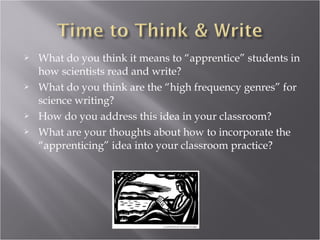
   What do you think it means to “apprentice” students in
    how scientists read and write?
   What do you think are the “high frequency genres” for
    science writing?
   How do you address this idea in your classroom?
   What are your thoughts about how to incorporate the
    “apprenticing” idea into your classroom practice?
Ecosystem from My Viewpoint: Using Table
             Mapping as Pre-Writing

•   Assume some prior knowledge for this demo

•   Use with kids during or after a course of study to see
    how their thoughts are organized

•   Walking around and asking students why they are
    mapping in a particular way, and by listening to
    their discussions, we can get an idea of their
    understanding
Ecosystem from My Viewpoint: Using Table
             Mapping as Pre-Writing

•   You have 20 minutes with your group to arrange
    and connect the words and pictures given to you

•   Show relationships with the arrows

•   You do not have to use all the arrows, but you do
    need to use all the words and pictures
Ecosystem from My Viewpoint: Using Table
             Mapping as Pre-Writing

•   Choose one person to stay with your group map to
    explain your layout

•   The rest of your group will be rotating to hear/see
    what other groups did

•   Your group will have 5 minutes to discuss what you
    saw and make any adjustments you want to make to
    your map
Ecosystem from My Viewpoint: Using Table
             Mapping as Pre-Writing

•   On the next blank page of your science notebook
     Title and date the page

     Write a description of your map, explaining
      relationships and connections you made
   What are your thoughts about the lesson and the strategies used?

   How might you use this strategy with your students?

   What are the challenges you see with this type of lesson?

   What resources do you need before trying this type of lesson or
    strategy?
   Our goal is to help you incorporate at least
    •   1 technology-based strategy (i.e. podcast, blog, wiki,
        etc.)
    •   2-3 Writing to Learn activities
    •   1 Public Writing activity


   Working with partners or in teams is
    encouraged!

   Start where you are
   Word Wall

   Entrance & Exit Tickets

   Making Science Accessible to English Learners: A
    Guidebook for Teachers
•   Share/Present
    • Your lesson plan ideas that incorporate any literacy
      strategies
    • Your questions, concerns, etc. ~ things this group may be
      able to help with


•   Feedback
    • Outstanding ideas ~ what do you appreciate about the
      lesson?
    • Suggestions ~ areas you have suggestions/ideas about
      how to improve (“I’m wondering…”)

Science workshop presentation

  • 2.
    Welcome & Introductions Who Are We? Andrew Conroy andrew_conroy2000@yahoo.com Kathleen Rowlands kathleen.rowlands@csun.edu Lynnette Ryan lynn.ryan@thevalleyacademy.net
  • 3.
    Welcome & Introductions Who Are You? Your Name Where You Teach The Subjects You Teach Your Favorite Part About Teaching Science What You Hope to Get Out of the Week
  • 4.
    Curriculum Map  Methods and strategies shared can be used with all kids, at all grade levels and at all ability levels  Resources Available  What You’ll Need to Bring  Questions?
  • 5.
    Compelling Reasons toUse Science Notebooks  Notebooks Are Thinking Tools – Notebooks are tools that encourage students to use writing for thinking and empowers them to become active in their own learning as they construct and process conceptual understandings.  Notebooks Guide Teacher Instruction – Notebooks give teachers access into student thinking—what they do and don’t understand, what misconceptions they have, and the organizational skills they use. Notebook assessment can guide next steps in instruction.
  • 6.
    Compelling Reasons toUse Science Notebooks (cont’d)  Notebooks Enhance Literacy Skills – Students have the opportunity to use various forms of expository writing in science notebooks (procedural, narrative, descriptive, labeling, and other styles). Notebooks offer numerous opportunities to develop and enhance students’ written, visual, and oral communication skills.  Notebooks Support Differentiated Learning – Notebooks provide the structure and support for students at different ability levels to succeed.
  • 7.
    Compelling Reasons toUse Science Notebooks (cont’d)  Notebooks Give Students a Way and a Place to Organize Their Learning – Students are writing their own “textbook” in a sense. They have a record of their learning that can be used a resource throughout the class and in future learning. (Science Notebook as Learning Log, pg. 65 in Content-Area Writing)  Notebooks Foster Teacher Collaboration – Developing science notebook exemplars, assessment strategies, literacy strategies, and ways to tailor notebooks to a school’s teaching and learning philosophy offer topics for important conversations between teachers.

  • 8.
    Title Page – name, class title, month/year  Table of Contents (3 pages) – 3-column format with page #, assignment title, assignment start date  Glossary (3-4 pages) – title  Page Numbers – upper right corner of each right hand page
  • 9.
    Drip Drill: UsingScience Notebooks and Line of Learning to Deepen Scientific Thinking • Good beginning of the year lab investigation • I’m assuming you know about variables, stating hypotheses, writing procedures, and creating data tables—with kids I teach each piece using modeling and gradual release
  • 10.
    Journal Assignment (3-5 minutes) Think of jumping into a pool off of a diving board, or of jumping into a puddle after it rains. What are the things (variables) that could affect how big of a splash you will make?
  • 11.
    Lab Objective In thislab, we will practice using the scientific method while investigating the effect of drop height on the size and shape of water droplet splatters when they land. We will be careful to change only the one variable whose effect we will observe (drop height). This is called the manipulated variable. All of the other conditions must be kept completely identical. These conditions are the controlled variables. The variable we are measuring (size and shape of splatter) is called the responding variable.
  • 12.
    Lab Conclusion • What were we trying to find/learn? (investigative question) • How did we look for the answer? (materials/procedure) • What did we find/learn? (specific claims, supported by data) • What does it mean? Why is it important? (learning that transfers to other disciplines and the ‘real world’)
  • 13.
    What are your thoughts about the lesson and the strategies used?  How might you use this strategy with your students?  What are the challenges you see with this type of lesson?  What resources do you need before trying this type of lesson or strategy?
  • 14.
    Think about theCommon Core video you watched last night…  On the next blank page of your science notebook, write down a few things that stood out to you or seemed important  Share with your elbow partner  Be prepared to share out with whole group
  • 15.
    After you choose your standards, partner with another person and fill in the table with Concept & Skills, Blooms Taxonomy Levels, and Possible Lessons or Instructional Routines for the standards you chose. • Put your ideas onto chart paper. Include the Standard. • Post around the room and be ready to share with the group.
  • 16.
    How does your teaching practice currently support the Common Core Standards? • What are the areas in which you can improve? • What are the resources you need in order to incorporate the Common Core into your classroom practice? (i.e. planning time, training, materials, teaching partner, etc.)
  • 17.
    Socratic Seminar Article • Chapter 1 and 2 (pg. 1-29) in Content-Area Writing: Every Teacher’s Guide
  • 18.
    On an indexcard, write a one sentence analysis of the difference between Writing-to-Learn and Public Writing.
  • 19.
    Take 5 minutes and review last night’s reading —Chapter 1 and 2; Writing in the Content Area • What stood out to you? What was important? • Choose one or two sentences that seem the most important to you. • Be prepared to share when the group is ready.
  • 20.
    Content-Area Writing: EveryTeacher’s Guide • Excellent resource for all content-area teachers, no matter where you are in your practice • Offers great ideas for lesson study with colleagues (i.e facilitating a writer’s workshop, common practice for supporting the writing process, etc.) • Chapters Overview Handout • Writing-to-Learn strategies in this workshop
  • 21.
    How do you use informal (writing to learn) and formal (public writing) writing in your content area?  After the reading and our discussion, how do you think you might imbed more of these writing strategies in your classroom?
  • 22.
    Socratic Seminar inthe Science Classroom: Jerry Sandusky—a Head Case Puzzle  Take about 5 minutes to review the article. Be sure you have “interacted” with and annotated the text  What questions do you have? What can you add to a discussion about this topic?
  • 23.
    Socratic Seminar inthe Science Classroom: Jerry Sandusky—a Head Case Puzzle  Organizational Handouts (mapmaker, conversation keeper, scribe) • keep students focused on the task at hand; they always have a job to do • Supports discussion about the discussion – “data driven”  Inner & Outer Circle  Process may seem too in-depth and cumbersome, but the first time is the most work
  • 24.
    What are your thoughts about the lesson and the strategies used?  How might you use this strategy with your students?  What are the challenges you see with this type of lesson?  What resources do you need before trying this type of lesson or strategy?
  • 25.
    “Text” is key • Organization (possible questions, timing, handouts, etc.) • Student accountability • Safe environment (goal is to have a supportive discussion, teach language, i.e. “what do you think?”) • Teacher as uninvolved as possible • One-sided conversations • Other ideas?
  • 26.
    Our goal is to help you incorporate at least • 1 technology-based strategy (i.e. podcast, blog, wiki, etc.) • 2-3 Writing to Learn activities • 1 Public Writing activity  Working with partners or in teams is encouraged!  Start where you are
  • 27.
    What type ofscience writing (genres) should we be exposing students to? Which genres should students practice? Genre - A category of artistic composition, as in music or literature, characterized by similarities in form, style, or subject matter.
  • 28.
    Rigor Plus Support:How Science Teachers Use Literacy Techniques to Get Students Ready for College • Write-Around Strategy (also called Silent Discussion) • Each person start with blank page in science notebook • Put your initials in the upper left-hand margin • When time starts, write your thoughts, reactions, questions, or feelings about the article • Use all the time for writing • When I say pass, pass your paper to the right without talking
  • 29.
    Rigor Plus Support:How Science Teachers Use Literacy Techniques to Get Students Ready for College • Read the entry on the page, and just beneath it, write for one minute. • You can tell your reaction, make a comment, ask questions, share a connection you’ve made, agree or disagree, or raise a whole new idea. • Remember to put your initials in the left margin and write for the entire time.
  • 30.
    Rigor Plus Support:How Science Teachers Use Literacy Techniques to Get Students Ready for College • Continue the conversation out loud for a few moments. • Each group share one highlight or thread of discussion.
  • 31.
    What do you think it means to “apprentice” students in how scientists read and write?  What do you think are the “high frequency genres” for science writing?  How do you address this idea in your classroom?  What are your thoughts about how to incorporate the “apprenticing” idea into your classroom practice?
  • 32.
    Ecosystem from MyViewpoint: Using Table Mapping as Pre-Writing • Assume some prior knowledge for this demo • Use with kids during or after a course of study to see how their thoughts are organized • Walking around and asking students why they are mapping in a particular way, and by listening to their discussions, we can get an idea of their understanding
  • 33.
    Ecosystem from MyViewpoint: Using Table Mapping as Pre-Writing • You have 20 minutes with your group to arrange and connect the words and pictures given to you • Show relationships with the arrows • You do not have to use all the arrows, but you do need to use all the words and pictures
  • 34.
    Ecosystem from MyViewpoint: Using Table Mapping as Pre-Writing • Choose one person to stay with your group map to explain your layout • The rest of your group will be rotating to hear/see what other groups did • Your group will have 5 minutes to discuss what you saw and make any adjustments you want to make to your map
  • 35.
    Ecosystem from MyViewpoint: Using Table Mapping as Pre-Writing • On the next blank page of your science notebook  Title and date the page  Write a description of your map, explaining relationships and connections you made
  • 36.
    What are your thoughts about the lesson and the strategies used?  How might you use this strategy with your students?  What are the challenges you see with this type of lesson?  What resources do you need before trying this type of lesson or strategy?
  • 37.
    Our goal is to help you incorporate at least • 1 technology-based strategy (i.e. podcast, blog, wiki, etc.) • 2-3 Writing to Learn activities • 1 Public Writing activity  Working with partners or in teams is encouraged!  Start where you are
  • 38.
    Word Wall  Entrance & Exit Tickets  Making Science Accessible to English Learners: A Guidebook for Teachers
  • 39.
    Share/Present • Your lesson plan ideas that incorporate any literacy strategies • Your questions, concerns, etc. ~ things this group may be able to help with • Feedback • Outstanding ideas ~ what do you appreciate about the lesson? • Suggestions ~ areas you have suggestions/ideas about how to improve (“I’m wondering…”)

Editor's Notes