Pedagogical scripting in CSCL
Petri Nokelainen
petri.nokelainen@tut.fi
Laboratory of Industrial and Information Management
Tampere University of Technology
What are scripts?
• Scripts are activity programs that aim to facilitate
collaborative learning by specifying activities in collaborative
settings, eventually sequencing these activities and assigning
the activities to individual learners (Weingberger et al., 2005).
– Specify activities (e.g., question asking)
• One learner may be assigned the activity to ask questions regarding one
specific problem and another learner may be expected to answer those
questions - then switch the roles.
– Sequence activities (e.g., collaboration)
• Orchestration of learners’ collaboration over time to improve learning
process.
– Micro vs. macro-scripts (Kobbe et al., 2007).
2
How scripts relate to pedagogy and
learning?
• When students interact as suggested by the script, they
should acquire more knowledge from collaborative learning
tasks than ”unscripted” learners (Weinberger et al., 2005).
• Scripts applied in a CSCL context involve
1. problem-based approach,
2. collaboration and
3. use of a representational tool (or tools) (Slof et al., 2010).
3
How scripts relate to pedagogy and
learning?
1. Problem-based approach:
• University studies should reflect the complexity of the world
outside to prepare students for the world of work.
• This ’preparation’ should include development of both hard
(subject knowledge) and soft skills (ability to apply the knowledge
in various situations).
(Salmisto, Postareff, & Nokelainen, 2017.)
4
How scripts relate to pedagogy and
learning?
5
  Occupational  Personal 
Conceptual Cognitive competence (knowledge and
understanding)
•Problem definition
•Systems thinking
•Evaluating issues from various perspectives
•Occupational awareness
•Effective use of information
•Conceptual and analytical abilities
•Analytical skills
•Problem-solving skills
Meta competence (learning to learn)
•Self-regulation
•Empowerment and agency
•Metacognition
•Life-long learning
•Self-sufficiency beliefs
•Motivation
•Responsible consciousness
•Intellectual development
•Critical thinking
•Reasoning skills
Operational Functional competence (psycho-motor and
applied skills, experience)
•Design skills
•Project management
•Methodological skills
•Organisation and time management skills
•Information retrieval skills
•Technical presentation skills
•Writing, reading, visual communication and
technical presentation skills
Social competence (behavioural and attitudinal
competencies)
•Teamwork/group work skills
•Negotiation skills
•Conflict management skills
•Communication skills
•Decision-making skills
•Ethics
(Hartikainen et al., 2017, modified from Le Deist & Winterton, 2005.)
How scripts relate to pedagogy and
learning?
2. Collaboration:
• Working together with teacher(s) and peers support development
of both hard and soft skills (Hartikainen, Nokelainen, Pylväs, &
Rintala, 2017) through collaborative knowledge
creation/construction/building (e.g., Paavola & Hakkarainen,
2005).
• However, need for pedagogical scripting is based on an idea that
collaboration without structure and guidance is not the optimal
way to advance individual and group level learning (Slof et al.,
2010).
6
How scripts relate to pedagogy and
learning?
3. Representational tool:
• For example, graphical (Van Drie et al., 2003) or CORDTRA
diagrams (Chronologically-Oriented Representations of Discourse
and Tool-related Activity, see Hmelo-Silver et al., 2011).
• A tool itself does not promote learning, but scripting is needed to
orchestrate peadagogically meaningful use of multiple tools (Slof
et al., 2010).
7
Two types of scripts
• Epistemic scripts:
– Describe how learners deal with the learning task, for example,
how they categorize or define new concepts with the goal to
(re-)construct knowledge.
• Social/collaboration scripts:
– Indicate how learners interact with each other, and how they
relate their contributions to contributions of their learning
partners in performing the epistemic activities.
– Learners may ask each other questions or critically negotiate
deviating perspectives and become aware of contradictions
within their individual conceptual models.
8
Epistemic scripts
• Specify and eventually sequence knowledge construction
activities.
• Guide the attention of learners towards specific aspects of
the task and towards specific task-oriented activities while
collaboratively discussing and constructing knowledge.
• Make relevant concepts salient so that they receive more
elaboration by learners.
• Provide visualizations, such as a diagram or a table that
contain central, yet abstract characteristics of the task
discussed during learners’ collaboration.
9
Epistemic scripts
• Assist the group in structuring the contents to be discussed.
• Provide ‘‘anchors’’ for each learner to integrate new
knowledge.
• Can be understood as task strategy, which can be more or
less specific to the domain and the learning task.
• In contrast to social scripts, epistemic scripts may be
applicable to individual learning scenarios.
10
Social/collaboration scripts
• Scripted collaboration focuses on advancing higher level
cognitive processing (e.g., elaboration, explanation,
argumentation, question asking) (Kobbe et al., 2007).
– Specify and sequence interaction of learners, such as eliciting
information from each other by asking critical questions.
– Promote specific social interaction patterns that motivate
elaboration activities, which in turn foster learning.
– Help learners’ structure discourse according to successful
interaction patterns of knowledge construction, thus, involving
equal and alternating participation during discourse that is
characterized by asking and answering questions, and critical
negotiation.
11
Social/collaboration scripts
• Reciprocal teaching: students switch roles as ”teacher” and
”student”, computer program may also act as a collaborator.
12
Scripts in action
• Study by De Wever et al. (2015) in the context of scripting
higher education students’ (N=186) collaboration with wikis
found that
– students in the scripted condition felt more responsible for the
complete wiki and took more turns when editing the wiki,
– the quality of the wiki itself was equal in scripted and non-
scripted conditions.
• Control group design
• An increase between pre- and posttest scores was found for
students in both conditions.
13
Scripts in action
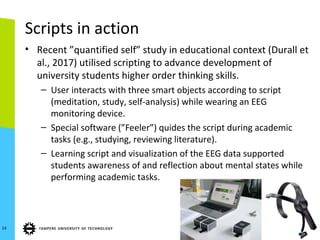
• Recent ”quantified self” study in educational context (Durall et
al., 2017) utilised scripting to advance development of
university students higher order thinking skills.
– User interacts with three smart objects according to script
(meditation, study, self-analysis) while wearing an EEG
monitoring device.
– Special software (”Feeler”) quides the script during academic
tasks (e.g., studying, reviewing literature).
– Learning script and visualization of the EEG data supported
students awareness of and reflection about mental states while
performing academic tasks.
14
Example: DICEOX script
– Description: Learners describe the main theoretical concepts of
the theory
– Inventor/History: Learners describe the historical beginning of
the theory
– Consequences: Learners describe the implications, which could
be made using the theory
– Evidence: Learners describe empirical evidence for the theory
– Other Theories: Learners link the new learning material to their
prior knowledge
– Extra Information: Learners describe additional information
dealing with the context of the theory
• Learners are represented in a higher education course a table containing
six columns for different aspects of the theory to be learned.
• Research has shown positive effects of the script regarding prompted
theory recall.
(Weinberger et al., 2005.)
15
Example: Expert problem solving script
(top-down approach)
• Students receive a PBL type task with questions that stem
from experts’ problem solving strategies.
– Students get to know how an expert would solve the problem.
• Students choose one relevant model that will solve the task
(from a list of competing models).
• Students solve the task by using the selected model.
– During the process, computer system presents questions (in a
way that an expert would) that support finding a relevant
solution.
• Research showed that the script guided the attention of
learners toward expert task strategies and supported learners
in applying them.
(Weinberger et al., 2005.)16
Example: MURDER script
– Mood: Learners relax and concentrate on the task
– Understand: Both learners read the first section of the text
– Repeat: One learner reiterates the text section without looking
at the text
– Detect: Learning partner provides feedback
– Elaborate: Both learners elaborate on the information
– Review: Both partners look through the learning material once
again
• Learners are expected to alternately engage in these activities for each
text section and, thereby, more effectively construct knowledge together.
• The script facilitates various activity types at the same time, which is
regarded as beneficial for learning.
(Weinberger et al., 2005.)17
Demonstration: MURDER script
• Script implementation in the Valaa environment.
• Learning topic: Kolb’s Experiental Learning Cycle
– MURDER script prescribes affective, cognitive, and meta-
cognitive activities (at the same time) to learner pairs.
– Learners are expected to alternately engage in these activities
for each text section and thereby more effectively construct
knowledge together.
18
Ville Ilkkala, CTO
ville@valaa.com
Valaa Ltd
valaa.com
References
• Cohen, E. G. (1994). Restructuring the classroom: Conditions for productive small groups.
Review of Educational Research, 64(1), 1-35.
• De Wever, B., Hämäläinen, R., Voet, M., & Gielen, M. (2015). A wiki task for first-year
university students: The effect of scripting students' collaboration. The Internet and Higher
Education, 25, 37-44.
• Durall, E., Leinonen, T., Gros, B., & Rodriguez-Kaarto, T. (2017). Reflection in Learning
through a Self-monitoring Device: Design Research on EEG Self-Monitoring during a Study
Session. Designs for Learning, 9(1), 10–20. DOI 10.16993/dfl.75.
• Fischer, F., Kollar, I., Mandl, H., & Haake, J. M. (Eds.) (2007). Scripting computer-supported
collaborative learning: cognitive, computational and educational perspectives. New York:
Springer.
• Haake, J. M., & Pfister, H-R. (2010). Scripting a distance-learning university course: Do
students benefit from net-based scripted collaboration? International Journal of Computer-
Supported Collaborative Learning, 5(2), 191-210.
• Hartikainen, S., Nokelainen, P., Pylväs, L., & Rintala, H. (2017). Active learning activities’
effect on the development of competences in STEM higher education: a review. Manuscript
under preparation.
19
References
• Hmelo-Silver, C. E., Jordan, R., Liu, L., & Chernobilsky, E. (2011). Representational Tools for
Understanding Complex Computer-Supported Collaborative Learning Environments. In S.
Puntambekar, G. Erkens, & C. Hmelo-Silver (Eds.), Analyzing Interactions in CSCL (pp. 83-106).
Computer-Supported Collaborative Learning Series, vol 12. Boston, MA: Springer.
• Le Deist, F. D., & Winterton, J. (2005). What is Competence? Human Resource Development
International, 8(1), 27-46.
• Paavola, S., & Hakkarainen, K. (2005). The Knowledge Creation Metaphor – An Emergent
Epistemological Approach to Learning. Science & Education, 14(6), 535–557.
• Rodríguez-Triana, M. J., Martínez-Monés, A., Asensio-Pérez, J. I., & Dimitriadis, Y. (2015).
Scripting and monitoring meet each other: Aligning learning analytics and learning design to
support teachers in orchestrating CSCL situations. British Journal of Educational Technology,
46(2), 330–343.
• Salmisto, A., Postareff, L., & Nokelainen, P. (2017). Relationships among Civil Engineering
Students' Approaches to Learning, Perceptions of the Teaching-Learning Environment, and
Study Success. Journal of Professional Issues in Engineering Education and Practice, 143(4).
DOI 10.1061/(ASCE)EI.1943-5541.0000343.
20
References
• Schellens, T., Van Keer, H., De Wever, B., & Valcke, M. (2007). Scripting by assigning roles:
Does it improve knowledge construction in asynchronous discussion groups? Computer-
Supported Collaborative Learning, 2(2-3), 225–246.
• Slof, B., Erkens, G., Kirschner, P. A., Jaspers, G. M., & Janssen, J. (2007). Guiding students’
online complex learning-task behavior through representational scripting. Computers in
Human Behavior, 26(5), 927-939.
• Van Drie, J., Van Boxtel, C., Erkens, G., & Kanselaar, G. (2003). Supporting Historical
Reasoning in CSCL. In B. Wasson, S. Ludvigsen, & U. Hoppe (Eds.), Designing for Change in
Networked Learning Environments (pp. 93-102). Dordrecht: Kluwer Academic Publishers.
• Wang, X., Kollar, I., & Stegmann, K. (2017). Adaptable scripting to foster regulation processes
and skills in computer-supported collaborative learning. International Journal of Computer-
Supported Collaborative Learning, 12(2), 153–172.
• Weinberger, A., Ertl, B., Fischer, F., & Mandl, H. (2005). Epistemic and social scripts in
computer-supported collaborative learning. Instructional Science, 33(1), 1-30.
21

Pedagogical scripting in CSCL

  • 1.
    Pedagogical scripting inCSCL Petri Nokelainen petri.nokelainen@tut.fi Laboratory of Industrial and Information Management Tampere University of Technology
  • 2.
    What are scripts? •Scripts are activity programs that aim to facilitate collaborative learning by specifying activities in collaborative settings, eventually sequencing these activities and assigning the activities to individual learners (Weingberger et al., 2005). – Specify activities (e.g., question asking) • One learner may be assigned the activity to ask questions regarding one specific problem and another learner may be expected to answer those questions - then switch the roles. – Sequence activities (e.g., collaboration) • Orchestration of learners’ collaboration over time to improve learning process. – Micro vs. macro-scripts (Kobbe et al., 2007). 2
  • 3.
    How scripts relateto pedagogy and learning? • When students interact as suggested by the script, they should acquire more knowledge from collaborative learning tasks than ”unscripted” learners (Weinberger et al., 2005). • Scripts applied in a CSCL context involve 1. problem-based approach, 2. collaboration and 3. use of a representational tool (or tools) (Slof et al., 2010). 3
  • 4.
    How scripts relateto pedagogy and learning? 1. Problem-based approach: • University studies should reflect the complexity of the world outside to prepare students for the world of work. • This ’preparation’ should include development of both hard (subject knowledge) and soft skills (ability to apply the knowledge in various situations). (Salmisto, Postareff, & Nokelainen, 2017.) 4
  • 5.
    How scripts relateto pedagogy and learning? 5   Occupational  Personal  Conceptual Cognitive competence (knowledge and understanding) •Problem definition •Systems thinking •Evaluating issues from various perspectives •Occupational awareness •Effective use of information •Conceptual and analytical abilities •Analytical skills •Problem-solving skills Meta competence (learning to learn) •Self-regulation •Empowerment and agency •Metacognition •Life-long learning •Self-sufficiency beliefs •Motivation •Responsible consciousness •Intellectual development •Critical thinking •Reasoning skills Operational Functional competence (psycho-motor and applied skills, experience) •Design skills •Project management •Methodological skills •Organisation and time management skills •Information retrieval skills •Technical presentation skills •Writing, reading, visual communication and technical presentation skills Social competence (behavioural and attitudinal competencies) •Teamwork/group work skills •Negotiation skills •Conflict management skills •Communication skills •Decision-making skills •Ethics (Hartikainen et al., 2017, modified from Le Deist & Winterton, 2005.)
  • 6.
    How scripts relateto pedagogy and learning? 2. Collaboration: • Working together with teacher(s) and peers support development of both hard and soft skills (Hartikainen, Nokelainen, Pylväs, & Rintala, 2017) through collaborative knowledge creation/construction/building (e.g., Paavola & Hakkarainen, 2005). • However, need for pedagogical scripting is based on an idea that collaboration without structure and guidance is not the optimal way to advance individual and group level learning (Slof et al., 2010). 6
  • 7.
    How scripts relateto pedagogy and learning? 3. Representational tool: • For example, graphical (Van Drie et al., 2003) or CORDTRA diagrams (Chronologically-Oriented Representations of Discourse and Tool-related Activity, see Hmelo-Silver et al., 2011). • A tool itself does not promote learning, but scripting is needed to orchestrate peadagogically meaningful use of multiple tools (Slof et al., 2010). 7
  • 8.
    Two types ofscripts • Epistemic scripts: – Describe how learners deal with the learning task, for example, how they categorize or define new concepts with the goal to (re-)construct knowledge. • Social/collaboration scripts: – Indicate how learners interact with each other, and how they relate their contributions to contributions of their learning partners in performing the epistemic activities. – Learners may ask each other questions or critically negotiate deviating perspectives and become aware of contradictions within their individual conceptual models. 8
  • 9.
    Epistemic scripts • Specifyand eventually sequence knowledge construction activities. • Guide the attention of learners towards specific aspects of the task and towards specific task-oriented activities while collaboratively discussing and constructing knowledge. • Make relevant concepts salient so that they receive more elaboration by learners. • Provide visualizations, such as a diagram or a table that contain central, yet abstract characteristics of the task discussed during learners’ collaboration. 9
  • 10.
    Epistemic scripts • Assistthe group in structuring the contents to be discussed. • Provide ‘‘anchors’’ for each learner to integrate new knowledge. • Can be understood as task strategy, which can be more or less specific to the domain and the learning task. • In contrast to social scripts, epistemic scripts may be applicable to individual learning scenarios. 10
  • 11.
    Social/collaboration scripts • Scriptedcollaboration focuses on advancing higher level cognitive processing (e.g., elaboration, explanation, argumentation, question asking) (Kobbe et al., 2007). – Specify and sequence interaction of learners, such as eliciting information from each other by asking critical questions. – Promote specific social interaction patterns that motivate elaboration activities, which in turn foster learning. – Help learners’ structure discourse according to successful interaction patterns of knowledge construction, thus, involving equal and alternating participation during discourse that is characterized by asking and answering questions, and critical negotiation. 11
  • 12.
    Social/collaboration scripts • Reciprocalteaching: students switch roles as ”teacher” and ”student”, computer program may also act as a collaborator. 12
  • 13.
    Scripts in action •Study by De Wever et al. (2015) in the context of scripting higher education students’ (N=186) collaboration with wikis found that – students in the scripted condition felt more responsible for the complete wiki and took more turns when editing the wiki, – the quality of the wiki itself was equal in scripted and non- scripted conditions. • Control group design • An increase between pre- and posttest scores was found for students in both conditions. 13
  • 14.
    Scripts in action •Recent ”quantified self” study in educational context (Durall et al., 2017) utilised scripting to advance development of university students higher order thinking skills. – User interacts with three smart objects according to script (meditation, study, self-analysis) while wearing an EEG monitoring device. – Special software (”Feeler”) quides the script during academic tasks (e.g., studying, reviewing literature). – Learning script and visualization of the EEG data supported students awareness of and reflection about mental states while performing academic tasks. 14
  • 15.
    Example: DICEOX script –Description: Learners describe the main theoretical concepts of the theory – Inventor/History: Learners describe the historical beginning of the theory – Consequences: Learners describe the implications, which could be made using the theory – Evidence: Learners describe empirical evidence for the theory – Other Theories: Learners link the new learning material to their prior knowledge – Extra Information: Learners describe additional information dealing with the context of the theory • Learners are represented in a higher education course a table containing six columns for different aspects of the theory to be learned. • Research has shown positive effects of the script regarding prompted theory recall. (Weinberger et al., 2005.) 15
  • 16.
    Example: Expert problemsolving script (top-down approach) • Students receive a PBL type task with questions that stem from experts’ problem solving strategies. – Students get to know how an expert would solve the problem. • Students choose one relevant model that will solve the task (from a list of competing models). • Students solve the task by using the selected model. – During the process, computer system presents questions (in a way that an expert would) that support finding a relevant solution. • Research showed that the script guided the attention of learners toward expert task strategies and supported learners in applying them. (Weinberger et al., 2005.)16
  • 17.
    Example: MURDER script –Mood: Learners relax and concentrate on the task – Understand: Both learners read the first section of the text – Repeat: One learner reiterates the text section without looking at the text – Detect: Learning partner provides feedback – Elaborate: Both learners elaborate on the information – Review: Both partners look through the learning material once again • Learners are expected to alternately engage in these activities for each text section and, thereby, more effectively construct knowledge together. • The script facilitates various activity types at the same time, which is regarded as beneficial for learning. (Weinberger et al., 2005.)17
  • 18.
    Demonstration: MURDER script •Script implementation in the Valaa environment. • Learning topic: Kolb’s Experiental Learning Cycle – MURDER script prescribes affective, cognitive, and meta- cognitive activities (at the same time) to learner pairs. – Learners are expected to alternately engage in these activities for each text section and thereby more effectively construct knowledge together. 18 Ville Ilkkala, CTO ville@valaa.com Valaa Ltd valaa.com
  • 19.
    References • Cohen, E.G. (1994). Restructuring the classroom: Conditions for productive small groups. Review of Educational Research, 64(1), 1-35. • De Wever, B., Hämäläinen, R., Voet, M., & Gielen, M. (2015). A wiki task for first-year university students: The effect of scripting students' collaboration. The Internet and Higher Education, 25, 37-44. • Durall, E., Leinonen, T., Gros, B., & Rodriguez-Kaarto, T. (2017). Reflection in Learning through a Self-monitoring Device: Design Research on EEG Self-Monitoring during a Study Session. Designs for Learning, 9(1), 10–20. DOI 10.16993/dfl.75. • Fischer, F., Kollar, I., Mandl, H., & Haake, J. M. (Eds.) (2007). Scripting computer-supported collaborative learning: cognitive, computational and educational perspectives. New York: Springer. • Haake, J. M., & Pfister, H-R. (2010). Scripting a distance-learning university course: Do students benefit from net-based scripted collaboration? International Journal of Computer- Supported Collaborative Learning, 5(2), 191-210. • Hartikainen, S., Nokelainen, P., Pylväs, L., & Rintala, H. (2017). Active learning activities’ effect on the development of competences in STEM higher education: a review. Manuscript under preparation. 19
  • 20.
    References • Hmelo-Silver, C.E., Jordan, R., Liu, L., & Chernobilsky, E. (2011). Representational Tools for Understanding Complex Computer-Supported Collaborative Learning Environments. In S. Puntambekar, G. Erkens, & C. Hmelo-Silver (Eds.), Analyzing Interactions in CSCL (pp. 83-106). Computer-Supported Collaborative Learning Series, vol 12. Boston, MA: Springer. • Le Deist, F. D., & Winterton, J. (2005). What is Competence? Human Resource Development International, 8(1), 27-46. • Paavola, S., & Hakkarainen, K. (2005). The Knowledge Creation Metaphor – An Emergent Epistemological Approach to Learning. Science & Education, 14(6), 535–557. • Rodríguez-Triana, M. J., Martínez-Monés, A., Asensio-Pérez, J. I., & Dimitriadis, Y. (2015). Scripting and monitoring meet each other: Aligning learning analytics and learning design to support teachers in orchestrating CSCL situations. British Journal of Educational Technology, 46(2), 330–343. • Salmisto, A., Postareff, L., & Nokelainen, P. (2017). Relationships among Civil Engineering Students' Approaches to Learning, Perceptions of the Teaching-Learning Environment, and Study Success. Journal of Professional Issues in Engineering Education and Practice, 143(4). DOI 10.1061/(ASCE)EI.1943-5541.0000343. 20
  • 21.
    References • Schellens, T.,Van Keer, H., De Wever, B., & Valcke, M. (2007). Scripting by assigning roles: Does it improve knowledge construction in asynchronous discussion groups? Computer- Supported Collaborative Learning, 2(2-3), 225–246. • Slof, B., Erkens, G., Kirschner, P. A., Jaspers, G. M., & Janssen, J. (2007). Guiding students’ online complex learning-task behavior through representational scripting. Computers in Human Behavior, 26(5), 927-939. • Van Drie, J., Van Boxtel, C., Erkens, G., & Kanselaar, G. (2003). Supporting Historical Reasoning in CSCL. In B. Wasson, S. Ludvigsen, & U. Hoppe (Eds.), Designing for Change in Networked Learning Environments (pp. 93-102). Dordrecht: Kluwer Academic Publishers. • Wang, X., Kollar, I., & Stegmann, K. (2017). Adaptable scripting to foster regulation processes and skills in computer-supported collaborative learning. International Journal of Computer- Supported Collaborative Learning, 12(2), 153–172. • Weinberger, A., Ertl, B., Fischer, F., & Mandl, H. (2005). Epistemic and social scripts in computer-supported collaborative learning. Instructional Science, 33(1), 1-30. 21