Learning / Technology
Professor Paul Maharg
paulmaharg.com/slides
preview
1. Learning / Technology
2. Law Teacher special issue on learning / technology
3. Why should we care?
4. The digital context
5. The state of research
6. Medical education vs legal education
7. Call for action
techne / poesis
‘techne is the name not only for the activities and skills of
the craftsman, but also for the arts of the mind and the
fine arts. Techne belongs to bringing-forth, to poiesis; it is
something poetic’
M. Heidegger, “The Question Concerning Technology”. In D.F. Krell (ed), Martin
Heidegger. Basic Writings (London, Routledge & Kegan Paul, 1978), p. 294.
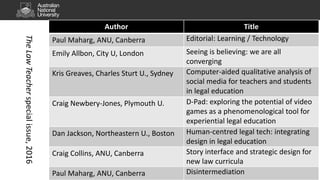
Author Title
Paul Maharg, ANU, Canberra Editorial: Learning / Technology
Emily Allbon, City U, London Seeing is believing: we are all
converging
Kris Greaves, Charles Sturt U., Sydney Computer-aided qualitative analysis of
social media for teachers and students
in legal education
Craig Newbery-Jones, Plymouth U. D-Pad: exploring the potential of video
games as a phenomenological tool for
experiential legal education
Dan Jackson, Northeastern U., Boston Human-centred legal tech: integrating
design in legal education
Craig Collins, ANU, Canberra Story interface and strategic design for
new law curricula
Paul Maharg, ANU, Canberra Disintermediation
TheLawTeacherspecialissue,2016
why should we care about this?
What scandalized the serious scholar Erasmus (as it fascinated
Dürer) was the fact that, not much more than half a century
after the first appearance of the printed book, demand had
turned it into a product beyond the control of the scholars and
specialists. The book had taken over as the transmitter of
European written culture, before scholars and educators had
had time to come to terms with its power and influence.
Jardine, L. (1996). Worldly Goods: A New History of the Renaissance. Macmillan,
London, p.228.
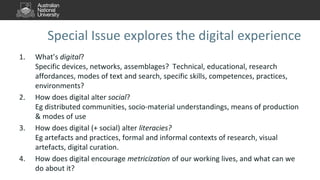
Special Issue explores the digital experience
1. What’s digital?
Specific devices, networks, assemblages? Technical, educational, research
affordances, modes of text and search, specific skills, competences, practices,
environments?
2. How does digital alter social?
Eg distributed communities, socio-material understandings, means of production
& modes of use
3. How does digital (+ social) alter literacies?
Eg artefacts and practices, formal and informal contexts of research, visual
artefacts, digital curation.
4. How does digital encourage metricization of our working lives, and what can we
do about it?
underlying transforming features of digital…
• Replicability
• Mutability
• Connectivity
• Instantaneity (& the ‘nearly now’)
• Portability
• Identity
Jones, C. (2013). The digital university: a concept in need of definition. In R. Goodfellow, M.R.Lea,
eds, Literacy in the Digital University. Critical Perspectives on Learning, Scholarship and
Technology. SRHE, Routledge, London, 162-172.
ten years ago we posed the question…
‘School children […] will be coming through to our
undergraduate law courses in a couple of years, and we need to
provide […] sophisticated and converged learning environments.
Are we ready for them?’
Editorial, The Law Teacher, 3, 2015.
Three brief examples of innovation scale since
then
1. Mobilisation of our culture
2. Advances in algorithmic applications, eg blockchain (can be
used for financial instruments, payments systems, contracts,
voting, utility asset management -- even law school
infrastructure
3. Exocortices – eg Emotiv Systems’ Insight device, and open-
source brain-computer interfaces (BCIs) @
http://openbci.com
digital media in legal education – as Spotify?
• Algorithmic identification: who I am, what I like, when I like it, find like
music & listeners, Discover Weekly playlist, different views & contexts
• Artists = authors; listeners = students; tutors create basic playlists &
students improv on the list
• Innovation in project working, eg construction of Touch Preview:
– ‘Spotify has a long history of spitting out new and interesting features from week-long
hackathons. It tells its employees to forget their normal jobs, tackle a problem and solve
it in a creative way. The Top Tracks feature that debuted last month was born of a
hackathon and now, thanks to another week of blowing off of their regular
responsibilities, the company has Touch Preview: a feature designed to aid in the lost
art of music discovery.’
T. O’Brien, “Spotify’s Touch Preview Lets You Sample New Songs Quickly”, Engadget 22 January 2015.
Available at: http://www.engadget.com/2015/01/22/spotifys-touch-preview/ (accessed 22 March 2015)
and yet, in 2016…
• We know little of learning / technology use in law
schools – less than two decades ago
• Are we clear about what works?
• NSS gives us ’fact-totems’, not insightful data. Cf
LSSSE
• No general archive of practice and theory
• No meta-reviews or systematic reviews of research
cf medical education
• Studies range from whole-nation surveys to ‘post-holing’ of
specific programmes & institutions
G.E. Kennedy, et al, “First Year Students’ Experiences with Technology: Are They Really Digital Natives?” (2008) 24 Australasian
Journal of Educational Technology, 24.
• Future preparation studies
B. Robin, et al., “Preparing for the Changing Role of Instructional Technologies in Medical Education” (2011) 86 Academic
Medicine, 435.
• Dissemination studies & guides
R. Ellaway and K. Masters, “AMEE Guide 32: E-Learning in Medical Education Part 1: Learning, Teaching and Assessment” (2008)
30 Medical Teacher, 30.
medical education research infrastructures…?
Cf Association for Medical Education in Europe (AMEE)
• Provides infrastructure for publication of the Guides
• Annual Conference across Europe
• Publishes Medical Education twelve times a year
• Publishes Best Evidence Medical Education Reviews
• Supports seminars and workshops on special
subjects
legal education research infrastructures…?
• Nearest to AMEE was UKCLE – defunct since 2011
• LETR noted poor state of research organisation – see
Recommendation 25, since then, no action.
• The result can only be a worsening situation for
theory and empirical research (along the lines stated
by Nuffield Report on sociolegal research, a decade
ago).
call for action…
Special Issue calls for:
• professional bodies and groups that are nationally and
internationally active in legal education to begin the process
of developing and organising research infrastructures for
learning/technology
• dissemination to the communities interested in and affected
by legal education.
what would this look like?
• An international body with diverse funding sources
bringing together jurisdictions, regulators, educators,
students, policy-makers, legal professions, other
disciplines and professions.
• Look again at AMEE activities…
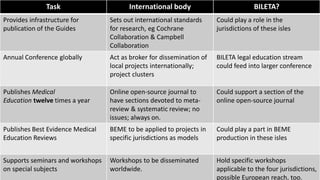
Task International body BILETA?
Provides infrastructure for
publication of the Guides
Sets out international standards
for research, eg Cochrane
Collaboration & Campbell
Collaboration
Could play a role in the
jurisdictions of these isles
Annual Conference globally Act as broker for dissemination of
local projects internationally;
project clusters
BILETA legal education stream
could feed into larger conference
Publishes Medical
Education twelve times a year
Online open-source journal to
have sections devoted to meta-
review & systematic review; no
issues; always on.
Could support a section of the
online open-source journal
Publishes Best Evidence Medical
Education Reviews
BEME to be applied to projects in
specific jurisdictions as models
Could play a part in BEME
production in these isles
Supports seminars and workshops
on special subjects
Workshops to be disseminated
worldwide.
Hold specific workshops
applicable to the four jurisdictions,
possible European reach, too.
Email:paul.maharg@anu.edu.au
Web: paulmaharg.com
Slides: paulmaharg.com/slides

Learning / Technology in Legal Education

  • 1.
    Learning / Technology ProfessorPaul Maharg paulmaharg.com/slides
  • 2.
    preview 1. Learning /Technology 2. Law Teacher special issue on learning / technology 3. Why should we care? 4. The digital context 5. The state of research 6. Medical education vs legal education 7. Call for action
  • 3.
    techne / poesis ‘techneis the name not only for the activities and skills of the craftsman, but also for the arts of the mind and the fine arts. Techne belongs to bringing-forth, to poiesis; it is something poetic’ M. Heidegger, “The Question Concerning Technology”. In D.F. Krell (ed), Martin Heidegger. Basic Writings (London, Routledge & Kegan Paul, 1978), p. 294.
  • 4.
    Author Title Paul Maharg,ANU, Canberra Editorial: Learning / Technology Emily Allbon, City U, London Seeing is believing: we are all converging Kris Greaves, Charles Sturt U., Sydney Computer-aided qualitative analysis of social media for teachers and students in legal education Craig Newbery-Jones, Plymouth U. D-Pad: exploring the potential of video games as a phenomenological tool for experiential legal education Dan Jackson, Northeastern U., Boston Human-centred legal tech: integrating design in legal education Craig Collins, ANU, Canberra Story interface and strategic design for new law curricula Paul Maharg, ANU, Canberra Disintermediation TheLawTeacherspecialissue,2016
  • 5.
    why should wecare about this? What scandalized the serious scholar Erasmus (as it fascinated Dürer) was the fact that, not much more than half a century after the first appearance of the printed book, demand had turned it into a product beyond the control of the scholars and specialists. The book had taken over as the transmitter of European written culture, before scholars and educators had had time to come to terms with its power and influence. Jardine, L. (1996). Worldly Goods: A New History of the Renaissance. Macmillan, London, p.228.
  • 6.
    Special Issue exploresthe digital experience 1. What’s digital? Specific devices, networks, assemblages? Technical, educational, research affordances, modes of text and search, specific skills, competences, practices, environments? 2. How does digital alter social? Eg distributed communities, socio-material understandings, means of production & modes of use 3. How does digital (+ social) alter literacies? Eg artefacts and practices, formal and informal contexts of research, visual artefacts, digital curation. 4. How does digital encourage metricization of our working lives, and what can we do about it?
  • 7.
    underlying transforming featuresof digital… • Replicability • Mutability • Connectivity • Instantaneity (& the ‘nearly now’) • Portability • Identity Jones, C. (2013). The digital university: a concept in need of definition. In R. Goodfellow, M.R.Lea, eds, Literacy in the Digital University. Critical Perspectives on Learning, Scholarship and Technology. SRHE, Routledge, London, 162-172.
  • 8.
    ten years agowe posed the question… ‘School children […] will be coming through to our undergraduate law courses in a couple of years, and we need to provide […] sophisticated and converged learning environments. Are we ready for them?’ Editorial, The Law Teacher, 3, 2015.
  • 9.
    Three brief examplesof innovation scale since then 1. Mobilisation of our culture 2. Advances in algorithmic applications, eg blockchain (can be used for financial instruments, payments systems, contracts, voting, utility asset management -- even law school infrastructure 3. Exocortices – eg Emotiv Systems’ Insight device, and open- source brain-computer interfaces (BCIs) @ http://openbci.com
  • 10.
    digital media inlegal education – as Spotify? • Algorithmic identification: who I am, what I like, when I like it, find like music & listeners, Discover Weekly playlist, different views & contexts • Artists = authors; listeners = students; tutors create basic playlists & students improv on the list • Innovation in project working, eg construction of Touch Preview: – ‘Spotify has a long history of spitting out new and interesting features from week-long hackathons. It tells its employees to forget their normal jobs, tackle a problem and solve it in a creative way. The Top Tracks feature that debuted last month was born of a hackathon and now, thanks to another week of blowing off of their regular responsibilities, the company has Touch Preview: a feature designed to aid in the lost art of music discovery.’ T. O’Brien, “Spotify’s Touch Preview Lets You Sample New Songs Quickly”, Engadget 22 January 2015. Available at: http://www.engadget.com/2015/01/22/spotifys-touch-preview/ (accessed 22 March 2015)
  • 11.
    and yet, in2016… • We know little of learning / technology use in law schools – less than two decades ago • Are we clear about what works? • NSS gives us ’fact-totems’, not insightful data. Cf LSSSE • No general archive of practice and theory • No meta-reviews or systematic reviews of research
  • 12.
    cf medical education •Studies range from whole-nation surveys to ‘post-holing’ of specific programmes & institutions G.E. Kennedy, et al, “First Year Students’ Experiences with Technology: Are They Really Digital Natives?” (2008) 24 Australasian Journal of Educational Technology, 24. • Future preparation studies B. Robin, et al., “Preparing for the Changing Role of Instructional Technologies in Medical Education” (2011) 86 Academic Medicine, 435. • Dissemination studies & guides R. Ellaway and K. Masters, “AMEE Guide 32: E-Learning in Medical Education Part 1: Learning, Teaching and Assessment” (2008) 30 Medical Teacher, 30.
  • 13.
    medical education researchinfrastructures…? Cf Association for Medical Education in Europe (AMEE) • Provides infrastructure for publication of the Guides • Annual Conference across Europe • Publishes Medical Education twelve times a year • Publishes Best Evidence Medical Education Reviews • Supports seminars and workshops on special subjects
  • 14.
    legal education researchinfrastructures…? • Nearest to AMEE was UKCLE – defunct since 2011 • LETR noted poor state of research organisation – see Recommendation 25, since then, no action. • The result can only be a worsening situation for theory and empirical research (along the lines stated by Nuffield Report on sociolegal research, a decade ago).
  • 15.
    call for action… SpecialIssue calls for: • professional bodies and groups that are nationally and internationally active in legal education to begin the process of developing and organising research infrastructures for learning/technology • dissemination to the communities interested in and affected by legal education.
  • 16.
    what would thislook like? • An international body with diverse funding sources bringing together jurisdictions, regulators, educators, students, policy-makers, legal professions, other disciplines and professions. • Look again at AMEE activities…
  • 17.
    Task International bodyBILETA? Provides infrastructure for publication of the Guides Sets out international standards for research, eg Cochrane Collaboration & Campbell Collaboration Could play a role in the jurisdictions of these isles Annual Conference globally Act as broker for dissemination of local projects internationally; project clusters BILETA legal education stream could feed into larger conference Publishes Medical Education twelve times a year Online open-source journal to have sections devoted to meta- review & systematic review; no issues; always on. Could support a section of the online open-source journal Publishes Best Evidence Medical Education Reviews BEME to be applied to projects in specific jurisdictions as models Could play a part in BEME production in these isles Supports seminars and workshops on special subjects Workshops to be disseminated worldwide. Hold specific workshops applicable to the four jurisdictions, possible European reach, too.
  • 18.