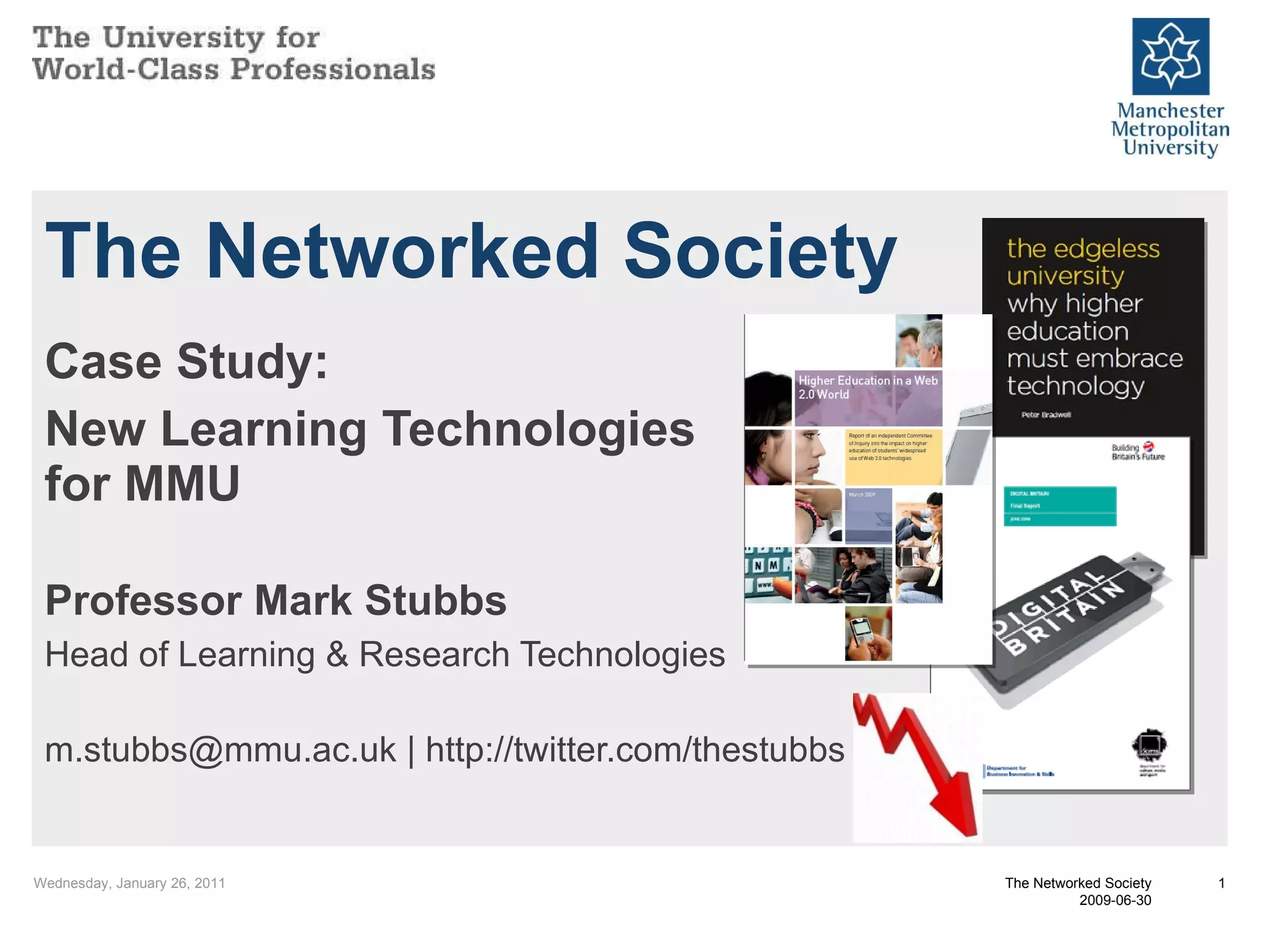
The Networked Society Case Study: New Learning Technologies for MMU Professor Mark Stubbs Head of Learning & Research Technologies m.stubbs@mmu.ac.uk | http://twitter.com/thestubbs Wednesday, January 26, 2011 The Networked Society 2009-06-30
Case Study Large UK university reviews ICT used to support learning & teaching Review Context Challenging policy and economic context Challenging cultural and technological context Review Process Learning from the past Envisioning the future Engaging stakeholders Establishing decision criteria Wednesday, January 26, 2011 Environment Scanning
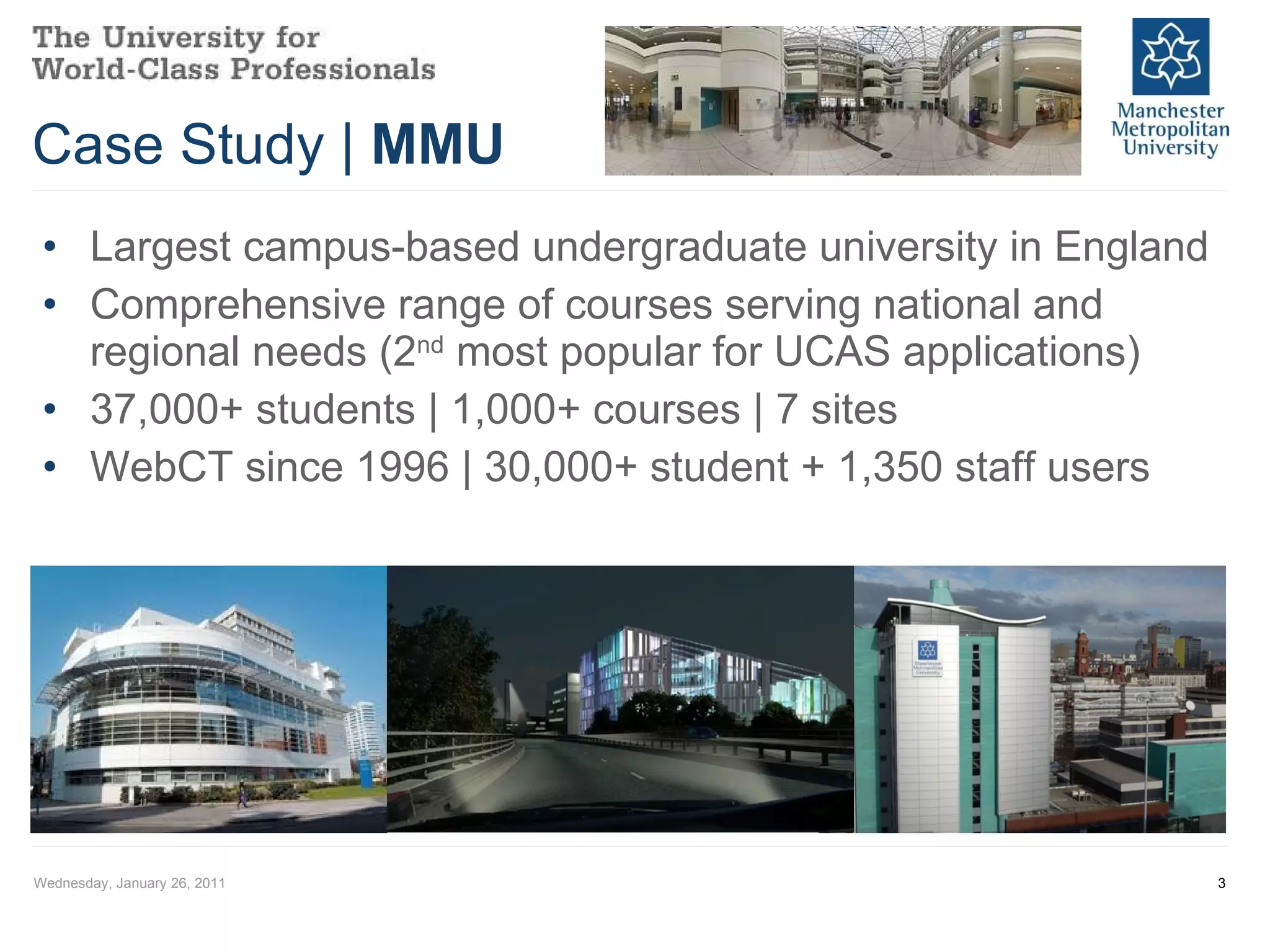
Case Study |  MMU Largest campus-based undergraduate university in England Comprehensive range of courses serving national and regional needs (2 nd  most popular for UCAS applications) 37,000+ students | 1,000+ courses | 7 sites WebCT since 1996 | 30,000+ student + 1,350 staff users Wednesday, January 26, 2011
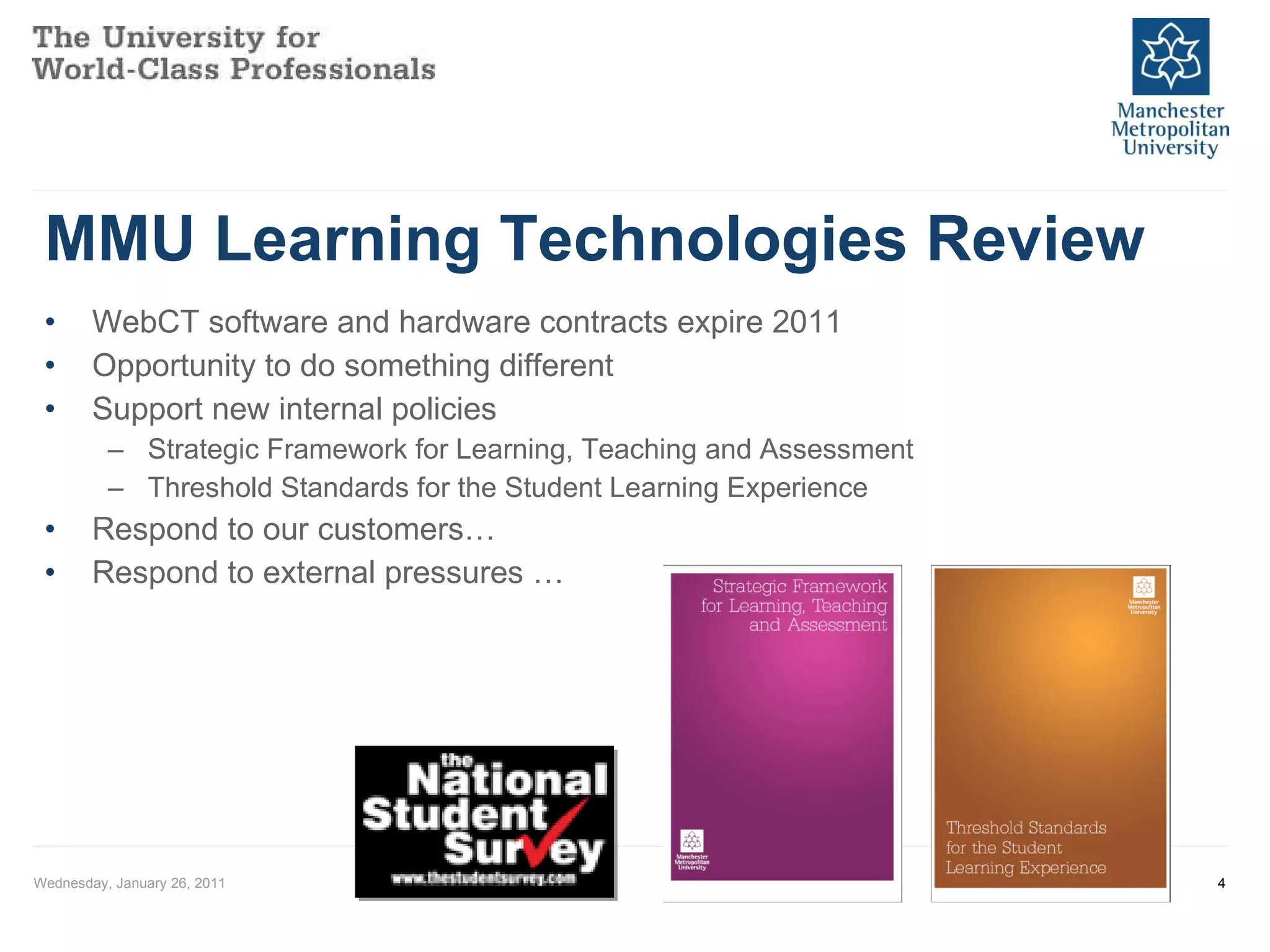
MMU Learning Technologies Review WebCT software and hardware contracts expire 2011 Opportunity to do something different Support new internal policies Strategic Framework for Learning, Teaching and Assessment Threshold Standards for the Student Learning Experience Respond to our customers… Respond to external pressures … Wednesday, January 26, 2011
Student Voice .. students want more direct face-to-face time with their lecturers and teaching staff, in smaller groups. … Vice Chancellors … would say it is not possible …  I think we need a radical rethink … Why on earth is it that we’re still delivering teaching and learning as we were when higher education was an elite pursuit and lecturers were talking to lecture theatres no bigger than this room? The numbers of students  on  our campuses have changed, who they are has changed, so why has teaching and learning stayed so similar? Those entering HE now are immersed in digital technologies and use social networking as a natural part of their every-day lives … these technologies might make HE more open, democratic and willing to redefine the relationship between students and their tutors @WesStreeting | http://tinyurl.com/ycfs4sp Wednesday, January 26, 2011
Committee of Enquiry into Changing Learner Experience  Higher Education in a Web 2.0 World findings HE influenced by expectations carried through from school Face-to-face matters Difficulties imagining social technologies in an educational context Opportunities for students to use technical proficiency to express themselves Need to address the digital divide for students and staff (access + skills) Need to develop information literacies Social Web.. profound effect on behaviours, …a strong sense of communities of interest …a disposition to share and participate …a preference for quick answers  … a casual approach to evaluating information and attributing it… [W]orld they encounter in HE has been constructed on wholly different norms Wednesday, January 26, 2011 http://tinyurl.com/ouvo2p
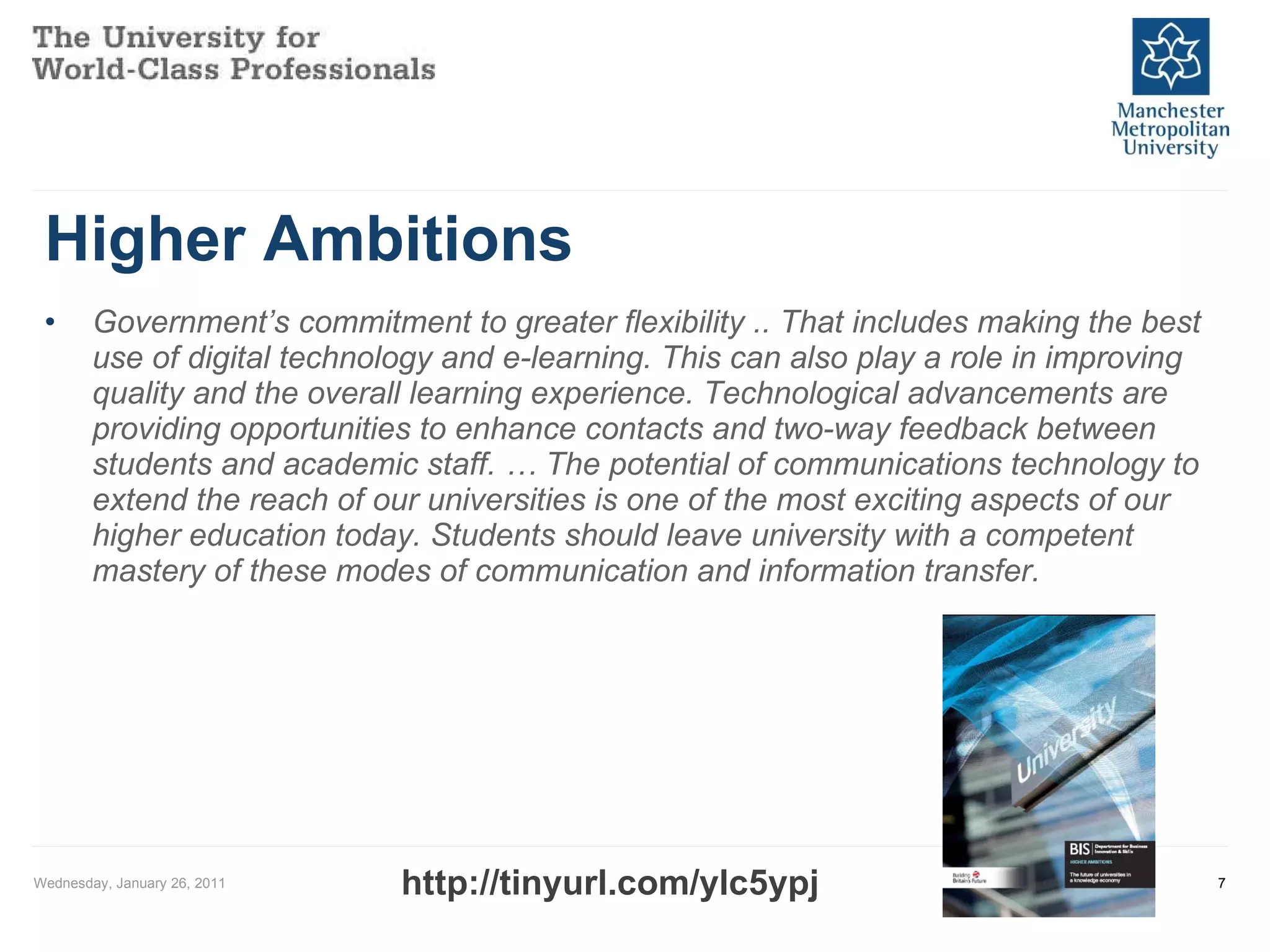
Higher Ambitions Government’s commitment to greater flexibility .. That includes making the best use of digital technology and e-learning. This can also play a role in improving quality and the overall learning experience. Technological advancements are providing opportunities to enhance contacts and two-way feedback between students and academic staff. … The potential of communications technology to extend the reach of our universities is one of the most exciting aspects of our higher education today. Students should leave university with a competent mastery of these modes of communication and information transfer. Wednesday, January 26, 2011 http://tinyurl.com/ylc5ypj
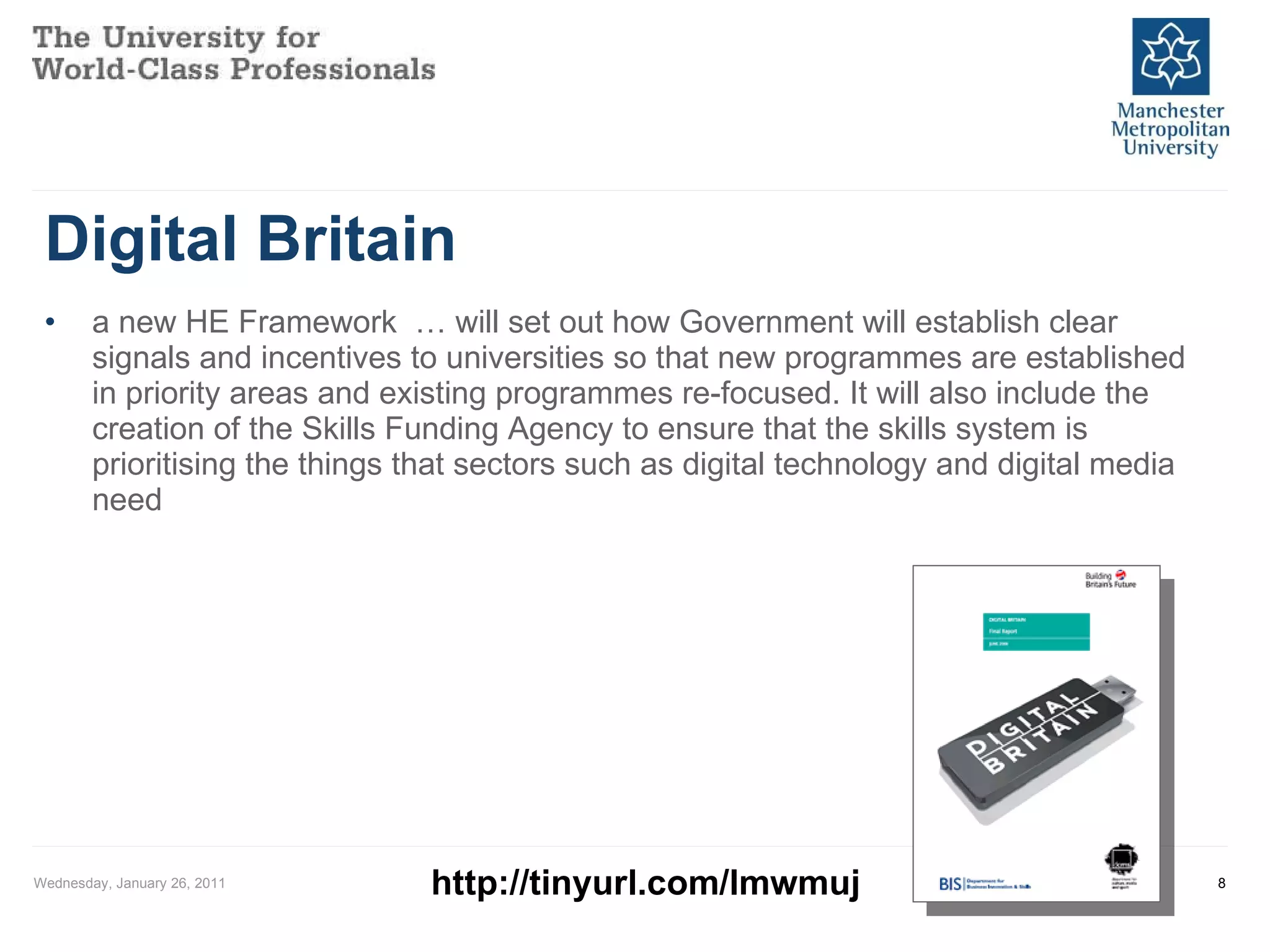
Digital Britain a new HE Framework  … will set out how Government will establish clear signals and incentives to universities so that new programmes are established in priority areas and existing programmes re-focused. It will also include the creation of the Skills Funding Agency to ensure that the skills system is prioritising the things that sectors such as digital technology and digital media need Wednesday, January 26, 2011 http://tinyurl.com/lmwmuj
HEFCE Enhancing Learning  Wednesday, January 26, 2011 Evidence suggests that the use of technology can improve recruitment and retention … [E]nhancing the quality of teaching and learning, and meeting student expectations, are the two most significant drivers for institutions to invest in new technologies…  [T]here is an opportunity for institutions to engage further with technologies with the intention of supporting learners in building knowledge collaboratively and engaging in social learning. Staff require support so they can effectively exploit the potential of these new technologies… Learners want and expect to be able to use their own devices in institutional contexts, and to personalise institutional services to meet their own requirements … http://tinyurl.com/ykk2ylg
Turbulence in the learning technologies market Leading commercial VLE, Blackboard, buys WebCT and Angel and needs to consolidate diverse customer base onto BB Learn 9 Open source VLE Moodle gains ground in schools, FE and HE but the complete re-write, Moodle 2, keeps slipping promised release dates Association of Learning Technologists debates whether VLE is dead http://tinyurl.com/ykh3llu Microsoft and Google begin to offer education-oriented variants of their cloud offerings Wednesday, January 26, 2011
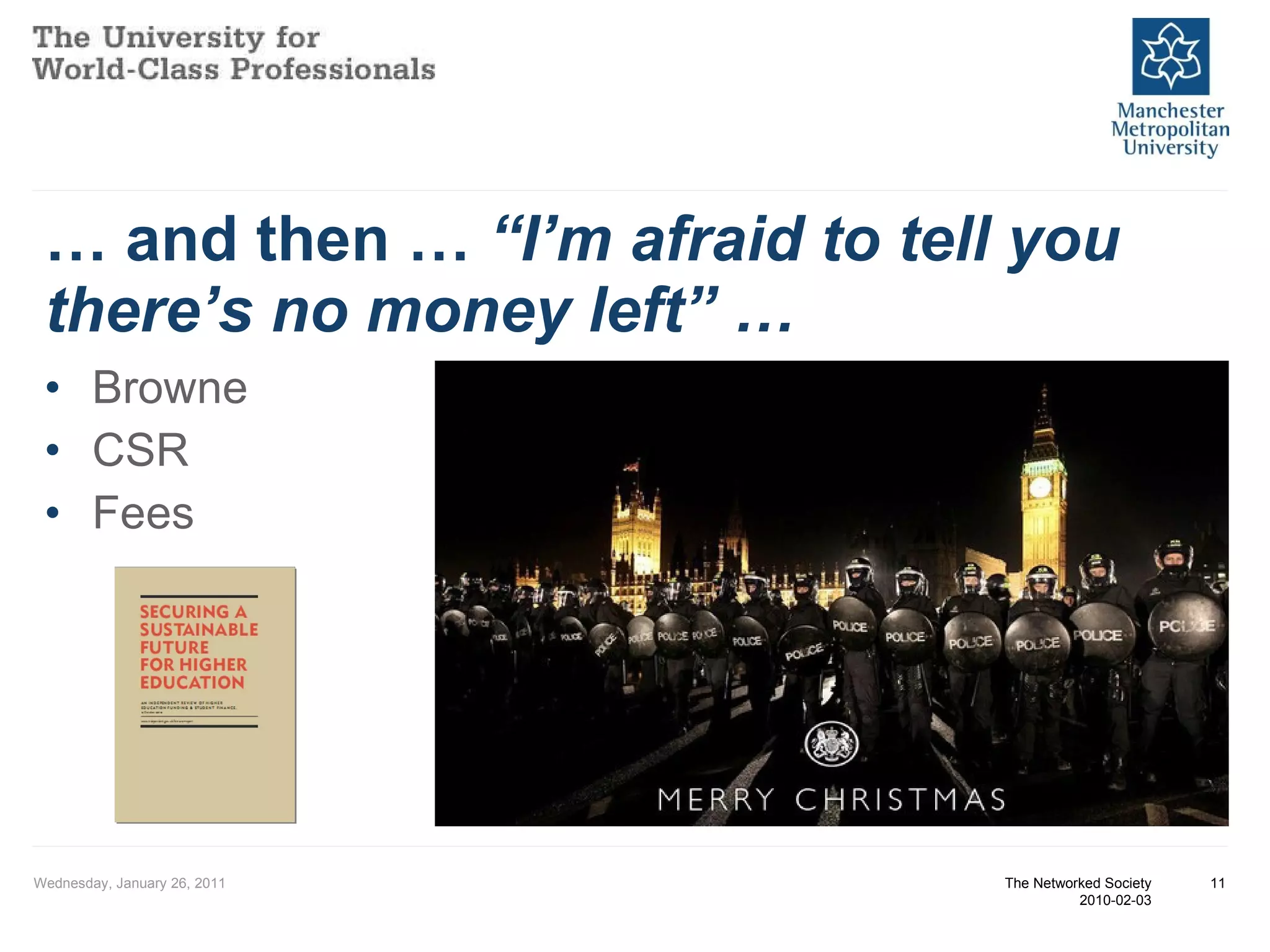
…  and then …  “I’m afraid to tell you there’s no money left” … Browne CSR Fees Wednesday, January 26, 2011 The Networked Society 2010-02-03
Learning Tech Review approach Steering Group DVC Student Experience (Chair) Director of Learning & Research Information Systems Head of the Centre for Learning & Teaching Project Leads Head of Learning & Research Technologies Principal Lecturer in Learning Technologies Scope VLE + podcasting; classroom tech; e-assessment; e-pdp; support; analytics Inputs... System evaluation: usage & student achievement User requirements: focus groups, road-shows & scenarios User evaluation: BB9 versus Moodle MMU’s Learning Technologies Review 2010-05-20
Learning from past usage Staff & students access VLE over 50 times a year, with students clicking more Content distribution dominant pattern of use and correlated with student success  More interactive mode of engagement slower to expand across institution  Students look for updates about assessment and discussion postings more frequently than changes are made Different norms for staff-student communication with announcements being most widely-used mechanism but some intensive use of VLE-only email and some synchronous communication  Use of VLE for assessment <15% of institution with online quizzes twice as popular as online assignment submission + very small use of SCORM materials http://lrt.mmu.ac.uk/ltreview/2010/01/06/how-weve-used-vista-since-2006/
Scenario thinking Scenario#1 integration between classroom and online learning environments; varied devices; varied preferences for paper; active interest in student engagement Scenario#2 students’ consuming information in ways & on devices of their choosing; use of Live@Edu, podcasting and IM; note-taking; appointment synching; ubiquitous campus wifi Scenario#3 student collaboration; students booking meeting rooms; social learning zones; augmented classes + voting with twitter; laptop loan Do these capture Network Society / Policy themes? What other scenarios would you add? MMU’s Learning Technologies Review 2010-05-20 http://lrt.mmu.ac.uk/ltreview/2010/01/28/scenarios
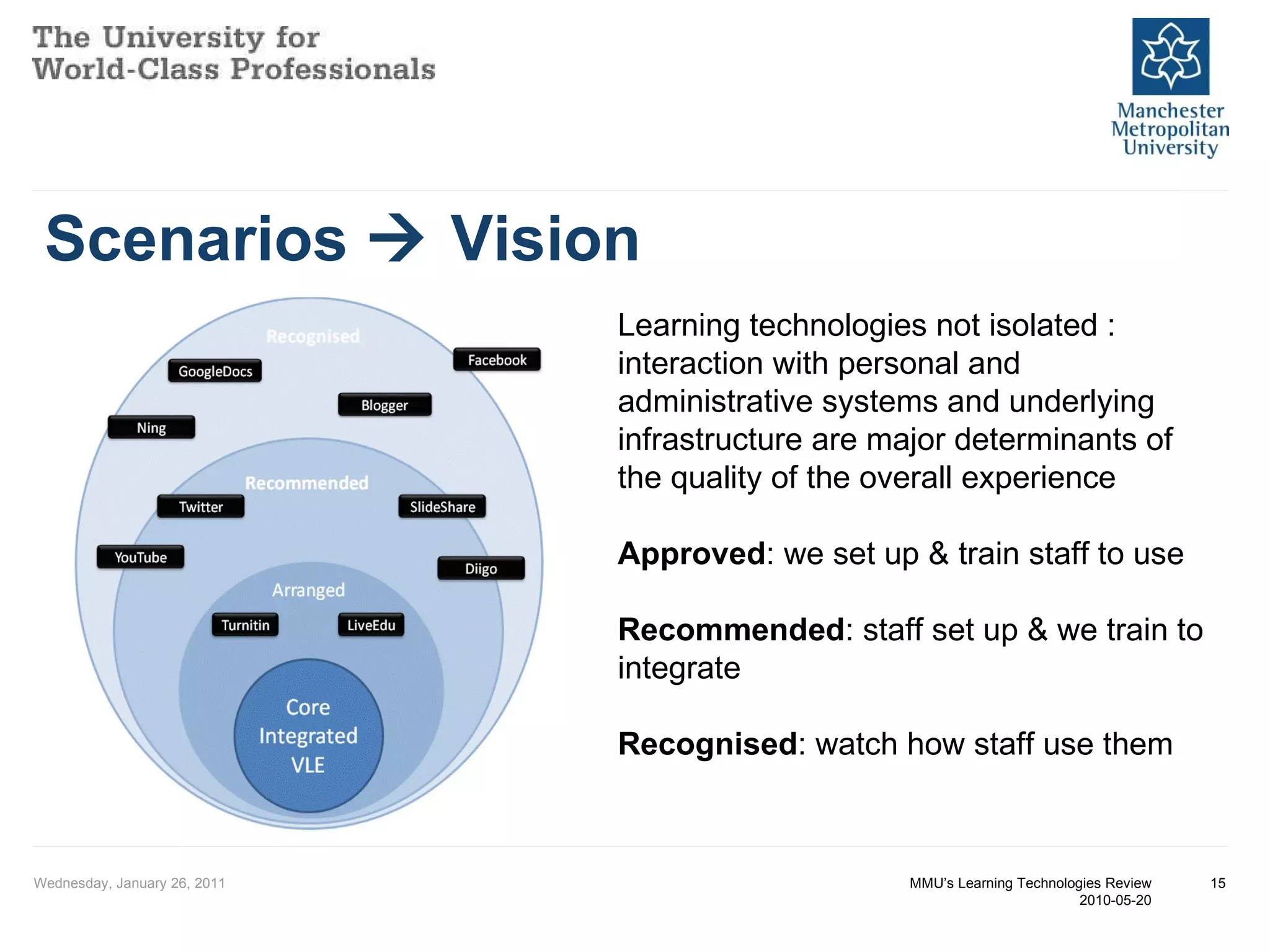
Scenarios    Vision Wednesday, January 26, 2011 MMU’s Learning Technologies Review 2010-05-20 Learning technologies not isolated : interaction with personal and administrative systems and underlying infrastructure are major determinants of the quality of the overall experience Approved : we set up & train staff to use Recommended : staff set up & we train to integrate Recognised : watch how staff use them
Aspirational ‘thresholds’ All teaching staff will be provided with laptops (and a monitor, keyboard and mouse)  All teaching rooms will have a means of plugging a laptop into a large screen or projector  All staff and students will be able to access WiFi from anywhere within MMU  All students will receive a personalised timetable and assignment submission deadlines and be notified rapidly of any changes to either  All students will be able to book small teaching rooms when rooms are not timetabled  All students can expect their engagement to be monitored for active progress review  All staff and students can expect institutional calendar appointments and news items to be made available for use on personal devices where legally and technically possible  Every Unit will have a presence in the VLE  Wednesday, January 26, 2011 MMU’s Learning Technologies Review 2010-05-20
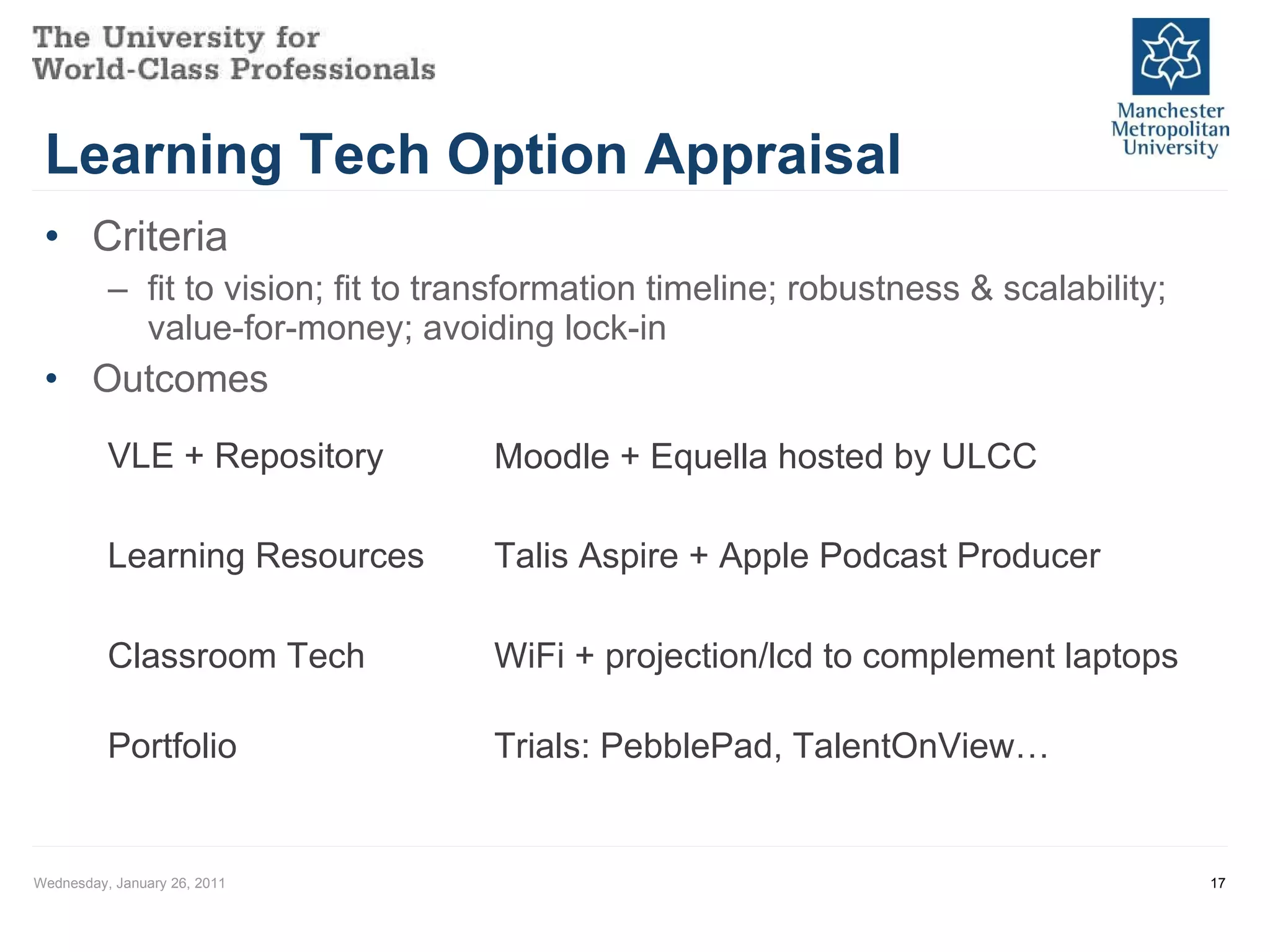
Learning Tech Option Appraisal Criteria fit to vision; fit to transformation timeline; robustness & scalability; value-for-money; avoiding lock-in Outcomes Wednesday, January 26, 2011 VLE + Repository Learning Resources Talis Aspire + Apple Podcast Producer Moodle + Equella hosted by ULCC Classroom Tech WiFi + projection/lcd to complement laptops Portfolio Trials: PebblePad, TalentOnView…
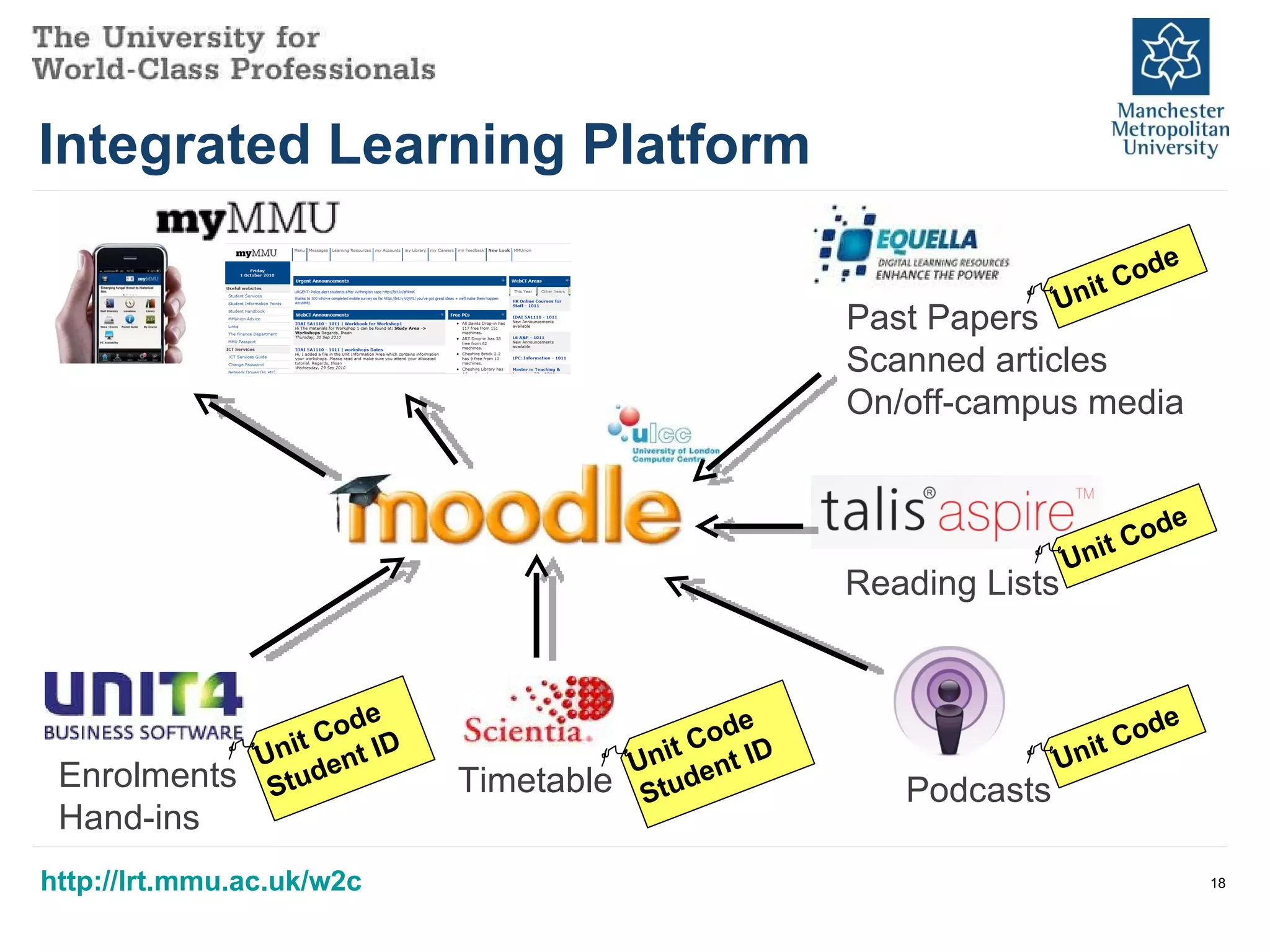
Integrated Learning Platform Past Papers Scanned articles On/off-campus media Unit Code Reading Lists Unit Code Podcasts Unit Code Unit Code Student ID Timetable Unit Code Student ID Enrolments Hand-ins http://lrt.mmu.ac.uk/w2c
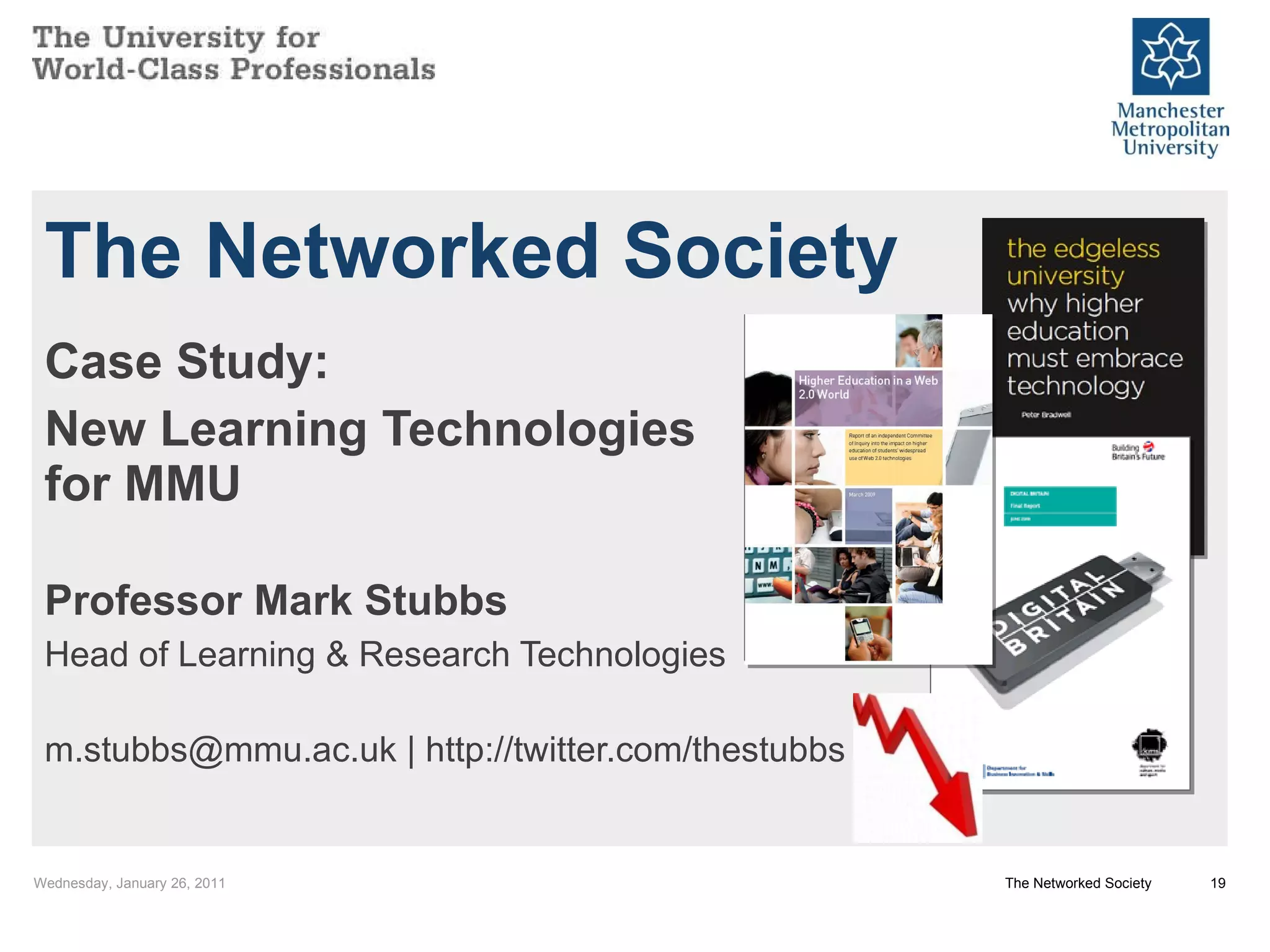
The Networked Society Case Study: New Learning Technologies for MMU Professor Mark Stubbs Head of Learning & Research Technologies m.stubbs@mmu.ac.uk | http://twitter.com/thestubbs Wednesday, January 26, 2011 The Networked Society

MMU46101014 Case Study 1011

  • 1.
    The Networked SocietyCase Study: New Learning Technologies for MMU Professor Mark Stubbs Head of Learning & Research Technologies m.stubbs@mmu.ac.uk | http://twitter.com/thestubbs Wednesday, January 26, 2011 The Networked Society 2009-06-30
  • 2.
    Case Study LargeUK university reviews ICT used to support learning & teaching Review Context Challenging policy and economic context Challenging cultural and technological context Review Process Learning from the past Envisioning the future Engaging stakeholders Establishing decision criteria Wednesday, January 26, 2011 Environment Scanning
  • 3.
    Case Study | MMU Largest campus-based undergraduate university in England Comprehensive range of courses serving national and regional needs (2 nd most popular for UCAS applications) 37,000+ students | 1,000+ courses | 7 sites WebCT since 1996 | 30,000+ student + 1,350 staff users Wednesday, January 26, 2011
  • 4.
    MMU Learning TechnologiesReview WebCT software and hardware contracts expire 2011 Opportunity to do something different Support new internal policies Strategic Framework for Learning, Teaching and Assessment Threshold Standards for the Student Learning Experience Respond to our customers… Respond to external pressures … Wednesday, January 26, 2011
  • 5.
    Student Voice ..students want more direct face-to-face time with their lecturers and teaching staff, in smaller groups. … Vice Chancellors … would say it is not possible … I think we need a radical rethink … Why on earth is it that we’re still delivering teaching and learning as we were when higher education was an elite pursuit and lecturers were talking to lecture theatres no bigger than this room? The numbers of students on our campuses have changed, who they are has changed, so why has teaching and learning stayed so similar? Those entering HE now are immersed in digital technologies and use social networking as a natural part of their every-day lives … these technologies might make HE more open, democratic and willing to redefine the relationship between students and their tutors @WesStreeting | http://tinyurl.com/ycfs4sp Wednesday, January 26, 2011
  • 6.
    Committee of Enquiryinto Changing Learner Experience Higher Education in a Web 2.0 World findings HE influenced by expectations carried through from school Face-to-face matters Difficulties imagining social technologies in an educational context Opportunities for students to use technical proficiency to express themselves Need to address the digital divide for students and staff (access + skills) Need to develop information literacies Social Web.. profound effect on behaviours, …a strong sense of communities of interest …a disposition to share and participate …a preference for quick answers … a casual approach to evaluating information and attributing it… [W]orld they encounter in HE has been constructed on wholly different norms Wednesday, January 26, 2011 http://tinyurl.com/ouvo2p
  • 7.
    Higher Ambitions Government’scommitment to greater flexibility .. That includes making the best use of digital technology and e-learning. This can also play a role in improving quality and the overall learning experience. Technological advancements are providing opportunities to enhance contacts and two-way feedback between students and academic staff. … The potential of communications technology to extend the reach of our universities is one of the most exciting aspects of our higher education today. Students should leave university with a competent mastery of these modes of communication and information transfer. Wednesday, January 26, 2011 http://tinyurl.com/ylc5ypj
  • 8.
    Digital Britain anew HE Framework … will set out how Government will establish clear signals and incentives to universities so that new programmes are established in priority areas and existing programmes re-focused. It will also include the creation of the Skills Funding Agency to ensure that the skills system is prioritising the things that sectors such as digital technology and digital media need Wednesday, January 26, 2011 http://tinyurl.com/lmwmuj
  • 9.
    HEFCE Enhancing Learning Wednesday, January 26, 2011 Evidence suggests that the use of technology can improve recruitment and retention … [E]nhancing the quality of teaching and learning, and meeting student expectations, are the two most significant drivers for institutions to invest in new technologies… [T]here is an opportunity for institutions to engage further with technologies with the intention of supporting learners in building knowledge collaboratively and engaging in social learning. Staff require support so they can effectively exploit the potential of these new technologies… Learners want and expect to be able to use their own devices in institutional contexts, and to personalise institutional services to meet their own requirements … http://tinyurl.com/ykk2ylg
  • 10.
    Turbulence in thelearning technologies market Leading commercial VLE, Blackboard, buys WebCT and Angel and needs to consolidate diverse customer base onto BB Learn 9 Open source VLE Moodle gains ground in schools, FE and HE but the complete re-write, Moodle 2, keeps slipping promised release dates Association of Learning Technologists debates whether VLE is dead http://tinyurl.com/ykh3llu Microsoft and Google begin to offer education-oriented variants of their cloud offerings Wednesday, January 26, 2011
  • 11.
    … andthen … “I’m afraid to tell you there’s no money left” … Browne CSR Fees Wednesday, January 26, 2011 The Networked Society 2010-02-03
  • 12.
    Learning Tech Reviewapproach Steering Group DVC Student Experience (Chair) Director of Learning & Research Information Systems Head of the Centre for Learning & Teaching Project Leads Head of Learning & Research Technologies Principal Lecturer in Learning Technologies Scope VLE + podcasting; classroom tech; e-assessment; e-pdp; support; analytics Inputs... System evaluation: usage & student achievement User requirements: focus groups, road-shows & scenarios User evaluation: BB9 versus Moodle MMU’s Learning Technologies Review 2010-05-20
  • 13.
    Learning from pastusage Staff & students access VLE over 50 times a year, with students clicking more Content distribution dominant pattern of use and correlated with student success More interactive mode of engagement slower to expand across institution Students look for updates about assessment and discussion postings more frequently than changes are made Different norms for staff-student communication with announcements being most widely-used mechanism but some intensive use of VLE-only email and some synchronous communication Use of VLE for assessment <15% of institution with online quizzes twice as popular as online assignment submission + very small use of SCORM materials http://lrt.mmu.ac.uk/ltreview/2010/01/06/how-weve-used-vista-since-2006/
  • 14.
    Scenario thinking Scenario#1integration between classroom and online learning environments; varied devices; varied preferences for paper; active interest in student engagement Scenario#2 students’ consuming information in ways & on devices of their choosing; use of Live@Edu, podcasting and IM; note-taking; appointment synching; ubiquitous campus wifi Scenario#3 student collaboration; students booking meeting rooms; social learning zones; augmented classes + voting with twitter; laptop loan Do these capture Network Society / Policy themes? What other scenarios would you add? MMU’s Learning Technologies Review 2010-05-20 http://lrt.mmu.ac.uk/ltreview/2010/01/28/scenarios
  • 15.
    Scenarios  Vision Wednesday, January 26, 2011 MMU’s Learning Technologies Review 2010-05-20 Learning technologies not isolated : interaction with personal and administrative systems and underlying infrastructure are major determinants of the quality of the overall experience Approved : we set up & train staff to use Recommended : staff set up & we train to integrate Recognised : watch how staff use them
  • 16.
    Aspirational ‘thresholds’ Allteaching staff will be provided with laptops (and a monitor, keyboard and mouse) All teaching rooms will have a means of plugging a laptop into a large screen or projector All staff and students will be able to access WiFi from anywhere within MMU All students will receive a personalised timetable and assignment submission deadlines and be notified rapidly of any changes to either All students will be able to book small teaching rooms when rooms are not timetabled All students can expect their engagement to be monitored for active progress review All staff and students can expect institutional calendar appointments and news items to be made available for use on personal devices where legally and technically possible Every Unit will have a presence in the VLE Wednesday, January 26, 2011 MMU’s Learning Technologies Review 2010-05-20
  • 17.
    Learning Tech OptionAppraisal Criteria fit to vision; fit to transformation timeline; robustness & scalability; value-for-money; avoiding lock-in Outcomes Wednesday, January 26, 2011 VLE + Repository Learning Resources Talis Aspire + Apple Podcast Producer Moodle + Equella hosted by ULCC Classroom Tech WiFi + projection/lcd to complement laptops Portfolio Trials: PebblePad, TalentOnView…
  • 18.
    Integrated Learning PlatformPast Papers Scanned articles On/off-campus media Unit Code Reading Lists Unit Code Podcasts Unit Code Unit Code Student ID Timetable Unit Code Student ID Enrolments Hand-ins http://lrt.mmu.ac.uk/w2c
  • 19.
    The Networked SocietyCase Study: New Learning Technologies for MMU Professor Mark Stubbs Head of Learning & Research Technologies m.stubbs@mmu.ac.uk | http://twitter.com/thestubbs Wednesday, January 26, 2011 The Networked Society