Of kindergartens and law schools: learning justice in the 21 st  century Paul Maharg Northumbria Law School
 
what do law schools do to students? Stress Benjamin, G. A. H., Kaszniak, A., Sales, B. & Shanfield, S. B. (1986) The role of legal education in producing psychological distress among law students and lawyers.  American Bar Foundation Research Journal,  225-252. Negative effect on values & motivation Sheldon, K. M. & Krieger, L. (2004) Does law school undermine law students? Examining changes in goals, values, and well-being.  Behavioral Sciences and the Law,  22, 261-286. Teaching content and methods induce cynicism McKinney, R. A. (2002) Depression and anxiety in law students: are we part of the problem and can we be part of the solution?  Journal of the Legal Writing Institute, 8, 229-55.  Rapaport, N.B. (2002) Is "thinking like a lawyer" really what we want to teach?  Journal of the Legal Writing Institute,  8, 91-108
what difference can legal education make? Legal education has a weak socialising affect, much weaker than the centripetal power of the job market. A. Sherr, A., Webb, J. (1989). Law students, the external market, and socialisation: do we make them turn to the City?  Journal of Law and Society  16, 2, 225. Legal subjects studied affect career ambitions, but had a neutral, short term or negative impact on the public service orientation of law students. Boon, A. (2005). From public service to service industry: the impact of socialisation and work on the motivation and values of lawyers.  International Journal of the Legal Profession,  12, 2, 229-260. A study on socio-economic & ethnic diversity in Scotland found similar results. Anderson, S., Maharg, P., Murray, L. (2003)  Minority and Social Diversity in Legal Education , Scottish Government Official Publication.
John Dewey (1859-1952) ‘ A democracy is more  than a form of government;  it is primarily a mode of  associated living, of conjoint communicated activity.’ Democracy and Education (1916) can  we make a difference?
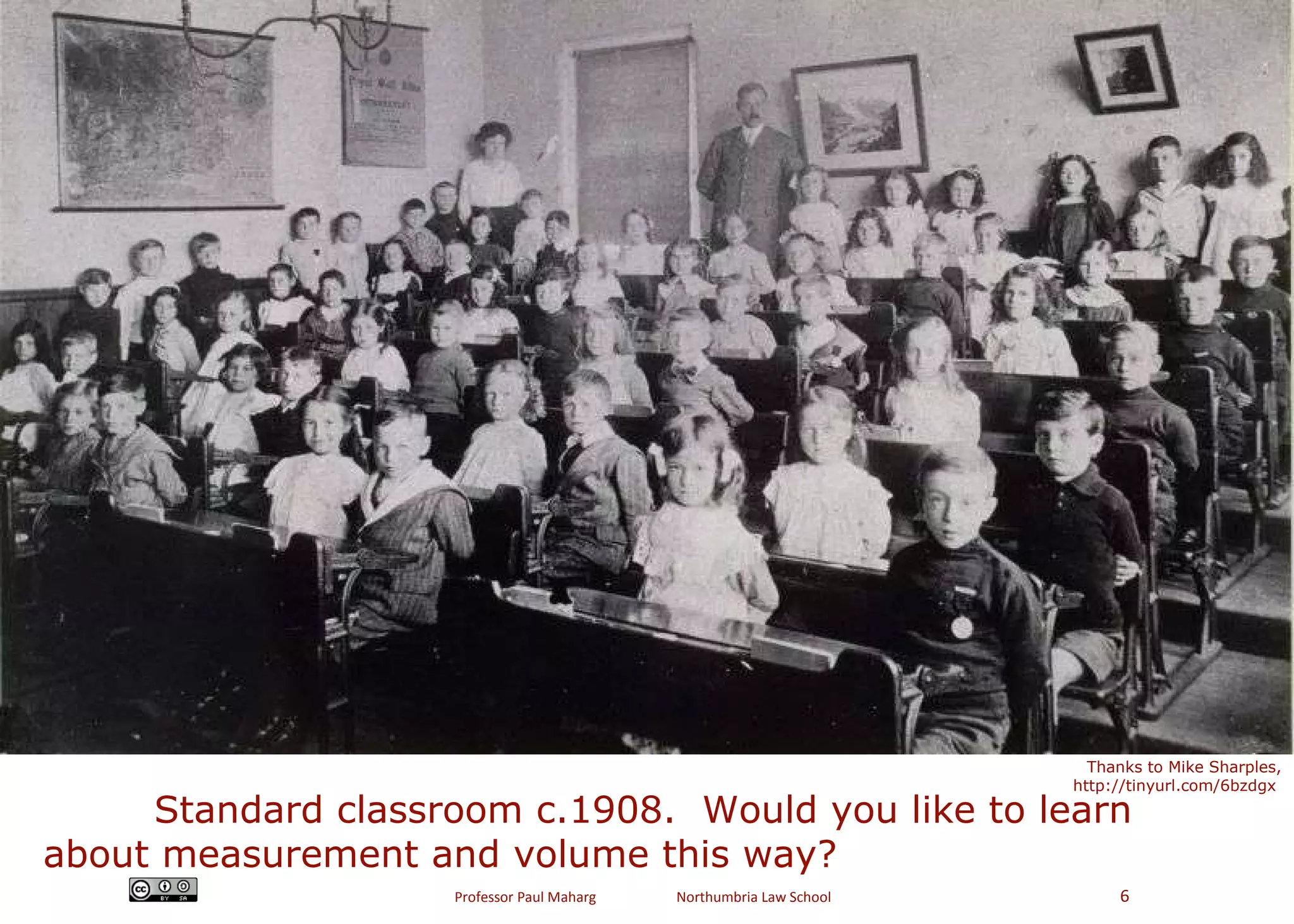
Standard classroom c.1908.  Would you like to learn  about measurement and volume this way?  Thanks to Mike Sharples, http://tinyurl.com/6bzdgx
… o r this way?  (Dewey’s Laboratory School, U. of Chicago, 1901)   http://tinyurl.com/6onvjp
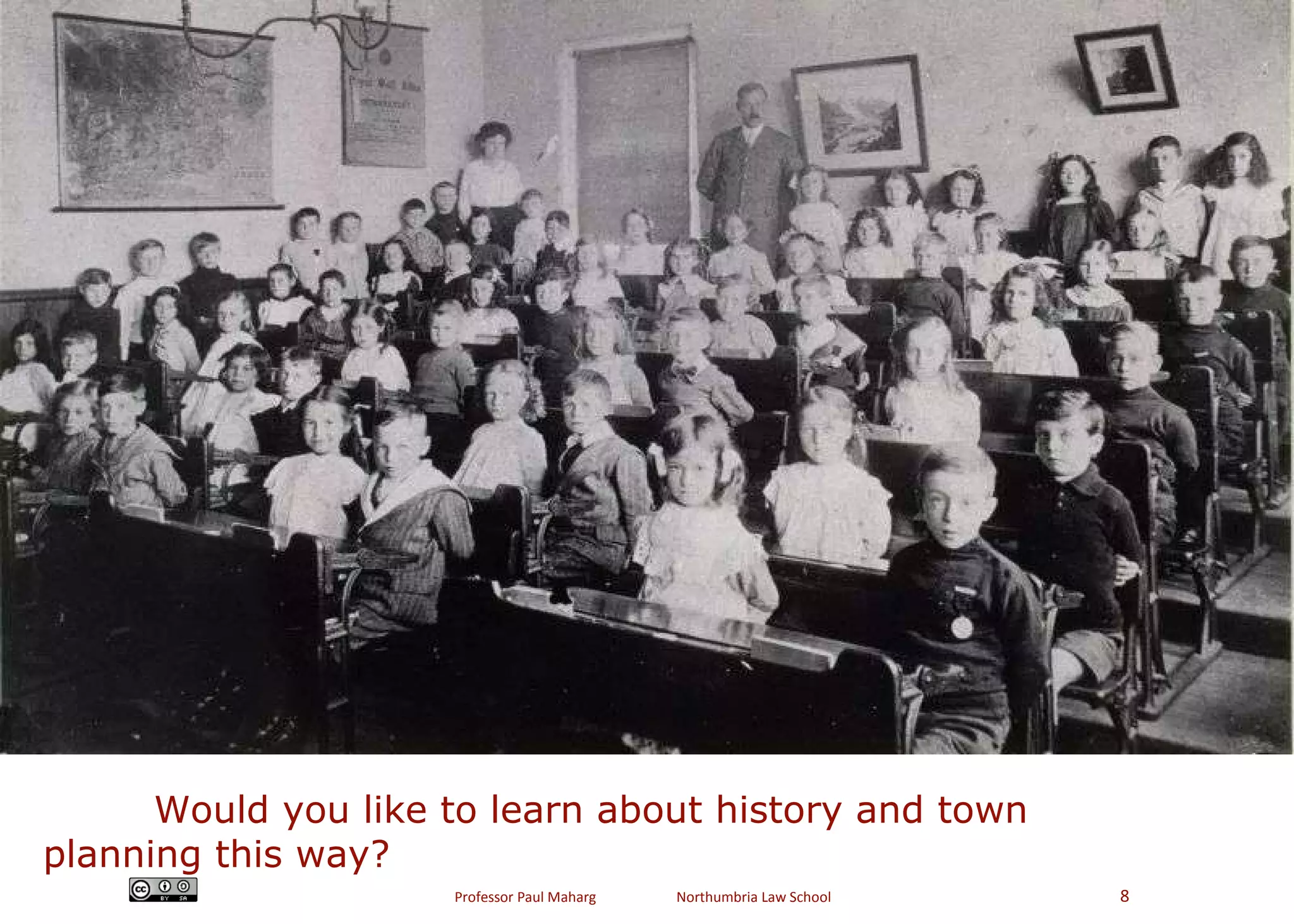
Would you like to learn about history and town  planning this way?
…  o r by building a table-top town for a social life  history project?  (Dewey’s Lab School) http://tinyurl.com/59c93q
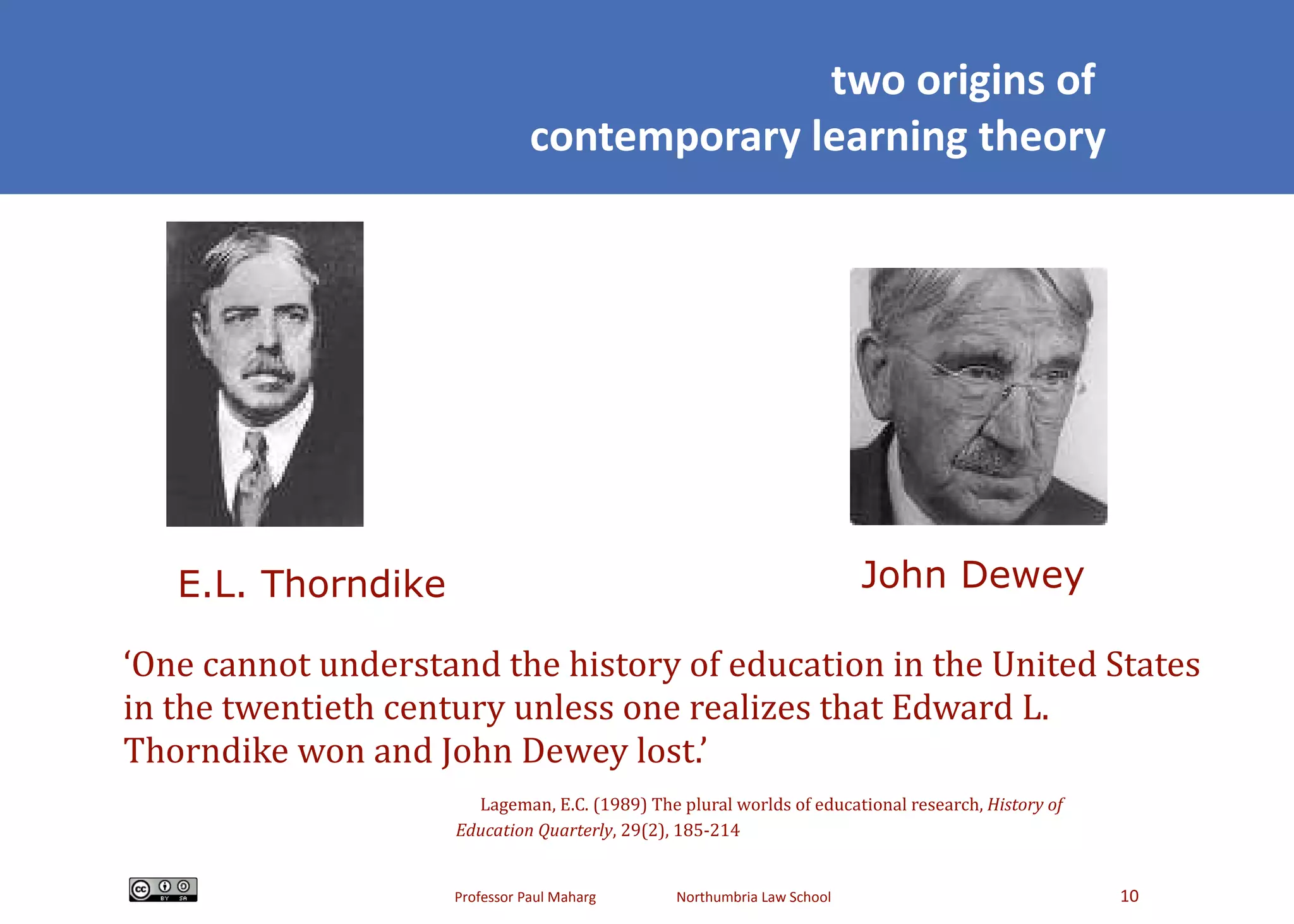
two origins of  contemporary learning theory ‘ One cannot understand the history of education in the United States in the twentieth century unless one realizes that Edward L. Thorndike won and John Dewey lost.’      Lageman, E.C. (1989) The plural worlds of educational research,  History of Education Quarterly , 29(2), 185-214 E.L. Thorndike John Dewey
E.L. Thorndike John Dewey 1. Educational psychologist Philosopher & educationalist 2. Theoretician & experimentalist Theoretician and practical implementer 3. Explored the dyadic relationship between mind & the world Interested in the arc between experience & the world 4. Adopted as precursor of a behaviourist approach to learning: assessment-led; laws of effect, recency, repetition Pragmatist approach to learning: prior experience, ways of contextual knowing; democracy & education 5. Emphasised teaching strategies Emphasised learning ecologies 6. Followed by: Watson, Skinner, Gagné; outcomes, competence & instructional design (ID) movements. Followed by: Bruner, Kilpatrick, standards movement, Constructivist tradition.
First kindergarten – opened 1837, Friedrich Fröbel Children played freely with blocks, bricks, tiles, shapes: his school was designed for designers Developed the idea of  freiarbeit  and the educational value of games. Other approaches Montessori method Waldorf education Sudbury school High/Scope method kindergarten approaches
 
 
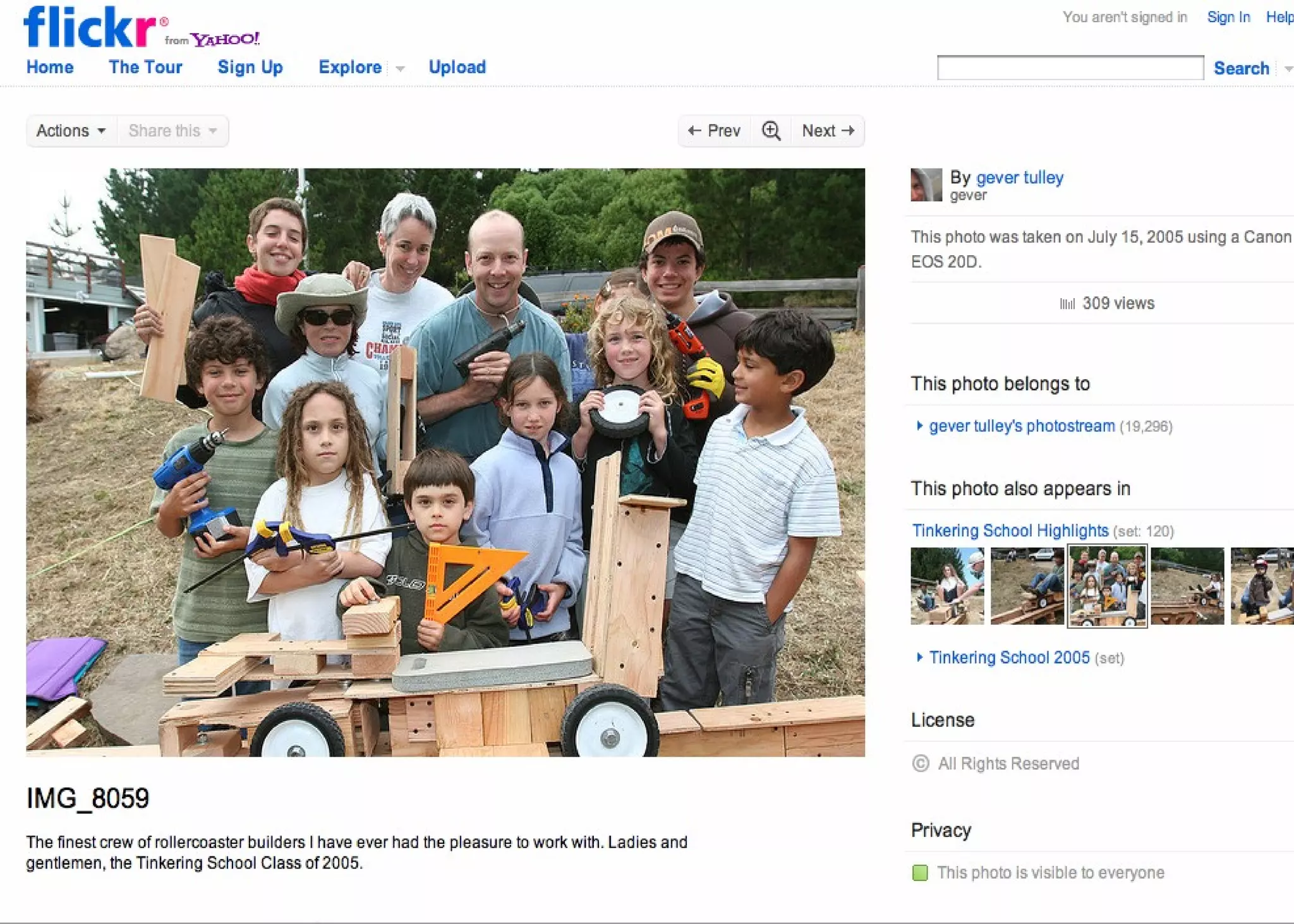
Open-plan education where spaces support activity & thinking School as teacher Vertical groupings, 5-11, instead of classes Articulated a pedagogy  of six selves & three I’s… ‘ I am sure that teaching is an art and that teachers are artists. The teacher teaches what he is, more than what he knows, and as an artist, involved and giving of himself with love.’ George Baines distributed learning: George Baines & primary education
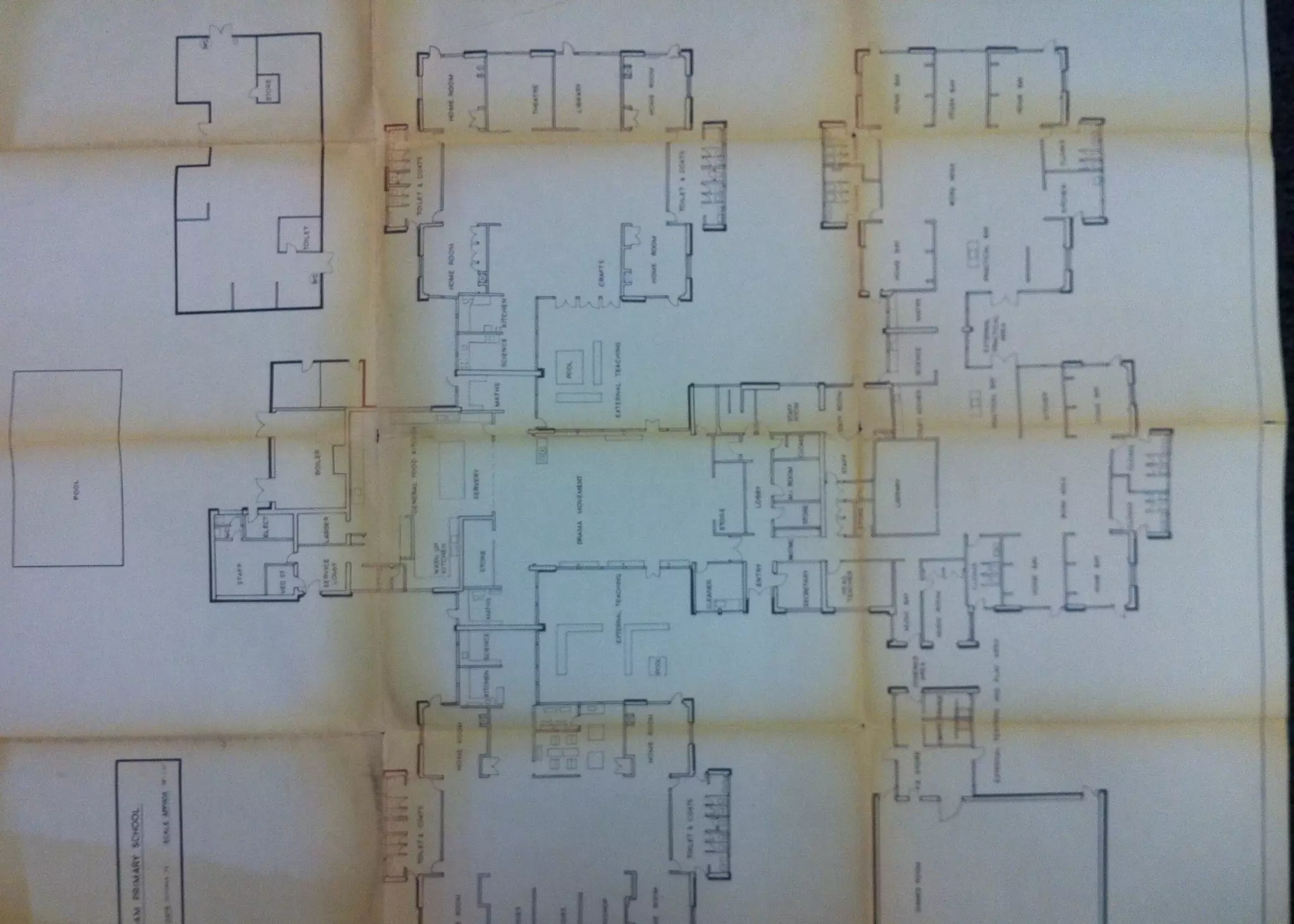
Open-plan building (the ‘articulate school’) Integrated day Family groupings of 40 children, aged 5-9 Team/co-operative teaching characteristics of the Eynsham school
 
All learning areas divided into bays: open-plan building Library Office Laboratory Studio Kitchen House Needleroom Music room Workshop Theatre Withdrawing room
No national curriculum, no LEA curriculum, no school curriculum Periods are blocks of time that are flexible if required.  Breaks are flexible: play and work are intertwined. Setting out and clearing up were part of the day’s activities for both children & staff. ‘ There is every effort made for the school to be a real community group and to develop skills and abilities of individuals and help them develop attitudes to enable them to be individuals yet concerned with the other individuals in their community.’ Eynsham teacher integrated day
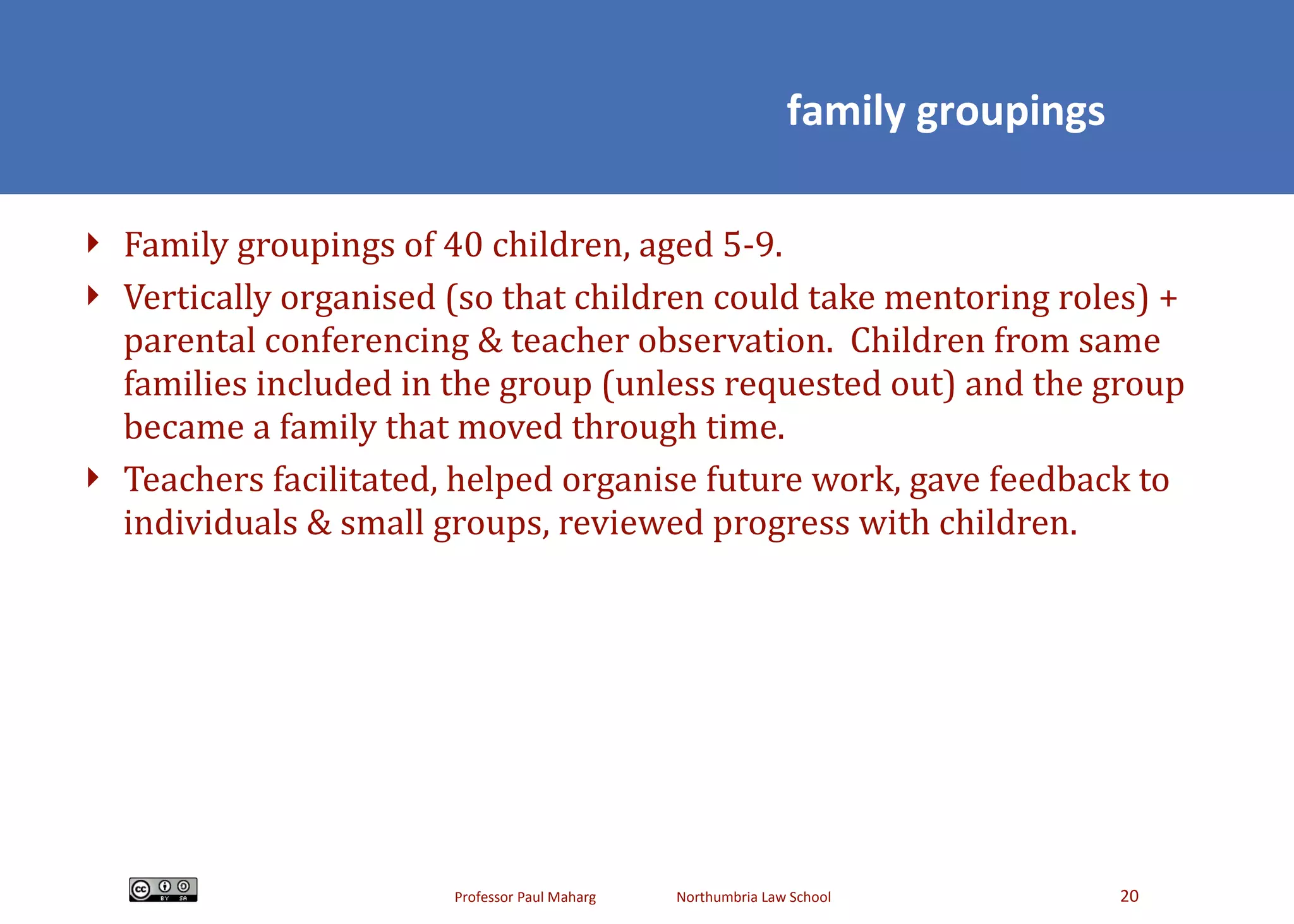
Family groupings of 40 children, aged 5-9.  Vertically organised (so that children could take mentoring roles) + parental conferencing & teacher observation.  Children from same families included in the group (unless requested out) and the group became a family that moved through time. Teachers facilitated, helped organise future work, gave feedback to individuals & small groups, reviewed progress with children.  family groupings
Teachers formed a co-operative: helping each other teach meeting regularly to plan & discuss activities and resources All teachers recorded their practice in daily diaries, which for some became a record that fed into writing about school activities.  Teacher practice exemplified Dewey’s democratic practices: ‘associated living’ & ‘associated thinking’ team teaching
curriculum  objectives
curriculum methods & techniques
 
six selves, three I’s Six selves Three I’s
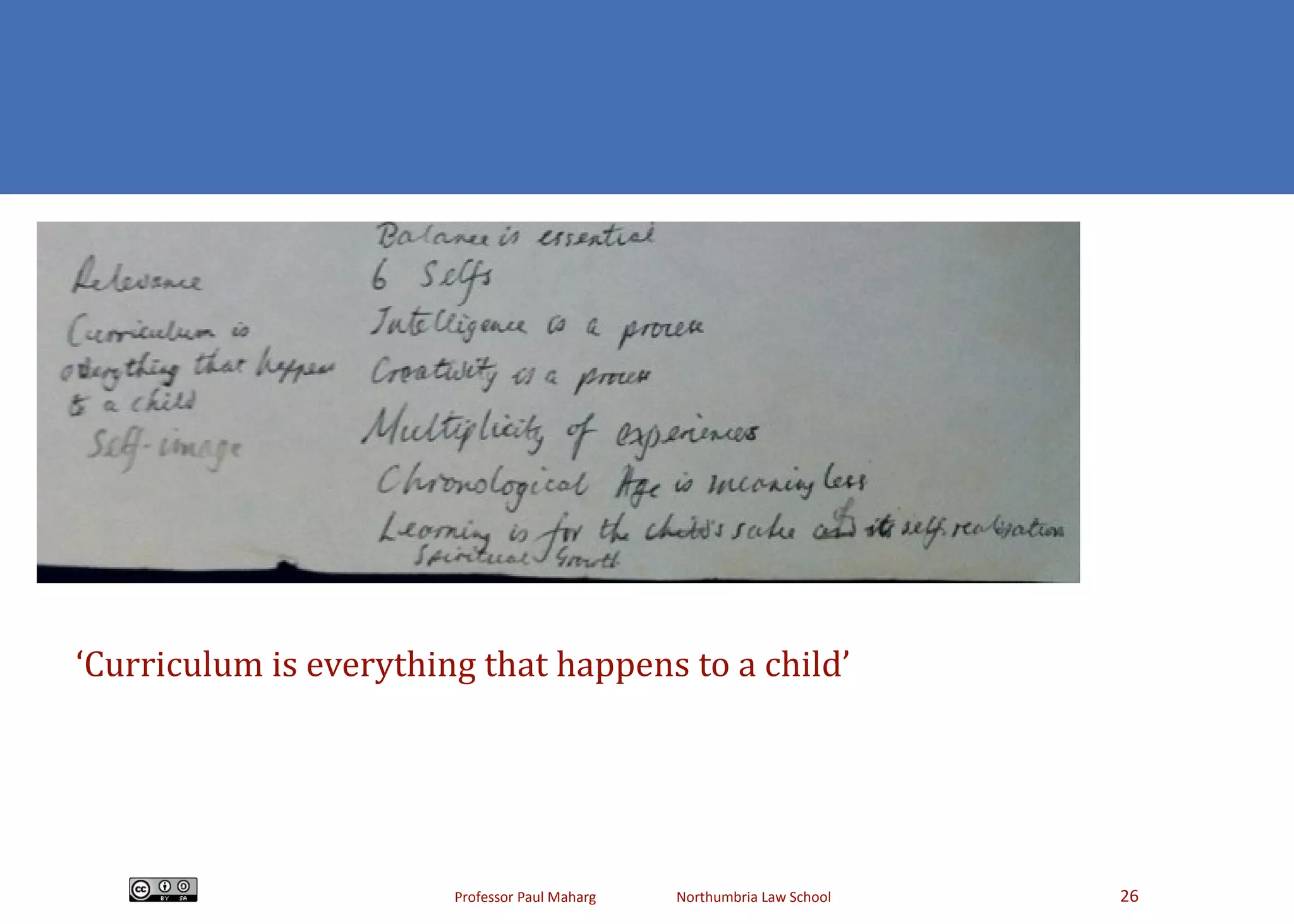
‘ Curriculum is everything that happens to a child’
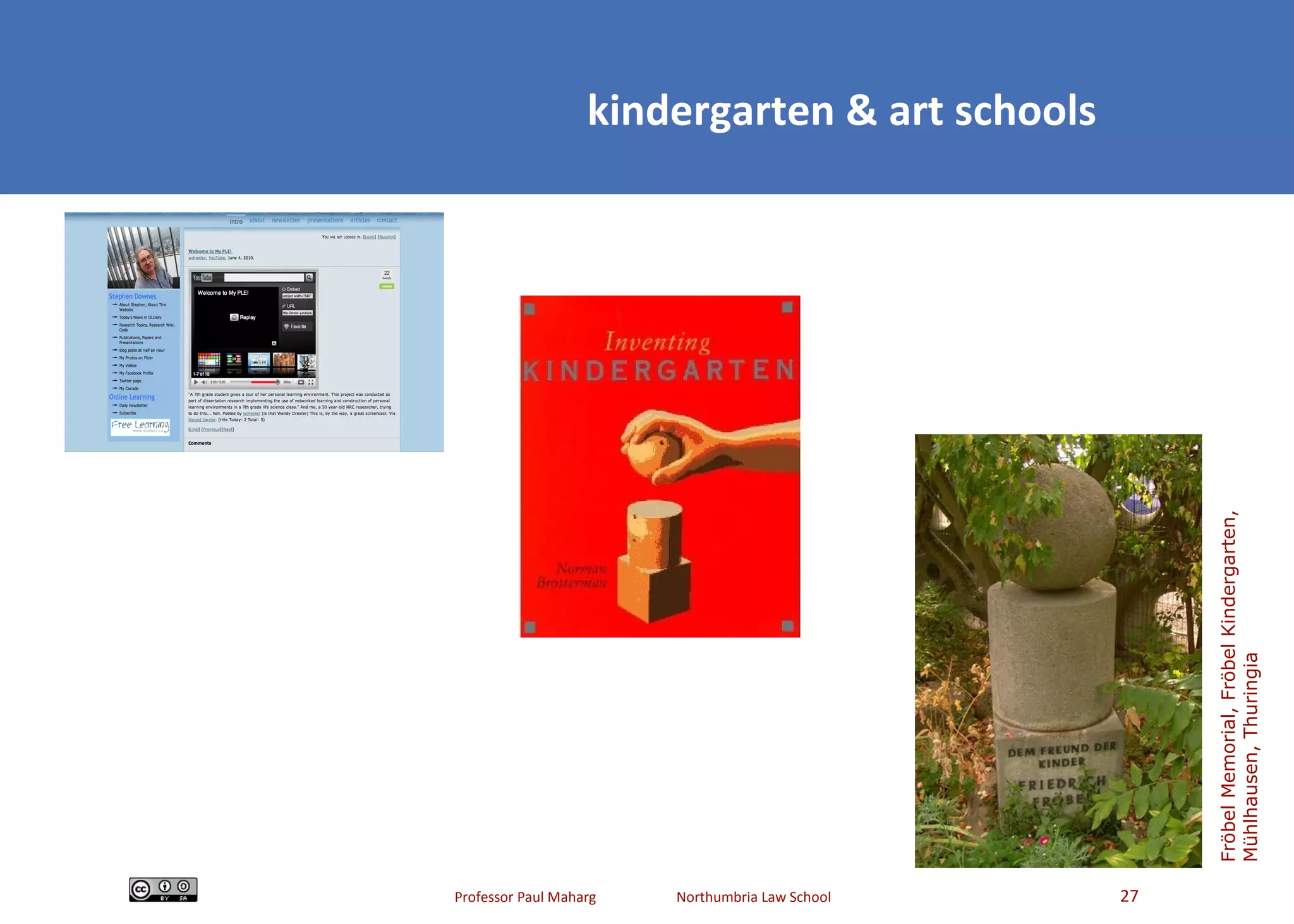
kindergarten & art schools Fröbel Memorial, Fröbel Kindergarten, Mühlhausen, Thuringia
signature pedagogies  (Lee Shulman) Sullivan, W.M., Colby, A., Wegner, J.W., Bond, L., Shulman, L.S. (2007)  Educating Lawyers.  Preparation for the Profession of Law,  Jossey-Bass, p. 24
transforming the pedagogy…?
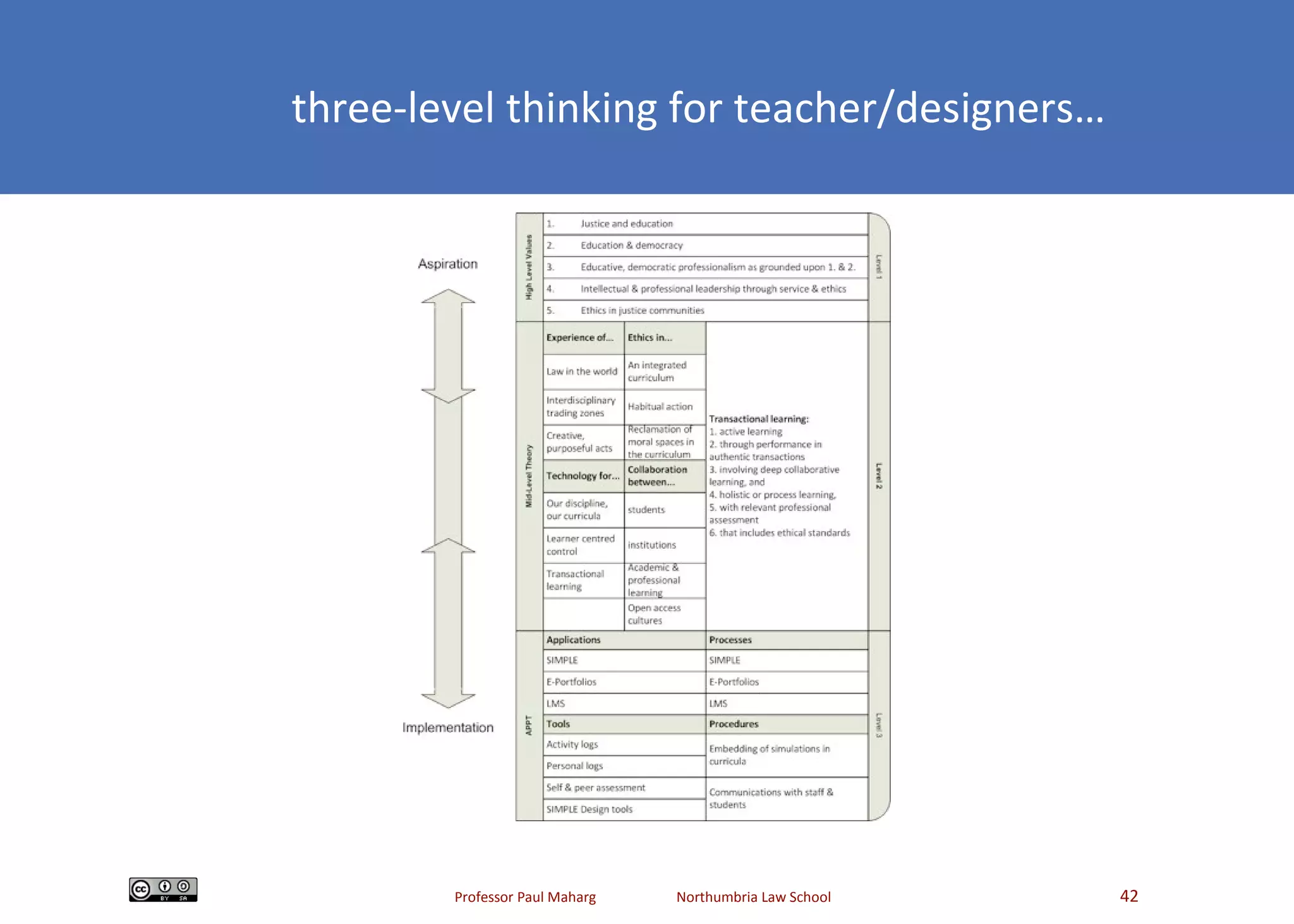
  A specific form of problem-based learning.  At least seven distinguishing elements –  active learning through  performance in authentic transactions involving  reflection in & on learning, deep  collaborative learning , and  holistic or  process learning, with  relevant professional assessment that includes  ethical standards –  that can have a significant effect on learning when used in simulations of professional practice.  transactional learning
 
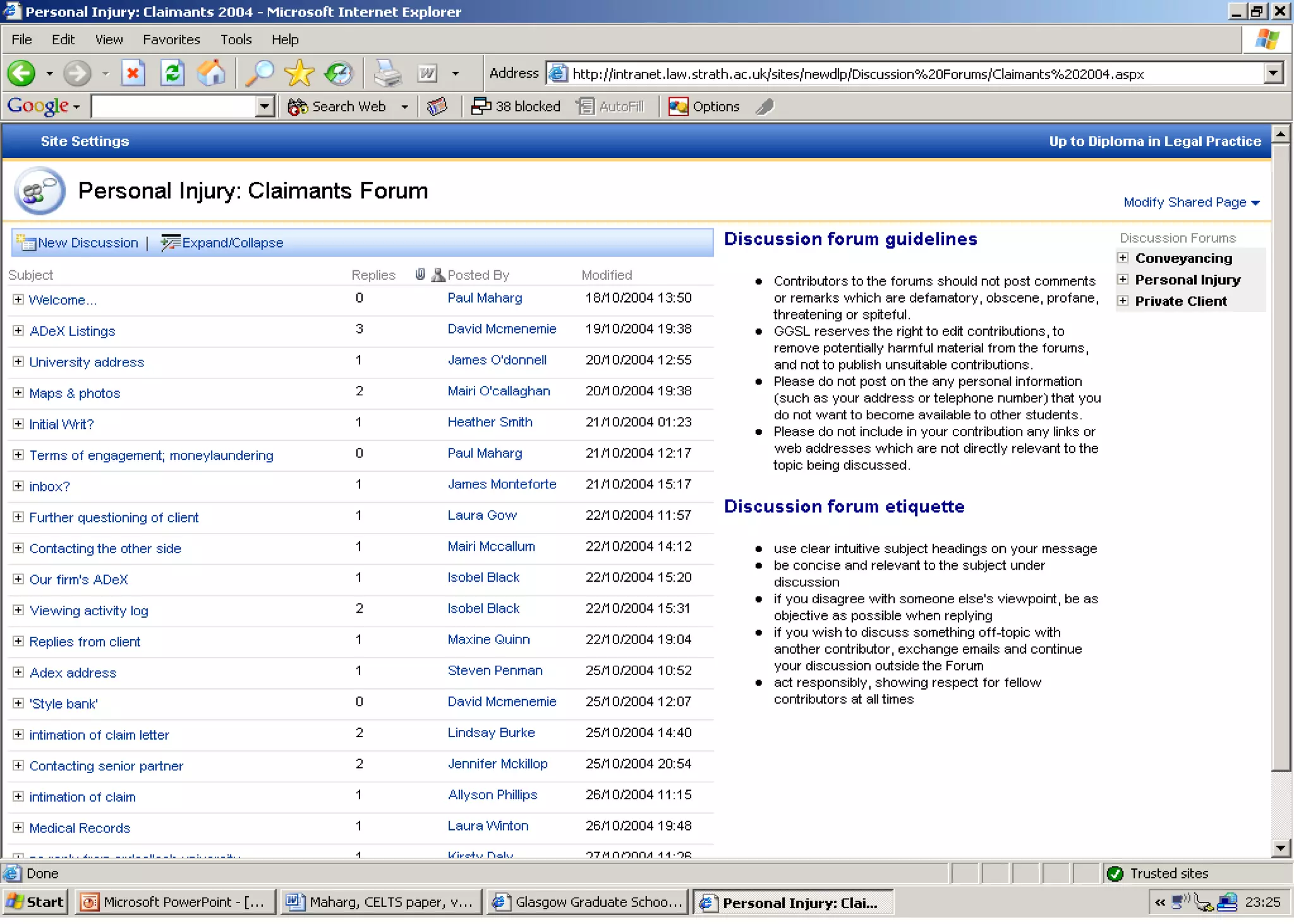
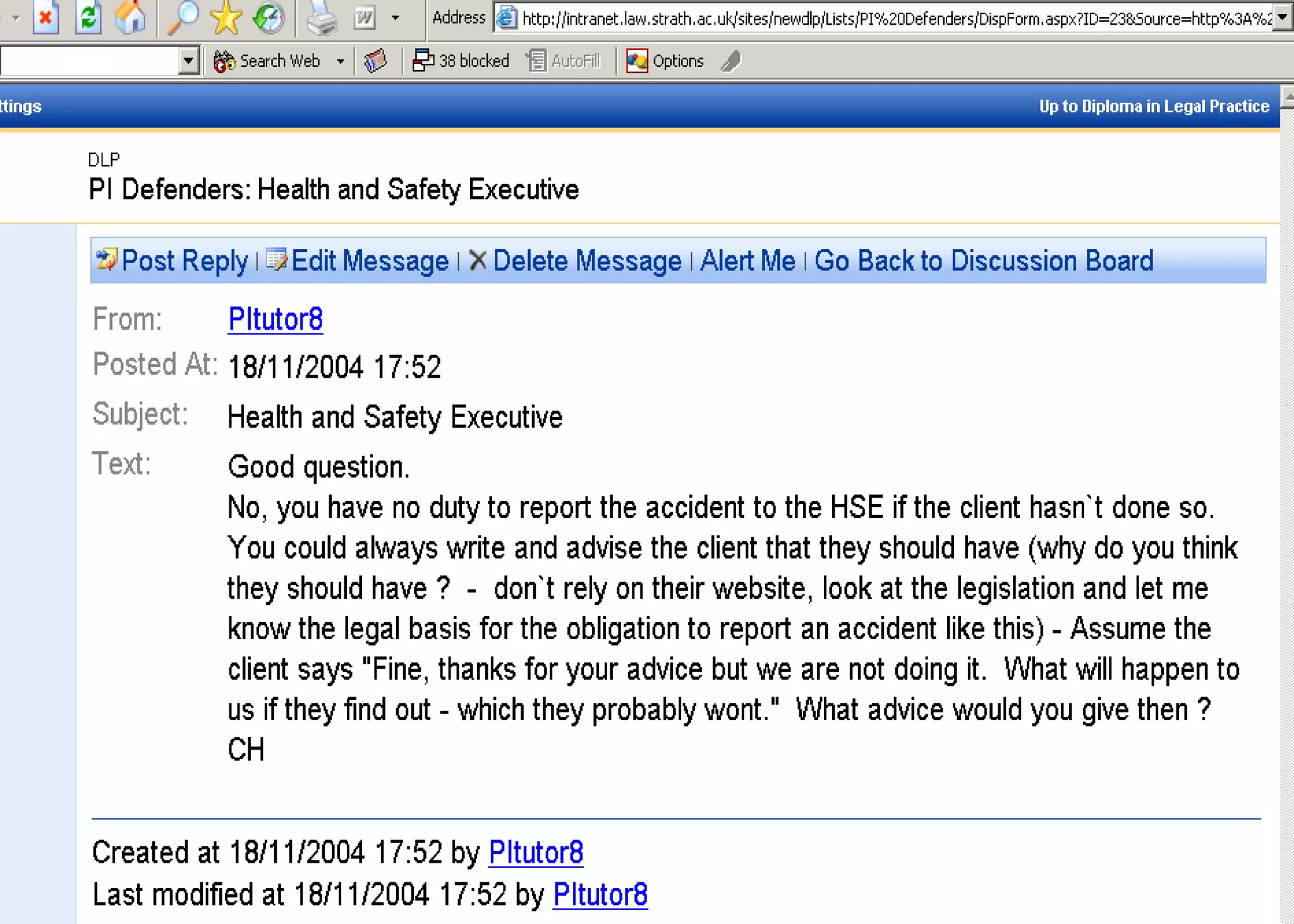
personal injury  negotiation project Administration: 272 students, 68 firms, 8 anonymous information sources – PI mentors 68 document sets, 34 transactions Each scenario has embedded variables, called from a document server, making it  similar, but also unique in critical ways students have 12 weeks to achieve settlement introductory & feedback lectures discussion forums FAQs & transaction guideline flowcharts voluntary face-to-face surgeries with a PI solicitor
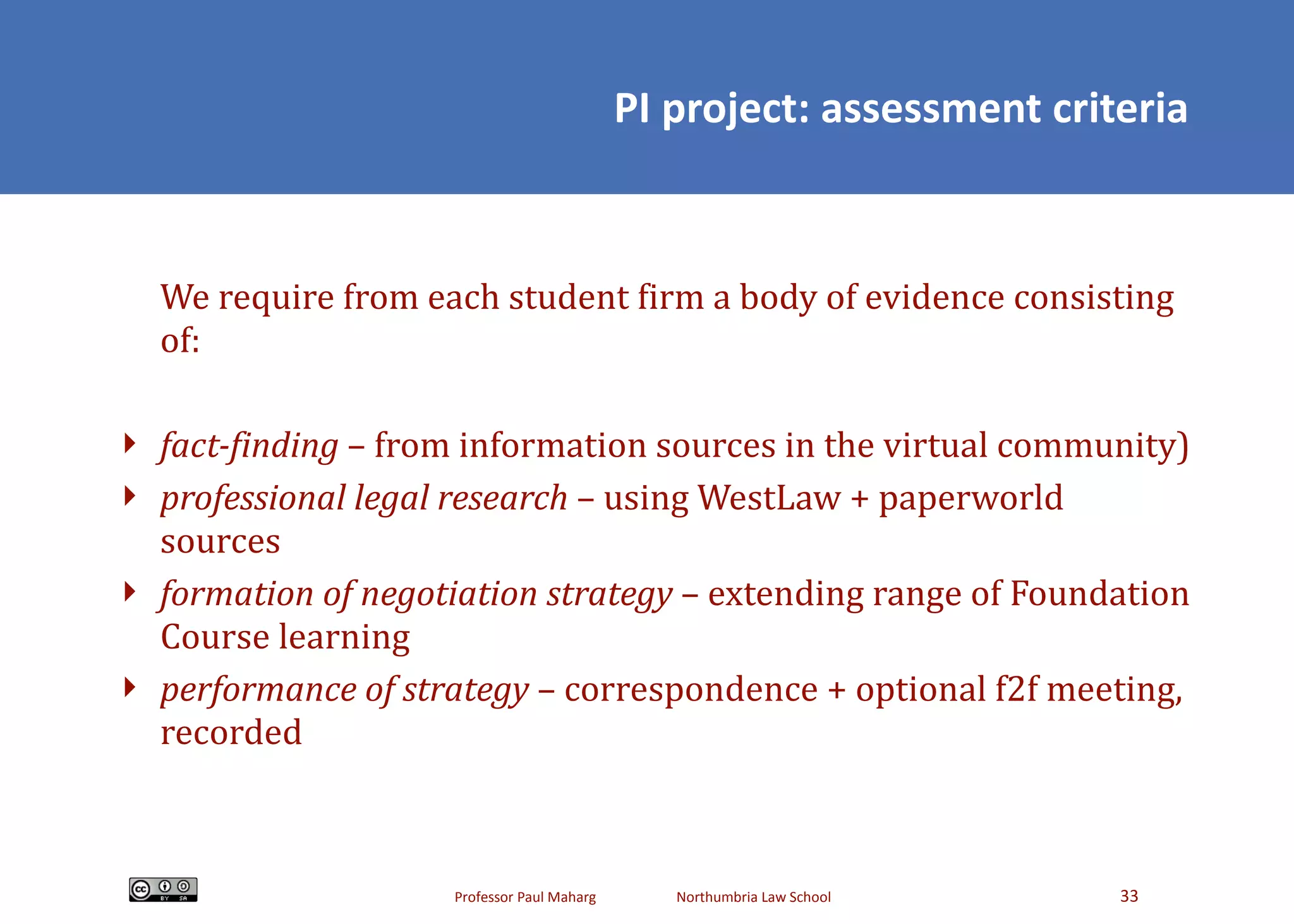
PI project: assessment criteria We require from each student firm a body of evidence consisting of: fact-finding  – from information sources in the virtual community) professional legal research  – using WestLaw + paperworld sources formation of negotiation strategy  – extending range of Foundation Course learning performance of strategy  –  correspondence + optional f2f meeting, recorded


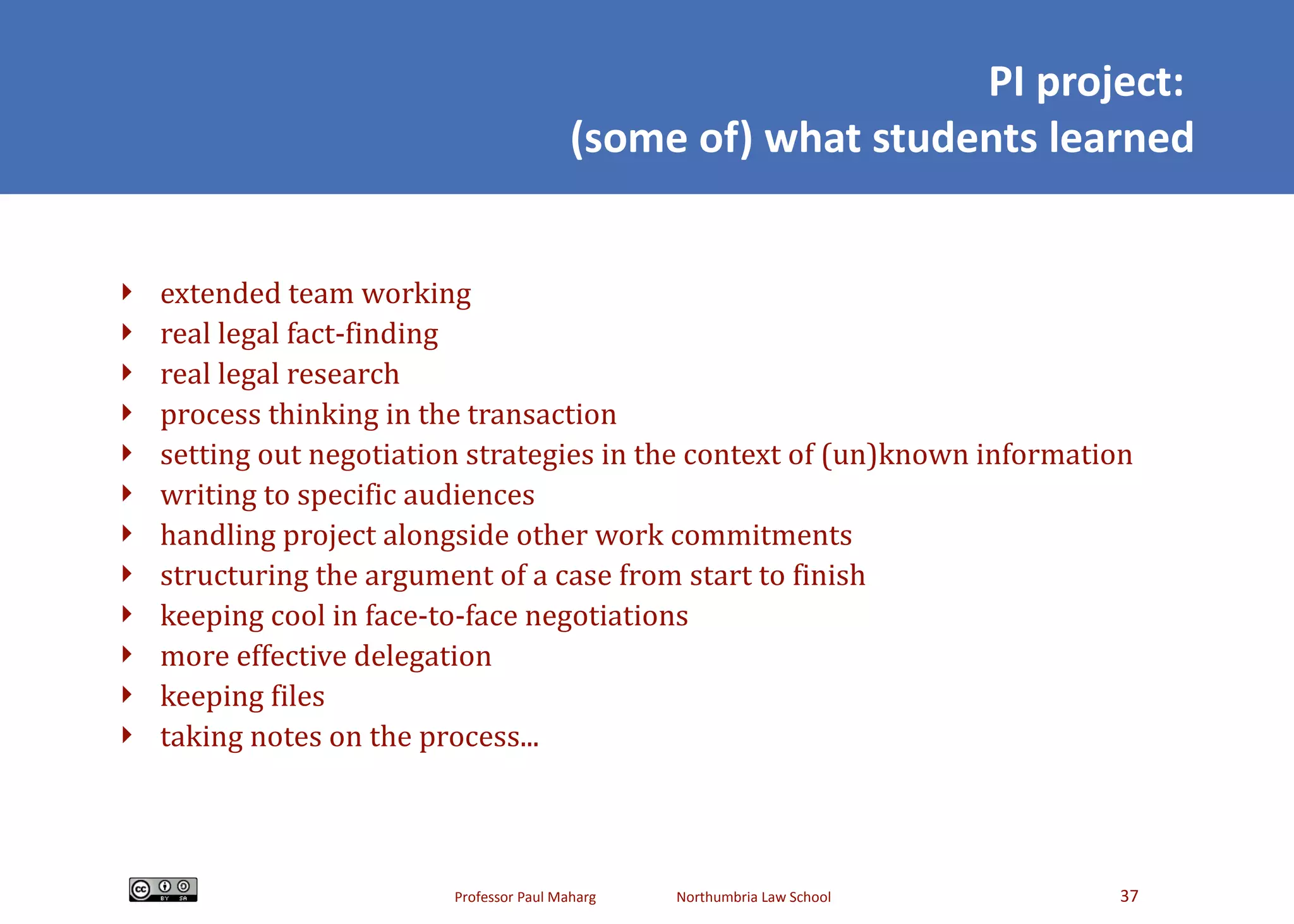
PI project:  (some of) what students learned extended team working real legal fact-finding real legal research process thinking in the transaction setting out negotiation strategies in the context of (un)known information writing to specific audiences handling project alongside other work commitments structuring the argument of a case from start to finish keeping cool in face-to-face negotiations more effective delegation keeping files taking notes on the process...
PI project: what students would have done differently… ‘ In tackling this project I think that our group made two main mistakes.  The first mistake we made was in approaching the task as law students as opposed to Lawyers.  By this I mean we tried to find the answer and work our way back.  Immediately we were thinking about claims and quantum and blame.  I don't think we actually initiated a claim until a week before the final settlement.  I think the phrase "like a bull in a china shop" would aptly describe the way we approached the problem.  […]  Our group knew what area of law and tests to apply yet we ended up often being ahead of ourselves and having to back-pedal The second mistake we made was estimating how long it would take to gather information.  We started our project quite late on and began to run out of time towards the end.  None of us appreciated the length of time it would take to gather information and on top of this we would often have to write two or three letters to the same person as the initial letter would not ask the right question.’
PI project: what students would have done differently… ‘ At the beginning we thought we perhaps lost sight of the fact that we had a client whom we had a duty to advise and inform.  On reflection we should have issued terms of engagement and advised the client better in monetary terms what the likely outcome was going to be.’ ‘ […] unlike other group projects I was involved in at undergraduate level I feel that I derived genuine benefit from this exercise in several ways: 1. reinforcing letter-writing, negotiation, time-management and IT skills 2. conducting legal research into issues of quantum working effectively in a group as a group - not delegating tasks at the first meeting and then putting together pieces of work at the second meeting.’
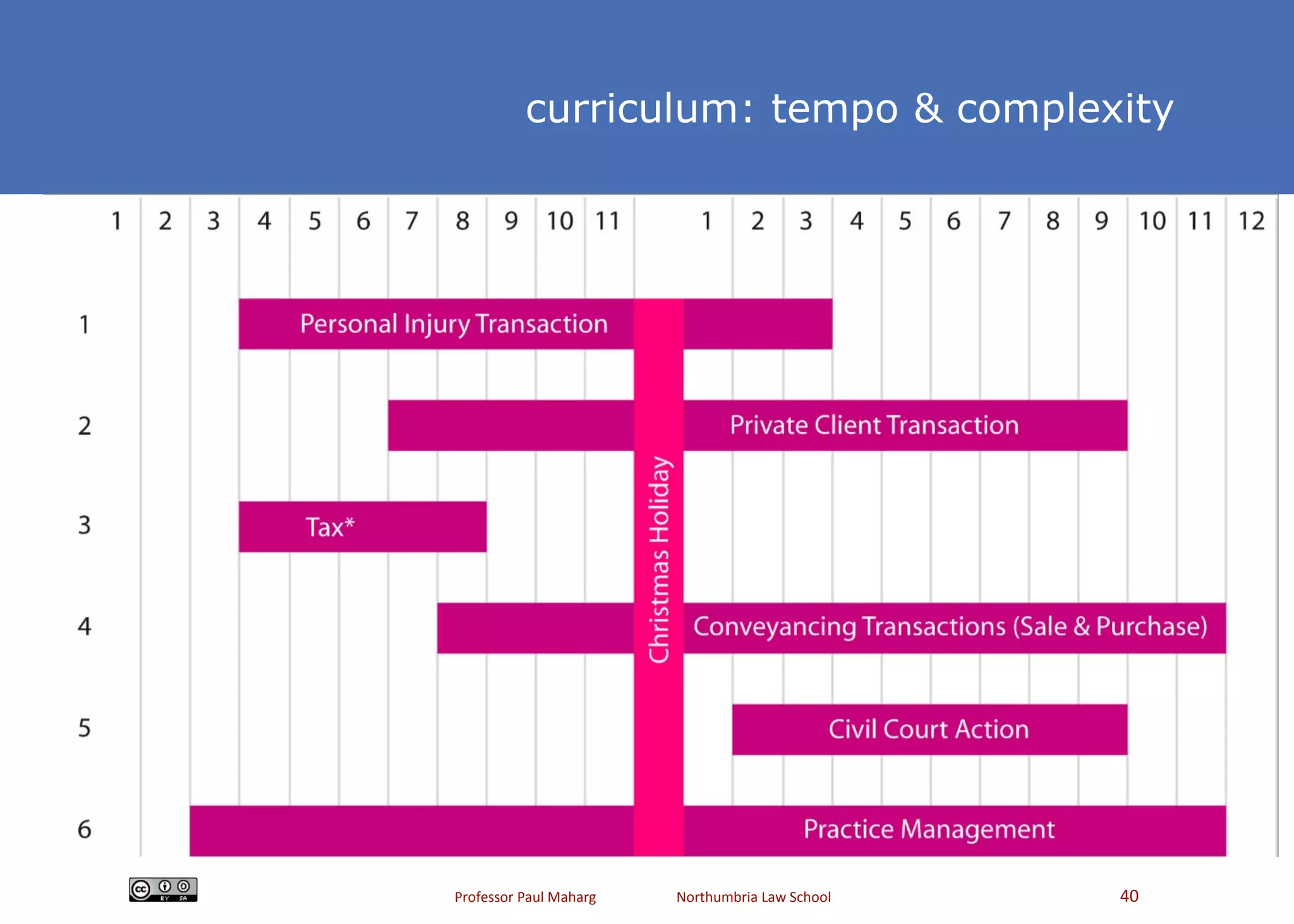
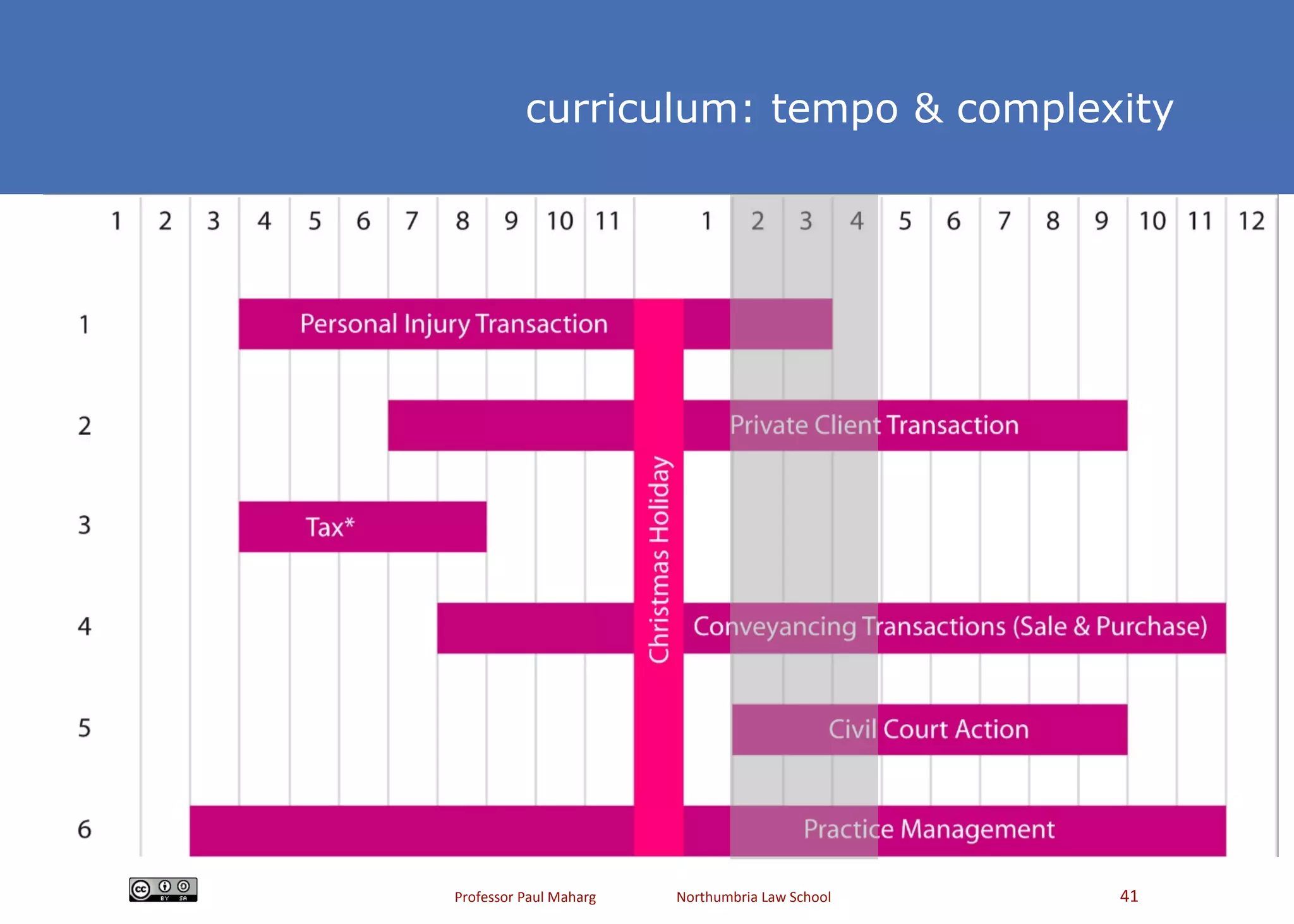
curriculum: tempo & complexity
three-level thinking for teacher/designers…
Curriculum is multiple distributed technologies and practices.  Eg timetables, course teams, notepads, learning spaces, forms of knowledge transmission, discussion, computers, forms of discourse, writing  –  all existing in time spans. Some technologies are ancient ( lectura, glossa) , some new (SIMPLE, standardised clients, mobile phones) Success in learning means: f or staff, the need to  compose and orchestrate the curriculum .  f or students, the tools, support & spaces to  manage their own curriculum curriculum is technology
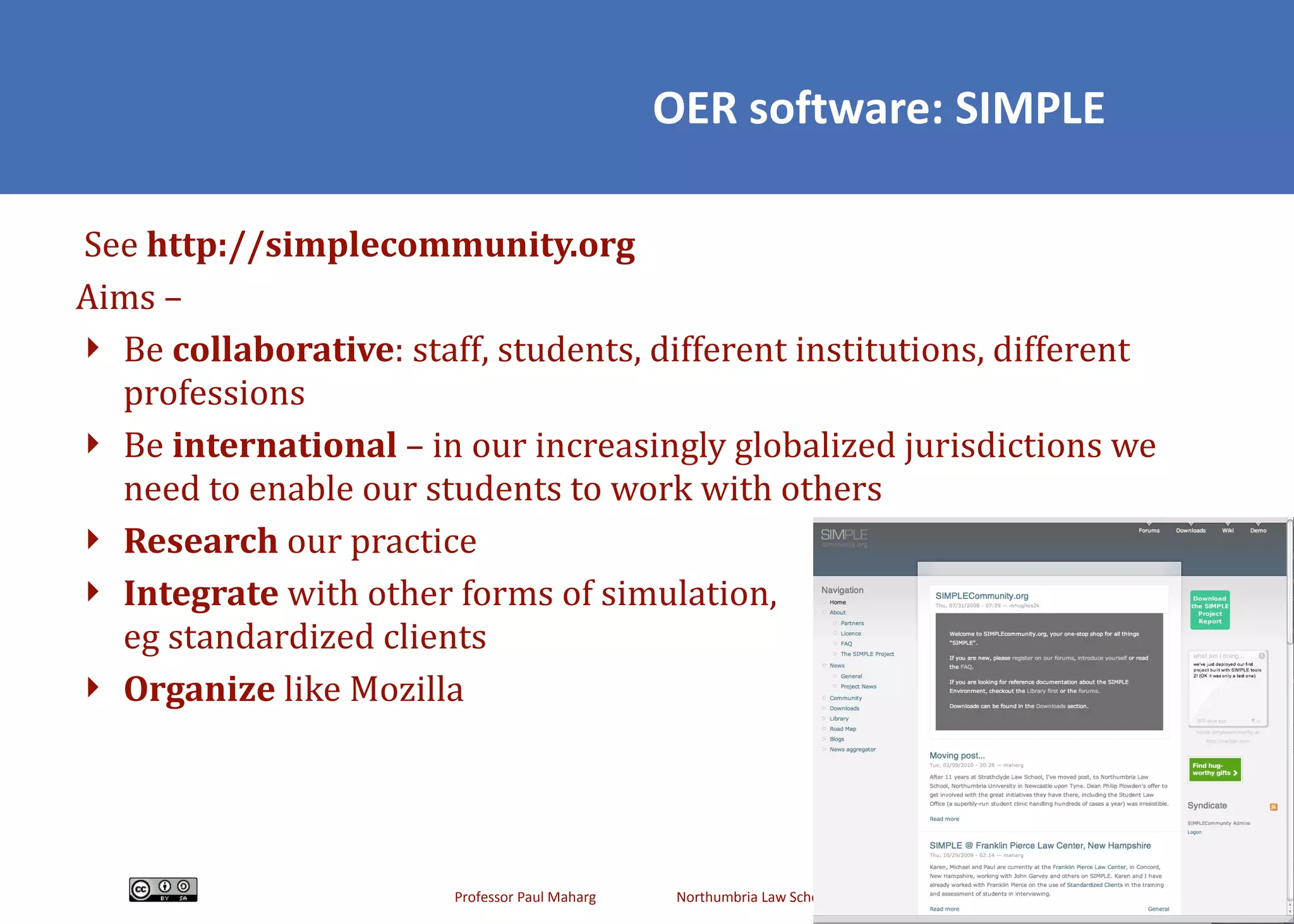
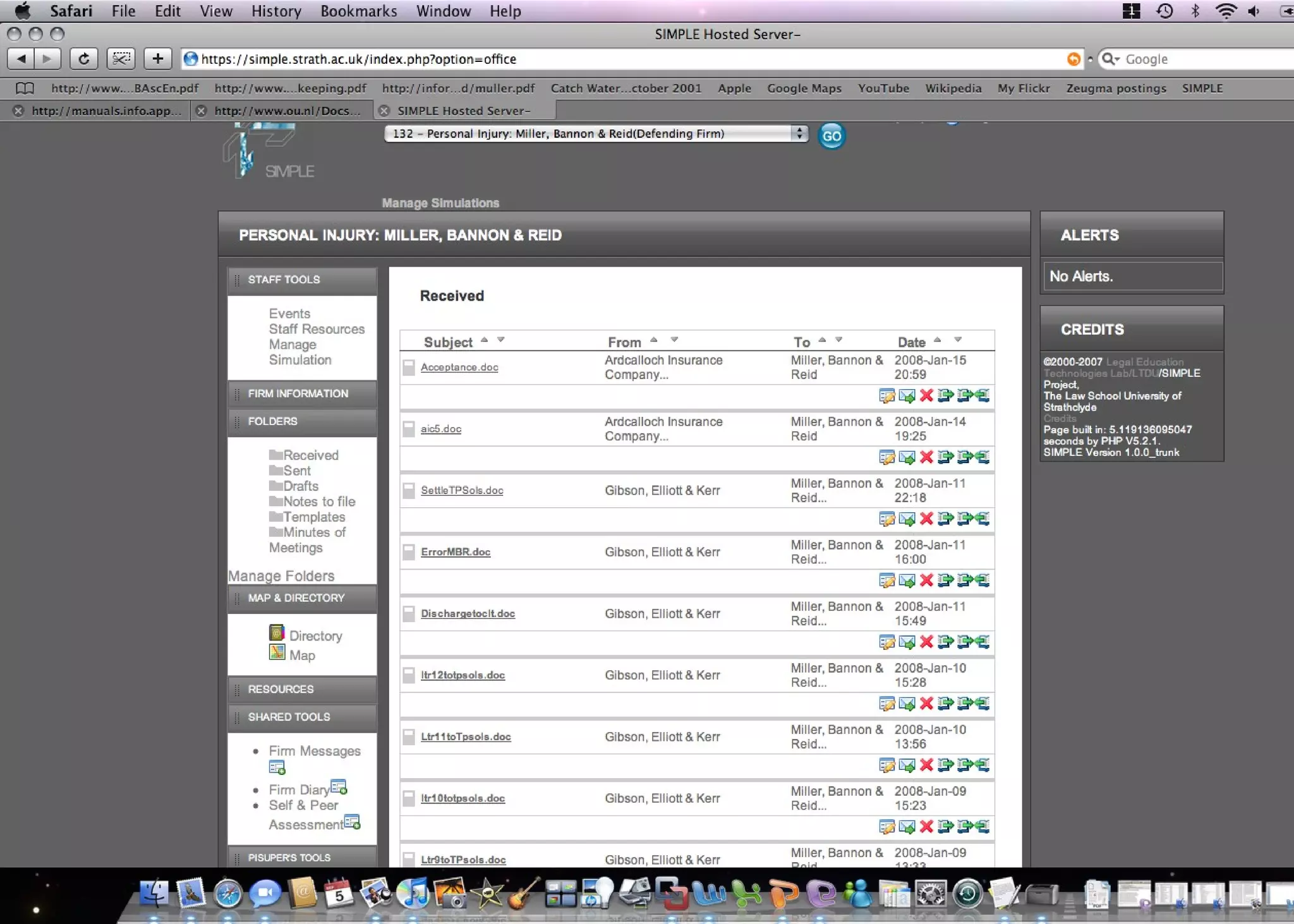
OER software: SIMPLE See  http://simplecommunity.org  Aims –  Be  collaborative : staff, students, different institutions, different professions Be  international  – in our increasingly globalized jurisdictions we need to enable our students to work with others Research  our practice Integrate  with other forms of simulation,  eg standardized clients O rganize  like Mozilla
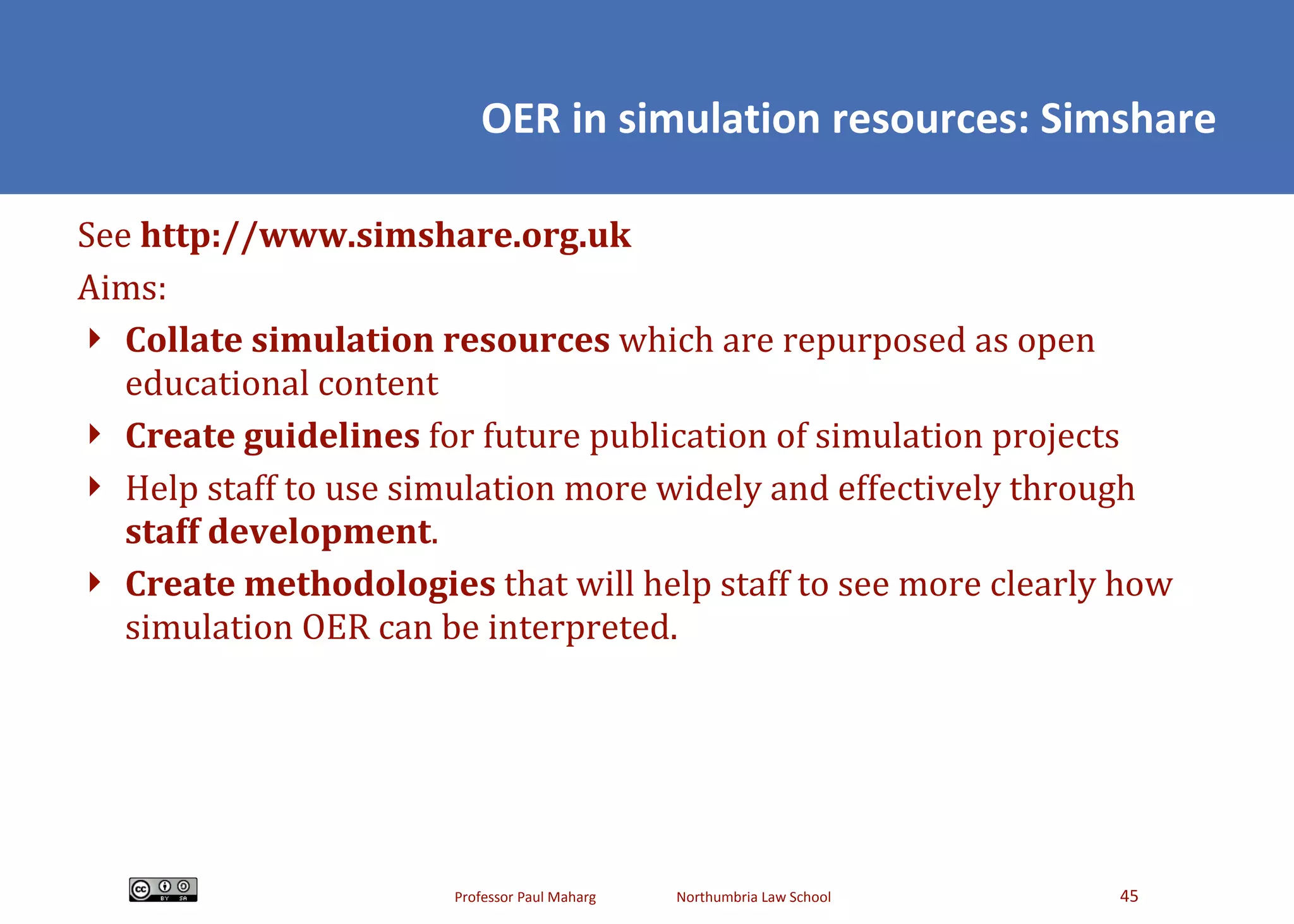
OER in simulation resources: Simshare See  http://www.simshare.org.uk Aims: Collate simulation resources  which are repurposed as open educational content Create guidelines  for future publication of simulation projects Help staff to use simulation more widely and effectively through  staff development . Create methodologies  that will help staff to see more clearly how simulation OER can be interpreted.
 
OER ethics resources See  www.teachinglegalethics.org
Two book series:  Emerging Legal Education  Book Series, Ashgate Publishing, editors Paul Maharg, Caroline Maughan, Elizabeth Mertz. Digital Games and Learning  Book Series, Continuum Publishing, editors Sara de Freitas & Paul Maharg. research & publication…
Slides: http://www.slideshare.net/paulmaharg Blog: http://zeugma.typepad.com SIMPLE: http://simplecommunity.org Simshare: http://www.simshare.org.uk Email: [email_address] web details

Kindergartens, law schools

  • 1.
    Of kindergartens andlaw schools: learning justice in the 21 st century Paul Maharg Northumbria Law School
  • 2.
  • 3.
    what do lawschools do to students? Stress Benjamin, G. A. H., Kaszniak, A., Sales, B. & Shanfield, S. B. (1986) The role of legal education in producing psychological distress among law students and lawyers. American Bar Foundation Research Journal, 225-252. Negative effect on values & motivation Sheldon, K. M. & Krieger, L. (2004) Does law school undermine law students? Examining changes in goals, values, and well-being. Behavioral Sciences and the Law, 22, 261-286. Teaching content and methods induce cynicism McKinney, R. A. (2002) Depression and anxiety in law students: are we part of the problem and can we be part of the solution? Journal of the Legal Writing Institute, 8, 229-55. Rapaport, N.B. (2002) Is "thinking like a lawyer" really what we want to teach? Journal of the Legal Writing Institute, 8, 91-108
  • 4.
    what difference canlegal education make? Legal education has a weak socialising affect, much weaker than the centripetal power of the job market. A. Sherr, A., Webb, J. (1989). Law students, the external market, and socialisation: do we make them turn to the City? Journal of Law and Society 16, 2, 225. Legal subjects studied affect career ambitions, but had a neutral, short term or negative impact on the public service orientation of law students. Boon, A. (2005). From public service to service industry: the impact of socialisation and work on the motivation and values of lawyers. International Journal of the Legal Profession, 12, 2, 229-260. A study on socio-economic & ethnic diversity in Scotland found similar results. Anderson, S., Maharg, P., Murray, L. (2003) Minority and Social Diversity in Legal Education , Scottish Government Official Publication.
  • 5.
    John Dewey (1859-1952)‘ A democracy is more than a form of government; it is primarily a mode of associated living, of conjoint communicated activity.’ Democracy and Education (1916) can we make a difference?
  • 6.
    Standard classroom c.1908. Would you like to learn about measurement and volume this way? Thanks to Mike Sharples, http://tinyurl.com/6bzdgx
  • 7.
    … o rthis way? (Dewey’s Laboratory School, U. of Chicago, 1901) http://tinyurl.com/6onvjp
  • 8.
    Would you liketo learn about history and town planning this way?
  • 9.
    … or by building a table-top town for a social life history project? (Dewey’s Lab School) http://tinyurl.com/59c93q
  • 10.
    two origins of contemporary learning theory ‘ One cannot understand the history of education in the United States in the twentieth century unless one realizes that Edward L. Thorndike won and John Dewey lost.’ Lageman, E.C. (1989) The plural worlds of educational research, History of Education Quarterly , 29(2), 185-214 E.L. Thorndike John Dewey
  • 11.
    E.L. Thorndike JohnDewey 1. Educational psychologist Philosopher & educationalist 2. Theoretician & experimentalist Theoretician and practical implementer 3. Explored the dyadic relationship between mind & the world Interested in the arc between experience & the world 4. Adopted as precursor of a behaviourist approach to learning: assessment-led; laws of effect, recency, repetition Pragmatist approach to learning: prior experience, ways of contextual knowing; democracy & education 5. Emphasised teaching strategies Emphasised learning ecologies 6. Followed by: Watson, Skinner, Gagné; outcomes, competence & instructional design (ID) movements. Followed by: Bruner, Kilpatrick, standards movement, Constructivist tradition.
  • 12.
    First kindergarten –opened 1837, Friedrich Fröbel Children played freely with blocks, bricks, tiles, shapes: his school was designed for designers Developed the idea of freiarbeit and the educational value of games. Other approaches Montessori method Waldorf education Sudbury school High/Scope method kindergarten approaches
  • 13.
  • 14.
  • 15.
    Open-plan education wherespaces support activity & thinking School as teacher Vertical groupings, 5-11, instead of classes Articulated a pedagogy of six selves & three I’s… ‘ I am sure that teaching is an art and that teachers are artists. The teacher teaches what he is, more than what he knows, and as an artist, involved and giving of himself with love.’ George Baines distributed learning: George Baines & primary education
  • 16.
    Open-plan building (the‘articulate school’) Integrated day Family groupings of 40 children, aged 5-9 Team/co-operative teaching characteristics of the Eynsham school
  • 17.
  • 18.
    All learning areasdivided into bays: open-plan building Library Office Laboratory Studio Kitchen House Needleroom Music room Workshop Theatre Withdrawing room
  • 19.
    No national curriculum,no LEA curriculum, no school curriculum Periods are blocks of time that are flexible if required. Breaks are flexible: play and work are intertwined. Setting out and clearing up were part of the day’s activities for both children & staff. ‘ There is every effort made for the school to be a real community group and to develop skills and abilities of individuals and help them develop attitudes to enable them to be individuals yet concerned with the other individuals in their community.’ Eynsham teacher integrated day
  • 20.
    Family groupings of40 children, aged 5-9. Vertically organised (so that children could take mentoring roles) + parental conferencing & teacher observation. Children from same families included in the group (unless requested out) and the group became a family that moved through time. Teachers facilitated, helped organise future work, gave feedback to individuals & small groups, reviewed progress with children. family groupings
  • 21.
    Teachers formed aco-operative: helping each other teach meeting regularly to plan & discuss activities and resources All teachers recorded their practice in daily diaries, which for some became a record that fed into writing about school activities. Teacher practice exemplified Dewey’s democratic practices: ‘associated living’ & ‘associated thinking’ team teaching
  • 22.
  • 23.
  • 24.
  • 25.
    six selves, threeI’s Six selves Three I’s
  • 26.
    ‘ Curriculum iseverything that happens to a child’
  • 27.
    kindergarten & artschools Fröbel Memorial, Fröbel Kindergarten, Mühlhausen, Thuringia
  • 28.
    signature pedagogies (Lee Shulman) Sullivan, W.M., Colby, A., Wegner, J.W., Bond, L., Shulman, L.S. (2007) Educating Lawyers. Preparation for the Profession of Law, Jossey-Bass, p. 24
  • 29.
  • 30.
    Aspecific form of problem-based learning. At least seven distinguishing elements – active learning through performance in authentic transactions involving reflection in & on learning, deep collaborative learning , and holistic or process learning, with relevant professional assessment that includes ethical standards – that can have a significant effect on learning when used in simulations of professional practice. transactional learning
  • 31.
  • 32.
    personal injury negotiation project Administration: 272 students, 68 firms, 8 anonymous information sources – PI mentors 68 document sets, 34 transactions Each scenario has embedded variables, called from a document server, making it similar, but also unique in critical ways students have 12 weeks to achieve settlement introductory & feedback lectures discussion forums FAQs & transaction guideline flowcharts voluntary face-to-face surgeries with a PI solicitor
  • 33.
    PI project: assessmentcriteria We require from each student firm a body of evidence consisting of: fact-finding – from information sources in the virtual community) professional legal research – using WestLaw + paperworld sources formation of negotiation strategy – extending range of Foundation Course learning performance of strategy – correspondence + optional f2f meeting, recorded
  • 34.
  • 35.
  • 36.
  • 37.
    PI project: (some of) what students learned extended team working real legal fact-finding real legal research process thinking in the transaction setting out negotiation strategies in the context of (un)known information writing to specific audiences handling project alongside other work commitments structuring the argument of a case from start to finish keeping cool in face-to-face negotiations more effective delegation keeping files taking notes on the process...
  • 38.
    PI project: whatstudents would have done differently… ‘ In tackling this project I think that our group made two main mistakes. The first mistake we made was in approaching the task as law students as opposed to Lawyers. By this I mean we tried to find the answer and work our way back. Immediately we were thinking about claims and quantum and blame. I don't think we actually initiated a claim until a week before the final settlement. I think the phrase "like a bull in a china shop" would aptly describe the way we approached the problem. […] Our group knew what area of law and tests to apply yet we ended up often being ahead of ourselves and having to back-pedal The second mistake we made was estimating how long it would take to gather information. We started our project quite late on and began to run out of time towards the end. None of us appreciated the length of time it would take to gather information and on top of this we would often have to write two or three letters to the same person as the initial letter would not ask the right question.’
  • 39.
    PI project: whatstudents would have done differently… ‘ At the beginning we thought we perhaps lost sight of the fact that we had a client whom we had a duty to advise and inform. On reflection we should have issued terms of engagement and advised the client better in monetary terms what the likely outcome was going to be.’ ‘ […] unlike other group projects I was involved in at undergraduate level I feel that I derived genuine benefit from this exercise in several ways: 1. reinforcing letter-writing, negotiation, time-management and IT skills 2. conducting legal research into issues of quantum working effectively in a group as a group - not delegating tasks at the first meeting and then putting together pieces of work at the second meeting.’
  • 40.
  • 41.
  • 42.
    three-level thinking forteacher/designers…
  • 43.
    Curriculum is multipledistributed technologies and practices. Eg timetables, course teams, notepads, learning spaces, forms of knowledge transmission, discussion, computers, forms of discourse, writing – all existing in time spans. Some technologies are ancient ( lectura, glossa) , some new (SIMPLE, standardised clients, mobile phones) Success in learning means: f or staff, the need to compose and orchestrate the curriculum . f or students, the tools, support & spaces to manage their own curriculum curriculum is technology
  • 44.
    OER software: SIMPLESee http://simplecommunity.org Aims – Be collaborative : staff, students, different institutions, different professions Be international – in our increasingly globalized jurisdictions we need to enable our students to work with others Research our practice Integrate with other forms of simulation, eg standardized clients O rganize like Mozilla
  • 45.
    OER in simulationresources: Simshare See http://www.simshare.org.uk Aims: Collate simulation resources which are repurposed as open educational content Create guidelines for future publication of simulation projects Help staff to use simulation more widely and effectively through staff development . Create methodologies that will help staff to see more clearly how simulation OER can be interpreted.
  • 46.
  • 47.
    OER ethics resourcesSee www.teachinglegalethics.org
  • 48.
    Two book series: Emerging Legal Education Book Series, Ashgate Publishing, editors Paul Maharg, Caroline Maughan, Elizabeth Mertz. Digital Games and Learning Book Series, Continuum Publishing, editors Sara de Freitas & Paul Maharg. research & publication…
  • 49.
    Slides: http://www.slideshare.net/paulmaharg Blog:http://zeugma.typepad.com SIMPLE: http://simplecommunity.org Simshare: http://www.simshare.org.uk Email: [email_address] web details