Prometheus, Sisyphus, Themis:
three rival futures for legal
education
Paul Maharg
He had been told that when looking for a good
oracle it was best to find the oracle that other
oracles went to, but he was shut. There was a sign
by the entrance saying, ‘I just don’t know any
more. Try next door, but that’s just a suggestion,
not formal oracular advice’.
Adams, D. (1993). Mostly Harmless. Pan Macmillan, London, 73
(Slides @ http://paulmaharg.com/slides)
preview
1. The two David Hamiltons: Interdisciplinary historical
understanding and the trading zone
2. Techne, forgetfulness and the future
– Glosses and webcasts
– Digital technologies
3. Three rival futures of legal education research:
Prometheus, Sisyphus, Themis
Slides @ http://paulmaharg.com/slides
Professor Paul Maharg | CC BY-NC-ND 2.5 CANADA 1
The two David Hamiltons:
Interdisciplinary historical understanding and
the trading zone
Towards a Theory of Schooling, eg 1
• Historical investigation of concepts such as ‘class’,
‘course’, ‘curriculum’ via intellectual genealogy, eg
– Class: from the University of Paris’ new Modus et
Ordo Parisiensis (early 16th century) describing
‘sub-division of schools’ with ‘individualized pupil-
by-pupil instruction’ (Hamilton, 7)
– It can refer either to sequence (eg of knowledge) or
coherence (eg an ordered society) and re the
second, see the new schools founded and
patronized by mercantile classes, to provide
a new knowledge for specialist mercantile
activities, not church administration,
and overseen by them.
Professor Paul Maharg | CC BY-NC-ND 2.5 CANADA 3
Towards a Theory of Schooling, eg 2
• Curriculum – first used in English in 17th
century records of University of Glasgow, in
1633 (OED) (Hamilton, 3). Context:
• introduced by Andrew Melville to create a
specifically Calvinist mode of learning
• Used Ramist techniques of highly formalized
teaching, with a knowledge plan that was rigid
• ‘the “whole life” of each student was to be
rendered open to teacher supervision’ (Hamilton,
49)
Professor Paul Maharg | CC BY-NC-ND 2.5 CANADA 4
Towards a Theory of Schooling, eg 2
‘First came the introduction of class divisions and
closer pupil surveillance; and second came the
refinement of pedagogic content and methods.
The net result, however, was cumulative:
teaching and learning became, for good or ill,
more open to external scrutiny and control.’
(Hamilton 49)
Professor Paul Maharg | CC BY-NC-ND 2.5 CANADA 5
Towards a Theory of Schooling, eg 3
• Classroom – first used in the context of Adam
Smith’s professorial lectures in Glasgow
University, including jurisprudence (1752-64)
• In education, Smith’s The Theory of Moral
Sentiments is influential, where sympathy is an
ethical & social bond (cf Francis Hutcheson’s
concept of the moral sense faculty, akin to an
aesthetic sense)
• Further developed by educators in and around
Glasgow – David Stow, Robert Owen.
• A pedagogy was developed around sympathy and
emulation (as self-esteem and self-improvement),
not emulation and competition (as rivalry and
conflict) Professor Paul Maharg | CC BY-NC-ND 2.5 CANADA 6
Results…
‘Slowly I began to appreciate that the weak sense of
history shown by classroom researchers was matched
only by the weak sense of the classroom shown by
educational historians.’
(Hamilton, 2)
• Hamilton’s meticulous historical discourse analysis
draws on generations of bibliographies into medieval,
Renaissance, modern universities – historical and
educational.
• His work is an example of Peter Galison’s trading zone,
where multi-disciplines come together to work on a
project
Professor Paul Maharg | CC BY-NC-ND 2.5 CANADA 7
Techne, forgetfulness and the future
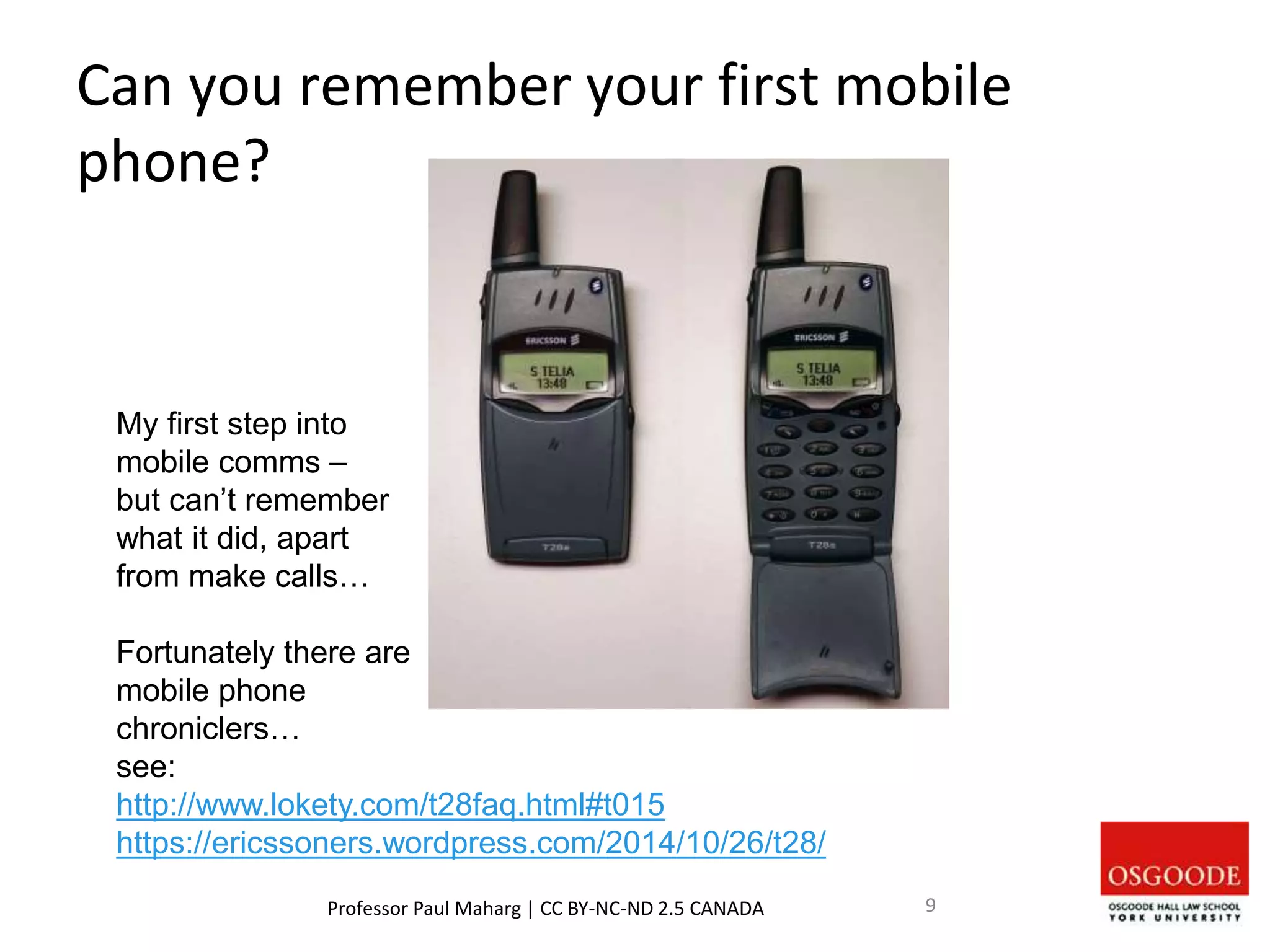
Can you remember your first mobile
phone?
Professor Paul Maharg | CC BY-NC-ND 2.5 CANADA 9
My first step into
mobile comms –
but can’t remember
what it did, apart
from make calls…
Fortunately there are
mobile phone
chroniclers…
see:
http://www.lokety.com/t28faq.html#t015
https://ericssoners.wordpress.com/2014/10/26/t28/
manuscript writing: the early context,
pre-12th century
1. Materials
– Wax tablets
– Tally sticks
– Paper
– Parchment or vellum
2. Forms of writing
– Different hands, thickness of line,
height of letters
– Early medieval scripts included scriptio continua –
– theexperiencewasratherlikereadingthisnottoodifficultthoug
heasierifyoutryreadingunderyourbreathalsocalledsubvocalis
ationwhichiswhatalotofscribestendedtodowhenreadingand
writingandofcoursenomodernpunctuation
3. Punctuation
– Marks were used at different heights in lines, eg ‘diple’
or arrowhead (for quoting scripture), hedera or ivy leaf
for start of quotations, and 7-shaped mark (end of
section)
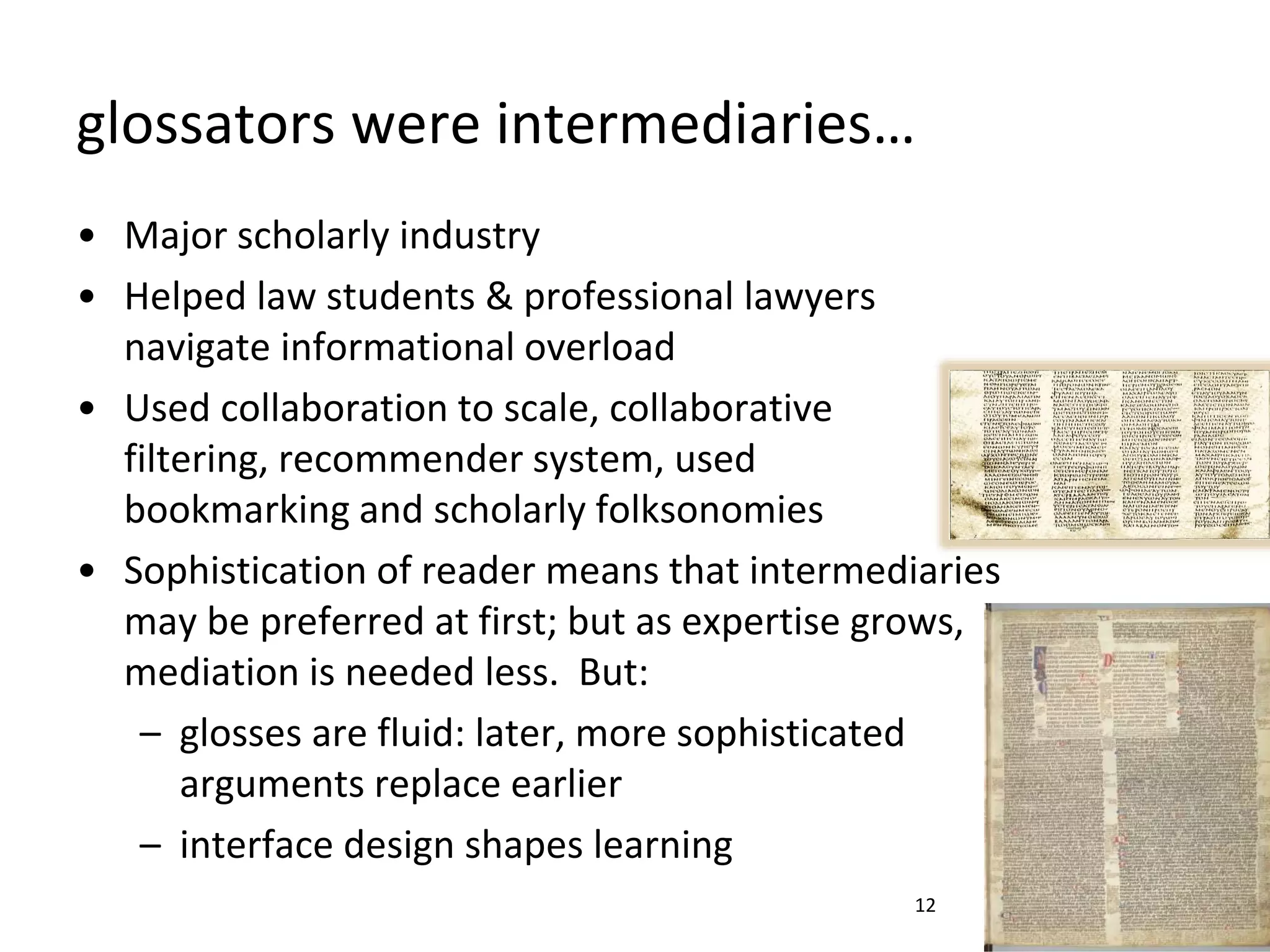
CodexSinaiticus,
http://tinyurl.com/6mm
w95
the 13th century
scholarly text
• Writers used alphabetisation,
arabic numerals, chapter divisions,
rubrics, capitals, paraph marks,
running titles
• Used compilatio – compilation of
extracts of works of authority
or auctoritas, chosen by
hierarchies of compilators
‘The late medieval book differs more from
its early medieval predecessors than it
does from the printed books of our own day.
The scholarly apparatus which we take for
granted – analytical table of contents, text
disposed into books, chapters, and paragraphs,
and accompanied by footnotes and index --
originated in the applications of the notions of
ordinatio and compilatio by writers, scribes, and
the rubricators of the thirteenth, fourteenth, and
fifteenth centuries.’ (Parkes 1976, 66)
glossators were intermediaries…
• Major scholarly industry
• Helped law students & professional lawyers
navigate informational overload
• Used collaboration to scale, collaborative
filtering, recommender system, used
bookmarking and scholarly folksonomies
• Sophistication of reader means that intermediaries
may be preferred at first; but as expertise grows,
mediation is needed less. But:
– glosses are fluid: later, more sophisticated
arguments replace earlier
– interface design shapes learning
12
1317.8.17 Professor Paul Maharg | CC BY-NC-ND 2.5 CANADA
‘Aesthetics matter:
interface design shapes learning’
Maharg (2007), chapter 9.
webcast v.1
https://onlineteachingmanifesto.wordpress.
com/
14Professor Paul Maharg | CC BY-NC-ND 2.5 CANADA
webcast v.2
15Professor Paul Maharg | CC BY-NC-ND 2.5 CANADA
webcast v.3
recovering the past
16Professor Paul Maharg | CC BY-NC-ND 2.5 CANADA
1. Coherence
2. Signalling
3. Redundancy
4. Spatial contiguity
5. Temporal contiguity
-- Richard E. Mayer’s multimedia principles (2009)
we forget how powerful, invisible
protocols shape our digital interface
• TCP/IP (Kahn & Cerf, 1970s)
• WWW (Berners-Lee, 1980s)
• Peer-to-peer (decentralised, sharing cultures, social
media, 1990s, 2000s)
• Blockchain (decentralised ledgers, where entries are
permanent, transparent, searchable, and can
store asset transactions, smart contracts,
digital signatures and certificates)
See Blockchain in Education
http://bit.ly/2zIdfMk
See also 10 ways Blockchain could be used in
education: http://bit.ly/2kmaFsV
Professor Paul Maharg | CC BY-NC-ND 2.5 CANADA 17
possible futures…
• Quality of digital content essential, more convergence in
platforms; campus becomes a learning platform
• A return beyond the book to a manuscript culture. But
immensely faster, more complex, with its own hierarchies of
knowledge and power.
• Distance and intimacy will be redefined; ownership and identity
defined
• More need for Open: OAccess, OResearch, OPlatforms, remixing
tools and cultures
• Increased threat to academic independence from corporate
providers, eg publishers:
– Cost of journal subscriptions – see http://bit.ly/2mNFxRv
– Corporate capture of our learning / teaching systems
• Analytics will matter more and will re-code what we do
• Bots and exo-cortices will facilitate collaborative learning online
18
19
But we have no disciplinary memory
of our technology in legal education…
• There are no histories, one bibliography (Goldman,
2008), no collective statements, no policy papers, no
map of interdisciplinary collaborations, no meta-
reviews, few discourse analyses of the field (none
updated). In the UK, three BILETA Reports (1991,
1996, 2004). One systematic review:
Maharg, P., Nicol, E. (2014). Simulation and technology in
legal education: a systematic review and future research
programme. In Grimes, R., Phillips, E., Strevens, C. (eds),
Legal Education: Simulation in Theory and Practice, Ashgate
Publishing, Emerging Legal Education series, 17-42.
Also true of legal education, legal
services and the profession
• LETR (2013)reported on poor or non-existent data,
research that was not sufficiently robust in methods –
same holds true for many jurisdictions
• For LETR we collected over 2,000 references online,
but not updated by regulators
• Recently, the IBA President’s Taskforce on the Future
of Legal Services attempted a survey of the field of
technology and legal services – but again, one-shot
research
• No sustained, longitudinal effort to map the field,
create taxonomies, tag-structures, etc
16.6.17 Professor Paul Maharg | CC BY-NC-ND 2.5 CANADA 20
Three rival futures
of legal education research:
Prometheus, Sisyphus, Themis
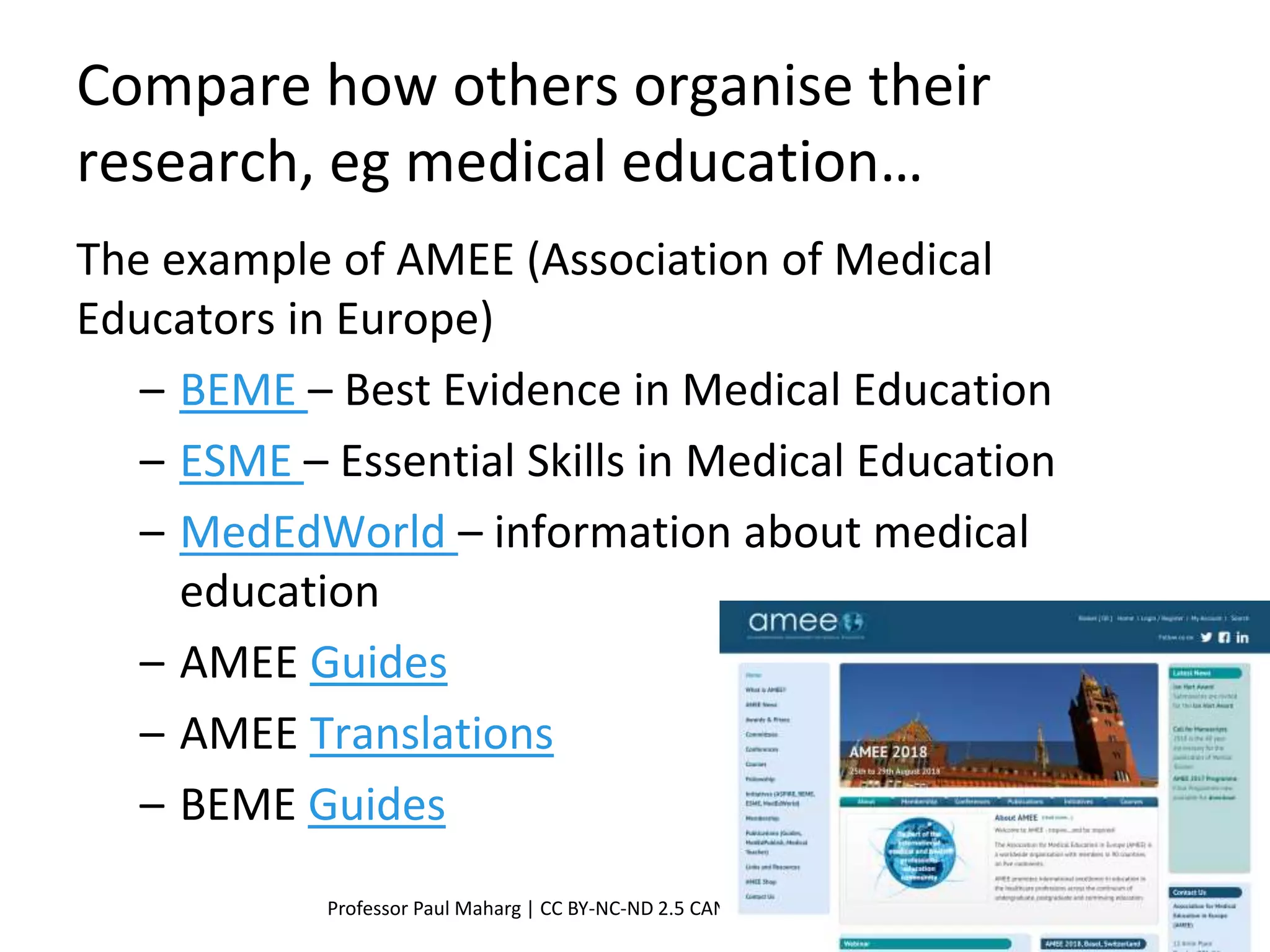
Compare how others organise their
research, eg medical education…
The example of AMEE (Association of Medical
Educators in Europe)
– BEME – Best Evidence in Medical Education
– ESME – Essential Skills in Medical Education
– MedEdWorld – information about medical
education
– AMEE Guides
– AMEE Translations
– BEME Guides
Professor Paul Maharg | CC BY-NC-ND 2.5 CANADA 22
16.6.17 Professor Paul Maharg | CC BY-NC-ND 2.5 CANADA 23
How could we start to emulate?
1. Map the field & create taxonomies for research data
2. Organise systematic data collection on law school
stats, eg across entry/exit points, across jurisdictions
(eg using Big Data Project methods)
3. Focus on studies on learning, and longitudinal data
4. Provide meta-reviews and systematic summaries of
research, where appropriate; literature guides;
commentaries; policy papers.
Professor Paul Maharg | CC BY-NC-ND 2.5 CANADA 24
Prometheus, Sisyphus, Themis?
• Prometheus – brilliant, creative,
experimentalist, counter-cultural and suffers
for it – Shelley’s Prometheus Unbound
• Sisyphus – condemned to roll a boulder
endlessly uphill – Robert Garioch’s Sisyphus, or
Carol Ann Duffy’s Mrs Sisyphus
• Themis -- goddess of right order, through
Eunomia, fair law, Dike, justice, Eirene, peace,
mother of the Hours, prophetess at Delphi
Professor Paul Maharg | CC BY-NC-ND 2.5 CANADA 25
Themis project
• An online space for collaborative, cross-disciplinary, inter-
jurisdictional research into legal education and the profession:
– Original research and meta-analysis on, eg
• the changing profession/market for legal services
• developments and best practices in legal education and
training
– Synthesis: consequences for LET of
regulatory/organisational/technological change in legal
services
– Databanking for evidence-based policy-making
• Resources and training:
– Working Paper Series
– Systematic Reviews Series
– Methods Series
Professor Paul Maharg | CC BY-NC-ND 2.5 CANADA 26
References
Goldman, P. (2008). Legal education and technology II: An annotated
bibliography. Law Library Journal, 100, 3, 415-528.
Hamilton, D. (1989). Towards a Theory of Schooling. Falmer Press, Lewes,
East Sussex. Reprinted 2013, Routledge, Oxon.
Maharg, P. (2007). Transforming Legal Education: Learning and Teaching
the Law in the Early Twenty-First Century. Routledge, London.
Mayer, R. E. (2009). Multimedia learning (2nd ed). New York: Cambridge
University Press.
Parkes, M.B. (1976), The Influence of the Concepts of Ordinatio and
Compilatio on the Development of the Book, in Medieval Learning and
Literature: Essays Presented to R.W. Hunt, edited by J.J.G. Alexander
and M.T. Gibson, Oxford University Press
Webb, J., Ching, J., Maharg, P., Sherr, A. (2013). Setting Standards. The
Future of Legal Services Education and Training Regulation in England
and Wales. SRA, BSB, IPS
Professor Paul Maharg | CC BY-NC-ND 2.5 CANADA 27
28
Email: pmaharg@osgoode.yorku.ca
Web: paulmaharg.com
Slides: paulmaharg.com/slides

Slides, unsw keynote

  • 1.
    Prometheus, Sisyphus, Themis: threerival futures for legal education Paul Maharg He had been told that when looking for a good oracle it was best to find the oracle that other oracles went to, but he was shut. There was a sign by the entrance saying, ‘I just don’t know any more. Try next door, but that’s just a suggestion, not formal oracular advice’. Adams, D. (1993). Mostly Harmless. Pan Macmillan, London, 73 (Slides @ http://paulmaharg.com/slides)
  • 2.
    preview 1. The twoDavid Hamiltons: Interdisciplinary historical understanding and the trading zone 2. Techne, forgetfulness and the future – Glosses and webcasts – Digital technologies 3. Three rival futures of legal education research: Prometheus, Sisyphus, Themis Slides @ http://paulmaharg.com/slides Professor Paul Maharg | CC BY-NC-ND 2.5 CANADA 1
  • 3.
    The two DavidHamiltons: Interdisciplinary historical understanding and the trading zone
  • 4.
    Towards a Theoryof Schooling, eg 1 • Historical investigation of concepts such as ‘class’, ‘course’, ‘curriculum’ via intellectual genealogy, eg – Class: from the University of Paris’ new Modus et Ordo Parisiensis (early 16th century) describing ‘sub-division of schools’ with ‘individualized pupil- by-pupil instruction’ (Hamilton, 7) – It can refer either to sequence (eg of knowledge) or coherence (eg an ordered society) and re the second, see the new schools founded and patronized by mercantile classes, to provide a new knowledge for specialist mercantile activities, not church administration, and overseen by them. Professor Paul Maharg | CC BY-NC-ND 2.5 CANADA 3
  • 5.
    Towards a Theoryof Schooling, eg 2 • Curriculum – first used in English in 17th century records of University of Glasgow, in 1633 (OED) (Hamilton, 3). Context: • introduced by Andrew Melville to create a specifically Calvinist mode of learning • Used Ramist techniques of highly formalized teaching, with a knowledge plan that was rigid • ‘the “whole life” of each student was to be rendered open to teacher supervision’ (Hamilton, 49) Professor Paul Maharg | CC BY-NC-ND 2.5 CANADA 4
  • 6.
    Towards a Theoryof Schooling, eg 2 ‘First came the introduction of class divisions and closer pupil surveillance; and second came the refinement of pedagogic content and methods. The net result, however, was cumulative: teaching and learning became, for good or ill, more open to external scrutiny and control.’ (Hamilton 49) Professor Paul Maharg | CC BY-NC-ND 2.5 CANADA 5
  • 7.
    Towards a Theoryof Schooling, eg 3 • Classroom – first used in the context of Adam Smith’s professorial lectures in Glasgow University, including jurisprudence (1752-64) • In education, Smith’s The Theory of Moral Sentiments is influential, where sympathy is an ethical & social bond (cf Francis Hutcheson’s concept of the moral sense faculty, akin to an aesthetic sense) • Further developed by educators in and around Glasgow – David Stow, Robert Owen. • A pedagogy was developed around sympathy and emulation (as self-esteem and self-improvement), not emulation and competition (as rivalry and conflict) Professor Paul Maharg | CC BY-NC-ND 2.5 CANADA 6
  • 8.
    Results… ‘Slowly I beganto appreciate that the weak sense of history shown by classroom researchers was matched only by the weak sense of the classroom shown by educational historians.’ (Hamilton, 2) • Hamilton’s meticulous historical discourse analysis draws on generations of bibliographies into medieval, Renaissance, modern universities – historical and educational. • His work is an example of Peter Galison’s trading zone, where multi-disciplines come together to work on a project Professor Paul Maharg | CC BY-NC-ND 2.5 CANADA 7
  • 9.
  • 10.
    Can you rememberyour first mobile phone? Professor Paul Maharg | CC BY-NC-ND 2.5 CANADA 9 My first step into mobile comms – but can’t remember what it did, apart from make calls… Fortunately there are mobile phone chroniclers… see: http://www.lokety.com/t28faq.html#t015 https://ericssoners.wordpress.com/2014/10/26/t28/
  • 11.
    manuscript writing: theearly context, pre-12th century 1. Materials – Wax tablets – Tally sticks – Paper – Parchment or vellum 2. Forms of writing – Different hands, thickness of line, height of letters – Early medieval scripts included scriptio continua – – theexperiencewasratherlikereadingthisnottoodifficultthoug heasierifyoutryreadingunderyourbreathalsocalledsubvocalis ationwhichiswhatalotofscribestendedtodowhenreadingand writingandofcoursenomodernpunctuation 3. Punctuation – Marks were used at different heights in lines, eg ‘diple’ or arrowhead (for quoting scripture), hedera or ivy leaf for start of quotations, and 7-shaped mark (end of section) CodexSinaiticus, http://tinyurl.com/6mm w95
  • 12.
    the 13th century scholarlytext • Writers used alphabetisation, arabic numerals, chapter divisions, rubrics, capitals, paraph marks, running titles • Used compilatio – compilation of extracts of works of authority or auctoritas, chosen by hierarchies of compilators ‘The late medieval book differs more from its early medieval predecessors than it does from the printed books of our own day. The scholarly apparatus which we take for granted – analytical table of contents, text disposed into books, chapters, and paragraphs, and accompanied by footnotes and index -- originated in the applications of the notions of ordinatio and compilatio by writers, scribes, and the rubricators of the thirteenth, fourteenth, and fifteenth centuries.’ (Parkes 1976, 66)
  • 13.
    glossators were intermediaries… •Major scholarly industry • Helped law students & professional lawyers navigate informational overload • Used collaboration to scale, collaborative filtering, recommender system, used bookmarking and scholarly folksonomies • Sophistication of reader means that intermediaries may be preferred at first; but as expertise grows, mediation is needed less. But: – glosses are fluid: later, more sophisticated arguments replace earlier – interface design shapes learning 12
  • 14.
    1317.8.17 Professor PaulMaharg | CC BY-NC-ND 2.5 CANADA ‘Aesthetics matter: interface design shapes learning’ Maharg (2007), chapter 9. webcast v.1 https://onlineteachingmanifesto.wordpress. com/
  • 15.
    14Professor Paul Maharg| CC BY-NC-ND 2.5 CANADA webcast v.2
  • 16.
    15Professor Paul Maharg| CC BY-NC-ND 2.5 CANADA webcast v.3
  • 17.
    recovering the past 16ProfessorPaul Maharg | CC BY-NC-ND 2.5 CANADA 1. Coherence 2. Signalling 3. Redundancy 4. Spatial contiguity 5. Temporal contiguity -- Richard E. Mayer’s multimedia principles (2009)
  • 18.
    we forget howpowerful, invisible protocols shape our digital interface • TCP/IP (Kahn & Cerf, 1970s) • WWW (Berners-Lee, 1980s) • Peer-to-peer (decentralised, sharing cultures, social media, 1990s, 2000s) • Blockchain (decentralised ledgers, where entries are permanent, transparent, searchable, and can store asset transactions, smart contracts, digital signatures and certificates) See Blockchain in Education http://bit.ly/2zIdfMk See also 10 ways Blockchain could be used in education: http://bit.ly/2kmaFsV Professor Paul Maharg | CC BY-NC-ND 2.5 CANADA 17
  • 19.
    possible futures… • Qualityof digital content essential, more convergence in platforms; campus becomes a learning platform • A return beyond the book to a manuscript culture. But immensely faster, more complex, with its own hierarchies of knowledge and power. • Distance and intimacy will be redefined; ownership and identity defined • More need for Open: OAccess, OResearch, OPlatforms, remixing tools and cultures • Increased threat to academic independence from corporate providers, eg publishers: – Cost of journal subscriptions – see http://bit.ly/2mNFxRv – Corporate capture of our learning / teaching systems • Analytics will matter more and will re-code what we do • Bots and exo-cortices will facilitate collaborative learning online 18
  • 20.
    19 But we haveno disciplinary memory of our technology in legal education… • There are no histories, one bibliography (Goldman, 2008), no collective statements, no policy papers, no map of interdisciplinary collaborations, no meta- reviews, few discourse analyses of the field (none updated). In the UK, three BILETA Reports (1991, 1996, 2004). One systematic review: Maharg, P., Nicol, E. (2014). Simulation and technology in legal education: a systematic review and future research programme. In Grimes, R., Phillips, E., Strevens, C. (eds), Legal Education: Simulation in Theory and Practice, Ashgate Publishing, Emerging Legal Education series, 17-42.
  • 21.
    Also true oflegal education, legal services and the profession • LETR (2013)reported on poor or non-existent data, research that was not sufficiently robust in methods – same holds true for many jurisdictions • For LETR we collected over 2,000 references online, but not updated by regulators • Recently, the IBA President’s Taskforce on the Future of Legal Services attempted a survey of the field of technology and legal services – but again, one-shot research • No sustained, longitudinal effort to map the field, create taxonomies, tag-structures, etc 16.6.17 Professor Paul Maharg | CC BY-NC-ND 2.5 CANADA 20
  • 22.
    Three rival futures oflegal education research: Prometheus, Sisyphus, Themis
  • 23.
    Compare how othersorganise their research, eg medical education… The example of AMEE (Association of Medical Educators in Europe) – BEME – Best Evidence in Medical Education – ESME – Essential Skills in Medical Education – MedEdWorld – information about medical education – AMEE Guides – AMEE Translations – BEME Guides Professor Paul Maharg | CC BY-NC-ND 2.5 CANADA 22
  • 24.
    16.6.17 Professor PaulMaharg | CC BY-NC-ND 2.5 CANADA 23
  • 25.
    How could westart to emulate? 1. Map the field & create taxonomies for research data 2. Organise systematic data collection on law school stats, eg across entry/exit points, across jurisdictions (eg using Big Data Project methods) 3. Focus on studies on learning, and longitudinal data 4. Provide meta-reviews and systematic summaries of research, where appropriate; literature guides; commentaries; policy papers. Professor Paul Maharg | CC BY-NC-ND 2.5 CANADA 24
  • 26.
    Prometheus, Sisyphus, Themis? •Prometheus – brilliant, creative, experimentalist, counter-cultural and suffers for it – Shelley’s Prometheus Unbound • Sisyphus – condemned to roll a boulder endlessly uphill – Robert Garioch’s Sisyphus, or Carol Ann Duffy’s Mrs Sisyphus • Themis -- goddess of right order, through Eunomia, fair law, Dike, justice, Eirene, peace, mother of the Hours, prophetess at Delphi Professor Paul Maharg | CC BY-NC-ND 2.5 CANADA 25
  • 27.
    Themis project • Anonline space for collaborative, cross-disciplinary, inter- jurisdictional research into legal education and the profession: – Original research and meta-analysis on, eg • the changing profession/market for legal services • developments and best practices in legal education and training – Synthesis: consequences for LET of regulatory/organisational/technological change in legal services – Databanking for evidence-based policy-making • Resources and training: – Working Paper Series – Systematic Reviews Series – Methods Series Professor Paul Maharg | CC BY-NC-ND 2.5 CANADA 26
  • 28.
    References Goldman, P. (2008).Legal education and technology II: An annotated bibliography. Law Library Journal, 100, 3, 415-528. Hamilton, D. (1989). Towards a Theory of Schooling. Falmer Press, Lewes, East Sussex. Reprinted 2013, Routledge, Oxon. Maharg, P. (2007). Transforming Legal Education: Learning and Teaching the Law in the Early Twenty-First Century. Routledge, London. Mayer, R. E. (2009). Multimedia learning (2nd ed). New York: Cambridge University Press. Parkes, M.B. (1976), The Influence of the Concepts of Ordinatio and Compilatio on the Development of the Book, in Medieval Learning and Literature: Essays Presented to R.W. Hunt, edited by J.J.G. Alexander and M.T. Gibson, Oxford University Press Webb, J., Ching, J., Maharg, P., Sherr, A. (2013). Setting Standards. The Future of Legal Services Education and Training Regulation in England and Wales. SRA, BSB, IPS Professor Paul Maharg | CC BY-NC-ND 2.5 CANADA 27
  • 29.